Rajarata University of Sri Lanka
P.B. Dharmasena
0777-613234, 0717-613234
dharmasenapb@ymail.com, dharmasenapb@gmail.com
5. Research Objectives
Rajarata University of Sri Lanka
P.B. Dharmasena
0777-613234, 0717-613234
dharmasenapb@ymail.com, dharmasenapb@gmail.com
https://independent.academia.edu/PunchiBandageDharmasena
https://www.researchgate.net/profile/Punchi_Bandage_Dharmasena/contributions
http://www.slideshare.net/DharmasenaPb
LESSON
FIVE
EMGT 3172 (1:15)
B.A. (Special) Degree Program
Monday 12.30 am – 2.00 pm
Hall: EML
Research Objectives
Lesson-5
1. Having decided what to study (Research Topic), and
knowing why you want to study it (Problem
Statement), you can now formulate the study
objectives.
2. Objectives should be closely related to the
statement of the problem. For example, if the
problem identified is low utilization of health
stations in a rural district, the general objective of
the study could be to assess the reasons for this low
utilization.
3. If we break down this general objective into smaller
and logically connected parts, then we get specific
objectives.
LESSON
FIVE
RESEARCH METHODOLOGY
Learning objectives
1. Describe the need for the
development of research
objectives
2. Differentiate between
general and specific
objectives
3. Formulate specific
objectives and hypotheses
Lesson-5
LESSON
FIVE
RESEARCH OBJECTIVES
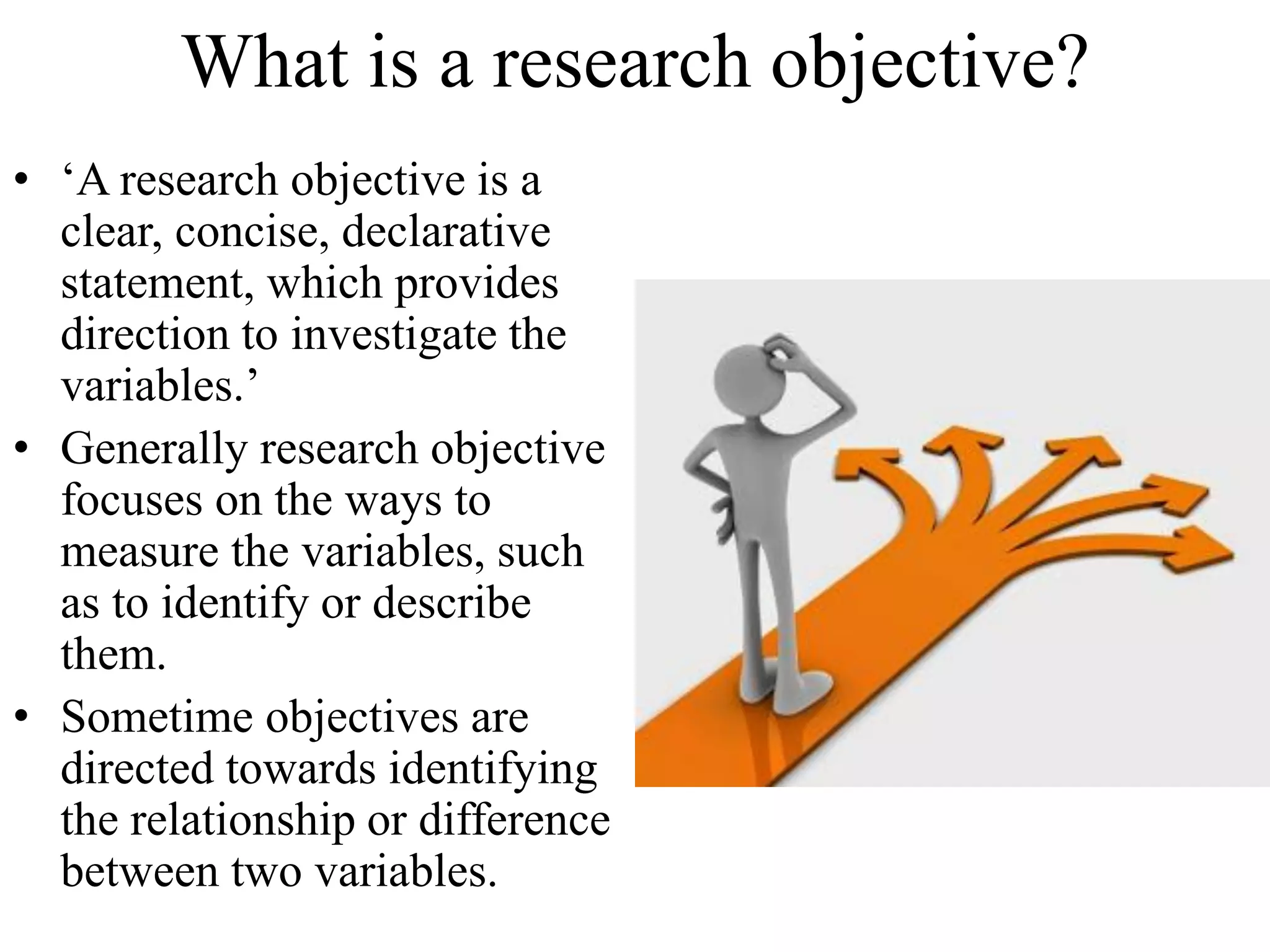
What is a research objective?
• ‘A research objective is a
clear, concise, declarative
statement, which provides
direction to investigate the
variables.’
• Generally research objective
focuses on the ways to
measure the variables, such
as to identify or describe
them.
• Sometime objectives are
directed towards identifying
the relationship or difference
between two variables.
Contd…
• Research objectives are the
results sought by the
researcher at the end of the
research process, i.e. what
the researcher will be able
to achieve at the end of the
research study.
• The objectives of a research
project summarize what is
to be achieved by the study.
• Objective should be closely
related to the statement of
the problem.
What is a research objective?
CHARACTERISTICS OF RESEARCH
OBJECTIVES
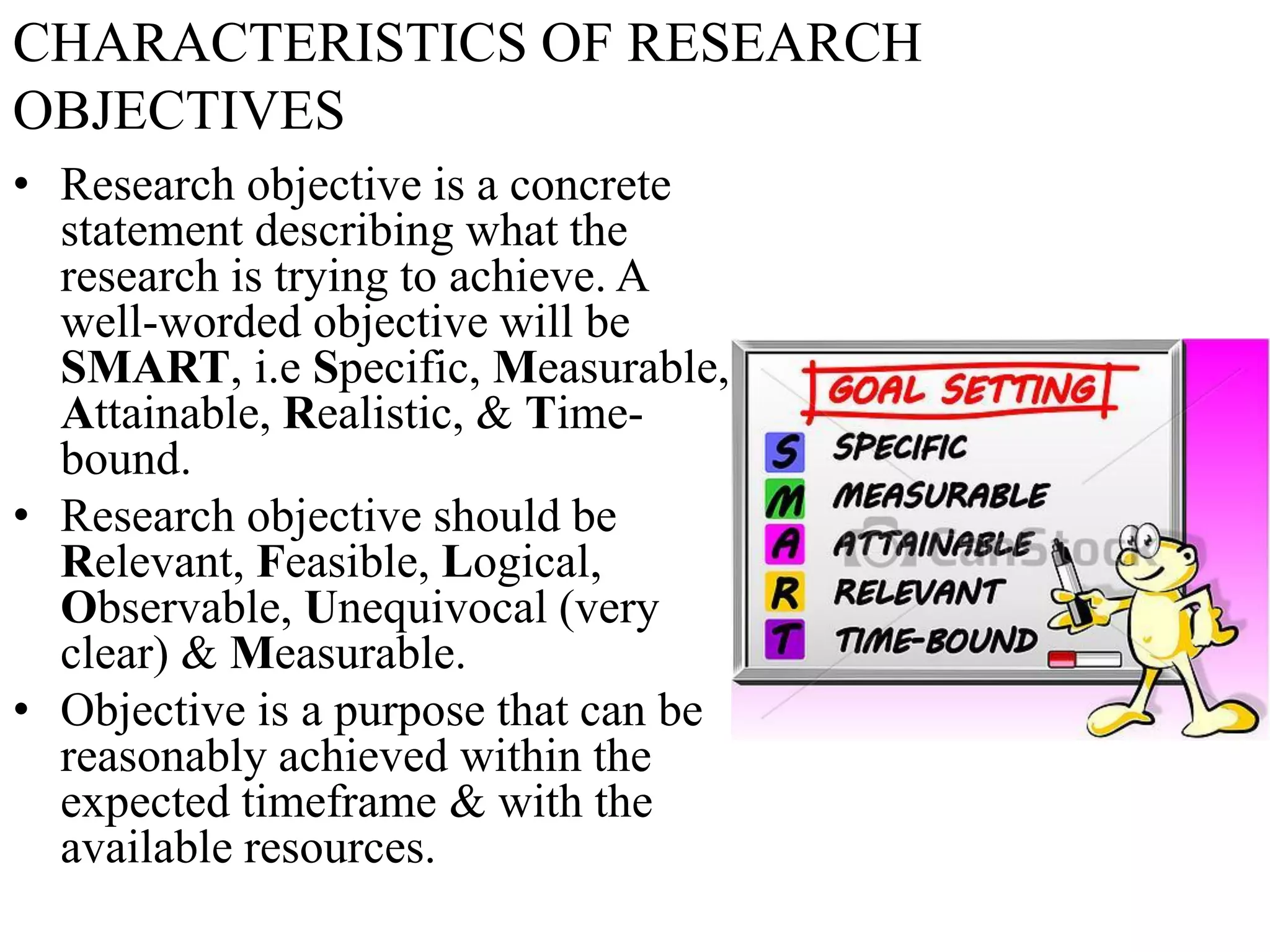
• Research objective is a concrete
statement describing what the
research is trying to achieve. A
well-worded objective will be
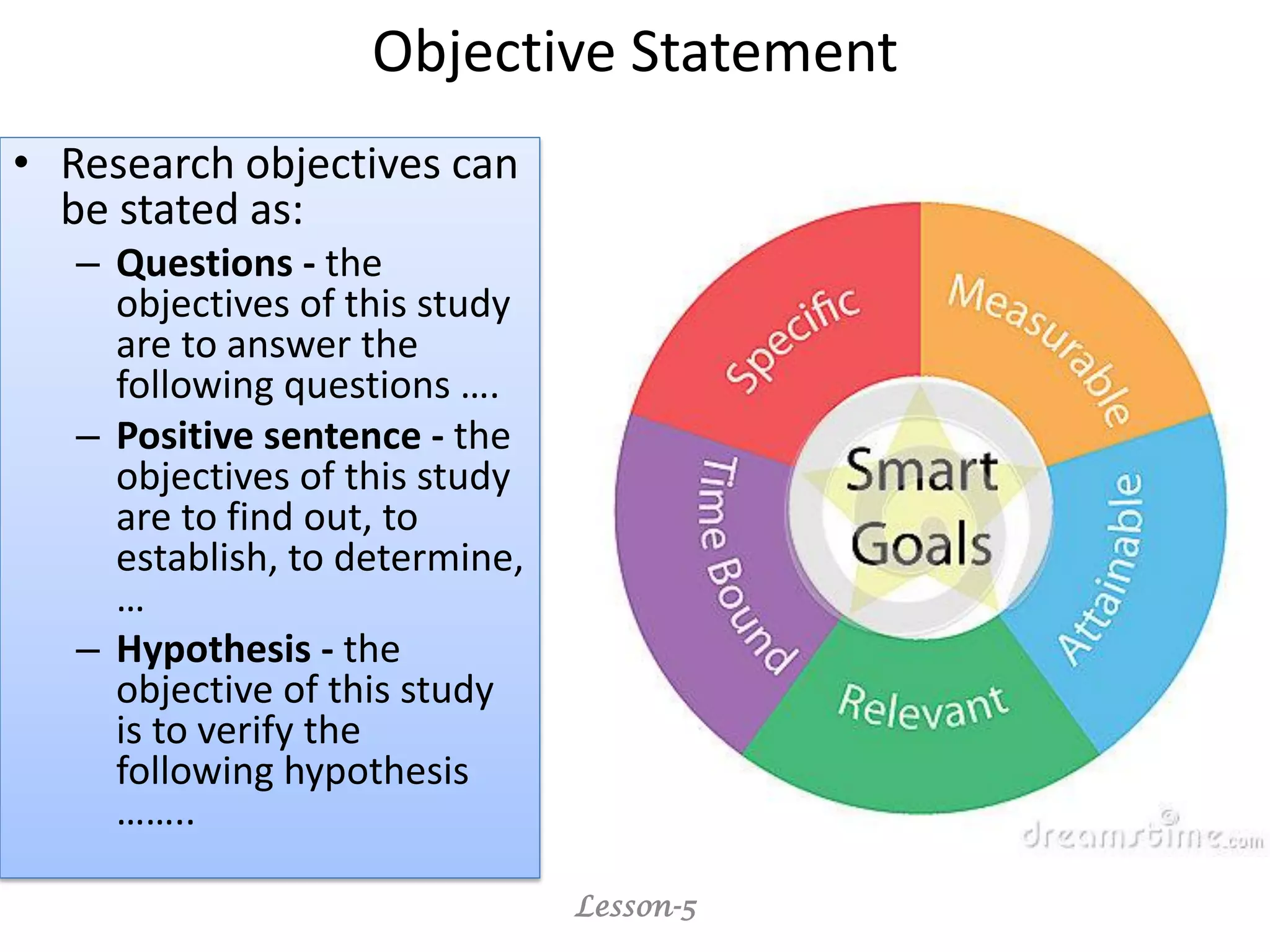
SMART, i.e Specific, Measurable,
Attainable, Realistic, & Time-
bound.
• Research objective should be
Relevant, Feasible, Logical,
Observable, Unequivocal (very
clear) & Measurable.
• Objective is a purpose that can be
reasonably achieved within the
expected timeframe & with the
available resources.
Contd…
• The objective or research
project summarizes what
is to be achieved by the
study.
• The research objectives
are the specific
accomplishment the
researchers hope to
achieve by the study.
• The objective includes
obtaining answers to
research questions or
testing the research
hypothesis.
CHARACTERISTICS OF
RESEARCH OBJECTIVES
Need of research objectives
The formulation of
research objectives will
help researcher
to focus on the study
with clearly defined
objectives and
to avoid the collection of
data which are not
strictly necessary for
understanding & solving
problem that he or she
has defined.
Contd…
• The formulation of
objectives organizes the
study in clearly defined
parts or phases.
• Properly formulated,
specific objectives will
facilitate the development
of research methodology
& will help to orient the
collection, analysis,
interpretation, &
utilization of data.
Need of research objectives
Types of research objectives
1. General objective/s
 General objectives are
broad goals to be
achieved.
 The general objectives
of the study state what
the researcher expects
to achieve by the
study in general terms.
 General objectives are
usually less in
number.
Contd…2. Specific objectives
 Specific objectives are short term &
narrow in focus.
 General objectives can be broken into
small logically connected parts to
form specific objectives.
 General objective is met through
accomplishing all the specific
objectives.
 The specific objectives are more in
number & they systematically address
various aspects of problem as defined
under ‘the statement of problem’ &
key factor that is assumed to
influence or cause the problem.
 They should specify what the
researcher will do in the study, where,
& for what purpose.
General objectives: aim of the study in general terms
Example: In a study on ‘occurrence of kidney diseases in NCP’, the
general objective is ‘to assess geographical spread of kidney
diseases in NCP’ .
Specific objectives: measurable statements on the specific questions
to be answered.
Unlike the general objectives, the specific objectives are more
specific and are related to the research problem situation. They
indicate the variable to be examined and measured.
Example: In the study of occurrence of kidney diseases in NCP the
specific objectives could be:
– To find out the magnitude of disease spread on DS basis,
– To examine the reasons for high incidence of diseases in certain
DS Divisions (sources of drinking water , use of agro-chemicals,
day consumption of drinking water etc.)
– To map water quality distribution in NCP
Lesson-5
Formulation of the Research Objectives
• Why?
– Focus the study (narrowing it down to essentials)
– Avoid collection of data that are not strictly necessary for
understanding and solving the identified problem
– Organize the study in clearly defined parts
• How should we state?
We have to make sure that our objectives:
– Cover the different aspects of the problem and its contributing
factors in a coherent way and in a logical sequence
– Are clearly expressed in measurable terms
– Are realistic considering local conditions
– Meet the purpose of the study
• Use action verbs that are specific enough to be measured (to
determine, to compare, to verify, to calculate, to describe, to
find out, to establish etc.)
• Avoid the use of vague non-action verbs such as to appreciate,
to understand, to study, to believe
Objective Statement
• Research objectives can
be stated as:
– Questions - the
objectives of this study
are to answer the
following questions ….
– Positive sentence - the
objectives of this study
are to find out, to
establish, to determine,
…
– Hypothesis - the
objective of this study
is to verify the
following hypothesis
……..
Lesson-5
Hypothesis
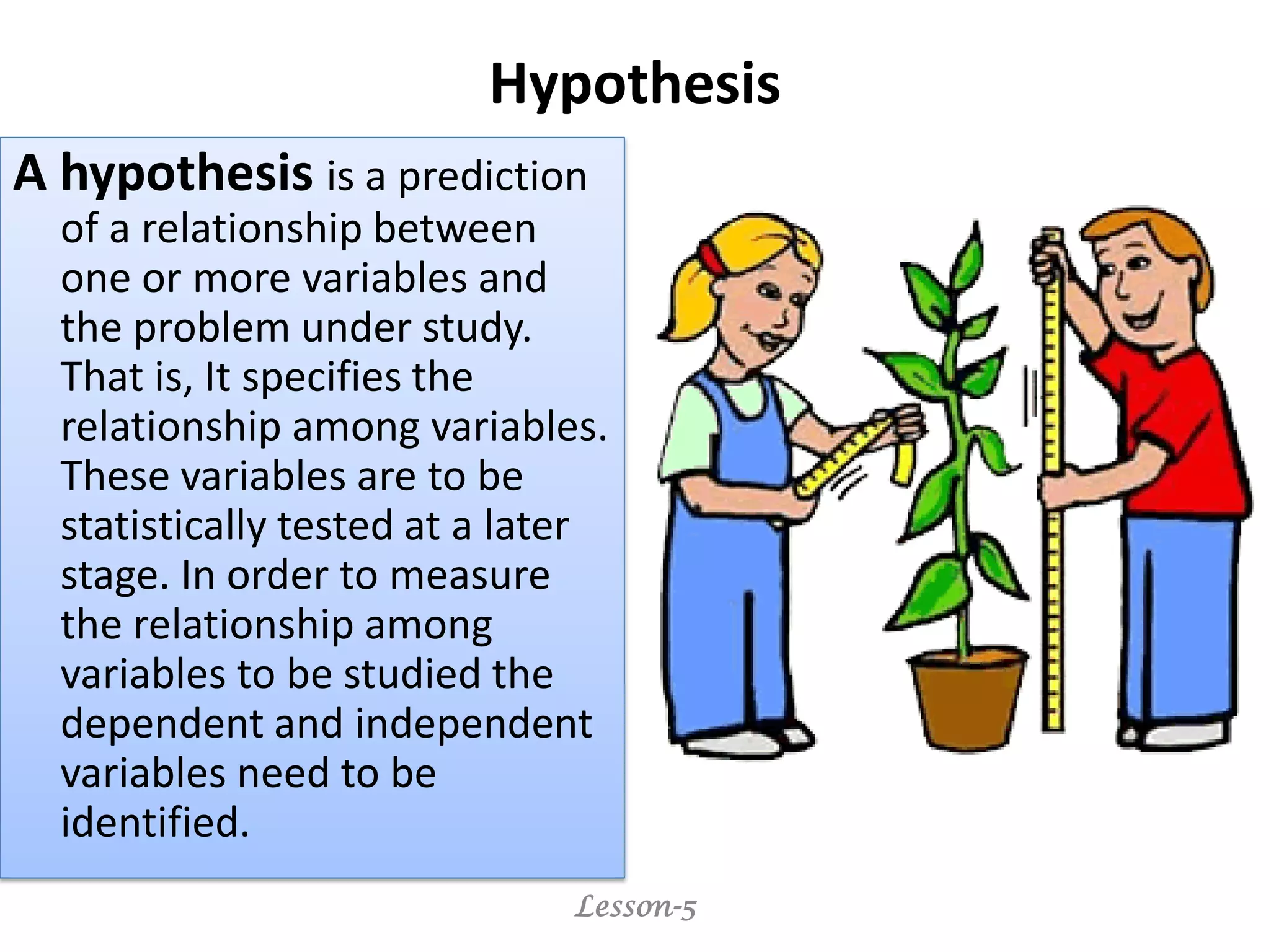
A hypothesis is a prediction
of a relationship between
one or more variables and
the problem under study.
That is, It specifies the
relationship among variables.
These variables are to be
statistically tested at a later
stage. In order to measure
the relationship among
variables to be studied the
dependent and independent
variables need to be
identified.
Lesson-5
Methods of stating objectives
While stating objectives of the study, the following guidelines
must be taken care of:
• The objectives should be presented briefly & concisely.
• They cover the different aspects of the problem & its
contributing factors in a coherent way & in a logical
sequence.
• The objectives are clearly phrased in operational terms,
specifying exactly what researcher is going to do, where, &
for what purpose.
• They are realistic considering local conditions.
• Use action verbs that are specify enough to be evaluated.
• Examples of action verbs are: to assess, to identify, to find
out, to determine, to compare, to find, to verify, to calculate,
to describe, to analyze, to establish, etc.
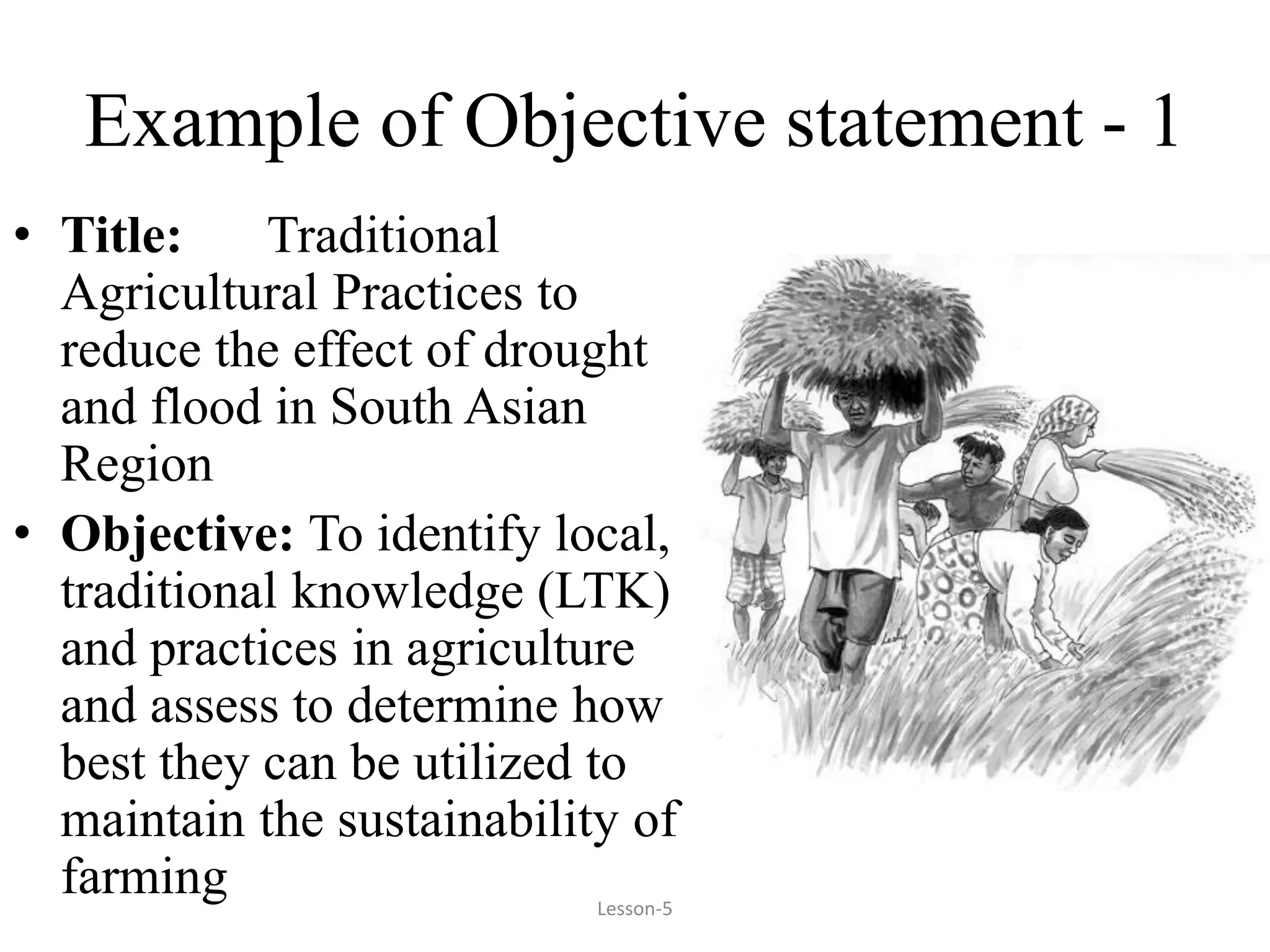
Example of Objective statement - 1
• Title: Traditional
Agricultural Practices to
reduce the effect of drought
and flood in South Asian
Region
• Objective: To identify local,
traditional knowledge (LTK)
and practices in agriculture
and assess to determine how
best they can be utilized to
maintain the sustainability of
farming Lesson-5
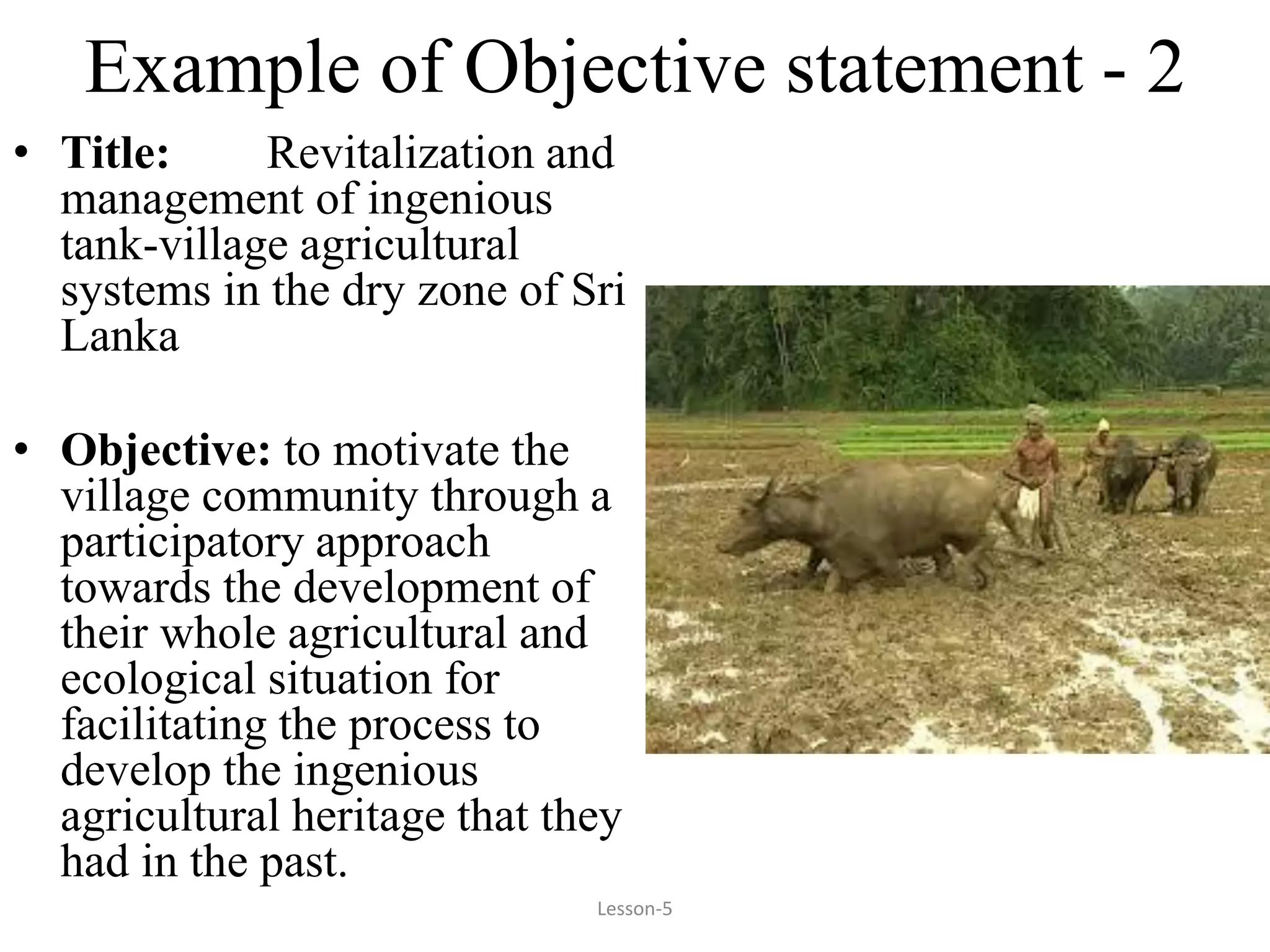
Example of Objective statement - 2
• Title: Revitalization and
management of ingenious
tank-village agricultural
systems in the dry zone of Sri
Lanka
• Objective: to motivate the
village community through a
participatory approach
towards the development of
their whole agricultural and
ecological situation for
facilitating the process to
develop the ingenious
agricultural heritage that they
had in the past.
Lesson-5
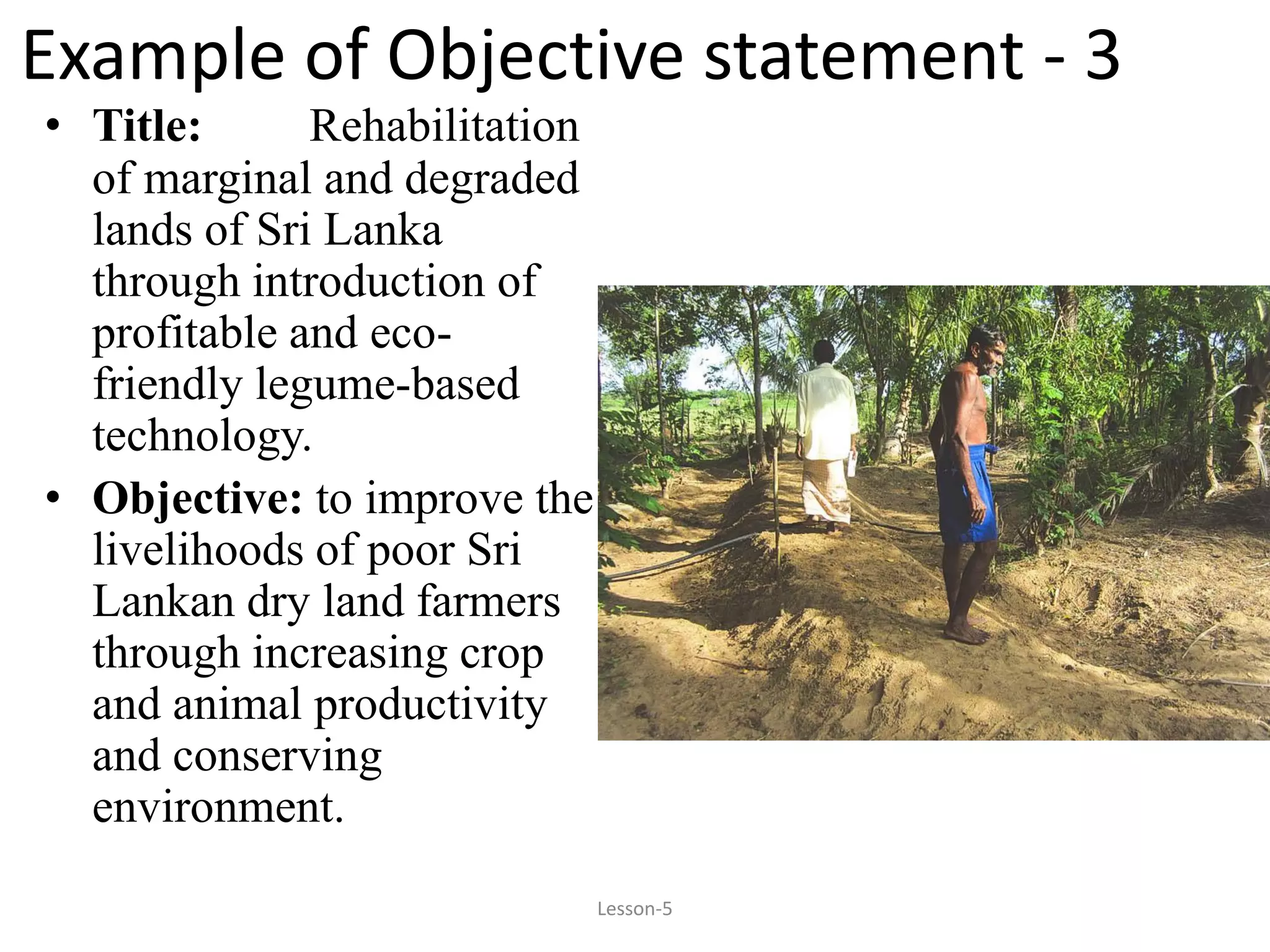
Example of Objective statement - 3
• Title: Rehabilitation
of marginal and degraded
lands of Sri Lanka
through introduction of
profitable and eco-
friendly legume-based
technology.
• Objective: to improve the
livelihoods of poor Sri
Lankan dry land farmers
through increasing crop
and animal productivity
and conserving
environment.
Lesson-5
Lesson-5
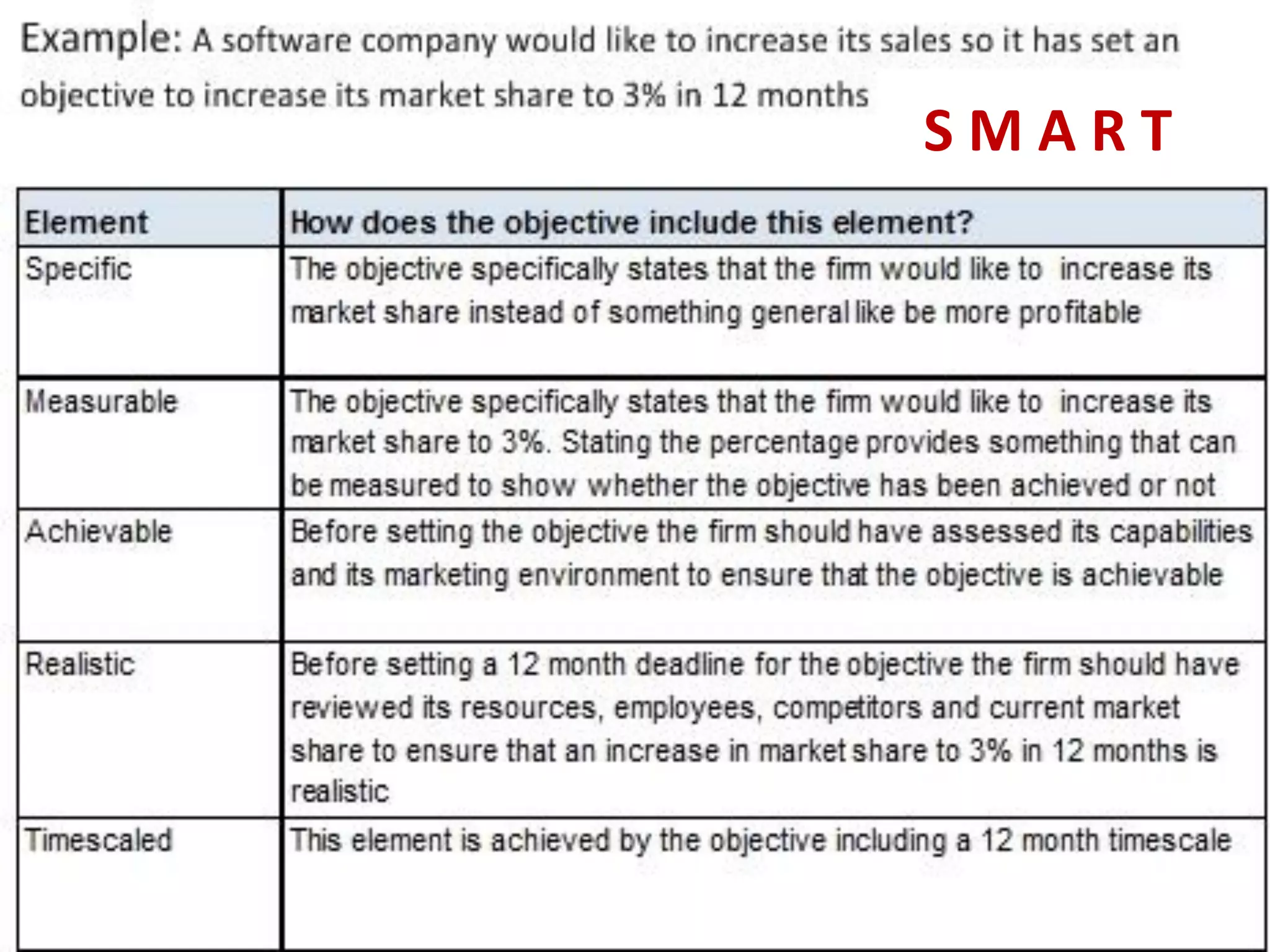
S M A R T
Goal vs. Objective
• The difference between goals and objectives is that goals
are broad, generalized statements of instructional intent,
while objectives are specific, measurable outcomes that
help a learner achieve the goals. For example:
• Goal The overall goal of this presentation is to help
participants understand how to write SMART
learning objectives.
• Objective: The objective of this presentation is to
help participants identify action verbs
that should not be included in writing
SMART learning objectives.
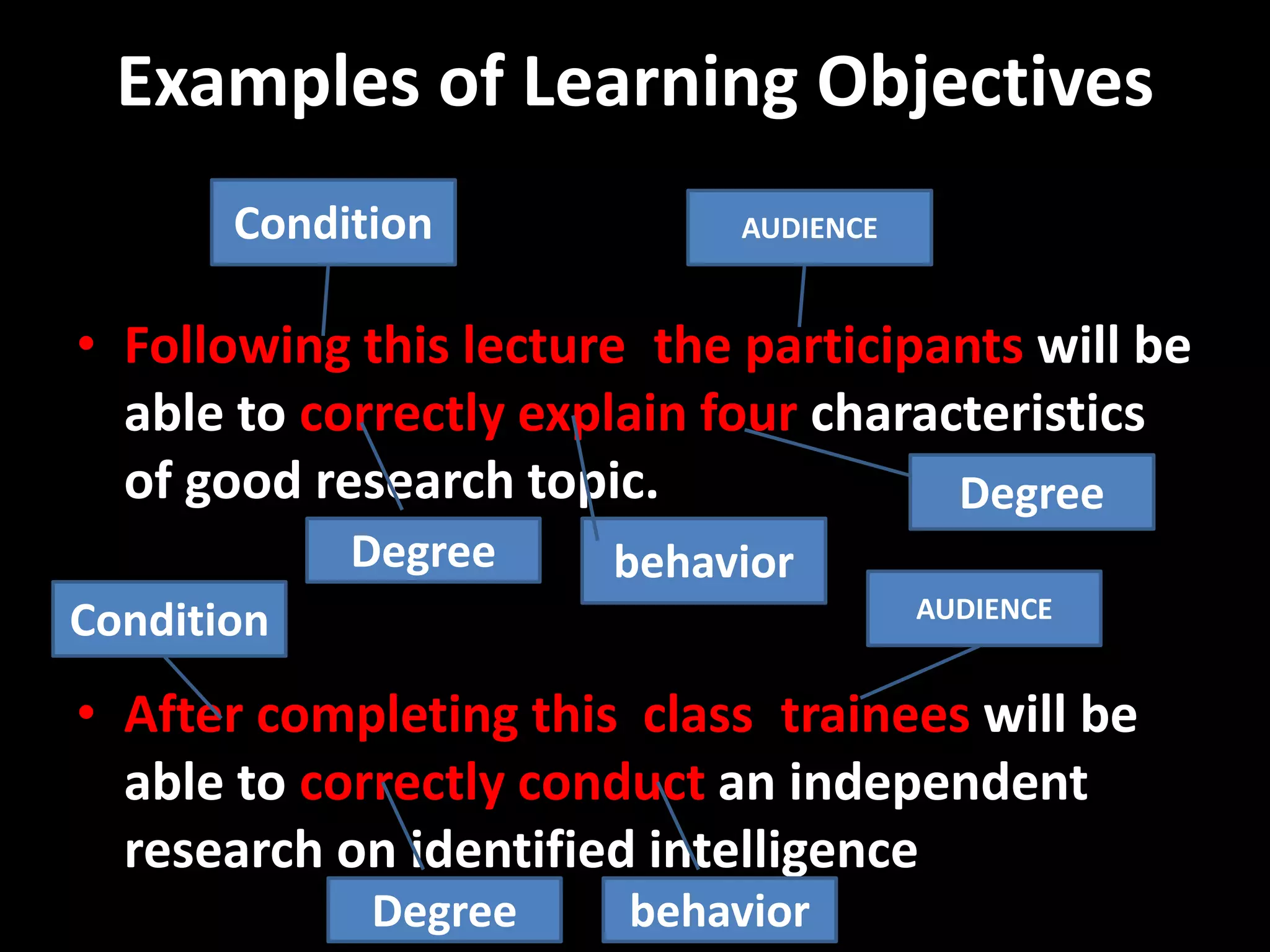
Examples of Learning Objectives
• Following this lecture, the participants will be
able to correctly explain four characteristics
of good research topic.
• After completing this class, trainees will be
able to correctly conduct an independent
research on identified intelligence problems.
Degree
Condition AUDIENCE
Condition AUDIENCE
behavior
Degree behavior
Degree
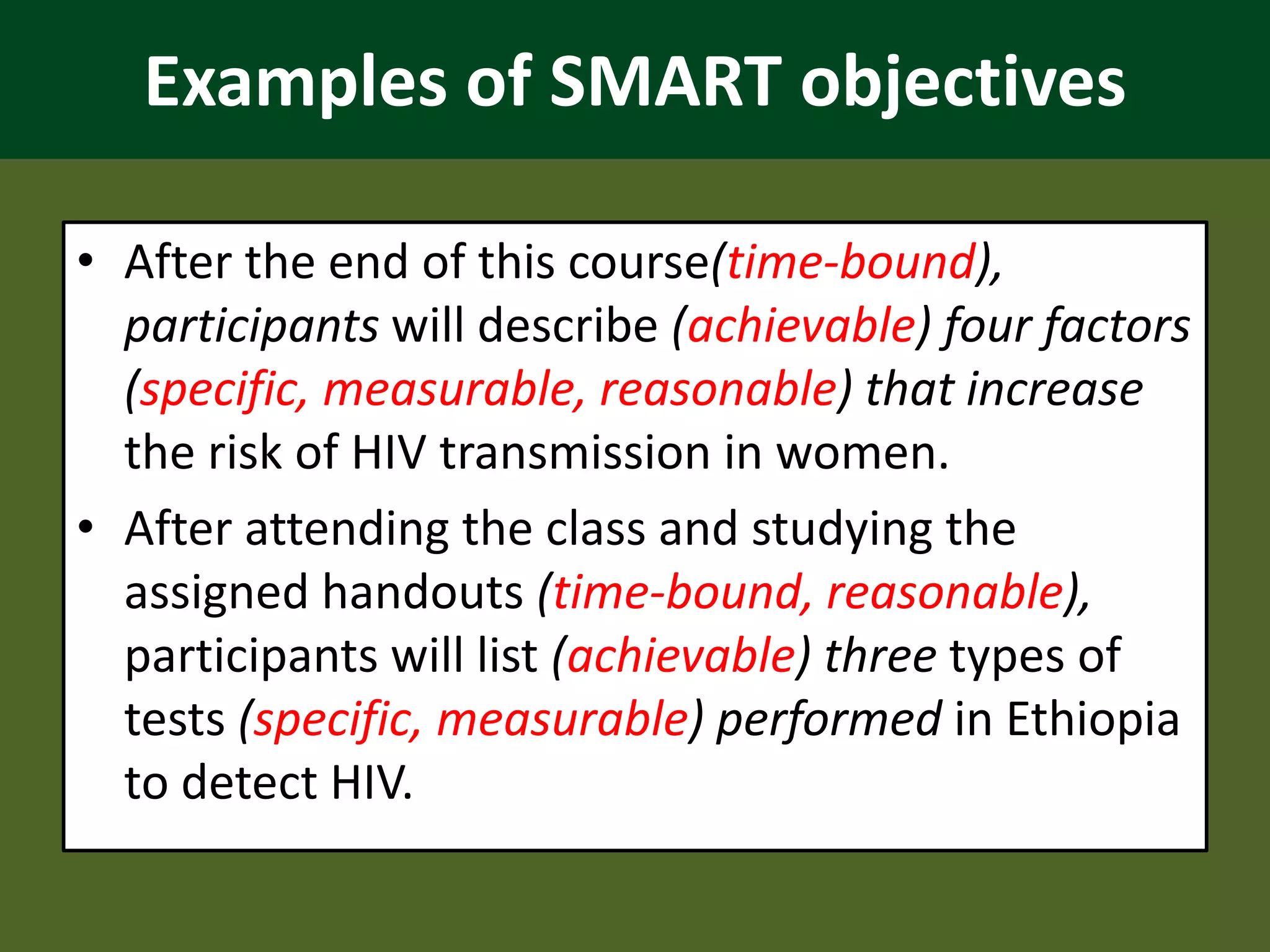
Examples of SMART objectives
• After the end of this course(time-bound),
participants will describe (achievable) four factors
(specific, measurable, reasonable) that increase
the risk of HIV transmission in women.
• After attending the class and studying the
assigned handouts (time-bound, reasonable),
participants will list (achievable) three types of
tests (specific, measurable) performed in Ethiopia
to detect HIV.

Lesson 5 research objectives

  • 1.
    Rajarata University ofSri Lanka P.B. Dharmasena 0777-613234, 0717-613234 dharmasenapb@ymail.com, dharmasenapb@gmail.com 5. Research Objectives Rajarata University of Sri Lanka P.B. Dharmasena 0777-613234, 0717-613234 dharmasenapb@ymail.com, dharmasenapb@gmail.com https://independent.academia.edu/PunchiBandageDharmasena https://www.researchgate.net/profile/Punchi_Bandage_Dharmasena/contributions http://www.slideshare.net/DharmasenaPb LESSON FIVE EMGT 3172 (1:15) B.A. (Special) Degree Program Monday 12.30 am – 2.00 pm Hall: EML
  • 2.
    Research Objectives Lesson-5 1. Havingdecided what to study (Research Topic), and knowing why you want to study it (Problem Statement), you can now formulate the study objectives. 2. Objectives should be closely related to the statement of the problem. For example, if the problem identified is low utilization of health stations in a rural district, the general objective of the study could be to assess the reasons for this low utilization. 3. If we break down this general objective into smaller and logically connected parts, then we get specific objectives. LESSON FIVE
  • 3.
    RESEARCH METHODOLOGY Learning objectives 1.Describe the need for the development of research objectives 2. Differentiate between general and specific objectives 3. Formulate specific objectives and hypotheses Lesson-5 LESSON FIVE RESEARCH OBJECTIVES
  • 4.
    What is aresearch objective? • ‘A research objective is a clear, concise, declarative statement, which provides direction to investigate the variables.’ • Generally research objective focuses on the ways to measure the variables, such as to identify or describe them. • Sometime objectives are directed towards identifying the relationship or difference between two variables.
  • 5.
    Contd… • Research objectivesare the results sought by the researcher at the end of the research process, i.e. what the researcher will be able to achieve at the end of the research study. • The objectives of a research project summarize what is to be achieved by the study. • Objective should be closely related to the statement of the problem. What is a research objective?
  • 6.
    CHARACTERISTICS OF RESEARCH OBJECTIVES •Research objective is a concrete statement describing what the research is trying to achieve. A well-worded objective will be SMART, i.e Specific, Measurable, Attainable, Realistic, & Time- bound. • Research objective should be Relevant, Feasible, Logical, Observable, Unequivocal (very clear) & Measurable. • Objective is a purpose that can be reasonably achieved within the expected timeframe & with the available resources.
  • 7.
    Contd… • The objectiveor research project summarizes what is to be achieved by the study. • The research objectives are the specific accomplishment the researchers hope to achieve by the study. • The objective includes obtaining answers to research questions or testing the research hypothesis. CHARACTERISTICS OF RESEARCH OBJECTIVES
  • 8.
    Need of researchobjectives The formulation of research objectives will help researcher to focus on the study with clearly defined objectives and to avoid the collection of data which are not strictly necessary for understanding & solving problem that he or she has defined.
  • 9.
    Contd… • The formulationof objectives organizes the study in clearly defined parts or phases. • Properly formulated, specific objectives will facilitate the development of research methodology & will help to orient the collection, analysis, interpretation, & utilization of data. Need of research objectives
  • 10.
    Types of researchobjectives 1. General objective/s  General objectives are broad goals to be achieved.  The general objectives of the study state what the researcher expects to achieve by the study in general terms.  General objectives are usually less in number.
  • 11.
    Contd…2. Specific objectives Specific objectives are short term & narrow in focus.  General objectives can be broken into small logically connected parts to form specific objectives.  General objective is met through accomplishing all the specific objectives.  The specific objectives are more in number & they systematically address various aspects of problem as defined under ‘the statement of problem’ & key factor that is assumed to influence or cause the problem.  They should specify what the researcher will do in the study, where, & for what purpose.
  • 12.
    General objectives: aimof the study in general terms Example: In a study on ‘occurrence of kidney diseases in NCP’, the general objective is ‘to assess geographical spread of kidney diseases in NCP’ . Specific objectives: measurable statements on the specific questions to be answered. Unlike the general objectives, the specific objectives are more specific and are related to the research problem situation. They indicate the variable to be examined and measured. Example: In the study of occurrence of kidney diseases in NCP the specific objectives could be: – To find out the magnitude of disease spread on DS basis, – To examine the reasons for high incidence of diseases in certain DS Divisions (sources of drinking water , use of agro-chemicals, day consumption of drinking water etc.) – To map water quality distribution in NCP Lesson-5
  • 13.
    Formulation of theResearch Objectives • Why? – Focus the study (narrowing it down to essentials) – Avoid collection of data that are not strictly necessary for understanding and solving the identified problem – Organize the study in clearly defined parts • How should we state? We have to make sure that our objectives: – Cover the different aspects of the problem and its contributing factors in a coherent way and in a logical sequence – Are clearly expressed in measurable terms – Are realistic considering local conditions – Meet the purpose of the study • Use action verbs that are specific enough to be measured (to determine, to compare, to verify, to calculate, to describe, to find out, to establish etc.) • Avoid the use of vague non-action verbs such as to appreciate, to understand, to study, to believe
  • 14.
    Objective Statement • Researchobjectives can be stated as: – Questions - the objectives of this study are to answer the following questions …. – Positive sentence - the objectives of this study are to find out, to establish, to determine, … – Hypothesis - the objective of this study is to verify the following hypothesis …….. Lesson-5
  • 15.
    Hypothesis A hypothesis isa prediction of a relationship between one or more variables and the problem under study. That is, It specifies the relationship among variables. These variables are to be statistically tested at a later stage. In order to measure the relationship among variables to be studied the dependent and independent variables need to be identified. Lesson-5
  • 16.
    Methods of statingobjectives While stating objectives of the study, the following guidelines must be taken care of: • The objectives should be presented briefly & concisely. • They cover the different aspects of the problem & its contributing factors in a coherent way & in a logical sequence. • The objectives are clearly phrased in operational terms, specifying exactly what researcher is going to do, where, & for what purpose. • They are realistic considering local conditions. • Use action verbs that are specify enough to be evaluated. • Examples of action verbs are: to assess, to identify, to find out, to determine, to compare, to find, to verify, to calculate, to describe, to analyze, to establish, etc.
  • 17.
    Example of Objectivestatement - 1 • Title: Traditional Agricultural Practices to reduce the effect of drought and flood in South Asian Region • Objective: To identify local, traditional knowledge (LTK) and practices in agriculture and assess to determine how best they can be utilized to maintain the sustainability of farming Lesson-5
  • 18.
    Example of Objectivestatement - 2 • Title: Revitalization and management of ingenious tank-village agricultural systems in the dry zone of Sri Lanka • Objective: to motivate the village community through a participatory approach towards the development of their whole agricultural and ecological situation for facilitating the process to develop the ingenious agricultural heritage that they had in the past. Lesson-5
  • 19.
    Example of Objectivestatement - 3 • Title: Rehabilitation of marginal and degraded lands of Sri Lanka through introduction of profitable and eco- friendly legume-based technology. • Objective: to improve the livelihoods of poor Sri Lankan dry land farmers through increasing crop and animal productivity and conserving environment. Lesson-5
  • 20.
  • 21.
    Goal vs. Objective •The difference between goals and objectives is that goals are broad, generalized statements of instructional intent, while objectives are specific, measurable outcomes that help a learner achieve the goals. For example: • Goal The overall goal of this presentation is to help participants understand how to write SMART learning objectives. • Objective: The objective of this presentation is to help participants identify action verbs that should not be included in writing SMART learning objectives.
  • 22.
    Examples of LearningObjectives • Following this lecture, the participants will be able to correctly explain four characteristics of good research topic. • After completing this class, trainees will be able to correctly conduct an independent research on identified intelligence problems. Degree Condition AUDIENCE Condition AUDIENCE behavior Degree behavior Degree
  • 23.
    Examples of SMARTobjectives • After the end of this course(time-bound), participants will describe (achievable) four factors (specific, measurable, reasonable) that increase the risk of HIV transmission in women. • After attending the class and studying the assigned handouts (time-bound, reasonable), participants will list (achievable) three types of tests (specific, measurable) performed in Ethiopia to detect HIV.