

The research problem
1
A research problem can be any question that you want
to answer and any assumption or assertion that you
want to challenge or investigate.
• Power, Meenaghan, & Twoomey (1985: 38),
‘Potential research questions may occur to us on a
regular basis, but the process of formulating them in
a meaning way is not at all an easy task’.
PREPARED BY:PROF.D.V.PATEL
1
What is research problem?
2
• Any question that you want answered and any
assumption or assertion that you want to
challenge or investigate.
• However;
• not all questions can be transformed into
research problems.
• the process of formulating them in a
meaningful way is not at all an easy task.
• it requires considerable knowledge of both the
subject area and research methodology.
PREPARED BY:PROF.D.V.PATEL
2
What is research problem?
• A research problem is a perceived gap between what is
and what should be.
• Research problem arise from:
1. Evolution of theories.
2. Peers and supervisors etc.
3. Published research (literature review).
4. Day-to-day experience
PREPARED BY:PROF.D.V.PATEL
3
S C H O O L O F N U T R I T I O N A N D D I E T E T I C S • U N I V E R S I T I S U L T A N Z A I N A L A B I D I N
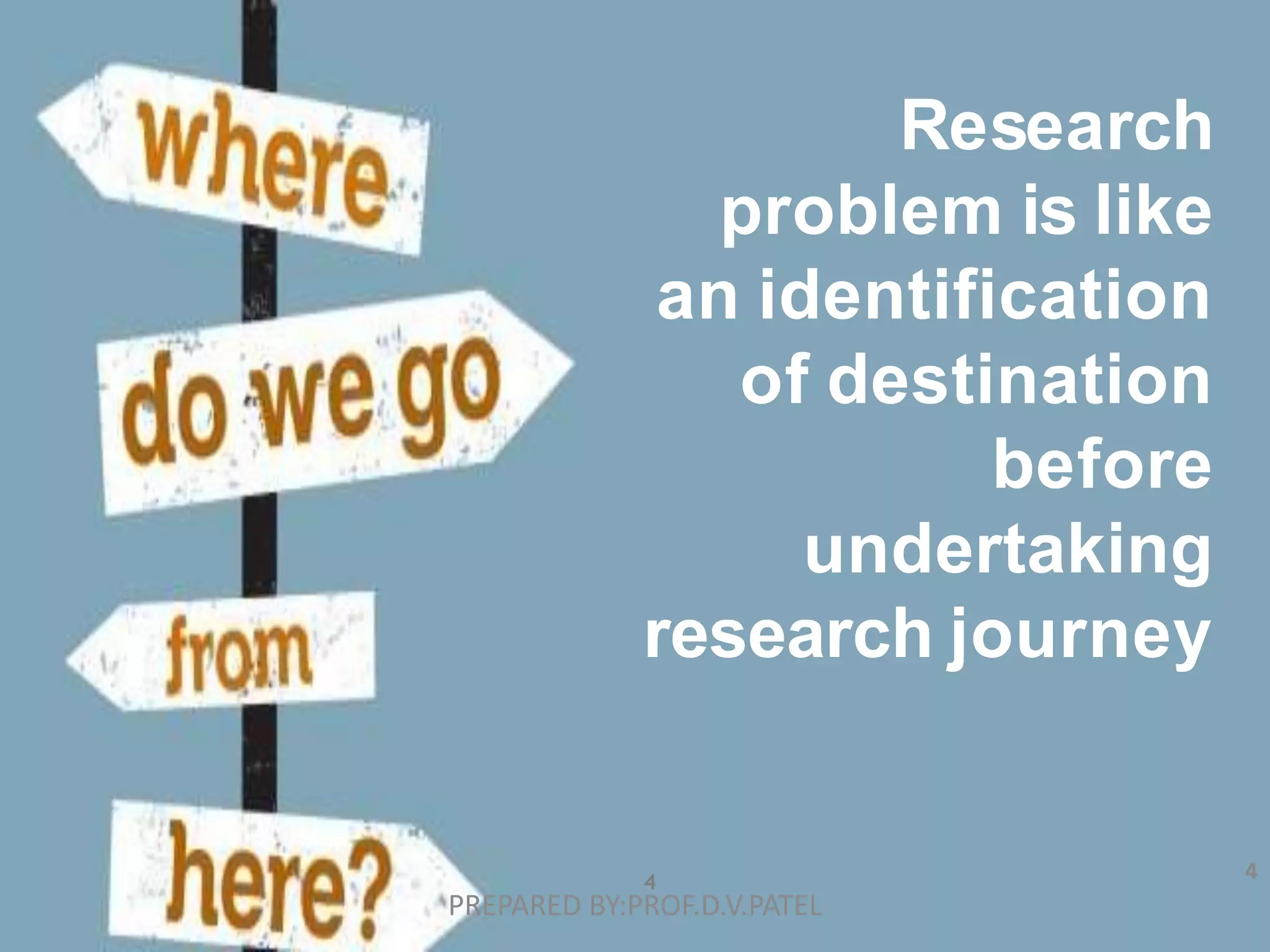
Research
problem is like
an identification
of destination
before
undertaking
research journey
4
PREPARED BY:PROF.D.V.PATEL
4
S C H O O L O F N U T R I T I O N A N D D I E T E T I C S • U N I V E R S I T I S U L T A N Z A I N A L A B I D I N
Clear research problem would
result in clear and economical
research plan.
5
PREPARED BY:PROF.D.V.PATEL
5
S C H O O L O F N U T R I T I O N A N D D I E T E T I C S • U N I V E R S I T I S U L T A N Z A I N A L A B I D I N
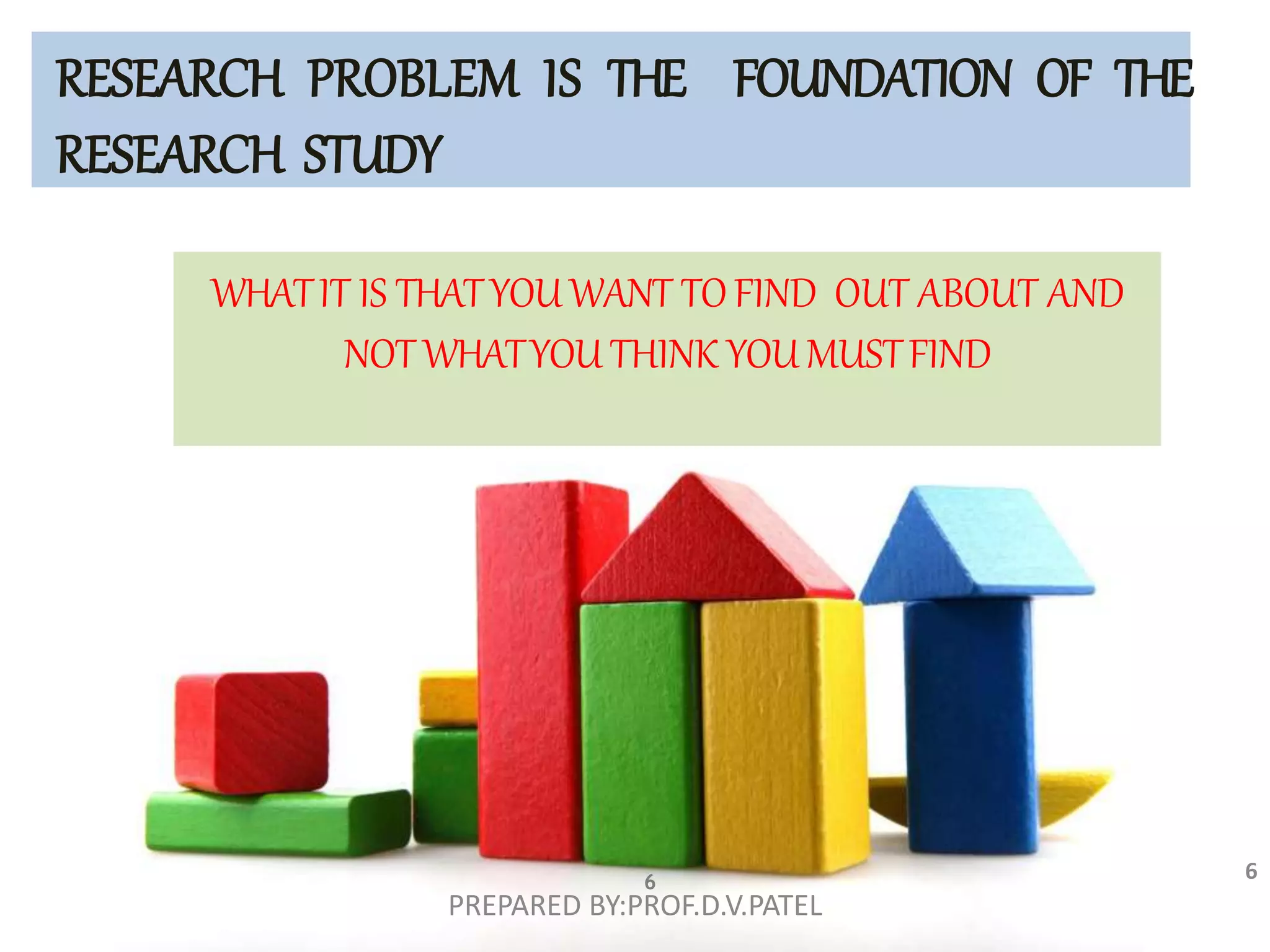
RESEARCH PROBLEM IS THE FOUNDATION OF THE
RESEARCH STUDY
6
WHATIT IS THATYOUWANT TOFIND OUT ABOUT AND
NOTWHATYOU THINK YOU MUSTFIND
PREPARED BY:PROF.D.V.PATEL
6
The way we formulate the research
problem determines every step that
follows:
• type of study design that can be used
• type of sampling strategy that can be
employed
• research instrument that can be used or
developed
• type of analysis that can be undertaken
10
PREPARED BY:PROF.D.V.PATEL
7
Formulating a research problem
8
The certain aim of this chapter is to detail the process
of problem formulation.
The specific process that you are likely to adopt
depends upon:
 Your expertise in research methodology
 Your knowledge of the subject area
 Your understanding of the issues to be examined
 The extent to which the focus of your study is
predetermined
PREPARED BY:PROF.D.V.PATEL
8
The importance of formulating a
research problem
9
The formulation of a research problem is the first and
most important step of the research process.
Kerlinger (1986: 17) ‘If one wants to solve a problem,
one must generally know what the problem is. It can be
said that a large part of the problem lies in knowing
what one is trying to do’.
PREPARED BY:PROF.D.V.PATEL
9
The importance of formulating a
research problem (con)
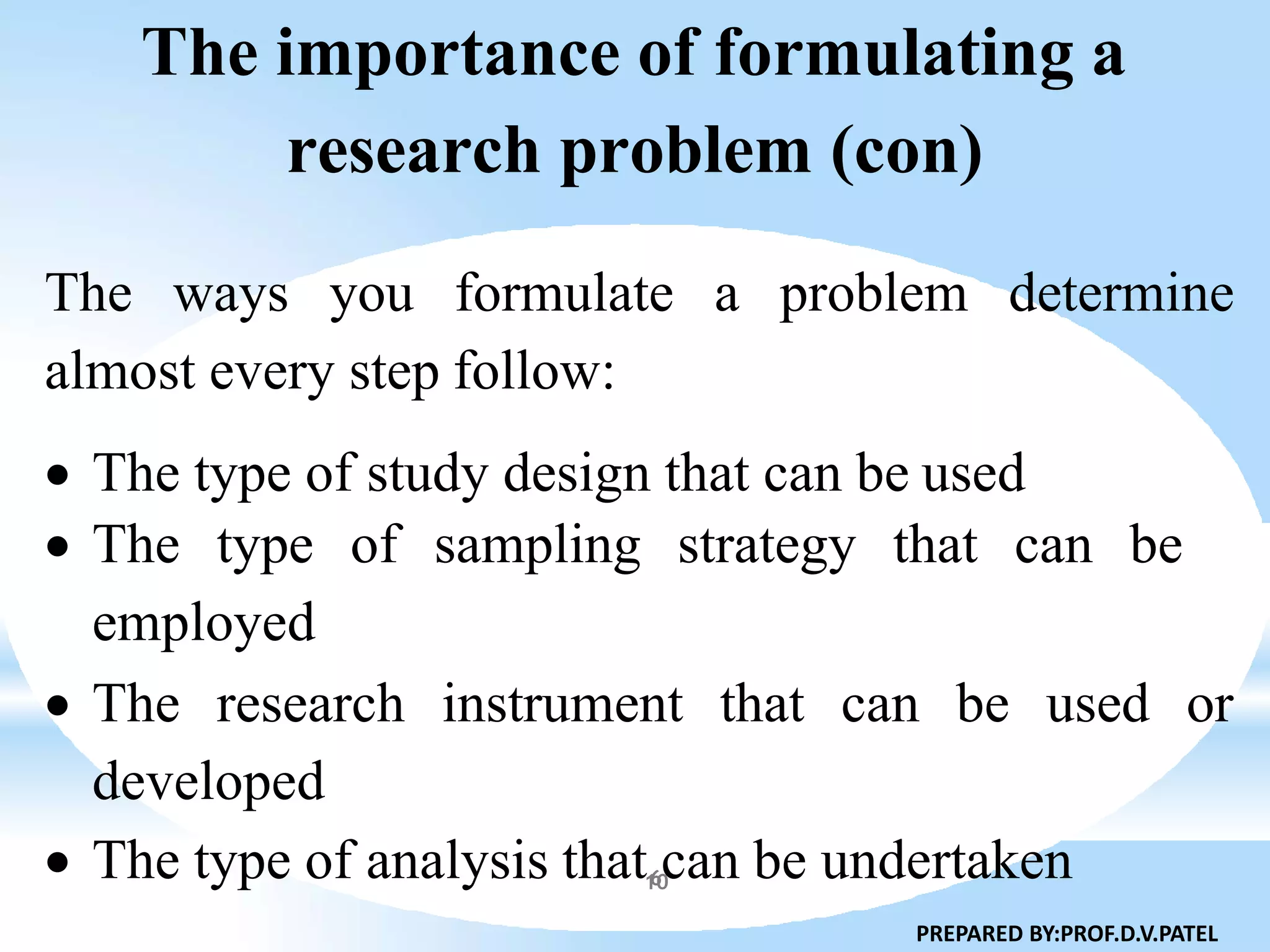
The ways you formulate a problem determine
almost every step follow:
 The type of study design that can be used
 The type of sampling strategy that can be
employed
 The research instrument that can be used or
developed
 The type of analysis that6can be undertaken
PREPARED BY:PROF.D.V.PATEL
10
11
S C H O O L O F N U T R I T I O N A N D D I E T E T I C S • U N I V E R S I T I S U L T A N Z A I N A L A B I D I N
PREPARED BY:PROF.D.V.PATEL
11
Establishing operational definition
• Working definitions or operational definitions are
pre-defined concepts that you plan to use either in your
research problem and/or in identifying the study
population in a measurable form.
• Used only for the purpose of your study and could be
quite different to legal definitions, or those used by
others.
• Working definitions will inform your readers what exactly
you mean by the concepts that you have used in your
study to avoid ambiguity and confusion.
PREPARED BY:PROF.D.V.PATEL
12
Establishing Operational Definitions
13
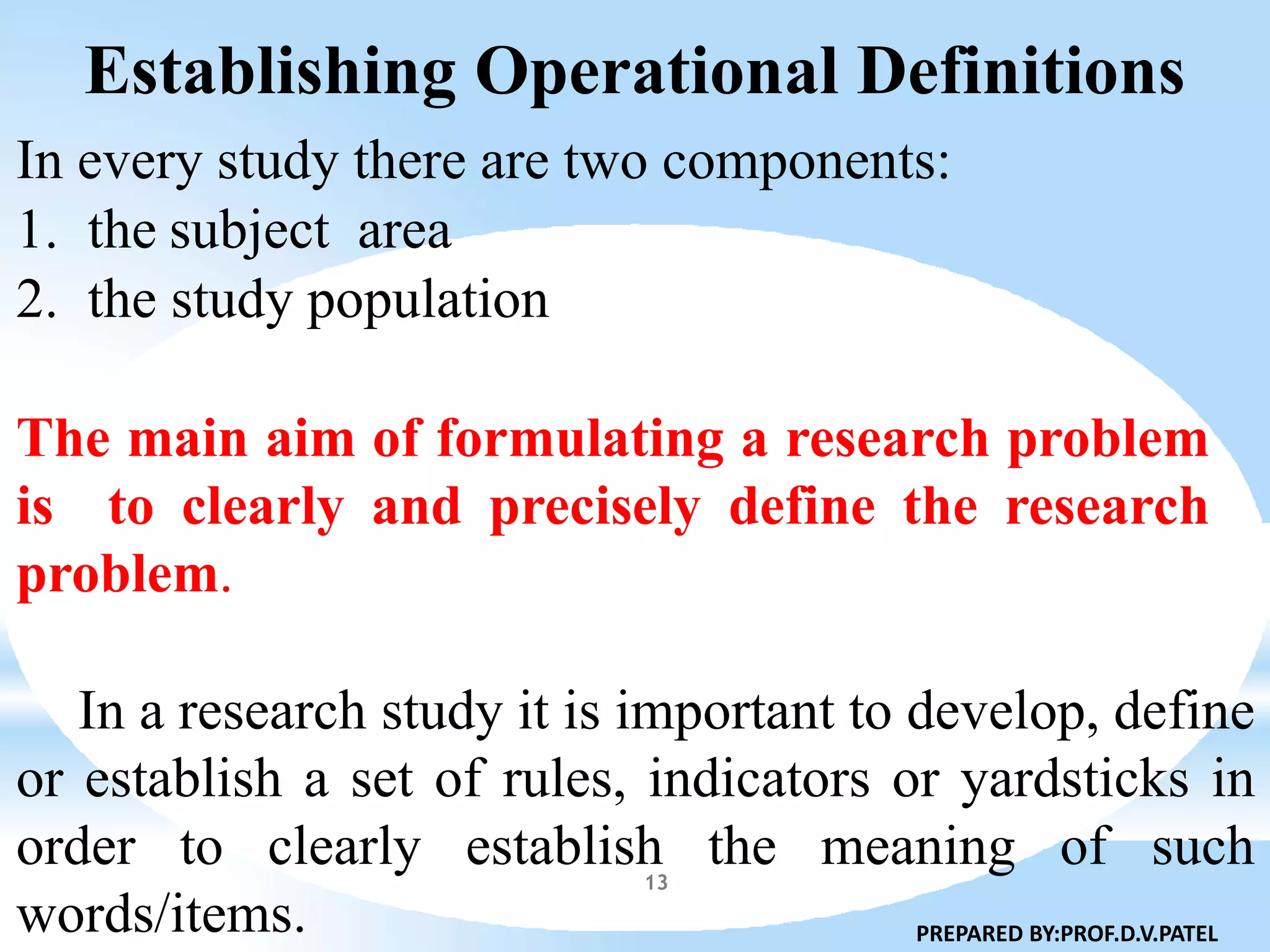
In every study there are two components:
1. the subject area
2. the study population
The main aim of formulating a research problem
is to clearly and precisely define the research
problem.
In a research study it is important to develop, define
or establish a set of rules, indicators or yardsticks in
order to clearly establish the meaning of such
words/items. PREPARED BY:PROF.D.V.PATEL
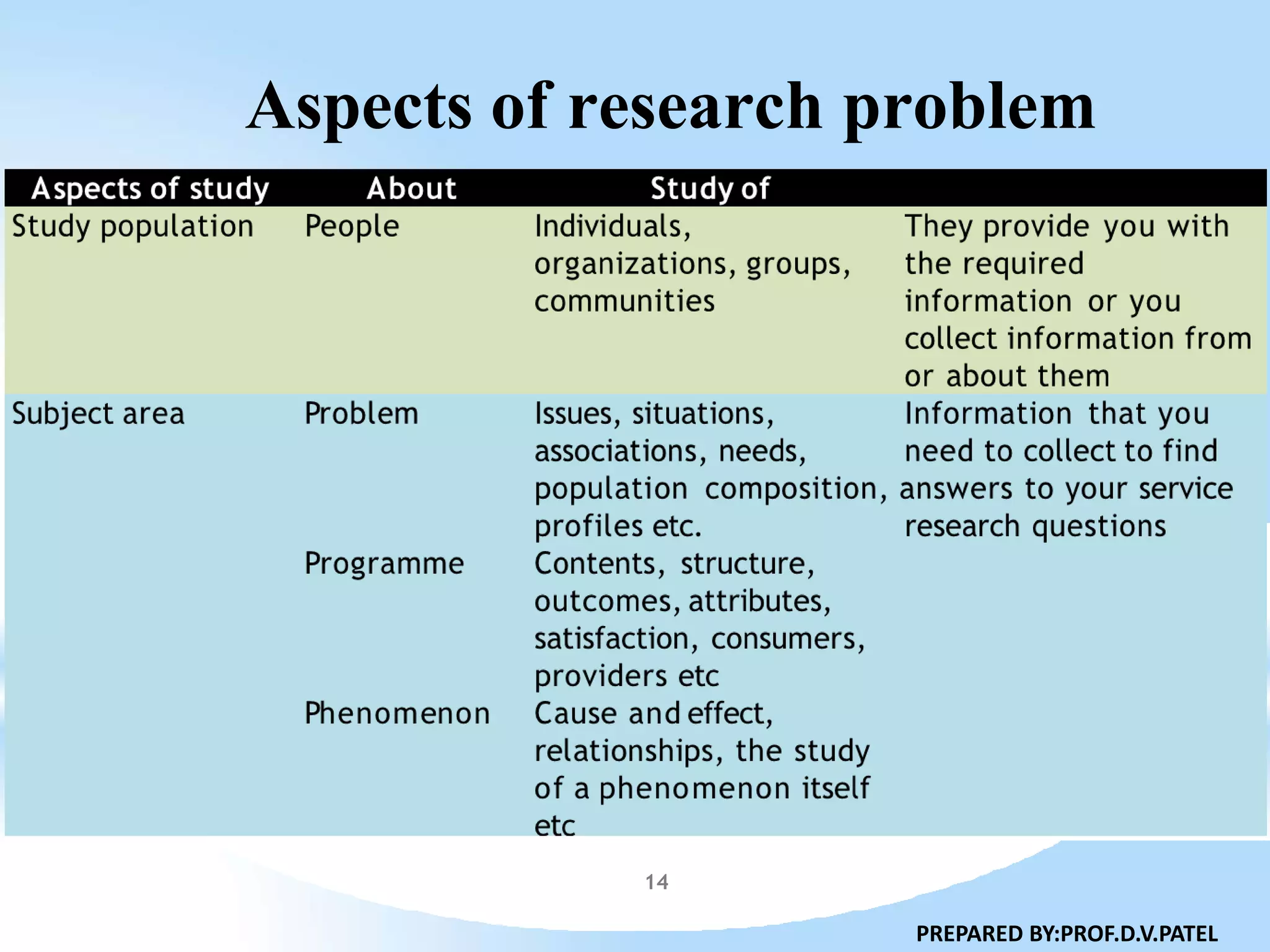
Aspects of research problem
PREPARED BY:PROF.D.V.PATEL
14
Establishing Operational Definitions
(con)
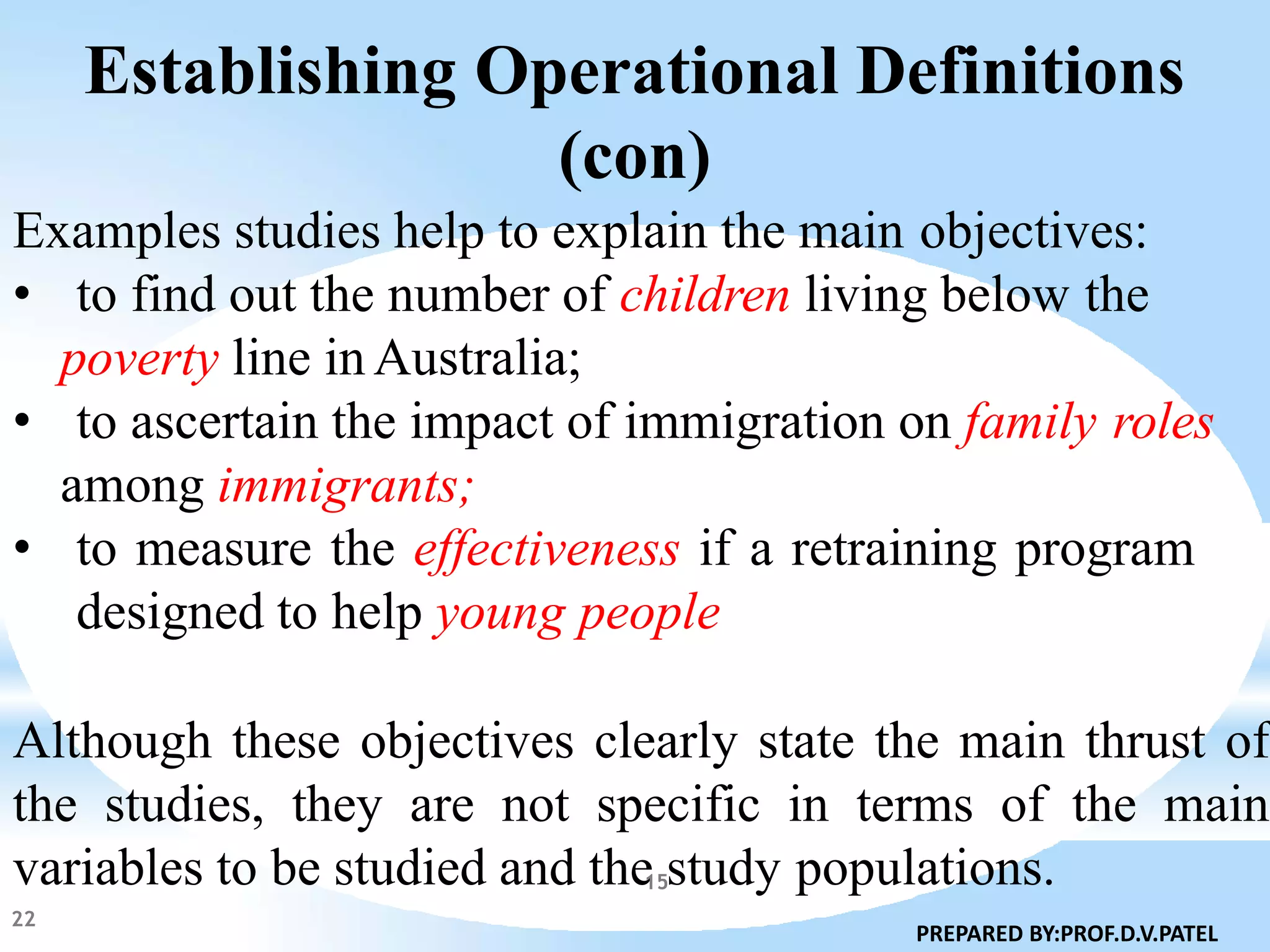
Examples studies help to explain the main objectives:
• to find out the number of children living below the
poverty line in Australia;
• to ascertain the impact of immigration on family roles
among immigrants;
• to measure the effectiveness if a retraining program
designed to help young people
Although these objectives clearly state the main thrust of
the studies, they are not specific in terms of the main
variables to be studied and the study populations.
22
PREPARED BY:PROF.D.V.PATEL
15
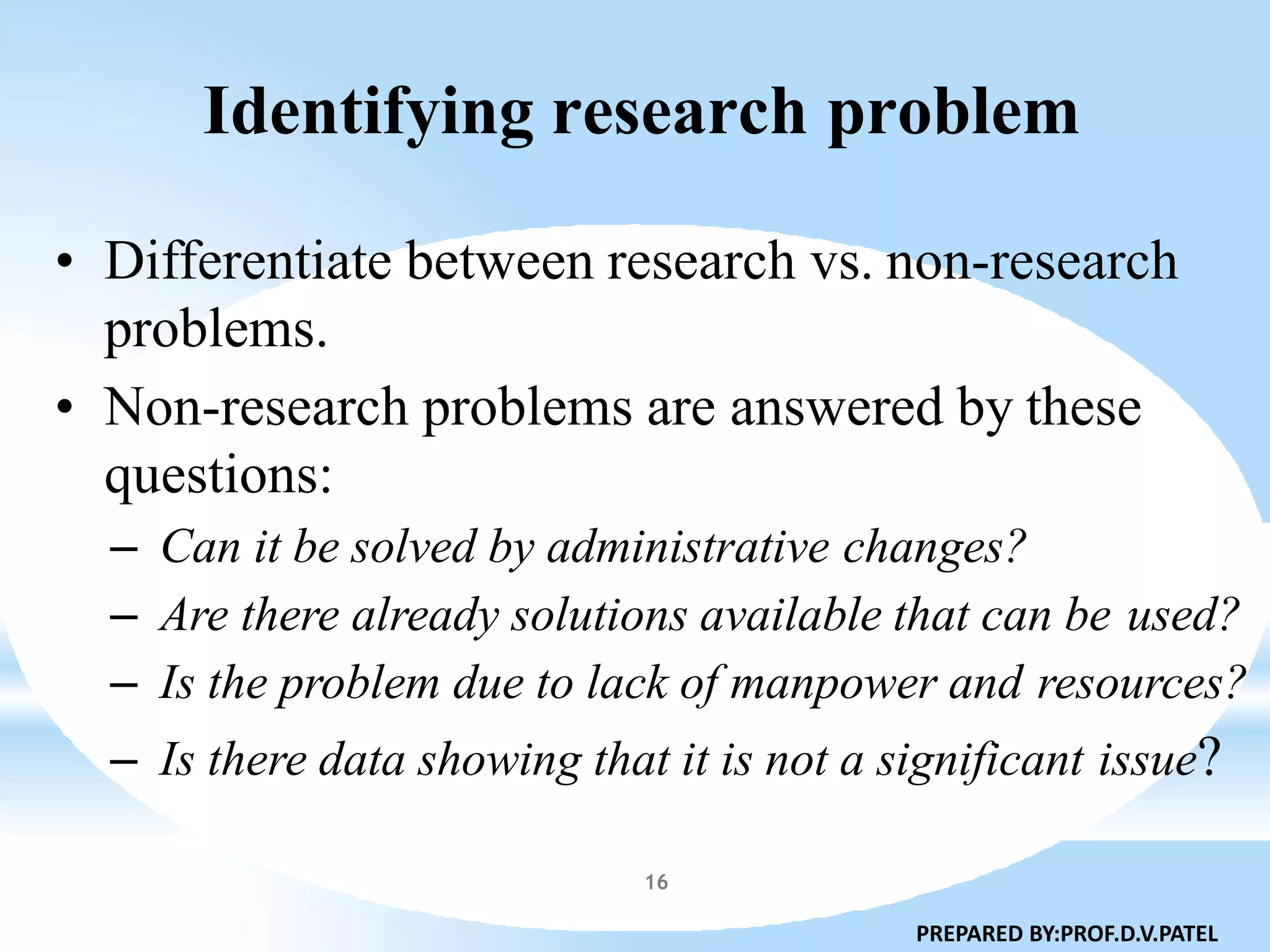
Identifying research problem
• Differentiate between research vs. non-research
problems.
• Non-research problems are answered by these
questions:
– Can it be solved by administrative changes?
– Are there already solutions available that can be used?
– Is the problem due to lack of manpower and resources?
– Is there data showing that it is not a significant issue?
PREPARED BY:PROF.D.V.PATEL
16
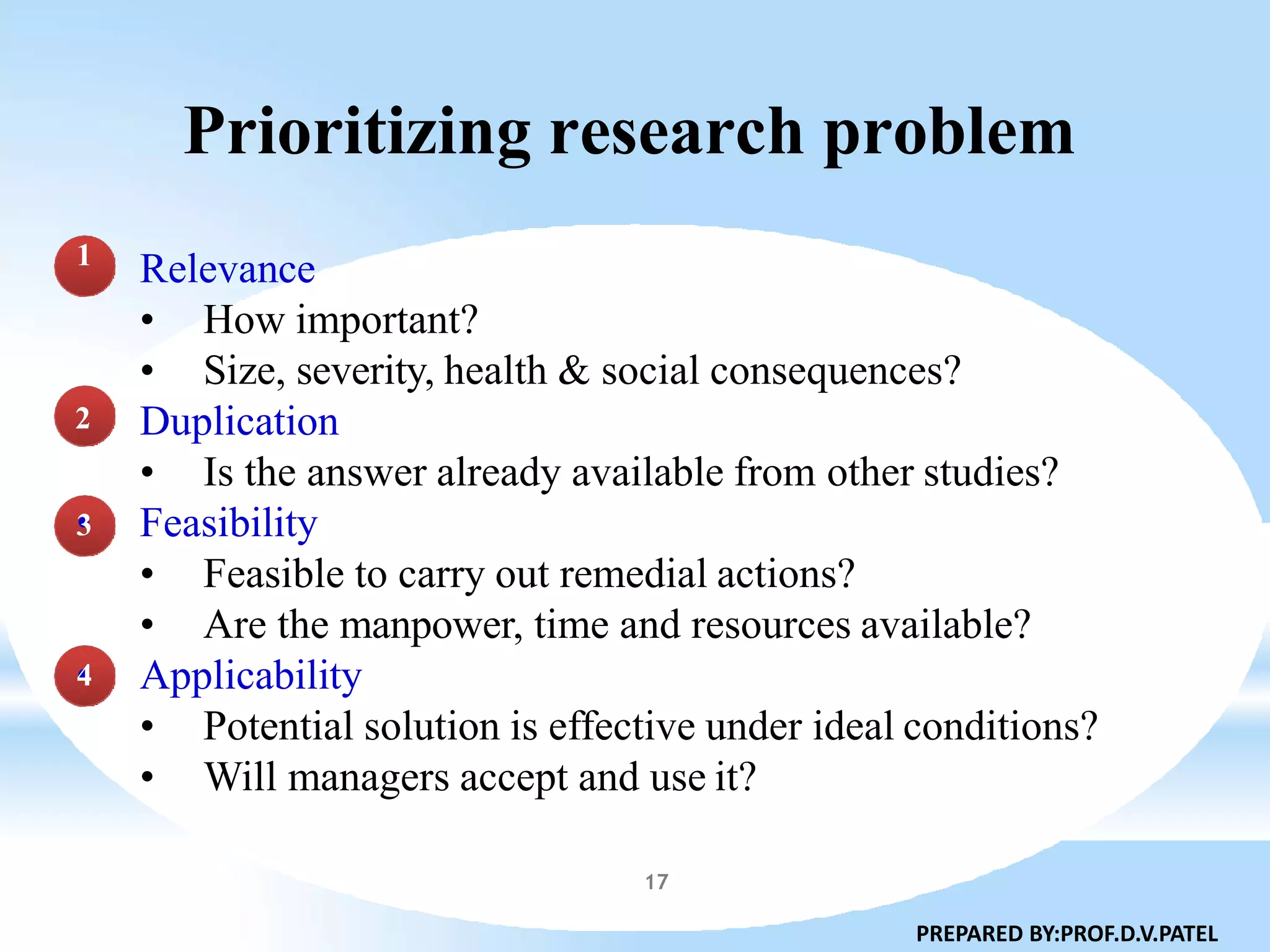
Prioritizing research problem
Relevance
• How important?
• Size, severity, health & social consequences?
Duplication
• Is the answer already available from other studies?
Feasibility
• Feasible to carry out remedial actions?
• Are the manpower, time and resources available?
Applicability
• Potential solution is effective under ideal conditions?
• Will managers accept and use it?
1
2
•3
•4
PREPARED BY:PROF.D.V.PATEL
17
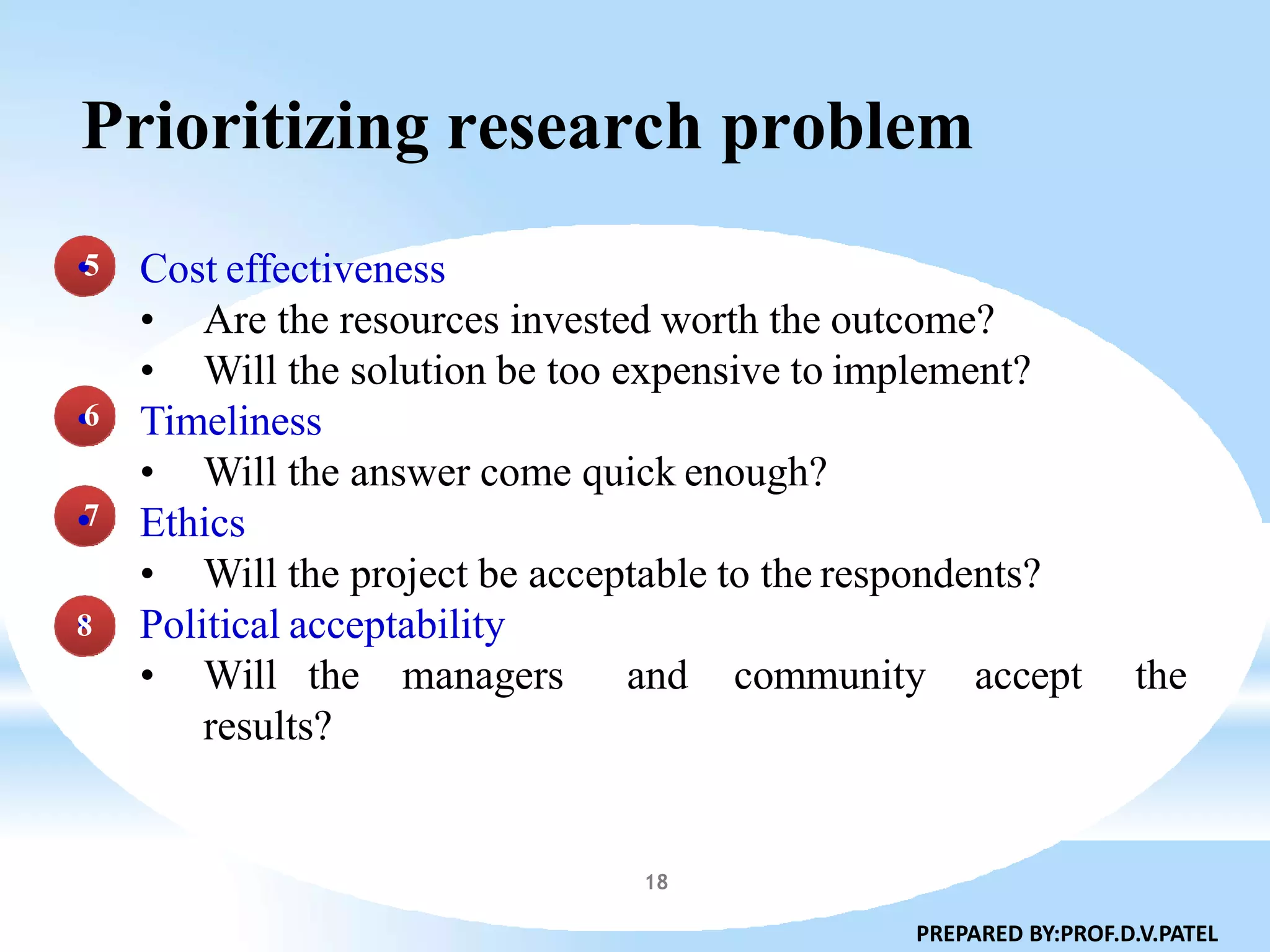
Prioritizing research problem
Cost effectiveness
• Are the resources invested worth the outcome?
• Will the solution be too expensive to implement?
Timeliness
• Will the answer come quick enough?
Ethics
• Will the project be acceptable to the respondents?
Political acceptability
• Will the managers and community accept the
results?
•5
•6
•7
•8
PREPARED BY:PROF.D.V.PATEL
18
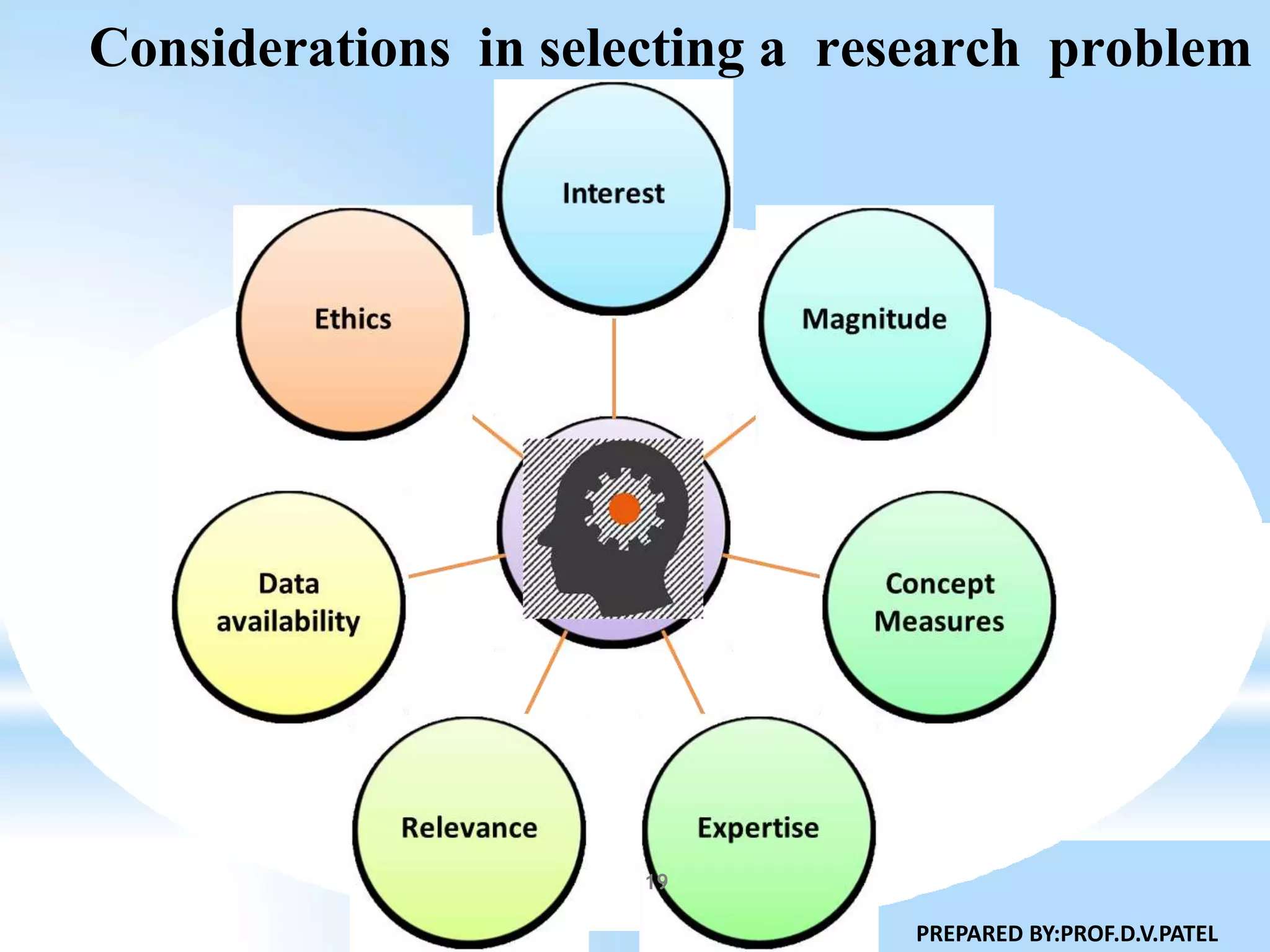
Considerations in selecting a research problem
PREPARED BY:PROF.D.V.PATEL
19
Considerations in selecting a research problem
20
When selecting a research problem/topic there are a
number of considerations to keep in mind. There are
seven main points such as:
• Interest: should be the most important
consideration in selecting a research problem.
• Magnitude: should have sufficient knowledge
about the research process to be able to visualize
the work involved in completing the proposed
study.
PREPARED BY:PROF.D.V.PATEL
Considerations in selecting a
research problem (con)
21
Measurement of concepts :
if you are using a concept in your study, make sure
you are clear about its indicators and their
measurement.
For example: if you plan to measure the effectiveness
of a health promotion program, you must be clear as
to what determines effectiveness and how it will be
measured. Do not use concept in your research
problem that you are not sure how to measure.
PREPARED BY:PROF.D.V.PATEL
Considerations in selecting a
research problem (con)
22
• Level of expertise : Make sure you have an
adequate level of expertise for the task you are
proposing.
• Relevance : select a topic that is of relevance to
you as a professional. Ensure that you study adds to
the existing body of knowledge, bridges current
gaps or useful in policy formulation.
PREPARED BY:PROF.D.V.PATEL
Considerations in selecting a
research problem (con)
23
• Availability of data : if your topic entails
collection of information from secondary
sources(office record, client , records, census or
other already-polished reports, ect..) before
finalizing your topic make sure that these data are
available and in the format you want.
• Ethical issues : other important consideration in
formulating a research problem is the ethical
issues involved.
PREPARED BY:PROF.D.V.PATEL
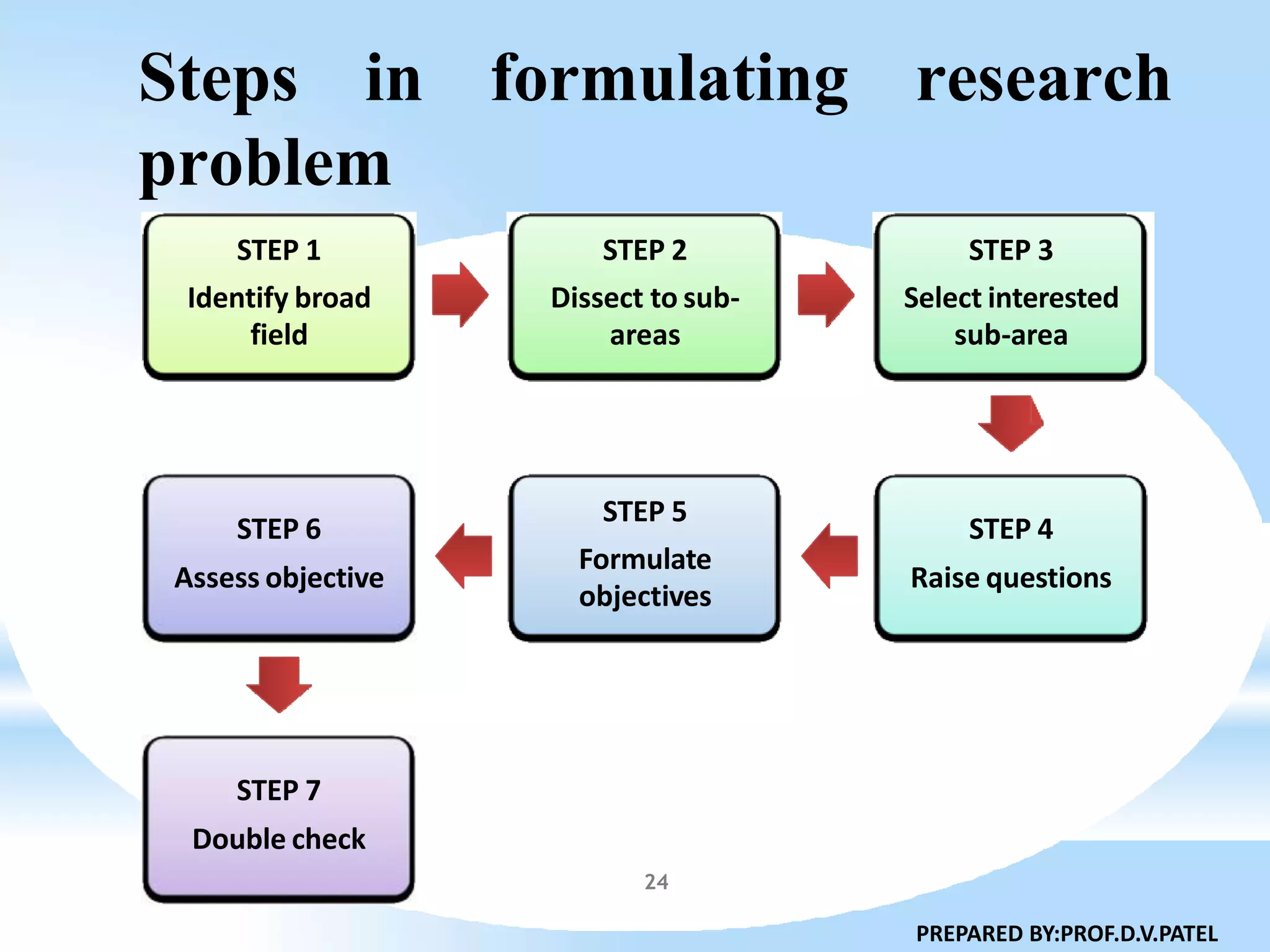
Steps in formulating research
problem
STEP 1
Identify broad
field
STEP 2
Dissect to sub-
areas
STEP 3
Select interested
sub-area
STEP 4
Raise questions
STEP 5
Formulate
objectives
STEP 6
Assess objective
STEP 7
Double check
PREPARED BY:PROF.D.V.PATEL
24
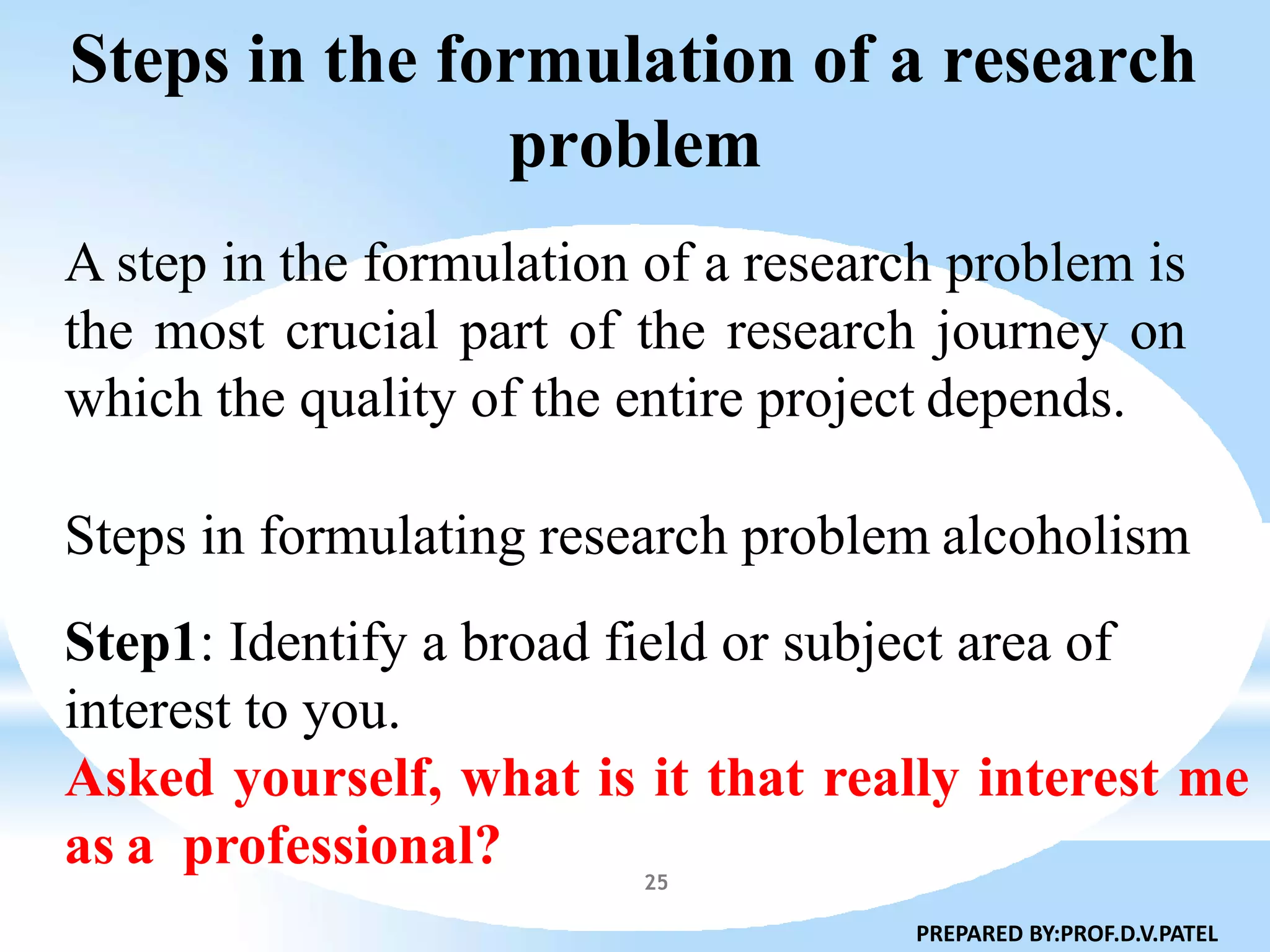
Steps in the formulation of a research
problem
25
A step in the formulation of a research problem is
the most crucial part of the research journey on
which the quality of the entire project depends.
Steps in formulating research problem alcoholism
Step1: Identify a broad field or subject area of
interest to you.
Asked yourself, what is it that really interest me
as a professional?
PREPARED BY:PROF.D.V.PATEL
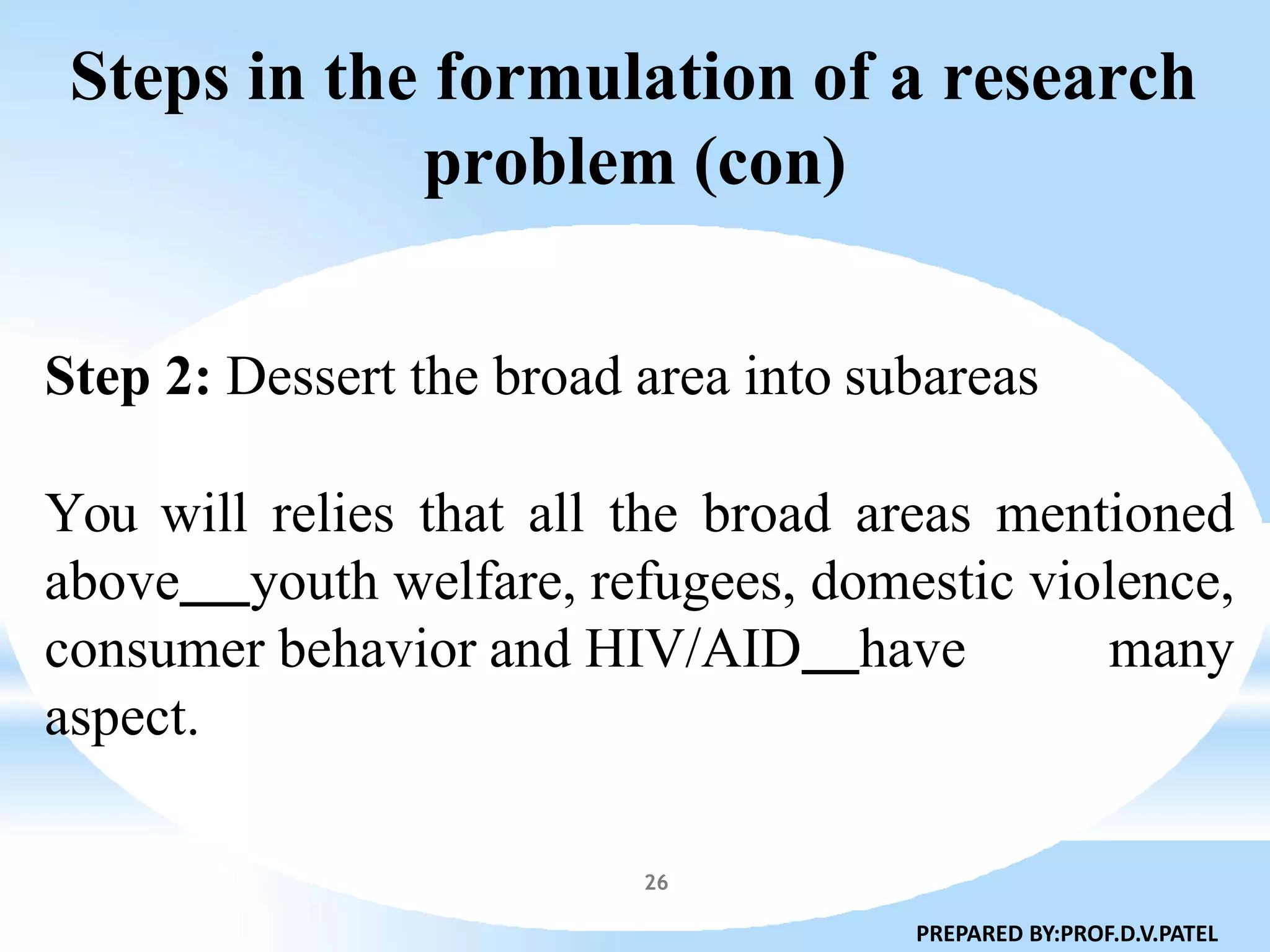
Steps in the formulation of a research
problem (con)
26
Step 2: Dessert the broad area into subareas
You will relies that all the broad areas mentioned
above youth welfare, refugees, domestic violence,
consumer behavior and HIV/AID have many
aspect.
PREPARED BY:PROF.D.V.PATEL
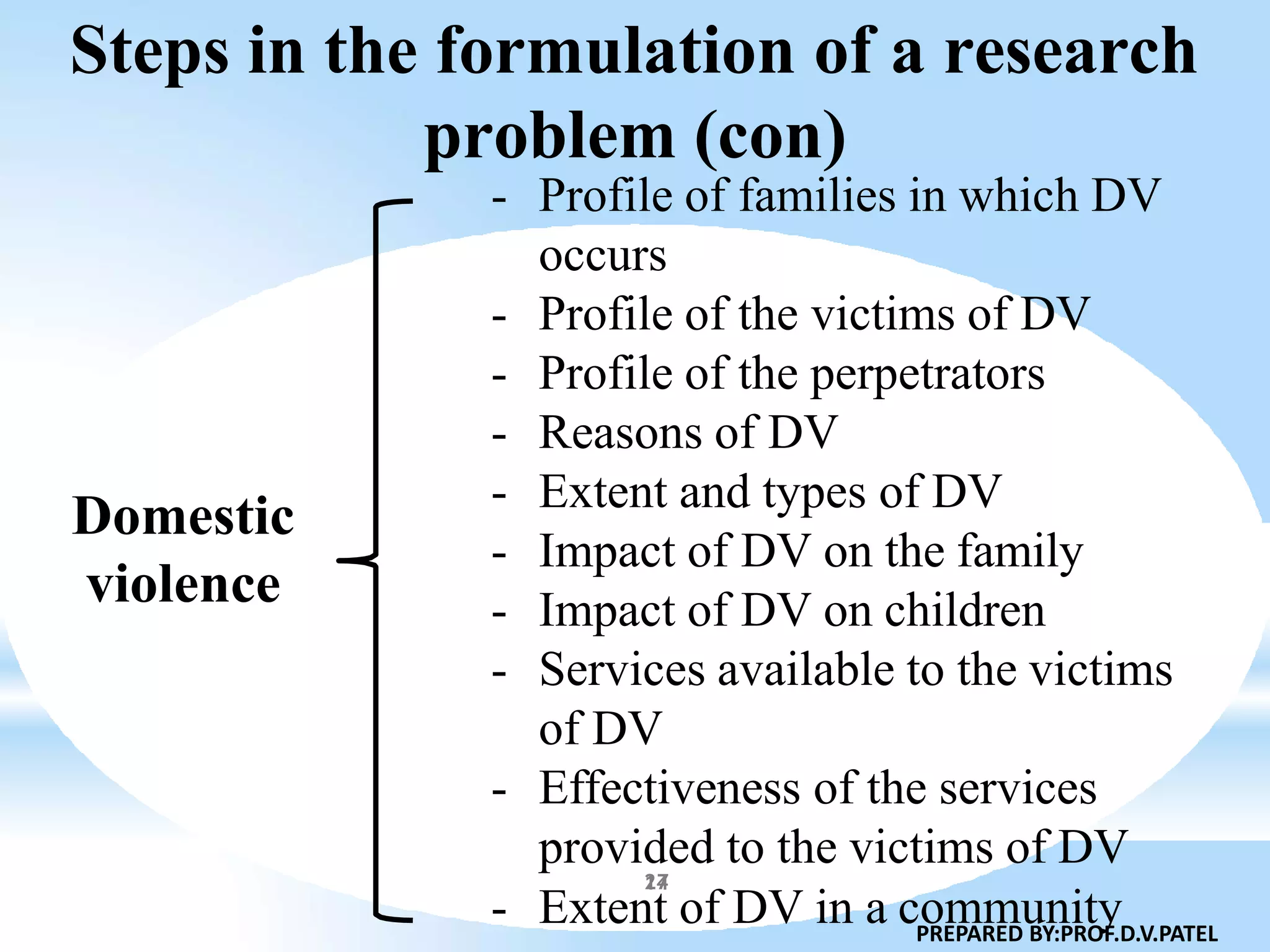
- Profile of families in which DV
occurs
- Profile of the victims of DV
- Profile of the perpetrators
- Reasons of DV
- Extent and types of DV
- Impact of DV on the family
- Impact of DV on children
- Services available to the victims
of DV
- Effectiveness of the services
provided to the victims of DV
Domestic
violence
14
- Extent of DV in a community
Steps in the formulation of a research
problem (con)
PREPARED BY:PROF.D.V.PATEL
27
Step 3: Select what is of most interest to you.
- It is neither advisable nor feasible to study all subareas.
- Select issues or subareas about which you are
passionate.
Step 4: Raise research questions
1. What is it that I want to find out about in the subareas?
2. Asked the question what you want to find yourself in a
situation.
15
Steps in the formulation of a research
problem (con)
PREPARED BY:PROF.D.V.PATEL
28
Steps in the formulation of a research
problem (con)
Step 5: Formulate objectives
Formulate your main objectives and your sub objectives
-The main difference between objectives and research
questions is in to behavioral aims by using action –oriented
words such as to find out, to determine’ , ‘to ascertain and ‘to
examine’
Step 6: Assess your objectives
-Now examine your objectives to ascertain the feasibility o
achieving them through your research endeavor.
-Consider them in the light of the time, resources (financial
and human) and technical expertise at your disposal.
16
PREPARED BY:PROF.D.V.PATEL
29
Steps in the formulation of a research
problem (con)
30
Step 7: Double-check.
- Go back and give final consideration to whether or
not you are sufficiently interested in the study, and
have adequate resources to undertake it.
- Ask yourself , am I really enthusiastic about this
study?
- Do I really have enough resources to undertake it?
- Answer these questions thoughtfully and
realistically.
PREPARED BY:PROF.D.V.PATEL
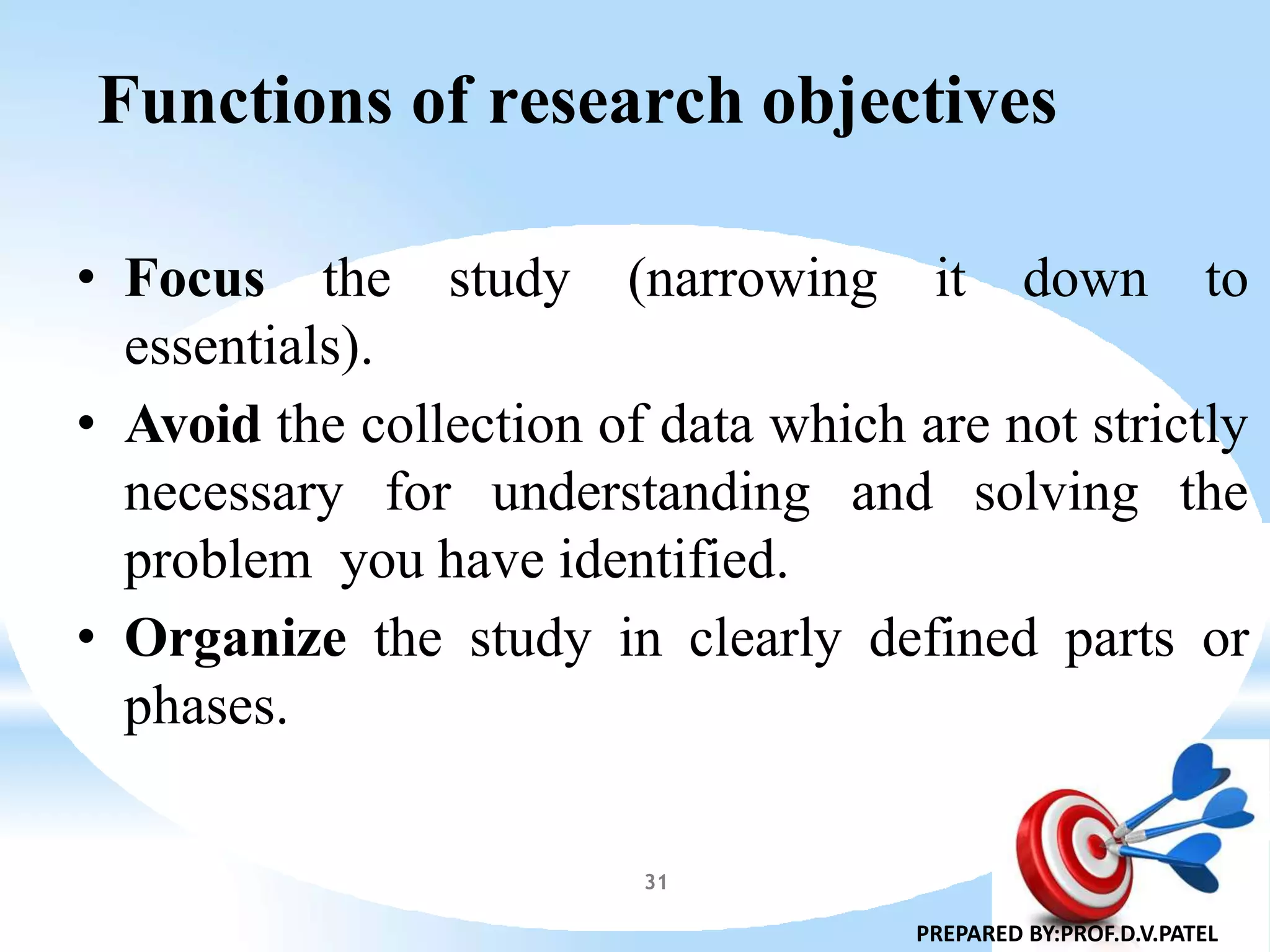
Functions of research objectives
• Focus the study (narrowing it down to
essentials).
• Avoid the collection of data which are not strictly
necessary for understanding and solving the
problem you have identified.
• Organize the study in clearly defined parts or
phases.
PREPARED BY:PROF.D.V.PATEL
31
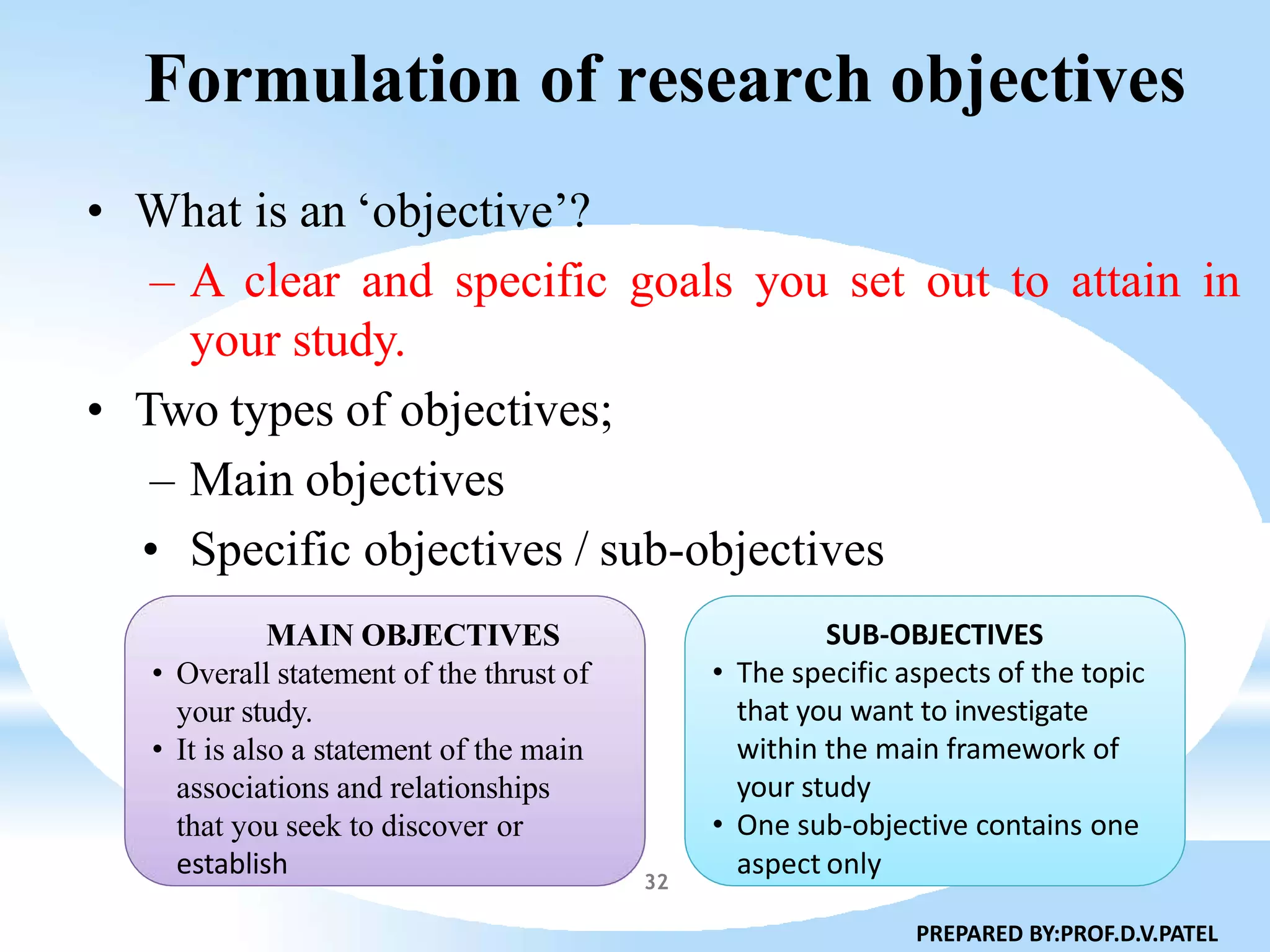
Formulation of research objectives
• What is an ‘objective’?
– A clear and specific goals you set out to attain in
your study.
• Two types of objectives;
– Main objectives
• Specific objectives / sub-objectives
MAIN OBJECTIVES
• Overall statement of the thrust of
your study.
• It is also a statement of the main
associations and relationships
that you seek to discover or
SUB-OBJECTIVES
• The specific aspects of the topic
that you want to investigate
within the main framework of
your study
• One sub-objective contains one
establish aspect only
PREPARED BY:PROF.D.V.PATEL
32
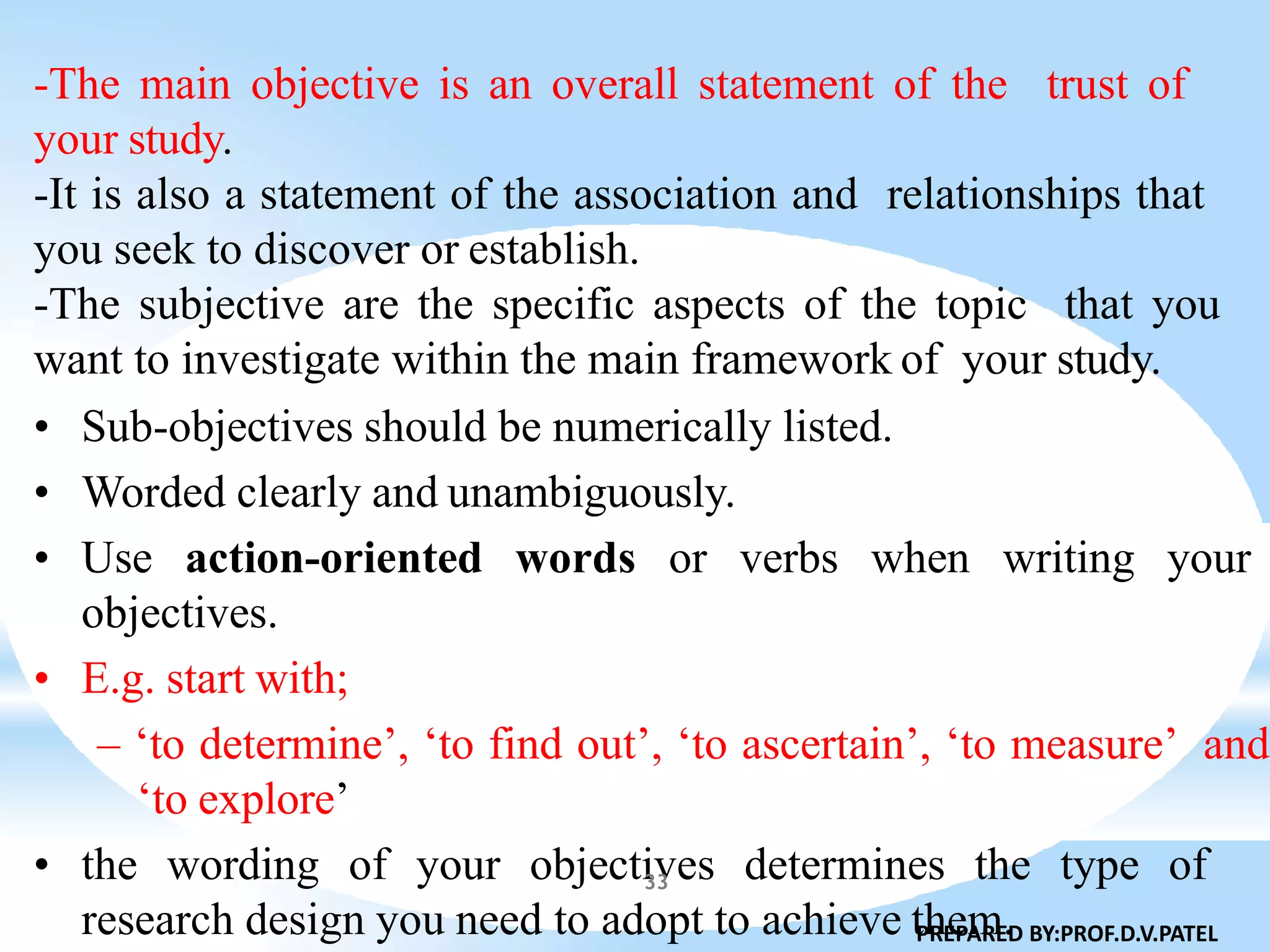
-The main objective is an overall statement of the trust of
your study.
-It is also a statement of the association and relationships that
you seek to discover or establish.
-The subjective are the specific aspects of the topic that you
want to investigate within the main framework of your study.
• Sub-objectives should be numerically listed.
• Worded clearly and unambiguously.
• Use action-oriented words or verbs when writing your
objectives.
• E.g. start with;
– ‘to determine’, ‘to find out’, ‘to ascertain’, ‘to measure’ and
‘to explore’
• the wording of your objectives determines the type of
research design you need to adopt to achieve them.PREPARED BY:PROF.D.V.PATEL
33
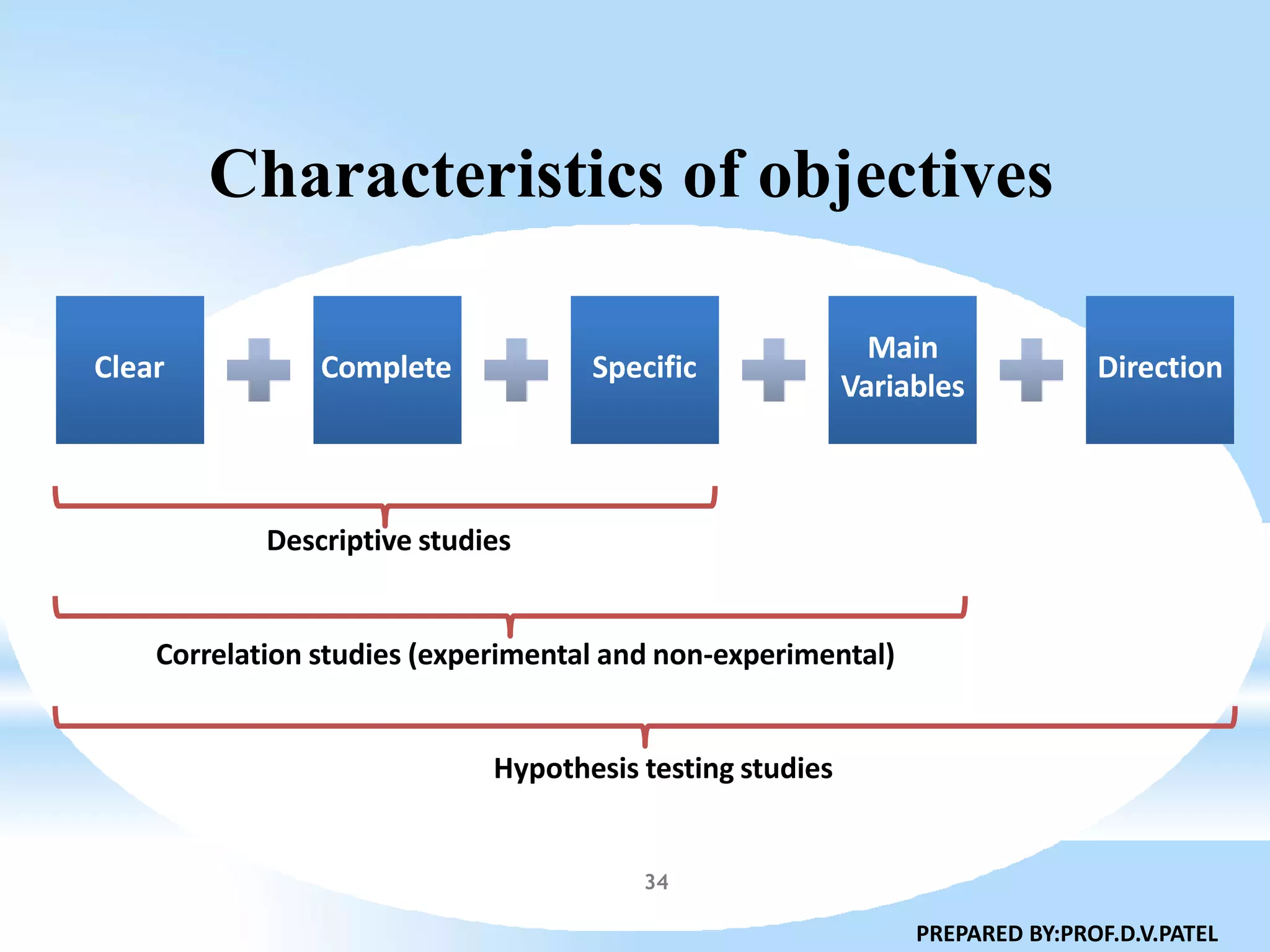
Characteristics of objectives
Clear Complete Specific
Main
Variables
Direction
Descriptive studies
Correlation studies (experimental and non-experimental)
Hypothesis testing studies
PREPARED BY:PROF.D.V.PATEL
34
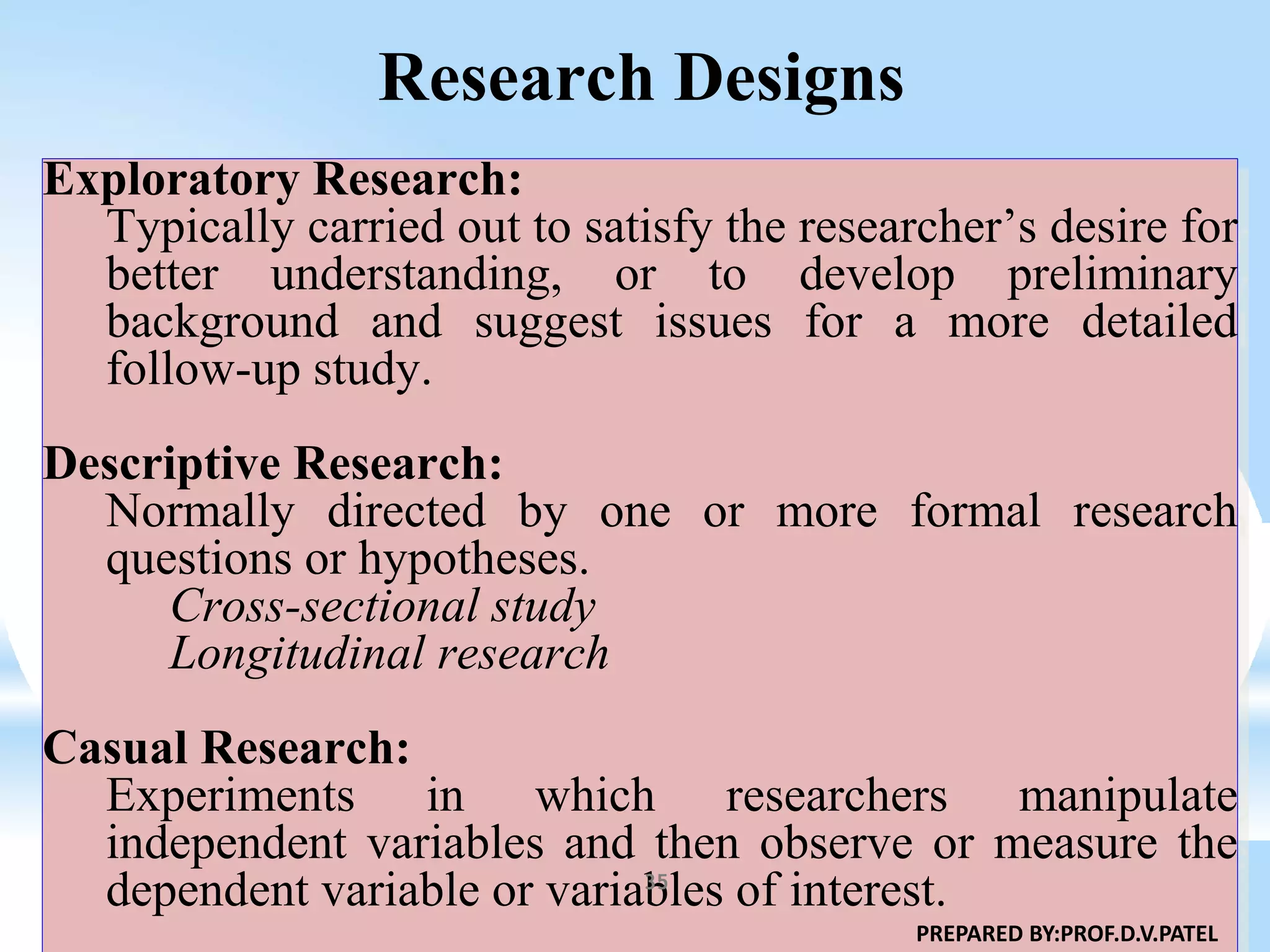
Research Designs
Exploratory Research:
Typically carried out to satisfy the researcher’s desire for
better understanding, or to develop preliminary
background and suggest issues for a more detailed
follow-up study.
Descriptive Research:
Normally directed by one or more formal research
questions or hypotheses.
Cross-sectional study
Longitudinal research
Casual Research:
Experiments in which researchers manipulate
independent variables and then observe or measure the
dependent variable or variables of interest.
PREPARED BY:PROF.D.V.PATEL
35
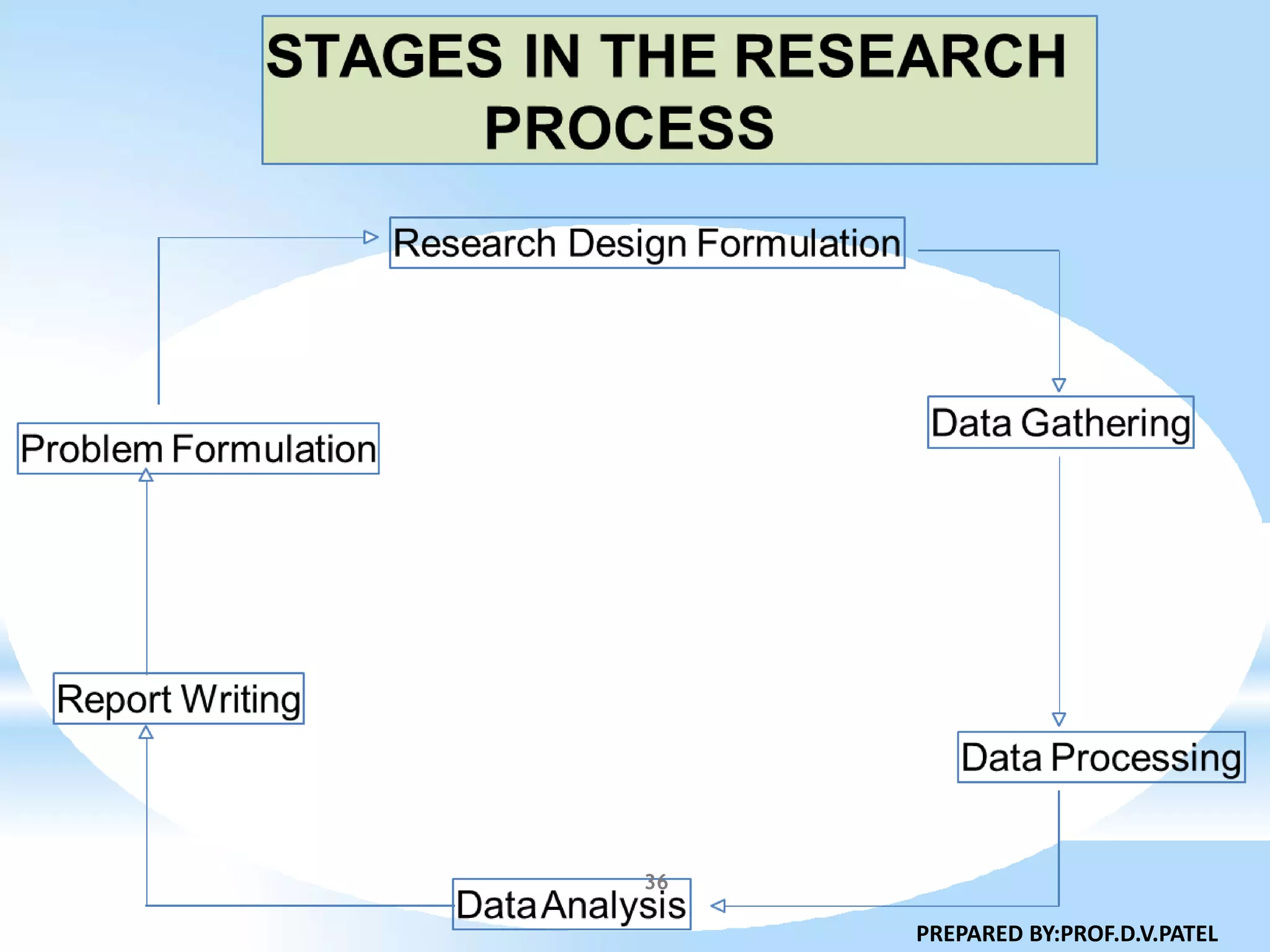
PREPARED BY:PROF.D.V.PATEL
36

Formulating a research problem

  • 1.
    The research problem 1 Aresearch problem can be any question that you want to answer and any assumption or assertion that you want to challenge or investigate. • Power, Meenaghan, & Twoomey (1985: 38), ‘Potential research questions may occur to us on a regular basis, but the process of formulating them in a meaning way is not at all an easy task’. PREPARED BY:PROF.D.V.PATEL 1
  • 2.
    What is researchproblem? 2 • Any question that you want answered and any assumption or assertion that you want to challenge or investigate. • However; • not all questions can be transformed into research problems. • the process of formulating them in a meaningful way is not at all an easy task. • it requires considerable knowledge of both the subject area and research methodology. PREPARED BY:PROF.D.V.PATEL 2
  • 3.
    What is researchproblem? • A research problem is a perceived gap between what is and what should be. • Research problem arise from: 1. Evolution of theories. 2. Peers and supervisors etc. 3. Published research (literature review). 4. Day-to-day experience PREPARED BY:PROF.D.V.PATEL 3
  • 4.
    S C HO O L O F N U T R I T I O N A N D D I E T E T I C S • U N I V E R S I T I S U L T A N Z A I N A L A B I D I N Research problem is like an identification of destination before undertaking research journey 4 PREPARED BY:PROF.D.V.PATEL 4
  • 5.
    S C HO O L O F N U T R I T I O N A N D D I E T E T I C S • U N I V E R S I T I S U L T A N Z A I N A L A B I D I N Clear research problem would result in clear and economical research plan. 5 PREPARED BY:PROF.D.V.PATEL 5
  • 6.
    S C HO O L O F N U T R I T I O N A N D D I E T E T I C S • U N I V E R S I T I S U L T A N Z A I N A L A B I D I N RESEARCH PROBLEM IS THE FOUNDATION OF THE RESEARCH STUDY 6 WHATIT IS THATYOUWANT TOFIND OUT ABOUT AND NOTWHATYOU THINK YOU MUSTFIND PREPARED BY:PROF.D.V.PATEL 6
  • 7.
    The way weformulate the research problem determines every step that follows: • type of study design that can be used • type of sampling strategy that can be employed • research instrument that can be used or developed • type of analysis that can be undertaken 10 PREPARED BY:PROF.D.V.PATEL 7
  • 8.
    Formulating a researchproblem 8 The certain aim of this chapter is to detail the process of problem formulation. The specific process that you are likely to adopt depends upon:  Your expertise in research methodology  Your knowledge of the subject area  Your understanding of the issues to be examined  The extent to which the focus of your study is predetermined PREPARED BY:PROF.D.V.PATEL 8
  • 9.
    The importance offormulating a research problem 9 The formulation of a research problem is the first and most important step of the research process. Kerlinger (1986: 17) ‘If one wants to solve a problem, one must generally know what the problem is. It can be said that a large part of the problem lies in knowing what one is trying to do’. PREPARED BY:PROF.D.V.PATEL 9
  • 10.
    The importance offormulating a research problem (con) The ways you formulate a problem determine almost every step follow:  The type of study design that can be used  The type of sampling strategy that can be employed  The research instrument that can be used or developed  The type of analysis that6can be undertaken PREPARED BY:PROF.D.V.PATEL 10
  • 11.
    11 S C HO O L O F N U T R I T I O N A N D D I E T E T I C S • U N I V E R S I T I S U L T A N Z A I N A L A B I D I N PREPARED BY:PROF.D.V.PATEL 11
  • 12.
    Establishing operational definition •Working definitions or operational definitions are pre-defined concepts that you plan to use either in your research problem and/or in identifying the study population in a measurable form. • Used only for the purpose of your study and could be quite different to legal definitions, or those used by others. • Working definitions will inform your readers what exactly you mean by the concepts that you have used in your study to avoid ambiguity and confusion. PREPARED BY:PROF.D.V.PATEL 12
  • 13.
    Establishing Operational Definitions 13 Inevery study there are two components: 1. the subject area 2. the study population The main aim of formulating a research problem is to clearly and precisely define the research problem. In a research study it is important to develop, define or establish a set of rules, indicators or yardsticks in order to clearly establish the meaning of such words/items. PREPARED BY:PROF.D.V.PATEL
  • 14.
    Aspects of researchproblem PREPARED BY:PROF.D.V.PATEL 14
  • 15.
    Establishing Operational Definitions (con) Examplesstudies help to explain the main objectives: • to find out the number of children living below the poverty line in Australia; • to ascertain the impact of immigration on family roles among immigrants; • to measure the effectiveness if a retraining program designed to help young people Although these objectives clearly state the main thrust of the studies, they are not specific in terms of the main variables to be studied and the study populations. 22 PREPARED BY:PROF.D.V.PATEL 15
  • 16.
    Identifying research problem •Differentiate between research vs. non-research problems. • Non-research problems are answered by these questions: – Can it be solved by administrative changes? – Are there already solutions available that can be used? – Is the problem due to lack of manpower and resources? – Is there data showing that it is not a significant issue? PREPARED BY:PROF.D.V.PATEL 16
  • 17.
    Prioritizing research problem Relevance •How important? • Size, severity, health & social consequences? Duplication • Is the answer already available from other studies? Feasibility • Feasible to carry out remedial actions? • Are the manpower, time and resources available? Applicability • Potential solution is effective under ideal conditions? • Will managers accept and use it? 1 2 •3 •4 PREPARED BY:PROF.D.V.PATEL 17
  • 18.
    Prioritizing research problem Costeffectiveness • Are the resources invested worth the outcome? • Will the solution be too expensive to implement? Timeliness • Will the answer come quick enough? Ethics • Will the project be acceptable to the respondents? Political acceptability • Will the managers and community accept the results? •5 •6 •7 •8 PREPARED BY:PROF.D.V.PATEL 18
  • 19.
    Considerations in selectinga research problem PREPARED BY:PROF.D.V.PATEL 19
  • 20.
    Considerations in selectinga research problem 20 When selecting a research problem/topic there are a number of considerations to keep in mind. There are seven main points such as: • Interest: should be the most important consideration in selecting a research problem. • Magnitude: should have sufficient knowledge about the research process to be able to visualize the work involved in completing the proposed study. PREPARED BY:PROF.D.V.PATEL
  • 21.
    Considerations in selectinga research problem (con) 21 Measurement of concepts : if you are using a concept in your study, make sure you are clear about its indicators and their measurement. For example: if you plan to measure the effectiveness of a health promotion program, you must be clear as to what determines effectiveness and how it will be measured. Do not use concept in your research problem that you are not sure how to measure. PREPARED BY:PROF.D.V.PATEL
  • 22.
    Considerations in selectinga research problem (con) 22 • Level of expertise : Make sure you have an adequate level of expertise for the task you are proposing. • Relevance : select a topic that is of relevance to you as a professional. Ensure that you study adds to the existing body of knowledge, bridges current gaps or useful in policy formulation. PREPARED BY:PROF.D.V.PATEL
  • 23.
    Considerations in selectinga research problem (con) 23 • Availability of data : if your topic entails collection of information from secondary sources(office record, client , records, census or other already-polished reports, ect..) before finalizing your topic make sure that these data are available and in the format you want. • Ethical issues : other important consideration in formulating a research problem is the ethical issues involved. PREPARED BY:PROF.D.V.PATEL
  • 24.
    Steps in formulatingresearch problem STEP 1 Identify broad field STEP 2 Dissect to sub- areas STEP 3 Select interested sub-area STEP 4 Raise questions STEP 5 Formulate objectives STEP 6 Assess objective STEP 7 Double check PREPARED BY:PROF.D.V.PATEL 24
  • 25.
    Steps in theformulation of a research problem 25 A step in the formulation of a research problem is the most crucial part of the research journey on which the quality of the entire project depends. Steps in formulating research problem alcoholism Step1: Identify a broad field or subject area of interest to you. Asked yourself, what is it that really interest me as a professional? PREPARED BY:PROF.D.V.PATEL
  • 26.
    Steps in theformulation of a research problem (con) 26 Step 2: Dessert the broad area into subareas You will relies that all the broad areas mentioned above youth welfare, refugees, domestic violence, consumer behavior and HIV/AID have many aspect. PREPARED BY:PROF.D.V.PATEL
  • 27.
    - Profile offamilies in which DV occurs - Profile of the victims of DV - Profile of the perpetrators - Reasons of DV - Extent and types of DV - Impact of DV on the family - Impact of DV on children - Services available to the victims of DV - Effectiveness of the services provided to the victims of DV Domestic violence 14 - Extent of DV in a community Steps in the formulation of a research problem (con) PREPARED BY:PROF.D.V.PATEL 27
  • 28.
    Step 3: Selectwhat is of most interest to you. - It is neither advisable nor feasible to study all subareas. - Select issues or subareas about which you are passionate. Step 4: Raise research questions 1. What is it that I want to find out about in the subareas? 2. Asked the question what you want to find yourself in a situation. 15 Steps in the formulation of a research problem (con) PREPARED BY:PROF.D.V.PATEL 28
  • 29.
    Steps in theformulation of a research problem (con) Step 5: Formulate objectives Formulate your main objectives and your sub objectives -The main difference between objectives and research questions is in to behavioral aims by using action –oriented words such as to find out, to determine’ , ‘to ascertain and ‘to examine’ Step 6: Assess your objectives -Now examine your objectives to ascertain the feasibility o achieving them through your research endeavor. -Consider them in the light of the time, resources (financial and human) and technical expertise at your disposal. 16 PREPARED BY:PROF.D.V.PATEL 29
  • 30.
    Steps in theformulation of a research problem (con) 30 Step 7: Double-check. - Go back and give final consideration to whether or not you are sufficiently interested in the study, and have adequate resources to undertake it. - Ask yourself , am I really enthusiastic about this study? - Do I really have enough resources to undertake it? - Answer these questions thoughtfully and realistically. PREPARED BY:PROF.D.V.PATEL
  • 31.
    Functions of researchobjectives • Focus the study (narrowing it down to essentials). • Avoid the collection of data which are not strictly necessary for understanding and solving the problem you have identified. • Organize the study in clearly defined parts or phases. PREPARED BY:PROF.D.V.PATEL 31
  • 32.
    Formulation of researchobjectives • What is an ‘objective’? – A clear and specific goals you set out to attain in your study. • Two types of objectives; – Main objectives • Specific objectives / sub-objectives MAIN OBJECTIVES • Overall statement of the thrust of your study. • It is also a statement of the main associations and relationships that you seek to discover or SUB-OBJECTIVES • The specific aspects of the topic that you want to investigate within the main framework of your study • One sub-objective contains one establish aspect only PREPARED BY:PROF.D.V.PATEL 32
  • 33.
    -The main objectiveis an overall statement of the trust of your study. -It is also a statement of the association and relationships that you seek to discover or establish. -The subjective are the specific aspects of the topic that you want to investigate within the main framework of your study. • Sub-objectives should be numerically listed. • Worded clearly and unambiguously. • Use action-oriented words or verbs when writing your objectives. • E.g. start with; – ‘to determine’, ‘to find out’, ‘to ascertain’, ‘to measure’ and ‘to explore’ • the wording of your objectives determines the type of research design you need to adopt to achieve them.PREPARED BY:PROF.D.V.PATEL 33
  • 34.
    Characteristics of objectives ClearComplete Specific Main Variables Direction Descriptive studies Correlation studies (experimental and non-experimental) Hypothesis testing studies PREPARED BY:PROF.D.V.PATEL 34
  • 35.
    Research Designs Exploratory Research: Typicallycarried out to satisfy the researcher’s desire for better understanding, or to develop preliminary background and suggest issues for a more detailed follow-up study. Descriptive Research: Normally directed by one or more formal research questions or hypotheses. Cross-sectional study Longitudinal research Casual Research: Experiments in which researchers manipulate independent variables and then observe or measure the dependent variable or variables of interest. PREPARED BY:PROF.D.V.PATEL 35
  • 36.