GUJARAT TECHNOLOGICAL UNIVERSITY
TATVA INSTITUTE OF TECHNOLOGICAL STUDIES
“ Formulating the Research Problem ”
Research Skills (2710001)
Guided By: Presented By:
Dr. H. R. Varia Bhavya S. Patel (170900713008)
Prof. J. K. Bihola
Department of Civil Engineering
M.E. Transportation Engineering Semester 1
December 2017
Topic Learning Outcomes
• Importance of formulating a research problem
• Sources of research problems
• Considerations in selecting a research problem
• Steps in formulating a research problem
• How to formulate research objectives ?
• Operational definitions
 Any question that you want answered and any
assumption or assertion that you want to challenge or
investigate.
 However,
◦ not all questions can be transformed into research
problems.
◦ the process of formulating them in a meaningful way is not
at all an easy task.
◦ it requires considerable knowledge of both the subject area
and research methodology.
 A research problem is a perceived gap between
what is and what should be.
 Research problem arise from;
◦ Evolution of theories.
◦ Peers and supervisors etc.
◦ Published research (literature review).
◦ Day-to-day experience
RESEARCH PROBLEM IS THE
FOUNDATION OF THE RESEARCH
STUDY
Clear research problem would result
in clear and economical research
plan.
The way we formulate the research problem
determines every step that
follows;
• type of study design that can be used
• type of sampling strategy that can be employed
• research instrument that can be used or developed
• type of analysis that can be undertaken
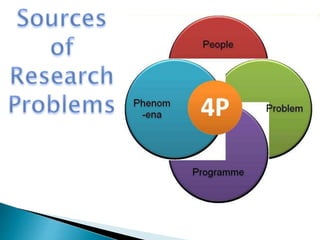
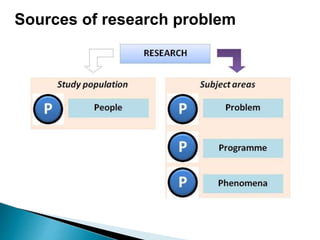
Sources of research problem
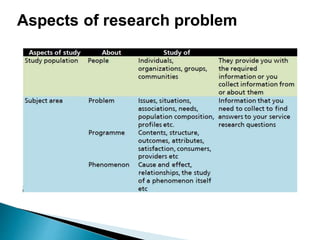
Aspects of research problem
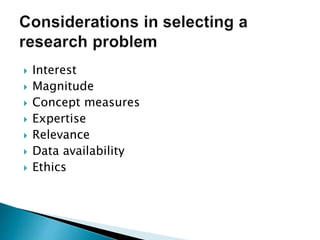
 Interest
 Magnitude
 Concept measures
 Expertise
 Relevance
 Data availability
 Ethics
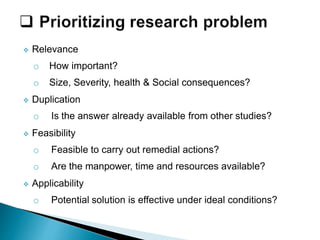
 Relevance
o How important?
o Size, Severity, health & Social consequences?
 Duplication
o Is the answer already available from other studies?
 Feasibility
o Feasible to carry out remedial actions?
o Are the manpower, time and resources available?
 Applicability
o Potential solution is effective under ideal conditions?
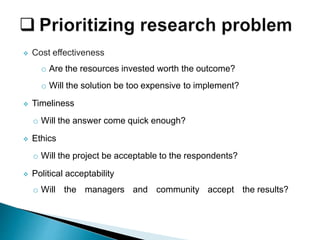
 Cost effectiveness
o Are the resources invested worth the outcome?
o Will the solution be too expensive to implement?
 Timeliness
o Will the answer come quick enough?
 Ethics
o Will the project be acceptable to the respondents?
 Political acceptability
o Will the managers and community accept the results?
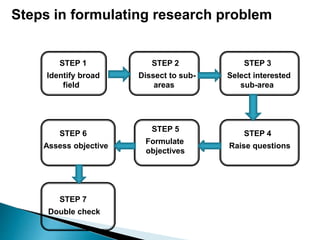
Steps in formulating research problem
STEP 1 STEP 2 STEP 3
Identify broad
field
Dissect to sub-
areas
Select interested
sub-area
STEP 5
STEP 6 STEP 4
Formulate
objectives
Assess objective Raise questions
STEP 7
Double check
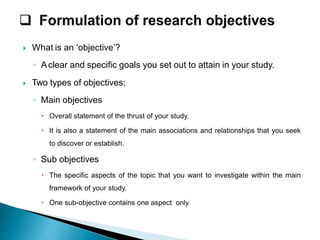
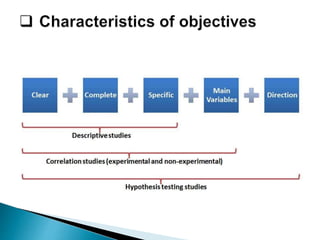
 What is an ‘objective’?
◦ Aclear and specific goals you set out to attain in your study.
 Two types of objectives;
◦ Main objectives
 Overall statement of the thrust of your study.
 It is also a statement of the main associations and relationships that you seek
to discover or establish.
◦ Sub objectives
 The specific aspects of the topic that you want to investigate within the main
framework of your study.
 One sub-objective contains one aspect only
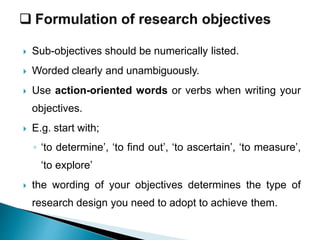
 Sub-objectives should be numerically listed.
 Worded clearly and unambiguously.
 Use action-oriented words or verbs when writing your
objectives.
 E.g. start with;
◦ ‘to determine’, ‘to find out’, ‘to ascertain’, ‘to measure’,
‘to explore’
 the wording of your objectives determines the type of
research design you need to adopt to achieve them.
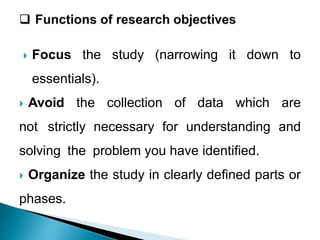
 Focus the study (narrowing it down to
essentials).
 Avoid the collection of data which are
not strictly necessary for understanding and
solving the problem you have identified.
 Organize the study in clearly defined parts or
phases.
 Working definitions or operational definitions are pre-
defined concepts that you plan to use either in your
research problem and/or in identifying the study population
in a measurable form.
 Used only for the purpose of your study and could be
quite different to legal definitions, or those used by others.
 Working definitions will inform your readers what exactly
you mean by the concepts that you have used in your study
to avoid ambiguity and confusion.
Formulation of Research Problem

Formulation of Research Problem

  • 1.
    GUJARAT TECHNOLOGICAL UNIVERSITY TATVAINSTITUTE OF TECHNOLOGICAL STUDIES “ Formulating the Research Problem ” Research Skills (2710001) Guided By: Presented By: Dr. H. R. Varia Bhavya S. Patel (170900713008) Prof. J. K. Bihola Department of Civil Engineering M.E. Transportation Engineering Semester 1 December 2017
  • 2.
    Topic Learning Outcomes •Importance of formulating a research problem • Sources of research problems • Considerations in selecting a research problem • Steps in formulating a research problem • How to formulate research objectives ? • Operational definitions
  • 5.
     Any questionthat you want answered and any assumption or assertion that you want to challenge or investigate.  However, ◦ not all questions can be transformed into research problems. ◦ the process of formulating them in a meaningful way is not at all an easy task. ◦ it requires considerable knowledge of both the subject area and research methodology.
  • 6.
     A researchproblem is a perceived gap between what is and what should be.  Research problem arise from; ◦ Evolution of theories. ◦ Peers and supervisors etc. ◦ Published research (literature review). ◦ Day-to-day experience
  • 8.
    RESEARCH PROBLEM ISTHE FOUNDATION OF THE RESEARCH STUDY
  • 9.
    Clear research problemwould result in clear and economical research plan.
  • 10.
    The way weformulate the research problem determines every step that follows; • type of study design that can be used • type of sampling strategy that can be employed • research instrument that can be used or developed • type of analysis that can be undertaken
  • 12.
  • 13.
  • 14.
     Interest  Magnitude Concept measures  Expertise  Relevance  Data availability  Ethics
  • 15.
     Relevance o Howimportant? o Size, Severity, health & Social consequences?  Duplication o Is the answer already available from other studies?  Feasibility o Feasible to carry out remedial actions? o Are the manpower, time and resources available?  Applicability o Potential solution is effective under ideal conditions?
  • 16.
     Cost effectiveness oAre the resources invested worth the outcome? o Will the solution be too expensive to implement?  Timeliness o Will the answer come quick enough?  Ethics o Will the project be acceptable to the respondents?  Political acceptability o Will the managers and community accept the results?
  • 17.
    Steps in formulatingresearch problem STEP 1 STEP 2 STEP 3 Identify broad field Dissect to sub- areas Select interested sub-area STEP 5 STEP 6 STEP 4 Formulate objectives Assess objective Raise questions STEP 7 Double check
  • 18.
     What isan ‘objective’? ◦ Aclear and specific goals you set out to attain in your study.  Two types of objectives; ◦ Main objectives  Overall statement of the thrust of your study.  It is also a statement of the main associations and relationships that you seek to discover or establish. ◦ Sub objectives  The specific aspects of the topic that you want to investigate within the main framework of your study.  One sub-objective contains one aspect only
  • 19.
     Sub-objectives shouldbe numerically listed.  Worded clearly and unambiguously.  Use action-oriented words or verbs when writing your objectives.  E.g. start with; ◦ ‘to determine’, ‘to find out’, ‘to ascertain’, ‘to measure’, ‘to explore’  the wording of your objectives determines the type of research design you need to adopt to achieve them.
  • 20.
     Focus thestudy (narrowing it down to essentials).  Avoid the collection of data which are not strictly necessary for understanding and solving the problem you have identified.  Organize the study in clearly defined parts or phases.
  • 22.
     Working definitionsor operational definitions are pre- defined concepts that you plan to use either in your research problem and/or in identifying the study population in a measurable form.  Used only for the purpose of your study and could be quite different to legal definitions, or those used by others.  Working definitions will inform your readers what exactly you mean by the concepts that you have used in your study to avoid ambiguity and confusion.