The Research Question
    RWJF | GRC | CAPS
The Research Question

The first thing to know is what is and is not a
research question.
The Research Question


A research question is
not data.
The Research Question

A research question is not statistical analysis.
The Research Question

 A research question is not knowing the
literature of your field.
The Research Question

 Data, analysis, and literature are all
important things.
But only so far as they support the argument
you want to make.
The Research Question

The argument is the answer you will
promote for the research question.
The Research Question


The research question comes before the
argument, before the data, and before
analysis.
For example:
Dinosaurs!

For decades, there was lively debate about
what killed the dinosaurs.
Dinosaurs!
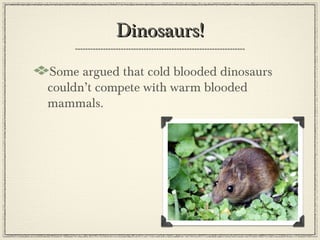
Some argued that cold blooded dinosaurs
couldn’t compete with warm blooded
mammals.
Dinosaurs!

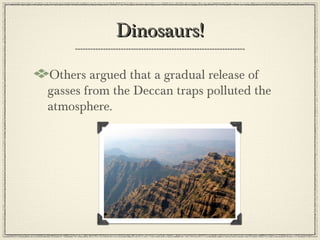
Others argued that a gradual release of
gasses from the Deccan traps polluted the
atmosphere.
Dinosaurs!


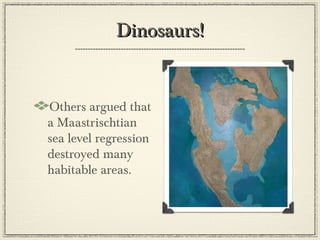
Others argued that
a Maastrischtian
sea level regression
destroyed many
habitable areas.
Dinosaurs!

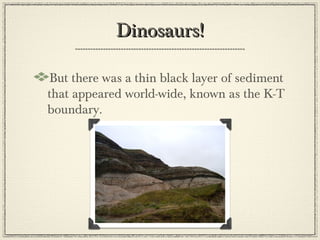
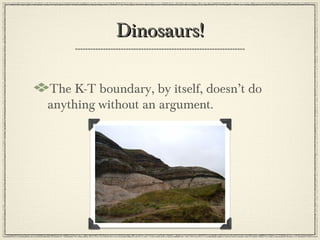
But there was a thin black layer of sediment
that appeared world-wide, known as the K-T
boundary.
Dinosaurs!

The K-T boundary, by itself, doesn’t do
anything without an argument.
Dinosaurs!

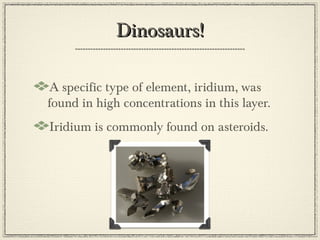
A specific type of element, iridium, was
found in high concentrations in this layer.
Iridium is commonly found on asteroids.
Dinosaurs!

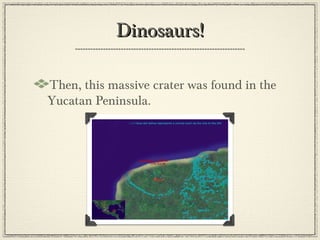
Then, this massive crater was found in the
Yucatan Peninsula.
Dinosaurs

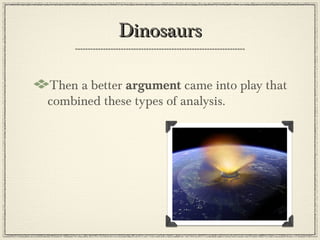
Then a better argument came into play that
combined these types of analysis.
Dinosaurs!


Break down the research question “What killed
the dinosaurs?”
           Time - is it an event or a process?
           Why just the dinosaurs?
The Research Question

By breaking down the implications and
assumptions of your research question, you can
better understand it’s most significant parts.
Dinosaurs!
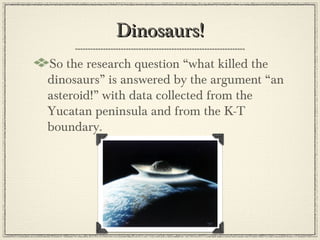
So the research question “what killed the
dinosaurs” is answered by the argument “an
asteroid!” with data collected from the
Yucatan peninsula and from the K-T
boundary.
The Research Question


A good argument should ask more questions
than it answers. For example:
Dinosaurs!

“Why didn’t dinosaurs evolve after the
asteroid?”
“Why did mammals survive?”
“Why did crocodiles and turtles survive?”
“Birds descended from dinosaurs, why were
they different?”
The Research Question


In other words, the research question should
pass the “so what?” test without the need for
elaboration.
The Research Question


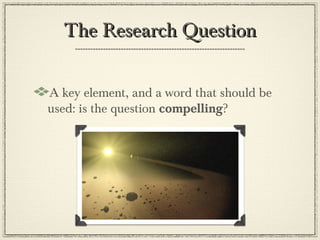
A key element, and a word that should be
used: is the question compelling?
The Research Question


 What about your
question is compelling?
What makes it
interesting?
The Research Question


Parts of a #winning research question:
      Does it address outstanding theoretical
     issues in your field?
      Does it have significance?
      Can it be solved?
The Research Question


To get at these broader issues, you need to do
these things:
The Research Question
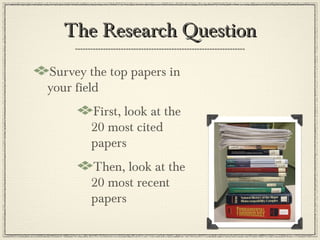
Survey the top papers in
your field
       First, look at the
       20 most cited
       papers
       Then, look at the
       20 most recent
       papers
The Research Question

After reading the literature in your field, ask
yourself:
       Is there an aspect to your subject of
      interest that hasn’t been explored yet?
      Is there something in your data that could
      address multiple questions?
The Research Question


Significance
      Why does your research matter?
      Who does it matter to? (audience)
The Research Question


Can it be solved?
      Can you address the research question?
      What kind of data do you need to gather?
      What kind of analysis do you need?
The Research Question
IMPORTANT
  Can you frame your research question in
  a way that you can test before you have
  data?
The Research Question
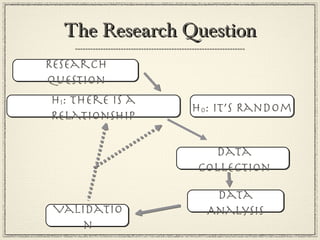
Research
Question
H1: There is a
                 H0: It’s Random
Relationship

                   Data
                 Collection

                    Data
 Validatio         Analysis
     n
Important Points


Is your question too broad? Too narrow?
       A question that is too broad will not be
       answerable.
       A question that is too narrow will not
       be compelling or generalizable.
Important Points

Can the topic be researched?
       Can your research question be
       answered by you? Otherwise it will be
       very hard to form an argument.
Important Points
Is the question timely?
         Is your question implied in current
        literature? Does it engage
        contemporary researchers in your
        field?
Important Points

Is the research question reasonable?
       Does your research question have a
       clear answer? Can you be the one to
       answer it?
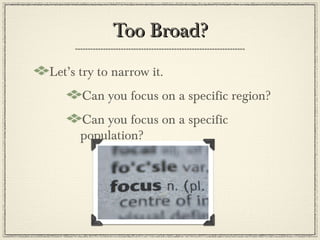
Too Broad?
Let’s try to narrow it.
      Can you focus on a specific region?
      Can you focus on a specific
      population?
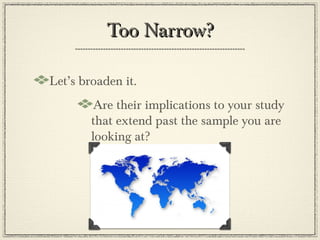
Too Narrow?

Let’s broaden it.
         Are their implications to your study
        that extend past the sample you are
        looking at?
The Research Question

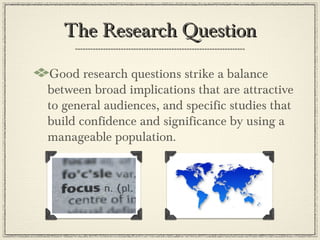
Good research questions strike a balance
between broad implications that are attractive
to general audiences, and specific studies that
build confidence and significance by using a
manageable population.
The Research Question

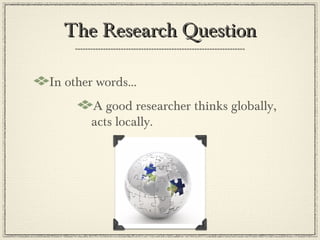
In other words...
        A good researcher thinks globally,
        acts locally.

The Research Question