IM2044 – Week 4: Lecture
Dr. Andres Baravalle

1
Interaction design
• The next slides are based on the
companion slides for the textbook
• By the end of this week, you should have
studied all chapters of the textbook up to
chapter 8

2
Overview
• Data gathering
– Interviews
– Questionnaires
– Ethnographic observations and observations
in a controlled environment

• Qualitative and quantitative analysis

3
Key issues in data gathering
• Setting goals
– Decide how to analyze data once collected

• Identifying participants
– Decide who to gather data from

• Relationship with participants
– Clear and professional
– Informed consent when appropriate

• Triangulation
– Look at data from more than one perspective

• Pilot studies
– Small trial of main study
4
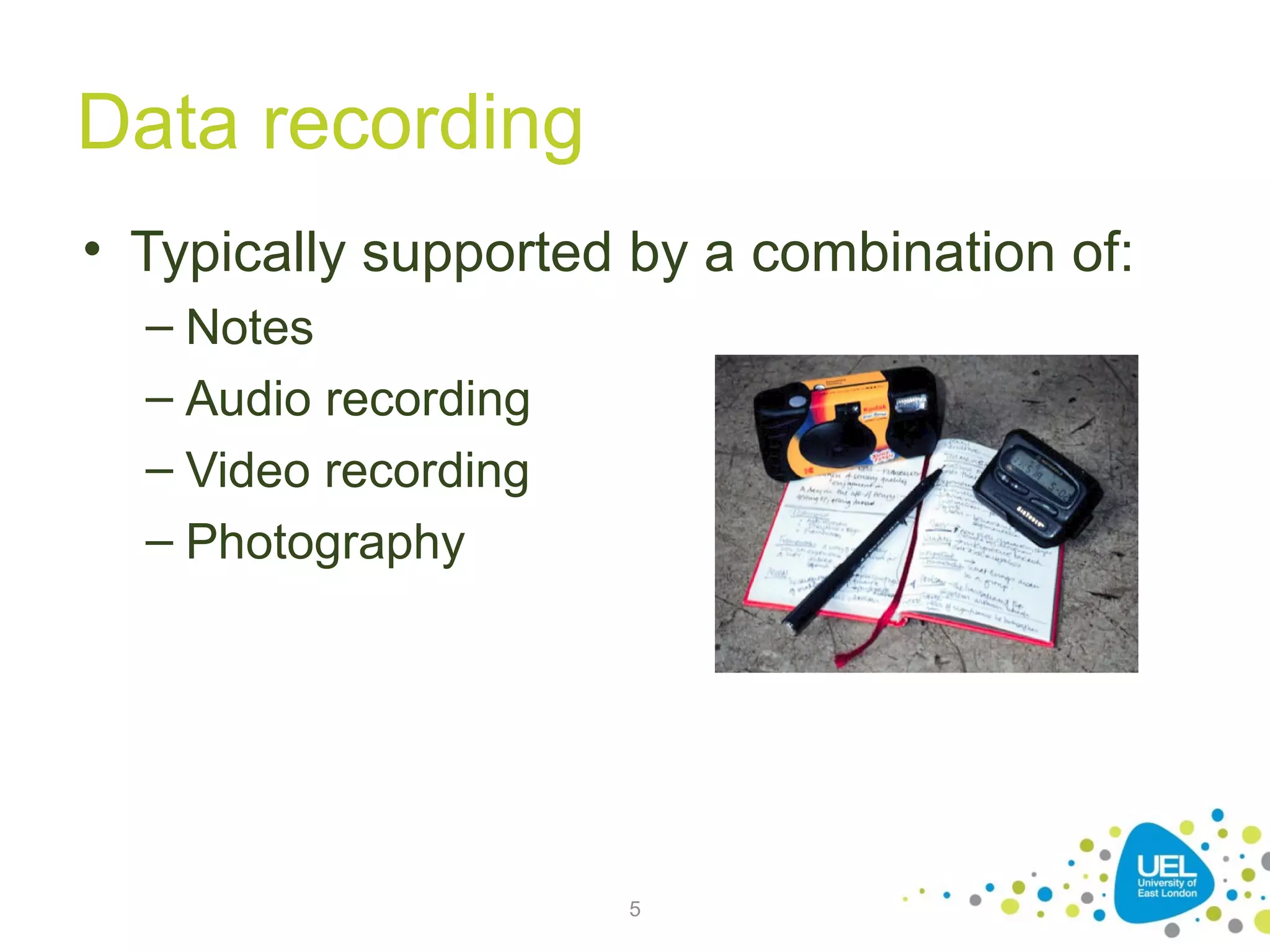
Data recording
• Typically supported by a combination of:
– Notes
– Audio recording
– Video recording
– Photography

5
Interviews
• Unstructured - not directed by a script.
Rich but not replicable.
• Structured - tightly scripted, often like a
questionnaire. Replicable but may lack
richness.
• Semi-structured - guided by a script but
interesting issues can be explored in more
depth. Can provide a good balance
between richness and replicability.
6
Closed vs. open questions
• ‘Closed questions’ have a predetermined
answer format, e.g., ‘yes’ or ‘no’
– Easier to analyse

• ‘Open questions’ do not have a
predetermined format
– Can allow to better explore research topics

7
Questions to avoid
• Long questions
• Compound sentences - split them into two
• Jargon and language that the interviewee
may not understand
• Leading questions that make assumptions
– e.g., why do you like …? Or
– Asking a question that the respondent is not
qualified to answer

• Unconscious biases, e.g. gender
stereotypes
8
Running the interview
• Introduction – introduce yourself, explain the goals of the
interview, reassure about the ethical issues, ask to
record, present any informed consent form.
• Warm-up – make first questions easy and nonthreatening.
• Main body – present questions in a logical order
• A cool-off period – include a few easy questions to
defuse tension at the end
• Closure – thank interviewee and signal the end,
e.g. switch recorder off.

9
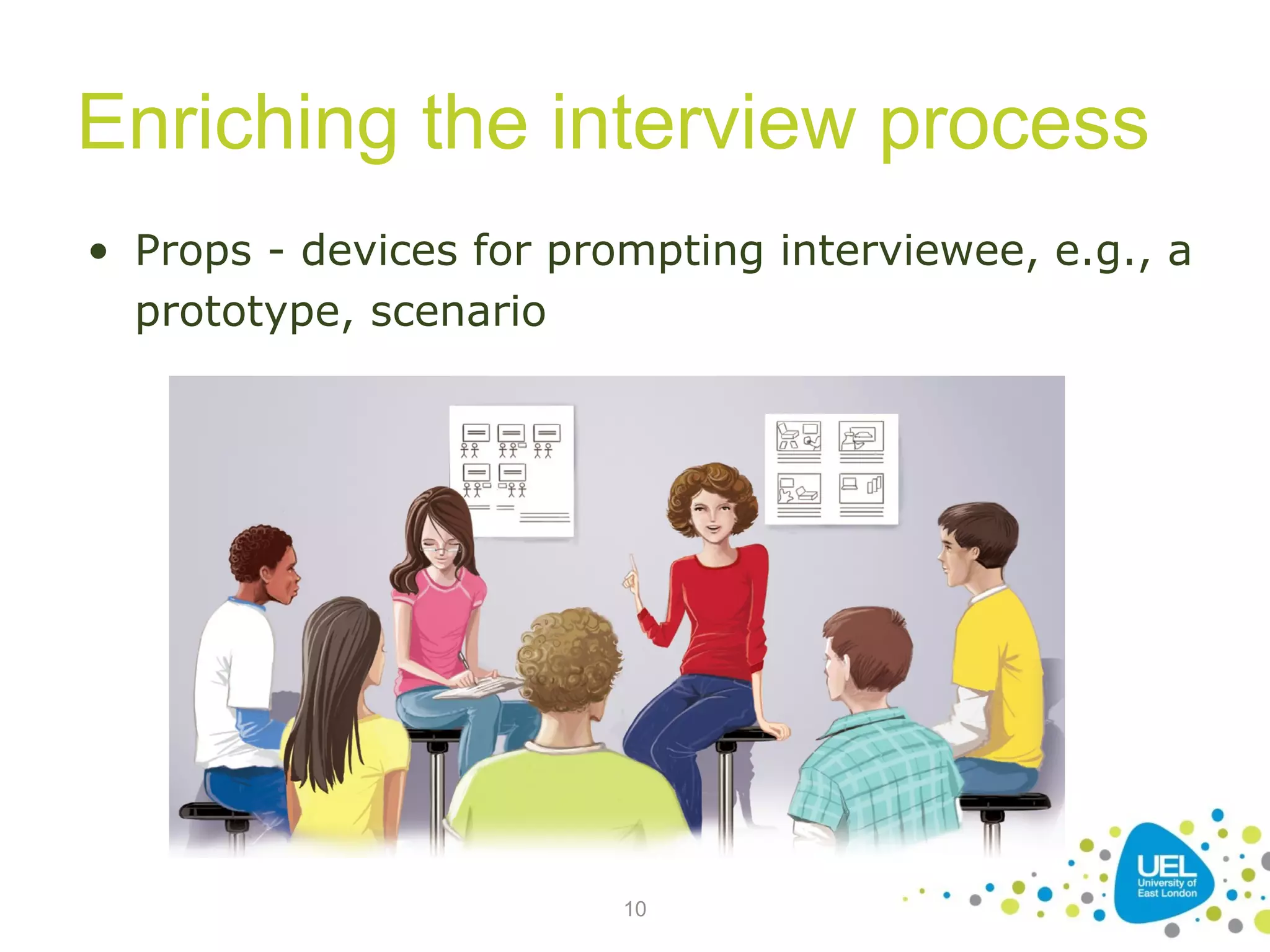
Enriching the interview process
• Props - devices for prompting interviewee, e.g., a
prototype, scenario

10
Questionnaires
• Questions can be closed or open
– Closed questions are easier to analyze, and
may be done by computer

• Can be administered to large populations
– Paper, email and the web used for
dissemination

• Sampling can be a problem when the size
of a population is unknown as is common
online
11
Questionnaire design
• Provide clear instructions on how to complete
the questionnaire.
• Decide on whether phrases will all be positive,
all negative or mixed.
• Different versions of the questionnaire might be
needed for different populations.
• The impact of a question can be influenced by
question order.
• Strike a balance between using white space and
keeping the questionnaire compact.
12
Question and response format
• ‘Yes’ and ‘No’ checkboxes
• Checkboxes that offer many options
• Rating scales
– Likert scales
– Semantic scales
– 3, 5, 7 or more points

• Open-ended responses

13
Encouraging a good response
• Make sure purpose of study is clear
• Ensure questionnaire is well designed
– Consider offering a short version for those who do not
have time to complete a long questionnaire

•
•
•
•

Promise anonymity
Follow-up with emails, phone calls, letters
Provide an incentive
40% response rate is high, 20% is often
acceptable
14
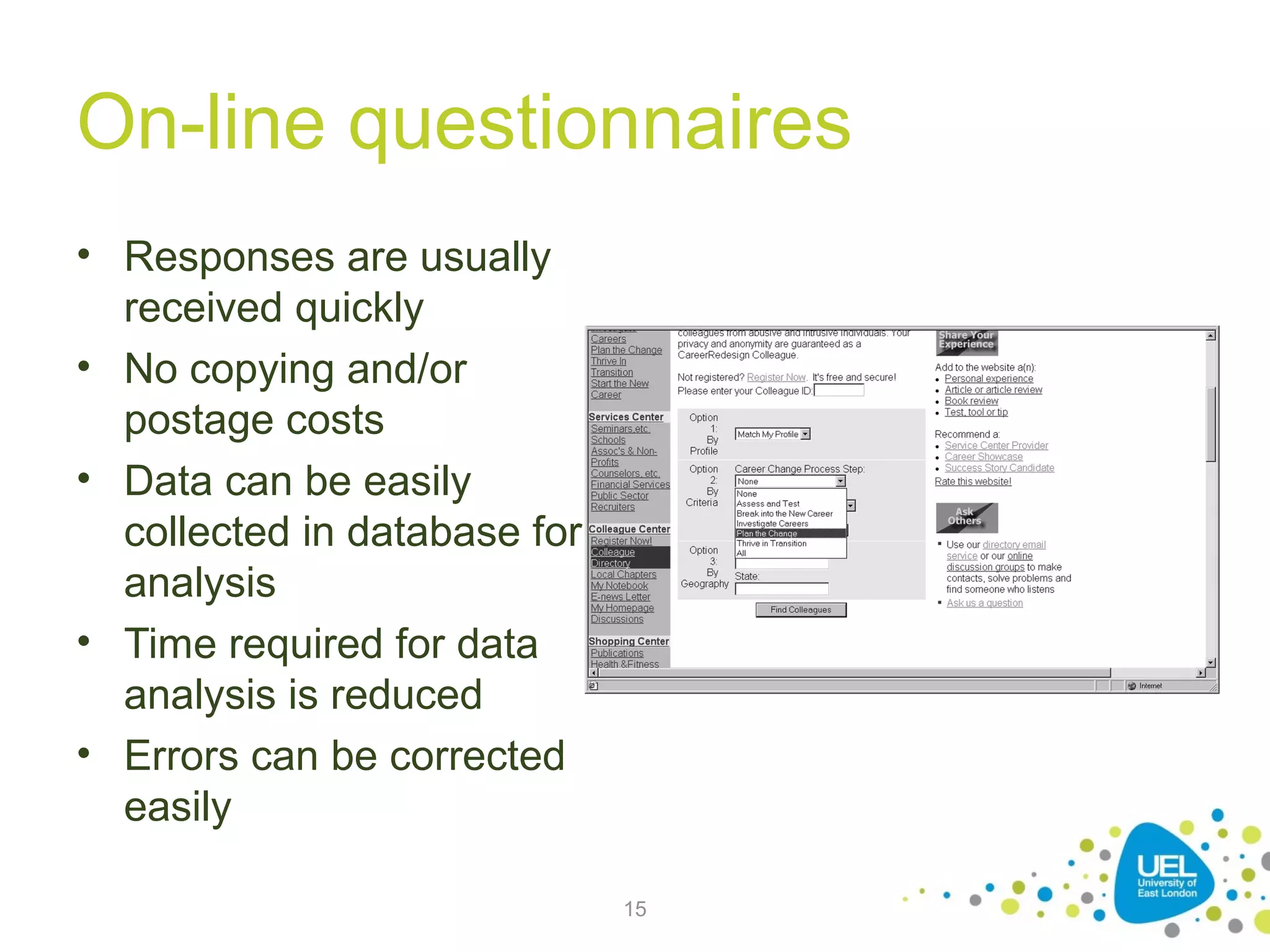
On-line questionnaires
• Responses are usually
received quickly
• No copying and/or
postage costs
• Data can be easily
collected in database for
analysis
• Time required for data
analysis is reduced
• Errors can be corrected
easily
15
Problems with online
questionnaires
• Sampling is problematic if population size
is unknown
• Preventing individuals from responding
more than once

16
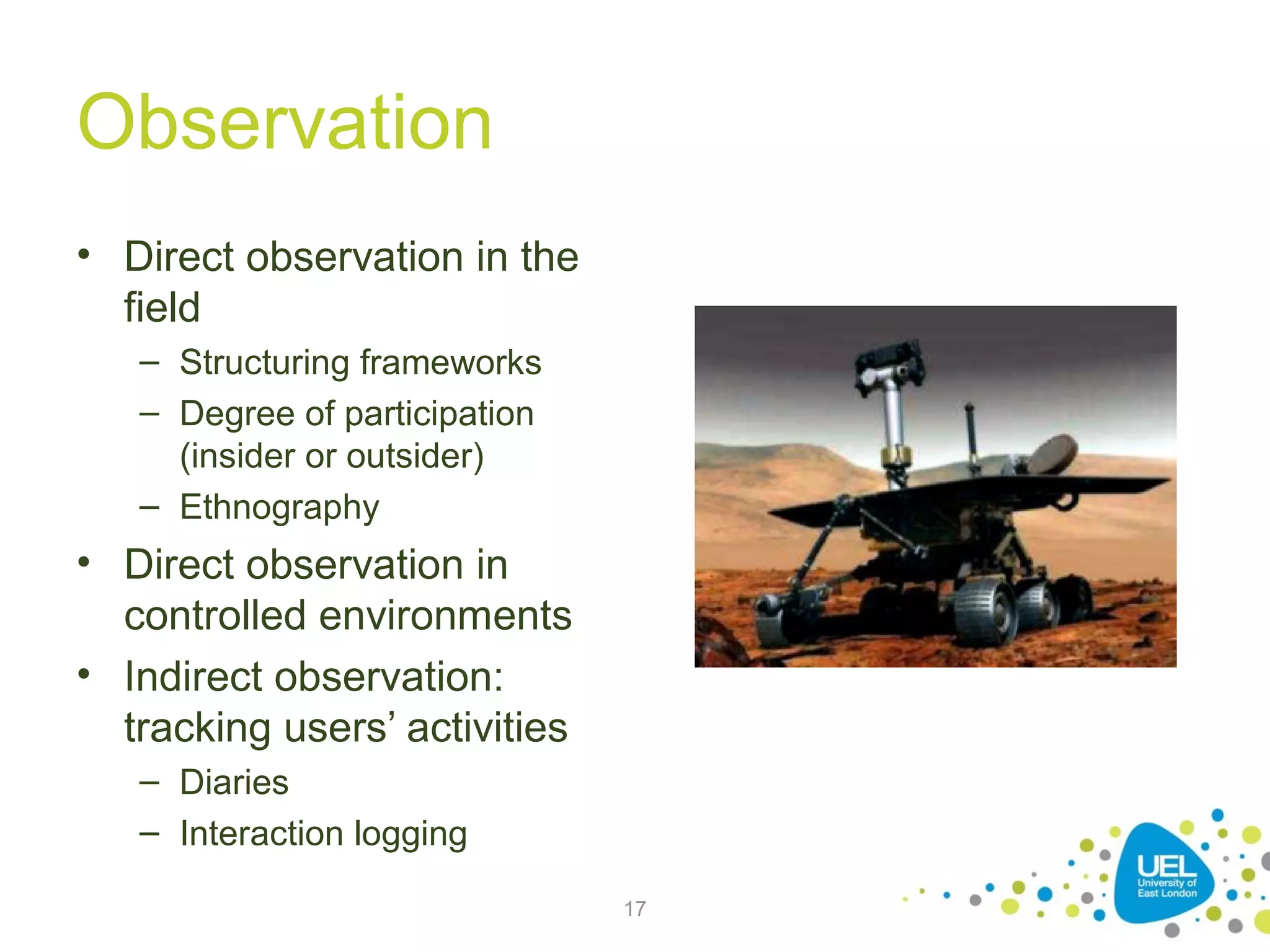
Observation
• Direct observation in the
field
– Structuring frameworks
– Degree of participation
(insider or outsider)
– Ethnography

• Direct observation in
controlled environments
• Indirect observation:
tracking users’ activities
– Diaries
– Interaction logging
17
Structuring frameworks to guide
observation
• The Goetz and LeCompte (1984)
framework:
- Who is present?
- What is their role?
- What is happening?
- When does the activity occur?
- Where is it happening?
- Why is it happening?
- How is the activity organized?
18
Ethnographic observations (1)
• Ethnography is a is a qualitative research
method aimed to understand human
behaviour
– Techniques used include participant observation,
interviews and questionnaires

• Ethnographers immerse themselves in the
culture that they study
– Collections of comments, incidents, and artifacts are
made
– A researcher’s degree of participation can vary along
a scale from ‘outside’ to ‘inside’
19
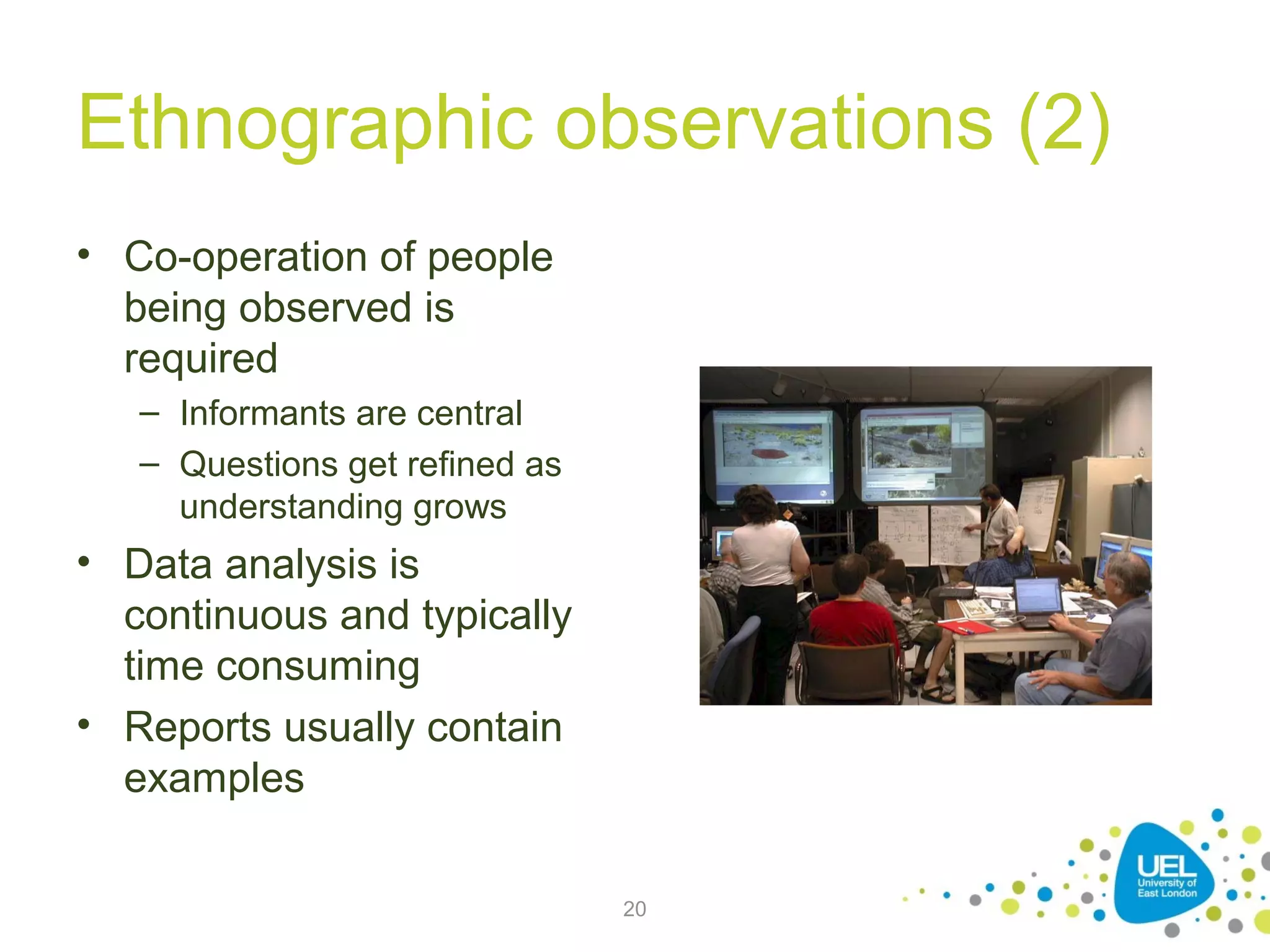
Ethnographic observations (2)
• Co-operation of people
being observed is
required
– Informants are central
– Questions get refined as
understanding grows

• Data analysis is
continuous and typically
time consuming
• Reports usually contain
examples
20
Online ethnography
• On-line interaction differs from face-toface
• Virtual worlds have a persistence that
physical worlds do not have
• Ethical considerations and presentation
issues are different

21
Observation in a controlled
environment
• Direct observation:
– Think-aloud technique

• Indirect observation:
– Diaries
– Interaction logs
– Web analytics

22
Choosing and combining data
gathering techniques
• Depends on:
– The focus of the study
– The participants involved
– The nature of the techniques selected
– The resources available

23
Quantitative and qualitative data
• Quantitative data – expressed as numbers
– Quantitative analysis – numerical methods to
ascertain size, magnitude, amount

• Qualitative data – difficult to measure sensibly
as numbers e.g. dissatisfaction
– Qualitative analysis – expresses the nature of
elements and is represented as themes, patterns,
stories

• Be very careful on how you manipulate data and
numbers!
24
Simple quantitative analysis
• Averages
– Mean: add up values and divide by number of data
points
– Median: middle value of data when ranked
– Mode: figure that appears most often in the data

• Percentages
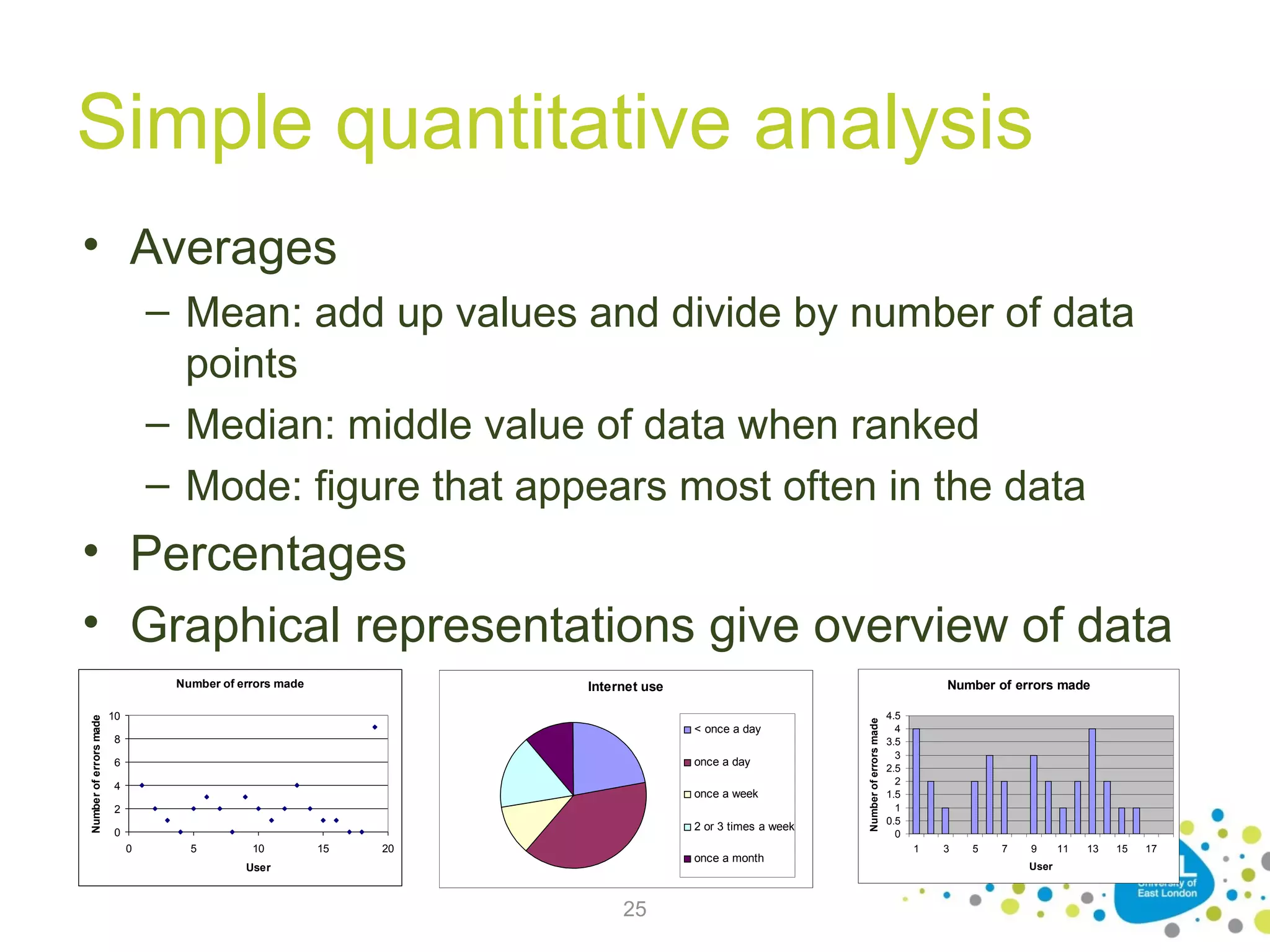
• Graphical representations give overview of data
Number of errors made

Internet use

10

< once a day

8

once a day

6
4

once a week

2

2 or 3 times a week
0
0

5

10

15

20

once a month

User

25

Number of errors made

Number of errors made

Number of errors made

4.5
4
3.5
3
2.5
2
1.5
1
0.5
0
1

3

5

7

9
User

11

13

15

17
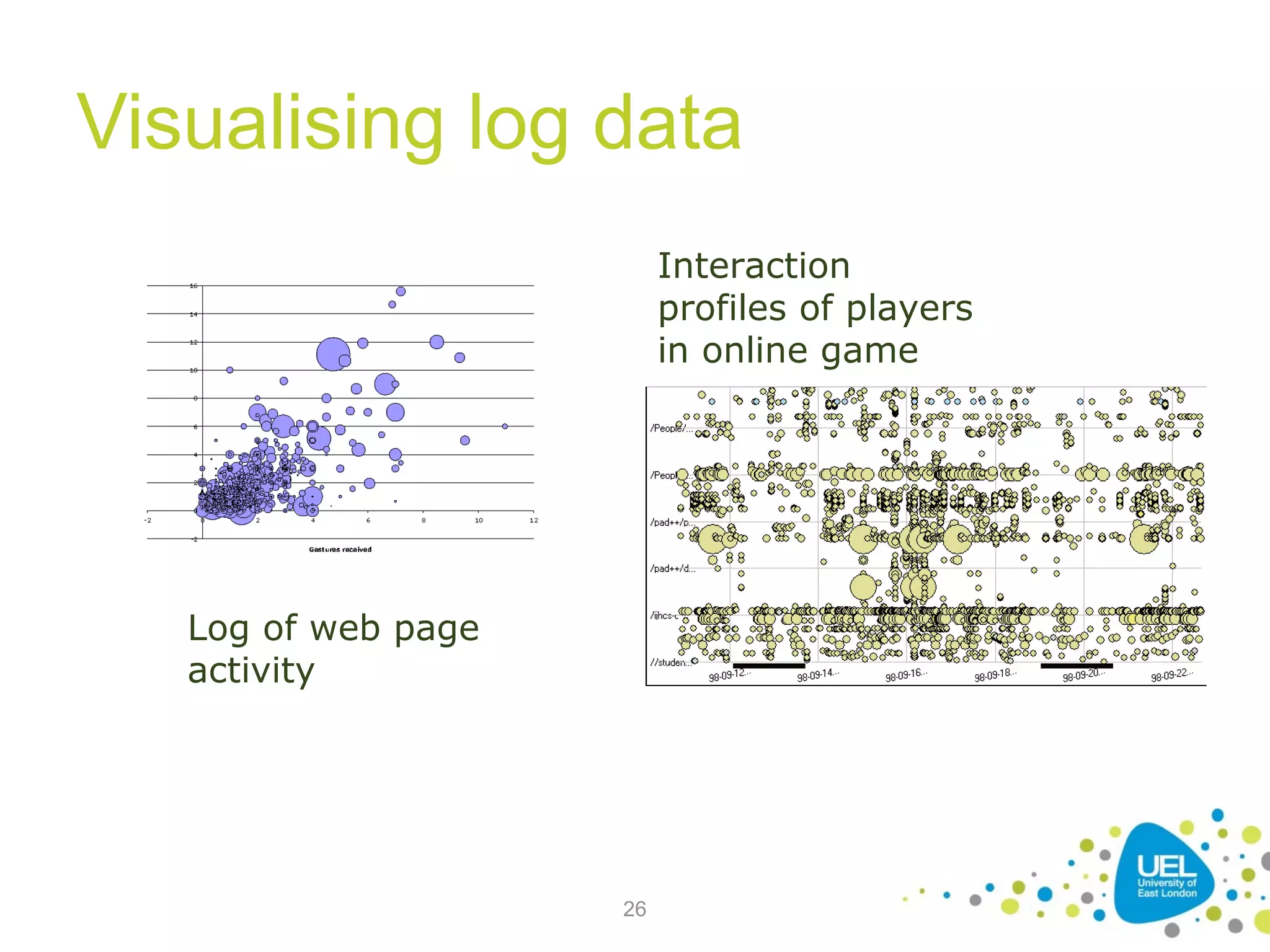
Visualising log data
Interaction
profiles of players
in online game

Log of web page
activity

26
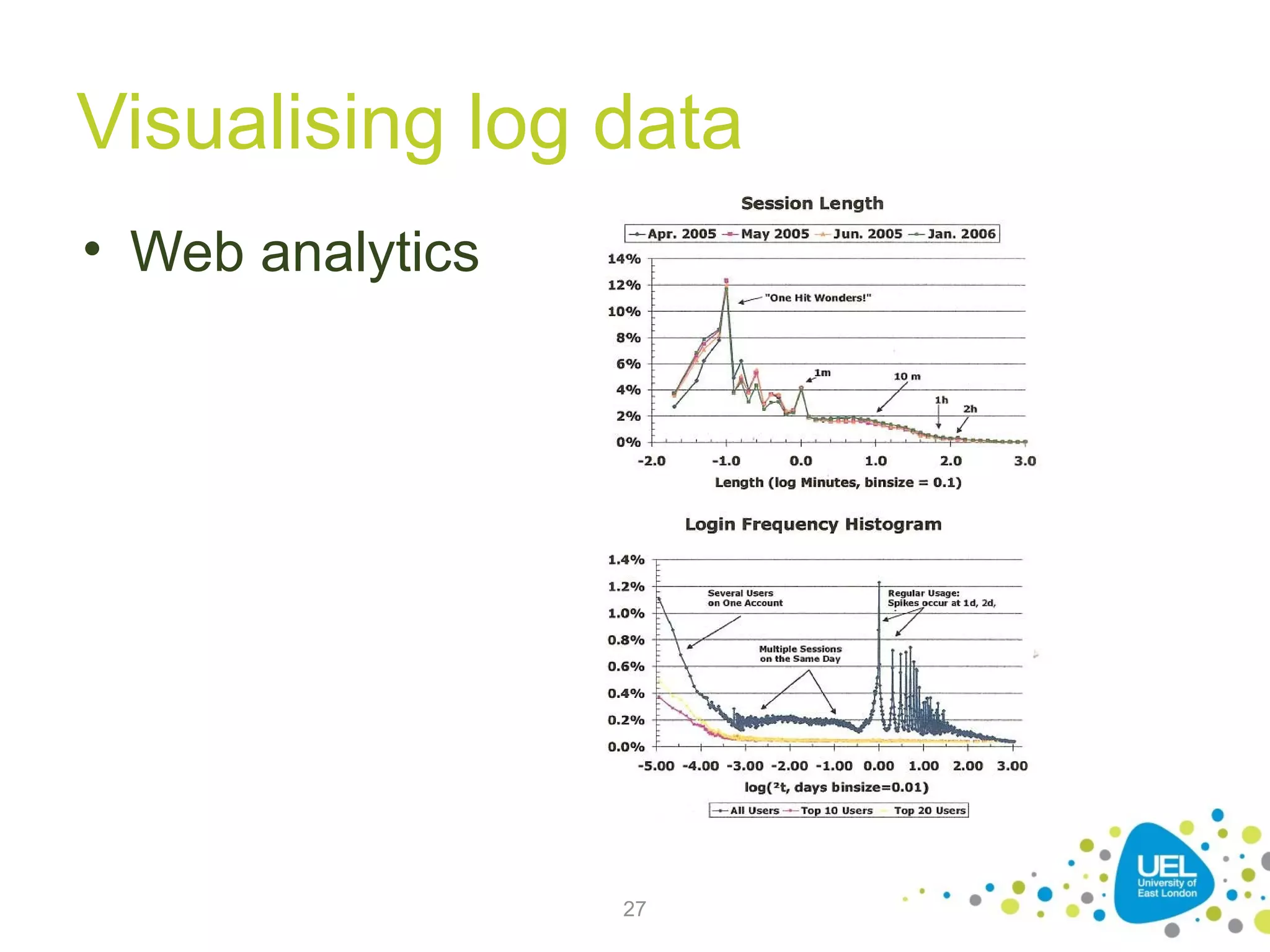
Visualising log data
• Web analytics

27
Simple qualitative analysis
• Recurring patterns or themes
– Emergent from data, dependent on
observation framework if used

• Categorizing data
– Categorization scheme may be emergent or
pre-specified

• Looking for critical incidents
– Helps to focus in on key events
28
Tools to support data analysis
• Spreadsheet – simple to use, basic
graphs
• Statistical packages - e.g. SPSS
• Specialist qualitative data analysis tools
– Categorization and theme-based analysis,
e.g. N6
– Quantitative analysis of text-based data

29
Theoretical frameworks for
qualitative analysis
• Basing data analysis around theoretical
frameworks provides further insight
• Three such frameworks are:
– Grounded Theory
– Distributed Cognition
– Activity Theory

30
Grounded Theory
• Aims to derive theory from systematic analysis
of data
• Based on categorization approach (called here
‘coding’)
• Three levels of ‘coding’
– Open: identify categories
– Axial: flesh out and link to subcategories
– Selective: form theoretical scheme

• Researchers are encouraged to draw on own
theoretical backgrounds to inform analysis
31
Distributed Cognition
• The people, environment & artefacts are
regarded as one cognitive system
• Used for analyzing collaborative work
• Focuses on information propagation &
transformation

32
Activity Theory
• Explains human behavior in terms of our
practical activity with the world
• Provides a framework that focuses
analysis around the concept of an ‘activity’
and helps to identify tensions between the
different elements of the system
• Two key models: one outlines what
constitutes an ‘activity’; one models the
mediating role of artifacts
33
Presenting the findings
• Only make claims that your data can support
• The best way to present your findings depends
on the audience, the purpose, and the data
gathering and analysis undertaken
• Graphical representations may be appropriate
for presentation
• Other techniques are:
– Rigorous notations, e.g. UML
– Using stories, e.g. to create scenarios

34

Data collection and analysis

  • 1.
    IM2044 – Week4: Lecture Dr. Andres Baravalle 1
  • 2.
    Interaction design • Thenext slides are based on the companion slides for the textbook • By the end of this week, you should have studied all chapters of the textbook up to chapter 8 2
  • 3.
    Overview • Data gathering –Interviews – Questionnaires – Ethnographic observations and observations in a controlled environment • Qualitative and quantitative analysis 3
  • 4.
    Key issues indata gathering • Setting goals – Decide how to analyze data once collected • Identifying participants – Decide who to gather data from • Relationship with participants – Clear and professional – Informed consent when appropriate • Triangulation – Look at data from more than one perspective • Pilot studies – Small trial of main study 4
  • 5.
    Data recording • Typicallysupported by a combination of: – Notes – Audio recording – Video recording – Photography 5
  • 6.
    Interviews • Unstructured -not directed by a script. Rich but not replicable. • Structured - tightly scripted, often like a questionnaire. Replicable but may lack richness. • Semi-structured - guided by a script but interesting issues can be explored in more depth. Can provide a good balance between richness and replicability. 6
  • 7.
    Closed vs. openquestions • ‘Closed questions’ have a predetermined answer format, e.g., ‘yes’ or ‘no’ – Easier to analyse • ‘Open questions’ do not have a predetermined format – Can allow to better explore research topics 7
  • 8.
    Questions to avoid •Long questions • Compound sentences - split them into two • Jargon and language that the interviewee may not understand • Leading questions that make assumptions – e.g., why do you like …? Or – Asking a question that the respondent is not qualified to answer • Unconscious biases, e.g. gender stereotypes 8
  • 9.
    Running the interview •Introduction – introduce yourself, explain the goals of the interview, reassure about the ethical issues, ask to record, present any informed consent form. • Warm-up – make first questions easy and nonthreatening. • Main body – present questions in a logical order • A cool-off period – include a few easy questions to defuse tension at the end • Closure – thank interviewee and signal the end, e.g. switch recorder off. 9
  • 10.
    Enriching the interviewprocess • Props - devices for prompting interviewee, e.g., a prototype, scenario 10
  • 11.
    Questionnaires • Questions canbe closed or open – Closed questions are easier to analyze, and may be done by computer • Can be administered to large populations – Paper, email and the web used for dissemination • Sampling can be a problem when the size of a population is unknown as is common online 11
  • 12.
    Questionnaire design • Provideclear instructions on how to complete the questionnaire. • Decide on whether phrases will all be positive, all negative or mixed. • Different versions of the questionnaire might be needed for different populations. • The impact of a question can be influenced by question order. • Strike a balance between using white space and keeping the questionnaire compact. 12
  • 13.
    Question and responseformat • ‘Yes’ and ‘No’ checkboxes • Checkboxes that offer many options • Rating scales – Likert scales – Semantic scales – 3, 5, 7 or more points • Open-ended responses 13
  • 14.
    Encouraging a goodresponse • Make sure purpose of study is clear • Ensure questionnaire is well designed – Consider offering a short version for those who do not have time to complete a long questionnaire • • • • Promise anonymity Follow-up with emails, phone calls, letters Provide an incentive 40% response rate is high, 20% is often acceptable 14
  • 15.
    On-line questionnaires • Responsesare usually received quickly • No copying and/or postage costs • Data can be easily collected in database for analysis • Time required for data analysis is reduced • Errors can be corrected easily 15
  • 16.
    Problems with online questionnaires •Sampling is problematic if population size is unknown • Preventing individuals from responding more than once 16
  • 17.
    Observation • Direct observationin the field – Structuring frameworks – Degree of participation (insider or outsider) – Ethnography • Direct observation in controlled environments • Indirect observation: tracking users’ activities – Diaries – Interaction logging 17
  • 18.
    Structuring frameworks toguide observation • The Goetz and LeCompte (1984) framework: - Who is present? - What is their role? - What is happening? - When does the activity occur? - Where is it happening? - Why is it happening? - How is the activity organized? 18
  • 19.
    Ethnographic observations (1) •Ethnography is a is a qualitative research method aimed to understand human behaviour – Techniques used include participant observation, interviews and questionnaires • Ethnographers immerse themselves in the culture that they study – Collections of comments, incidents, and artifacts are made – A researcher’s degree of participation can vary along a scale from ‘outside’ to ‘inside’ 19
  • 20.
    Ethnographic observations (2) •Co-operation of people being observed is required – Informants are central – Questions get refined as understanding grows • Data analysis is continuous and typically time consuming • Reports usually contain examples 20
  • 21.
    Online ethnography • On-lineinteraction differs from face-toface • Virtual worlds have a persistence that physical worlds do not have • Ethical considerations and presentation issues are different 21
  • 22.
    Observation in acontrolled environment • Direct observation: – Think-aloud technique • Indirect observation: – Diaries – Interaction logs – Web analytics 22
  • 23.
    Choosing and combiningdata gathering techniques • Depends on: – The focus of the study – The participants involved – The nature of the techniques selected – The resources available 23
  • 24.
    Quantitative and qualitativedata • Quantitative data – expressed as numbers – Quantitative analysis – numerical methods to ascertain size, magnitude, amount • Qualitative data – difficult to measure sensibly as numbers e.g. dissatisfaction – Qualitative analysis – expresses the nature of elements and is represented as themes, patterns, stories • Be very careful on how you manipulate data and numbers! 24
  • 25.
    Simple quantitative analysis •Averages – Mean: add up values and divide by number of data points – Median: middle value of data when ranked – Mode: figure that appears most often in the data • Percentages • Graphical representations give overview of data Number of errors made Internet use 10 < once a day 8 once a day 6 4 once a week 2 2 or 3 times a week 0 0 5 10 15 20 once a month User 25 Number of errors made Number of errors made Number of errors made 4.5 4 3.5 3 2.5 2 1.5 1 0.5 0 1 3 5 7 9 User 11 13 15 17
  • 26.
    Visualising log data Interaction profilesof players in online game Log of web page activity 26
  • 27.
    Visualising log data •Web analytics 27
  • 28.
    Simple qualitative analysis •Recurring patterns or themes – Emergent from data, dependent on observation framework if used • Categorizing data – Categorization scheme may be emergent or pre-specified • Looking for critical incidents – Helps to focus in on key events 28
  • 29.
    Tools to supportdata analysis • Spreadsheet – simple to use, basic graphs • Statistical packages - e.g. SPSS • Specialist qualitative data analysis tools – Categorization and theme-based analysis, e.g. N6 – Quantitative analysis of text-based data 29
  • 30.
    Theoretical frameworks for qualitativeanalysis • Basing data analysis around theoretical frameworks provides further insight • Three such frameworks are: – Grounded Theory – Distributed Cognition – Activity Theory 30
  • 31.
    Grounded Theory • Aimsto derive theory from systematic analysis of data • Based on categorization approach (called here ‘coding’) • Three levels of ‘coding’ – Open: identify categories – Axial: flesh out and link to subcategories – Selective: form theoretical scheme • Researchers are encouraged to draw on own theoretical backgrounds to inform analysis 31
  • 32.
    Distributed Cognition • Thepeople, environment & artefacts are regarded as one cognitive system • Used for analyzing collaborative work • Focuses on information propagation & transformation 32
  • 33.
    Activity Theory • Explainshuman behavior in terms of our practical activity with the world • Provides a framework that focuses analysis around the concept of an ‘activity’ and helps to identify tensions between the different elements of the system • Two key models: one outlines what constitutes an ‘activity’; one models the mediating role of artifacts 33
  • 34.
    Presenting the findings •Only make claims that your data can support • The best way to present your findings depends on the audience, the purpose, and the data gathering and analysis undertaken • Graphical representations may be appropriate for presentation • Other techniques are: – Rigorous notations, e.g. UML – Using stories, e.g. to create scenarios 34

Editor's Notes

  • #20 Analyzing video and data logs can be time-consuming