RESEARCH PROBLEM
ANAMIKA RAMAWAT
M.Sc. NURSING Prev.
Batch – 2017-18
GCON, Jodhpur
INTRODUCTION
Definition
■ According to Kerlinger, ‘A problem is an interrogative sentence or
statement that asks what relation exists between two or more
variable.The answer to question will provide what is having
sought in the research.
■ R.S. Woodworth defines problem as ‘a situation for which we have

no ready & successful response by instinct or by previous acquired
habit. We must find out what to do’, i.e. the solution can be found
out only after an investigation.
■ In other words, ‘a research problem is an area of concern where
there is a gap in the knowledge base needed for professional
practices.
Research Question
■ Research questions are those that the researcher would like to answer or
address in the study.
■ Depending on the complexity and breadth of the study, there could be
more than one research questions.
■ Identifying a research question will provide greater focus to the research.
■ It will clarify the direction of the search may it be a descriptive or
experimental in nature.
■ A well-written research question will also shed light on appropriate
research methods.
■ There are certain characteristics of
a research question.
■ Each question should be clear and
specific.
■ It should refer to the problem or
phenomenon under study.
■ It should reflect an intervention in
experimental work.
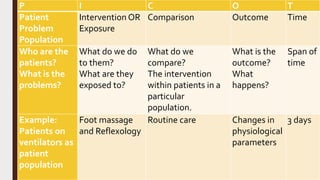
■ To formulate a focused clinical
question "PICOT" format is used in
the following table.
P I C O T
Patient
Problem
Population
Intervention OR
Exposure
Comparison Outcome Time
Who are the
patients?
What is the
problems?
What do we do
to them?
What are they
exposed to?
What do we
compare?
The intervention
within patients in a
particular
population.
What is the
outcome?
What
happens?
Span of
time
Example:
Patients on
ventilators as
patient
population
Foot massage
and Reflexology
Routine care Changes in
physiological
parameters
3 days
ELEMENTS OF A RESEARCH PROBLEM
■ There are five distinct elements
(components) of a research
problem.These are also denoted
by "5W’s"
i.e.Why,What,When,Where,
Who/from whom of a research
study.
1. Objective or aim of the problem to be explored
 This answers the question "Why" of a research problem.
 This means why there is a need of carrying out this study.
2.The topic or theme which needs to be
investigated
■ This answers the question "What".What is to be
studied?"
3.The time dimension
 The period or time of the study when the data are to
be gathered.
 This answers the question "When?"When is the
research to be performed?
4.The area or location where the
study is to be conducted
 This answers the question
"Where?"Where we need to
conduct the study?
5. Population or universe from whom the data needs to be
gathered
■ This answers the question "Who?" or "from whom?"
■ Who are the respondents? From whom the data to
■ be collected?"These may include persons, groups of persons,
wound dressings, syringes, each activity etc.
■ FOR EXAMPLE:
Consider a research problem
■ "To assess the effectiveness of a structured exercise
protocol on back pain among the nurses working in
intensive care units of MDM, Jodhpur".
■ All the elements of this research problem are depicted
in Figure 1.
FACTORS/CRITERIA TO BE CONSIDERED
WHILE SELECTING A RESEARCH PROBLEM
■ One commonly used acronym to
define the criteria for a good
research problem or question is
 FINER, where
 F stands for feasible,
 I for interesting,
 N for novel,
 E for ethical, and
 R relevant.
■ However, there are many factors that
should be considered while deciding
credibility of a particular research
question for a scientific investigation.
■ Significance to nursing profession:A problem that a
researcher is selecting should ha significance to nursing
profession or it will not serve any purpose. A research
problem is a significant for nursing profession when it is
directed to develop or refine the body of professional
knowledge.
■ A research problem could be considered significant for
nursing profession if it fulfils the following criteria:
Benefits nursing profession and patients, nurses, and health
care fraternity through the study.
Improves clinical nursing practices through the results.
Promotes nursing theory development or testing.
Provides solutions of current nursing practice needs.
Generates information to get practical implications for nursing
profession.
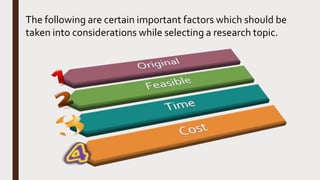
The following are certain important factors which should be
taken into considerations while selecting a research topic.
OF
NURSING RESEARCH
PROBLEM
There are numerous sources for generating
the appropriate nursing research problem.
However, the following are certain
important sources which could be helpful in
selecting a research topic.
1. Previous research
2. Personal Experience
3. Consumer feedback
4. Literature
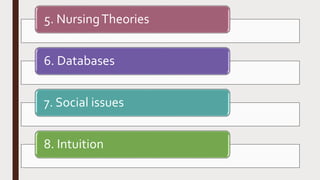
5. NursingTheories
6. Databases
7. Social issues
8. Intuition
9. Brainstorming sessions
10. Folklores
11. Consultation with the
experts
12. Social issues
PHASES OF ESTABLISHING A PROBLEM
STATEMENT
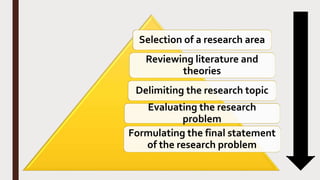
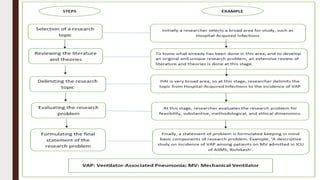
■ Formulation of research problem is a
complex and long process, which includes
following steps (Steps for formulation of
research problem along with specific
example are also illustrated in Fig):-
Selection of a research area
Reviewing literature and
theories
Delimiting the research topic
Evaluating the research
problem
Formulating the final statement
of the research problem
Example ofWell-Formulated Research Problem
‘A descriptive study on the prevalence of pin site infection among patients with external skeletal fixation
admitted in orthopedic wards of MDM Hospital, Jodhpur’
It is an example of declarative form of the statement of problem, where it is precisely and concisely stated
and includes most of the required components of a research statement.
■ Some of these components are listed below:
• Research study design: Descriptive
•Variable(s): It has only one research variables ‘prevalence of pin site infection’
• Population: Patients with external skeletal
• Research setting: Orthopedic wards of MDM Hospital, Jodhpur.
SUMMARY
Research problem presentation

Research problem presentation

  • 1.
    RESEARCH PROBLEM ANAMIKA RAMAWAT M.Sc.NURSING Prev. Batch – 2017-18 GCON, Jodhpur
  • 2.
  • 3.
    Definition ■ According toKerlinger, ‘A problem is an interrogative sentence or statement that asks what relation exists between two or more variable.The answer to question will provide what is having sought in the research. ■ R.S. Woodworth defines problem as ‘a situation for which we have no ready & successful response by instinct or by previous acquired habit. We must find out what to do’, i.e. the solution can be found out only after an investigation. ■ In other words, ‘a research problem is an area of concern where there is a gap in the knowledge base needed for professional practices.
  • 5.
    Research Question ■ Researchquestions are those that the researcher would like to answer or address in the study. ■ Depending on the complexity and breadth of the study, there could be more than one research questions. ■ Identifying a research question will provide greater focus to the research. ■ It will clarify the direction of the search may it be a descriptive or experimental in nature. ■ A well-written research question will also shed light on appropriate research methods.
  • 6.
    ■ There arecertain characteristics of a research question. ■ Each question should be clear and specific. ■ It should refer to the problem or phenomenon under study. ■ It should reflect an intervention in experimental work. ■ To formulate a focused clinical question "PICOT" format is used in the following table.
  • 7.
    P I CO T Patient Problem Population Intervention OR Exposure Comparison Outcome Time Who are the patients? What is the problems? What do we do to them? What are they exposed to? What do we compare? The intervention within patients in a particular population. What is the outcome? What happens? Span of time Example: Patients on ventilators as patient population Foot massage and Reflexology Routine care Changes in physiological parameters 3 days
  • 9.
    ELEMENTS OF ARESEARCH PROBLEM ■ There are five distinct elements (components) of a research problem.These are also denoted by "5W’s" i.e.Why,What,When,Where, Who/from whom of a research study.
  • 11.
    1. Objective oraim of the problem to be explored  This answers the question "Why" of a research problem.  This means why there is a need of carrying out this study.
  • 12.
    2.The topic ortheme which needs to be investigated ■ This answers the question "What".What is to be studied?"
  • 13.
    3.The time dimension The period or time of the study when the data are to be gathered.  This answers the question "When?"When is the research to be performed?
  • 14.
    4.The area orlocation where the study is to be conducted  This answers the question "Where?"Where we need to conduct the study?
  • 15.
    5. Population oruniverse from whom the data needs to be gathered ■ This answers the question "Who?" or "from whom?" ■ Who are the respondents? From whom the data to ■ be collected?"These may include persons, groups of persons, wound dressings, syringes, each activity etc.
  • 16.
    ■ FOR EXAMPLE: Considera research problem ■ "To assess the effectiveness of a structured exercise protocol on back pain among the nurses working in intensive care units of MDM, Jodhpur". ■ All the elements of this research problem are depicted in Figure 1.
  • 18.
    FACTORS/CRITERIA TO BECONSIDERED WHILE SELECTING A RESEARCH PROBLEM
  • 19.
    ■ One commonlyused acronym to define the criteria for a good research problem or question is  FINER, where  F stands for feasible,  I for interesting,  N for novel,  E for ethical, and  R relevant. ■ However, there are many factors that should be considered while deciding credibility of a particular research question for a scientific investigation.
  • 20.
    ■ Significance tonursing profession:A problem that a researcher is selecting should ha significance to nursing profession or it will not serve any purpose. A research problem is a significant for nursing profession when it is directed to develop or refine the body of professional knowledge. ■ A research problem could be considered significant for nursing profession if it fulfils the following criteria:
  • 21.
    Benefits nursing professionand patients, nurses, and health care fraternity through the study. Improves clinical nursing practices through the results. Promotes nursing theory development or testing. Provides solutions of current nursing practice needs. Generates information to get practical implications for nursing profession.
  • 22.
    The following arecertain important factors which should be taken into considerations while selecting a research topic.
  • 26.
  • 27.
    There are numeroussources for generating the appropriate nursing research problem. However, the following are certain important sources which could be helpful in selecting a research topic.
  • 28.
    1. Previous research 2.Personal Experience 3. Consumer feedback 4. Literature
  • 29.
    5. NursingTheories 6. Databases 7.Social issues 8. Intuition
  • 30.
    9. Brainstorming sessions 10.Folklores 11. Consultation with the experts 12. Social issues
  • 32.
    PHASES OF ESTABLISHINGA PROBLEM STATEMENT ■ Formulation of research problem is a complex and long process, which includes following steps (Steps for formulation of research problem along with specific example are also illustrated in Fig):-
  • 33.
    Selection of aresearch area Reviewing literature and theories Delimiting the research topic Evaluating the research problem Formulating the final statement of the research problem
  • 35.
    Example ofWell-Formulated ResearchProblem ‘A descriptive study on the prevalence of pin site infection among patients with external skeletal fixation admitted in orthopedic wards of MDM Hospital, Jodhpur’ It is an example of declarative form of the statement of problem, where it is precisely and concisely stated and includes most of the required components of a research statement. ■ Some of these components are listed below: • Research study design: Descriptive •Variable(s): It has only one research variables ‘prevalence of pin site infection’ • Population: Patients with external skeletal • Research setting: Orthopedic wards of MDM Hospital, Jodhpur.
  • 36.