RESEARCH PROBLEM
AN INTRODUCTION
Dr.S.BELLARMIN DIANA
ASSISTANT PROFESSOR
DEPARTMENT OF MANAGEMENT STUDIES
BON SECOURS COLLEGE FOR WOMEN, THANJAVUR.
RESEARCH PROBLEM
 In research process, the first and foremost step happens to be that of
selecting and properly defining a research problem.
 It refers to some difficulty which a researcher experiences in the context
of either theoretical or practical situation and wants to obtain a solution
for the same.
 A research problem is a specific issue, difficulty, contradiction, or gap in
knowledge that you will aim to address in your research. You might look
for practical problems aimed at contributing to change, or theoretical
problems aimed at expanding knowledge.
RESEARCH PROBLEM
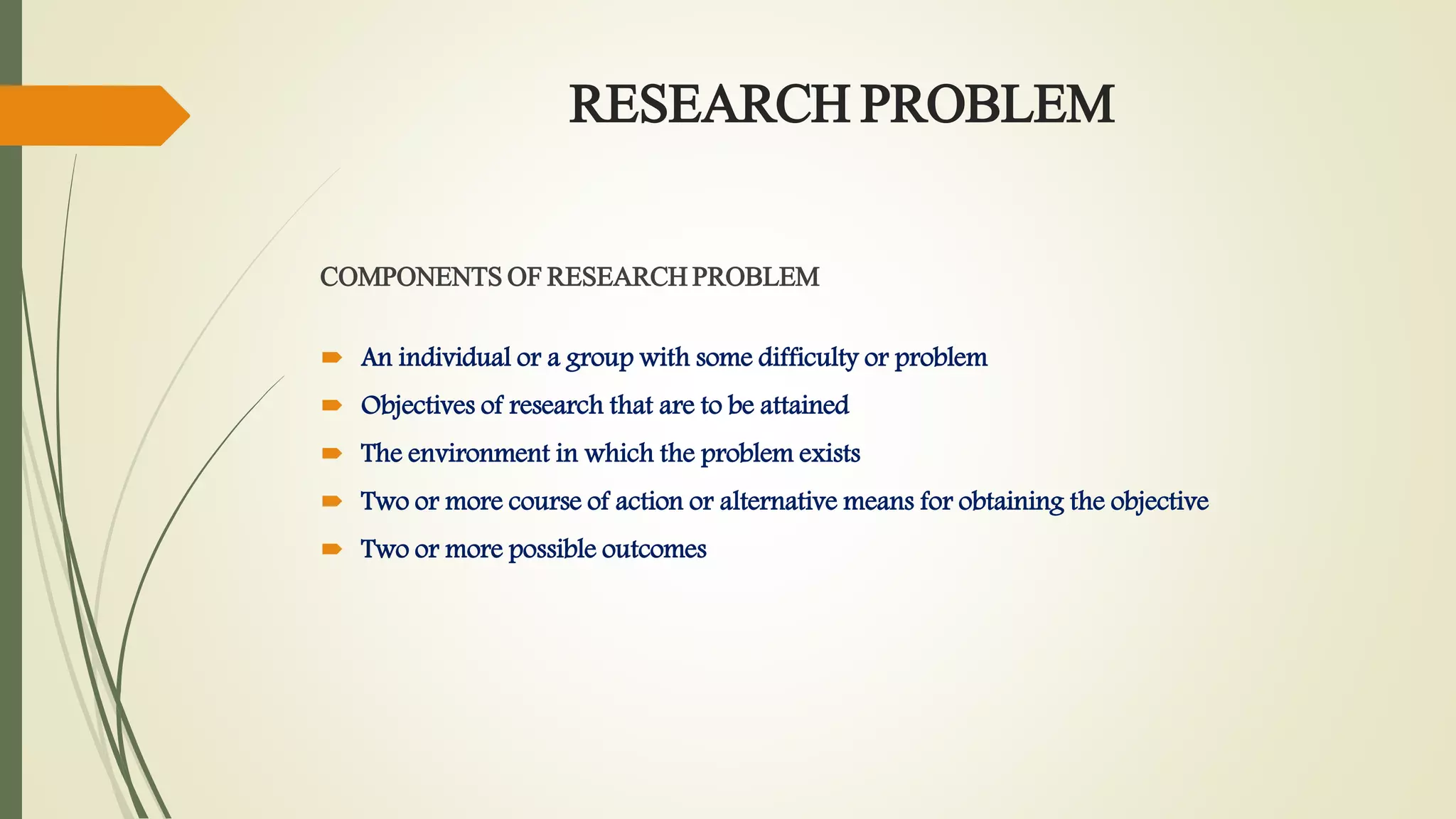
COMPONENTS OF RESEARCH PROBLEM
 An individual or a group with some difficulty or problem
 Objectives of research that are to be attained
 The environment in which the problem exists
 Two or more course of action or alternative means for obtaining the objective
 Two or more possible outcomes
IDENTIFICATION AND SOURCES
Identifying a problem to study can be challenging, not because there is a lack of issues that
could be investigated, but due to pursuing a goal of formulating a socially relevant and
researchable problem statement that is unique and does not simply duplicate the work of
others. The researchers themselves should finalize their own topic for a research problem after
having a thorough discussion with the experts and guides.
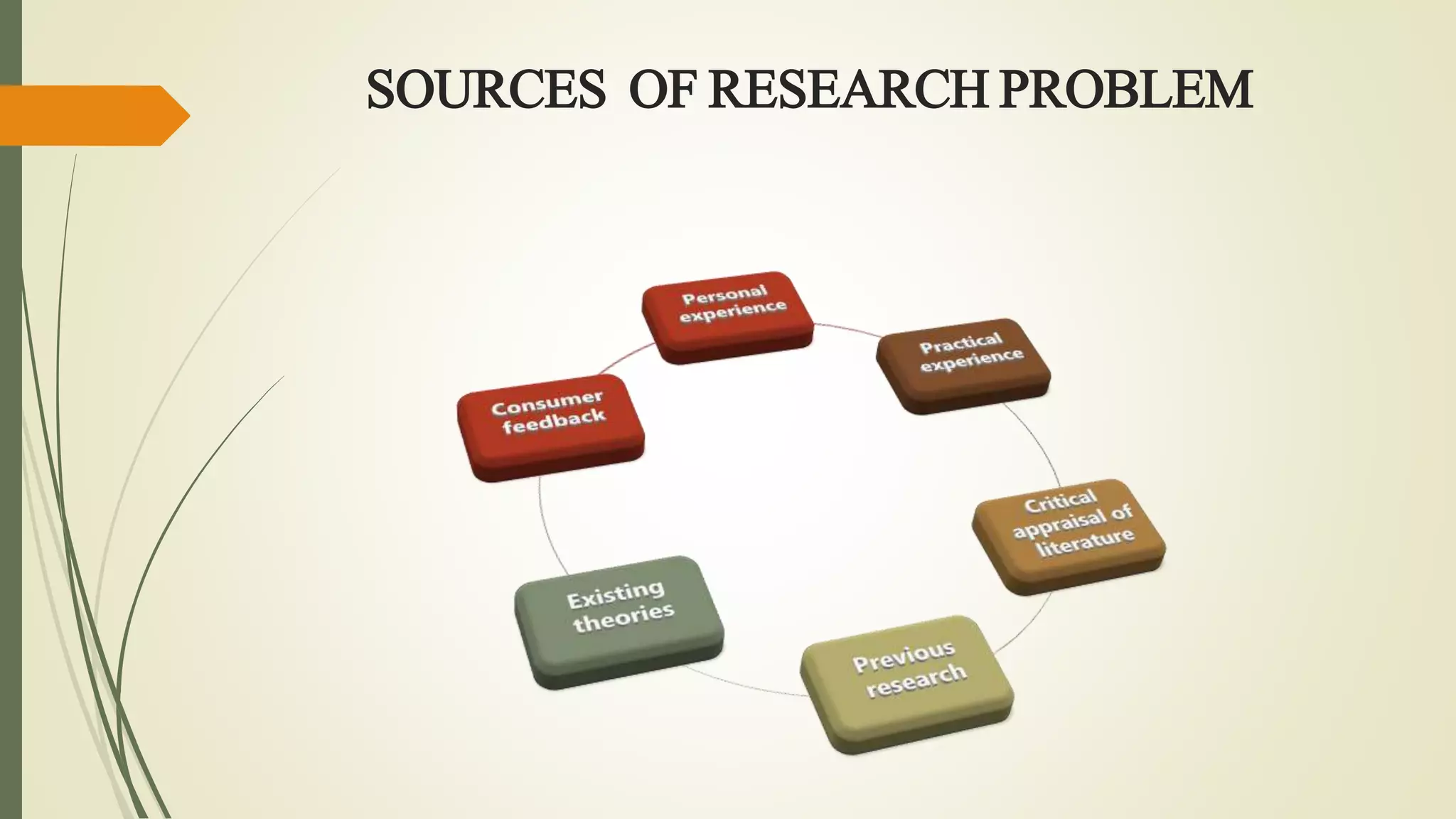
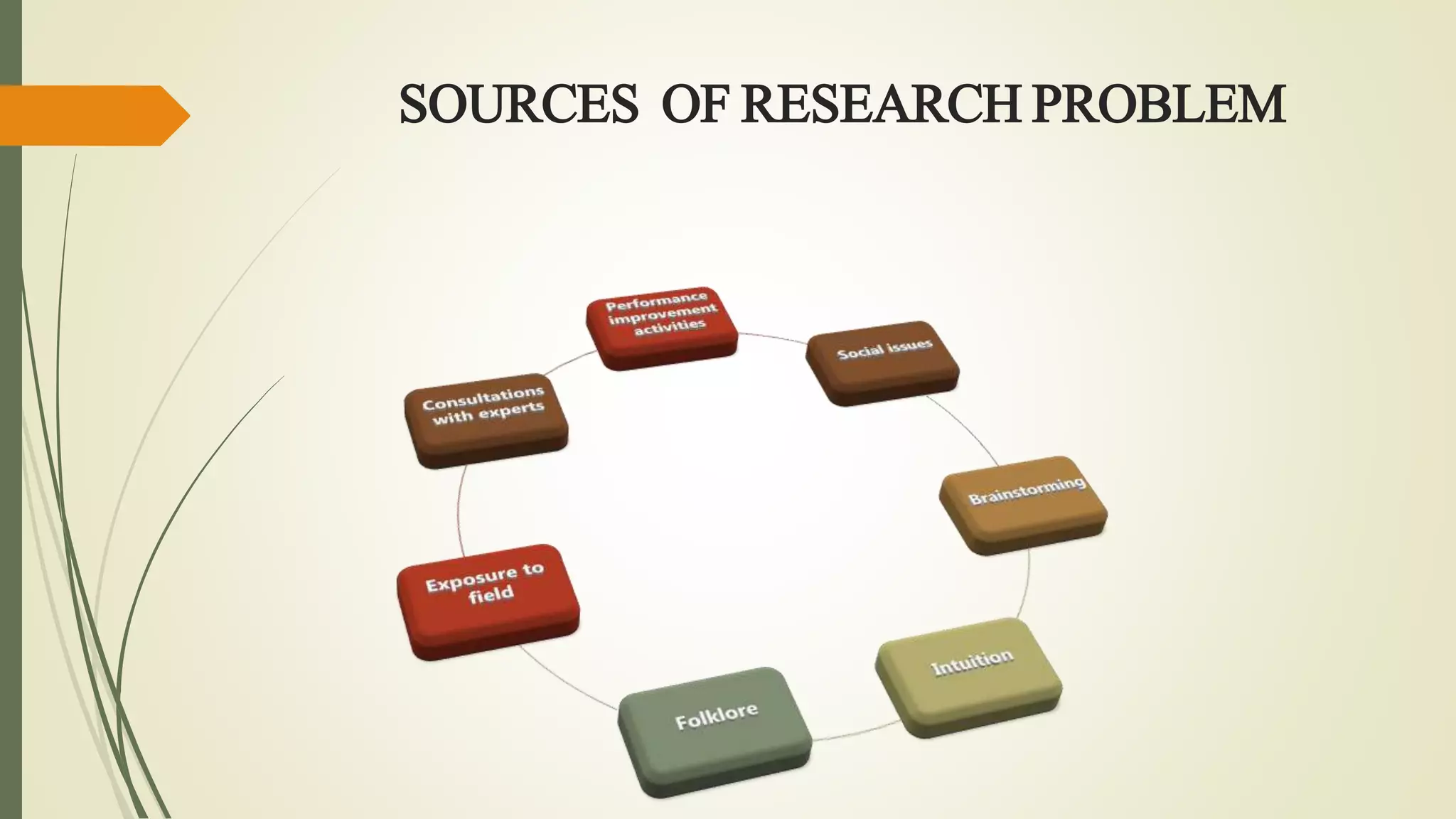
SOURCES OF RESEARCH PROBLEM
SELECTION OF RESEARCH PROBLEM
criteria for selection
 Subjects which are overdone should not be chosen. It will be difficult to throw any new light
 Controversial subjects should not become the choice of an average researcher.
 Too vague or too narrow problems should be avoided
 The subjects selected for research should be familiar and feasible
 The subject selected should be a significant one
 The importance of the subject, the qualification and the training of a researcher, the costs
involved, the time factor are few criteria that must be considered
 The researcher has to make sure of the availability of necessary resources (equipment and
adequate library facilities)
 Selection of a problem must be preceded by a preliminary study.(this is necessary when the field
of inquiry is relatively new)
FORMULATION OF RESEARCH PROBLEM
 Formulation of research problem refers to state the problem
in a researchable manner.
 It includes narrowing down the research area and formulating
the objectives.
 The researcher needs to refine the topic and clearly state what
is intended to explore about the topic
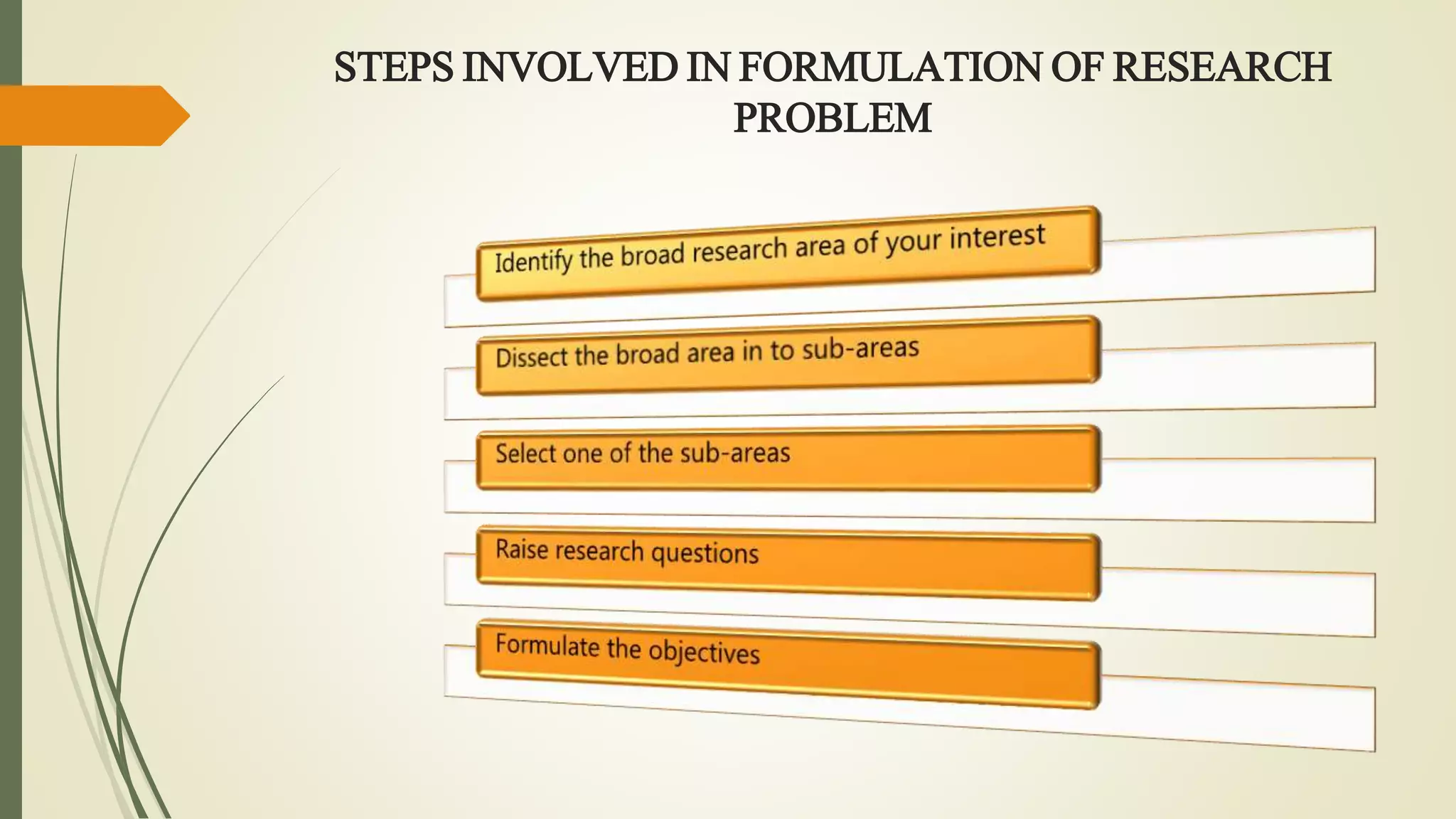
STEPS INVOLVED IN FORMULATION OF RESEARCH
PROBLEM
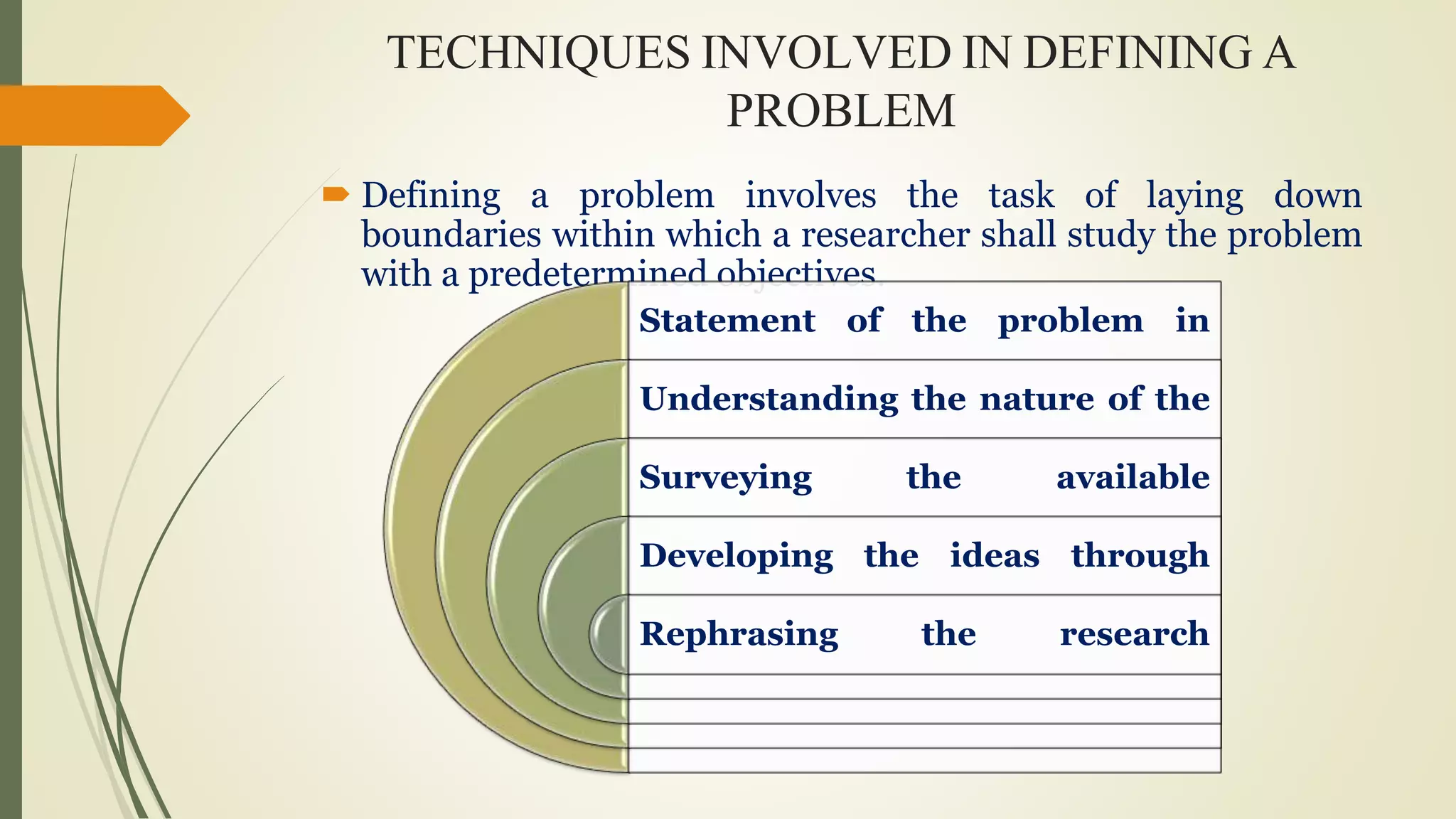
TECHNIQUES INVOLVED IN DEFINING A
PROBLEM
 Defining a problem involves the task of laying down
boundaries within which a researcher shall study the problem
with a predetermined objectives.
Statement of the problem in
Understanding the nature of the
Surveying the available
Developing the ideas through
Rephrasing the research
DEFINING RESEARCH PROBLEM
POINTS TO BE CONSIDERED
 Technical terms and words or phrases, with special meanings used in the statement of the
problem should be clearly defined.
 Basic assumptions related to the research problem should be clearly stated
 The criteria for the selection of the problem should be provided
 The suitability of the time period and the sources of data available must also be considered
by the researcher
 The scope of the investigation or the limits within which the problem is to be studied must
be mentioned explicitly in defining a research problem
CRITERIA OF GOOD RESEARCH PROBLEM
 A good research problem should add knowledge or improve the current practices.
 It should be a novel and original one
 Possibilities for empirical verification and testing
 It should be clear and unambiguous
 It should express the relationship between two or more variables.
 Approval of topic from competent authority is also an important criterion
RESEARCH DESIGN
MEANING AND DEFINITION
Research design is the conceptual structure within which research is conducted.
It constitutes the blueprint for the collection, measurement and analysis of data.
A research design is the arrangement of conditions for collection and
analysis of data in a manner that aims to combine relevance to the research
purpose with economy in procedure.
Claire Seltltiz and others
A research design is the logical and systematic planning and directing a piece of
research
Pauline .V .Young
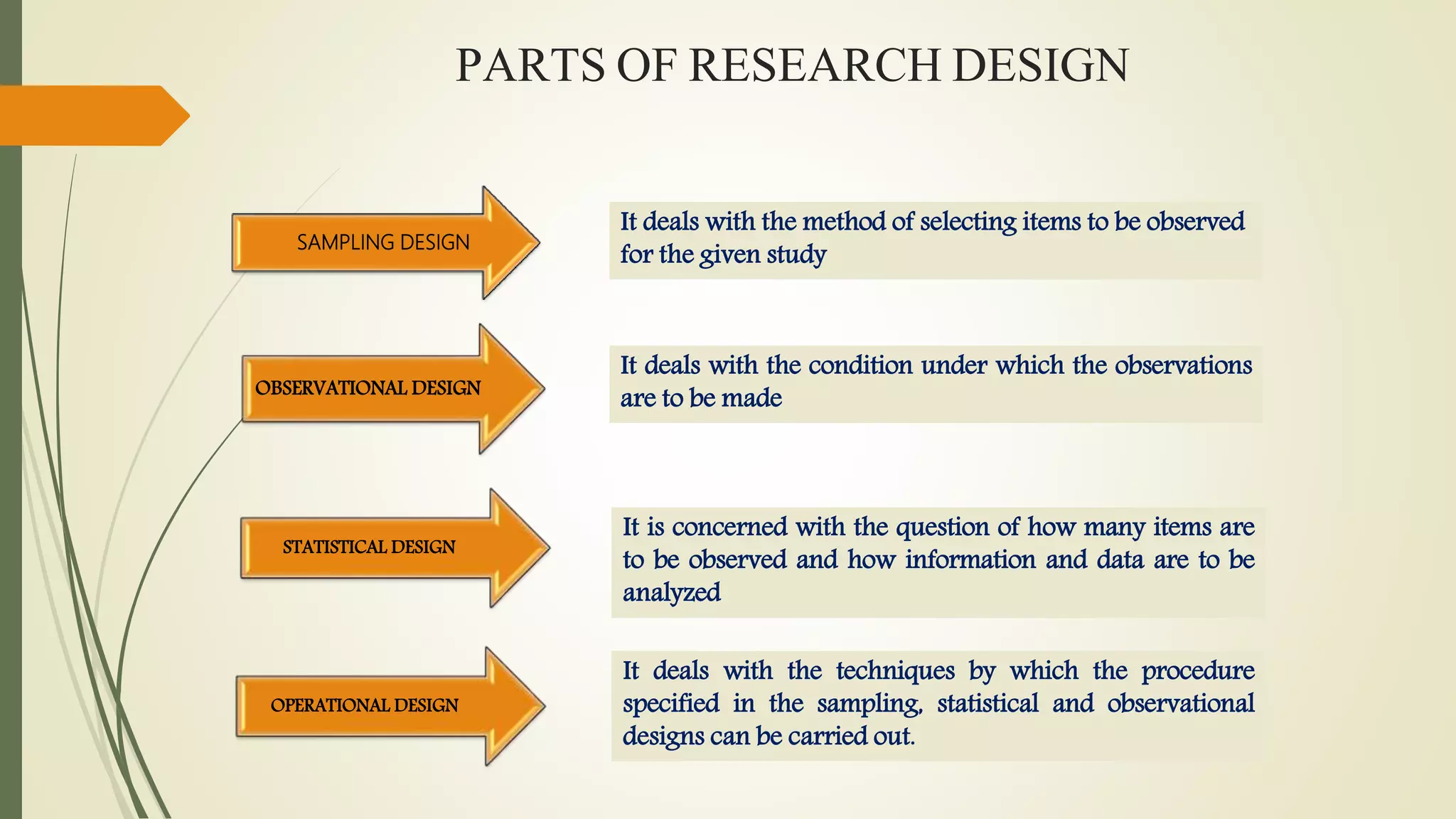
PARTS OF RESEARCH DESIGN
SAMPLING DESIGN
OBSERVATIONAL DESIGN
STATISTICAL DESIGN
OPERATIONAL DESIGN
It deals with the method of selecting items to be observed
for the given study
It deals with the condition under which the observations
are to be made
It is concerned with the question of how many items are
to be observed and how information and data are to be
analyzed
It deals with the techniques by which the procedure
specified in the sampling, statistical and observational
designs can be carried out.
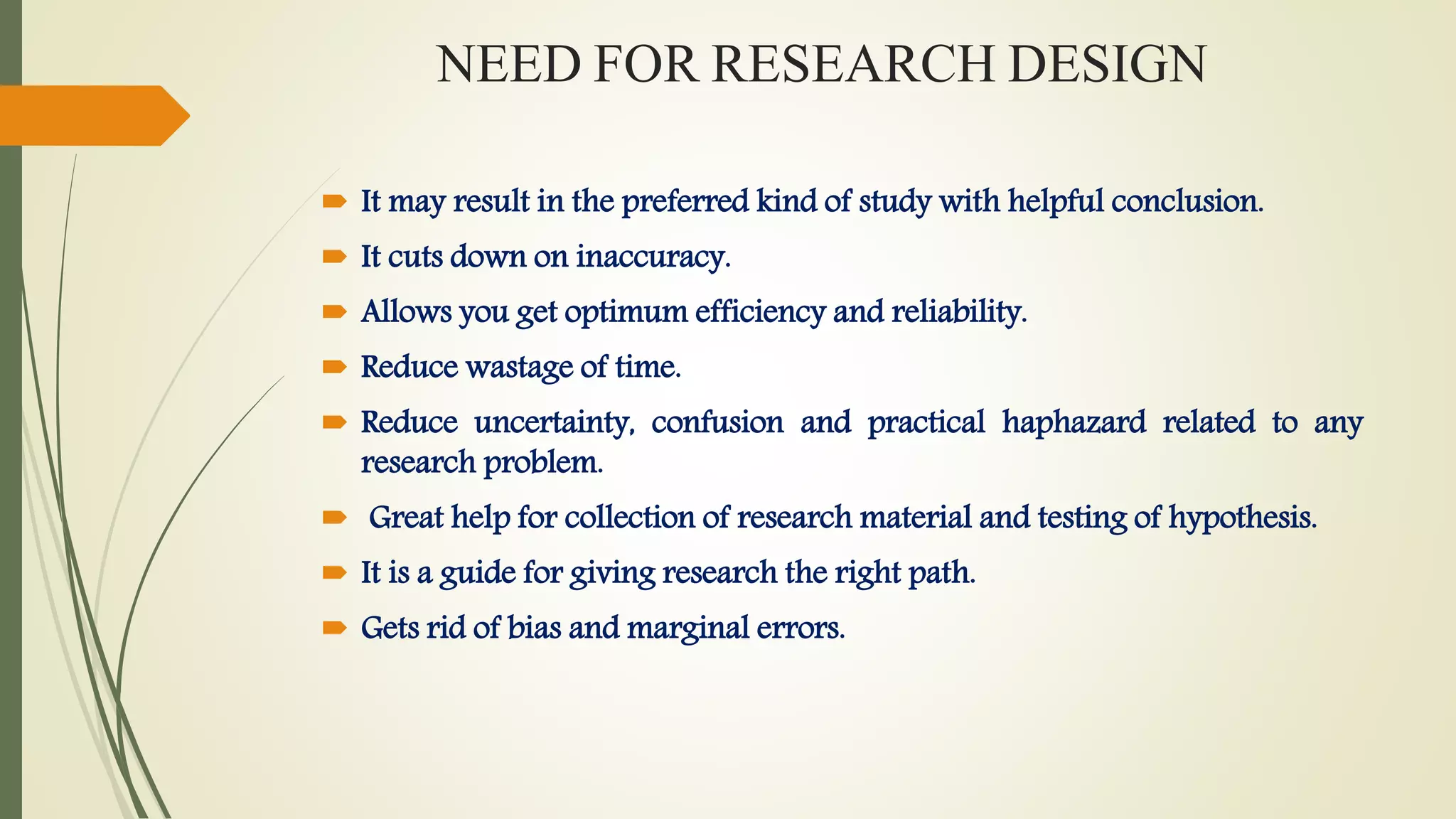
NEED FOR RESEARCH DESIGN
 It may result in the preferred kind of study with helpful conclusion.
 It cuts down on inaccuracy.
 Allows you get optimum efficiency and reliability.
 Reduce wastage of time.
 Reduce uncertainty, confusion and practical haphazard related to any
research problem.
 Great help for collection of research material and testing of hypothesis.
 It is a guide for giving research the right path.
 Gets rid of bias and marginal errors.
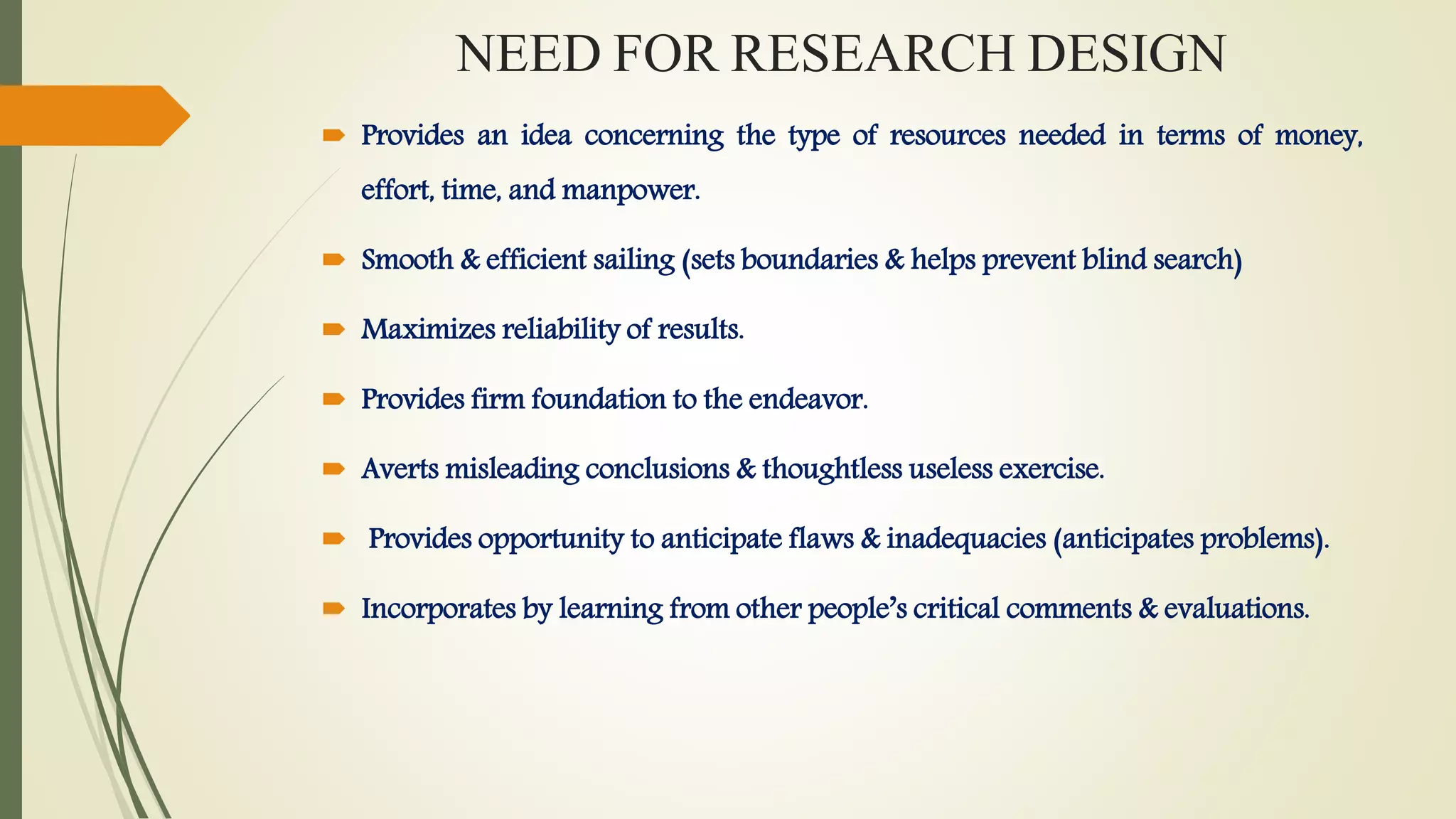
NEED FOR RESEARCH DESIGN
 Provides an idea concerning the type of resources needed in terms of money,
effort, time, and manpower.
 Smooth & efficient sailing (sets boundaries & helps prevent blind search)
 Maximizes reliability of results.
 Provides firm foundation to the endeavor.
 Averts misleading conclusions & thoughtless useless exercise.
 Provides opportunity to anticipate flaws & inadequacies (anticipates problems).
 Incorporates by learning from other people’s critical comments & evaluations.
NEED FOR RESEARCH DESIGN
 Research design is needed because it facilitates the smooth sailing of the various research
operations, thereby making research as efficient as possible yielding maximal information
with minimal expenditure of effort, time and money.
 Research design stands for advance planning of the method to be adopted for collecting the
relevant data and the techniques to be used in their analysis, keeping in view the objective
of the research and the availability of staff, time and money.
PROPERTIES OR CHARACTERISTICS OF A GOOD RESEARCH
DESIGN
 A good research design is an ethical research design
 A good research design is one that is capable of obtaining the most reliable and valid data
 A good research design is one that is capable of measuring any odd events in any
circumstances
 A good research design is one that helps an investigator avoid making mistaken
conclusions
 A good research design is one that can adequately control the various threats of validity,
both internal and external.
IMPORTANT CONCEPTS OF RESEARCH DESIGN
VARIABLE: A concept which can take on different quantitative values is called variable.(EX-
weight, height)
CONTINUOUS VARIABLES: Phenomenon which can take on quantitatively different values
even in decimal points are called continuous variables.
DISCRETE VARIABLES: if the variables can only be expressed in integer values, they are non-
continuous variable or discrete variables.
DEPENDENT AND INDEPENDENT VARIABLES: if one variable depends upon or is a
consequence of the other variable is termed as a dependent variable and the variable that is
that is antecedent to the dependent variable is termed as an independent variable.
IMPORTANT CONCEPTS OF RESEARCH DESIGN
 EXTRANEOUS VARIABLE: Independent variables that are not related to the purpose of the
study, but may affect the dependent variable are termed as extraneous variable.
 CONTROL: The technical term control is used when we design the study minimizing the
effects of extraneous independent variables.
 RESEARCH HYPOTHESIS: when prediction or a hypothesized relationship is to be tested by
scientific methods, it is termed as research hypothesis.
 EXPERIMENTAL AND NON-EXPERIMENTAL HYPOTHESIS TESTING RESEARCH: Research
in which the independent variable is manipulated is termed as experimental hypothesis
hypothesis testing research and the research in which an independent variable is not
not manipulated is called non-experimental hypothesis testing research.
IMPORTANT CONCEPTS OF RESEARCH DESIGN
 EXPERIMENTAL AND CONTROL GROUP: When a group is exposed to a usual conditions,
it is termed as a control group. When the group is exposed to some novel or special
condition, it is termed as an experimental group.
 TREATEMENT: The different conditions under which experimental and control groups are
put are usually referred to as treatment.
 EXPERIMENT: The process of examining the truth of a statistical hypothesis, relating to
some research problem is known as an experiment.
 EXPERIMENTAL UNITS: The predetermined plots or the blocks, where different treatments
are used are known as experimental units.
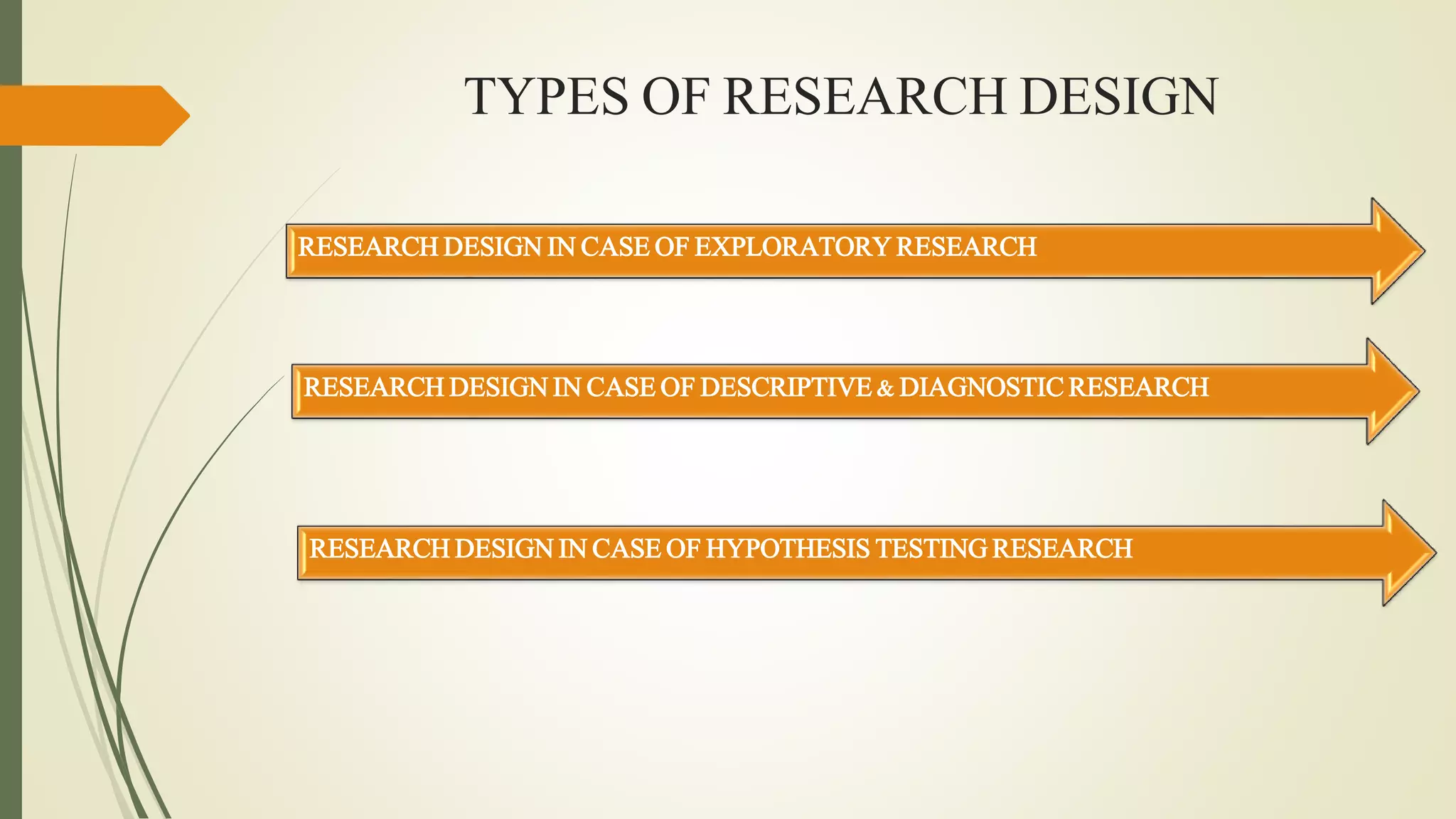
TYPES OF RESEARCH DESIGN
RESEARCH DESIGN IN CASE OF EXPLORATORY RESEARCH
RESEARCH DESIGN IN CASE OF DESCRIPTIVE & DIAGNOSTIC RESEARCH
RESEARCH DESIGN IN CASE OF HYPOTHESIS TESTING RESEARCH
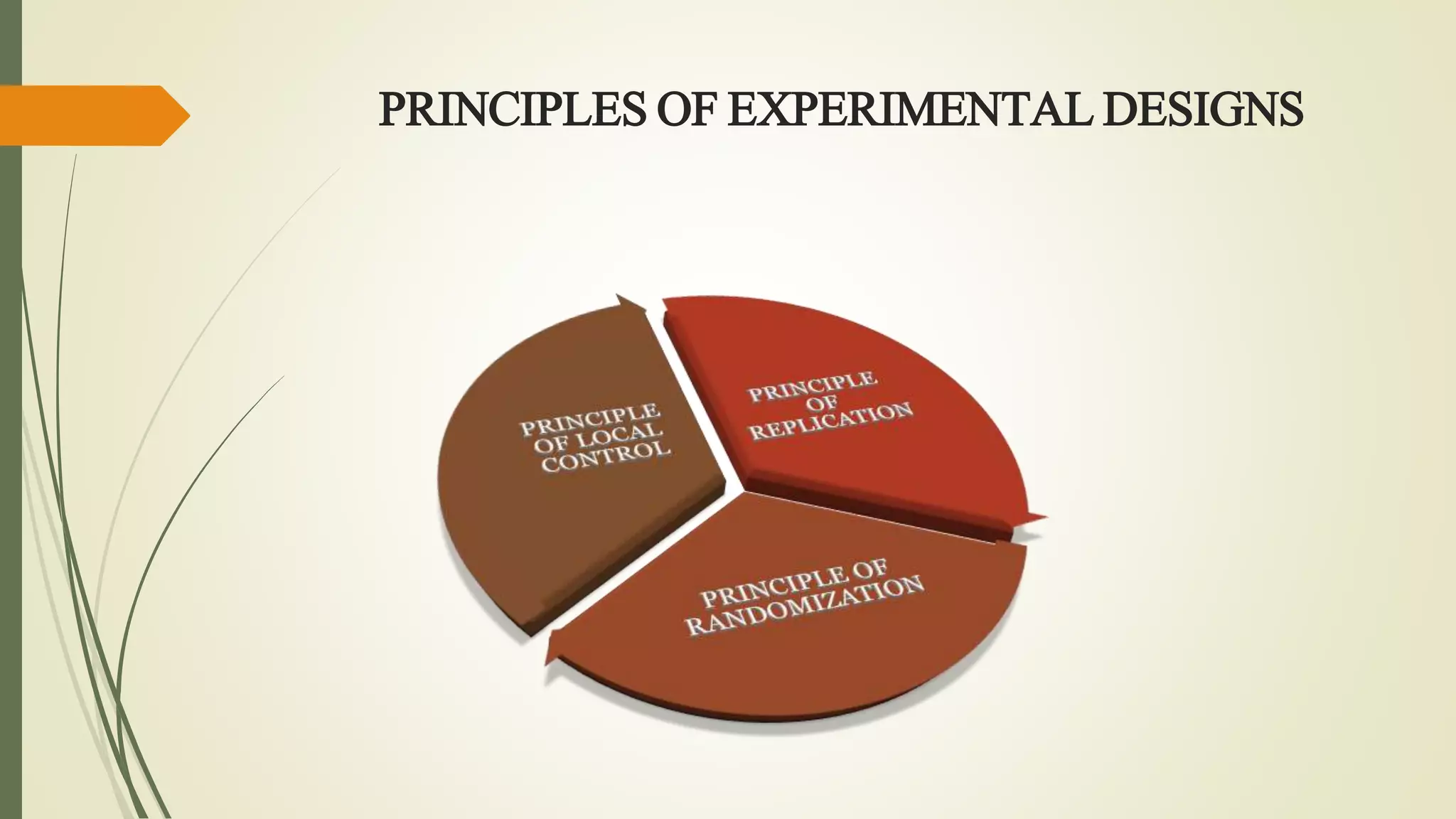
PRINCIPLES OF EXPERIMENTAL DESIGNS
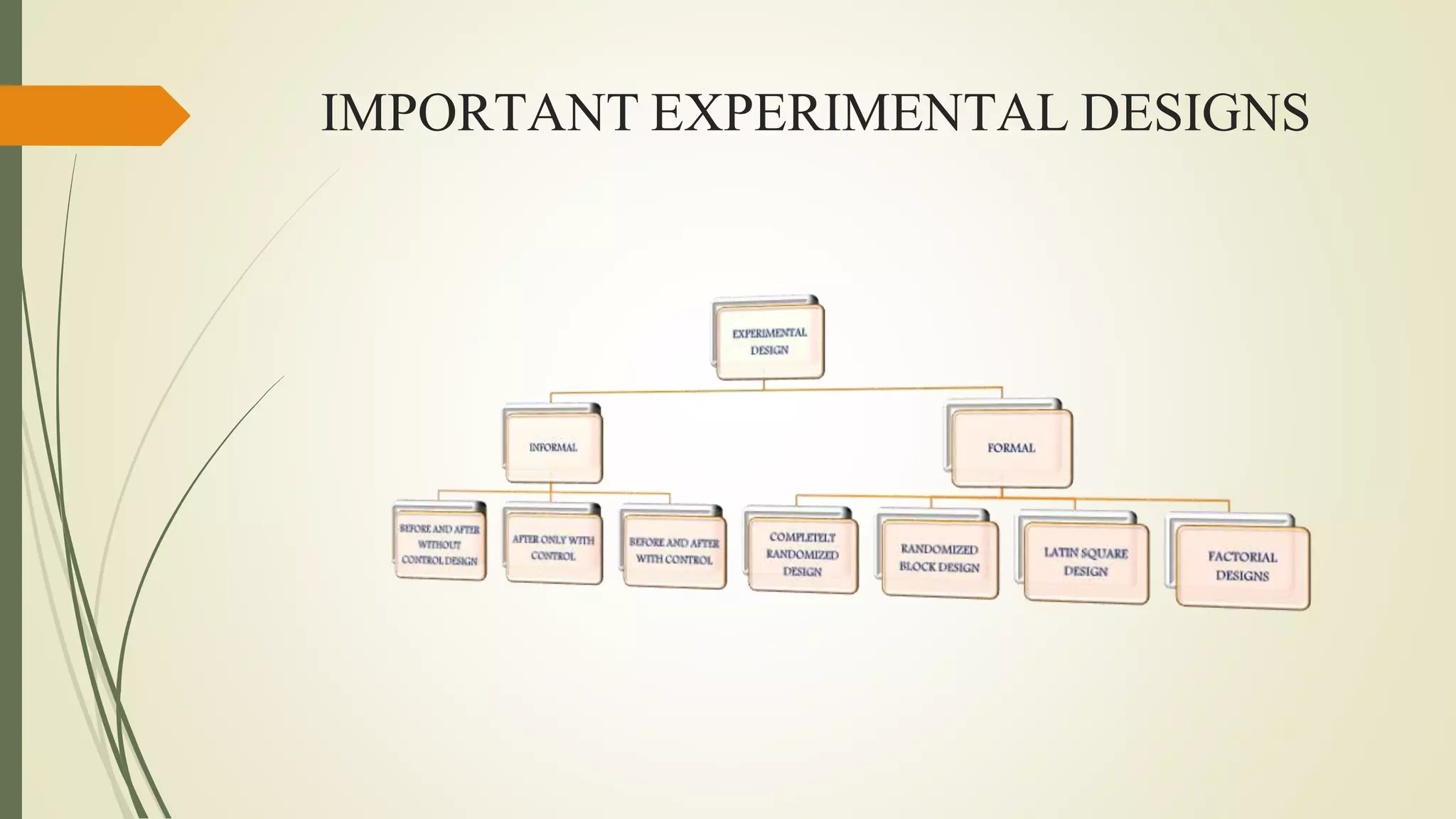
IMPORTANT EXPERIMENTAL DESIGNS
BEFORE AND AFTER WITHOUT CONTROL DESIGN
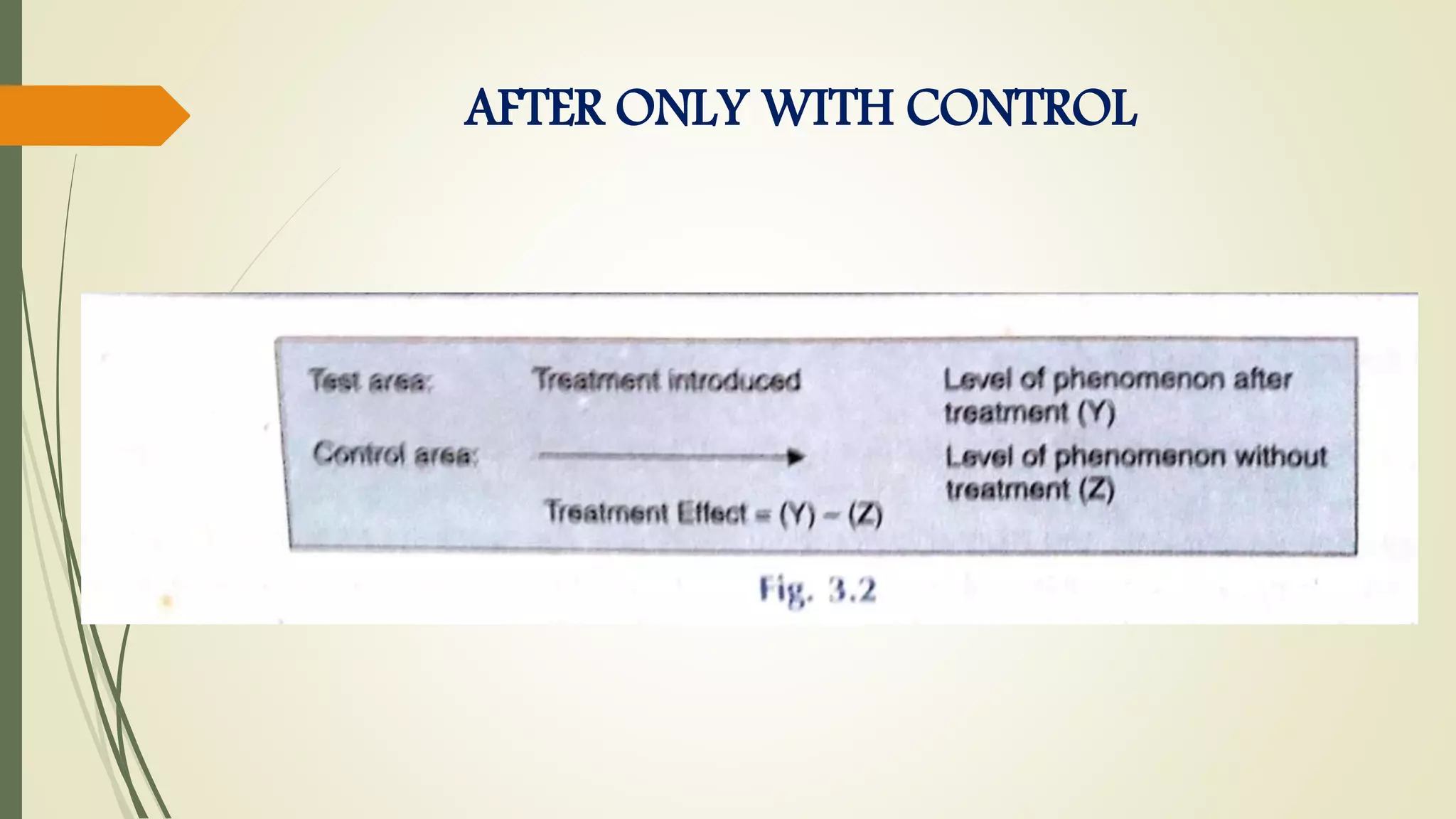
AFTER ONLY WITH CONTROL
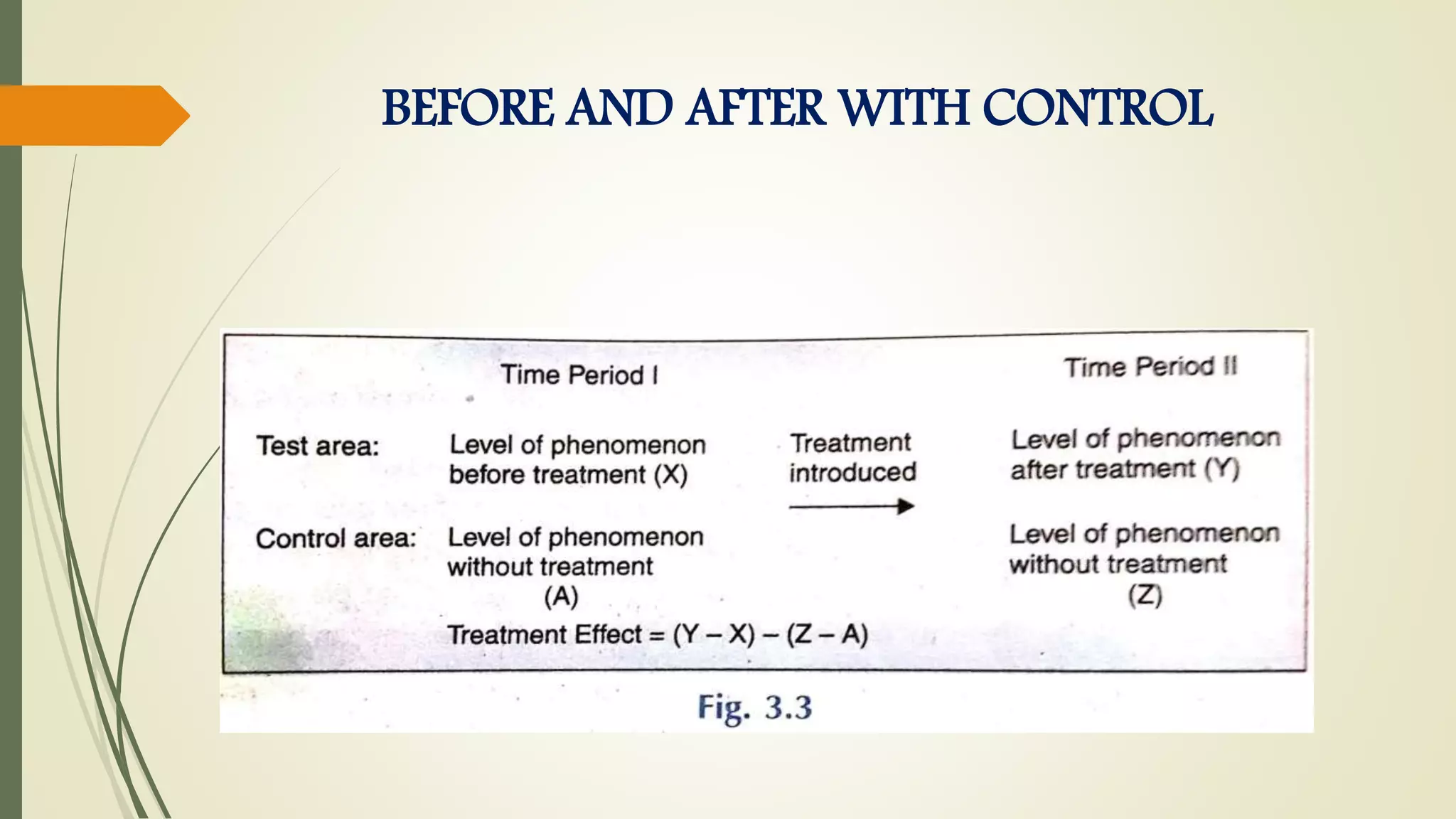
BEFORE AND AFTER WITH CONTROL
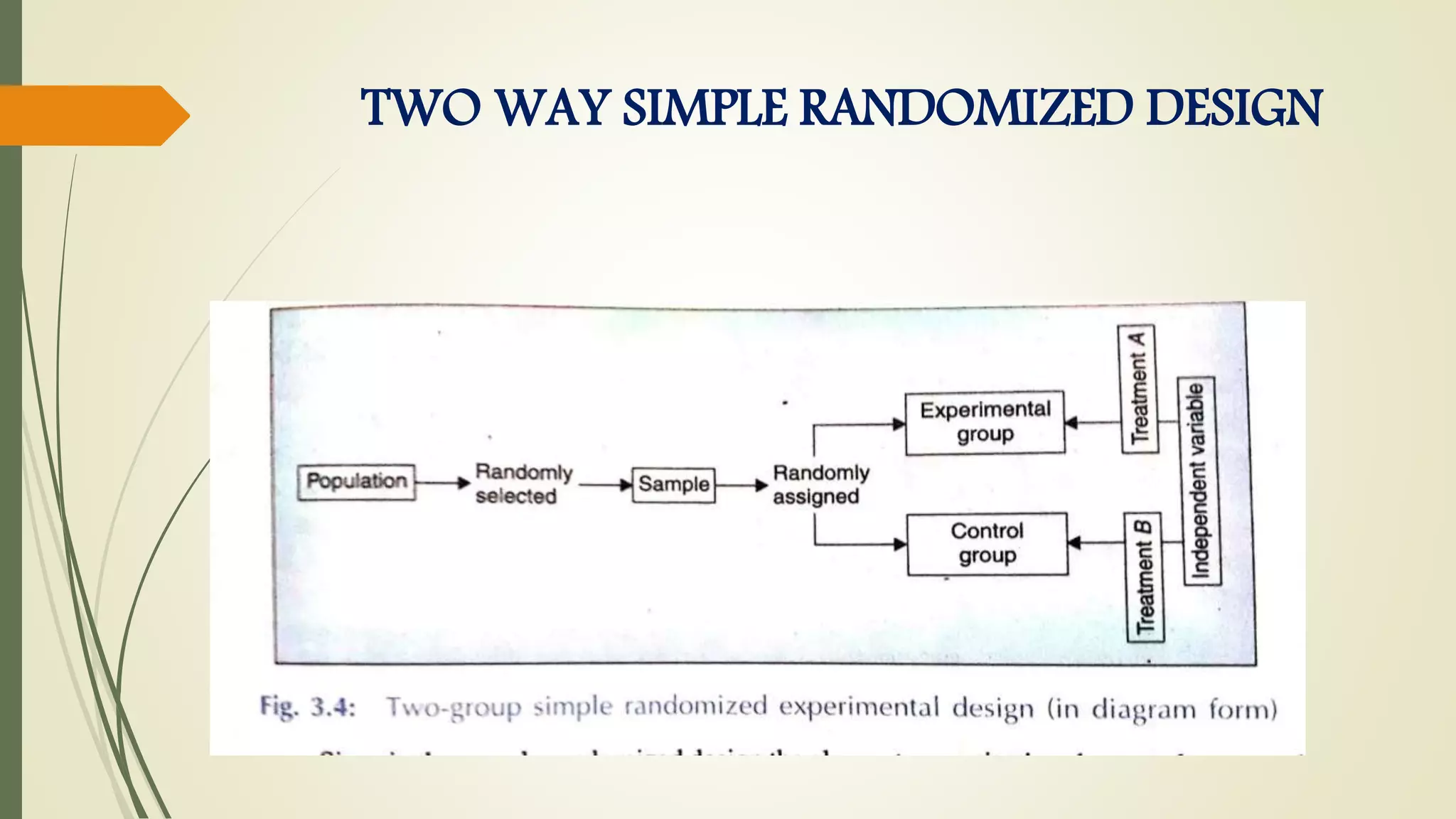
TWO WAY SIMPLE RANDOMIZED DESIGN
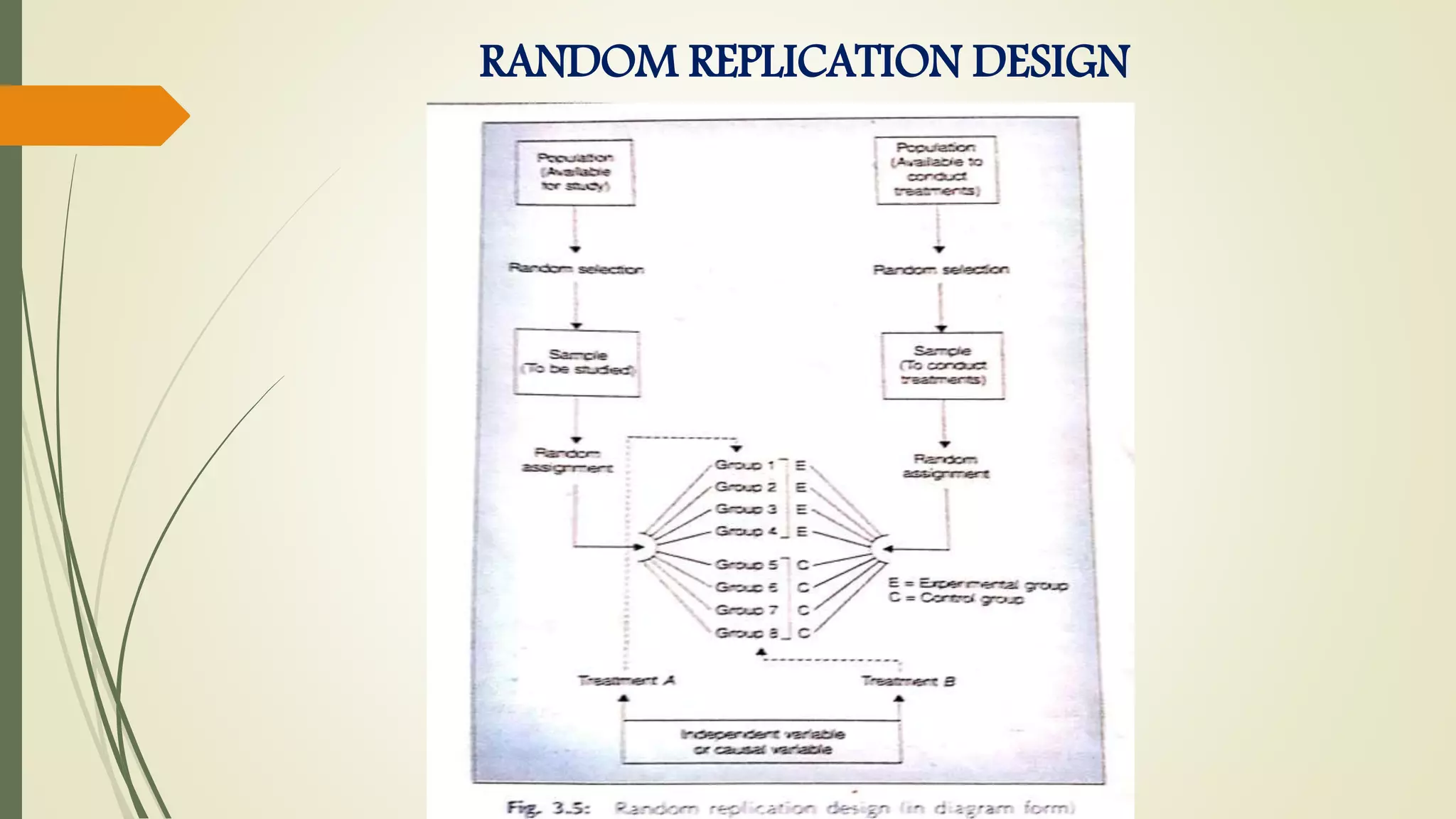
RANDOM REPLICATION DESIGN
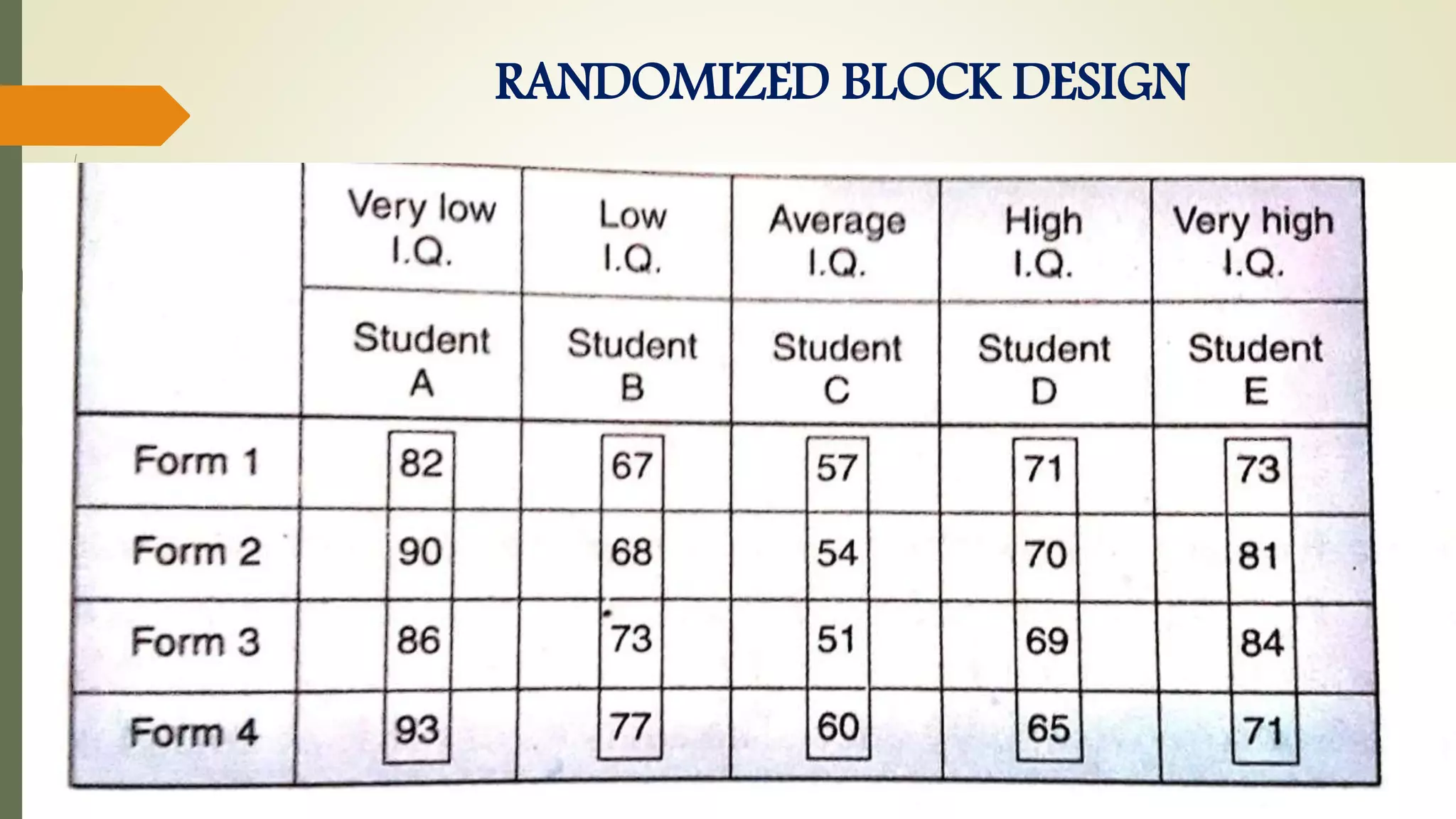
RANDOMIZED BLOCK DESIGN
LATIN SQUARE DESIGN
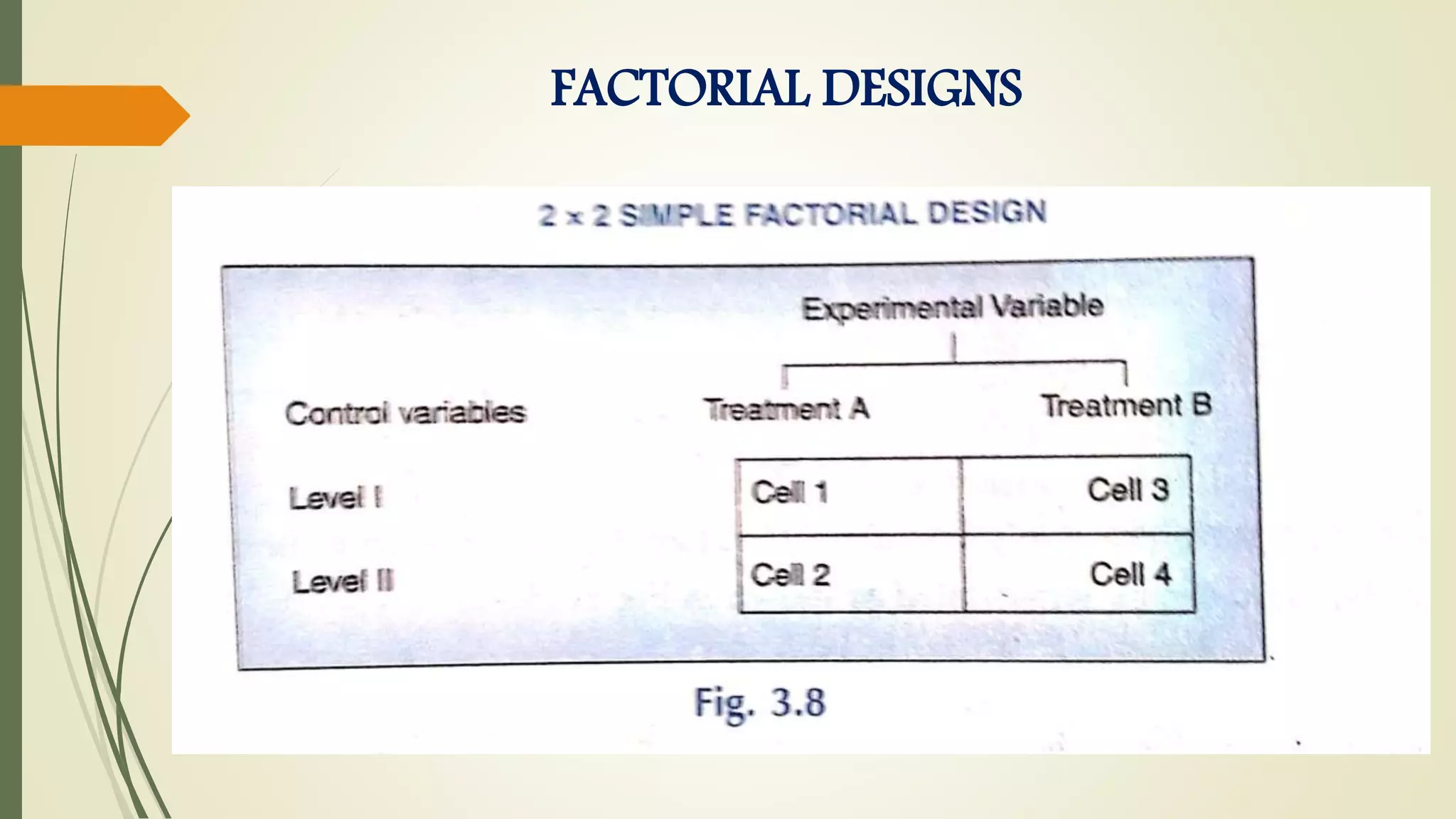
FACTORIAL DESIGNS
Research problem
Research problem

Research problem

  • 1.
    RESEARCH PROBLEM AN INTRODUCTION Dr.S.BELLARMINDIANA ASSISTANT PROFESSOR DEPARTMENT OF MANAGEMENT STUDIES BON SECOURS COLLEGE FOR WOMEN, THANJAVUR.
  • 2.
    RESEARCH PROBLEM  Inresearch process, the first and foremost step happens to be that of selecting and properly defining a research problem.  It refers to some difficulty which a researcher experiences in the context of either theoretical or practical situation and wants to obtain a solution for the same.  A research problem is a specific issue, difficulty, contradiction, or gap in knowledge that you will aim to address in your research. You might look for practical problems aimed at contributing to change, or theoretical problems aimed at expanding knowledge.
  • 3.
    RESEARCH PROBLEM COMPONENTS OFRESEARCH PROBLEM  An individual or a group with some difficulty or problem  Objectives of research that are to be attained  The environment in which the problem exists  Two or more course of action or alternative means for obtaining the objective  Two or more possible outcomes
  • 4.
    IDENTIFICATION AND SOURCES Identifyinga problem to study can be challenging, not because there is a lack of issues that could be investigated, but due to pursuing a goal of formulating a socially relevant and researchable problem statement that is unique and does not simply duplicate the work of others. The researchers themselves should finalize their own topic for a research problem after having a thorough discussion with the experts and guides.
  • 5.
  • 6.
  • 7.
    SELECTION OF RESEARCHPROBLEM criteria for selection  Subjects which are overdone should not be chosen. It will be difficult to throw any new light  Controversial subjects should not become the choice of an average researcher.  Too vague or too narrow problems should be avoided  The subjects selected for research should be familiar and feasible  The subject selected should be a significant one  The importance of the subject, the qualification and the training of a researcher, the costs involved, the time factor are few criteria that must be considered  The researcher has to make sure of the availability of necessary resources (equipment and adequate library facilities)  Selection of a problem must be preceded by a preliminary study.(this is necessary when the field of inquiry is relatively new)
  • 8.
    FORMULATION OF RESEARCHPROBLEM  Formulation of research problem refers to state the problem in a researchable manner.  It includes narrowing down the research area and formulating the objectives.  The researcher needs to refine the topic and clearly state what is intended to explore about the topic
  • 9.
    STEPS INVOLVED INFORMULATION OF RESEARCH PROBLEM
  • 10.
    TECHNIQUES INVOLVED INDEFINING A PROBLEM  Defining a problem involves the task of laying down boundaries within which a researcher shall study the problem with a predetermined objectives. Statement of the problem in Understanding the nature of the Surveying the available Developing the ideas through Rephrasing the research
  • 11.
    DEFINING RESEARCH PROBLEM POINTSTO BE CONSIDERED  Technical terms and words or phrases, with special meanings used in the statement of the problem should be clearly defined.  Basic assumptions related to the research problem should be clearly stated  The criteria for the selection of the problem should be provided  The suitability of the time period and the sources of data available must also be considered by the researcher  The scope of the investigation or the limits within which the problem is to be studied must be mentioned explicitly in defining a research problem
  • 12.
    CRITERIA OF GOODRESEARCH PROBLEM  A good research problem should add knowledge or improve the current practices.  It should be a novel and original one  Possibilities for empirical verification and testing  It should be clear and unambiguous  It should express the relationship between two or more variables.  Approval of topic from competent authority is also an important criterion
  • 13.
    RESEARCH DESIGN MEANING ANDDEFINITION Research design is the conceptual structure within which research is conducted. It constitutes the blueprint for the collection, measurement and analysis of data. A research design is the arrangement of conditions for collection and analysis of data in a manner that aims to combine relevance to the research purpose with economy in procedure. Claire Seltltiz and others A research design is the logical and systematic planning and directing a piece of research Pauline .V .Young
  • 14.
    PARTS OF RESEARCHDESIGN SAMPLING DESIGN OBSERVATIONAL DESIGN STATISTICAL DESIGN OPERATIONAL DESIGN It deals with the method of selecting items to be observed for the given study It deals with the condition under which the observations are to be made It is concerned with the question of how many items are to be observed and how information and data are to be analyzed It deals with the techniques by which the procedure specified in the sampling, statistical and observational designs can be carried out.
  • 15.
    NEED FOR RESEARCHDESIGN  It may result in the preferred kind of study with helpful conclusion.  It cuts down on inaccuracy.  Allows you get optimum efficiency and reliability.  Reduce wastage of time.  Reduce uncertainty, confusion and practical haphazard related to any research problem.  Great help for collection of research material and testing of hypothesis.  It is a guide for giving research the right path.  Gets rid of bias and marginal errors.
  • 16.
    NEED FOR RESEARCHDESIGN  Provides an idea concerning the type of resources needed in terms of money, effort, time, and manpower.  Smooth & efficient sailing (sets boundaries & helps prevent blind search)  Maximizes reliability of results.  Provides firm foundation to the endeavor.  Averts misleading conclusions & thoughtless useless exercise.  Provides opportunity to anticipate flaws & inadequacies (anticipates problems).  Incorporates by learning from other people’s critical comments & evaluations.
  • 17.
    NEED FOR RESEARCHDESIGN  Research design is needed because it facilitates the smooth sailing of the various research operations, thereby making research as efficient as possible yielding maximal information with minimal expenditure of effort, time and money.  Research design stands for advance planning of the method to be adopted for collecting the relevant data and the techniques to be used in their analysis, keeping in view the objective of the research and the availability of staff, time and money.
  • 18.
    PROPERTIES OR CHARACTERISTICSOF A GOOD RESEARCH DESIGN  A good research design is an ethical research design  A good research design is one that is capable of obtaining the most reliable and valid data  A good research design is one that is capable of measuring any odd events in any circumstances  A good research design is one that helps an investigator avoid making mistaken conclusions  A good research design is one that can adequately control the various threats of validity, both internal and external.
  • 19.
    IMPORTANT CONCEPTS OFRESEARCH DESIGN VARIABLE: A concept which can take on different quantitative values is called variable.(EX- weight, height) CONTINUOUS VARIABLES: Phenomenon which can take on quantitatively different values even in decimal points are called continuous variables. DISCRETE VARIABLES: if the variables can only be expressed in integer values, they are non- continuous variable or discrete variables. DEPENDENT AND INDEPENDENT VARIABLES: if one variable depends upon or is a consequence of the other variable is termed as a dependent variable and the variable that is that is antecedent to the dependent variable is termed as an independent variable.
  • 20.
    IMPORTANT CONCEPTS OFRESEARCH DESIGN  EXTRANEOUS VARIABLE: Independent variables that are not related to the purpose of the study, but may affect the dependent variable are termed as extraneous variable.  CONTROL: The technical term control is used when we design the study minimizing the effects of extraneous independent variables.  RESEARCH HYPOTHESIS: when prediction or a hypothesized relationship is to be tested by scientific methods, it is termed as research hypothesis.  EXPERIMENTAL AND NON-EXPERIMENTAL HYPOTHESIS TESTING RESEARCH: Research in which the independent variable is manipulated is termed as experimental hypothesis hypothesis testing research and the research in which an independent variable is not not manipulated is called non-experimental hypothesis testing research.
  • 21.
    IMPORTANT CONCEPTS OFRESEARCH DESIGN  EXPERIMENTAL AND CONTROL GROUP: When a group is exposed to a usual conditions, it is termed as a control group. When the group is exposed to some novel or special condition, it is termed as an experimental group.  TREATEMENT: The different conditions under which experimental and control groups are put are usually referred to as treatment.  EXPERIMENT: The process of examining the truth of a statistical hypothesis, relating to some research problem is known as an experiment.  EXPERIMENTAL UNITS: The predetermined plots or the blocks, where different treatments are used are known as experimental units.
  • 22.
    TYPES OF RESEARCHDESIGN RESEARCH DESIGN IN CASE OF EXPLORATORY RESEARCH RESEARCH DESIGN IN CASE OF DESCRIPTIVE & DIAGNOSTIC RESEARCH RESEARCH DESIGN IN CASE OF HYPOTHESIS TESTING RESEARCH
  • 23.
  • 24.
  • 25.
    BEFORE AND AFTERWITHOUT CONTROL DESIGN
  • 26.
  • 27.
    BEFORE AND AFTERWITH CONTROL
  • 28.
    TWO WAY SIMPLERANDOMIZED DESIGN
  • 29.
  • 30.
  • 31.
  • 32.