By
Dr. Anupama Vinay Oka
Research Guide
Shri JJT University
FORMATION OF RESEARCH
STATEMENT, OBJECTIVES &
HYPOTHESIS
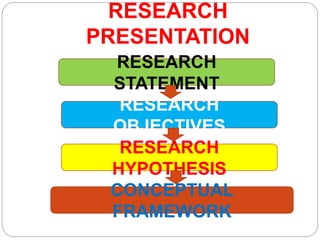
RESEARCH
PRESENTATION
RESEARCH
STATEMENT
RESEARCH
OBJECTIVES
RESEARCH
HYPOTHESIS
CONCEPTUAL
FRAMEWORK
A - RESEARCH
STATEMENT
INTRODUCTION
 Fundamental first step in the research process.
 It is the most difficult and challenging phase in the
research project.
 It is the research scholar’s
IDENTIFICATION/RECOGNITION OR
PERCEPTION of a problem
RESEARCH PROBLEM
 It is a situation that needs solution.
 It is a gap in knowledge that needs to be filled
Example:
“Everybody wants to go to heaven but nobody
wants to die”
Dying looks like a problem that needs a solution yet
there is no
possible solution to it. People must die.
A research on people can live forever makes little
or no sense. So it is described as a incongruence
(Not being suitable)
Research problem
 Is used in research work as a claim that outlines
the problem addressed by a study.
 Should address an existing gap in knowledge in
the field and lead to further research.
 To write a persuasive problem statement, need
to describe : (a) the ideal, (b), the reality, and (c)
the consequences.
Problem Statement
Hernon and Schwartz (2007) defined in the following points:
a) Clarity and precision
b) Identification of what would be studied,
c) Identification of an overarching question and key factors or
variables;
d) Identification of key concepts and terms- articulation of the
boundaries or parameters; generalizability; conveyance of
the importance, benefits, and justification
e) No use of unnecessary jargon; and
f) Conveyance of more than the mere gathering of
descriptive data providing a snapshot.
PROBLEM STATEMENT
 It is the description of an issue currently existing
which needs to be addressed
 It provides the context for the research study and
generates the questions which the research aims
to answer
PURPOSES OF RESEARCH
STATEMENT
 It summarizes the content of the entire study
 It is a frame of reference for the whole study
 It enables you to claim the study as your own
 It helps the other researcher to refer your work
COMPONENTS OF THE
STATEMENT PROBLEM
 The problem itself, stated clearly with enough
contextual details to establish, “Why it is
important.”
 The method of solving the problem, often stated
as a claim or working thesis
 The purpose, statement of objectives and scope
of the project being proposed
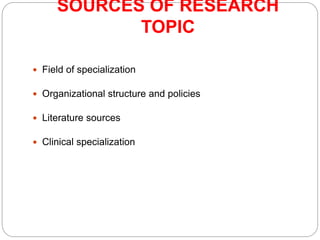
SOURCES OF RESEARCH
TOPIC
 Field of specialization
 Organizational structure and policies
 Literature sources
 Clinical specialization
SOURCES OF
RESEARCH PROBLEM
 Empirical interest – Curiosity in each area –
Theory/Practical
 Creativity and Innovation
 New Investigations
 Previous Research – 1] Stimulates readers thinking
2] Identification of gap in the
literature
3] Suggest area for further
study
4] Refinement of existing
Cont - - -
SOURCES OF
RESEARCH PROBLEM
 Cultural stereotypes
 Practical Needs – 1] Own experience
2] Nursing practices
 Interest of others
 Political concerns – 1] Political climate – Health care
cost
2] Cause and effect
treatment of diseases
3] Improvement in the
standard of health
Cont - - -
Sources of Research
Problem
 Priorities –
1] List of priorities (Existing scenario)
2] Priorities as per the agencies who provide funds for
research
work
3] Organizational / Institutional priorities
Cont - - -
Sources of Research
Problem
 In short - - -
1] Personal experiences
2] Existing problems in the work place
3] Technological and scientific advancement
4] Offshoots of other researchers
5] Suggestions from colleagues, administrators,
teachers etc.
6] professional journals, seminars, symposia,
conferences
Cont - - -
Sources of Research
Problem
 Other sources of topics - - -
1] Field of specialization
2] Organizational structure and policies
3] Literature sources
4] Clinical specialization
Cont - - -
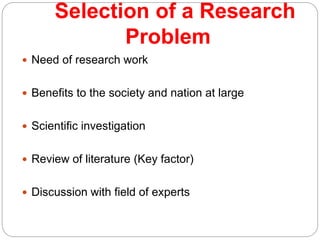
Selection of a Research
Problem
 Need of research work
 Benefits to the society and nation at large
 Scientific investigation
 Review of literature (Key factor)
 Discussion with field of experts
Criteria of a Research
Problem
 Originality – Preliminary survey of existing –
1] Literature
2] Original contribution
3] Avoid duplication of efforts
4] Strong and weak points – Research
techniques
 Neither General OR Specific –
General – It is generally vague to be tested
Specific – It is usually to narrow
Cont - - -
Problem
 Significance
1] Is the problem important one?
2] Will the society benefits out of my study?
3] Will the results lead to practical implications?
4] Will the findings challenge to untested assumptions?
5] Will the research study help to formulate policies OR existing practices?
6] Is the problem is of current interest?
7] is the problem likely to continue in the future?
8] Does the problem have theoretical importance?
9] Would this study substantially revise or extend existing knowledge?
10] Would this study findings lead to some useful change in best practice?
11] What are the variables?
12] What will be measured?
13] What relationship will be examined?
 Solvability
1] Supernatural amorphous phenomenon (Impossible to specify)
a) How does the mind works
b) Is it possible to change the human nature
2] Operational definitions
Cont - - -
Problem
 Feasibility
1] Study design
2] Access to organizations
3] Samples under the study
4] Methods of data collection
5] Types of variables
6] Selection of scales of measurement and statistics
7] Character and distribution of variables –
a) Parametric
b) Non- parametric statistics
8] Time for study
9] Sources
10] Cost effectiveness
11] Ethical consideration
Criteria of a Research
Problem
Interesting
Research scholars interest – Purely intellectual.
It should not be only for Reward, Material Benefit, Advancement in position,
Vertical increase in
authority and so further
Key points for criteria
1] Researcher’s interest
2] Novelty
3] Theoretical value
4] Practical value
5] Availability of the data
6] Special equipment
7] Sponsorship
8] Administrative support
9] Hazards
10] Ethical and legal aspects
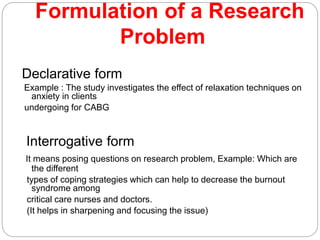
Formulation of a Research
Problem
Declarative form
Example : The study investigates the effect of relaxation techniques on
anxiety in clients
undergoing for CABG
Interrogative form
It means posing questions on research problem, Example: Which are
the different
types of coping strategies which can help to decrease the burnout
syndrome among
critical care nurses and doctors.
(It helps in sharpening and focusing the issue)
Formulation of a Research
Problem
 Variable under the study must clearly and
unambiguously stated.
 Variable relationship to each other.
 Nature of population
 Testability – [Qualitative/Quantitative form]
 Dependent and Independent variables
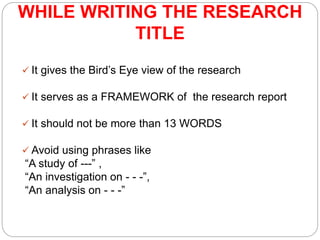
WHILE WRITING THE RESEARCH
TITLE
 It gives the Bird’s Eye view of the research
 It serves as a FRAMEWORK of the research report
 It should not be more than 13 WORDS
 Avoid using phrases like
“A study of ---” ,
“An investigation on - - -”,
“An analysis on - - -”
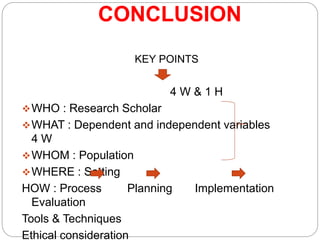
CONCLUSION
KEY POINTS
4 W & 1 H
WHO : Research Scholar
WHAT : Dependent and independent variables
4 W
WHOM : Population
WHERE : Setting
HOW : Process Planning Implementation
Evaluation
Tools & Techniques
Ethical consideration
B - RESEARCH
OBJECTIVES
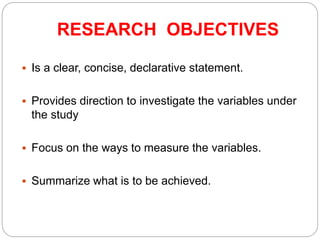
RESEARCH OBJECTIVES
 Is a clear, concise, declarative statement.
 Provides direction to investigate the variables under
the study
 Focus on the ways to measure the variables.
 Summarize what is to be achieved.
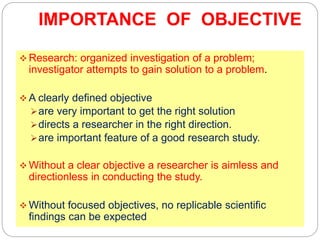
IMPORTANCE OF OBJECTIVE
 Research: organized investigation of a problem;
investigator attempts to gain solution to a problem.
 A clearly defined objective
are very important to get the right solution
directs a researcher in the right direction.
are important feature of a good research study.
 Without a clear objective a researcher is aimless and
directionless in conducting the study.
 Without focused objectives, no replicable scientific
findings can be expected
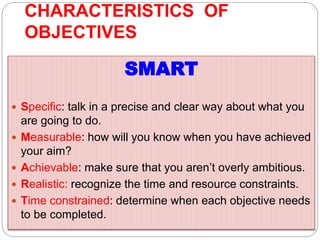
CHARACTERISTICS OF
OBJECTIVES
SMART
 Specific: talk in a precise and clear way about what you
are going to do.
 Measurable: how will you know when you have achieved
your aim?
 Achievable: make sure that you aren’t overly ambitious.
 Realistic: recognize the time and resource constraints.
 Time constrained: determine when each objective needs
to be completed.
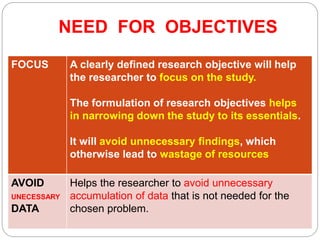
NEED FOR OBJECTIVES
FOCUS A clearly defined research objective will help
the researcher to focus on the study.
The formulation of research objectives helps
in narrowing down the study to its essentials.
It will avoid unnecessary findings, which
otherwise lead to wastage of resources
AVOID
UNECESSARY
DATA
Helps the researcher to avoid unnecessary
accumulation of data that is not needed for the
chosen problem.
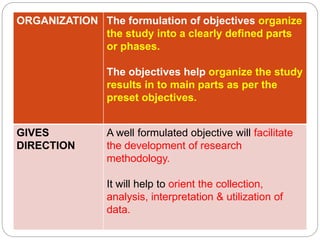
ORGANIZATION The formulation of objectives organize
the study into a clearly defined parts
or phases.
The objectives help organize the study
results in to main parts as per the
preset objectives.
GIVES
DIRECTION
A well formulated objective will facilitate
the development of research
methodology.
It will help to orient the collection,
analysis, interpretation & utilization of
data.
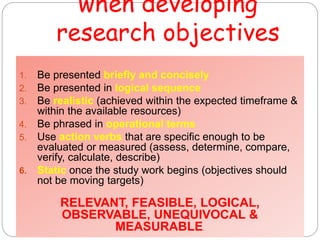
when developing
research objectives
1. Be presented briefly and concisely
2. Be presented in logical sequence
3. Be realistic (achieved within the expected timeframe &
within the available resources)
4. Be phrased in operational terms
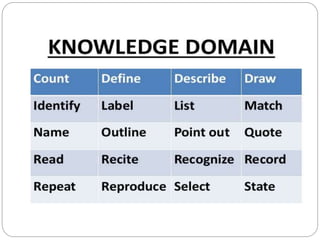
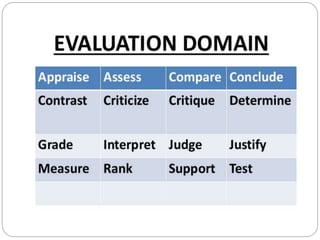
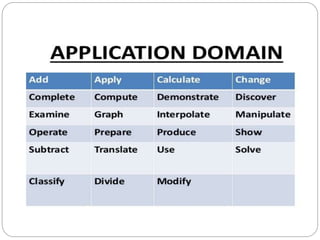
5. Use action verbs that are specific enough to be
evaluated or measured (assess, determine, compare,
verify, calculate, describe)
6. Static once the study work begins (objectives should
not be moving targets)
RELEVANT, FEASIBLE, LOGICAL,
OBSERVABLE, UNEQUIVOCAL &
MEASURABLE.
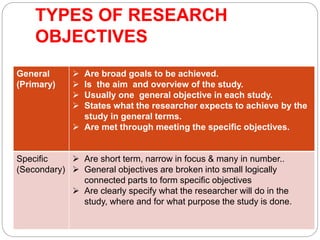
TYPES OF RESEARCH
OBJECTIVES
General
(Primary)
 Are broad goals to be achieved.
 Is the aim and overview of the study.
 Usually one general objective in each study.
 States what the researcher expects to achieve by the
study in general terms.
 Are met through meeting the specific objectives.
Specific
(Secondary)
 Are short term, narrow in focus & many in number..
 General objectives are broken into small logically
connected parts to form specific objectives
 Are clearly specify what the researcher will do in the
study, where and for what purpose the study is done.
C - RESEARCH
HYPOTHESIS
HYPOTHESIS
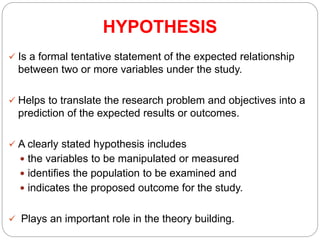
 Is a formal tentative statement of the expected relationship
between two or more variables under the study.
 Helps to translate the research problem and objectives into a
prediction of the expected results or outcomes.
 A clearly stated hypothesis includes
 the variables to be manipulated or measured
 identifies the population to be examined and
 indicates the proposed outcome for the study.
 Plays an important role in the theory building.
DEFINITION
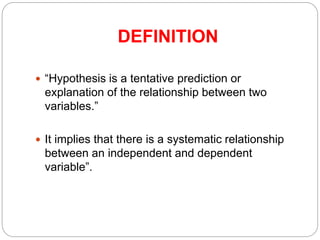
 “Hypothesis is a tentative prediction or
explanation of the relationship between two
variables.”
 It implies that there is a systematic relationship
between an independent and dependent
variable”.
IMPORTANCE OF
HYPOTHESIS
 Enables to objectively investigate new areas of
discovery, helps in theory building.
 Provides objectivity, directions, clear and specific
goals.
 Helps selecting sample and research
procedures to meet the set goals.
 Provides a link between theories and actual
practical research.
 Serves as a bridge between theory and reality.
Cont - -
-
 Suggests the methodology to be chosen to
conduct the study.
 Is a tentative statement of the anticipated results,
give direction to proceed.
 Stimulates the thinking process.
 Provides directions about the methodology to be
chosen & techniques of data analysis;
understanding what to expect from the results.
 Serves as a framework for drawing conclusions.
 Without a hypothesis a research would be an
aimless wandering.
CHARACTERISTICS
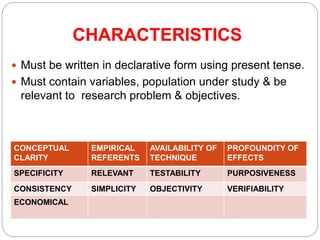
 Must be written in declarative form using present tense.
 Must contain variables, population under study & be
relevant to research problem & objectives.
CONCEPTUAL
CLARITY
EMPIRICAL
REFERENTS
AVAILABILITY OF
TECHNIQUE
PROFOUNDITY OF
EFFECTS
SPECIFICITY RELEVANT TESTABILITY PURPOSIVENESS
CONSISTENCY SIMPLICITY OBJECTIVITY VERIFIABILITY
ECONOMICAL
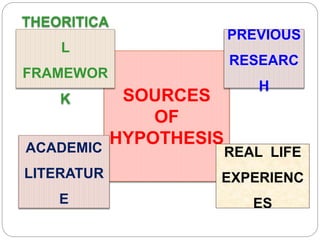
SOURCES
OF
HYPOTHESIS
PREVIOUS
RESEARC
H
ACADEMIC
LITERATUR
E
REAL LIFE
EXPERIENC
ES
THEORITICA
L
FRAMEWOR
K
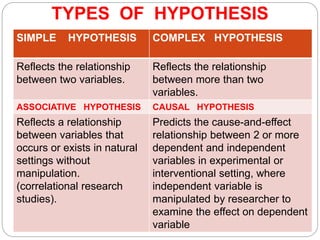
TYPES OF HYPOTHESIS
SIMPLE HYPOTHESIS COMPLEX HYPOTHESIS
Reflects the relationship
between two variables.
Reflects the relationship
between more than two
variables.
ASSOCIATIVE HYPOTHESIS CAUSAL HYPOTHESIS
Reflects a relationship
between variables that
occurs or exists in natural
settings without
manipulation.
(correlational research
studies).
Predicts the cause-and-effect
relationship between 2 or more
dependent and independent
variables in experimental or
interventional setting, where
independent variable is
manipulated by researcher to
examine the effect on dependent
variable
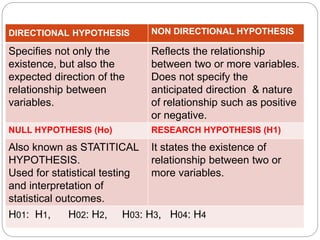
DIRECTIONAL HYPOTHESIS NON DIRECTIONAL HYPOTHESIS
Specifies not only the
existence, but also the
expected direction of the
relationship between
variables.
Reflects the relationship
between two or more variables.
Does not specify the
anticipated direction & nature
of relationship such as positive
or negative.
NULL HYPOTHESIS (Ho) RESEARCH HYPOTHESIS (H1)
Also known as STATITICAL
HYPOTHESIS.
Used for statistical testing
and interpretation of
statistical outcomes.
It states the existence of
relationship between two or
more variables.
H01: H1, H02: H2, H03: H3, H04: H4
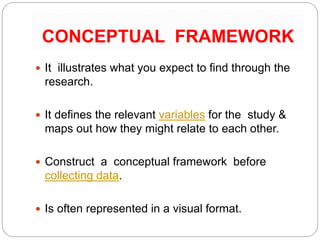
CONCEPTUAL FRAMEWORK
 It illustrates what you expect to find through the
research.
 It defines the relevant variables for the study &
maps out how they might relate to each other.
 Construct a conceptual framework before
collecting data.
 Is often represented in a visual format.
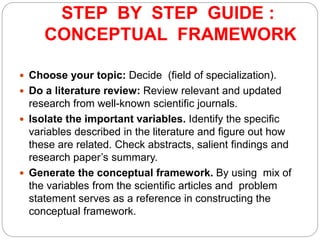
STEP BY STEP GUIDE :
CONCEPTUAL FRAMEWORK
 Choose your topic: Decide (field of specialization).
 Do a literature review: Review relevant and updated
research from well-known scientific journals.
 Isolate the important variables. Identify the specific
variables described in the literature and figure out how
these are related. Check abstracts, salient findings and
research paper’s summary.
 Generate the conceptual framework. By using mix of
the variables from the scientific articles and problem
statement serves as a reference in constructing the
conceptual framework.
DESIGNING
CONCEPTUAL FRAMEWORK
 A conceptual framework can be designed in many
different ways.
 Depends on what kind of relationships you expect to
find.
 To visualize our expected cause-and-effect
relationship, use the basic design components of
boxes, arrows, and lines.
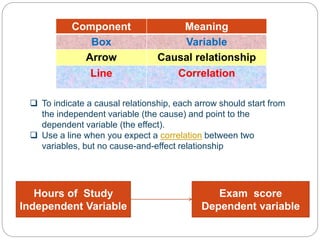
Component Meaning
Box Variable
Arrow Causal relationship
Line Correlation
 To indicate a causal relationship, each arrow should start from
the independent variable (the cause) and point to the
dependent variable (the effect).
 Use a line when you expect a correlation between two
variables, but no cause-and-effect relationship
Hours of Study
Independent Variable
Exam score
Dependent variable
ANALYSIS OF DATA
Steps of data analysis
1. Data presentation: compilation, editing, coding,
classification, tabulation
2. Describing the data: (descriptive statistics)
3. Drawing the inference of data: (inferential
statistics)
4. Interpretation of data
DESCRIPTIVE STATISTICS
 Measures to condense data: frequency and %
distribution through tabulation and graphic
presentation
 Measures of central tendency: Mean, median,
mode
 Measures of Dispersion: Mean, mean deviation,
standard deviation & quartile deviation
 Measures of Relationship: correlation coefficient
(Karl Pearson & Spearman’s Rank)
INFERENTIAL STATISTICS
Concepts related to Inferential statistics : Type
I and II errors, Level of significance,
Confidence level, Degree of freedom
Test of Significance:
Parametric tests: (t-test, Z-test & ANOVA)
Nonparametric tests: (chi-square test, median test,
McNemar test, Mann-Whitney test, Wilcoxon Test &
Fisher’s exact test).
THANK YOU

Formation of research statement

  • 1.
    By Dr. Anupama VinayOka Research Guide Shri JJT University FORMATION OF RESEARCH STATEMENT, OBJECTIVES & HYPOTHESIS
  • 2.
  • 3.
  • 4.
    INTRODUCTION  Fundamental firststep in the research process.  It is the most difficult and challenging phase in the research project.  It is the research scholar’s IDENTIFICATION/RECOGNITION OR PERCEPTION of a problem
  • 5.
    RESEARCH PROBLEM  Itis a situation that needs solution.  It is a gap in knowledge that needs to be filled Example: “Everybody wants to go to heaven but nobody wants to die” Dying looks like a problem that needs a solution yet there is no possible solution to it. People must die. A research on people can live forever makes little or no sense. So it is described as a incongruence (Not being suitable)
  • 6.
    Research problem  Isused in research work as a claim that outlines the problem addressed by a study.  Should address an existing gap in knowledge in the field and lead to further research.  To write a persuasive problem statement, need to describe : (a) the ideal, (b), the reality, and (c) the consequences.
  • 7.
    Problem Statement Hernon andSchwartz (2007) defined in the following points: a) Clarity and precision b) Identification of what would be studied, c) Identification of an overarching question and key factors or variables; d) Identification of key concepts and terms- articulation of the boundaries or parameters; generalizability; conveyance of the importance, benefits, and justification e) No use of unnecessary jargon; and f) Conveyance of more than the mere gathering of descriptive data providing a snapshot.
  • 8.
    PROBLEM STATEMENT  Itis the description of an issue currently existing which needs to be addressed  It provides the context for the research study and generates the questions which the research aims to answer
  • 9.
    PURPOSES OF RESEARCH STATEMENT It summarizes the content of the entire study  It is a frame of reference for the whole study  It enables you to claim the study as your own  It helps the other researcher to refer your work
  • 10.
    COMPONENTS OF THE STATEMENTPROBLEM  The problem itself, stated clearly with enough contextual details to establish, “Why it is important.”  The method of solving the problem, often stated as a claim or working thesis  The purpose, statement of objectives and scope of the project being proposed
  • 11.
    SOURCES OF RESEARCH TOPIC Field of specialization  Organizational structure and policies  Literature sources  Clinical specialization
  • 12.
    SOURCES OF RESEARCH PROBLEM Empirical interest – Curiosity in each area – Theory/Practical  Creativity and Innovation  New Investigations  Previous Research – 1] Stimulates readers thinking 2] Identification of gap in the literature 3] Suggest area for further study 4] Refinement of existing Cont - - -
  • 13.
    SOURCES OF RESEARCH PROBLEM Cultural stereotypes  Practical Needs – 1] Own experience 2] Nursing practices  Interest of others  Political concerns – 1] Political climate – Health care cost 2] Cause and effect treatment of diseases 3] Improvement in the standard of health Cont - - -
  • 14.
    Sources of Research Problem Priorities – 1] List of priorities (Existing scenario) 2] Priorities as per the agencies who provide funds for research work 3] Organizational / Institutional priorities Cont - - -
  • 15.
    Sources of Research Problem In short - - - 1] Personal experiences 2] Existing problems in the work place 3] Technological and scientific advancement 4] Offshoots of other researchers 5] Suggestions from colleagues, administrators, teachers etc. 6] professional journals, seminars, symposia, conferences Cont - - -
  • 16.
    Sources of Research Problem Other sources of topics - - - 1] Field of specialization 2] Organizational structure and policies 3] Literature sources 4] Clinical specialization Cont - - -
  • 17.
    Selection of aResearch Problem  Need of research work  Benefits to the society and nation at large  Scientific investigation  Review of literature (Key factor)  Discussion with field of experts
  • 18.
    Criteria of aResearch Problem  Originality – Preliminary survey of existing – 1] Literature 2] Original contribution 3] Avoid duplication of efforts 4] Strong and weak points – Research techniques  Neither General OR Specific – General – It is generally vague to be tested Specific – It is usually to narrow Cont - - -
  • 19.
    Problem  Significance 1] Isthe problem important one? 2] Will the society benefits out of my study? 3] Will the results lead to practical implications? 4] Will the findings challenge to untested assumptions? 5] Will the research study help to formulate policies OR existing practices? 6] Is the problem is of current interest? 7] is the problem likely to continue in the future? 8] Does the problem have theoretical importance? 9] Would this study substantially revise or extend existing knowledge? 10] Would this study findings lead to some useful change in best practice? 11] What are the variables? 12] What will be measured? 13] What relationship will be examined?  Solvability 1] Supernatural amorphous phenomenon (Impossible to specify) a) How does the mind works b) Is it possible to change the human nature 2] Operational definitions Cont - - -
  • 20.
    Problem  Feasibility 1] Studydesign 2] Access to organizations 3] Samples under the study 4] Methods of data collection 5] Types of variables 6] Selection of scales of measurement and statistics 7] Character and distribution of variables – a) Parametric b) Non- parametric statistics 8] Time for study 9] Sources 10] Cost effectiveness 11] Ethical consideration
  • 21.
    Criteria of aResearch Problem Interesting Research scholars interest – Purely intellectual. It should not be only for Reward, Material Benefit, Advancement in position, Vertical increase in authority and so further Key points for criteria 1] Researcher’s interest 2] Novelty 3] Theoretical value 4] Practical value 5] Availability of the data 6] Special equipment 7] Sponsorship 8] Administrative support 9] Hazards 10] Ethical and legal aspects
  • 22.
    Formulation of aResearch Problem Declarative form Example : The study investigates the effect of relaxation techniques on anxiety in clients undergoing for CABG Interrogative form It means posing questions on research problem, Example: Which are the different types of coping strategies which can help to decrease the burnout syndrome among critical care nurses and doctors. (It helps in sharpening and focusing the issue)
  • 23.
    Formulation of aResearch Problem  Variable under the study must clearly and unambiguously stated.  Variable relationship to each other.  Nature of population  Testability – [Qualitative/Quantitative form]  Dependent and Independent variables
  • 24.
    WHILE WRITING THERESEARCH TITLE  It gives the Bird’s Eye view of the research  It serves as a FRAMEWORK of the research report  It should not be more than 13 WORDS  Avoid using phrases like “A study of ---” , “An investigation on - - -”, “An analysis on - - -”
  • 25.
    CONCLUSION KEY POINTS 4 W& 1 H WHO : Research Scholar WHAT : Dependent and independent variables 4 W WHOM : Population WHERE : Setting HOW : Process Planning Implementation Evaluation Tools & Techniques Ethical consideration
  • 26.
  • 27.
    RESEARCH OBJECTIVES  Isa clear, concise, declarative statement.  Provides direction to investigate the variables under the study  Focus on the ways to measure the variables.  Summarize what is to be achieved.
  • 28.
    IMPORTANCE OF OBJECTIVE Research: organized investigation of a problem; investigator attempts to gain solution to a problem.  A clearly defined objective are very important to get the right solution directs a researcher in the right direction. are important feature of a good research study.  Without a clear objective a researcher is aimless and directionless in conducting the study.  Without focused objectives, no replicable scientific findings can be expected
  • 29.
    CHARACTERISTICS OF OBJECTIVES SMART  Specific:talk in a precise and clear way about what you are going to do.  Measurable: how will you know when you have achieved your aim?  Achievable: make sure that you aren’t overly ambitious.  Realistic: recognize the time and resource constraints.  Time constrained: determine when each objective needs to be completed.
  • 30.
    NEED FOR OBJECTIVES FOCUSA clearly defined research objective will help the researcher to focus on the study. The formulation of research objectives helps in narrowing down the study to its essentials. It will avoid unnecessary findings, which otherwise lead to wastage of resources AVOID UNECESSARY DATA Helps the researcher to avoid unnecessary accumulation of data that is not needed for the chosen problem.
  • 31.
    ORGANIZATION The formulationof objectives organize the study into a clearly defined parts or phases. The objectives help organize the study results in to main parts as per the preset objectives. GIVES DIRECTION A well formulated objective will facilitate the development of research methodology. It will help to orient the collection, analysis, interpretation & utilization of data.
  • 32.
    when developing research objectives 1.Be presented briefly and concisely 2. Be presented in logical sequence 3. Be realistic (achieved within the expected timeframe & within the available resources) 4. Be phrased in operational terms 5. Use action verbs that are specific enough to be evaluated or measured (assess, determine, compare, verify, calculate, describe) 6. Static once the study work begins (objectives should not be moving targets) RELEVANT, FEASIBLE, LOGICAL, OBSERVABLE, UNEQUIVOCAL & MEASURABLE.
  • 33.
    TYPES OF RESEARCH OBJECTIVES General (Primary) Are broad goals to be achieved.  Is the aim and overview of the study.  Usually one general objective in each study.  States what the researcher expects to achieve by the study in general terms.  Are met through meeting the specific objectives. Specific (Secondary)  Are short term, narrow in focus & many in number..  General objectives are broken into small logically connected parts to form specific objectives  Are clearly specify what the researcher will do in the study, where and for what purpose the study is done.
  • 38.
  • 39.
    HYPOTHESIS  Is aformal tentative statement of the expected relationship between two or more variables under the study.  Helps to translate the research problem and objectives into a prediction of the expected results or outcomes.  A clearly stated hypothesis includes  the variables to be manipulated or measured  identifies the population to be examined and  indicates the proposed outcome for the study.  Plays an important role in the theory building.
  • 40.
    DEFINITION  “Hypothesis isa tentative prediction or explanation of the relationship between two variables.”  It implies that there is a systematic relationship between an independent and dependent variable”.
  • 41.
    IMPORTANCE OF HYPOTHESIS  Enablesto objectively investigate new areas of discovery, helps in theory building.  Provides objectivity, directions, clear and specific goals.  Helps selecting sample and research procedures to meet the set goals.  Provides a link between theories and actual practical research.  Serves as a bridge between theory and reality. Cont - - -
  • 42.
     Suggests themethodology to be chosen to conduct the study.  Is a tentative statement of the anticipated results, give direction to proceed.  Stimulates the thinking process.  Provides directions about the methodology to be chosen & techniques of data analysis; understanding what to expect from the results.  Serves as a framework for drawing conclusions.  Without a hypothesis a research would be an aimless wandering.
  • 43.
    CHARACTERISTICS  Must bewritten in declarative form using present tense.  Must contain variables, population under study & be relevant to research problem & objectives. CONCEPTUAL CLARITY EMPIRICAL REFERENTS AVAILABILITY OF TECHNIQUE PROFOUNDITY OF EFFECTS SPECIFICITY RELEVANT TESTABILITY PURPOSIVENESS CONSISTENCY SIMPLICITY OBJECTIVITY VERIFIABILITY ECONOMICAL
  • 44.
  • 45.
    TYPES OF HYPOTHESIS SIMPLEHYPOTHESIS COMPLEX HYPOTHESIS Reflects the relationship between two variables. Reflects the relationship between more than two variables. ASSOCIATIVE HYPOTHESIS CAUSAL HYPOTHESIS Reflects a relationship between variables that occurs or exists in natural settings without manipulation. (correlational research studies). Predicts the cause-and-effect relationship between 2 or more dependent and independent variables in experimental or interventional setting, where independent variable is manipulated by researcher to examine the effect on dependent variable
  • 46.
    DIRECTIONAL HYPOTHESIS NONDIRECTIONAL HYPOTHESIS Specifies not only the existence, but also the expected direction of the relationship between variables. Reflects the relationship between two or more variables. Does not specify the anticipated direction & nature of relationship such as positive or negative. NULL HYPOTHESIS (Ho) RESEARCH HYPOTHESIS (H1) Also known as STATITICAL HYPOTHESIS. Used for statistical testing and interpretation of statistical outcomes. It states the existence of relationship between two or more variables. H01: H1, H02: H2, H03: H3, H04: H4
  • 47.
    CONCEPTUAL FRAMEWORK  Itillustrates what you expect to find through the research.  It defines the relevant variables for the study & maps out how they might relate to each other.  Construct a conceptual framework before collecting data.  Is often represented in a visual format.
  • 48.
    STEP BY STEPGUIDE : CONCEPTUAL FRAMEWORK  Choose your topic: Decide (field of specialization).  Do a literature review: Review relevant and updated research from well-known scientific journals.  Isolate the important variables. Identify the specific variables described in the literature and figure out how these are related. Check abstracts, salient findings and research paper’s summary.  Generate the conceptual framework. By using mix of the variables from the scientific articles and problem statement serves as a reference in constructing the conceptual framework.
  • 49.
    DESIGNING CONCEPTUAL FRAMEWORK  Aconceptual framework can be designed in many different ways.  Depends on what kind of relationships you expect to find.  To visualize our expected cause-and-effect relationship, use the basic design components of boxes, arrows, and lines.
  • 50.
    Component Meaning Box Variable ArrowCausal relationship Line Correlation  To indicate a causal relationship, each arrow should start from the independent variable (the cause) and point to the dependent variable (the effect).  Use a line when you expect a correlation between two variables, but no cause-and-effect relationship Hours of Study Independent Variable Exam score Dependent variable
  • 51.
    ANALYSIS OF DATA Stepsof data analysis 1. Data presentation: compilation, editing, coding, classification, tabulation 2. Describing the data: (descriptive statistics) 3. Drawing the inference of data: (inferential statistics) 4. Interpretation of data
  • 52.
    DESCRIPTIVE STATISTICS  Measuresto condense data: frequency and % distribution through tabulation and graphic presentation  Measures of central tendency: Mean, median, mode  Measures of Dispersion: Mean, mean deviation, standard deviation & quartile deviation  Measures of Relationship: correlation coefficient (Karl Pearson & Spearman’s Rank)
  • 53.
    INFERENTIAL STATISTICS Concepts relatedto Inferential statistics : Type I and II errors, Level of significance, Confidence level, Degree of freedom Test of Significance: Parametric tests: (t-test, Z-test & ANOVA) Nonparametric tests: (chi-square test, median test, McNemar test, Mann-Whitney test, Wilcoxon Test & Fisher’s exact test).
  • 54.