













© CHIPS Networks
© CHIPS Networks
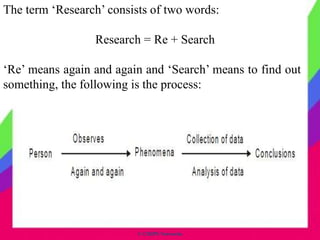
The term ‘Research’ consists of two words:
Research = Re + Search
‘Re’ means again and again and ‘Search’ means to find out
something, the following is the process:
© CHIPS Networks
1. To gain familiarity with a phenomenon or to achieve new insights into it
2. To portray accurately the characteristics of a particular individual, situation or
a
group
3. To determine the frequency with which something occurs or with which it is
associated with something else
4. To test a hypothesis of a causal relationship between variables
© CHIPS Networks
© CHIPS Networks
© CHIPS Networks
MOTIVATION IN RESEARCH
1. Desire to get a research degree along with its consequential benefits
2. Desire to face the challenge in solving the unsolved problems, i.e., concern over
practical problems initiates research
3. Desire to get intellectual joy of doing some creative work
4. Desire to be of service to society
5. Desire to get respectability.
© CHIPS Networks
© CHIPS Networks
© CHIPS Networks
Descriptive research is used to describe characteristics of a population or phenomenon
being studied. It does not answer questions about how/when/why the characteristics occurred.
The main characteristic of this method is that the researcher has no control over the
variables;
he can only report what has happened or what is happening.
for example,
•frequency of shopping,
•preferences of people, or similar data.
© CHIPS Networks
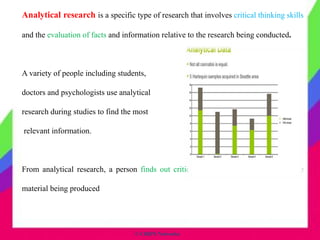
Analytical research is a specific type of research that involves critical thinking skills
and the evaluation of facts and information relative to the research being conducted.
A variety of people including students,
doctors and psychologists use analytical
research during studies to find the most
relevant information.
From analytical research, a person finds out critical details to add new ideas to the
material being produced
© CHIPS Networks
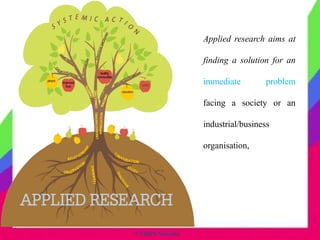
Applied research aims at
finding a solution for an
immediate problem
facing a society or an
industrial/business
organisation,
© CHIPS Networks
Basic research, also called pure research or fundamental research, is
scientific research aimed to improve scientific theories for improved understanding or
prediction of natural or other phenomena.
“Gathering knowledge for knowledge’s sake is termed ‘pure’ or ‘basic’ research.
© CHIPS Networks
Quantitative research is based on the measurement of quantity or amount. It is
applicable to phenomena that can be expressed in terms of quantity.
© CHIPS Networks
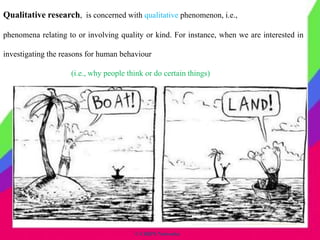
Qualitative research, is concerned with qualitative phenomenon, i.e.,
phenomena relating to or involving quality or kind. For instance, when we are interested in
investigating the reasons for human behaviour
(i.e., why people think or do certain things)
© CHIPS Networks
Conceptual research is that related to some abstract idea(s) or theory. It is generally used
by philosophers and thinkers to develop new concepts or to reinterpret existing ones.
The conceptual researcher sits at his desk with pen in hand and tries to solve these
problems by thinking about them. He does no experiments but may make use of
observations by others, since this is the mass of data that he is trying to make sense of.
Until fairly recently, conceptual research was considered the most honorable form of
research—it required using the brain, not the hands.
© CHIPS Networks
© CHIPS Networks
Empirical research is based on
observed and measured phenomena and
derives knowledge from actual
experience rather than from theory or
belief.
© CHIPS Networks
All other types of research are variations of one or more of the above stated
approaches, based on either the purpose of research, or the time required to
accomplish research, on the environment in which research is done, or on the basis of
some other similar factor
© CHIPS Networks
A longitudinal survey is a co relational research study that involves repeated observations
of the same variables over long periods of time, often many decades.
© CHIPS Networks
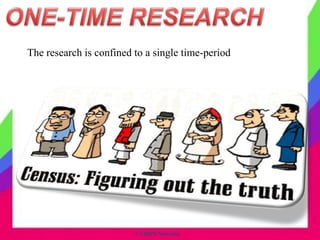
The research is confined to a single time-period
© CHIPS Networks
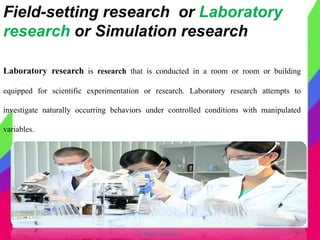
Laboratory research is research that is conducted in a room or room or building
equipped for scientific experimentation or research. Laboratory research attempts to
investigate naturally occurring behaviors under controlled conditions with manipulated
variables.
Field-setting research or Laboratory
research or Simulation research
© CHIPS Networks
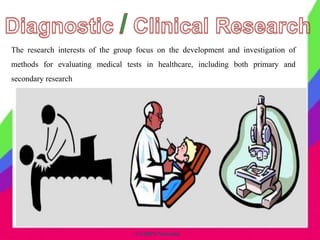
The research interests of the group focus on the development and investigation of
methods for evaluating medical tests in healthcare, including both primary and
secondary research
© CHIPS Networks
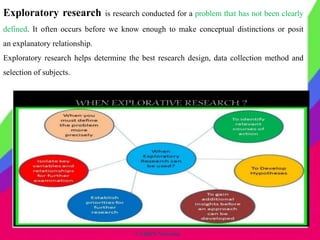
Exploratory research is research conducted for a problem that has not been clearly
defined. It often occurs before we know enough to make conceptual distinctions or posit
an explanatory relationship.
Exploratory research helps determine the best research design, data collection method and
selection of subjects.
© CHIPS Networks
Historical research is that which utilizes historical sources like
documents, remains, etc. to study events or ideas of the past, including the
philosophy of persons and groups at any remote point of time.
© CHIPS Networks
While doing conclusion oriented research, a researcher is free to pick up a problem,
redesign the enquiry as he proceeds and is prepared to conceptualize as he wishes.
© CHIPS Networks
Decision-oriented research is always for the need of a decision maker and the
researcher in this case is not free to embark upon research according to his own
inclination.
Operations research is an example of decision oriented research since it is a scientific
method of providing executive departments with a quantitative basis for decisions
regarding operations under their control.
© CHIPS Networks

Types of research

  • 1.
  • 2.
  • 3.
    The term ‘Research’consists of two words: Research = Re + Search ‘Re’ means again and again and ‘Search’ means to find out something, the following is the process: © CHIPS Networks
  • 4.
    1. To gainfamiliarity with a phenomenon or to achieve new insights into it 2. To portray accurately the characteristics of a particular individual, situation or a group 3. To determine the frequency with which something occurs or with which it is associated with something else 4. To test a hypothesis of a causal relationship between variables © CHIPS Networks
  • 5.
  • 6.
  • 7.
    MOTIVATION IN RESEARCH 1.Desire to get a research degree along with its consequential benefits 2. Desire to face the challenge in solving the unsolved problems, i.e., concern over practical problems initiates research 3. Desire to get intellectual joy of doing some creative work 4. Desire to be of service to society 5. Desire to get respectability. © CHIPS Networks
  • 8.
  • 9.
    © CHIPS Networks Descriptiveresearch is used to describe characteristics of a population or phenomenon being studied. It does not answer questions about how/when/why the characteristics occurred. The main characteristic of this method is that the researcher has no control over the variables; he can only report what has happened or what is happening. for example, •frequency of shopping, •preferences of people, or similar data.
  • 10.
    © CHIPS Networks Analyticalresearch is a specific type of research that involves critical thinking skills and the evaluation of facts and information relative to the research being conducted. A variety of people including students, doctors and psychologists use analytical research during studies to find the most relevant information. From analytical research, a person finds out critical details to add new ideas to the material being produced
  • 11.
    © CHIPS Networks Appliedresearch aims at finding a solution for an immediate problem facing a society or an industrial/business organisation,
  • 12.
    © CHIPS Networks Basicresearch, also called pure research or fundamental research, is scientific research aimed to improve scientific theories for improved understanding or prediction of natural or other phenomena. “Gathering knowledge for knowledge’s sake is termed ‘pure’ or ‘basic’ research.
  • 13.
    © CHIPS Networks Quantitativeresearch is based on the measurement of quantity or amount. It is applicable to phenomena that can be expressed in terms of quantity.
  • 14.
    © CHIPS Networks Qualitativeresearch, is concerned with qualitative phenomenon, i.e., phenomena relating to or involving quality or kind. For instance, when we are interested in investigating the reasons for human behaviour (i.e., why people think or do certain things)
  • 15.
    © CHIPS Networks Conceptualresearch is that related to some abstract idea(s) or theory. It is generally used by philosophers and thinkers to develop new concepts or to reinterpret existing ones. The conceptual researcher sits at his desk with pen in hand and tries to solve these problems by thinking about them. He does no experiments but may make use of observations by others, since this is the mass of data that he is trying to make sense of. Until fairly recently, conceptual research was considered the most honorable form of research—it required using the brain, not the hands.
  • 16.
  • 17.
    © CHIPS Networks Empiricalresearch is based on observed and measured phenomena and derives knowledge from actual experience rather than from theory or belief.
  • 18.
    © CHIPS Networks Allother types of research are variations of one or more of the above stated approaches, based on either the purpose of research, or the time required to accomplish research, on the environment in which research is done, or on the basis of some other similar factor
  • 19.
    © CHIPS Networks Alongitudinal survey is a co relational research study that involves repeated observations of the same variables over long periods of time, often many decades.
  • 20.
    © CHIPS Networks Theresearch is confined to a single time-period
  • 21.
    © CHIPS Networks Laboratoryresearch is research that is conducted in a room or room or building equipped for scientific experimentation or research. Laboratory research attempts to investigate naturally occurring behaviors under controlled conditions with manipulated variables. Field-setting research or Laboratory research or Simulation research
  • 22.
    © CHIPS Networks Theresearch interests of the group focus on the development and investigation of methods for evaluating medical tests in healthcare, including both primary and secondary research
  • 23.
    © CHIPS Networks Exploratoryresearch is research conducted for a problem that has not been clearly defined. It often occurs before we know enough to make conceptual distinctions or posit an explanatory relationship. Exploratory research helps determine the best research design, data collection method and selection of subjects.
  • 24.
    © CHIPS Networks Historicalresearch is that which utilizes historical sources like documents, remains, etc. to study events or ideas of the past, including the philosophy of persons and groups at any remote point of time.
  • 25.
    © CHIPS Networks Whiledoing conclusion oriented research, a researcher is free to pick up a problem, redesign the enquiry as he proceeds and is prepared to conceptualize as he wishes.
  • 26.
    © CHIPS Networks Decision-orientedresearch is always for the need of a decision maker and the researcher in this case is not free to embark upon research according to his own inclination. Operations research is an example of decision oriented research since it is a scientific method of providing executive departments with a quantitative basis for decisions regarding operations under their control.
  • 27.