KHURRAM RAFI
ROLL NO. 14035401-003
M.Phil. Education
1
Formulation means translating and
transforming the selected research
problem into a scientifically
answerable research question.
This is the aim of the every study.
2
 Questions for qualitative research often have to be
designed on the spot, leaving room for people to elaborate
on their answers and even to turn the study in a direction
the researcher didn't expect.
The literature review is
the mother of research
question. Maxwell (2005)
3
Useful Techniques
Rational thinking
Creative thinking
 Searching the literature
Scanning the media
Brainstorming
Exploring past projects
Discussion
Keeping an ideas notebook
4
5
 In research we formulate research question after reviewing the
literature,
 It enables us to communicate our ideas with others,
 We make such research question which may address the
relationship among the variables,
 In quantitative research It should identify the variables being
investigated and specify the type of relationship (descriptive,
predictive, or causal) to be investigated.
 Research Questions Usually a research problem is initially
posed as a question, which serves as the focus of the
researcher’s investigation.
 Research question should specify What (measureable
variables), Who (subjects and controls), Where (location) ,How
(method). kent and campbell (2005) 6
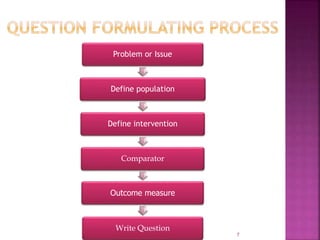
Problem or Issue
Define population
Define intervention
Comparator
Outcome measure
Write Question
7
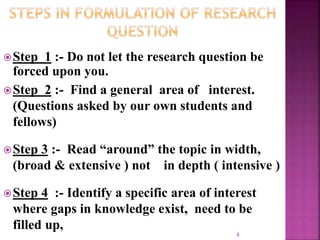
Step 1 :- Do not let the research question be
forced upon you.
Step 2 :- Find a general area of interest.
(Questions asked by our own students and
fellows)
Step 3 :- Read “around” the topic in width,
(broad & extensive ) not in depth ( intensive )
Step 4 :- Identify a specific area of interest
where gaps in knowledge exist, need to be
filled up,
8
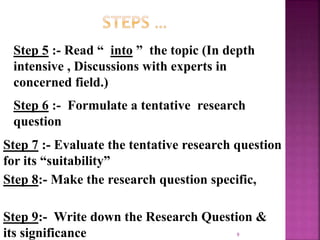
Step 5 :- Read “ into ” the topic (In depth
intensive , Discussions with experts in
concerned field.)
Step 6 :- Formulate a tentative research
question
Step 7 :- Evaluate the tentative research question
for its “suitability”
Step 8:- Make the research question specific,
Step 9:- Write down the Research Question &
its significance 9
Narrowing, clarifying, and even
redefining your questions is essential
to the research process.
Forming the right ‘questions’ should
be seen as an iterative process that is
informed by reading and doing at all
stages.
10
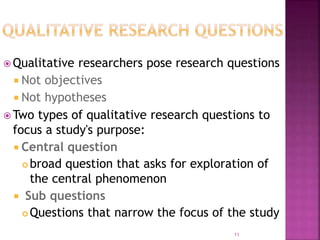
 Qualitative researchers pose research questions
 Not objectives
 Not hypotheses
 Two types of qualitative research questions to
focus a study's purpose:
 Central question
 broad question that asks for exploration of
the central phenomenon
 Sub questions
 Questions that narrow the focus of the study
11
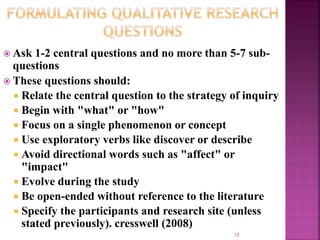
 Ask 1-2 central questions and no more than 5-7 sub-
questions
 These questions should:
 Relate the central question to the strategy of inquiry
 Begin with "what" or "how"
 Focus on a single phenomenon or concept
 Use exploratory verbs like discover or describe
 Avoid directional words such as "affect" or
"impact"
 Evolve during the study
 Be open-ended without reference to the literature
 Specify the participants and research site (unless
stated previously). cresswell (2008)
12
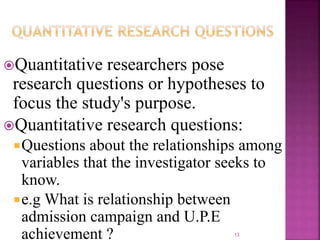
Quantitative researchers pose
research questions or hypotheses to
focus the study's purpose.
Quantitative research questions:
Questions about the relationships among
variables that the investigator seeks to
know.
e.g What is relationship between
admission campaign and U.P.E
achievement ? 13
Does (name the theory) explain the
relationship between (independent
variable) and (dependent variable),
controlling for the effects of (control
variable)?
14
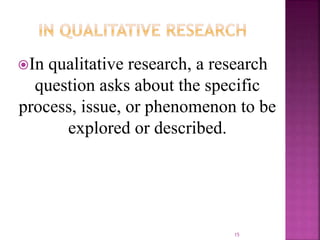
In qualitative research, a research
question asks about the specific
process, issue, or phenomenon to be
explored or described.
15
1. What topic (idea) of study are you interested in?
2. What has already been done in this area (the
literature)?
3. What major outcome(s) (dependent variable) are you
interested in?
4. What intervention (independent variable) are you
interested in?
5. Are you looking for differences or a relationship
(association)?
6. To what group (population) do you wish to apply your
results?
7. What is your specific research question?
8. What answer to your question do you expect to find
(the research hypothesis)?
9. Why is this question important today (relevance)?
16
Whereas research questions in
quantitative research restrict, and commit
researchers to, the variables that will be
addressed, research questions in
qualitative research are broad enough to
permit the discovery of the specific
experiences, events, artifacts, concepts,
or other empirical and/or analytic
subjects that will ultimately be the focus
of study. 17
 Research questions can not be formulate along with
hypothesis.
 Research question should be researchable,
 Research question should be feasible,
 Research question should be evocative,
 Research question should be relevant to the field,
 Research question should be clear,
 Research question should be ethical,
 Research question should not be too long,
 Research question should address the data,
 Research question is limited within the research problem,
18
 Qualitative research questions are limited in their scope
and wording.
 The contents of the question are according to the
phenomena to be studied.
 Research questions may consists of central question and
several sub questions.
 Sub questions may be more than two,
 Question may be reformulate and refinement,
 Sub questions may be specific or broad.
 In qualitative research sub questions may be formulate
during the study,
19
Thank you
20

Formulating Research question and limitaions

  • 1.
    KHURRAM RAFI ROLL NO.14035401-003 M.Phil. Education 1
  • 2.
    Formulation means translatingand transforming the selected research problem into a scientifically answerable research question. This is the aim of the every study. 2
  • 3.
     Questions forqualitative research often have to be designed on the spot, leaving room for people to elaborate on their answers and even to turn the study in a direction the researcher didn't expect. The literature review is the mother of research question. Maxwell (2005) 3
  • 4.
    Useful Techniques Rational thinking Creativethinking  Searching the literature Scanning the media Brainstorming Exploring past projects Discussion Keeping an ideas notebook 4
  • 5.
  • 6.
     In researchwe formulate research question after reviewing the literature,  It enables us to communicate our ideas with others,  We make such research question which may address the relationship among the variables,  In quantitative research It should identify the variables being investigated and specify the type of relationship (descriptive, predictive, or causal) to be investigated.  Research Questions Usually a research problem is initially posed as a question, which serves as the focus of the researcher’s investigation.  Research question should specify What (measureable variables), Who (subjects and controls), Where (location) ,How (method). kent and campbell (2005) 6
  • 7.
    Problem or Issue Definepopulation Define intervention Comparator Outcome measure Write Question 7
  • 8.
    Step 1 :-Do not let the research question be forced upon you. Step 2 :- Find a general area of interest. (Questions asked by our own students and fellows) Step 3 :- Read “around” the topic in width, (broad & extensive ) not in depth ( intensive ) Step 4 :- Identify a specific area of interest where gaps in knowledge exist, need to be filled up, 8
  • 9.
    Step 5 :-Read “ into ” the topic (In depth intensive , Discussions with experts in concerned field.) Step 6 :- Formulate a tentative research question Step 7 :- Evaluate the tentative research question for its “suitability” Step 8:- Make the research question specific, Step 9:- Write down the Research Question & its significance 9
  • 10.
    Narrowing, clarifying, andeven redefining your questions is essential to the research process. Forming the right ‘questions’ should be seen as an iterative process that is informed by reading and doing at all stages. 10
  • 11.
     Qualitative researcherspose research questions  Not objectives  Not hypotheses  Two types of qualitative research questions to focus a study's purpose:  Central question  broad question that asks for exploration of the central phenomenon  Sub questions  Questions that narrow the focus of the study 11
  • 12.
     Ask 1-2central questions and no more than 5-7 sub- questions  These questions should:  Relate the central question to the strategy of inquiry  Begin with "what" or "how"  Focus on a single phenomenon or concept  Use exploratory verbs like discover or describe  Avoid directional words such as "affect" or "impact"  Evolve during the study  Be open-ended without reference to the literature  Specify the participants and research site (unless stated previously). cresswell (2008) 12
  • 13.
    Quantitative researchers pose researchquestions or hypotheses to focus the study's purpose. Quantitative research questions: Questions about the relationships among variables that the investigator seeks to know. e.g What is relationship between admission campaign and U.P.E achievement ? 13
  • 14.
    Does (name thetheory) explain the relationship between (independent variable) and (dependent variable), controlling for the effects of (control variable)? 14
  • 15.
    In qualitative research,a research question asks about the specific process, issue, or phenomenon to be explored or described. 15
  • 16.
    1. What topic(idea) of study are you interested in? 2. What has already been done in this area (the literature)? 3. What major outcome(s) (dependent variable) are you interested in? 4. What intervention (independent variable) are you interested in? 5. Are you looking for differences or a relationship (association)? 6. To what group (population) do you wish to apply your results? 7. What is your specific research question? 8. What answer to your question do you expect to find (the research hypothesis)? 9. Why is this question important today (relevance)? 16
  • 17.
    Whereas research questionsin quantitative research restrict, and commit researchers to, the variables that will be addressed, research questions in qualitative research are broad enough to permit the discovery of the specific experiences, events, artifacts, concepts, or other empirical and/or analytic subjects that will ultimately be the focus of study. 17
  • 18.
     Research questionscan not be formulate along with hypothesis.  Research question should be researchable,  Research question should be feasible,  Research question should be evocative,  Research question should be relevant to the field,  Research question should be clear,  Research question should be ethical,  Research question should not be too long,  Research question should address the data,  Research question is limited within the research problem, 18
  • 19.
     Qualitative researchquestions are limited in their scope and wording.  The contents of the question are according to the phenomena to be studied.  Research questions may consists of central question and several sub questions.  Sub questions may be more than two,  Question may be reformulate and refinement,  Sub questions may be specific or broad.  In qualitative research sub questions may be formulate during the study, 19
  • 20.