R E S E A R C H M E T H O D O L O G Y
LECTURE # 4:
“Formulating a Research Problem”
by Muhammad Salman Jamil
The Research Problem
 A research problem is a statement about:
 Area of concern,
 A condition to be improved
 A difficulty to be eliminated,
 A troubling question that exists in scholarly literature
 In simple words, a research problem is a question that a
researcher wants to answer.
 Research problem depends on several factors such as:
 Researcher’s knowledge
 Skills or Interest
 Expertise or motivation
 Creativity with respect to the subject of inquiry.
 It is believed that most of the good research studies
need lots of time for selection of a research problem.
2
The importance of Research Problem
 The formulation of a research problem is the first and most
important step of the research process.
 It is like the identification of a destination before undertaking a
journey.
 A research problem is like the foundation of a building. The type
and design of the building are dependent upon the foundation.
 A famous saying about computers, ‘garbage in, garbage out’, is
equally applicable to a research problem.
 The formulation of research problem is combination of type of
Study design, type of sampling strategy, type of research
instrument & type of analysis that can be undertaken.
3
Sources of Research Problem
 “Potential research questions may occur to us on a
regular basis, but the process of formulating them in a
meaningful way is not at all an easy task” (Twoomey,
1985).
 As a newcomer it might seem easy to formulate a
problem but it requires considerable knowledge of both
the subject area and research methodology. Once you
examine a question more closely you will soon realize
the complexity of formulating an idea into a problem
which is researchable.
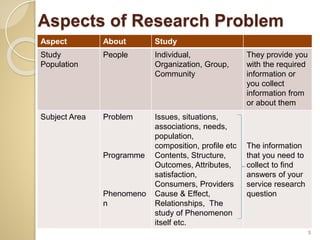
 There are numerous sources from which we extract
information such as
 People
 Problems
 Programme
 Phenomena 4
Aspects of Research Problem
5
Aspect About Study
Study
Population
People Individual,
Organization, Group,
Community
They provide you
with the required
information or
you collect
information from
or about them
Subject Area Problem
Programme
Phenomeno
n
Issues, situations,
associations, needs,
population,
composition, profile etc
Contents, Structure,
Outcomes, Attributes,
satisfaction,
Consumers, Providers
Cause & Effect,
Relationships, The
study of Phenomenon
itself etc.
The information
that you need to
collect to find
answers of your
service research
question
 Every research study has two aspects: the people
provide you with the ‘study population’, whereas the
other three Ps furnish the ‘subject areas’.
 There is need of proper examination of 4Ps related to issues
associated with these categories
 There are lots of problem arises on which problem needs to
identify such as disease, drug rehabilitation, an
immunization programme, the effectiveness of a treatment,
the extent of consumers or customer satisfaction are
examples of these categories.
 The 4Ps is applicable in both categories of research i.e.
Qualitative or Quantitative.
6
Discussion about 4 P’s
4P’s in Qualitative &
Quantitative
 The concept of 4Ps is applicable to both quantitative and
qualitative research though the main difference at this
stage is the extent of their specificity, dissection, precision
and focus.
 In qualitative research these attributes are deliberately
kept very loose so that you can explore more as you go
along, in case you find something of relevance.
Prepared By: Muhammad Salman
Jamil 7
Consideration in selection of
Research Problem
 When selecting a research problem for your study, there
are a few factors which researcher needs to consider.
 These factors will ensure that your research process is
more manageable and you will remain motivated.
 The selection considerations & factors are mentioned
below:
 Interest
 Magnitude
 Measurement of Concept
 Level of Expertise
 Relevance
 Ability of Data
 Ethical Issues
8
 Interest: The most important criterion in selecting a
research problem because it’s time consuming &
hardworking. If the level of interest is not there then its
difficult to keep up the motivation to continue.
 Magnitude: A magnitude plays an important role in
conducting research especially in descriptive study.
Selecting the write magnitude & narrowing down the
topic makes work more manageable, specific and clear.
It also plays an important role in managing within the
time limits along with available resources.
 Measurement of Concept: It is imperative in
Quantitative studies to clear about concepts’ indicators
and their measurement. that you are reasonably clear
about the concepts at every stage.
For Example: Health promotion programme, it require
effectiveness and how it will be measured.
9
 Level of Expertise: The need of expertise is really
important for problem selection, it highlights the area in
which effort is utilized. There is a role of research
supervisors is to help in defining the direction of research
correctly but remember that you need to do most of the
work yourself.
 Relevance: After interest, the relevance is really
important for researchable projects. It motivates the
researcher that the research will add to existing body of
knowledge.
 Ability of Data: If your research title needs collection of
information (journal, reports, proceedings) before
finalizing the title, you need to make sure you have these
materials available and in the relevant format.
10
 Ethical Issues: There is involvement of ethical
issues for research problem. Another important
consideration in formulating a research problem is
the ethical issues involved. How ethical issues can
affect the study population and how ethical
problems can be overcome should be thoroughly
examined at the problem-formulation stage.
11
Formulating Research Problem
 In any research task, the formulation of a research
problem is the most important part of the research
process.
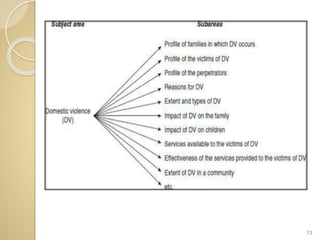
 The process of formulating a research problem consists of
a number of steps, as its help in broaden the knowledge
of subject area:
Identify a broad field or subject area of interest to you – Step I
Dissect the broad area into subareas – Step II
Select what is of most interest to you – Step III
Raise research questions – Step IV
Formulate objectives – Step V
Assess your objectives – Step VI
Double-check – Step VII
12
13
Formulating Research Objective
 Objectives are the goals you set out to attain in your study.
Its important what you want to achieve through the study. It
is divided into two broad categories are:
Main Objectives
Sub Objectives
 The main objective is an overall statement of the thrust of
your study. It is also a statement of the main associations
and relationships that you seek to discover or establish.
 It is considered as the specific aspects of the topic that you
want to investigate within the main framework of your study.
 Sub-objectives should be numerically listed. They should
be worded clearly and unambiguously. It represent only one
aspect of the study by use of action-oriented words or
verbs such ‘to determine’ or ‘to find out’, ‘to ascertain’, ‘to
measure’ and ‘to explore’.
14
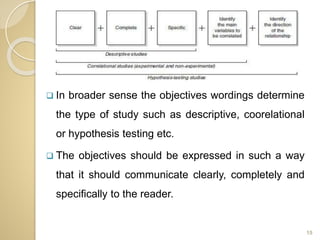
 In broader sense the objectives wordings determine
the type of study such as descriptive, coorelational
or hypothesis testing etc.
 The objectives should be expressed in such a way
that it should communicate clearly, completely and
specifically to the reader.
15
Study Population- Research
Respondents
 Its an important phase of research study & it is
needed to narrow down the whole population to
finalize that who is your respondents who would
answer your research questions.
 The respondent’s criteria might be class of people
required to answer or age group that being focused
or gender, community or geographical locals.
 In quantitative study, it is required to narrow down
research problem & study population. It would help
the researcher to be specific and clear.
 In qualitative research, the study population &
research problem should remain flexible to ensure
the freedom necessary to obtain varied data.
16
Establishing Operational Definition
 In a research study, it is really important for researcher
to develop a set of rules, indicators or yard stick to clear
the meanings of used terms. In a research study you
need to define these clearly in order to avoid ambiguity
and confusion.
 When you define concepts you are planning research
problem or population in a measurable form, termed as
working definitions or operational definitions.
The operational definition:
 Depends upon researcher & type of study.
 Avoid ambiguity & confusion in a research study.
 Have no rules for deciding but it needs the
appropriateness to convince the reader
17
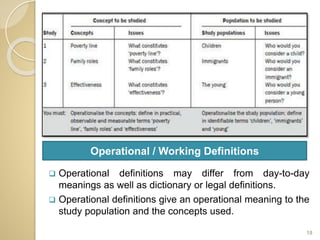
 Operational definitions may differ from day-to-day
meanings as well as dictionary or legal definitions.
 Operational definitions give an operational meaning to the
study population and the concepts used.
18
Operational / Working Definitions

Research Methodology

  • 1.
    R E SE A R C H M E T H O D O L O G Y LECTURE # 4: “Formulating a Research Problem” by Muhammad Salman Jamil
  • 2.
    The Research Problem A research problem is a statement about:  Area of concern,  A condition to be improved  A difficulty to be eliminated,  A troubling question that exists in scholarly literature  In simple words, a research problem is a question that a researcher wants to answer.  Research problem depends on several factors such as:  Researcher’s knowledge  Skills or Interest  Expertise or motivation  Creativity with respect to the subject of inquiry.  It is believed that most of the good research studies need lots of time for selection of a research problem. 2
  • 3.
    The importance ofResearch Problem  The formulation of a research problem is the first and most important step of the research process.  It is like the identification of a destination before undertaking a journey.  A research problem is like the foundation of a building. The type and design of the building are dependent upon the foundation.  A famous saying about computers, ‘garbage in, garbage out’, is equally applicable to a research problem.  The formulation of research problem is combination of type of Study design, type of sampling strategy, type of research instrument & type of analysis that can be undertaken. 3
  • 4.
    Sources of ResearchProblem  “Potential research questions may occur to us on a regular basis, but the process of formulating them in a meaningful way is not at all an easy task” (Twoomey, 1985).  As a newcomer it might seem easy to formulate a problem but it requires considerable knowledge of both the subject area and research methodology. Once you examine a question more closely you will soon realize the complexity of formulating an idea into a problem which is researchable.  There are numerous sources from which we extract information such as  People  Problems  Programme  Phenomena 4
  • 5.
    Aspects of ResearchProblem 5 Aspect About Study Study Population People Individual, Organization, Group, Community They provide you with the required information or you collect information from or about them Subject Area Problem Programme Phenomeno n Issues, situations, associations, needs, population, composition, profile etc Contents, Structure, Outcomes, Attributes, satisfaction, Consumers, Providers Cause & Effect, Relationships, The study of Phenomenon itself etc. The information that you need to collect to find answers of your service research question
  • 6.
     Every researchstudy has two aspects: the people provide you with the ‘study population’, whereas the other three Ps furnish the ‘subject areas’.  There is need of proper examination of 4Ps related to issues associated with these categories  There are lots of problem arises on which problem needs to identify such as disease, drug rehabilitation, an immunization programme, the effectiveness of a treatment, the extent of consumers or customer satisfaction are examples of these categories.  The 4Ps is applicable in both categories of research i.e. Qualitative or Quantitative. 6 Discussion about 4 P’s
  • 7.
    4P’s in Qualitative& Quantitative  The concept of 4Ps is applicable to both quantitative and qualitative research though the main difference at this stage is the extent of their specificity, dissection, precision and focus.  In qualitative research these attributes are deliberately kept very loose so that you can explore more as you go along, in case you find something of relevance. Prepared By: Muhammad Salman Jamil 7
  • 8.
    Consideration in selectionof Research Problem  When selecting a research problem for your study, there are a few factors which researcher needs to consider.  These factors will ensure that your research process is more manageable and you will remain motivated.  The selection considerations & factors are mentioned below:  Interest  Magnitude  Measurement of Concept  Level of Expertise  Relevance  Ability of Data  Ethical Issues 8
  • 9.
     Interest: Themost important criterion in selecting a research problem because it’s time consuming & hardworking. If the level of interest is not there then its difficult to keep up the motivation to continue.  Magnitude: A magnitude plays an important role in conducting research especially in descriptive study. Selecting the write magnitude & narrowing down the topic makes work more manageable, specific and clear. It also plays an important role in managing within the time limits along with available resources.  Measurement of Concept: It is imperative in Quantitative studies to clear about concepts’ indicators and their measurement. that you are reasonably clear about the concepts at every stage. For Example: Health promotion programme, it require effectiveness and how it will be measured. 9
  • 10.
     Level ofExpertise: The need of expertise is really important for problem selection, it highlights the area in which effort is utilized. There is a role of research supervisors is to help in defining the direction of research correctly but remember that you need to do most of the work yourself.  Relevance: After interest, the relevance is really important for researchable projects. It motivates the researcher that the research will add to existing body of knowledge.  Ability of Data: If your research title needs collection of information (journal, reports, proceedings) before finalizing the title, you need to make sure you have these materials available and in the relevant format. 10
  • 11.
     Ethical Issues:There is involvement of ethical issues for research problem. Another important consideration in formulating a research problem is the ethical issues involved. How ethical issues can affect the study population and how ethical problems can be overcome should be thoroughly examined at the problem-formulation stage. 11
  • 12.
    Formulating Research Problem In any research task, the formulation of a research problem is the most important part of the research process.  The process of formulating a research problem consists of a number of steps, as its help in broaden the knowledge of subject area: Identify a broad field or subject area of interest to you – Step I Dissect the broad area into subareas – Step II Select what is of most interest to you – Step III Raise research questions – Step IV Formulate objectives – Step V Assess your objectives – Step VI Double-check – Step VII 12
  • 13.
  • 14.
    Formulating Research Objective Objectives are the goals you set out to attain in your study. Its important what you want to achieve through the study. It is divided into two broad categories are: Main Objectives Sub Objectives  The main objective is an overall statement of the thrust of your study. It is also a statement of the main associations and relationships that you seek to discover or establish.  It is considered as the specific aspects of the topic that you want to investigate within the main framework of your study.  Sub-objectives should be numerically listed. They should be worded clearly and unambiguously. It represent only one aspect of the study by use of action-oriented words or verbs such ‘to determine’ or ‘to find out’, ‘to ascertain’, ‘to measure’ and ‘to explore’. 14
  • 15.
     In broadersense the objectives wordings determine the type of study such as descriptive, coorelational or hypothesis testing etc.  The objectives should be expressed in such a way that it should communicate clearly, completely and specifically to the reader. 15
  • 16.
    Study Population- Research Respondents Its an important phase of research study & it is needed to narrow down the whole population to finalize that who is your respondents who would answer your research questions.  The respondent’s criteria might be class of people required to answer or age group that being focused or gender, community or geographical locals.  In quantitative study, it is required to narrow down research problem & study population. It would help the researcher to be specific and clear.  In qualitative research, the study population & research problem should remain flexible to ensure the freedom necessary to obtain varied data. 16
  • 17.
    Establishing Operational Definition In a research study, it is really important for researcher to develop a set of rules, indicators or yard stick to clear the meanings of used terms. In a research study you need to define these clearly in order to avoid ambiguity and confusion.  When you define concepts you are planning research problem or population in a measurable form, termed as working definitions or operational definitions. The operational definition:  Depends upon researcher & type of study.  Avoid ambiguity & confusion in a research study.  Have no rules for deciding but it needs the appropriateness to convince the reader 17
  • 18.
     Operational definitionsmay differ from day-to-day meanings as well as dictionary or legal definitions.  Operational definitions give an operational meaning to the study population and the concepts used. 18 Operational / Working Definitions