LAYOUT DESIGN RULES                                               21


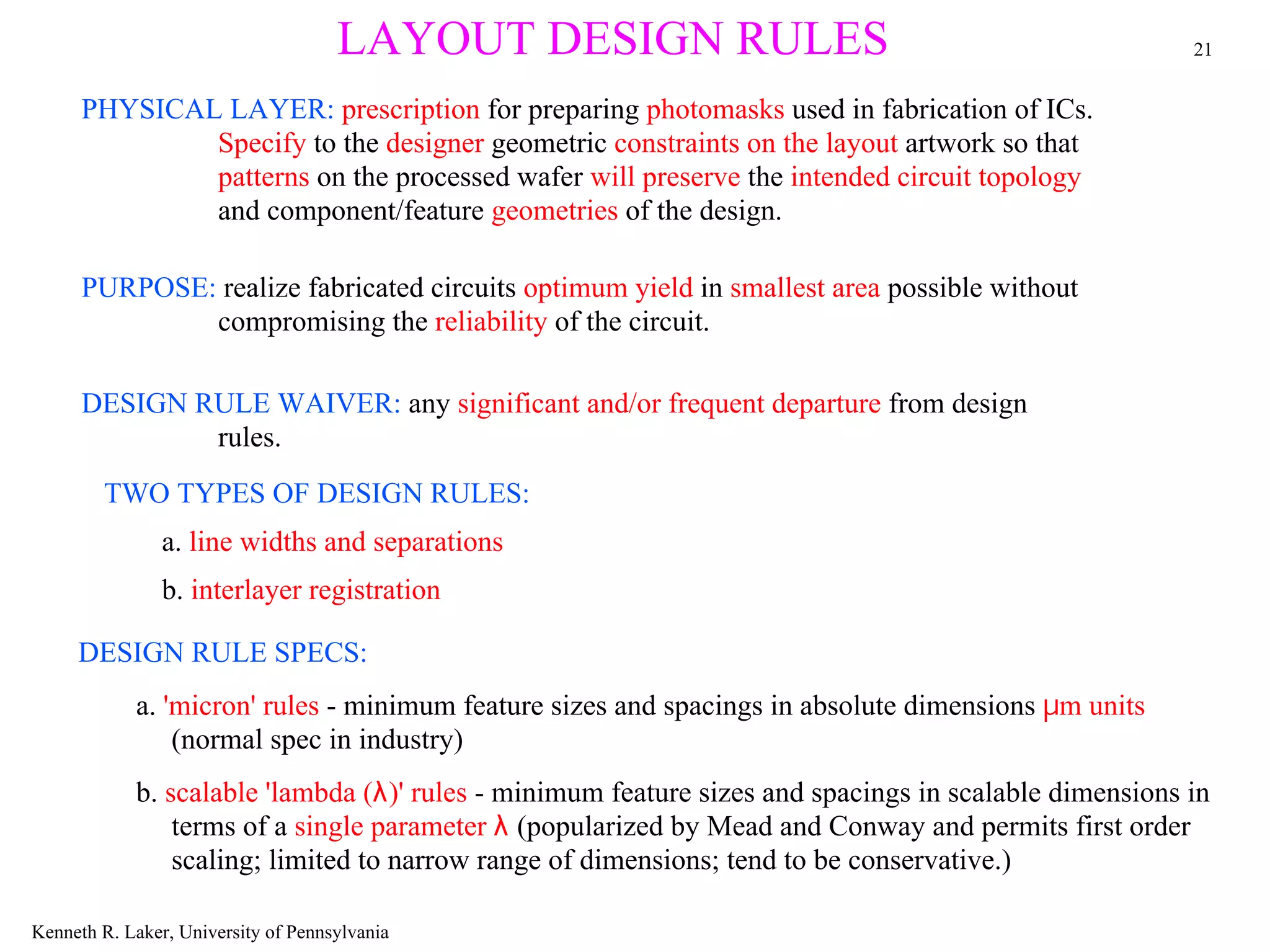
      PHYSICAL LAYER: prescription for preparing photomasks used in fabrication of ICs.
              Specify to the designer geometric constraints on the layout artwork so that
              patterns on the processed wafer will preserve the intended circuit topology
              and component/feature geometries of the design.

      PURPOSE: realize fabricated circuits optimum yield in smallest area possible without
              compromising the reliability of the circuit.

      DESIGN RULE WAIVER: any significant and/or frequent departure from design
              rules.
        TWO TYPES OF DESIGN RULES:
                a. line widths and separations
                b. interlayer registration

     DESIGN RULE SPECS:
            a. 'micron' rules - minimum feature sizes and spacings in absolute dimensions µm units
                (normal spec in industry)
            b. scalable 'lambda (λ)' rules - minimum feature sizes and spacings in scalable dimensions in
                terms of a single parameter λ (popularized by Mead and Conway and permits first order
                scaling; limited to narrow range of dimensions; tend to be conservative.)

Kenneth R. Laker, University of Pennsylvania
22


                                               LAYOUT DESIGN RULES

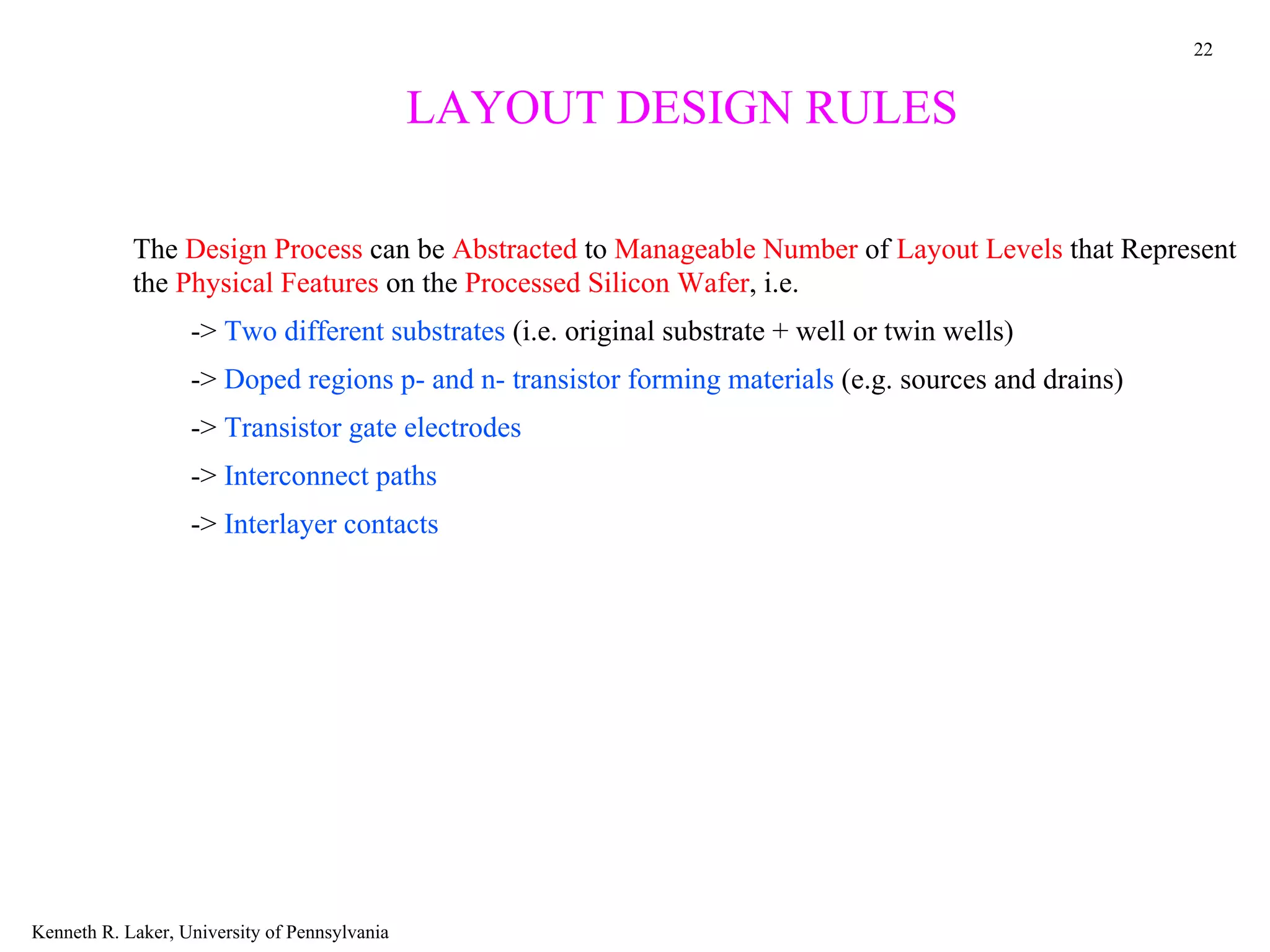
            The Design Process can be Abstracted to Manageable Number of Layout Levels that Represent
            the Physical Features on the Processed Silicon Wafer, i.e.
                   -> Two different substrates (i.e. original substrate + well or twin wells)
                   -> Doped regions p- and n- transistor forming materials (e.g. sources and drains)
                   -> Transistor gate electrodes
                   -> Interconnect paths
                   -> Interlayer contacts


Kenneth R. Laker, University of Pennsylvania
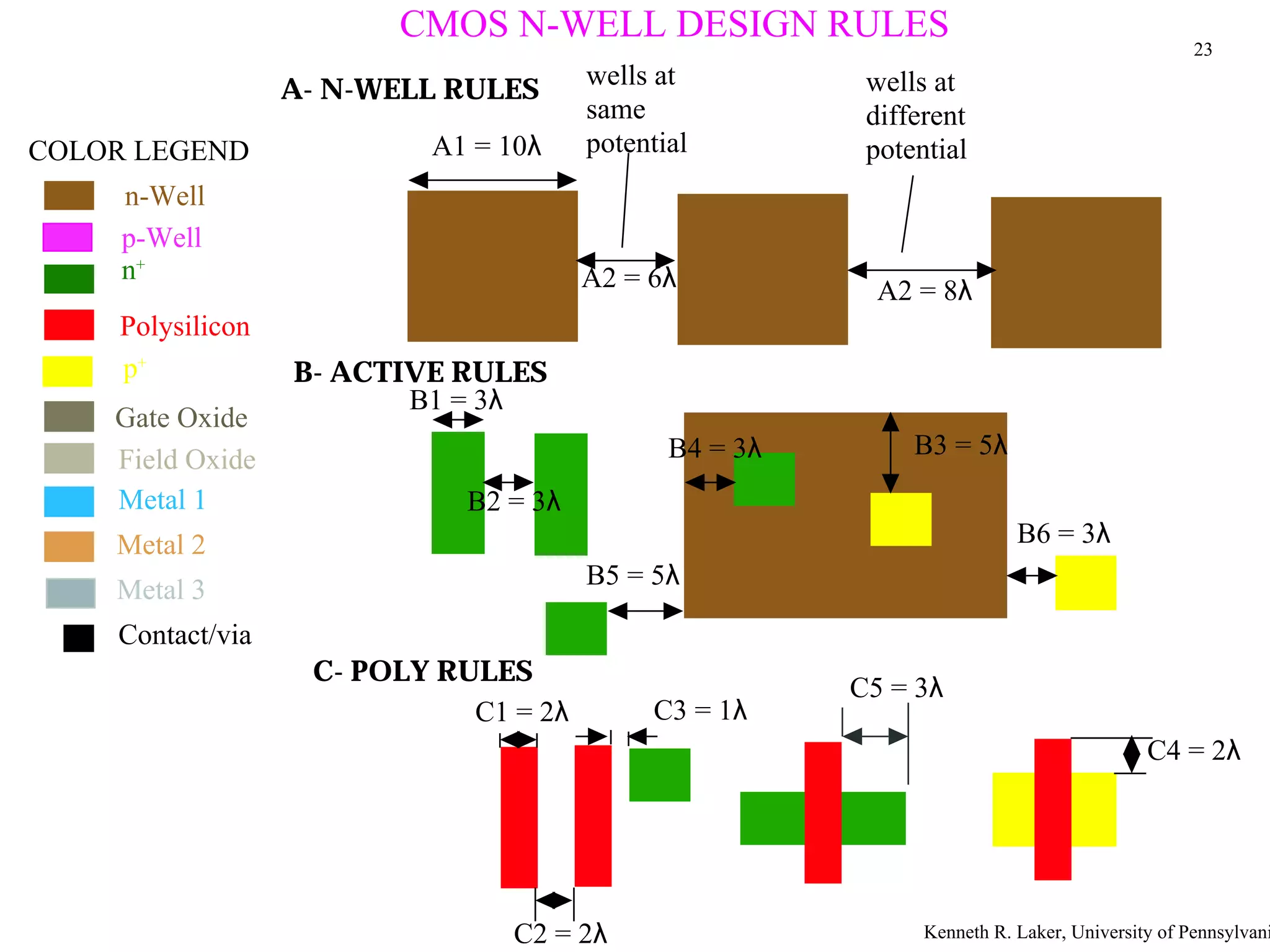
CMOS N-WELL DESIGN RULES                                               23
                                       wells at          wells at
                  A- N-WELL RULES
                                       same              different
COLOR LEGEND              A1 = 10λ     potential         potential
     n-Well
     p-Well
     n+                                A2 = 6λ            A2 = 8λ
    Polysilicon
    p+            B- ACTIVE RULES
                         B1 = 3λ
    Gate Oxide
                                              B4 = 3λ        B3 = 5λ
    Field Oxide
    Metal 1                  B2 = 3λ
    Metal 2                                                              B6 = 3λ
                                       B5 = 5λ
    Metal 3
    Contact/via
                   C- POLY RULES
                                                        C5 = 3λ
                             C1 = 2λ        C3 = 1λ
                                                                                         C4 = 2λ


                                C2 = 2λ                       Kenneth R. Laker, University of Pennsylvani
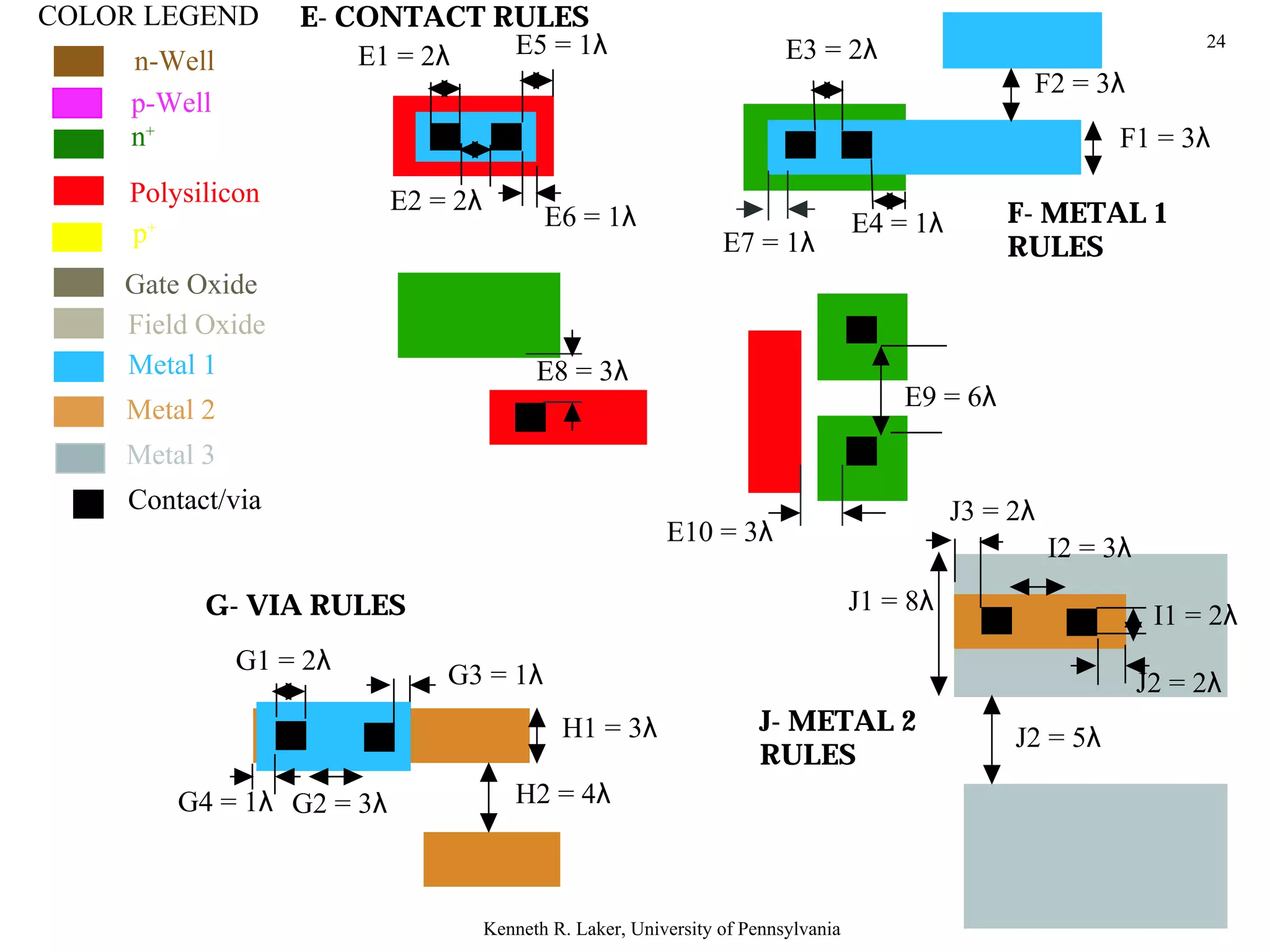
COLOR LEGEND      E- CONTACT RULES
                      E1 = 2λ E5 = 1λ                                E3 = 2λ                                      24
     n-Well
                                                                                               F2 = 3λ
     p-Well
     n+                                                                                                 F1 = 3λ
    Polysilicon           E2 = 2λ
                                       E6 = 1λ                                 E4 = 1λ       F- METAL 1
    p+                                                       E7 = 1λ                         RULES
    Gate Oxide
    Field Oxide
    Metal 1                           E8 = 3λ
    Metal 2                                                                        E9 = 6λ

    Metal 3
    Contact/via                                                                          J3 = 2λ
                                                      E10 = 3λ
                                                                                                   I2 = 3λ

          G- VIA RULES                                                         J1 = 8λ                        I1 = 2λ
              G1 = 2λ         G3 = 1λ                                                                        J2 = 2λ
                                         H1 = 3λ                  J- METAL 2
                                                                                              J2 = 5λ
                                                                  RULES
        G4 = 1λ G2 = 3λ             H2 = 4λ


                                Kenneth R. Laker, University of Pennsylvania
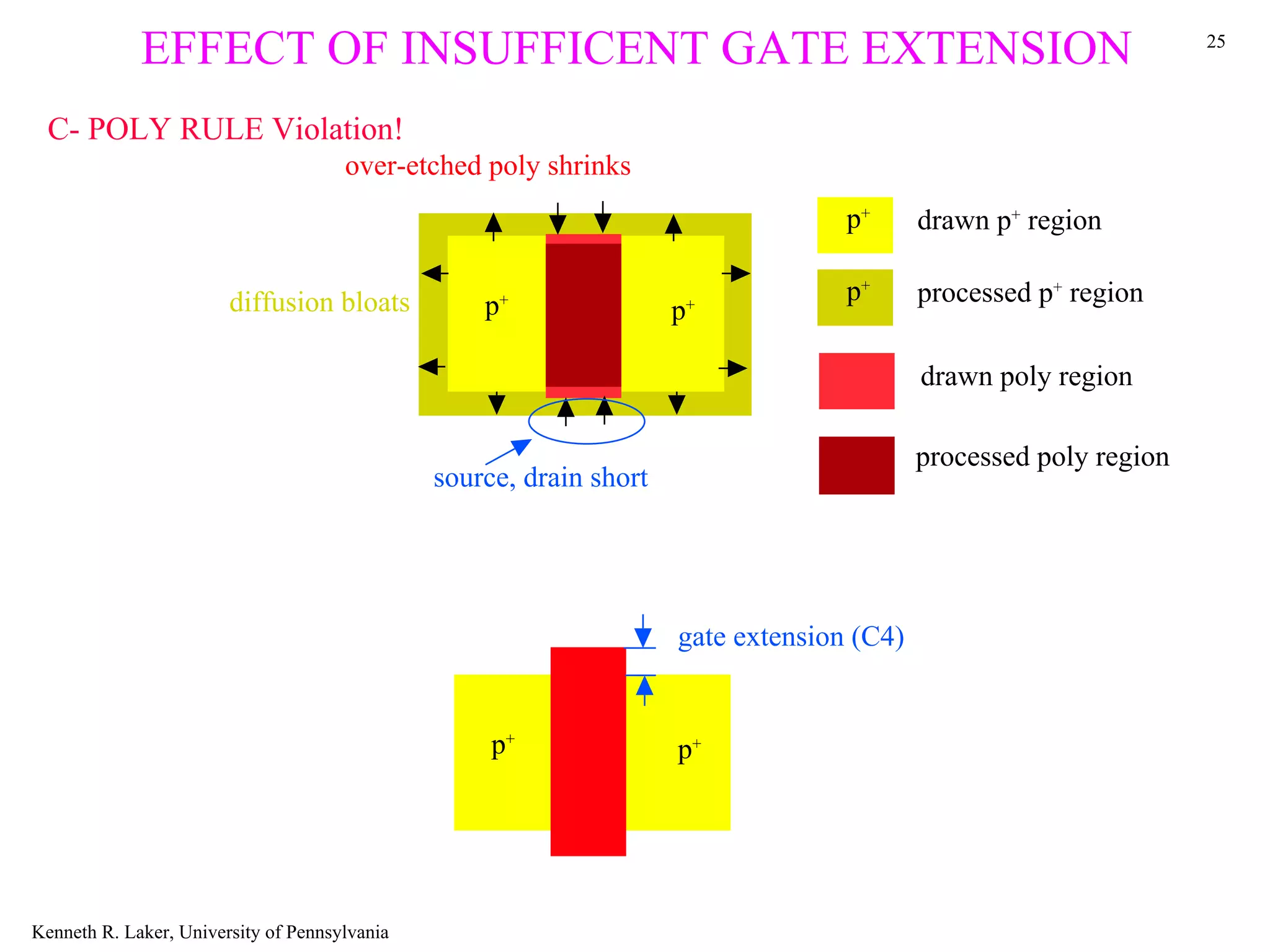
EFFECT OF INSUFFICENT GATE EXTENSION                                                                  25


 C- POLY RULE Violation!
                                      over-etched poly shrinks
                                                                                   p+      drawn p+ region

                        diffusion bloats                                           p+      processed p+ region
                                                   p+                p+


                                                                                           drawn poly region

                                                                                           processed poly region
                                               source, drain short


                                                                     gate extension (C4)


                                                    p+               p+


Kenneth R. Laker, University of Pennsylvania
26

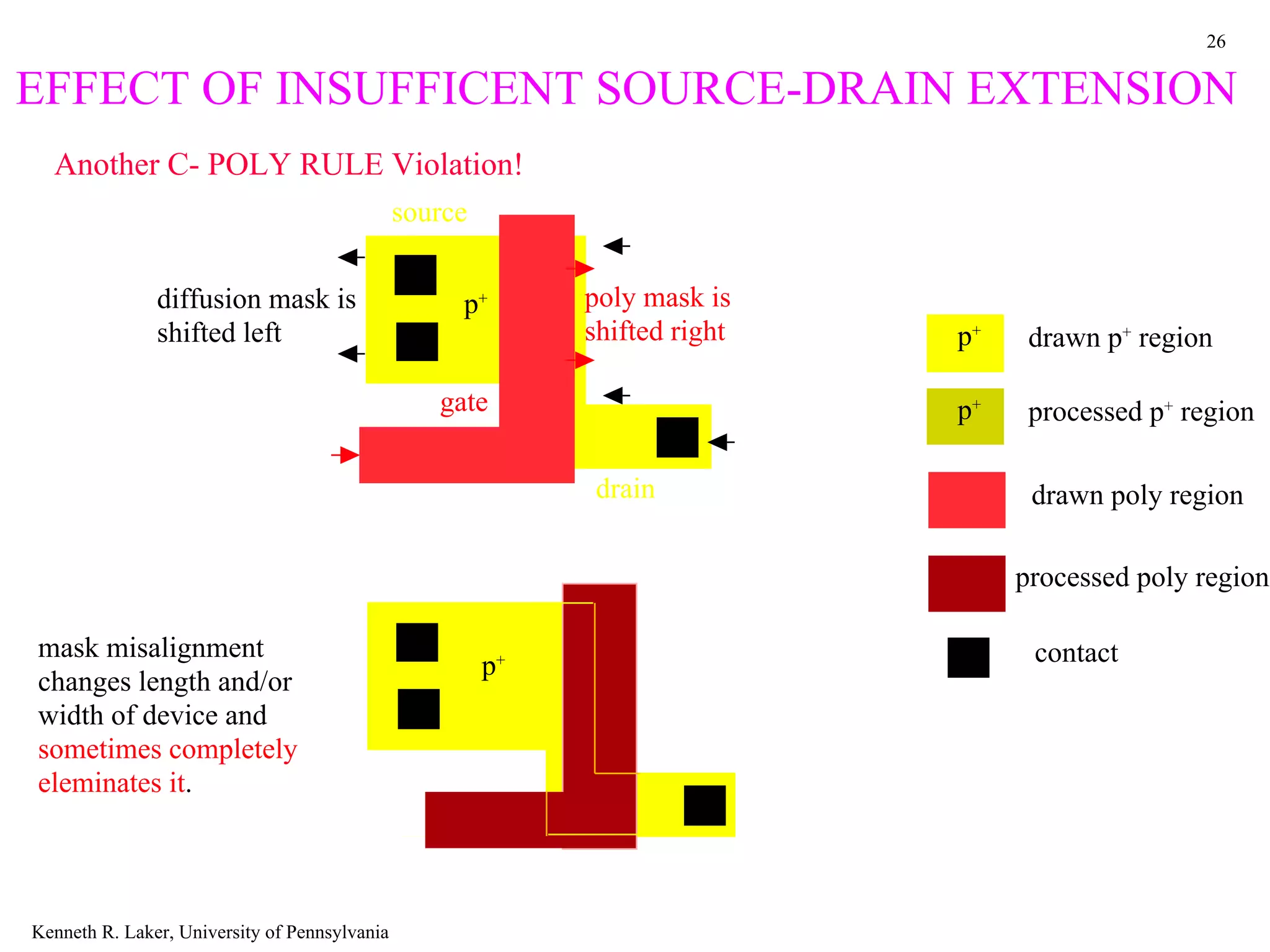
EFFECT OF INSUFFICENT SOURCE-DRAIN EXTENSION
  Another C- POLY RULE Violation!
                                               source


               diffusion mask is                    p+       poly mask is
               shifted left                                  shifted right   p+    drawn p+ region

                                                  gate                       p+    processed p+ region

                                                             drain                 drawn poly region

                                                                                  processed poly region

mask misalignment                                                                  contact
                                                        p+
changes length and/or
width of device and
sometimes completely
eleminates it.


Kenneth R. Laker, University of Pennsylvania
27


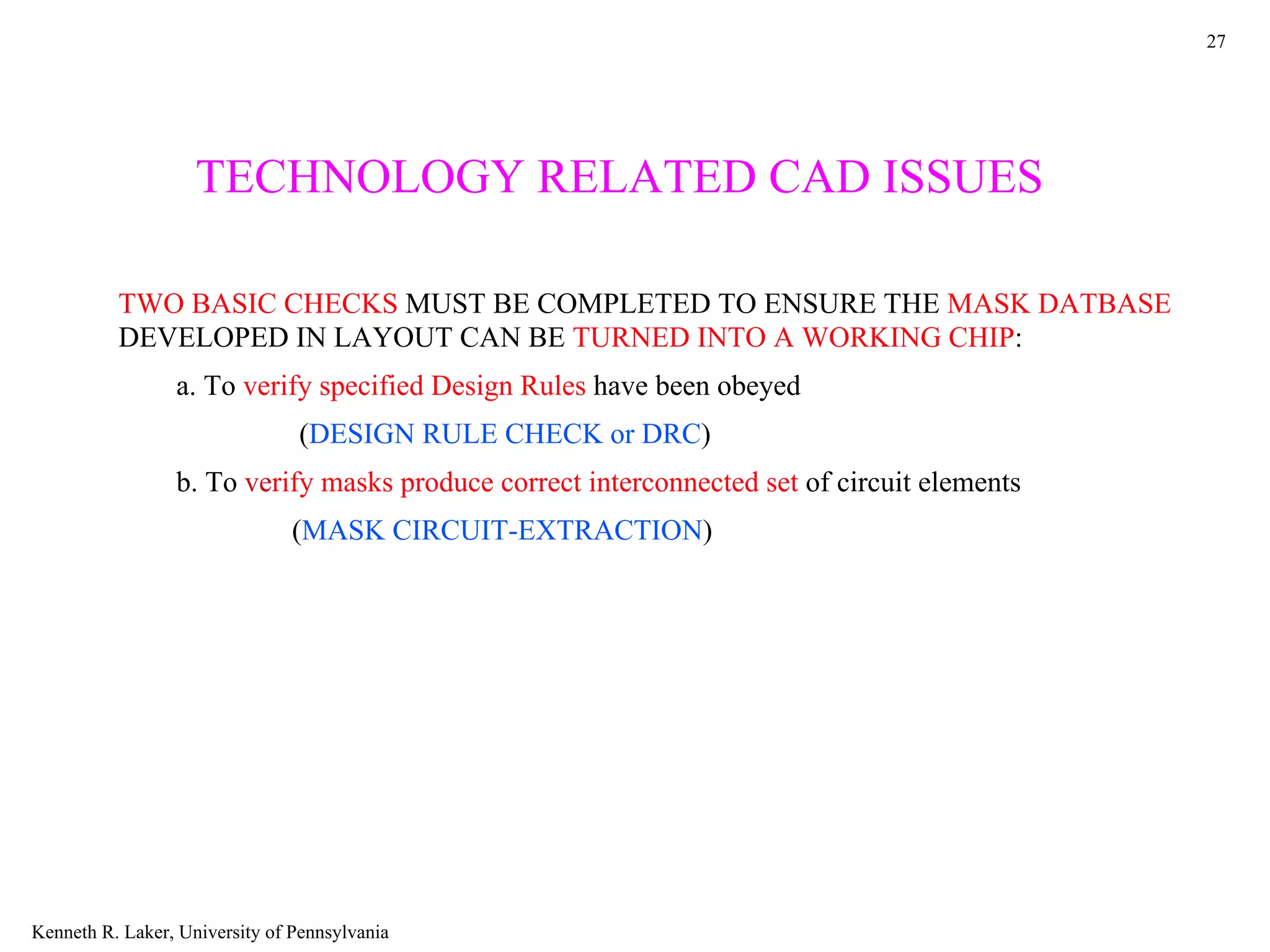
                    TECHNOLOGY RELATED CAD ISSUES

          TWO BASIC CHECKS MUST BE COMPLETED TO ENSURE THE MASK DATBASE
          DEVELOPED IN LAYOUT CAN BE TURNED INTO A WORKING CHIP:
                 a. To verify specified Design Rules have been obeyed
                                (DESIGN RULE CHECK or DRC)
                 b. To verify masks produce correct interconnected set of circuit elements
                                (MASK CIRCUIT-EXTRACTION)


Kenneth R. Laker, University of Pennsylvania
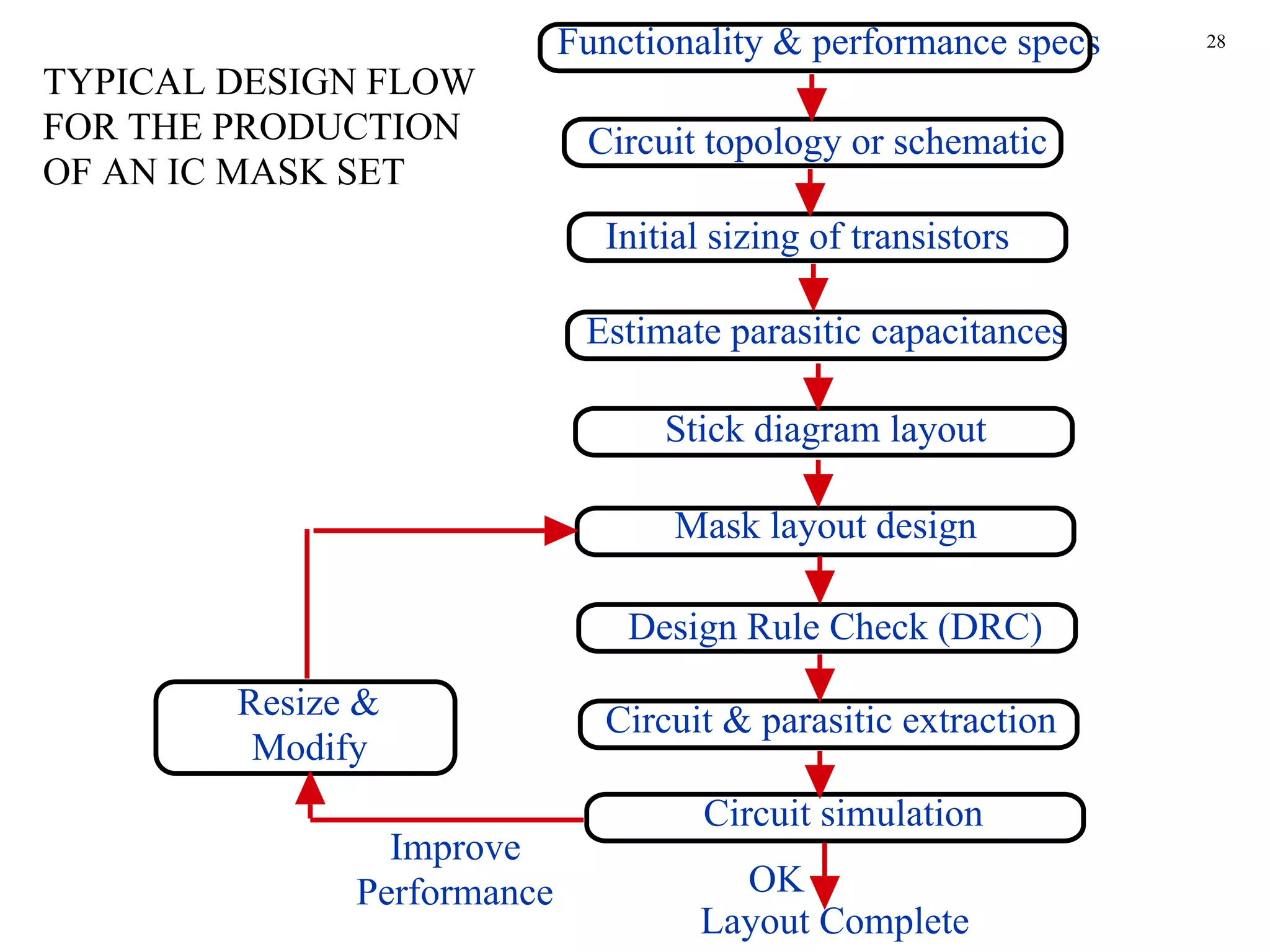
Functionality & performance specs   28

TYPICAL DESIGN FLOW
FOR THE PRODUCTION           Circuit topology or schematic
OF AN IC MASK SET
                              Initial sizing of transistors

                             Estimate parasitic capacitances

                                  Stick diagram layout

                                   Mask layout design

                                Design Rule Check (DRC)
        Resize &              Circuit & parasitic extraction
         Modify
                                     Circuit simulation
                Improve
              Performance             OK
                                    Layout Complete

Layout rules

  • 1.
    LAYOUT DESIGN RULES 21 PHYSICAL LAYER: prescription for preparing photomasks used in fabrication of ICs. Specify to the designer geometric constraints on the layout artwork so that patterns on the processed wafer will preserve the intended circuit topology and component/feature geometries of the design. PURPOSE: realize fabricated circuits optimum yield in smallest area possible without compromising the reliability of the circuit. DESIGN RULE WAIVER: any significant and/or frequent departure from design rules. TWO TYPES OF DESIGN RULES: a. line widths and separations b. interlayer registration DESIGN RULE SPECS: a. 'micron' rules - minimum feature sizes and spacings in absolute dimensions µm units (normal spec in industry) b. scalable 'lambda (λ)' rules - minimum feature sizes and spacings in scalable dimensions in terms of a single parameter λ (popularized by Mead and Conway and permits first order scaling; limited to narrow range of dimensions; tend to be conservative.) Kenneth R. Laker, University of Pennsylvania
  • 2.
    22 LAYOUT DESIGN RULES The Design Process can be Abstracted to Manageable Number of Layout Levels that Represent the Physical Features on the Processed Silicon Wafer, i.e. -> Two different substrates (i.e. original substrate + well or twin wells) -> Doped regions p- and n- transistor forming materials (e.g. sources and drains) -> Transistor gate electrodes -> Interconnect paths -> Interlayer contacts Kenneth R. Laker, University of Pennsylvania
  • 3.
    CMOS N-WELL DESIGNRULES 23 wells at wells at A- N-WELL RULES same different COLOR LEGEND A1 = 10λ potential potential n-Well p-Well n+ A2 = 6λ A2 = 8λ Polysilicon p+ B- ACTIVE RULES B1 = 3λ Gate Oxide B4 = 3λ B3 = 5λ Field Oxide Metal 1 B2 = 3λ Metal 2 B6 = 3λ B5 = 5λ Metal 3 Contact/via C- POLY RULES C5 = 3λ C1 = 2λ C3 = 1λ C4 = 2λ C2 = 2λ Kenneth R. Laker, University of Pennsylvani
  • 4.
    COLOR LEGEND E- CONTACT RULES E1 = 2λ E5 = 1λ E3 = 2λ 24 n-Well F2 = 3λ p-Well n+ F1 = 3λ Polysilicon E2 = 2λ E6 = 1λ E4 = 1λ F- METAL 1 p+ E7 = 1λ RULES Gate Oxide Field Oxide Metal 1 E8 = 3λ Metal 2 E9 = 6λ Metal 3 Contact/via J3 = 2λ E10 = 3λ I2 = 3λ G- VIA RULES J1 = 8λ I1 = 2λ G1 = 2λ G3 = 1λ J2 = 2λ H1 = 3λ J- METAL 2 J2 = 5λ RULES G4 = 1λ G2 = 3λ H2 = 4λ Kenneth R. Laker, University of Pennsylvania
  • 5.
    EFFECT OF INSUFFICENTGATE EXTENSION 25 C- POLY RULE Violation! over-etched poly shrinks p+ drawn p+ region diffusion bloats p+ processed p+ region p+ p+ drawn poly region processed poly region source, drain short gate extension (C4) p+ p+ Kenneth R. Laker, University of Pennsylvania
  • 6.
    26 EFFECT OF INSUFFICENTSOURCE-DRAIN EXTENSION Another C- POLY RULE Violation! source diffusion mask is p+ poly mask is shifted left shifted right p+ drawn p+ region gate p+ processed p+ region drain drawn poly region processed poly region mask misalignment contact p+ changes length and/or width of device and sometimes completely eleminates it. Kenneth R. Laker, University of Pennsylvania
  • 7.
    27 TECHNOLOGY RELATED CAD ISSUES TWO BASIC CHECKS MUST BE COMPLETED TO ENSURE THE MASK DATBASE DEVELOPED IN LAYOUT CAN BE TURNED INTO A WORKING CHIP: a. To verify specified Design Rules have been obeyed (DESIGN RULE CHECK or DRC) b. To verify masks produce correct interconnected set of circuit elements (MASK CIRCUIT-EXTRACTION) Kenneth R. Laker, University of Pennsylvania
  • 8.
    Functionality & performancespecs 28 TYPICAL DESIGN FLOW FOR THE PRODUCTION Circuit topology or schematic OF AN IC MASK SET Initial sizing of transistors Estimate parasitic capacitances Stick diagram layout Mask layout design Design Rule Check (DRC) Resize & Circuit & parasitic extraction Modify Circuit simulation Improve Performance OK Layout Complete