DENSE WAVELENGTH DIVISION MULTIPLEXING PRESNTED BY: 1.NAVEEN TIWARI 2.NAVEEN KUSHWAHA 3.MOHIT KUMAR
CONTENTS Introduction DWDM Technology DWDM System & Components Topology Transmission Challenges Market Dynamics Future Applications
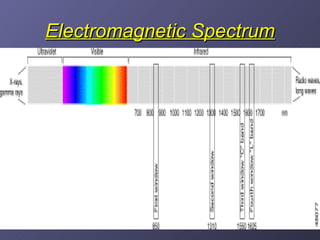
Electromagnetic Spectrum
INTRODUCTION One of the major issues in the networking industry today is tremendous demand for more and more bandwidth. With the development of Optical network and the use Dense Wavelength Division Technology, a new and probably, a very crucial milestone is being reached in network evaluation.
OPTICAL NETWORKING Optical networks are high-capacity telecommunications networks based on optical technologies. The origin of optical networks is linked to  Wavelength Division Multiplexing (WDM) which arose to provide additional capacity on existing fibers.
CLASSIFICATION OF OPTICAL NETWORK FIRST GENERATION :  Networks use Cu based or microwave technology based. SECAND  GENERATION :  Networks use  microwave links with optical fibers. THIRED GENERATION :  Networks employ Wavelength Division Multiplexing technology.
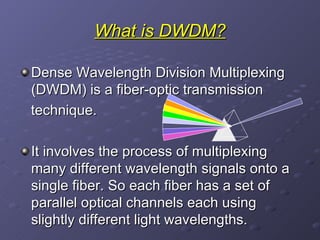
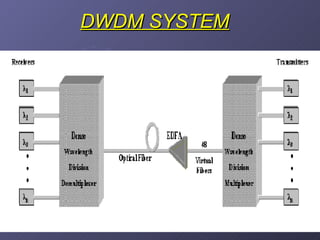
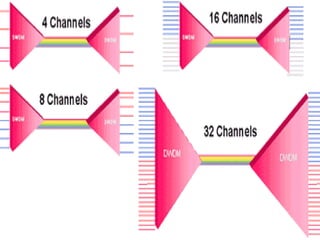
What is DWDM? Dense Wavelength Division Multiplexing (DWDM) is a fiber-optic transmission technique.  It involves the process of multiplexing many different wavelength signals onto a single fiber. So each fiber has a set of parallel optical channels each using slightly different light wavelengths.
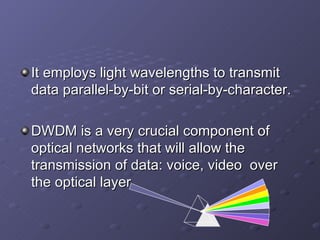
It employs light wavelengths to transmit data parallel-by-bit or serial-by-character. DWDM is a very crucial component of optical networks that will allow the transmission of data: voice, video  over the optical layer.
It transmits multiple data signals using different wavelengths of light through a single fiber. Incoming optical signals are assigned to specific frequencies within a designated frequency band. The capacity of fiber is increased when these signals are multiplexed onto one fiber
Transmission capabilities is 4-8 times of TDM Systems with the help of Erbium doped optical amplifier. EDFA’s : increase the optical signal and don’t have to regenerate signal to boost it strength. It lengthens the distances of transmission to more than 300 km before regeneration .
Why DWDM? Unlimited Transmission Capacity Transparency Scalability Dynamic Provisioning
Is DWDM Flexible? DWDM is a protocol and bit rate independent hence, data signals such as ATM, SONET and IP can be transmitted through same stream regardless their speed difference. The signals are never terminated within the optical layer allows the independence of bit rate and protocols,allowing DWDM technology to be integrated with existing equipment in network. Hence, there’s a flexibility to expand capacity within any portion of their networks.
Is DWDM Expandable? “  DWDM technology gives us the ability to expand out fiber network rapidly to meet growing demands of our customer”, said Mike Flynn, group President for ALLTEL’s communications operations. DWDM coupled with ATM simplifies the network, reduce network costs and provide new services. They can add current and new TDM systems to their existing technology to create a system with virtually endless capacity expansion
DISADVANTAGES Not cost effective for low channel  numbers  Sonet/sdh network management system Are not well equipped to handle dwdm topologies
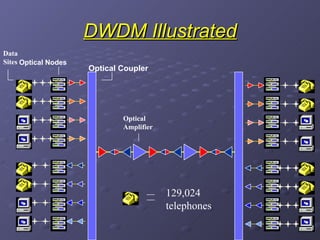
DWDM Illustrated Optical Nodes Optical Amplifier 129,024 telephones Data Sites Optical Coupler
DWDM SYSTEM
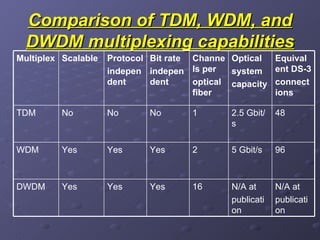
Comparison of TDM, WDM, and DWDM multiplexing capabilities N/A at publication N/A at publication 16 Yes Yes Yes DWDM 96 5 Gbit/s 2 Yes Yes Yes WDM 48 2.5 Gbit/s 1 No No No TDM Equivalent DS-3 connections Optical system capacity Channels per optical fiber Bit rate independent Protocol independent Scalable Multiplex
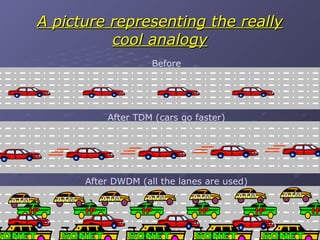
A really cool analogy Think of the fiber as a multilane highway Traditional TDM systems use only one lane, and to increase throughput, the cars speed up. Because only one lane is used, only one type of traffic can flow. DWDM networks allow traffic to use the rest of the unused lanes. By using more lanes, different types of data can flow at different rates.
A picture representing the really cool analogy Before After TDM (cars go faster) After DWDM (all the lanes are used) ATM ATM ATM ATM ATM ATM ATM IP IP IP IP IP IP SONET SONET SONET SONET SONET
Example of Speeds Currently Lucent DWDM systems support transmissions of 160 separate wavelengths.  Each wavelength is capable of supporting a signal of up to 10 Gbps. The total combined bandwidth is 1.6 trillion bits per second. This is greater than the speed of one million T-1 connections.
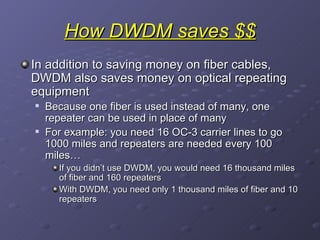
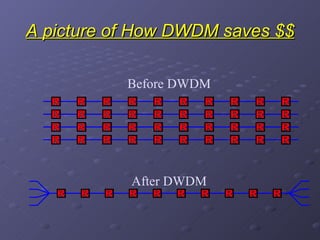
How DWDM saves $$ In addition to saving money on fiber cables, DWDM also saves money on optical repeating equipment Because one fiber is used instead of many, one repeater can be used in place of many For example: you need 16 OC-3 carrier lines to go 1000 miles and repeaters are needed every 100 miles… If you didn’t use DWDM, you would need 16 thousand miles of fiber and 160 repeaters With DWDM, you need only 1 thousand miles of fiber and 10 repeaters
A picture of How DWDM saves $$ R R R R R R R R R R R R R R R R R R R R R R R R R R R R R R R R R R R R R R R R Before DWDM R R R R R R R R R R After DWDM
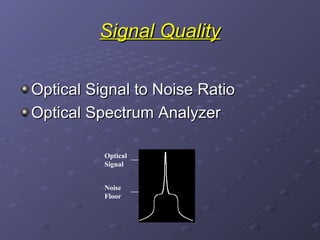
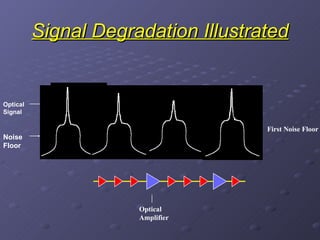
Signal Quality Optical Signal to Noise Ratio Optical Spectrum Analyzer Optical Signal Noise Floor
Signal Degradation Illustrated Optical Amplifier First Noise Floor Noise Floor Optical Signal
DWDM Components Transmitter : Laser with precise stable waveleng-th. Link: Optical fiber that exhibits low loss and transmission performance in relevant wavelength spectra. Receiver:Photo detectors and Optical demultiple-xers using thin film filters or diffractive elements. Optical add/drop multiplexers and optical cross connect components.
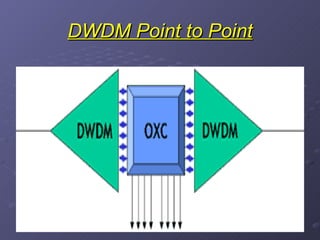
DWDM Point to Point
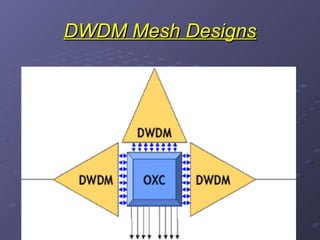
DWDM Mesh Designs
 
Advantages of DWDM Point to Point Systems The   DWDM point-to-point architecture is  simple to build and troubleshoot  . It enables protocol transparency, increme-ntal growth, and capacity expansion over time, while dramatically reducing start-up costs .  Point-to-point solutions are also extremely efficient. No amplifiers or additional equipment required.
DWDM System Characteristics Well-engineered DWDM systems offer component reliability, system availability, and system margin. Although filters were often susceptible to humidity, this is no longer the case. An optical amplifier has two key elements: the optical fiber that is doped with the element erbium and the amplifier.  Automatic adjustment of the optical amplifiers when channels are added or removed achieves optimal system performance.
In the 1530- to 1565-nm range, silica-based optical amplifiers with filters and fluoride-based optical amplifiers perform equally well. The system wavelength and bit rate can be upgraded but planning for this is critical.
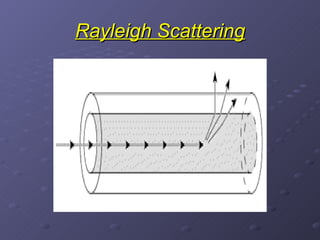
Transmission Challenges Attenuation Attenuation is caused by : -  intrinsic factors primarily  scattering and absorption -  extrinsic factors, including stress from the manufacturing process, the environment, and physical bending Rayleigh scattering  - is an issue at shorter wavelengths
Rayleigh Scattering
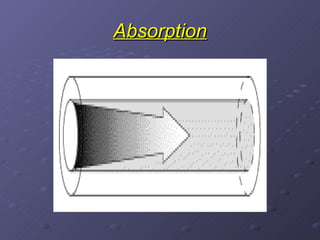
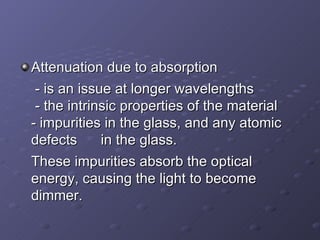
Attenuation due to absorption  - is an issue at longer wavelengths   - the intrinsic properties of the material  - impurities in the glass, and any atomic defects  in the glass.  These impurities absorb the optical energy, causing the light to become dimmer.
Absorption
Dispersion Dispersion is the spreading of light pulses as they travel down optical fiber. Dispersion results in distortion of the signal, which limits the bandwidth of the fiber. Two general types of dispersion Chromatic Dispersion -  is linear  Chromatic dispersion occurs because different wavelengths propagate at different speeds.  Increases as the square of the bit rate.  Polarization Mode Dispersion -  is nonlinear.  Polarization mode dispersion (PMD) is caused by ovality of the fiber shape as a result of the manufacturing process or from external stressors.
Changes over time  PMD is generally not a problem at speeds below OC-192. Smearing of the signal   Fiber Non Linear ties Because nonlinear effects tend to manifest themselves when optical power is very high, they become important in DWDM. These nonlinearities fall into two broad groups: -  scattering  phenomena -  refractive index phenomena
Scattering Phenomena   -  Stimulated Brillouin Scattering (SBS)   - Stimulated Raman Scattering (SRS)    Solution use moderate channel powers and densely packed channel plan that minimizes the overall width of the spectrum. Refractive Index Phenomena This group of nonlinearities includes    -  self-phase modulation (SPM)   - cross-phase modulation (CPM)   - four-wave mixing (FWM)
SPM   - This phenomena causes the signal's  spectrum to widen and can lead to crosstalk or  an unexpected dispersion penalty.  Four-wave mixing   -  results in cross-talk and signal-to-noise      degradation.    - troublesome in the dispersion shifted fiber    that is used to propagate STM-64/OC-192.    - limit the channel capacity of a DWDM      system.
Market Scope and Company Profile KMI Corporation The DWDM systems market jumped from $4.2 billion in 1999 to $8.9 billion in 2000. From $1.7 billion in 1997, the market has grown at a 73% CAGR over the last four years. This growth reflects several trends:   - a maturation of the long distance segment of   the DWDM equipment market   - stiffening competition that will lead to price    pressures
From 1999 to 2000   - the number of vendors offering DWDM   system-level products grew from 15 to 30   - the number of carriers that have deployed    DWDM climbed from 75 to 175. -  the number of contracts for DWDM will    double from 75 to 150. -  Such growth reflects the tremendous  demand long-distance carriers face for transport in bandwidth. Lucent Technologies - five-year agreement with Bell Atlantic valued at approximately $500 million for optical networking, including DWDM, network management software and SONET transmission equipment.
According to Dell'Oro Group, Lucent captured the largest market share - 34 percent (or approximately $1.3 billion) - of the $3.8 billion global DWDM equipment market in 1999. Lucent will install the DWDM optical networking system in the new, 900- mile (1,300 km) route between Xian and Wuhan which is worth more than $10 million. "Getting an early lead in this market will prove to be very important," said Scott Clavenna, principal analyst at Pioneer Consulting, which has forecast the metro DWDM market to grow to nearly $1 billion by 2003.
Future of DWDM What the future holds Two-way  video communication  Digital video for our everyday use at home and at work. Change from voice telephony to digital data heavy  with  video to require multiplying backbone transmission capacity. The Ultimate Squeeze   - reducing the “space” between wavelengths   - expanding the range of transmission    wavelengths - better EDFAs
Develop better equipment for switching and manipulating the various wavelengths after the signal emerges from the optical “pipe.” WDM is creating huge new information pipelines that will bring better service at lower cost. But the real information revolution won’t come until cheap WDM pipelines reach individual residences.
Applications of DWDM DWDM is ready made for long-distance telecommunications operators that use either point-to-point or ring topologies.  Building or expanding networks  Network wholesalers can lease capacity, rather than entire fibers.  The transparency of DWDM systems to various bit rates and protocols. Utilize the existing thin fiber  DWDM improves signal transmission
Summary Telco network growth was badly under estimated DWDM was introduced to increase bandwidth by better utilizing existing fiber optic cabling DWDM is able to place many network formats of different speeds on the same fiber optic cable Optical Add-Drop Multiplexers and Cross Connects are what places the digital signals on the fiber Less cable and therefore less optical repeating equipment is needed for DWDM  DWDM SAVES $$$
Thank You  For Your Attention

Dwdm

  • 1.
    DENSE WAVELENGTH DIVISIONMULTIPLEXING PRESNTED BY: 1.NAVEEN TIWARI 2.NAVEEN KUSHWAHA 3.MOHIT KUMAR
  • 2.
    CONTENTS Introduction DWDMTechnology DWDM System & Components Topology Transmission Challenges Market Dynamics Future Applications
  • 3.
  • 4.
    INTRODUCTION One ofthe major issues in the networking industry today is tremendous demand for more and more bandwidth. With the development of Optical network and the use Dense Wavelength Division Technology, a new and probably, a very crucial milestone is being reached in network evaluation.
  • 5.
    OPTICAL NETWORKING Opticalnetworks are high-capacity telecommunications networks based on optical technologies. The origin of optical networks is linked to Wavelength Division Multiplexing (WDM) which arose to provide additional capacity on existing fibers.
  • 6.
    CLASSIFICATION OF OPTICALNETWORK FIRST GENERATION : Networks use Cu based or microwave technology based. SECAND GENERATION : Networks use microwave links with optical fibers. THIRED GENERATION : Networks employ Wavelength Division Multiplexing technology.
  • 7.
    What is DWDM?Dense Wavelength Division Multiplexing (DWDM) is a fiber-optic transmission technique. It involves the process of multiplexing many different wavelength signals onto a single fiber. So each fiber has a set of parallel optical channels each using slightly different light wavelengths.
  • 8.
    It employs lightwavelengths to transmit data parallel-by-bit or serial-by-character. DWDM is a very crucial component of optical networks that will allow the transmission of data: voice, video over the optical layer.
  • 9.
    It transmits multipledata signals using different wavelengths of light through a single fiber. Incoming optical signals are assigned to specific frequencies within a designated frequency band. The capacity of fiber is increased when these signals are multiplexed onto one fiber
  • 10.
    Transmission capabilities is4-8 times of TDM Systems with the help of Erbium doped optical amplifier. EDFA’s : increase the optical signal and don’t have to regenerate signal to boost it strength. It lengthens the distances of transmission to more than 300 km before regeneration .
  • 11.
    Why DWDM? UnlimitedTransmission Capacity Transparency Scalability Dynamic Provisioning
  • 12.
    Is DWDM Flexible?DWDM is a protocol and bit rate independent hence, data signals such as ATM, SONET and IP can be transmitted through same stream regardless their speed difference. The signals are never terminated within the optical layer allows the independence of bit rate and protocols,allowing DWDM technology to be integrated with existing equipment in network. Hence, there’s a flexibility to expand capacity within any portion of their networks.
  • 13.
    Is DWDM Expandable?“ DWDM technology gives us the ability to expand out fiber network rapidly to meet growing demands of our customer”, said Mike Flynn, group President for ALLTEL’s communications operations. DWDM coupled with ATM simplifies the network, reduce network costs and provide new services. They can add current and new TDM systems to their existing technology to create a system with virtually endless capacity expansion
  • 14.
    DISADVANTAGES Not costeffective for low channel numbers Sonet/sdh network management system Are not well equipped to handle dwdm topologies
  • 15.
    DWDM Illustrated OpticalNodes Optical Amplifier 129,024 telephones Data Sites Optical Coupler
  • 16.
  • 17.
    Comparison of TDM,WDM, and DWDM multiplexing capabilities N/A at publication N/A at publication 16 Yes Yes Yes DWDM 96 5 Gbit/s 2 Yes Yes Yes WDM 48 2.5 Gbit/s 1 No No No TDM Equivalent DS-3 connections Optical system capacity Channels per optical fiber Bit rate independent Protocol independent Scalable Multiplex
  • 18.
    A really coolanalogy Think of the fiber as a multilane highway Traditional TDM systems use only one lane, and to increase throughput, the cars speed up. Because only one lane is used, only one type of traffic can flow. DWDM networks allow traffic to use the rest of the unused lanes. By using more lanes, different types of data can flow at different rates.
  • 19.
    A picture representingthe really cool analogy Before After TDM (cars go faster) After DWDM (all the lanes are used) ATM ATM ATM ATM ATM ATM ATM IP IP IP IP IP IP SONET SONET SONET SONET SONET
  • 20.
    Example of SpeedsCurrently Lucent DWDM systems support transmissions of 160 separate wavelengths. Each wavelength is capable of supporting a signal of up to 10 Gbps. The total combined bandwidth is 1.6 trillion bits per second. This is greater than the speed of one million T-1 connections.
  • 21.
    How DWDM saves$$ In addition to saving money on fiber cables, DWDM also saves money on optical repeating equipment Because one fiber is used instead of many, one repeater can be used in place of many For example: you need 16 OC-3 carrier lines to go 1000 miles and repeaters are needed every 100 miles… If you didn’t use DWDM, you would need 16 thousand miles of fiber and 160 repeaters With DWDM, you need only 1 thousand miles of fiber and 10 repeaters
  • 22.
    A picture ofHow DWDM saves $$ R R R R R R R R R R R R R R R R R R R R R R R R R R R R R R R R R R R R R R R R Before DWDM R R R R R R R R R R After DWDM
  • 23.
    Signal Quality OpticalSignal to Noise Ratio Optical Spectrum Analyzer Optical Signal Noise Floor
  • 24.
    Signal Degradation IllustratedOptical Amplifier First Noise Floor Noise Floor Optical Signal
  • 25.
    DWDM Components Transmitter: Laser with precise stable waveleng-th. Link: Optical fiber that exhibits low loss and transmission performance in relevant wavelength spectra. Receiver:Photo detectors and Optical demultiple-xers using thin film filters or diffractive elements. Optical add/drop multiplexers and optical cross connect components.
  • 26.
  • 27.
  • 28.
  • 29.
    Advantages of DWDMPoint to Point Systems The DWDM point-to-point architecture is simple to build and troubleshoot . It enables protocol transparency, increme-ntal growth, and capacity expansion over time, while dramatically reducing start-up costs . Point-to-point solutions are also extremely efficient. No amplifiers or additional equipment required.
  • 30.
    DWDM System CharacteristicsWell-engineered DWDM systems offer component reliability, system availability, and system margin. Although filters were often susceptible to humidity, this is no longer the case. An optical amplifier has two key elements: the optical fiber that is doped with the element erbium and the amplifier. Automatic adjustment of the optical amplifiers when channels are added or removed achieves optimal system performance.
  • 31.
    In the 1530-to 1565-nm range, silica-based optical amplifiers with filters and fluoride-based optical amplifiers perform equally well. The system wavelength and bit rate can be upgraded but planning for this is critical.
  • 32.
    Transmission Challenges AttenuationAttenuation is caused by : - intrinsic factors primarily scattering and absorption - extrinsic factors, including stress from the manufacturing process, the environment, and physical bending Rayleigh scattering - is an issue at shorter wavelengths
  • 33.
  • 34.
    Attenuation due toabsorption - is an issue at longer wavelengths - the intrinsic properties of the material - impurities in the glass, and any atomic defects in the glass. These impurities absorb the optical energy, causing the light to become dimmer.
  • 35.
  • 36.
    Dispersion Dispersion isthe spreading of light pulses as they travel down optical fiber. Dispersion results in distortion of the signal, which limits the bandwidth of the fiber. Two general types of dispersion Chromatic Dispersion - is linear Chromatic dispersion occurs because different wavelengths propagate at different speeds. Increases as the square of the bit rate. Polarization Mode Dispersion - is nonlinear. Polarization mode dispersion (PMD) is caused by ovality of the fiber shape as a result of the manufacturing process or from external stressors.
  • 37.
    Changes over time PMD is generally not a problem at speeds below OC-192. Smearing of the signal Fiber Non Linear ties Because nonlinear effects tend to manifest themselves when optical power is very high, they become important in DWDM. These nonlinearities fall into two broad groups: - scattering phenomena - refractive index phenomena
  • 38.
    Scattering Phenomena - Stimulated Brillouin Scattering (SBS) - Stimulated Raman Scattering (SRS) Solution use moderate channel powers and densely packed channel plan that minimizes the overall width of the spectrum. Refractive Index Phenomena This group of nonlinearities includes - self-phase modulation (SPM) - cross-phase modulation (CPM) - four-wave mixing (FWM)
  • 39.
    SPM - This phenomena causes the signal's spectrum to widen and can lead to crosstalk or an unexpected dispersion penalty. Four-wave mixing - results in cross-talk and signal-to-noise degradation. - troublesome in the dispersion shifted fiber that is used to propagate STM-64/OC-192. - limit the channel capacity of a DWDM system.
  • 40.
    Market Scope andCompany Profile KMI Corporation The DWDM systems market jumped from $4.2 billion in 1999 to $8.9 billion in 2000. From $1.7 billion in 1997, the market has grown at a 73% CAGR over the last four years. This growth reflects several trends: - a maturation of the long distance segment of the DWDM equipment market - stiffening competition that will lead to price pressures
  • 41.
    From 1999 to2000 - the number of vendors offering DWDM system-level products grew from 15 to 30 - the number of carriers that have deployed DWDM climbed from 75 to 175. - the number of contracts for DWDM will double from 75 to 150. - Such growth reflects the tremendous demand long-distance carriers face for transport in bandwidth. Lucent Technologies - five-year agreement with Bell Atlantic valued at approximately $500 million for optical networking, including DWDM, network management software and SONET transmission equipment.
  • 42.
    According to Dell'OroGroup, Lucent captured the largest market share - 34 percent (or approximately $1.3 billion) - of the $3.8 billion global DWDM equipment market in 1999. Lucent will install the DWDM optical networking system in the new, 900- mile (1,300 km) route between Xian and Wuhan which is worth more than $10 million. "Getting an early lead in this market will prove to be very important," said Scott Clavenna, principal analyst at Pioneer Consulting, which has forecast the metro DWDM market to grow to nearly $1 billion by 2003.
  • 43.
    Future of DWDMWhat the future holds Two-way video communication Digital video for our everyday use at home and at work. Change from voice telephony to digital data heavy with video to require multiplying backbone transmission capacity. The Ultimate Squeeze - reducing the “space” between wavelengths - expanding the range of transmission wavelengths - better EDFAs
  • 44.
    Develop better equipmentfor switching and manipulating the various wavelengths after the signal emerges from the optical “pipe.” WDM is creating huge new information pipelines that will bring better service at lower cost. But the real information revolution won’t come until cheap WDM pipelines reach individual residences.
  • 45.
    Applications of DWDMDWDM is ready made for long-distance telecommunications operators that use either point-to-point or ring topologies. Building or expanding networks Network wholesalers can lease capacity, rather than entire fibers. The transparency of DWDM systems to various bit rates and protocols. Utilize the existing thin fiber DWDM improves signal transmission
  • 46.
    Summary Telco networkgrowth was badly under estimated DWDM was introduced to increase bandwidth by better utilizing existing fiber optic cabling DWDM is able to place many network formats of different speeds on the same fiber optic cable Optical Add-Drop Multiplexers and Cross Connects are what places the digital signals on the fiber Less cable and therefore less optical repeating equipment is needed for DWDM DWDM SAVES $$$
  • 47.
    Thank You For Your Attention