1
This presentation includes ,


                      INTRODUCTION.

                      DESIGN.

                      FABRICATION PROCESS.

                      EXPERIMENTAL RESULTS.


                                              3
This presentation includes ,

                       Figures included

     Process flow diagram.            Photolithography.

     +ve & -ve photo resist.          Fabricated sensor.

     Root principle.                  Exp. Setup.

     Relaxation oscillator.           Results.


                                                           4
Introduction


               PCBMEMS Technology.

               FR4.

               Photo resist.


                                     5
PCBMEMS Technology

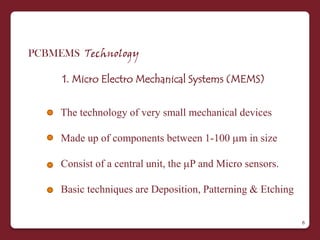
     1. Micro Electro Mechanical Systems (MEMS)


     The technology of very small mechanical devices

     Made up of components between 1-100 m in size

     Consist of a central unit, the P and Micro sensors.

     Basic techniques are Deposition, Patterning & Etching

                                                             6
PCBMEMS Technology

                2. Materials used


     Silicon

     Polymers

     Metals

     Ceramics

                                    7
PCBMEMS Technology


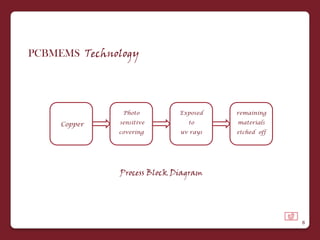
               Photo         Exposed   remaining

     Copper   sensitive        to      materials
              covering       uv rays   etched off


              Process Block Diagram


                                                    8
FR4

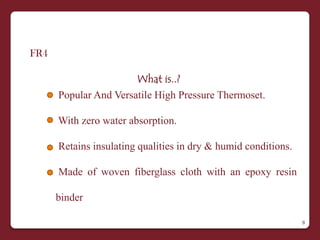
                       What is..?
      Popular And Versatile High Pressure Thermoset.

      With zero water absorption.

      Retains insulating qualities in dry & humid conditions.

      Made of woven fiberglass cloth with an epoxy resin

      binder

                                                                9
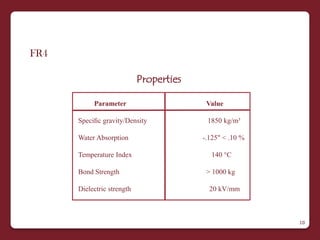
FR4

                            Properties

           Parameter                      Value

      Specific gravity/Density             1850 kg/m³

      Water Absorption                   -.125" < .10 %

      Temperature Index                    140 °C

      Bond Strength                       > 1000 kg

      Dielectric strength                  20 kV/mm


                                                          10
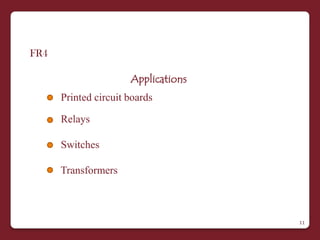
FR4

                      Applications
      Printed circuit boards

      Relays

      Switches

      Transformers


                                     11
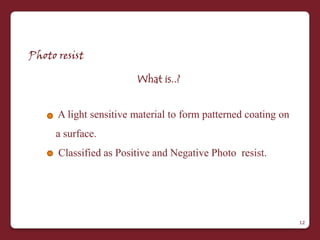
Photo resist

                        What is..?


      A light sensitive material to form patterned coating on
     a surface.
      Classified as Positive and Negative Photo resist.


                                                                12
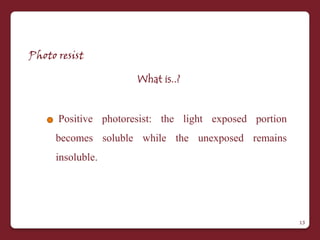
Photo resist

                      What is..?


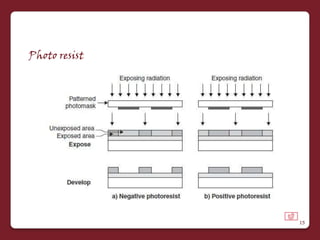
      Positive photoresist: the light exposed portion
     becomes soluble while the unexposed remains
     insoluble.


                                                        13
Photo resist

                       What is..?


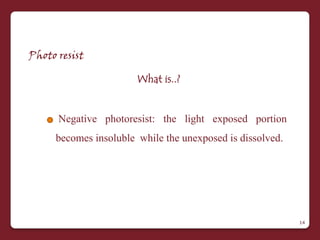
      Negative photoresist: the light exposed portion
     becomes insoluble while the unexposed is dissolved.


                                                           14
Photo resist


               15
Photo resist
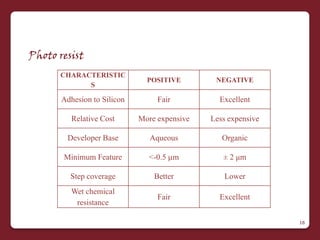
      CHARACTERISTIC
                               POSITIVE        NEGATIVE
            S

       Adhesion to Silicon        Fair          Excellent

          Relative Cost      More expensive   Less expensive

        Developer Base          Aqueous          Organic

       Minimum Feature         <-0.5 m           ± 2 μm

         Step coverage           Better          Lower
         Wet chemical
                                  Fair          Excellent
          resistance

                                                               16
Design


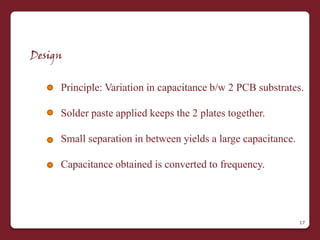
     Principle: Variation in capacitance b/w 2 PCB substrates.

     Solder paste applied keeps the 2 plates together.

     Small separation in between yields a large capacitance.

     Capacitance obtained is converted to frequency.


                                                               17
Design

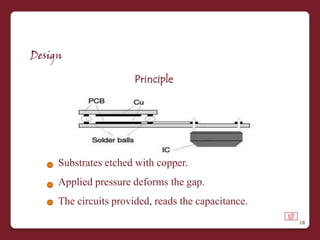
                       Principle


     Substrates etched with copper.
     Applied pressure deforms the gap.
     The circuits provided, reads the capacitance.
                                                     18
Design

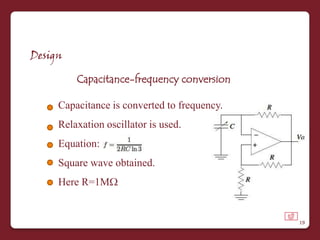
         Capacitance-frequency conversion

     Capacitance is converted to frequency.
     Relaxation oscillator is used.
     Equation:
     Square wave obtained.
     Here R=1M


                                              19
Fabrication process

                   Photolithography

      Selectively remove parts of a thin film.

      Uses light to transfer geometric pattern.

      Affords exact control of shape & size of the objects.


                                                              20
Fabrication process

                    Photolithography
      Cleaning
      Preparation
      Photo resist application
      Exposure and developing
      Etching
      Photo resist removal

                                       21
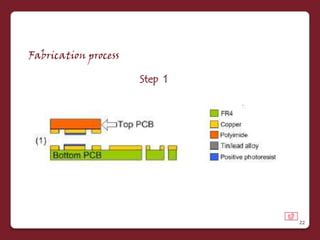
Fabrication process

                      Step 1


                               22
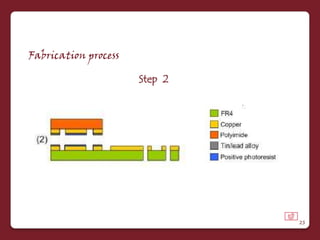
Fabrication process

                      Step 2


                               23
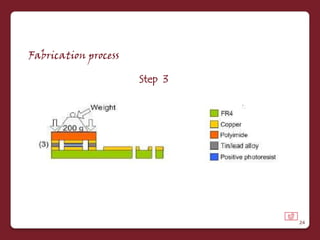
Fabrication process

                      Step 3


                               24
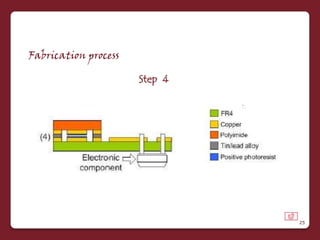
Fabrication process

                      Step 4


                               25
Experimental Results

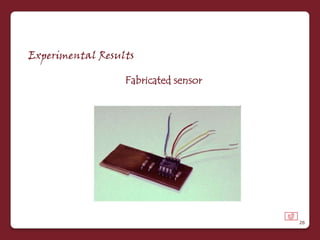
                  Fabricated sensor


                                      26
Experimental Results

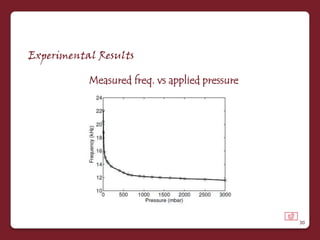
AIM : To obtain the relation b/w applied pressure & output frequency

      A metal chamber gas was glued on the top PCB.
      Connected it with a regulated pressure source through.
      A manometer is used to measure the applied pressure.
      Pressure was varied & the frequencies obtained were
      read on an oscilloscope


                                                                       27
Experimental Results

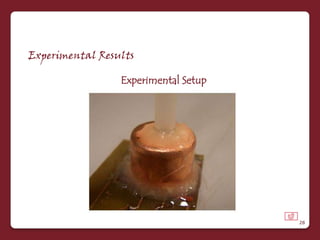
                 Experimental Setup


                                      28
Experimental Results


    Pressure was varied & waiting time was given after
    each.

    The pressure was varied in the range from 0-3000 mbar.

    Result is plotted as a function of the applied pressure.


                                                               29
Experimental Results

           Measured freq. vs applied pressure


                                                30
Experimental Results

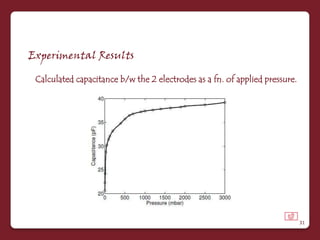
 Calculated capacitance b/w the 2 electrodes as a fn. of applied pressure.


                                                                             31
Advantages


    Low cost.

    Ease of integration with electronics.

    Manufactured in large volumes.

    Wide range of applications.


                                            32
Conclusion


    Inexpensive fabrication.

    Relying only on PCB techniques & automated
    soldering.

    Applicable in industries.


                                                 33
Future Scope


This process along with some modifications may be used
to fabricate other sensors like accelerometers and micro
fluidic detectors.


                                                           34
35
Photograph of a PCBMEMS Fabricated Accelerometer


                                                   36
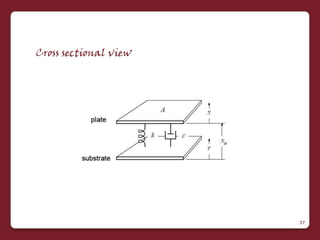
Cross sectional view


                       37
References

   IEEE Electron Device Letters 2009, v.30 n.12, p.1293-
   1295

   A Thesis on Design, Fabrication, and Dynamic
   Modeling of a PCBMEMS Accelerometer by John E.
   Rogers.

   Soldering techniques-UNC Dept. of Chemistry

   An introduction to thermosets R.Bruce. Prime IBM
   (retired) / consultant www.primethermosets.com
                                                           38
References

   Mask less Lithographic PCB/Laminate MEMS for a
   Salinity Sensing System D. Fries et al. University of
   South Florida.

   Applications of High-Performance MEMS Pressure
   Sensors Based on Dissolved Wafer Process by
   Srinivas Tadigadapa and Sonbol Massoud-Ansari
   Integrated Sensing Systems (ISSYS) Inc.,387 Airport
   Industrial Drive, Ypsilanti, MI 48198


                                                           39
References

   Soldering techniques for PCB-Min Chen, student
   member IEEE.

   Photolithography written by Scotten.W.Jones.

   Capacitive pressure sensor design Version 8/PC
   Part Number 30-090-101 March 2006
   ©IntelliSense Software Corporation 2004, 2005, 2006


                                                         40
References

   www.primethermosets.com
   www.sensorcontrolsindia.com
   www.seminar projects.com
   Wikipedia


                                 41
42
43

capacitive pressure sensor

  • 1.
  • 3.
    This presentation includes, INTRODUCTION. DESIGN. FABRICATION PROCESS. EXPERIMENTAL RESULTS. 3
  • 4.
    This presentation includes, Figures included Process flow diagram. Photolithography. +ve & -ve photo resist. Fabricated sensor. Root principle. Exp. Setup. Relaxation oscillator. Results. 4
  • 5.
    Introduction PCBMEMS Technology. FR4. Photo resist. 5
  • 6.
    PCBMEMS Technology 1. Micro Electro Mechanical Systems (MEMS) The technology of very small mechanical devices Made up of components between 1-100 m in size Consist of a central unit, the P and Micro sensors. Basic techniques are Deposition, Patterning & Etching 6
  • 7.
    PCBMEMS Technology 2. Materials used Silicon Polymers Metals Ceramics 7
  • 8.
    PCBMEMS Technology Photo Exposed remaining Copper sensitive to materials covering uv rays etched off Process Block Diagram 8
  • 9.
    FR4 What is..? Popular And Versatile High Pressure Thermoset. With zero water absorption. Retains insulating qualities in dry & humid conditions. Made of woven fiberglass cloth with an epoxy resin binder 9
  • 10.
    FR4 Properties Parameter Value Specific gravity/Density 1850 kg/m³ Water Absorption -.125" < .10 % Temperature Index 140 °C Bond Strength > 1000 kg Dielectric strength 20 kV/mm 10
  • 11.
    FR4 Applications Printed circuit boards Relays Switches Transformers 11
  • 12.
    Photo resist What is..? A light sensitive material to form patterned coating on a surface. Classified as Positive and Negative Photo resist. 12
  • 13.
    Photo resist What is..? Positive photoresist: the light exposed portion becomes soluble while the unexposed remains insoluble. 13
  • 14.
    Photo resist What is..? Negative photoresist: the light exposed portion becomes insoluble while the unexposed is dissolved. 14
  • 15.
  • 16.
    Photo resist CHARACTERISTIC POSITIVE NEGATIVE S Adhesion to Silicon Fair Excellent Relative Cost More expensive Less expensive Developer Base Aqueous Organic Minimum Feature <-0.5 m ± 2 μm Step coverage Better Lower Wet chemical Fair Excellent resistance 16
  • 17.
    Design Principle: Variation in capacitance b/w 2 PCB substrates. Solder paste applied keeps the 2 plates together. Small separation in between yields a large capacitance. Capacitance obtained is converted to frequency. 17
  • 18.
    Design Principle Substrates etched with copper. Applied pressure deforms the gap. The circuits provided, reads the capacitance. 18
  • 19.
    Design Capacitance-frequency conversion Capacitance is converted to frequency. Relaxation oscillator is used. Equation: Square wave obtained. Here R=1M 19
  • 20.
    Fabrication process Photolithography Selectively remove parts of a thin film. Uses light to transfer geometric pattern. Affords exact control of shape & size of the objects. 20
  • 21.
    Fabrication process Photolithography Cleaning Preparation Photo resist application Exposure and developing Etching Photo resist removal 21
  • 22.
  • 23.
  • 24.
  • 25.
  • 26.
    Experimental Results Fabricated sensor 26
  • 27.
    Experimental Results AIM :To obtain the relation b/w applied pressure & output frequency A metal chamber gas was glued on the top PCB. Connected it with a regulated pressure source through. A manometer is used to measure the applied pressure. Pressure was varied & the frequencies obtained were read on an oscilloscope 27
  • 28.
    Experimental Results Experimental Setup 28
  • 29.
    Experimental Results Pressure was varied & waiting time was given after each. The pressure was varied in the range from 0-3000 mbar. Result is plotted as a function of the applied pressure. 29
  • 30.
    Experimental Results Measured freq. vs applied pressure 30
  • 31.
    Experimental Results Calculatedcapacitance b/w the 2 electrodes as a fn. of applied pressure. 31
  • 32.
    Advantages Low cost. Ease of integration with electronics. Manufactured in large volumes. Wide range of applications. 32
  • 33.
    Conclusion Inexpensive fabrication. Relying only on PCB techniques & automated soldering. Applicable in industries. 33
  • 34.
    Future Scope This processalong with some modifications may be used to fabricate other sensors like accelerometers and micro fluidic detectors. 34
  • 35.
  • 36.
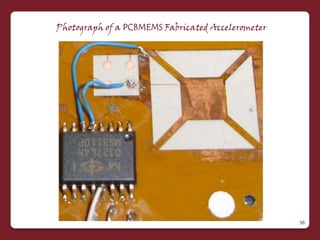
    Photograph of aPCBMEMS Fabricated Accelerometer 36
  • 37.
  • 38.
    References IEEE Electron Device Letters 2009, v.30 n.12, p.1293- 1295 A Thesis on Design, Fabrication, and Dynamic Modeling of a PCBMEMS Accelerometer by John E. Rogers. Soldering techniques-UNC Dept. of Chemistry An introduction to thermosets R.Bruce. Prime IBM (retired) / consultant www.primethermosets.com 38
  • 39.
    References Mask less Lithographic PCB/Laminate MEMS for a Salinity Sensing System D. Fries et al. University of South Florida. Applications of High-Performance MEMS Pressure Sensors Based on Dissolved Wafer Process by Srinivas Tadigadapa and Sonbol Massoud-Ansari Integrated Sensing Systems (ISSYS) Inc.,387 Airport Industrial Drive, Ypsilanti, MI 48198 39
  • 40.
    References Soldering techniques for PCB-Min Chen, student member IEEE. Photolithography written by Scotten.W.Jones. Capacitive pressure sensor design Version 8/PC Part Number 30-090-101 March 2006 ©IntelliSense Software Corporation 2004, 2005, 2006 40
  • 41.
    References www.primethermosets.com www.sensorcontrolsindia.com www.seminar projects.com Wikipedia 41
  • 42.
  • 43.