Analog VLSI Design Nguyen Cao Qui
Introduction to  the course Name:  “ Analog VLSI Design ” Instructor:  Nguyen Cao Qui   email:  [email_address] Goals:  The goal of this course is to introduce the principles of operation, design and technology of Analog Integrated Circuits to Electrical Engineering students at Senior level. VLSI technology and analog integrated circuit design is covered with an emphasis on CMOS Technology. CMOS layout design and analog simulation tools (Microwind) are demonstrated and used. Students will do a design project and  final exam at the end.
Introduction to  the course Number of credits : 3  (1: theory ; 2: homework + project +Seminar) Textbooks:  “ CMOS: Circuit Design, Layout, and Simulation” R. Jacob Baker Other Books:  "CMOS Analog Circuit Design" Phillip E. Allen and Douglas R. Holdberg
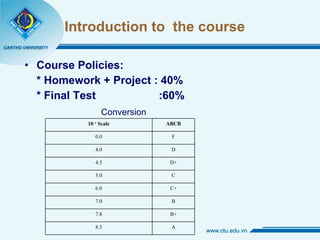
Introduction to  the course Course Policies: * Homework + Project : 40% * Final Test   :60% C onversion 10 ‘ Scale ABCB 0.0 F 4.0 D 4.5 D+ 5.0 C 6.0 C+ 7.0 B 7.8 B+ 8.5 A
CONTENTS Chapter 1:  Introduction to CMOS Design Chapter 2: The Well Chapter 3: The Metal Layers Chapter 4: The Active and Poly Layers Chapter 5:  CAD Tools (Microwind) Chapter 6:  Resistors, Capacitors, MOSFETs Chapter 7:  Models for Analog Design  (IC Course) Chapter 8:  The Inverter  (IC Course) Chapter 9:  VLSI Layout  Examples Chapter 10: Current Mirrors Chapter 11: Amplifiers Chapter 12: Differential Amplifiers Chapter 13: Operational Amplifiers I Chapter 14: Voltage References  Chapter 15: Data Converter Fundamentals (ADC) Chapter 16: Data Converter Fundamentals (DAC)
Chapter 1 Introduction to CMOS Design CMOS  (complementary metal oxide semiconductor) CMOS  is used in most very large scale integrated (VLSI) or ultra-large scale integrated (ULSI) "VLSI"  : chips containing thousands  or millions of MOSFETs. "ULSI"  : containing billions, or more, MOSFETs. We focus simply on analog CMOS circuit design
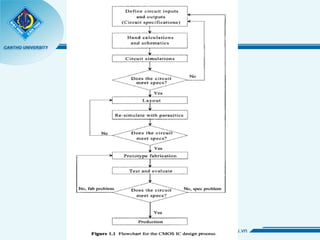
Introduction to CMOS Design 1.  The CMOS IC Design Process
 
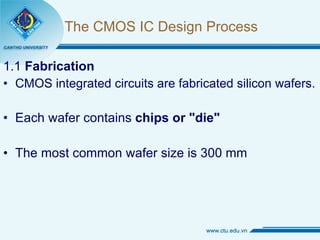
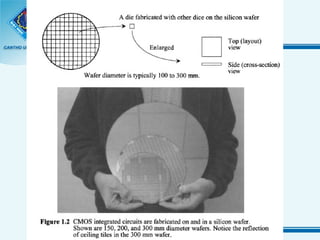
The CMOS IC Design Process 1.1  Fabrication CMOS integrated circuits are fabricated silicon wafers. Each wafer contains  chips   or "die" The most common wafer size is 300 mm


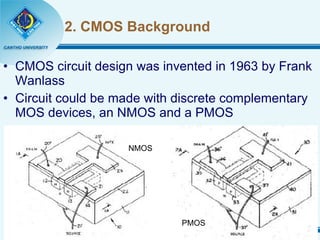
2. CMOS Background CMOS circuit design was invented in 1963 by Frank Wanlass Circuit could be made with discrete complementary MOS devices, an NMOS and a PMOS NMOS PMOS
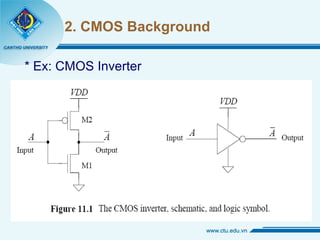
2. CMOS Background * Ex: CMOS Inverter
2. CMOS Background Advantages of CMOS: Low power Layout on small area Can be fabricated with few defects and low cost. 95% of ICs are fabricated in CMOS
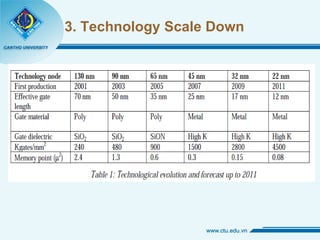
3. Technology Scale Down * The Moore’s Law : Doubling every 18 months
3. Technology Scale Down
Chapter 2: The Well * Studying the well to: Understanding CMOS integrated circuit layout and design. Understanding the performance limitations and parasitics. Understanding the details of each fabrication (layout) layer.
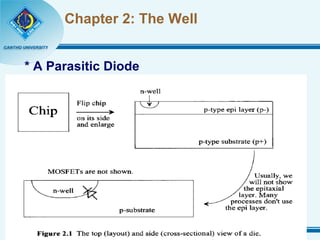
Chapter 2: The Well * The Substrate (The Unprocessed Wafer) CMOS circuits are fabricated on and in a silicon wafer N-type wafer: doping with donor atoms, exp: phosphorus P-type wafer: doping with  acceptor atoms, exp: boron P-type wafer: the most common substrate used NMOS are fabricated directly in the p-type wafer PMOS are fabricated in an "n-well."
Chapter 2: The Well * A Parasitic Diode
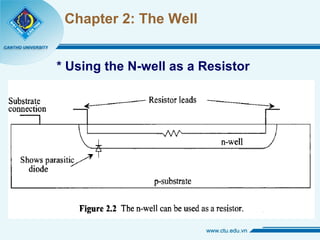
Chapter 2: The Well * Using the N-well as a Resistor
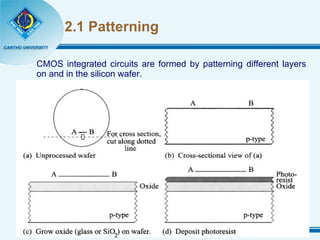
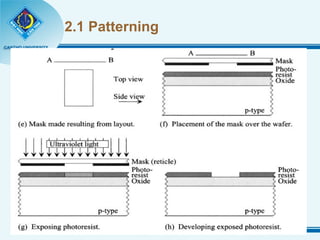
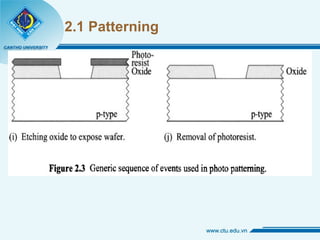
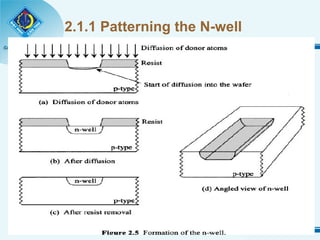
2.1 Patterning CMOS integrated circuits are formed by patterning different layers on and in the silicon wafer.
2.1 Patterning
2.1 Patterning
2.1.1 Patterning the N-well
2.2 Laying Out the N-well
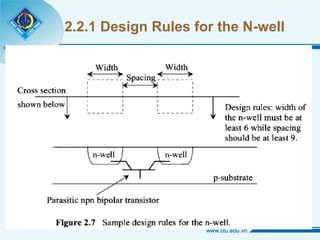
2.2.1 Design Rules for the N-well
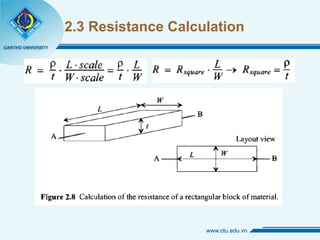
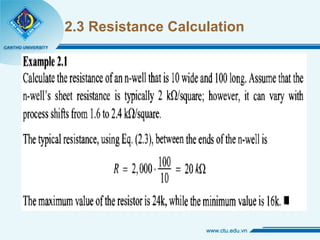
2.3 Resistance Calculation
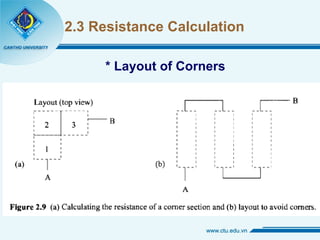
2.3 Resistance Calculation * Layout of Corners
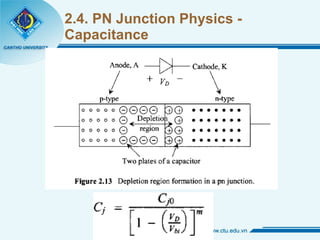
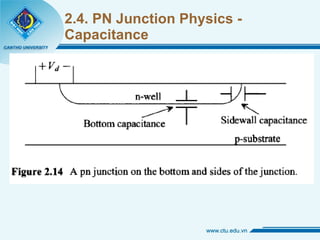
2.4. PN Junction Physics -  Capacitance
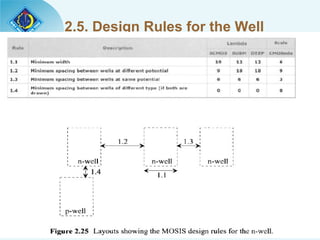
2.5. Design Rules for the Well
Chapter 3: The Metal Layers The metal layers: connect circuit elements (MOSFETs, capacitors, and resistors). There are several metal layers when layout These levels of metal are named metal1 (M1), metal2 (M2)…
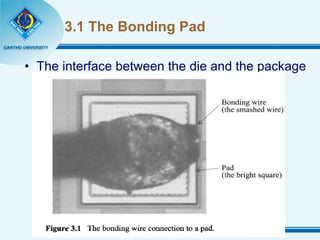
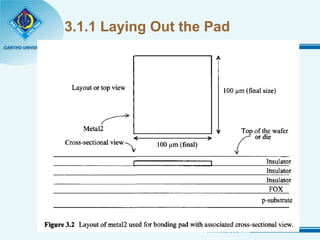
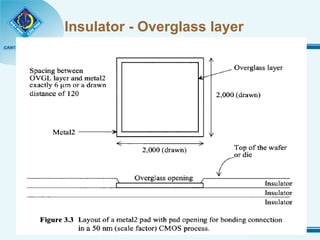
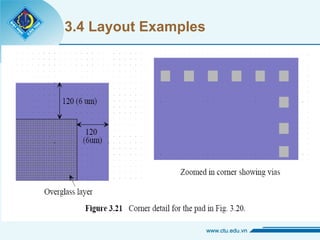
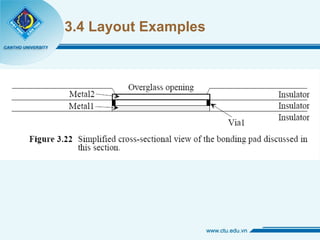
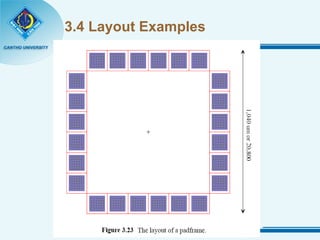
3.1 The Bonding Pad The interface between the die and the package
3.1.1 Laying Out the Pad
Capacitance of Metal-to-Substrate
Insulator - Overglass layer
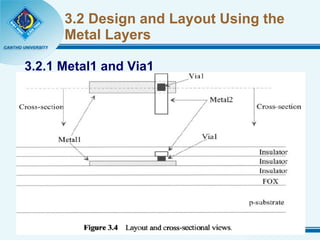
3.2 Design and Layout Using the Metal Layers 3.2.1 Metal1 and Via1
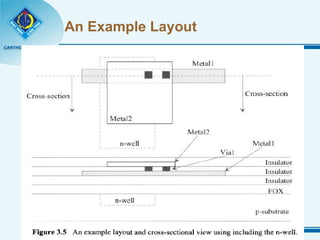
An Example Layout
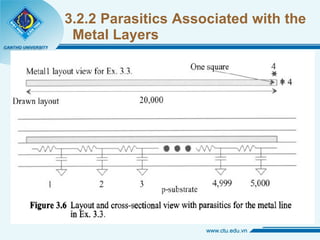
3.2.2 Parasitics Associated with the  Metal Layers
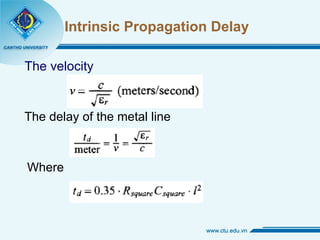
Intrinsic Propagation Delay The velocity The delay of the metal line Where
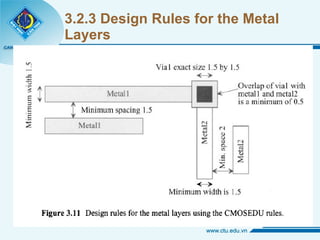
3.2.3 Design Rules for the Metal Layers
A Layout Trick for the Metal Layers
3.2.4 Contact Resistance
3.4 Layout Examples
3.4 Layout Examples
3.4 Layout Examples
3.4 Layout Examples
3.4 Layout Examples
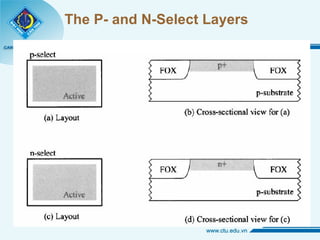
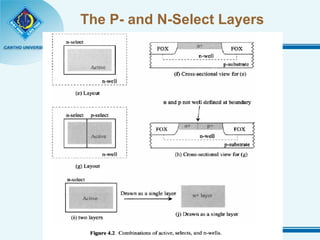
Chapter 4:   The Active and Poly Layers The active, n-select, p-select, and poly:  form n-channel and p-channel MOSFETs. Metal layers can make an contact to the substrate or well. The n-select layers indicate where to implant n-type. The p-select layers indicate where to implant p-type.
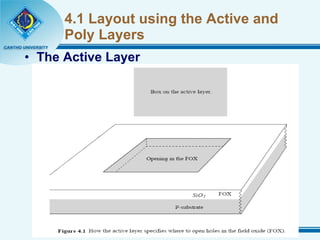
Chapter 4:   The Active and Poly Layers The active defines an opening in the oxide. The active and select layers are always used together. The poly layer forms the gate of the MOSFETs. Poly is a short name for polysilicon.
4.1 Layout using the Active and  Poly Layers The Active Layer
The P- and N-Select Layers
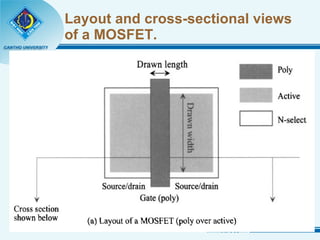
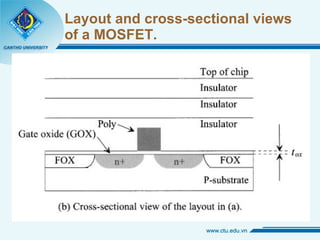
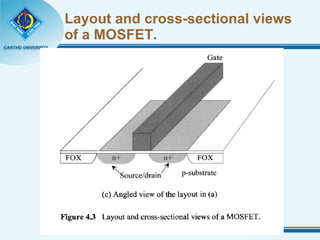
The Poly Layer The poly layer is used for MOSFET formation. The gate of the MOSFET is formed with the polysilicon. The source and drain of the MOSFET are formed with the n+ implant.
Layout and cross-sectional views of a MOSFET.
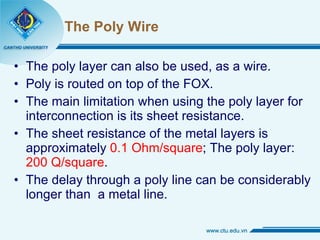
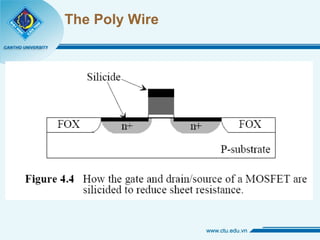
The Poly Wire The poly layer can also be used, as a wire.  Poly is routed on top of the FOX. The main limitation when using the poly layer for interconnection is its sheet resistance. The sheet resistance of the metal layers is approximately  0.1 Ohm/square ; The poly layer:  200 Q/square . The delay through a poly line can be considerably longer than  a metal line.
The Poly Wire
4.1.1 Process Flow
4.1.1 Process Flow
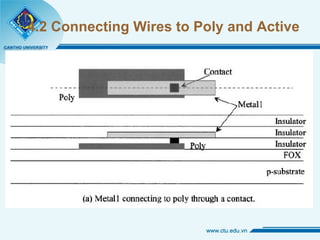
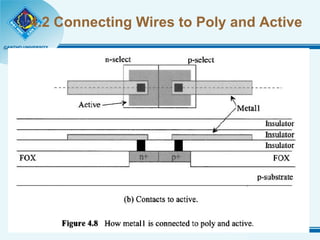
4.2 Connecting Wires to Poly and Active
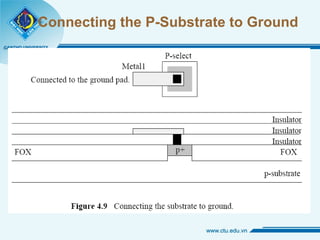
Connecting the P-Substrate to Ground
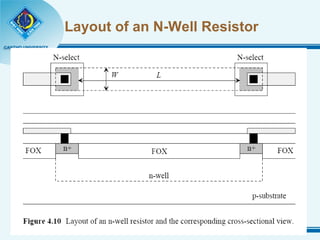
Layout of an N-Well Resistor
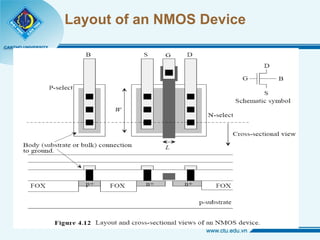
Layout of an NMOS Device
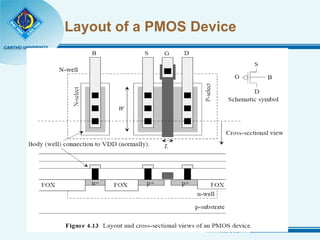
Layout of a PMOS Device
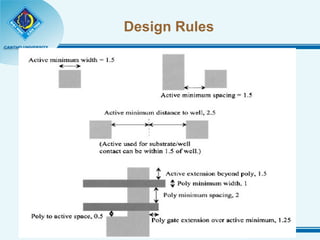
Design Rules
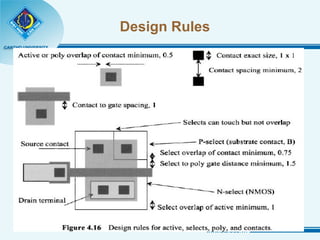
Design Rules
 

Analog vlsi

  • 1.
    Analog VLSI DesignNguyen Cao Qui
  • 2.
    Introduction to the course Name: “ Analog VLSI Design ” Instructor: Nguyen Cao Qui email: [email_address] Goals: The goal of this course is to introduce the principles of operation, design and technology of Analog Integrated Circuits to Electrical Engineering students at Senior level. VLSI technology and analog integrated circuit design is covered with an emphasis on CMOS Technology. CMOS layout design and analog simulation tools (Microwind) are demonstrated and used. Students will do a design project and final exam at the end.
  • 3.
    Introduction to the course Number of credits : 3 (1: theory ; 2: homework + project +Seminar) Textbooks: “ CMOS: Circuit Design, Layout, and Simulation” R. Jacob Baker Other Books: "CMOS Analog Circuit Design" Phillip E. Allen and Douglas R. Holdberg
  • 4.
    Introduction to the course Course Policies: * Homework + Project : 40% * Final Test :60% C onversion 10 ‘ Scale ABCB 0.0 F 4.0 D 4.5 D+ 5.0 C 6.0 C+ 7.0 B 7.8 B+ 8.5 A
  • 5.
    CONTENTS Chapter 1: Introduction to CMOS Design Chapter 2: The Well Chapter 3: The Metal Layers Chapter 4: The Active and Poly Layers Chapter 5: CAD Tools (Microwind) Chapter 6: Resistors, Capacitors, MOSFETs Chapter 7: Models for Analog Design (IC Course) Chapter 8: The Inverter (IC Course) Chapter 9: VLSI Layout Examples Chapter 10: Current Mirrors Chapter 11: Amplifiers Chapter 12: Differential Amplifiers Chapter 13: Operational Amplifiers I Chapter 14: Voltage References Chapter 15: Data Converter Fundamentals (ADC) Chapter 16: Data Converter Fundamentals (DAC)
  • 6.
    Chapter 1 Introductionto CMOS Design CMOS (complementary metal oxide semiconductor) CMOS is used in most very large scale integrated (VLSI) or ultra-large scale integrated (ULSI) "VLSI" : chips containing thousands or millions of MOSFETs. "ULSI" : containing billions, or more, MOSFETs. We focus simply on analog CMOS circuit design
  • 7.
    Introduction to CMOSDesign 1. The CMOS IC Design Process
  • 8.
  • 9.
    The CMOS ICDesign Process 1.1 Fabrication CMOS integrated circuits are fabricated silicon wafers. Each wafer contains chips or "die" The most common wafer size is 300 mm
  • 10.
  • 11.
  • 12.
  • 13.
    2. CMOS BackgroundCMOS circuit design was invented in 1963 by Frank Wanlass Circuit could be made with discrete complementary MOS devices, an NMOS and a PMOS NMOS PMOS
  • 14.
    2. CMOS Background* Ex: CMOS Inverter
  • 15.
    2. CMOS BackgroundAdvantages of CMOS: Low power Layout on small area Can be fabricated with few defects and low cost. 95% of ICs are fabricated in CMOS
  • 16.
    3. Technology ScaleDown * The Moore’s Law : Doubling every 18 months
  • 17.
  • 18.
    Chapter 2: TheWell * Studying the well to: Understanding CMOS integrated circuit layout and design. Understanding the performance limitations and parasitics. Understanding the details of each fabrication (layout) layer.
  • 19.
    Chapter 2: TheWell * The Substrate (The Unprocessed Wafer) CMOS circuits are fabricated on and in a silicon wafer N-type wafer: doping with donor atoms, exp: phosphorus P-type wafer: doping with acceptor atoms, exp: boron P-type wafer: the most common substrate used NMOS are fabricated directly in the p-type wafer PMOS are fabricated in an "n-well."
  • 20.
    Chapter 2: TheWell * A Parasitic Diode
  • 21.
    Chapter 2: TheWell * Using the N-well as a Resistor
  • 22.
    2.1 Patterning CMOSintegrated circuits are formed by patterning different layers on and in the silicon wafer.
  • 23.
  • 24.
  • 25.
  • 26.
    2.2 Laying Outthe N-well
  • 27.
    2.2.1 Design Rulesfor the N-well
  • 28.
  • 29.
  • 30.
    2.3 Resistance Calculation* Layout of Corners
  • 31.
    2.4. PN JunctionPhysics - Capacitance
  • 32.
    2.4. PN JunctionPhysics - Capacitance
  • 33.
    2.5. Design Rulesfor the Well
  • 34.
    Chapter 3: TheMetal Layers The metal layers: connect circuit elements (MOSFETs, capacitors, and resistors). There are several metal layers when layout These levels of metal are named metal1 (M1), metal2 (M2)…
  • 35.
    3.1 The BondingPad The interface between the die and the package
  • 36.
  • 37.
  • 38.
  • 39.
    3.2 Design andLayout Using the Metal Layers 3.2.1 Metal1 and Via1
  • 40.
  • 41.
    3.2.2 Parasitics Associatedwith the Metal Layers
  • 42.
    Intrinsic Propagation DelayThe velocity The delay of the metal line Where
  • 43.
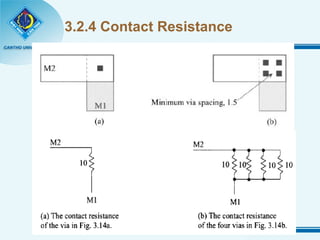
    3.2.3 Design Rulesfor the Metal Layers
  • 44.
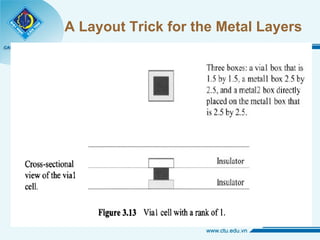
    A Layout Trickfor the Metal Layers
  • 45.
  • 46.
  • 47.
  • 48.
  • 49.
  • 50.
  • 51.
    Chapter 4: The Active and Poly Layers The active, n-select, p-select, and poly: form n-channel and p-channel MOSFETs. Metal layers can make an contact to the substrate or well. The n-select layers indicate where to implant n-type. The p-select layers indicate where to implant p-type.
  • 52.
    Chapter 4: The Active and Poly Layers The active defines an opening in the oxide. The active and select layers are always used together. The poly layer forms the gate of the MOSFETs. Poly is a short name for polysilicon.
  • 53.
    4.1 Layout usingthe Active and Poly Layers The Active Layer
  • 54.
    The P- andN-Select Layers
  • 55.
    The P- andN-Select Layers
  • 56.
    The Poly LayerThe poly layer is used for MOSFET formation. The gate of the MOSFET is formed with the polysilicon. The source and drain of the MOSFET are formed with the n+ implant.
  • 57.
    Layout and cross-sectionalviews of a MOSFET.
  • 58.
    Layout and cross-sectionalviews of a MOSFET.
  • 59.
    Layout and cross-sectionalviews of a MOSFET.
  • 60.
    The Poly WireThe poly layer can also be used, as a wire. Poly is routed on top of the FOX. The main limitation when using the poly layer for interconnection is its sheet resistance. The sheet resistance of the metal layers is approximately 0.1 Ohm/square ; The poly layer: 200 Q/square . The delay through a poly line can be considerably longer than a metal line.
  • 61.
  • 62.
  • 63.
  • 64.
    4.2 Connecting Wiresto Poly and Active
  • 65.
    4.2 Connecting Wiresto Poly and Active
  • 66.
  • 67.
    Layout of anN-Well Resistor
  • 68.
    Layout of anNMOS Device
  • 69.
    Layout of aPMOS Device
  • 70.
  • 71.
  • 72.

Editor's Notes

  • #6 Voltage References