Topographical
Map Reading
Lower Sec Geographical Skills
1) Map
•  A	
  representation of an area	
  of	
  land	
  or	
  sea	
  
in	
  the	
  form	
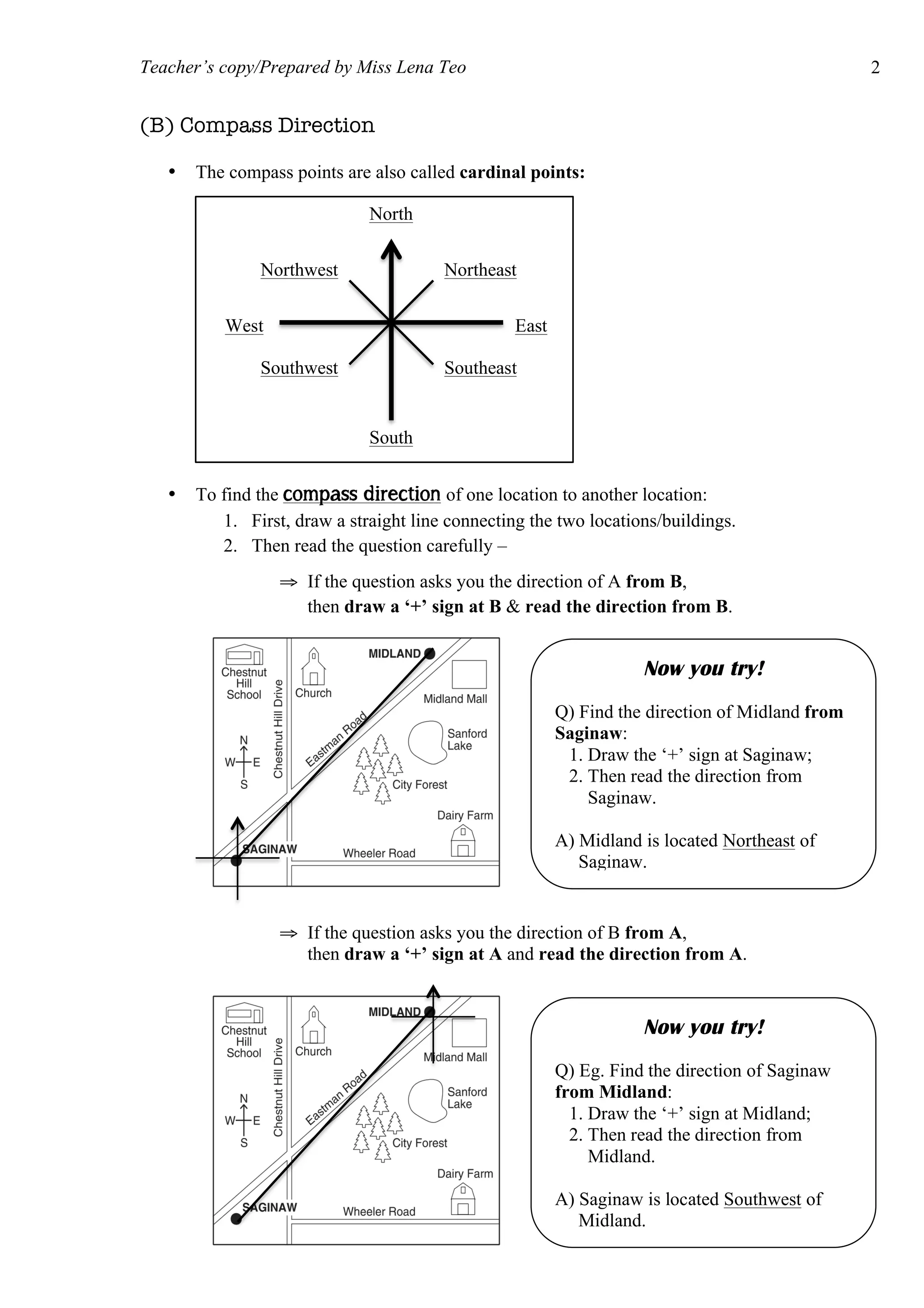
  of	
  a	
  diagram.	


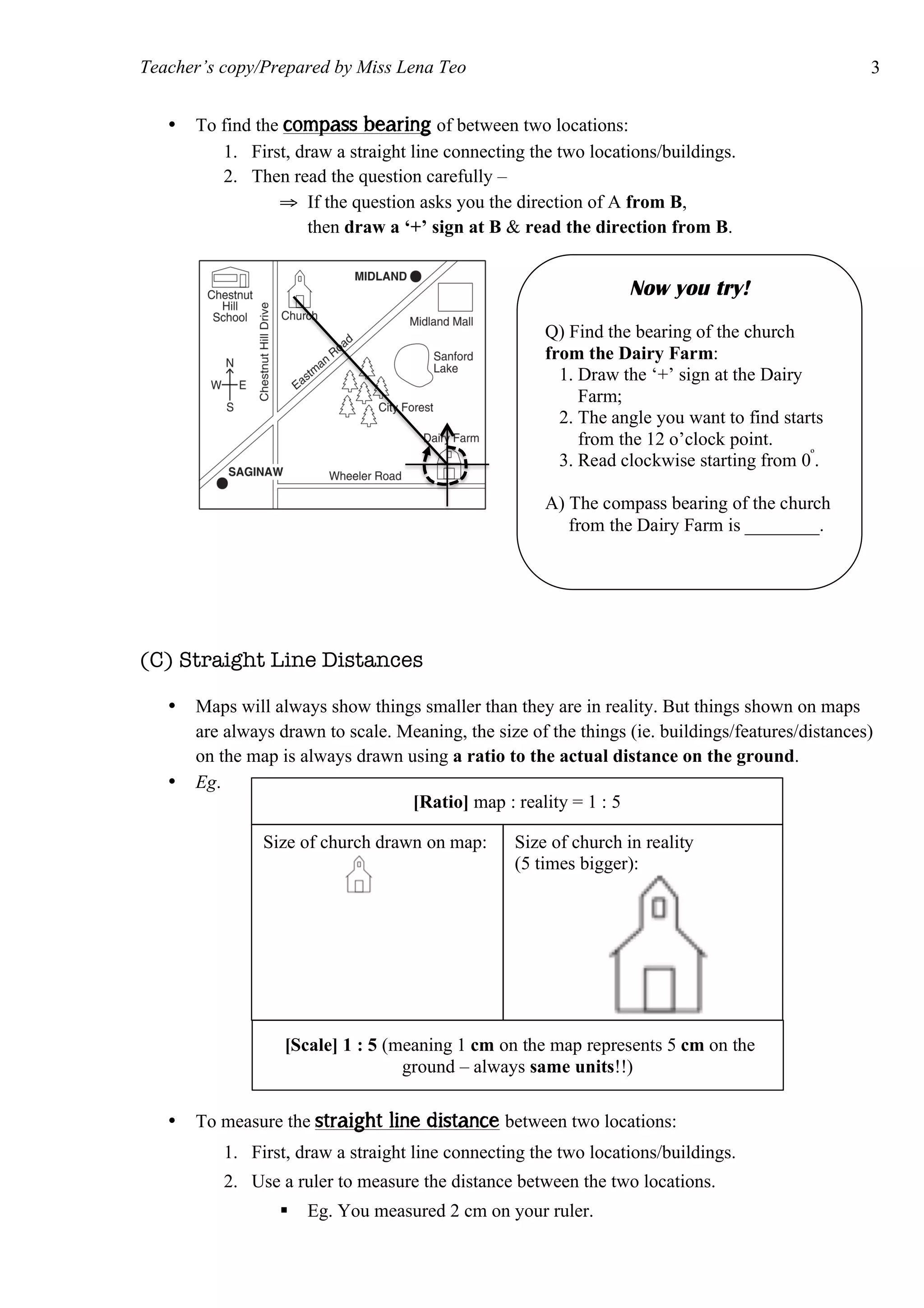
•  We	
  often	
  refer	
  to	
  maps	
  when	
  we	
  travel	
  or	
  	
  
when	
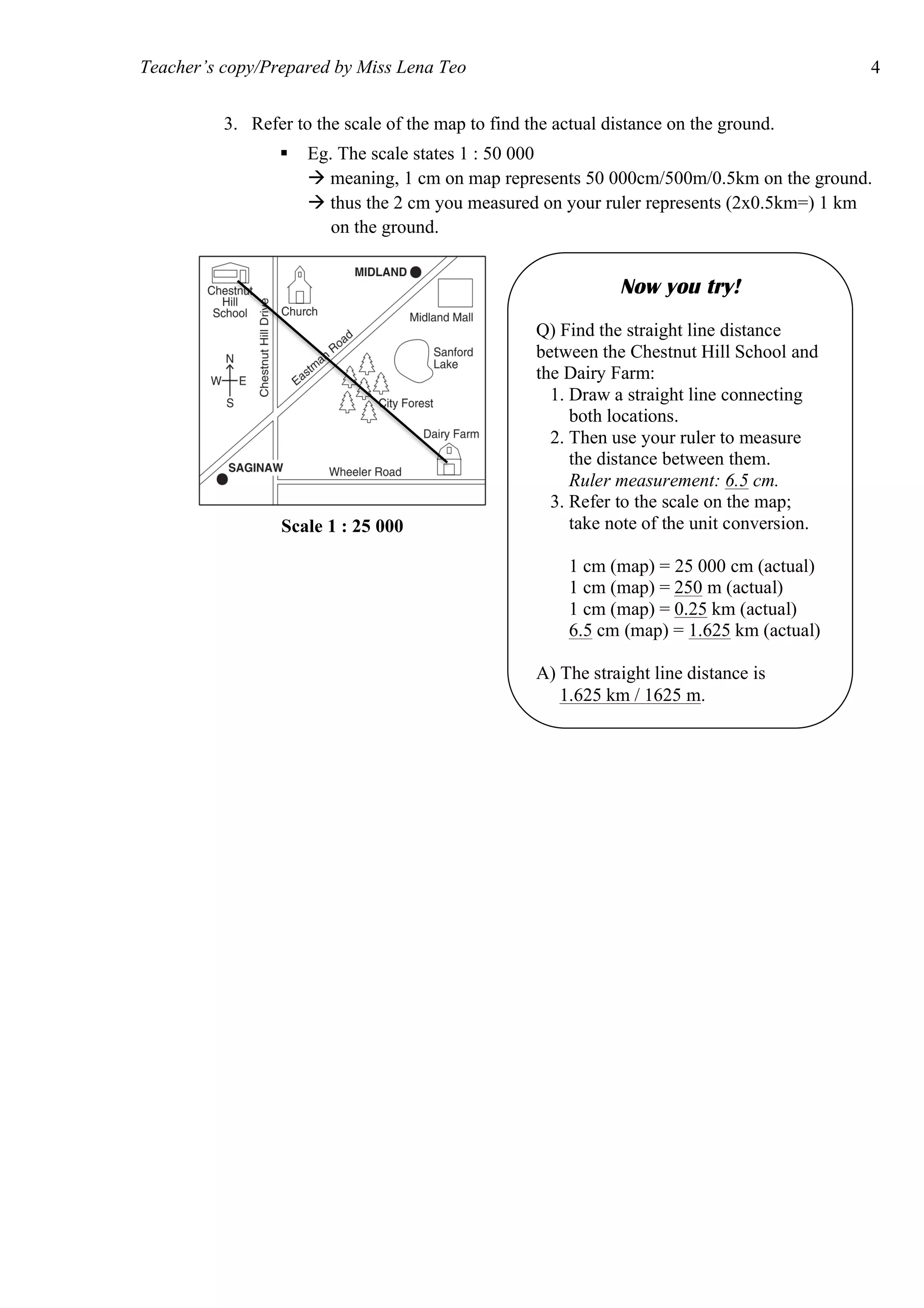
  we	
  are	
  finding	
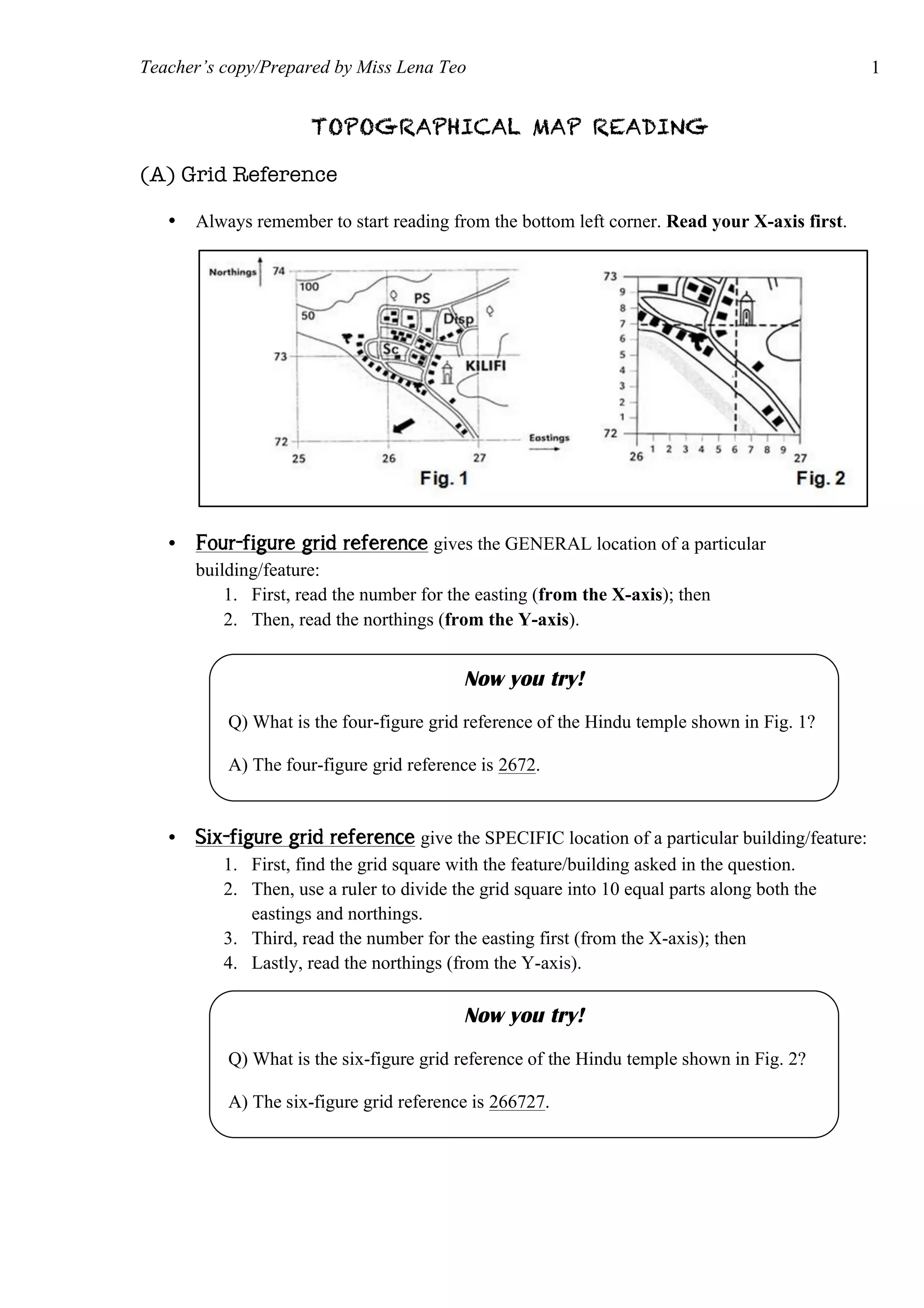
  our	
  way	
  to	
  places.	
  
1) Map
•  It	
  can	
  show	
  boundaries between countries,	
  
physical	
  features,	
  elevation,	
  cities,	
  roads,	
  
climates,	
  economic	
  activities	
  etc.	
  
1) Map
•  It	
  can	
  show	
  boundaries	
  between	
  countries,	
  
physical features,	
  elevation,	
  cities,	
  roads,	
  
climates,	
  economic	
  activities	
  etc.	
  
1) Map
•  It	
  can	
  show	
  boundaries	
  between	
  countries,	
  
physical	
  features,	
  elevation,	
  cities,	
  roads,	
  
climates,	
  economic	
  activities	
  etc.	
  
1) Map
Is	
  a	
  globe	
  a	
  map?	
  
•  Yes!	
  Globes	
  are	
  some	
  	
  
of	
  the	
  most	
  accurate	
  	
  
maps	
  that	
  exist.	
  	
  
Antique	
  map:	
  400-­‐year-­‐old	
  map	
  
Notice	
  any	
  differences?	
  
(Commonly	
  used)	
  
Area	
  accurate	
  Peters	
  Projection	
  Map	
  overlaid	
  with	
  	
  
commonly	
  used	
  Mercator	
  Projection	
  Map	
  
Mercator	
  Map	
   Peters	
  Map	
  
2) Map Symbols
Used	
  to	
  represent	
  	
  
physical & human	
  	
  
features	
  in	
  an	
  area.	


2) Map Symbols
•  The	
  legend:	
  	
  
contains	
  symbols	
  to	
  	
  
help	
  us	
  locate	
  features	
  	
  
on	
  the	
  map.	
  
3) Compass
•  An	
  instrument	
  containing	
  a	
  magnetized	
  pointer	
  
that	
  shows the direction of the
magnetic north &	
  bearings	
  from	
  it.	
  
3) Compass (i. Compass Direction)
•  There	
  are	
  four compass points (cardinal	
  
points):	
  North	
  (N),	
  South	
  (S),	
  East	
  (E)	
  &	
  West	
  (W)	
  
•  If	
  the	
  north	
  line	
  or	
  
compass	
  rose	
  is	
  not	
  
given	
  on	
  the	
  map,	
  
assume	
  that	
  north is
towards the top
of	
  the	
  map.	
  
3) Compass (i. Compass Direction)
•  Can	
  be	
  further	
  divided	
  into	
  eight compass
points	
  (intercardinal	
  /	
  ordinal	
  points).	
  
3) Compass (i. Compass Direction)
•  A	
  16-point compass	
  rose	
  (secondary	
  
intercardinal	
  points):	
  
3) Compass (ii. Compass Bearing)
•  The	
  compass	
  direction	
  between	
  two	
  points	
  
measured	
  in	
  degrees.	
  
(	
  	
  	
  ˚)	
  
(	
  	
  	
  ˚)	
  (	
  	
  	
  ˚)	
  
(	
  	
  	
  ˚)	
  
(	
  	
  	
  ˚)	
  
(	
  	
  	
  ˚)	
  
(	
  	
  	
  ˚)	
  
(	
  	
  	
  ˚)	
  
3) Compass (ii. Compass Bearing)
•  Find	
  the	
  compass	
  bearing	
  of	
  the	
  nearest	
  hospital	
  
from your	
  current	
  location.	
  
Step	
  1:	
  Draw compass rose 	


  on	
  current	
  location.	
  
Your	
  current	
  location	
  
Nearest	
  hospital	
  
N	
  
3) Compass (ii. Compass Bearing)
•  Find	
  the	
  compass	
  bearing	
  of	
  the	
  nearest	
  hospital	
  
from your	
  current	
  location.	
  
Step	
  2:	
  Join both locations	


  with	
  a	
  straight	
  line.	
  
Your	
  current	
  location	
  
Nearest	
  hospital	
  
N	
  
3) Compass (ii. Compass Bearing)
•  Find	
  the	
  compass	
  bearing	
  of	
  the	
  nearest	
  hospital	
  
from your	
  current	
  location.	
  
Step	
  3:	
  Measure clockwise


  starting	
  from	
  the	
  north	


  arrow.	
   Your	
  current	
  location	
  
Nearest	
  hospital	
  
N	
  
3) Compass (ii. Compass Bearing)
•  Find	
  the	
  compass	
  bearing	
  of	
  the	
  nearest	
  hospital	
  
from your	
  current	
  location.	
  
Step	
  3:	
  Measure clockwise


  starting	
  from	
  the	
  north	


  arrow.	
   Your	
  current	
  location	
  
Nearest	
  hospital	
  
N	
  
180˚	
  
3) Compass (ii. Compass Bearing)
•  Find	
  the	
  compass	
  bearing	
  of	
  the	
  nearest	
  hospital	
  
from your	
  current	
  location.	
  
Step	
  3:	
  Measure clockwise


  starting	
  from	
  the	
  north	


  arrow.	
   Your	
  current	
  location	
  
Nearest	
  hospital	
  
N	
  
Ans:	
  180˚	
  +	
  72˚	
  =	
  252˚	
  	
  
180˚	
  
3) Compass (ii. Compass Bearing)
•  Modern	
  instruments:	
  
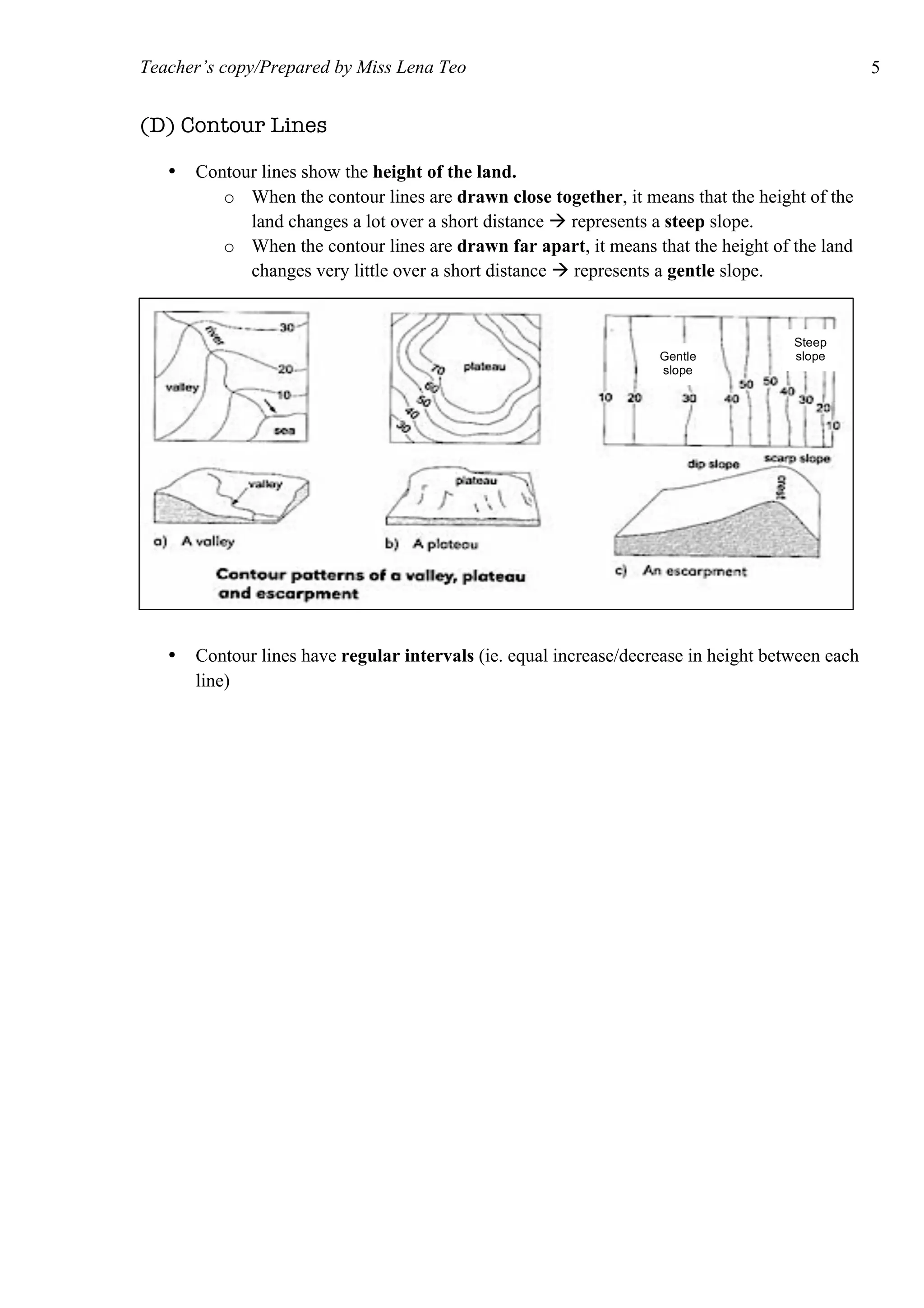
4) Contour Lines
•  Lines	
  drawn	
  on	
  maps	
  connecting points of equal
elevation	
  (ie.	
  equal	
  heights).	
  
4) Contour Lines
When	
  contour	
  lines	
  are	
  far	
  apart,	
  it	
  
means	
  that	
  the	
  height	
  of	
  land	
  changes	
  
very	
  li<le	
  over	
  a	
  short	
  distance.	
  	
  
This	
  indicates	
  a	
  gentler	
  slope.	
  
When	
  contour	
  lines	
  are	
  close	
  
together,	
  it	
  means	
  that	
  height	
  of	
  land	
  
changes	
  a	
  lot	
  over	
  a	
  short	
  distance.	
  
This	
  indicates	
  a	
  steep	
  slope.	
  
4) Contour Lines
5) Scale
•  All	
  maps	
  show	
  things	
  	
  
smaller	
  than	
  they	
  are	
  	
  
in	
  real	
  life.	
  
•  Maps	
  are	
  drawn to
scale for accuracy.	


  Ratio	
  scale	


  Linear	
  scale	
  
5) Scale (i. Ratio scale)
1 : 25 000 means	
  that	
  
1	
  cm	
  on	
  the	
  map	
  represents	
  
25	
  000	
  cm	
  on	
  the	
  actual	
  ground.	


  Ratio	
  scale	


  1	
  :	
  25000	
  
1	
  cm	
  (on	
  map)	
  :	
  25000	
  cm	
  (actual	
  ground)	


  ÷	
  100	
  
1	
  cm	
  (on	
  map)	
  :	
  250	
  m	


  (actual	
  ground)	


  ÷	
  1000	
  
1	
  cm	
  (on	
  map)	
  :	
  0.25	
  km	


  (actual	
  ground)	
  
5) Scale (ii. Linear scale)


A	
  distance	
  of	
  3	
  cm	
  on	
  the	
  map	
  
represents	
  1	
  km	
  on	
  the	
  actual	
  
ground.	


  Linear	
  scale	


6) Grid Reference
•  Vertical	
  grid	
  lines	
  	
  
are	
  called	
  
eastings	
  	
  
because	
  	
  
their	
  values	
  	
  
increase	
  	
  
eastwards.	


6) Grid Reference
•  Horizontal	
  grid	
  lines	
  	
  
are	
  called	
  
Northings	
  
because	
  	
  
their	
  values	
  	
  
increase	
  	
  
northwards.	


6) Grid Reference (i. 4 Figure grid)
•  Used	
  to	
  identify	
  	
  
the	
  general
location of	
  a	
  	
  
feature	
  on	
  a	
  map.	
  
6) Grid Reference (i. 4 Figure grid)
Find	
  the	
  4	
  figure	
  	
  
grid	
  reference	
  of	
  	
  
Lake	
  Cedric.	


Step	
  1:	
  	
  
Find the grid	
  	
  
where	
  Lake	
  Cedric	
  	
  
is	
  located	
  in.	


Step	
  1	
  
6) Grid Reference (i. 4 Figure grid)
Find	
  the	
  4	
  figure	
  	
  
grid	
  reference	
  of	
  	
  
Lake	
  Cedric.	


Step	
  2:	
  	
  
Extend	
  the	
  lines	
  on	
  	
  
the	
  Left-bottom
corner.	


Step	
  2	
  
6) Grid Reference (i. 4 Figure grid)
Find	
  the	
  4	
  figure	
  	
  
grid	
  reference	
  of	
  	
  
Lake	
  Cedric.	


Step	
  3:	
  	
  
Write down the
easting first,	
  	
  
followed	
  by	
  the	
  	
  
northing.	
  
	
   Ans:	
  2 1 3 9
6) Grid Reference (ii. 6 Figure grid)
•  Gives	
  a	
  more
specific
location
of	
  a	
  feature	
  	
  
on	
  a	
  map.	
  
6) Grid Reference (ii. 6 Figure grid)
Find	
  the	
  6	
  figure	
  	
  
grid	
  reference	
  of	
  	
  
Bob’s	
  Boathouse.	


Step	
  1:	
  	
  
Find the grid	
  	
  
where	
  Bob’s	
  	
  
Boathouse	
  is	
  	
  
located	
  in.	


Step	
  1	
  
6) Grid Reference (ii. 6 Figure grid)
Find	
  the	
  6	
  figure	
  	
  
grid	
  reference	
  of	
  	
  
Bob’s	
  Boathouse.	


Step	
  2:	
  	
  
Extend	
  the	
  lines	
  on	
  	
  
the	
  Left-bottom
corner.	
  
Step	
  2	
  
6) Grid Reference (ii. 6 Figure grid)
Find	
  the	
  6	
  figure	
  	
  
grid	
  reference	
  of	
  	
  
Bob’s	
  Boathouse.	


Step	
  3:	
  	
  
Write	
  down	
  the	
  	
  
4	
  figure	
  grid	
  	
  
reference.	
  
Step	
  2	
  
2 1 __ 3 8 __
6) Grid Reference (ii. 6 Figure grid)
Find	
  the	
  6	
  figure	
  	
  
grid	
  reference	
  of	
  	
  
Bob’s	
  Boathouse.	


Step	
  4:	
  	
  
Divide	
  the	
  length	
  &	
  
breadth	
  of	
  the	
  grid	
  	
  
into	
  10 equal parts.	
  
Step	
  2	
  
2 1 __ 3 8 __
6) Grid Reference (ii. 6 Figure grid)
Find	
  the	
  6	
  figure	
  	
  
grid	
  reference	
  of	
  	
  
Bob’s	
  Boathouse.	


Step	
  5:	
  	
  
Count	
  the	
  grid	
  line.	
  
Fill	
  in	
  the	
  blank	
  with	
  	
  
the	
  line	
  number.	
  
Step	
  2	
  
2 1 __ 3 8 __
7
4	
  
4 7

Chapter 2 - Topo Map Reading

  • 1.
  • 2.
    1) Map •  A  representation of an area  of  land  or  sea   in  the  form  of  a  diagram.     •  We  often  refer  to  maps  when  we  travel  or     when  we  are  finding  our  way  to  places.  
  • 3.
    1) Map •  It  can  show  boundaries between countries,   physical  features,  elevation,  cities,  roads,   climates,  economic  activities  etc.  
  • 4.
    1) Map •  It  can  show  boundaries  between  countries,   physical features,  elevation,  cities,  roads,   climates,  economic  activities  etc.  
  • 5.
    1) Map •  It  can  show  boundaries  between  countries,   physical  features,  elevation,  cities,  roads,   climates,  economic  activities  etc.  
  • 6.
    1) Map Is  a  globe  a  map?   •  Yes!  Globes  are  some     of  the  most  accurate     maps  that  exist.    
  • 7.
  • 8.
    Notice  any  differences?   (Commonly  used)  
  • 9.
    Area  accurate  Peters  Projection  Map  overlaid  with     commonly  used  Mercator  Projection  Map   Mercator  Map   Peters  Map  
  • 10.
    2) Map Symbols Used  to  represent     physical & human     features  in  an  area.    
  • 11.
    2) Map Symbols • The  legend:     contains  symbols  to     help  us  locate  features     on  the  map.  
  • 12.
    3) Compass •  An  instrument  containing  a  magnetized  pointer   that  shows the direction of the magnetic north &  bearings  from  it.  
  • 13.
    3) Compass (i.Compass Direction) •  There  are  four compass points (cardinal   points):  North  (N),  South  (S),  East  (E)  &  West  (W)   •  If  the  north  line  or   compass  rose  is  not   given  on  the  map,   assume  that  north is towards the top of  the  map.  
  • 14.
    3) Compass (i.Compass Direction) •  Can  be  further  divided  into  eight compass points  (intercardinal  /  ordinal  points).  
  • 15.
    3) Compass (i.Compass Direction) •  A  16-point compass  rose  (secondary   intercardinal  points):  
  • 16.
    3) Compass (ii.Compass Bearing) •  The  compass  direction  between  two  points   measured  in  degrees.   (      ˚)   (      ˚)  (      ˚)   (      ˚)   (      ˚)   (      ˚)   (      ˚)   (      ˚)  
  • 17.
    3) Compass (ii.Compass Bearing) •  Find  the  compass  bearing  of  the  nearest  hospital   from your  current  location.   Step  1:  Draw compass rose                              on  current  location.   Your  current  location   Nearest  hospital   N  
  • 18.
    3) Compass (ii.Compass Bearing) •  Find  the  compass  bearing  of  the  nearest  hospital   from your  current  location.   Step  2:  Join both locations                              with  a  straight  line.   Your  current  location   Nearest  hospital   N  
  • 19.
    3) Compass (ii.Compass Bearing) •  Find  the  compass  bearing  of  the  nearest  hospital   from your  current  location.   Step  3:  Measure clockwise                            starting  from  the  north                              arrow.   Your  current  location   Nearest  hospital   N  
  • 20.
    3) Compass (ii.Compass Bearing) •  Find  the  compass  bearing  of  the  nearest  hospital   from your  current  location.   Step  3:  Measure clockwise                            starting  from  the  north                              arrow.   Your  current  location   Nearest  hospital   N   180˚  
  • 21.
    3) Compass (ii.Compass Bearing) •  Find  the  compass  bearing  of  the  nearest  hospital   from your  current  location.   Step  3:  Measure clockwise                            starting  from  the  north                              arrow.   Your  current  location   Nearest  hospital   N   Ans:  180˚  +  72˚  =  252˚     180˚  
  • 22.
    3) Compass (ii.Compass Bearing) •  Modern  instruments:  
  • 23.
    4) Contour Lines • Lines  drawn  on  maps  connecting points of equal elevation  (ie.  equal  heights).  
  • 24.
    4) Contour Lines When  contour  lines  are  far  apart,  it   means  that  the  height  of  land  changes   very  li<le  over  a  short  distance.     This  indicates  a  gentler  slope.   When  contour  lines  are  close   together,  it  means  that  height  of  land   changes  a  lot  over  a  short  distance.   This  indicates  a  steep  slope.  
  • 25.
  • 26.
    5) Scale •  All  maps  show  things     smaller  than  they  are     in  real  life.   •  Maps  are  drawn to scale for accuracy.            Ratio  scale        Linear  scale  
  • 27.
    5) Scale (i.Ratio scale) 1 : 25 000 means  that   1  cm  on  the  map  represents   25  000  cm  on  the  actual  ground.                  Ratio  scale                                                          1  :  25000   1  cm  (on  map)  :  25000  cm  (actual  ground)                                                                                  ÷  100   1  cm  (on  map)  :  250  m                (actual  ground)                                                                                      ÷  1000   1  cm  (on  map)  :  0.25  km          (actual  ground)  
  • 28.
    5) Scale (ii.Linear scale)     A  distance  of  3  cm  on  the  map   represents  1  km  on  the  actual   ground.          Linear  scale      
  • 29.
    6) Grid Reference • Vertical  grid  lines     are  called   eastings     because     their  values     increase     eastwards.              
  • 30.
    6) Grid Reference • Horizontal  grid  lines     are  called   Northings   because     their  values     increase     northwards.              
  • 31.
    6) Grid Reference(i. 4 Figure grid) •  Used  to  identify     the  general location of  a     feature  on  a  map.  
  • 32.
    6) Grid Reference(i. 4 Figure grid) Find  the  4  figure     grid  reference  of     Lake  Cedric.     Step  1:     Find the grid     where  Lake  Cedric     is  located  in.     Step  1  
  • 33.
    6) Grid Reference(i. 4 Figure grid) Find  the  4  figure     grid  reference  of     Lake  Cedric.     Step  2:     Extend  the  lines  on     the  Left-bottom corner.       Step  2  
  • 34.
    6) Grid Reference(i. 4 Figure grid) Find  the  4  figure     grid  reference  of     Lake  Cedric.     Step  3:     Write down the easting first,     followed  by  the     northing.     Ans:  2 1 3 9
  • 35.
    6) Grid Reference(ii. 6 Figure grid) •  Gives  a  more specific location of  a  feature     on  a  map.  
  • 36.
    6) Grid Reference(ii. 6 Figure grid) Find  the  6  figure     grid  reference  of     Bob’s  Boathouse.     Step  1:     Find the grid     where  Bob’s     Boathouse  is     located  in.     Step  1  
  • 37.
    6) Grid Reference(ii. 6 Figure grid) Find  the  6  figure     grid  reference  of     Bob’s  Boathouse.     Step  2:     Extend  the  lines  on     the  Left-bottom corner.   Step  2  
  • 38.
    6) Grid Reference(ii. 6 Figure grid) Find  the  6  figure     grid  reference  of     Bob’s  Boathouse.     Step  3:     Write  down  the     4  figure  grid     reference.   Step  2   2 1 __ 3 8 __
  • 39.
    6) Grid Reference(ii. 6 Figure grid) Find  the  6  figure     grid  reference  of     Bob’s  Boathouse.     Step  4:     Divide  the  length  &   breadth  of  the  grid     into  10 equal parts.   Step  2   2 1 __ 3 8 __
  • 40.
    6) Grid Reference(ii. 6 Figure grid) Find  the  6  figure     grid  reference  of     Bob’s  Boathouse.     Step  5:     Count  the  grid  line.   Fill  in  the  blank  with     the  line  number.   Step  2   2 1 __ 3 8 __ 7 4   4 7