1
EDGEFIELD SECONDARY SCHOOL
HUMANITIES DEPARTMENT
LOWER SECONDARY GEOGRAPHY SCHEME OF WORK 2015
SECONDARY 2 EXPRESS/ NA
THEME: URBAN LIVING
Week (2
Periods)
Topic
[Knowledge]
Learning
Outcomes
IT Skills / Thinking Skills NE messages /
Values
TERM ONE
Week 1-2 Introduction: How and where do people
live?
Knowledge
 Development of Human Society
 Hunting and gathering
− Hunt wild animals
− Gather food from flora
− Nomadic
− Agrarian society Cultivate plants
− Domesticate animals
− Sedentary
 Industrial society
− Commercial farming
− Mass production of goods
− Industrial cities
 Location of industrial cities
- Waterways (eg.
Shanghai)
- Source of energy supply
(eg. Newcastle)
- Source of raw materials
(eg. Seattle)
 Features of Cities (with specific
Geographical
Concepts
 Place
 Space
 Scale
 Environment
Students would not
be assessed for the
introductory issue.
It is intended to
provide them with an
overarching schema
to understand some
key ideas related to
the Sec 2 Theme of
Urban Living as they
examine issues
arising from housing,
transport and flood
hazards in the
context of cities.
 Geographical inquiry
questions
Rationale: Students will be
introduced to this mode of
questioning and develop their
proficiency through subsequent topic
study and GI.
 Geographical data collection
and analysis through
fieldwork
 Geographical data analysis
and presentation
Rationale: Students will be exposed
to use primary and secondary data
collection to support their
investigation. They also make use
of various data representations to
illustrate their findings. By exposing
students to a range of geographical
data and skills, they would become
adept at carrying out sound analysis
and interpretation of the data they
are presented with.
Desired
Outcome of
Education:
Confident
Person; self-
directed learner;
active
contributor;
concerned
citizen
21st
Century
CC:
Curiosity and
creativity
ICT:
Openness;
management of
information
NE Message: 1
& 6
2
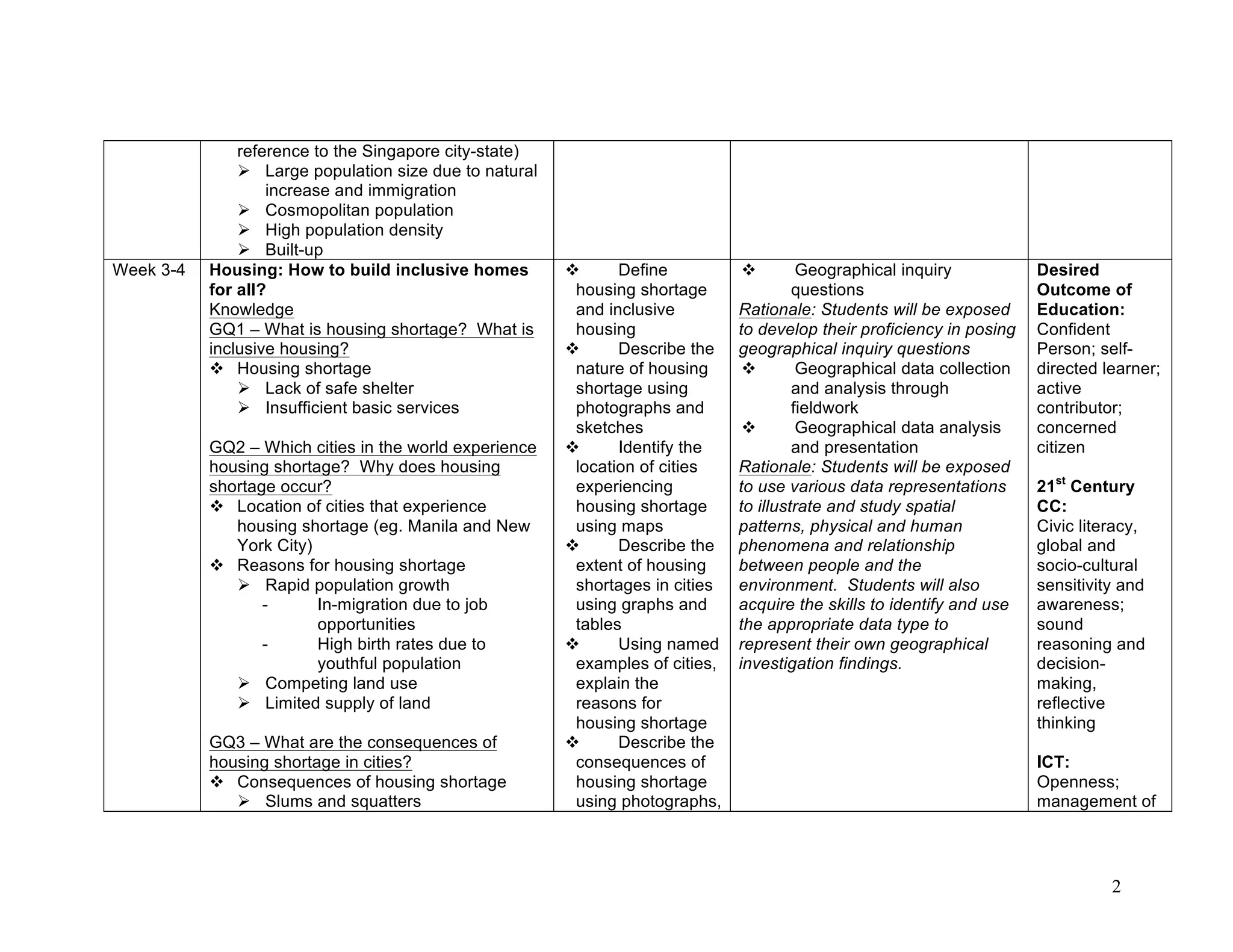
reference to the Singapore city-state)
 Large population size due to natural
increase and immigration
 Cosmopolitan population
 High population density
 Built-up
Week 3-4 Housing: How to build inclusive homes
for all?
Knowledge
GQ1 – What is housing shortage? What is
inclusive housing?
 Housing shortage
 Lack of safe shelter
 Insufficient basic services
GQ2 – Which cities in the world experience
housing shortage? Why does housing
shortage occur?
 Location of cities that experience
housing shortage (eg. Manila and New
York City)
 Reasons for housing shortage
 Rapid population growth
- In-migration due to job
opportunities
- High birth rates due to
youthful population
 Competing land use
 Limited supply of land
GQ3 – What are the consequences of
housing shortage in cities?
 Consequences of housing shortage
 Slums and squatters
 Define
housing shortage
and inclusive
housing
 Describe the
nature of housing
shortage using
photographs and
sketches
 Identify the
location of cities
experiencing
housing shortage
using maps
 Describe the
extent of housing
shortages in cities
using graphs and
tables
 Using named
examples of cities,
explain the
reasons for
housing shortage
 Describe the
consequences of
housing shortage
using photographs,
 Geographical inquiry
questions
Rationale: Students will be exposed
to develop their proficiency in posing
geographical inquiry questions
 Geographical data collection
and analysis through
fieldwork
 Geographical data analysis
and presentation
Rationale: Students will be exposed
to use various data representations
to illustrate and study spatial
patterns, physical and human
phenomena and relationship
between people and the
environment. Students will also
acquire the skills to identify and use
the appropriate data type to
represent their own geographical
investigation findings.
Desired
Outcome of
Education:
Confident
Person; self-
directed learner;
active
contributor;
concerned
citizen
21st
Century
CC:
Civic literacy,
global and
socio-cultural
sensitivity and
awareness;
sound
reasoning and
decision-
making,
reflective
thinking
ICT:
Openness;
management of
3
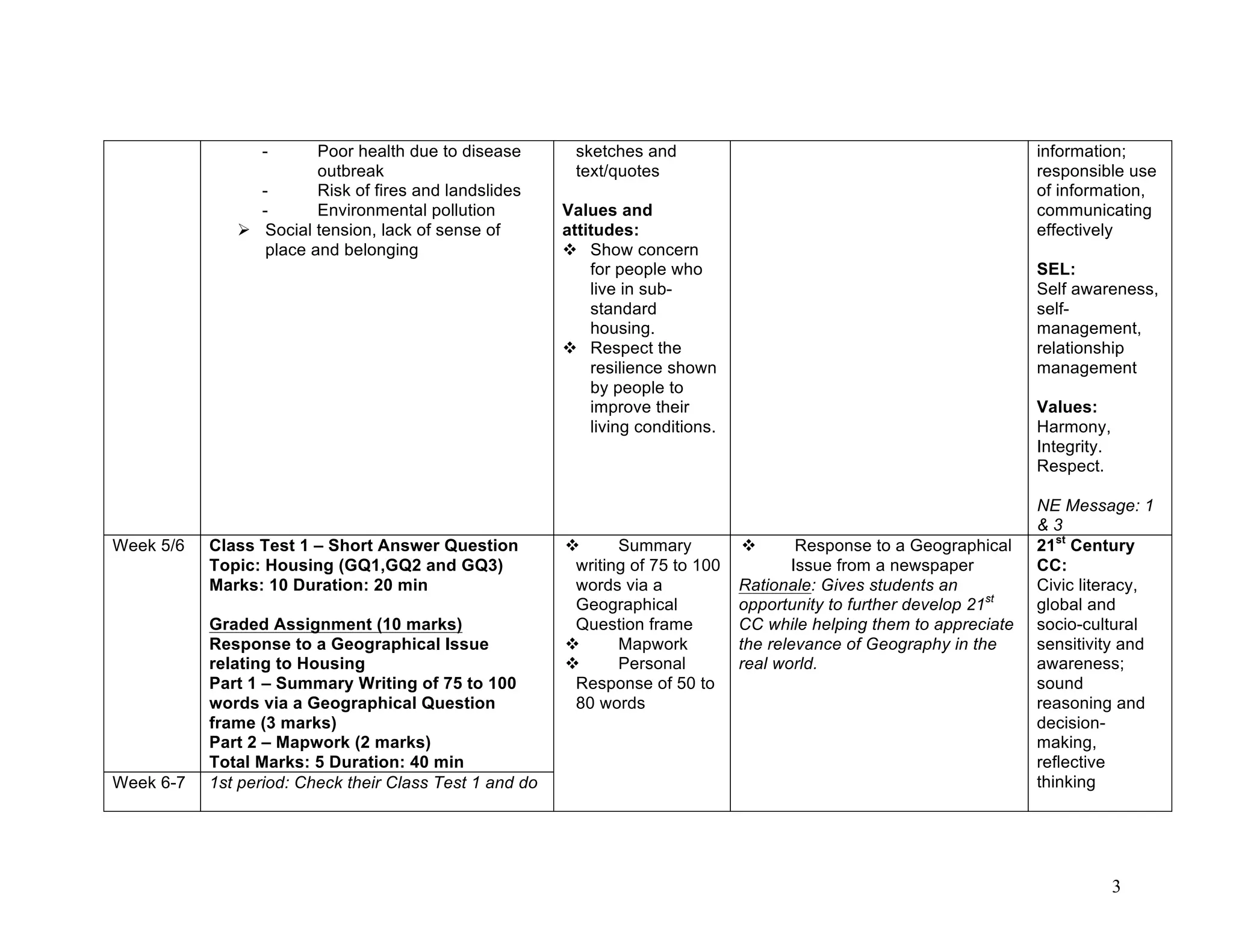
- Poor health due to disease
outbreak
- Risk of fires and landslides
- Environmental pollution
 Social tension, lack of sense of
place and belonging
sketches and
text/quotes
Values and
attitudes:
 Show concern
for people who
live in sub-
standard
housing.
 Respect the
resilience shown
by people to
improve their
living conditions.
information;
responsible use
of information,
communicating
effectively
SEL:
Self awareness,
self-
management,
relationship
management
Values:
Harmony,
Integrity.
Respect.
NE Message: 1
& 3
Week 5/6 Class Test 1 – Short Answer Question
Topic: Housing (GQ1,GQ2 and GQ3)
Marks: 10 Duration: 20 min
Graded Assignment (10 marks)
Response to a Geographical Issue
relating to Housing
Part 1 – Summary Writing of 75 to 100
words via a Geographical Question
frame (3 marks)
Part 2 – Mapwork (2 marks)
Total Marks: 5 Duration: 40 min
 Summary
writing of 75 to 100
words via a
Geographical
Question frame
 Mapwork
 Personal
Response of 50 to
80 words
 Response to a Geographical
Issue from a newspaper
Rationale: Gives students an
opportunity to further develop 21st
CC while helping them to appreciate
the relevance of Geography in the
real world.
21st
Century
CC:
Civic literacy,
global and
socio-cultural
sensitivity and
awareness;
sound
reasoning and
decision-
making,
reflective
thinkingWeek 6-7 1st period: Check their Class Test 1 and do
4
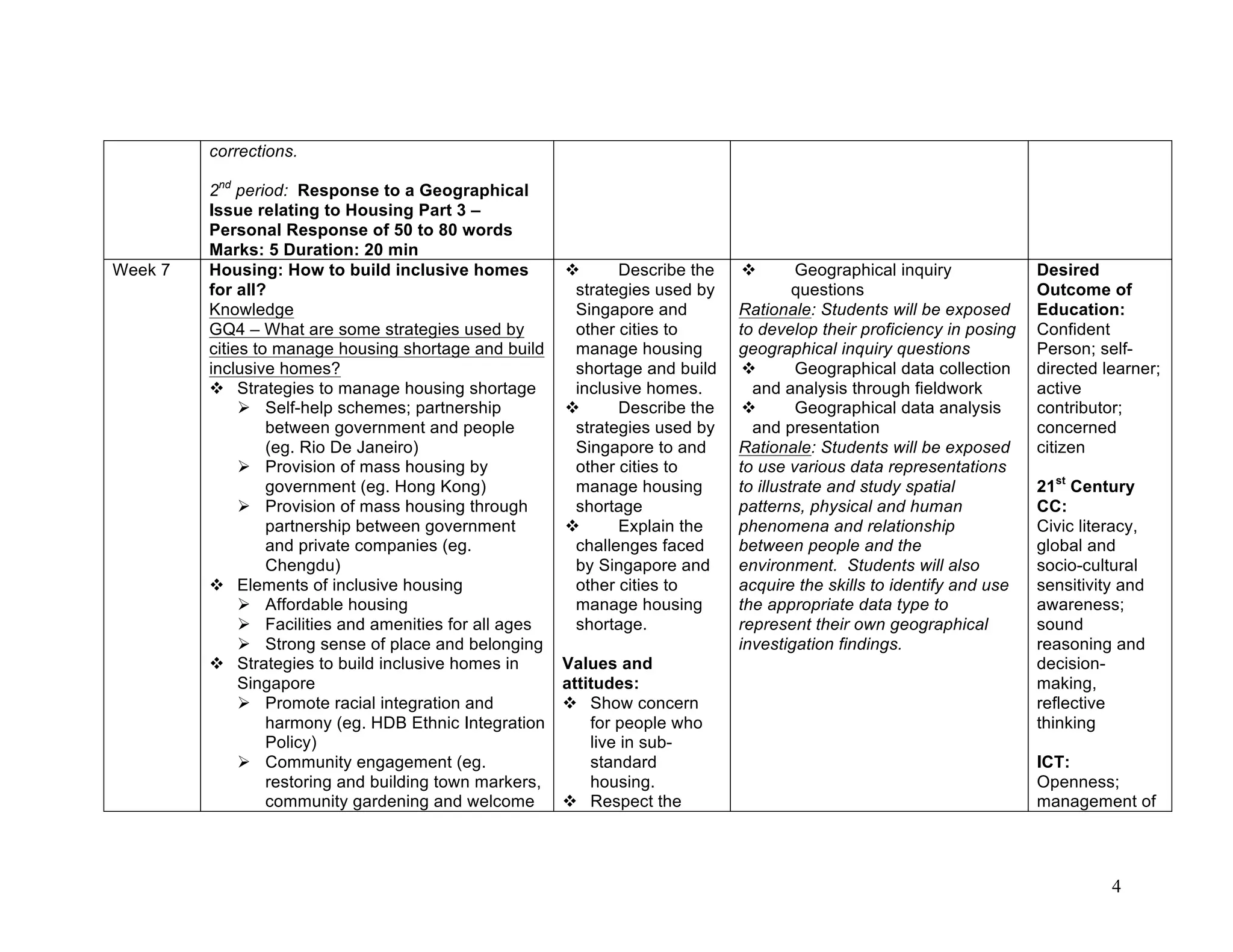
corrections.
2nd
period: Response to a Geographical
Issue relating to Housing Part 3 –
Personal Response of 50 to 80 words
Marks: 5 Duration: 20 min
Week 7 Housing: How to build inclusive homes
for all?
Knowledge
GQ4 – What are some strategies used by
cities to manage housing shortage and build
inclusive homes?
 Strategies to manage housing shortage
 Self-help schemes; partnership
between government and people
(eg. Rio De Janeiro)
 Provision of mass housing by
government (eg. Hong Kong)
 Provision of mass housing through
partnership between government
and private companies (eg.
Chengdu)
 Elements of inclusive housing
 Affordable housing
 Facilities and amenities for all ages
 Strong sense of place and belonging
 Strategies to build inclusive homes in
Singapore
 Promote racial integration and
harmony (eg. HDB Ethnic Integration
Policy)
 Community engagement (eg.
restoring and building town markers,
community gardening and welcome
 Describe the
strategies used by
Singapore and
other cities to
manage housing
shortage and build
inclusive homes.
 Describe the
strategies used by
Singapore to and
other cities to
manage housing
shortage
 Explain the
challenges faced
by Singapore and
other cities to
manage housing
shortage.
Values and
attitudes:
 Show concern
for people who
live in sub-
standard
housing.
 Respect the
 Geographical inquiry
questions
Rationale: Students will be exposed
to develop their proficiency in posing
geographical inquiry questions
 Geographical data collection
and analysis through fieldwork
 Geographical data analysis
and presentation
Rationale: Students will be exposed
to use various data representations
to illustrate and study spatial
patterns, physical and human
phenomena and relationship
between people and the
environment. Students will also
acquire the skills to identify and use
the appropriate data type to
represent their own geographical
investigation findings.
Desired
Outcome of
Education:
Confident
Person; self-
directed learner;
active
contributor;
concerned
citizen
21st
Century
CC:
Civic literacy,
global and
socio-cultural
sensitivity and
awareness;
sound
reasoning and
decision-
making,
reflective
thinking
ICT:
Openness;
management of
5
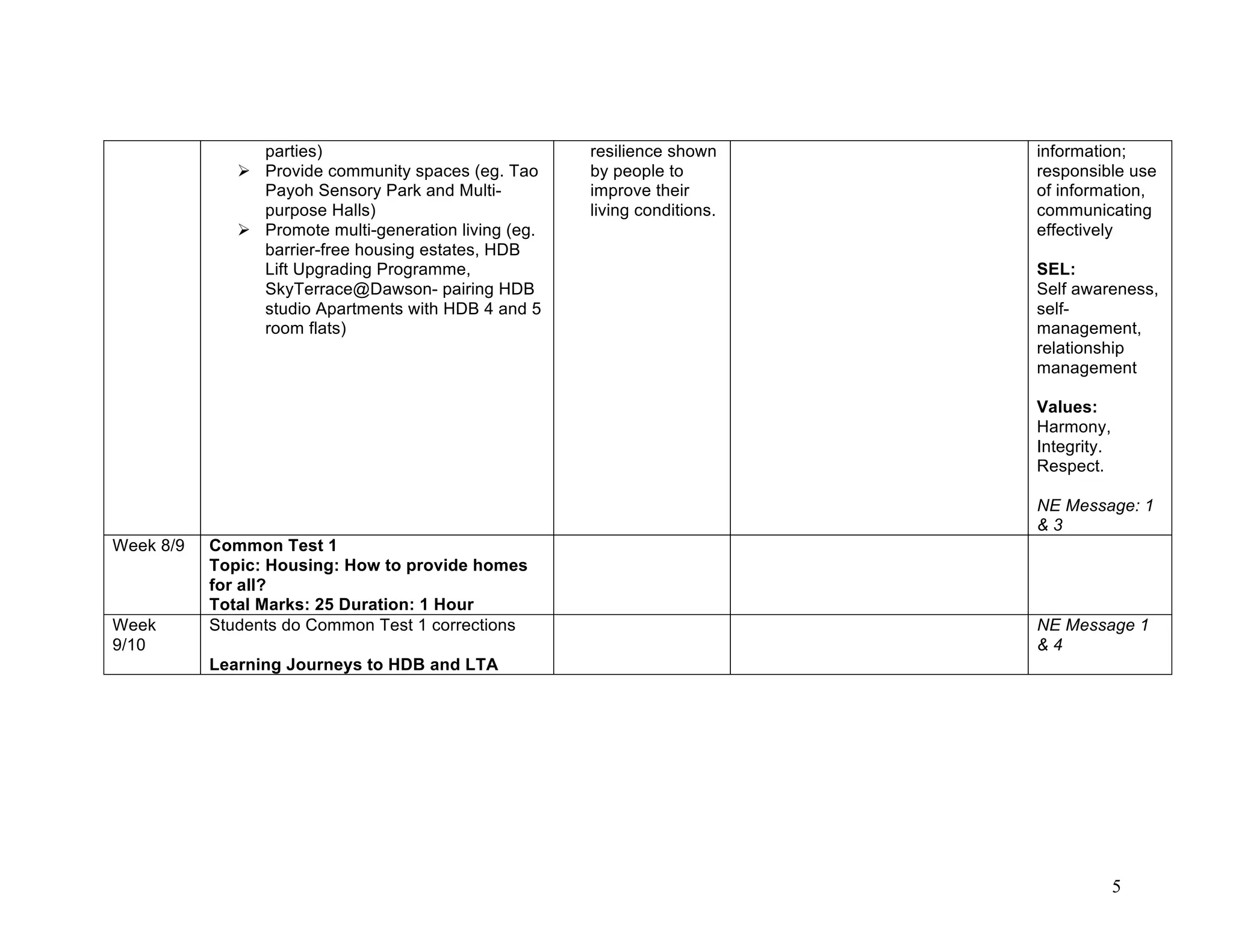
parties)
 Provide community spaces (eg. Tao
Payoh Sensory Park and Multi-
purpose Halls)
 Promote multi-generation living (eg.
barrier-free housing estates, HDB
Lift Upgrading Programme,
SkyTerrace@Dawson- pairing HDB
studio Apartments with HDB 4 and 5
room flats)
resilience shown
by people to
improve their
living conditions.
information;
responsible use
of information,
communicating
effectively
SEL:
Self awareness,
self-
management,
relationship
management
Values:
Harmony,
Integrity.
Respect.
NE Message: 1
& 3
Week 8/9 Common Test 1
Topic: Housing: How to provide homes
for all?
Total Marks: 25 Duration: 1 Hour
Week
9/10
Students do Common Test 1 corrections
Learning Journeys to HDB and LTA
NE Message 1
& 4
6
Week
(Period)
Topic
[Key concepts]
Learning Outcomes IT Skills / Thinking Skills NE messages/
Values
TERM TWO
Week 1-
3/4
Floods: How can cities prepare for
floods?
Knowledge
GQ1 - What are floods?
 Types of floods
 Coastal flood
 River flood
 Flash flood
 Causes of floods
 Intensity, frequency and duration of
rainfall
 Snowmelt
 Storm surge
 Catastrophic events (eg. volcanic
eruption and dam failure)
GQ2 - Which cities are prone to floods?
Why are these cities more prone to floods
than others?
 Cities prone to floods (e.g. New
Orleans, USA and Manila, Philippines)
 Factors contributing to floods
 Height above sea level
 Permeability of surface cover
 Drainage capacity
 Proximity to water bodies
GQ3 – How do floods affect people living
in cities?
 Impact of Hurricane Katrina and
Typhoon Ketsana
 Social impacts
Geographical
Concepts
 Excess
overland flow
 Location
 Natural hazard
 Legislation
 Human
intervention
 Public
education
 Describe the types
of floods.
 Explain the
causes of floods.
 Describe the
location of cities
prone to floods
using maps.
 Explain why some
cities are prone to
floods with the use
of photographs,
sketches and
text/quotes.
 Describe the
socio-economic
impact of floods
with the use of
 Geographical inquiry questions
Rationale: Through the various
issues, students would learn that
geographical inquiry questions can
be contextualised and applied to an
issue being studied. With repeated
exposure, students would develop
their proficiency in posing such
questions as well.
 Geographical data collection and
analysis through fieldwork
 Geographical data analysis and
presentation
Rationale: Geographers use various
data representations to illustrate and
study spatial patterns, physical and
human phenomena and
relationships between people and
the environment. Students exposed
to a range of geographical data and
skills would become adept at
carrying out sound analysis and
interpretation of the data they are
presented with. Students would also
acquire the skills to identify and use
the appropriate data type to
represent their own geographical
investigation findings.
Desired Outcome
of Education:
Confident Person;
self-directed
learner; active
contributor;
concerned citizen
21st
Century CC:
Civic literacy,
global and socio-
cultural sensitivity
and awareness;
sound reasoning
and decision-
making, reflective
thinking
ICT:
Openness;
management of
information;
responsible use of
information,
communicating
effectively
SEL:
Self awareness,
Social awareness,
7
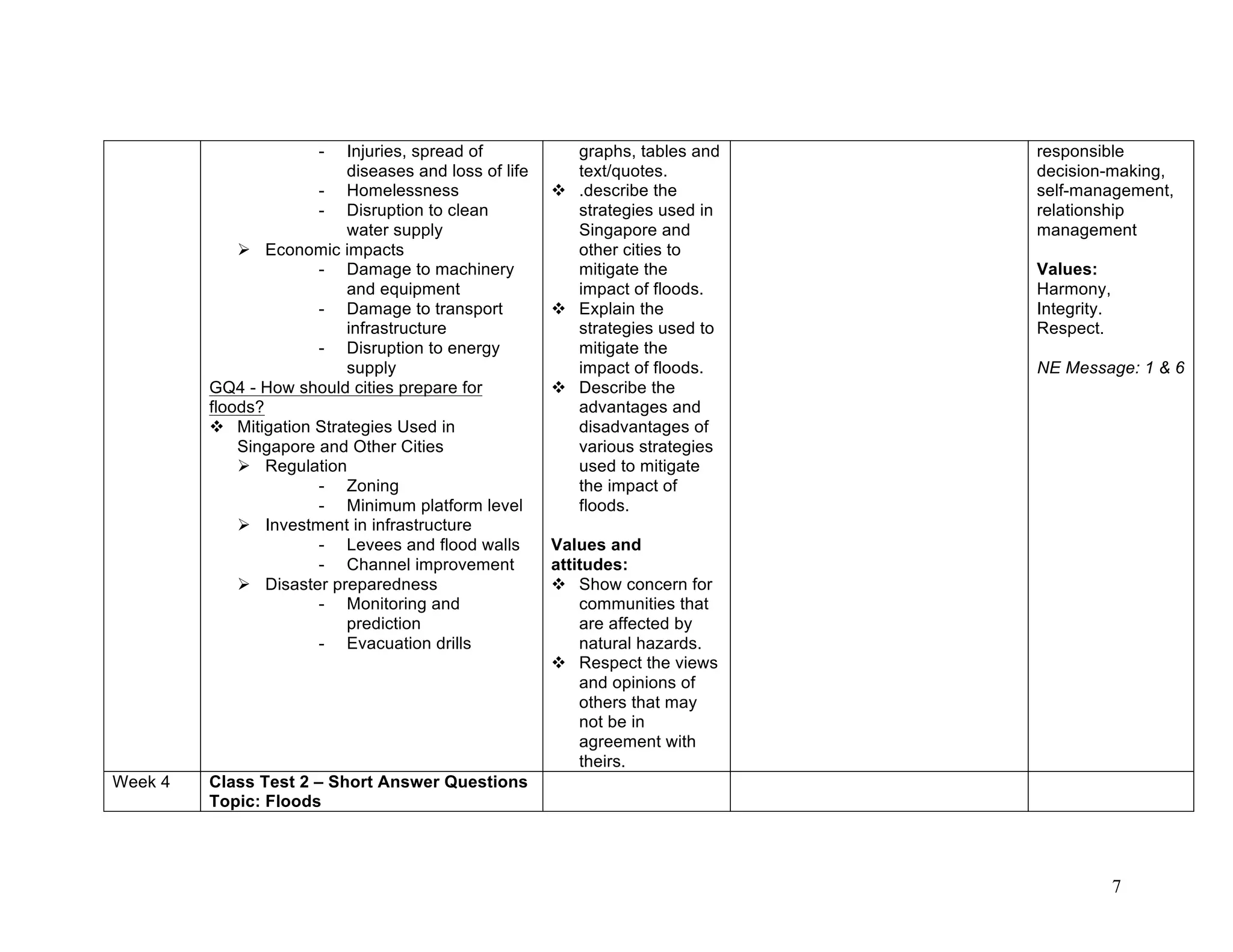
- Injuries, spread of
diseases and loss of life
- Homelessness
- Disruption to clean
water supply
 Economic impacts
- Damage to machinery
and equipment
- Damage to transport
infrastructure
- Disruption to energy
supply
GQ4 - How should cities prepare for
floods?
 Mitigation Strategies Used in
Singapore and Other Cities
 Regulation
- Zoning
- Minimum platform level
 Investment in infrastructure
- Levees and flood walls
- Channel improvement
 Disaster preparedness
- Monitoring and
prediction
- Evacuation drills
graphs, tables and
text/quotes.
 .describe the
strategies used in
Singapore and
other cities to
mitigate the
impact of floods.
 Explain the
strategies used to
mitigate the
impact of floods.
 Describe the
advantages and
disadvantages of
various strategies
used to mitigate
the impact of
floods.
Values and
attitudes:
 Show concern for
communities that
are affected by
natural hazards.
 Respect the views
and opinions of
others that may
not be in
agreement with
theirs.
responsible
decision-making,
self-management,
relationship
management
Values:
Harmony,
Integrity.
Respect.
NE Message: 1 & 6
Week 4 Class Test 2 – Short Answer Questions
Topic: Floods
8
Marks: 10 Duration: 15 min
Graded Assignment 2 (10 marks)
Response to a Geographical Issue
relating to Floods
Part 1 – Summary Writing of 75 to 100
words via a Geographical Question
frame (3 marks)
Part 2 – Mapwork (2 marks)
Total Marks: 5 Duration: 20 min
Part 3 – Personal Response of 50 to 80
words
Marks: 5 Duration: 20 min
Week 5 Revision and preparation for mid-year
exam 2015
Week 6-8 Mid-Year Exam 2015
Week 9-
10
Review of Mid Year Exam Paper
Week
(Period)
Topic
[Key concepts]
Learning
Outcomes
IT Skills / Thinking Skills NE messages/
Values
TERM THREE
Week 1 Geographical Investigation: What makes
Compass Point in the Sengkang
neighbourhood special to its residents?
Knowledge
 Discover places in the neighbourhood
Aims of GI:
 Describe the
characteristics
(eg. natural,
cultural,
aesthetical
Conduct secondary data research
through library and online searches
on Sengkang neighborhood.
Desired Outcome
of Education:
Confident Person;
self-directed
learner; active
contributor;
9
that are special to the residents and
understand the reasons why; and
 Understand that different residents may
feel differently about the different places
in the neighbourhood
design) of
Sengkang
neighboruhood
and explain the
reasons that may
make Compass
Point in the
Sengkang
neighbourhood
special to
different groups
of residents.
 Describe the
profile of the
residents, the
history,
development and
characteristics of
the Sengkang
neighbourhood.
concerned citizen
21st
Century CC:
Civic literacy,
global and socio-
cultural sensitivity
and awareness;
sound reasoning
and decision-
making, reflective
thinking
ICT:
Openness;
management of
information;
responsible use of
information,
communicating
effectively
SEL:
Self awareness,
self-management,
relationship
management
Values:
Harmony,
Integrity,
Respect
NE Message: 3 & 6
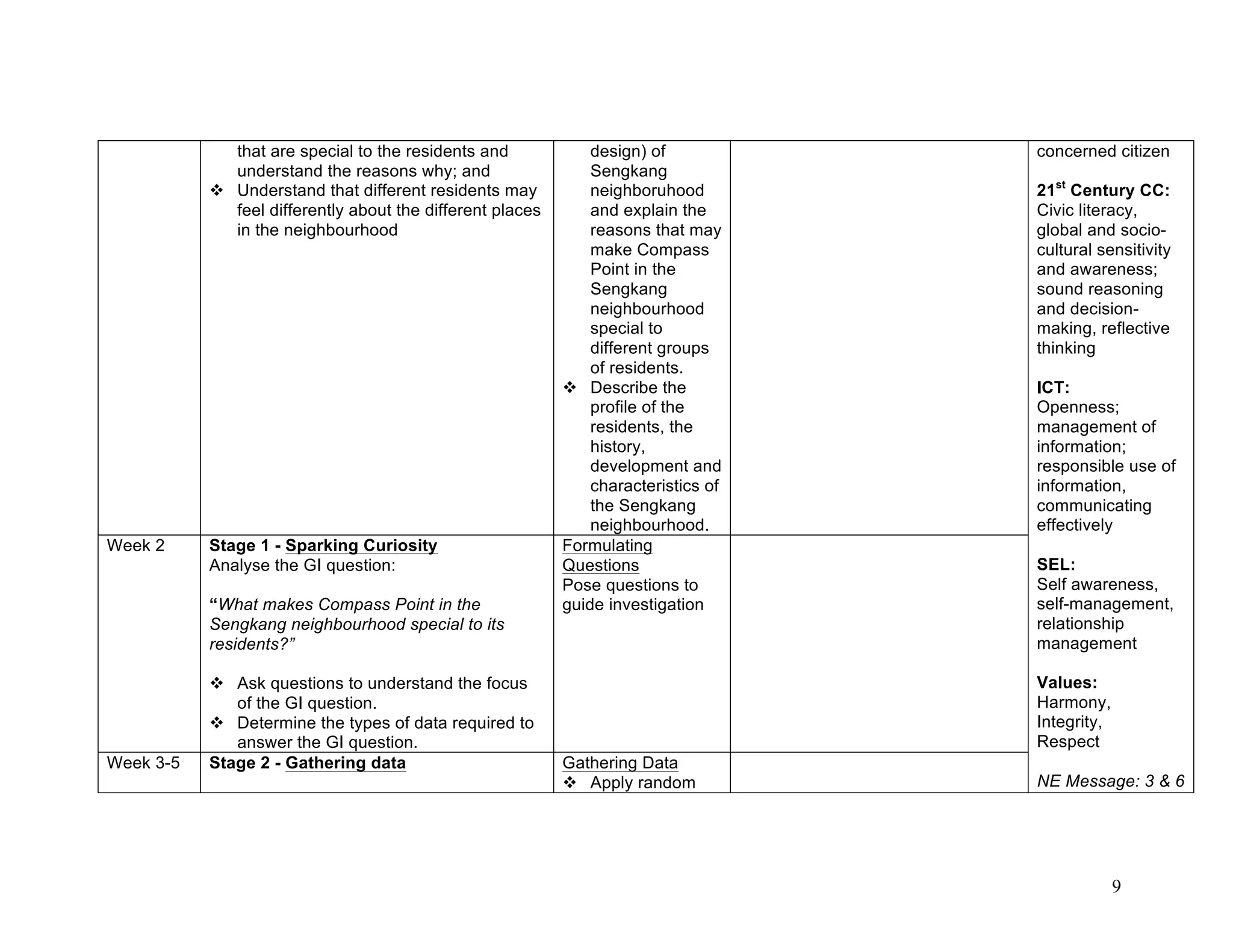
Week 2 Stage 1 - Sparking Curiosity
Analyse the GI question:
“What makes Compass Point in the
Sengkang neighbourhood special to its
residents?”
 Ask questions to understand the focus
of the GI question.
 Determine the types of data required to
answer the GI question.
Formulating
Questions
Pose questions to
guide investigation
Week 3-5 Stage 2 - Gathering data Gathering Data
 Apply random
10
 Conduct preliminary research on data
collection methods using online and
print materials
 Acquire fieldwork skills
 Identify collection methods and tools
that could be used for the fieldwork
and systematic
sampling
appropriately.
 Construct a
questionnaire
and carry out
interviews.
 Observe and
sketch places,
landscapes and
natural features.
 Identify relevant
information via
library and online
searches.
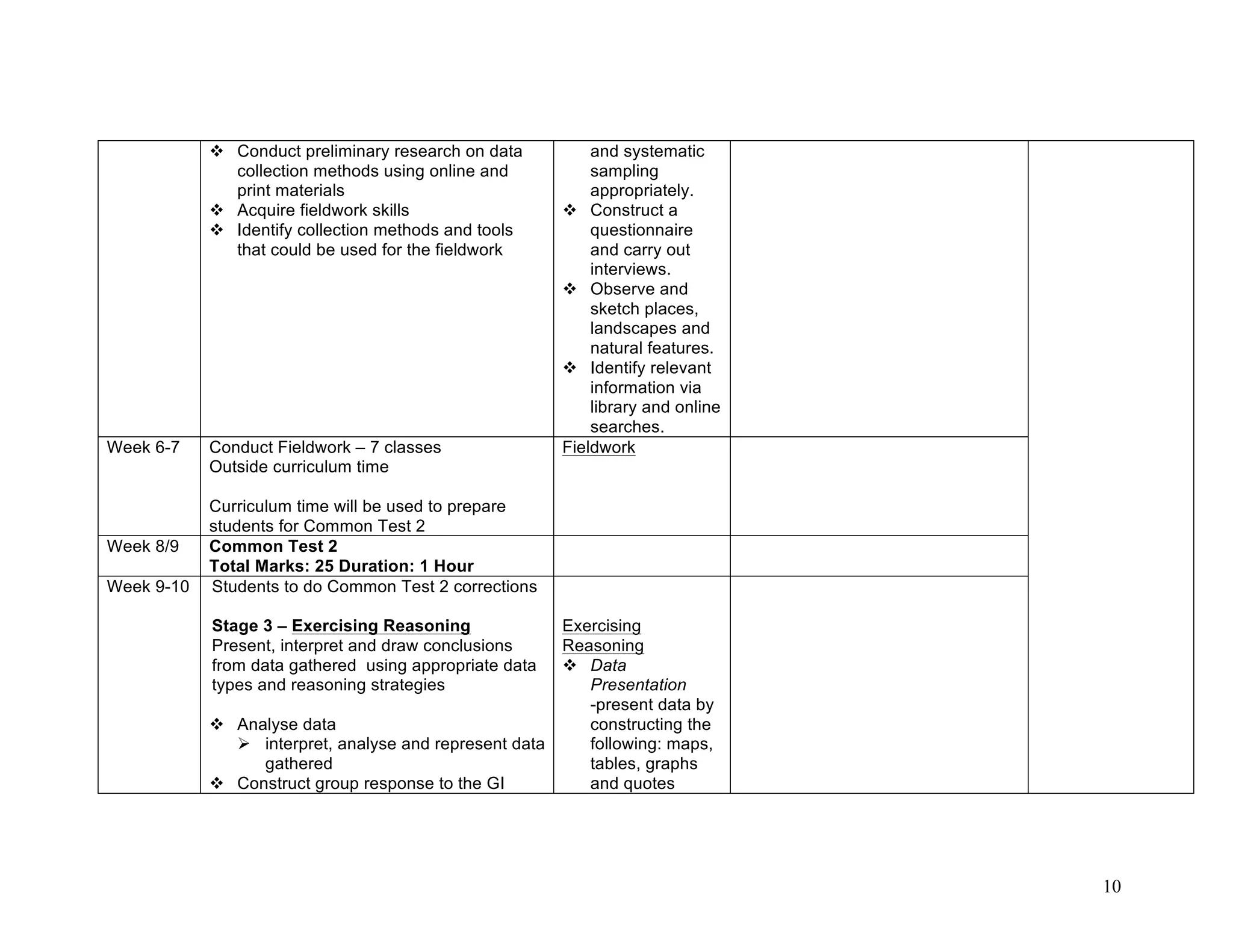
Week 6-7 Conduct Fieldwork – 7 classes
Outside curriculum time
Curriculum time will be used to prepare
students for Common Test 2
Fieldwork
Week 8/9 Common Test 2
Total Marks: 25 Duration: 1 Hour
Week 9-10 Students to do Common Test 2 corrections
Stage 3 – Exercising Reasoning
Present, interpret and draw conclusions
from data gathered using appropriate data
types and reasoning strategies
 Analyse data
 interpret, analyse and represent data
gathered
 Construct group response to the GI
Exercising
Reasoning
 Data
Presentation
-present data by
constructing the
following: maps,
tables, graphs
and quotes
11
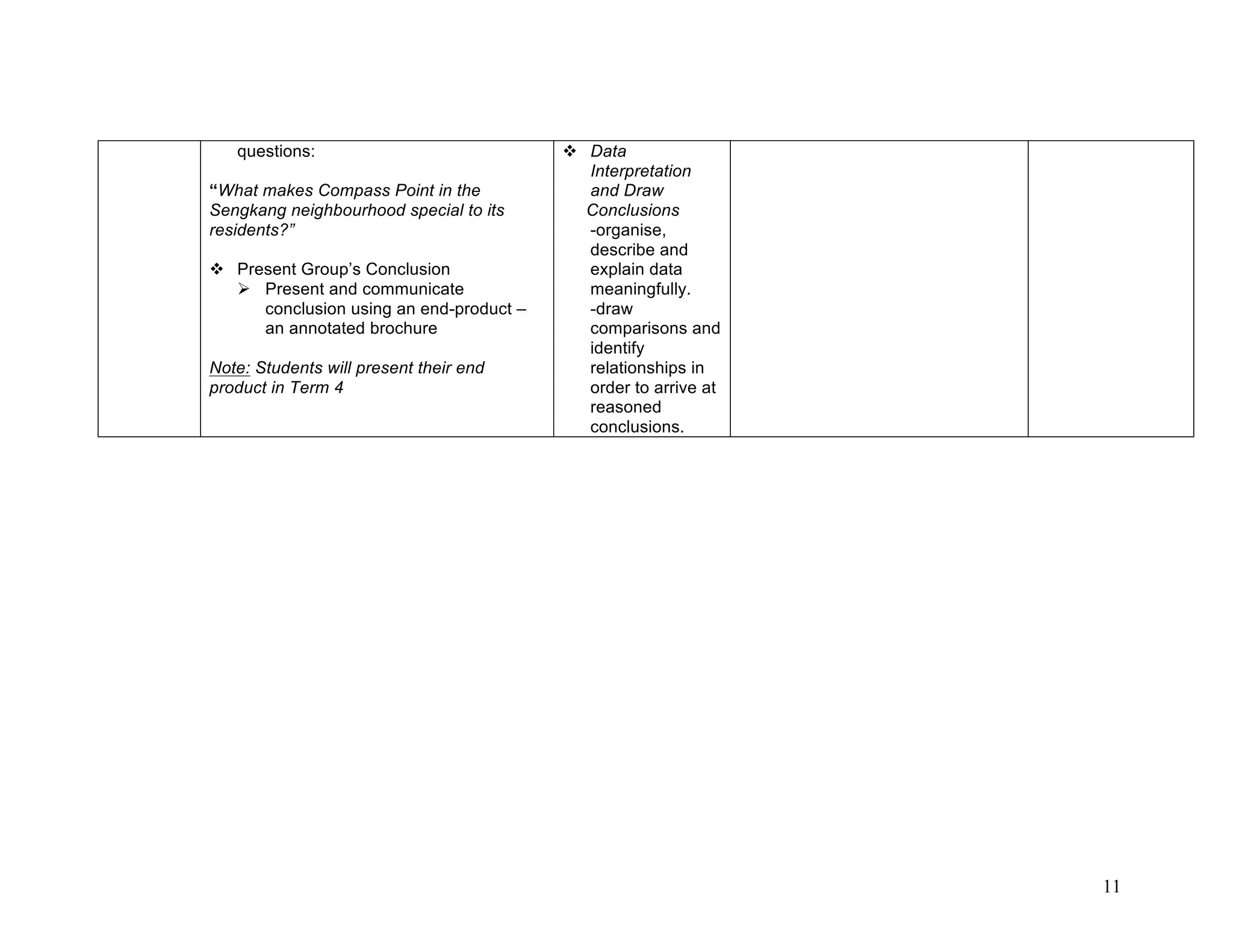
questions:
“What makes Compass Point in the
Sengkang neighbourhood special to its
residents?”
 Present Group’s Conclusion
 Present and communicate
conclusion using an end-product –
an annotated brochure
Note: Students will present their end
product in Term 4
 Data
Interpretation
and Draw
Conclusions
-organise,
describe and
explain data
meaningfully.
-draw
comparisons and
identify
relationships in
order to arrive at
reasoned
conclusions.
12
Week
(Period)
Topic
[Key concepts]
Learning
Outcomes
IT Skills / Thinking Skills NE messages/
Values
TERM FOUR
Week 1- 2/3 Stage 3 – Exercising Reasoning
Group End Product Presentation
Presentation of a
brochure on “What
makes Compass
Point so special to
the residents in
Sengkang
Neighbourhood?”
Week 3/4 Stage 4 – Individual Reflection
Reflect on the Learning and Experience
by individual students
 Analysis of class data
 Identify strengths, limitations and
possible ways of improving the
investigation
Reflective Thinking
Describe the
strengths and
limitations of the
investigation and
suggest ways to
improve it.
END OF GI
NO EOY FOR S2 GEOGRAPHY
Teachers will grade GI submissions in the midst of EOY
NATIONAL EDUCATION MESSAGES
1. Singapore is our homeland; this is where we belong. We treasure our heritage and take pride in shaping our own unique way of
life.
2. We must preserve racial and religious harmony. We value our diversity and are determined to stay a united people.
3. We must uphold meritocracy and incorruptibility. We provide opportunities for all, according to their ability and effort.
4. No one owes Singapore a living. We find our own way to survive and prosper, turning challenge into opportunity.
5. We must ourselves defend Singapore. We are proud to defend Singapore ourselves, no one else is responsible for our security
and well-being.
6. We have confidence in our future. United, determined and well-prepared, we have what it takes to build a bright future for
ourselves, and to progress together as one nation.

SOW 2015 (Revised)

  • 1.
    1 EDGEFIELD SECONDARY SCHOOL HUMANITIESDEPARTMENT LOWER SECONDARY GEOGRAPHY SCHEME OF WORK 2015 SECONDARY 2 EXPRESS/ NA THEME: URBAN LIVING Week (2 Periods) Topic [Knowledge] Learning Outcomes IT Skills / Thinking Skills NE messages / Values TERM ONE Week 1-2 Introduction: How and where do people live? Knowledge  Development of Human Society  Hunting and gathering − Hunt wild animals − Gather food from flora − Nomadic − Agrarian society Cultivate plants − Domesticate animals − Sedentary  Industrial society − Commercial farming − Mass production of goods − Industrial cities  Location of industrial cities - Waterways (eg. Shanghai) - Source of energy supply (eg. Newcastle) - Source of raw materials (eg. Seattle)  Features of Cities (with specific Geographical Concepts  Place  Space  Scale  Environment Students would not be assessed for the introductory issue. It is intended to provide them with an overarching schema to understand some key ideas related to the Sec 2 Theme of Urban Living as they examine issues arising from housing, transport and flood hazards in the context of cities.  Geographical inquiry questions Rationale: Students will be introduced to this mode of questioning and develop their proficiency through subsequent topic study and GI.  Geographical data collection and analysis through fieldwork  Geographical data analysis and presentation Rationale: Students will be exposed to use primary and secondary data collection to support their investigation. They also make use of various data representations to illustrate their findings. By exposing students to a range of geographical data and skills, they would become adept at carrying out sound analysis and interpretation of the data they are presented with. Desired Outcome of Education: Confident Person; self- directed learner; active contributor; concerned citizen 21st Century CC: Curiosity and creativity ICT: Openness; management of information NE Message: 1 & 6
  • 2.
    2 reference to theSingapore city-state)  Large population size due to natural increase and immigration  Cosmopolitan population  High population density  Built-up Week 3-4 Housing: How to build inclusive homes for all? Knowledge GQ1 – What is housing shortage? What is inclusive housing?  Housing shortage  Lack of safe shelter  Insufficient basic services GQ2 – Which cities in the world experience housing shortage? Why does housing shortage occur?  Location of cities that experience housing shortage (eg. Manila and New York City)  Reasons for housing shortage  Rapid population growth - In-migration due to job opportunities - High birth rates due to youthful population  Competing land use  Limited supply of land GQ3 – What are the consequences of housing shortage in cities?  Consequences of housing shortage  Slums and squatters  Define housing shortage and inclusive housing  Describe the nature of housing shortage using photographs and sketches  Identify the location of cities experiencing housing shortage using maps  Describe the extent of housing shortages in cities using graphs and tables  Using named examples of cities, explain the reasons for housing shortage  Describe the consequences of housing shortage using photographs,  Geographical inquiry questions Rationale: Students will be exposed to develop their proficiency in posing geographical inquiry questions  Geographical data collection and analysis through fieldwork  Geographical data analysis and presentation Rationale: Students will be exposed to use various data representations to illustrate and study spatial patterns, physical and human phenomena and relationship between people and the environment. Students will also acquire the skills to identify and use the appropriate data type to represent their own geographical investigation findings. Desired Outcome of Education: Confident Person; self- directed learner; active contributor; concerned citizen 21st Century CC: Civic literacy, global and socio-cultural sensitivity and awareness; sound reasoning and decision- making, reflective thinking ICT: Openness; management of
  • 3.
    3 - Poor healthdue to disease outbreak - Risk of fires and landslides - Environmental pollution  Social tension, lack of sense of place and belonging sketches and text/quotes Values and attitudes:  Show concern for people who live in sub- standard housing.  Respect the resilience shown by people to improve their living conditions. information; responsible use of information, communicating effectively SEL: Self awareness, self- management, relationship management Values: Harmony, Integrity. Respect. NE Message: 1 & 3 Week 5/6 Class Test 1 – Short Answer Question Topic: Housing (GQ1,GQ2 and GQ3) Marks: 10 Duration: 20 min Graded Assignment (10 marks) Response to a Geographical Issue relating to Housing Part 1 – Summary Writing of 75 to 100 words via a Geographical Question frame (3 marks) Part 2 – Mapwork (2 marks) Total Marks: 5 Duration: 40 min  Summary writing of 75 to 100 words via a Geographical Question frame  Mapwork  Personal Response of 50 to 80 words  Response to a Geographical Issue from a newspaper Rationale: Gives students an opportunity to further develop 21st CC while helping them to appreciate the relevance of Geography in the real world. 21st Century CC: Civic literacy, global and socio-cultural sensitivity and awareness; sound reasoning and decision- making, reflective thinkingWeek 6-7 1st period: Check their Class Test 1 and do
  • 4.
    4 corrections. 2nd period: Response toa Geographical Issue relating to Housing Part 3 – Personal Response of 50 to 80 words Marks: 5 Duration: 20 min Week 7 Housing: How to build inclusive homes for all? Knowledge GQ4 – What are some strategies used by cities to manage housing shortage and build inclusive homes?  Strategies to manage housing shortage  Self-help schemes; partnership between government and people (eg. Rio De Janeiro)  Provision of mass housing by government (eg. Hong Kong)  Provision of mass housing through partnership between government and private companies (eg. Chengdu)  Elements of inclusive housing  Affordable housing  Facilities and amenities for all ages  Strong sense of place and belonging  Strategies to build inclusive homes in Singapore  Promote racial integration and harmony (eg. HDB Ethnic Integration Policy)  Community engagement (eg. restoring and building town markers, community gardening and welcome  Describe the strategies used by Singapore and other cities to manage housing shortage and build inclusive homes.  Describe the strategies used by Singapore to and other cities to manage housing shortage  Explain the challenges faced by Singapore and other cities to manage housing shortage. Values and attitudes:  Show concern for people who live in sub- standard housing.  Respect the  Geographical inquiry questions Rationale: Students will be exposed to develop their proficiency in posing geographical inquiry questions  Geographical data collection and analysis through fieldwork  Geographical data analysis and presentation Rationale: Students will be exposed to use various data representations to illustrate and study spatial patterns, physical and human phenomena and relationship between people and the environment. Students will also acquire the skills to identify and use the appropriate data type to represent their own geographical investigation findings. Desired Outcome of Education: Confident Person; self- directed learner; active contributor; concerned citizen 21st Century CC: Civic literacy, global and socio-cultural sensitivity and awareness; sound reasoning and decision- making, reflective thinking ICT: Openness; management of
  • 5.
    5 parties)  Provide communityspaces (eg. Tao Payoh Sensory Park and Multi- purpose Halls)  Promote multi-generation living (eg. barrier-free housing estates, HDB Lift Upgrading Programme, SkyTerrace@Dawson- pairing HDB studio Apartments with HDB 4 and 5 room flats) resilience shown by people to improve their living conditions. information; responsible use of information, communicating effectively SEL: Self awareness, self- management, relationship management Values: Harmony, Integrity. Respect. NE Message: 1 & 3 Week 8/9 Common Test 1 Topic: Housing: How to provide homes for all? Total Marks: 25 Duration: 1 Hour Week 9/10 Students do Common Test 1 corrections Learning Journeys to HDB and LTA NE Message 1 & 4
  • 6.
    6 Week (Period) Topic [Key concepts] Learning OutcomesIT Skills / Thinking Skills NE messages/ Values TERM TWO Week 1- 3/4 Floods: How can cities prepare for floods? Knowledge GQ1 - What are floods?  Types of floods  Coastal flood  River flood  Flash flood  Causes of floods  Intensity, frequency and duration of rainfall  Snowmelt  Storm surge  Catastrophic events (eg. volcanic eruption and dam failure) GQ2 - Which cities are prone to floods? Why are these cities more prone to floods than others?  Cities prone to floods (e.g. New Orleans, USA and Manila, Philippines)  Factors contributing to floods  Height above sea level  Permeability of surface cover  Drainage capacity  Proximity to water bodies GQ3 – How do floods affect people living in cities?  Impact of Hurricane Katrina and Typhoon Ketsana  Social impacts Geographical Concepts  Excess overland flow  Location  Natural hazard  Legislation  Human intervention  Public education  Describe the types of floods.  Explain the causes of floods.  Describe the location of cities prone to floods using maps.  Explain why some cities are prone to floods with the use of photographs, sketches and text/quotes.  Describe the socio-economic impact of floods with the use of  Geographical inquiry questions Rationale: Through the various issues, students would learn that geographical inquiry questions can be contextualised and applied to an issue being studied. With repeated exposure, students would develop their proficiency in posing such questions as well.  Geographical data collection and analysis through fieldwork  Geographical data analysis and presentation Rationale: Geographers use various data representations to illustrate and study spatial patterns, physical and human phenomena and relationships between people and the environment. Students exposed to a range of geographical data and skills would become adept at carrying out sound analysis and interpretation of the data they are presented with. Students would also acquire the skills to identify and use the appropriate data type to represent their own geographical investigation findings. Desired Outcome of Education: Confident Person; self-directed learner; active contributor; concerned citizen 21st Century CC: Civic literacy, global and socio- cultural sensitivity and awareness; sound reasoning and decision- making, reflective thinking ICT: Openness; management of information; responsible use of information, communicating effectively SEL: Self awareness, Social awareness,
  • 7.
    7 - Injuries, spreadof diseases and loss of life - Homelessness - Disruption to clean water supply  Economic impacts - Damage to machinery and equipment - Damage to transport infrastructure - Disruption to energy supply GQ4 - How should cities prepare for floods?  Mitigation Strategies Used in Singapore and Other Cities  Regulation - Zoning - Minimum platform level  Investment in infrastructure - Levees and flood walls - Channel improvement  Disaster preparedness - Monitoring and prediction - Evacuation drills graphs, tables and text/quotes.  .describe the strategies used in Singapore and other cities to mitigate the impact of floods.  Explain the strategies used to mitigate the impact of floods.  Describe the advantages and disadvantages of various strategies used to mitigate the impact of floods. Values and attitudes:  Show concern for communities that are affected by natural hazards.  Respect the views and opinions of others that may not be in agreement with theirs. responsible decision-making, self-management, relationship management Values: Harmony, Integrity. Respect. NE Message: 1 & 6 Week 4 Class Test 2 – Short Answer Questions Topic: Floods
  • 8.
    8 Marks: 10 Duration:15 min Graded Assignment 2 (10 marks) Response to a Geographical Issue relating to Floods Part 1 – Summary Writing of 75 to 100 words via a Geographical Question frame (3 marks) Part 2 – Mapwork (2 marks) Total Marks: 5 Duration: 20 min Part 3 – Personal Response of 50 to 80 words Marks: 5 Duration: 20 min Week 5 Revision and preparation for mid-year exam 2015 Week 6-8 Mid-Year Exam 2015 Week 9- 10 Review of Mid Year Exam Paper Week (Period) Topic [Key concepts] Learning Outcomes IT Skills / Thinking Skills NE messages/ Values TERM THREE Week 1 Geographical Investigation: What makes Compass Point in the Sengkang neighbourhood special to its residents? Knowledge  Discover places in the neighbourhood Aims of GI:  Describe the characteristics (eg. natural, cultural, aesthetical Conduct secondary data research through library and online searches on Sengkang neighborhood. Desired Outcome of Education: Confident Person; self-directed learner; active contributor;
  • 9.
    9 that are specialto the residents and understand the reasons why; and  Understand that different residents may feel differently about the different places in the neighbourhood design) of Sengkang neighboruhood and explain the reasons that may make Compass Point in the Sengkang neighbourhood special to different groups of residents.  Describe the profile of the residents, the history, development and characteristics of the Sengkang neighbourhood. concerned citizen 21st Century CC: Civic literacy, global and socio- cultural sensitivity and awareness; sound reasoning and decision- making, reflective thinking ICT: Openness; management of information; responsible use of information, communicating effectively SEL: Self awareness, self-management, relationship management Values: Harmony, Integrity, Respect NE Message: 3 & 6 Week 2 Stage 1 - Sparking Curiosity Analyse the GI question: “What makes Compass Point in the Sengkang neighbourhood special to its residents?”  Ask questions to understand the focus of the GI question.  Determine the types of data required to answer the GI question. Formulating Questions Pose questions to guide investigation Week 3-5 Stage 2 - Gathering data Gathering Data  Apply random
  • 10.
    10  Conduct preliminaryresearch on data collection methods using online and print materials  Acquire fieldwork skills  Identify collection methods and tools that could be used for the fieldwork and systematic sampling appropriately.  Construct a questionnaire and carry out interviews.  Observe and sketch places, landscapes and natural features.  Identify relevant information via library and online searches. Week 6-7 Conduct Fieldwork – 7 classes Outside curriculum time Curriculum time will be used to prepare students for Common Test 2 Fieldwork Week 8/9 Common Test 2 Total Marks: 25 Duration: 1 Hour Week 9-10 Students to do Common Test 2 corrections Stage 3 – Exercising Reasoning Present, interpret and draw conclusions from data gathered using appropriate data types and reasoning strategies  Analyse data  interpret, analyse and represent data gathered  Construct group response to the GI Exercising Reasoning  Data Presentation -present data by constructing the following: maps, tables, graphs and quotes
  • 11.
    11 questions: “What makes CompassPoint in the Sengkang neighbourhood special to its residents?”  Present Group’s Conclusion  Present and communicate conclusion using an end-product – an annotated brochure Note: Students will present their end product in Term 4  Data Interpretation and Draw Conclusions -organise, describe and explain data meaningfully. -draw comparisons and identify relationships in order to arrive at reasoned conclusions.
  • 12.
    12 Week (Period) Topic [Key concepts] Learning Outcomes IT Skills/ Thinking Skills NE messages/ Values TERM FOUR Week 1- 2/3 Stage 3 – Exercising Reasoning Group End Product Presentation Presentation of a brochure on “What makes Compass Point so special to the residents in Sengkang Neighbourhood?” Week 3/4 Stage 4 – Individual Reflection Reflect on the Learning and Experience by individual students  Analysis of class data  Identify strengths, limitations and possible ways of improving the investigation Reflective Thinking Describe the strengths and limitations of the investigation and suggest ways to improve it. END OF GI NO EOY FOR S2 GEOGRAPHY Teachers will grade GI submissions in the midst of EOY NATIONAL EDUCATION MESSAGES 1. Singapore is our homeland; this is where we belong. We treasure our heritage and take pride in shaping our own unique way of life. 2. We must preserve racial and religious harmony. We value our diversity and are determined to stay a united people. 3. We must uphold meritocracy and incorruptibility. We provide opportunities for all, according to their ability and effort. 4. No one owes Singapore a living. We find our own way to survive and prosper, turning challenge into opportunity. 5. We must ourselves defend Singapore. We are proud to defend Singapore ourselves, no one else is responsible for our security and well-being. 6. We have confidence in our future. United, determined and well-prepared, we have what it takes to build a bright future for ourselves, and to progress together as one nation.