DETERMINATION OF FLIGHT
DIRECTION
INTRODUCTION
• The term “Photography” is derived from two Greek words
meaning “phos”(light) and “graphien” (writing)
• Photography is the production of permanent images by
means of action of the light
• Aerial Photography is broadly defined as any photographs
of that takes place from an elevated position.
MANY FACTORS DETERMINE
THE QUALITY OF AERIAL
PHOTOGRAPHY
Quality of the lens system
 Manufacturing the camera
 Photographic material
 Weather conditions and sun angel during photo flight
CLASSIFICATION OF
AERIAL PHOTOGRAPH
• Aerial photographs are usually classified according
to the orientation of the camera axis, the focal
length of the camera
• There are 3 types
* Horizontal photography
* Vertical photography
*Oblique photography
ANNOTATIONS
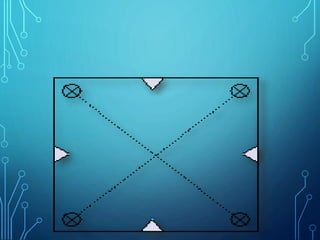
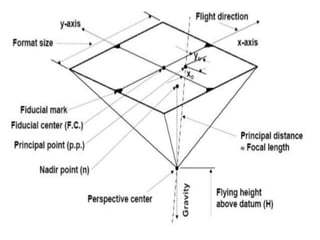
• Fiducial marks
* these are the marks built into aerial
cameras which appear on the sides or in the
corners of the photo
* these are used to determine the precise
location of the principal point
• Fiducial axes
The lines joining the opposite fiducial marks on a
photograph are called fiducial axes.
• Principal point
It is a point on the aerial photograph, where a
perpendicular from the interior perspective centre of the
camera lens meets the plane of the aerial photograph
The principal point is the geometric centre of the
photograph
• XY co-ordinate:
they are obtained by joining opposite fiducial imaginary
X co-ordinate and Y co-ordinates.
• Perspective centre:
It is the centre point of the lens in camera.
• Flight line:
Photographs are taken with the frame of the cameras
along one line. These lines are called flight line.
CONJUGATE PRINCIPAL
POINT
It is a principle point of an aerial photo represented on an
adjacent aerial photograph.
NADIR POINT
Nadir point is the point in which a vertical line
through the perspective centre of the camera
lens pierces the plane of the aerial photograph.
PHOTO-BASE
• The airbase is called the photo-base on an aerial
photograph and represents the length of the air-base on a
photograph.
In practice it is measurable distance between the
principal point and the conjugate point
PREPARATION OF FLIGHT TO
ACQUIRE AERIAL
PHOTOGRAPHS
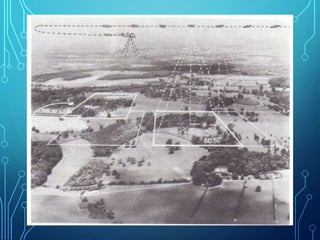
• process begins with selecting an image scale, camera lens
and format size, and desired image overlap.
• flight planner can then determine such geometric factors
as the appropriate flying height, the distance between
image centres, the direction and spacing of flight line, and
the number of images required to cover the study area.
• Based on these factors, a flight maps are prepared for the
firm providing the photographic services.
DETERMINATION OF FLIGHT
DIRECTION
PROCEDURE
• Demarcate the boundary of stereopair.
• Demarcate the symbols like fiducial marks, scale etc.
• Join opposite fiducial marks to get co-ordinates.
• X and Y co-ordinates meet the centre and meeting poin
called principal point.
• Principal point of first photograph will be present on
second photograph called conjugate principal point.
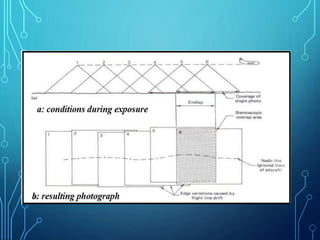
• Maximum number of points will be present due to 40% -
60% overlap.
• By finding or tracing common points, we can determine
the flight direction.
CONCLUSION
Before the aerial photographs came into practice
for analytical and computational work, similar
data collection for topographical surveys and
geological investigations used to be various
photogrammetric and photo-interpretation
techniques, the same work is being carried out
more precisely with economy of time, money
and efforts.
THANK YOU

Determination of Flight Direction

  • 1.
  • 2.
    INTRODUCTION • The term“Photography” is derived from two Greek words meaning “phos”(light) and “graphien” (writing) • Photography is the production of permanent images by means of action of the light • Aerial Photography is broadly defined as any photographs of that takes place from an elevated position.
  • 3.
    MANY FACTORS DETERMINE THEQUALITY OF AERIAL PHOTOGRAPHY Quality of the lens system  Manufacturing the camera  Photographic material  Weather conditions and sun angel during photo flight
  • 4.
    CLASSIFICATION OF AERIAL PHOTOGRAPH •Aerial photographs are usually classified according to the orientation of the camera axis, the focal length of the camera • There are 3 types * Horizontal photography * Vertical photography *Oblique photography
  • 5.
    ANNOTATIONS • Fiducial marks *these are the marks built into aerial cameras which appear on the sides or in the corners of the photo * these are used to determine the precise location of the principal point
  • 7.
    • Fiducial axes Thelines joining the opposite fiducial marks on a photograph are called fiducial axes. • Principal point It is a point on the aerial photograph, where a perpendicular from the interior perspective centre of the camera lens meets the plane of the aerial photograph The principal point is the geometric centre of the photograph
  • 8.
    • XY co-ordinate: theyare obtained by joining opposite fiducial imaginary X co-ordinate and Y co-ordinates. • Perspective centre: It is the centre point of the lens in camera. • Flight line: Photographs are taken with the frame of the cameras along one line. These lines are called flight line.
  • 10.
    CONJUGATE PRINCIPAL POINT It isa principle point of an aerial photo represented on an adjacent aerial photograph.
  • 11.
    NADIR POINT Nadir pointis the point in which a vertical line through the perspective centre of the camera lens pierces the plane of the aerial photograph.
  • 12.
    PHOTO-BASE • The airbaseis called the photo-base on an aerial photograph and represents the length of the air-base on a photograph. In practice it is measurable distance between the principal point and the conjugate point
  • 13.
    PREPARATION OF FLIGHTTO ACQUIRE AERIAL PHOTOGRAPHS • process begins with selecting an image scale, camera lens and format size, and desired image overlap. • flight planner can then determine such geometric factors as the appropriate flying height, the distance between image centres, the direction and spacing of flight line, and the number of images required to cover the study area. • Based on these factors, a flight maps are prepared for the firm providing the photographic services.
  • 14.
  • 17.
    PROCEDURE • Demarcate theboundary of stereopair. • Demarcate the symbols like fiducial marks, scale etc. • Join opposite fiducial marks to get co-ordinates. • X and Y co-ordinates meet the centre and meeting poin called principal point.
  • 18.
    • Principal pointof first photograph will be present on second photograph called conjugate principal point. • Maximum number of points will be present due to 40% - 60% overlap. • By finding or tracing common points, we can determine the flight direction.
  • 19.
    CONCLUSION Before the aerialphotographs came into practice for analytical and computational work, similar data collection for topographical surveys and geological investigations used to be various photogrammetric and photo-interpretation techniques, the same work is being carried out more precisely with economy of time, money and efforts.
  • 20.