Lesson objectives:
Knowledge:
All will explain how
height is shown on maps
Most will recognise
slope types
Some will identify
landscape features from
looking at contours
Skills:
All will will complete the
contour shading task.
Most will be able to plot
the cross section of a
route
Some will shade your
cross section & add
landscape features
Keywords for today's lesson:
Contours
Gradient
Slope
Elevation
Topographic
Intervals
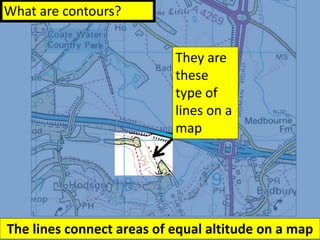
They are
these
type of
lines on a
map
What are contours?
The lines connect areas of equal altitude on a map
Why do we use contours?
True or False
1. Maps are Flat
2. Hills are not Flat
Contours lines are the easiest way of showing
changes in height of the landscape on a map
Why do we use contours?
• They can be used to learn about the shape of
the land (the relief).
• A map with only a few contour lines will be
flat (and often low lying)
• If a map has lots of contours it is a
mountainous or hilly area.
Contours lines are the easiest way of showing
changes in height of the landscape on a map
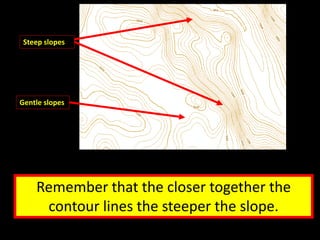
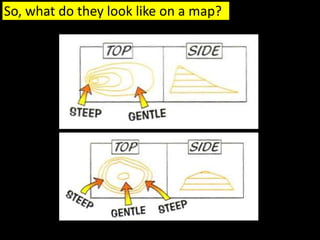
Remember that the closer together the
contour lines the steeper the slope.
Gentle slopes
Steep slopes
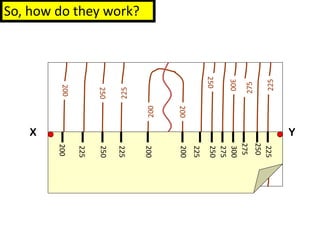
X Y
200
250
225
225
200
200
250
275
300
275
250
225
225
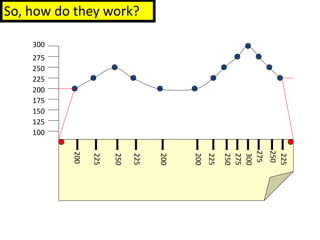
So, how do they work?
100
125
150
175
200
225
250
275
300
200
250
225
225
200
200
250
275
300
275
250
225
225
So, how do they work?
So, what do they look like on a map?
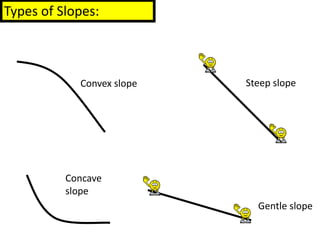
Convex slope
Concave
slope
Steep slope
Gentle slope
Types of Slopes:
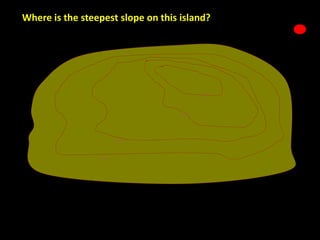
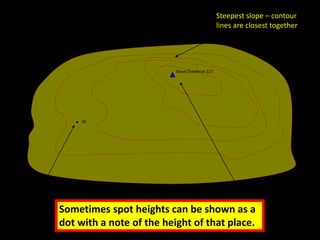
Where is the steepest slope on this island?
50
100
150
200
Steepest slope – contour
lines are closest together
Slieve Dowdican 227
.76
50
100
150
200
Sometimes spot heights can be shown as a
dot with a note of the height of that place.
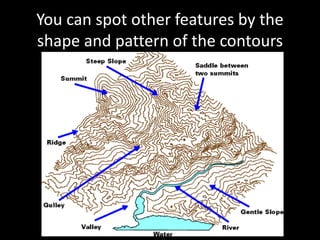
You can spot other features by the
shape and pattern of the contours
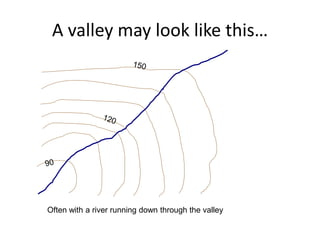
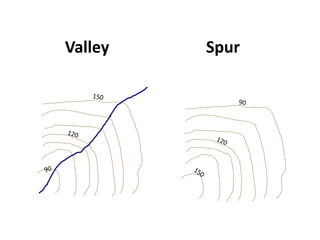
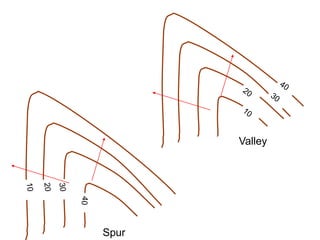
A valley may look like this…
Often with a river running down through the valley
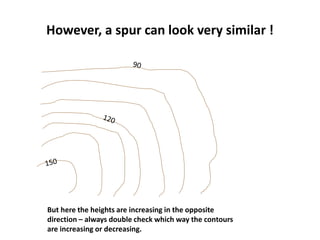
However, a spur can look very similar !
But here the heights are increasing in the opposite
direction – always double check which way the contours
are increasing or decreasing.
Valley Spur
Valley
Spur
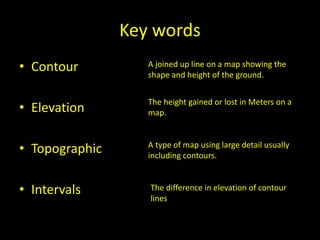
Key words
• Contour
• Elevation
• Topographic
• Intervals
A joined up line on a map showing the
shape and height of the ground.
The height gained or lost in Meters on a
map.
A type of map using large detail usually
including contours.
The difference in elevation of contour
lines
Activity
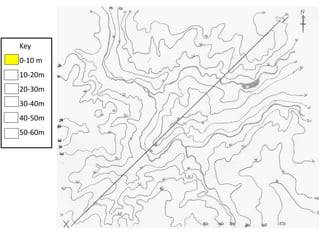
- Using the map, you are going to shade in areas
of equal height (altitude) using the connecting
contour lines
- You will use a key to show the heights shown
You need:
-Your map
-Colouring Pencils
-Scrap Paper
Key
0-10 m
10-20m
20-30m
30-40m
40-50m
50-60m
What you need to do
1. Complete shading task on contour map
2. Plot a cross section between X and Y on the
back of your sheet
3. Add the shading to your cross section
4. Mark on the two rivers
Have we met our lesson objectives?
Knowledge:
All will explain what are
contours on a map
Most will explain why
contours are important
Some will identify
landscape features from
looking at contours
Skills:
All will complete the
contour shading task.
Most will be able to plot
the cross section of a
route
Some will shade your
cross section & add
landscape features

Contours on OS Maps

  • 1.
    Lesson objectives: Knowledge: All willexplain how height is shown on maps Most will recognise slope types Some will identify landscape features from looking at contours Skills: All will will complete the contour shading task. Most will be able to plot the cross section of a route Some will shade your cross section & add landscape features
  • 2.
    Keywords for today'slesson: Contours Gradient Slope Elevation Topographic Intervals
  • 3.
    They are these type of lineson a map What are contours? The lines connect areas of equal altitude on a map
  • 4.
    Why do weuse contours? True or False 1. Maps are Flat 2. Hills are not Flat Contours lines are the easiest way of showing changes in height of the landscape on a map
  • 5.
    Why do weuse contours? • They can be used to learn about the shape of the land (the relief). • A map with only a few contour lines will be flat (and often low lying) • If a map has lots of contours it is a mountainous or hilly area. Contours lines are the easiest way of showing changes in height of the landscape on a map
  • 6.
    Remember that thecloser together the contour lines the steeper the slope. Gentle slopes Steep slopes
  • 7.
  • 8.
  • 9.
    So, what dothey look like on a map?
  • 10.
  • 11.
    Where is thesteepest slope on this island? 50 100 150 200
  • 12.
    Steepest slope –contour lines are closest together Slieve Dowdican 227 .76 50 100 150 200 Sometimes spot heights can be shown as a dot with a note of the height of that place.
  • 13.
    You can spotother features by the shape and pattern of the contours
  • 14.
    A valley maylook like this… Often with a river running down through the valley
  • 15.
    However, a spurcan look very similar ! But here the heights are increasing in the opposite direction – always double check which way the contours are increasing or decreasing.
  • 16.
  • 17.
  • 18.
    Key words • Contour •Elevation • Topographic • Intervals A joined up line on a map showing the shape and height of the ground. The height gained or lost in Meters on a map. A type of map using large detail usually including contours. The difference in elevation of contour lines
  • 19.
    Activity - Using themap, you are going to shade in areas of equal height (altitude) using the connecting contour lines - You will use a key to show the heights shown You need: -Your map -Colouring Pencils -Scrap Paper
  • 20.
  • 21.
    What you needto do 1. Complete shading task on contour map 2. Plot a cross section between X and Y on the back of your sheet 3. Add the shading to your cross section 4. Mark on the two rivers
  • 22.
    Have we metour lesson objectives? Knowledge: All will explain what are contours on a map Most will explain why contours are important Some will identify landscape features from looking at contours Skills: All will complete the contour shading task. Most will be able to plot the cross section of a route Some will shade your cross section & add landscape features