1
ORDNANCE SURVEY
MAP READING
MADE EASY
2
What is a map?
A map is simply a drawing or picture (in 2D) of a landscape or
area of a country (in 3D). It could be anything from a sketch
map for a visitor to find your school to a detailed map of a town
centre or mountain range.
Using a map you can visualise in your mind what the place
looks like that you are going to, and you can see what
landmarks and features you will pass on the way to your
destination. Maps mean you know what to expect, and they
help you to know you are going in the right direction to arrive
at your destination safely and quickly.
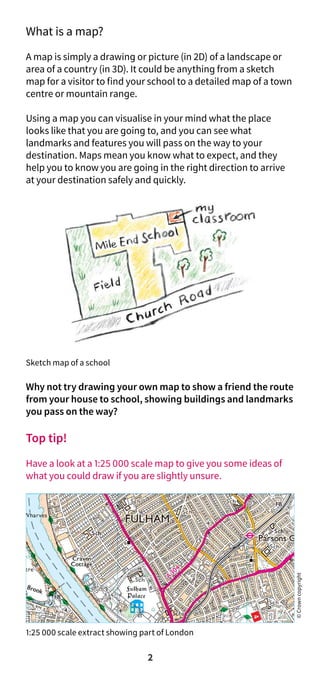
Sketch map of a school
Why not try drawing your own map to show a friend the route
from your house to school, showing buildings and landmarks
you pass on the way?
Top tip!
Have a look at a 1:25 000 scale map to give you some ideas of
what you could draw if you are slightly unsure.
1:25 000 scale extract showing part of London
©
Crown
copyright
3
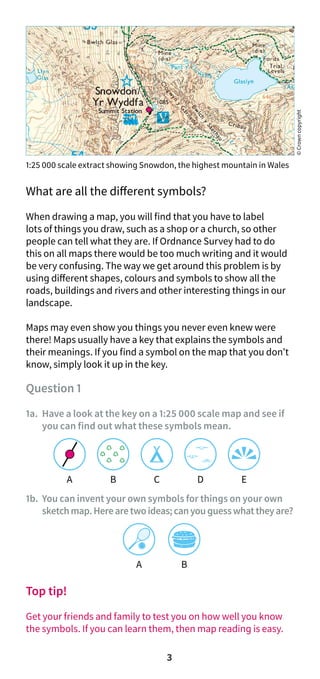
1:25 000 scale extract showing Snowdon, the highest mountain in Wales
What are all the different symbols?
When drawing a map, you will find that you have to label
lots of things you draw, such as a shop or a church, so other
people can tell what they are. If Ordnance Survey had to do
this on all maps there would be too much writing and it would
be very confusing. The way we get around this problem is by
using different shapes, colours and symbols to show all the
roads, buildings and rivers and other interesting things in our
landscape.
Maps may even show you things you never even knew were
there! Maps usually have a key that explains the symbols and
their meanings. If you find a symbol on the map that you don’t
know, simply look it up in the key.
Question 1
1a. Have a look at the key on a 1:25 000 scale map and see if
you can find out what these symbols mean.
A B C D E
1b. You can invent your own symbols for things on your own
sketchmap.Herearetwoideas;canyouguesswhattheyare?
A B
Top tip!
Get your friends and family to test you on how well you know
the symbols. If you can learn them, then map reading is easy.
©
Crown
copyright
4
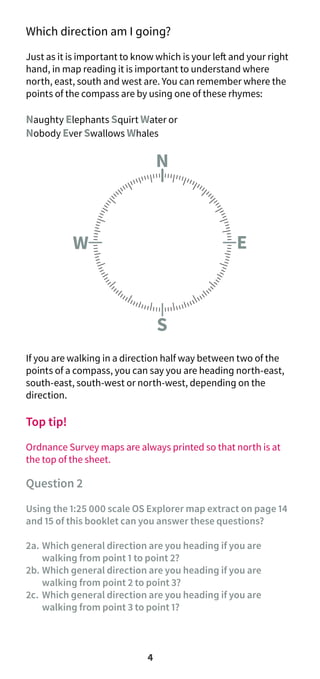
Which direction am I going?
Just as it is important to know which is your left and your right
hand, in map reading it is important to understand where
north, east, south and west are. You can remember where the
points of the compass are by using one of these rhymes:
Naughty Elephants Squirt Water or
Nobody Ever Swallows Whales
N
S
W E
If you are walking in a direction half way between two of the
points of a compass, you can say you are heading north‑east,
south-east, south‑west or north-west, depending on the
direction.
Top tip!
Ordnance Survey maps are always printed so that north is at
the top of the sheet.
Question 2
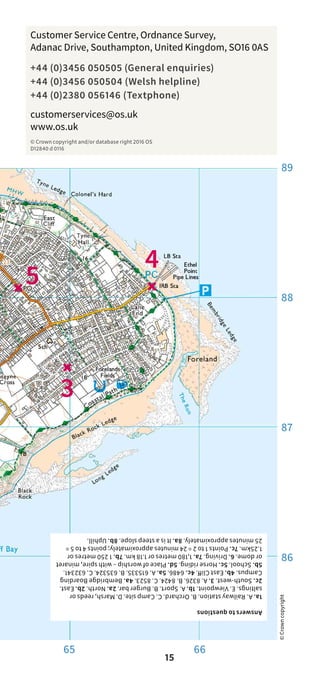
Using the 1:25 000 scale OS Explorer map extract on page 14
and 15 of this booklet can you answer these questions?
2a. Which general direction are you heading if you are
walking from point 1 to point 2?
2b. Which general direction are you heading if you are
walking from point 2 to point 3?
2c. Which general direction are you heading if you are
walking from point 3 to point 1?
5
Using the National Grid
You might have noticed by now that OS maps are covered in a
series of blue grid lines. These grid lines help you to pinpoint
an exact location anywhere on the map. The vertical lines are
called eastings, as they increase in value as you travel east
on the map. The horizontal lines are called northings as they
increase in value as you travel north on the map.
They’re linked to the National Grid which provides a unique
reference system, and can be applied to all OS maps of Great
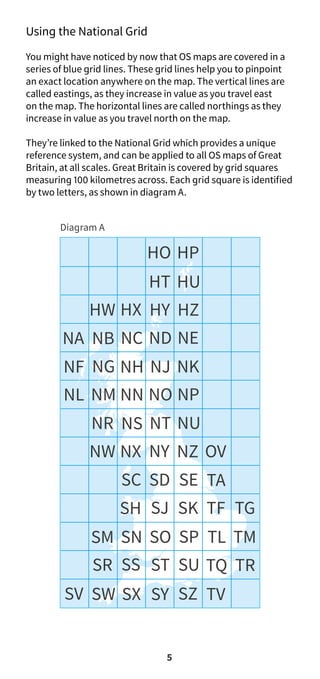
Britain, at all scales. Great Britain is covered by grid squares
measuring 100 kilometres across. Each grid square is identified
by two letters, as shown in diagram A.
HO HP
HT HU
HW HX HY HZ
NA NB NC ND NE
NF NG NH NJ NK
NL NM NN NO NP
NR NS NT NU
NW NX NY NZ OV
SC SD SE TA
SH SJ SK TF TG
SM SN SO SP TL
SS ST SU TQ TR
SV SW SX SY SZ
TM
SR
TV
Diagram A
6
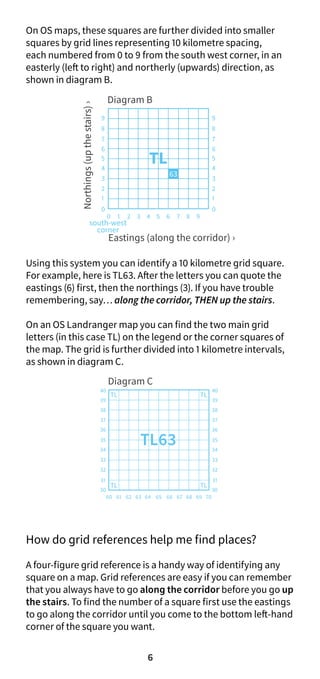
On OS maps, these squares are further divided into smaller
squares by grid lines representing 10 kilometre spacing,
each numbered from 0 to 9 from the south west corner, in an
easterly (left to right) and northerly (upwards) direction, as
shown in diagram B.
TL
63
Diagram B
5
1
3
4
6
7
5
0 1 2 3 9
4 6 7 8
9
8
0
south-west
corner
2
5
1
3
4
6
7
0
2
9
8
Northings
(up
the
stairs)
›
Eastings (along the corridor) ›
Using this system you can identify a 10 kilometre grid square.
For example, here is TL63. After the letters you can quote the
eastings (6) first, then the northings (3). If you have trouble
remembering, say… along the corridor, THEN up the stairs.
On an OS Landranger map you can find the two main grid
letters (in this case TL) on the legend or the corner squares of
the map. The grid is further divided into 1 kilometre intervals,
as shown in diagram C.
TL63
Diagram C
35
31
33
34
36
37
38
65
60 61 62 63 69
64 66 67 68
39
30
32
40
70
TL TL
TL TL
35
31
33
34
36
37
38
39
30
32
40
How do grid references help me find places?
A four-figure grid reference is a handy way of identifying any
square on a map. Grid references are easy if you can remember
that you always have to go along the corridor before you go up
the stairs. To find the number of a square first use the eastings
to go along the corridor until you come to the bottom left-hand
corner of the square you want.
7
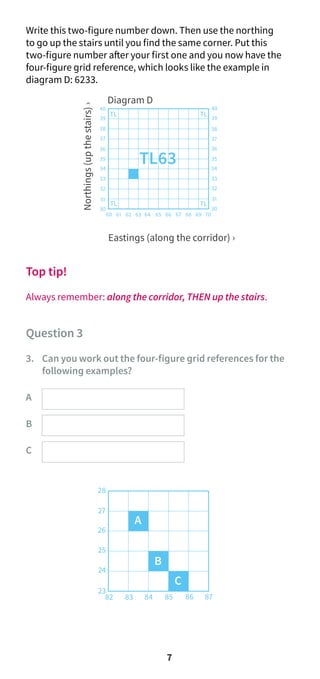
Write this two-figure number down. Then use the northing
to go up the stairs until you find the same corner. Put this
two‑figure number after your first one and you now have the
four-figure grid reference, which looks like the example in
diagram D: 6233.
TL63
TL TL
TL TL
Diagram D
35
31
33
34
36
37
38
65
60 61 63 69
64 66 67 68
35
30
31
32
33
39
34
36
37
38
39
30
40 40
70
62
32
62
32
Northings
(up
the
stairs)
›
Eastings (along the corridor) ›
Top tip!
Always remember: along the corridor, THEN up the stairs.
Question 3
3. Can you work out the four-figure grid references for the
following examples?
A
B
C
A
B
C
28
27
26
25
24
23
82 83 84 85 86 87
8
Question 4
Using the 1:25 000 scale OS Explorer map extract on page 14
and 15 of this booklet, can you answer these questions?
4a. What is the name of the school in grid square 6486?
4b. What is the name of the named building in grid square
6488?
4c. What grid square is Black Rock found in?
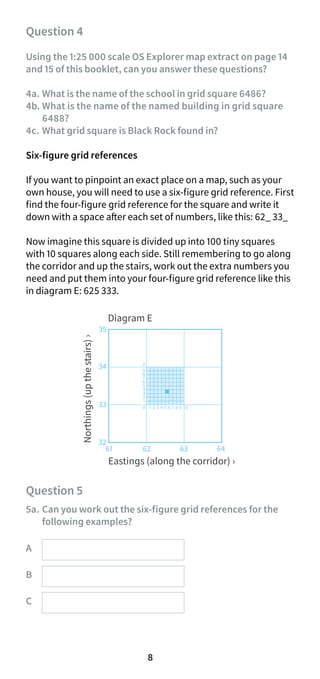
Six-figure grid references
If you want to pinpoint an exact place on a map, such as your
own house, you will need to use a six-figure grid reference. First
find the four-figure grid reference for the square and write it
down with a space after each set of numbers, like this: 62_ 33_
Now imagine this square is divided up into 100 tiny squares
with 10 squares along each side. Still remembering to go along
the corridor and up the stairs, work out the extra numbers you
need and put them into your four-figure grid reference like this
in diagram E: 625 333.
Diagram E
Northings
(up
the
stairs)
›
Eastings (along the corridor) ›
35
34
33
32
2
61 62 64
63
1 2 3 4 5 6 7 8 9 0
0
1
4
3
6
5
8
7
9
0
Question 5
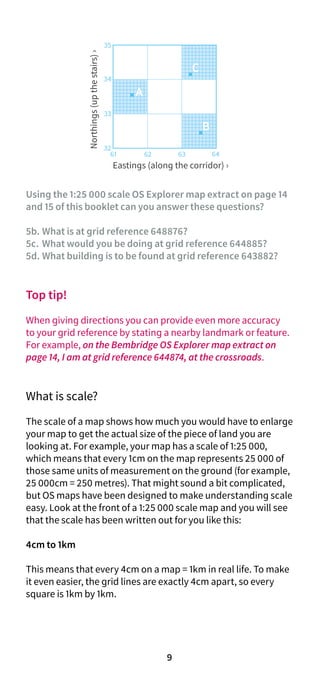
5a. Can you work out the six-figure grid references for the
following examples?
A
B
C
9
Northings
(up
the
stairs)
›
Eastings (along the corridor) ›
A
B
C
35
34
33
32
61 62 64
63
Using the 1:25 000 scale OS Explorer map extract on page 14
and 15 of this booklet can you answer these questions?
5b. What is at grid reference 648876?
5c. What would you be doing at grid reference 644885?
5d. What building is to be found at grid reference 643882?
Top tip!
When giving directions you can provide even more accuracy
to your grid reference by stating a nearby landmark or feature.
For example, on the Bembridge OS Explorer map extract on
page 14, I am at grid reference 644874, at the crossroads.
What is scale?
The scale of a map shows how much you would have to enlarge
your map to get the actual size of the piece of land you are
looking at. For example, your map has a scale of 1:25 000,
which means that every 1cm on the map represents 25 000 of
those same units of measurement on the ground (for example,
25 000cm = 250 metres). That might sound a bit complicated,
but OS maps have been designed to make understanding scale
easy. Look at the front of a 1:25 000 scale map and you will see
that the scale has been written out for you like this:
4cm to 1km
This means that every 4cm on a map = 1km in real life. To make
it even easier, the grid lines are exactly 4cm apart, so every
square is 1km by 1km.
10
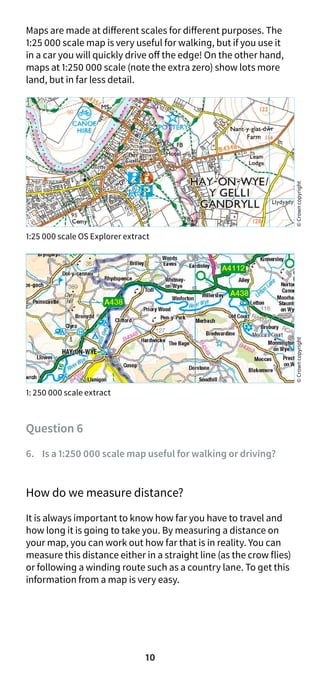
Maps are made at different scales for different purposes. The
1:25 000 scale map is very useful for walking, but if you use it
in a car you will quickly drive off the edge! On the other hand,
maps at 1:250 000 scale (note the extra zero) show lots more
land, but in far less detail.
1:25 000 scale OS Explorer extract
1: 250 000 scale extract
Question 6
6. Is a 1:250 000 scale map useful for walking or driving?
How do we measure distance?
It is always important to know how far you have to travel and
how long it is going to take you. By measuring a distance on
your map, you can work out how far that is in reality. You can
measure this distance either in a straight line (as the crow flies)
or following a winding route such as a country lane. To get this
information from a map is very easy.
©
Crown
copyright
©
Crown
copyright
11
Here is a way of doing it:
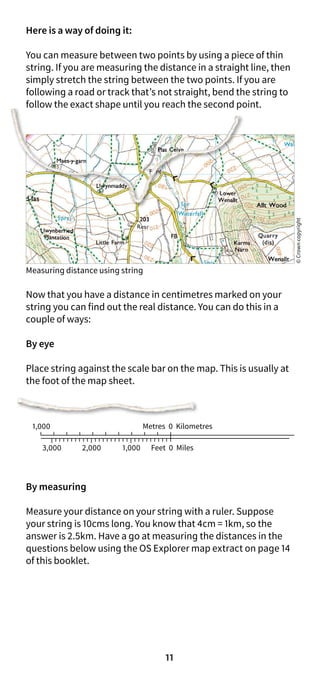
You can measure between two points by using a piece of thin
string. If you are measuring the distance in a straight line, then
simply stretch the string between the two points. If you are
following a road or track that’s not straight, bend the string to
follow the exact shape until you reach the second point.
Measuring distance using string
Now that you have a distance in centimetres marked on your
string you can find out the real distance. You can do this in a
couple of ways:
By eye
Place string against the scale bar on the map. This is usually at
the foot of the map sheet.
Metres 0 Kilometres
Feet 0 Miles
1,000 1 km
3,000 2,000 1,000
By measuring
Measure your distance on your string with a ruler. Suppose
your string is 10cms long. You know that 4cm = 1km, so the
answer is 2.5km. Have a go at measuring the distances in the
questions below using the OS Explorer map extract on page 14
of this booklet.
©
Crown
copyright
12
Question 7
Using the 1:25 000 scale OS Explorer map extract on page 14
and 15 of this booklet:
7a. How far is it in a straight line on the ground from point 1
to point 2?
7b. How far is it to walk along the road from point 4 (IRB Sta)
to point 5 (PO)?
7c. Can you work out how long it would take you to walk
both these distances?
(Most people walk at 3km per hour, so it will take 20 minutes
to walk in a straight line across a 1km grid square).
Top tip!
Remember that the grid lines on a 1:25 000 scale map are 1km
apart. A quick way of estimating distance is to count each
square you cross in a straight line. If going diagonally the
distance across the grid square is about 1½km.
How are hills and mountains shown on a map?
The ability to understand the shape of the ground from a
map is a useful skill to learn, particularly in mountainous
landscapes. The height and shape of the ground is shown on
1:25 000 scale maps by brown contour lines. A contour is a line
drawn on a map that joins points of equal height above sea
level. For 1:25 000 scale maps the vertical interval between
contours is usually 5 metres, although in mountainous regions
it may well be 10 metres.
10
20
30
40
10
20
30 40
The above diagram shows the link between the shape of a hill
and the contours representing it on a map. Another way of
thinking about contour lines is as a tide mark left by the sea as
the tide goes out, leaving a line every 5 metres.
13
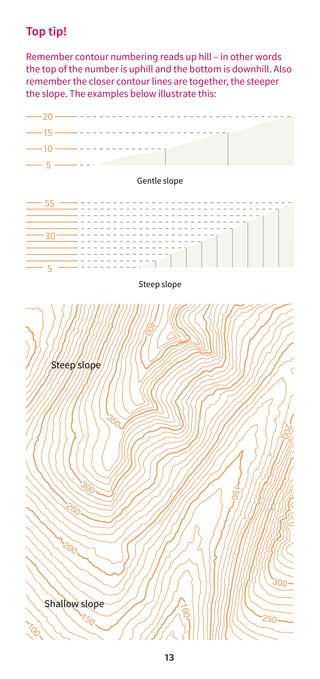
Top tip!
Remember contour numbering reads up hill – in other words
the top of the number is uphill and the bottom is downhill. Also
remember the closer contour lines are together, the steeper
the slope. The examples below illustrate this:
20
15
10
5
Gentle slope
30
5
55
Steep slope
Steep slope
Shallow slope
14
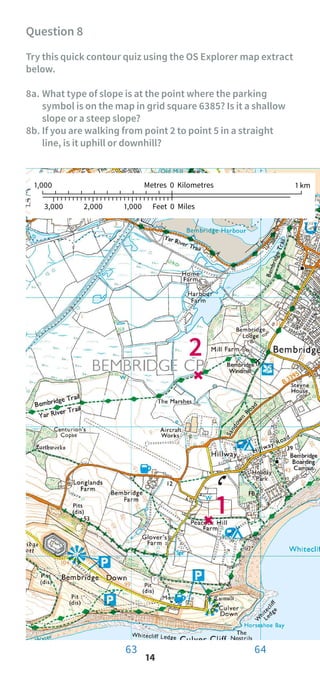
Question 8
Try this quick contour quiz using the OS Explorer map extract
below.
8a. What type of slope is at the point where the parking
symbol is on the map in grid square 6385? Is it a shallow
slope or a steep slope?
8b. If you are walking from point 2 to point 5 in a straight
line, is it uphill or downhill?
63 64
1
2
Metres 0 Kilometres
Feet 0 Miles
1,000 1 km
3,000 2,000 1,000
15
89
88
87
86
65 66
3
4
5
Answers
to
questions
1a.
A.
Railway
station.
B.
Orchard.
C.
Camp
site.
D.
Marsh,
reeds
or
saltings.
E.
Viewpoint.
1b.
A.
Sport.
B.
Burger
bar.
2a.
North.
2b.
East.
2c.
South-west.
3.
A.
8326.
B.
8424.
C.
8523.
4a.
Bembridge
Boarding
Campus.
4b.
East
Cliff.
4c.
6486.
5a.
A.
615335.
B.
635324.
C.
632341.
5b.
School.
5c.
Horse
riding.
5d.
Place
of
worship
–
with
spire,
minaret
or
dome.
6.
Driving.
7a.
1,180
metres
or
1.18
km.
7b.
1
250
metres
or
1.25km.
7c.
Points
1
to
2
=
24
minutes
approximately;
points
4
to
5
=
25
minutes
approximately.
8a.
It
is
a
steep
slope.
8b.
Uphill.
Customer Service Centre, Ordnance Survey,
Adanac Drive, Southampton, United Kingdom, SO16 0AS
+44 (0)3456 050505 (General enquiries)
+44 (0)3456 050504 (Welsh helpline)
+44 (0)2380 056146 (Textphone)
customerservices@os.uk
www.os.uk
© Crown copyright and/or database right 2016 OS
D12840 d 0116
©
Crown
copyright
16

map-reading-made-easy (1).pdf

  • 1.
  • 2.
    2 What is amap? A map is simply a drawing or picture (in 2D) of a landscape or area of a country (in 3D). It could be anything from a sketch map for a visitor to find your school to a detailed map of a town centre or mountain range. Using a map you can visualise in your mind what the place looks like that you are going to, and you can see what landmarks and features you will pass on the way to your destination. Maps mean you know what to expect, and they help you to know you are going in the right direction to arrive at your destination safely and quickly. Sketch map of a school Why not try drawing your own map to show a friend the route from your house to school, showing buildings and landmarks you pass on the way? Top tip! Have a look at a 1:25 000 scale map to give you some ideas of what you could draw if you are slightly unsure. 1:25 000 scale extract showing part of London © Crown copyright
  • 3.
    3 1:25 000 scaleextract showing Snowdon, the highest mountain in Wales What are all the different symbols? When drawing a map, you will find that you have to label lots of things you draw, such as a shop or a church, so other people can tell what they are. If Ordnance Survey had to do this on all maps there would be too much writing and it would be very confusing. The way we get around this problem is by using different shapes, colours and symbols to show all the roads, buildings and rivers and other interesting things in our landscape. Maps may even show you things you never even knew were there! Maps usually have a key that explains the symbols and their meanings. If you find a symbol on the map that you don’t know, simply look it up in the key. Question 1 1a. Have a look at the key on a 1:25 000 scale map and see if you can find out what these symbols mean. A B C D E 1b. You can invent your own symbols for things on your own sketchmap.Herearetwoideas;canyouguesswhattheyare? A B Top tip! Get your friends and family to test you on how well you know the symbols. If you can learn them, then map reading is easy. © Crown copyright
  • 4.
    4 Which direction amI going? Just as it is important to know which is your left and your right hand, in map reading it is important to understand where north, east, south and west are. You can remember where the points of the compass are by using one of these rhymes: Naughty Elephants Squirt Water or Nobody Ever Swallows Whales N S W E If you are walking in a direction half way between two of the points of a compass, you can say you are heading north‑east, south-east, south‑west or north-west, depending on the direction. Top tip! Ordnance Survey maps are always printed so that north is at the top of the sheet. Question 2 Using the 1:25 000 scale OS Explorer map extract on page 14 and 15 of this booklet can you answer these questions? 2a. Which general direction are you heading if you are walking from point 1 to point 2? 2b. Which general direction are you heading if you are walking from point 2 to point 3? 2c. Which general direction are you heading if you are walking from point 3 to point 1?
  • 5.
    5 Using the NationalGrid You might have noticed by now that OS maps are covered in a series of blue grid lines. These grid lines help you to pinpoint an exact location anywhere on the map. The vertical lines are called eastings, as they increase in value as you travel east on the map. The horizontal lines are called northings as they increase in value as you travel north on the map. They’re linked to the National Grid which provides a unique reference system, and can be applied to all OS maps of Great Britain, at all scales. Great Britain is covered by grid squares measuring 100 kilometres across. Each grid square is identified by two letters, as shown in diagram A. HO HP HT HU HW HX HY HZ NA NB NC ND NE NF NG NH NJ NK NL NM NN NO NP NR NS NT NU NW NX NY NZ OV SC SD SE TA SH SJ SK TF TG SM SN SO SP TL SS ST SU TQ TR SV SW SX SY SZ TM SR TV Diagram A
  • 6.
    6 On OS maps,these squares are further divided into smaller squares by grid lines representing 10 kilometre spacing, each numbered from 0 to 9 from the south west corner, in an easterly (left to right) and northerly (upwards) direction, as shown in diagram B. TL 63 Diagram B 5 1 3 4 6 7 5 0 1 2 3 9 4 6 7 8 9 8 0 south-west corner 2 5 1 3 4 6 7 0 2 9 8 Northings (up the stairs) › Eastings (along the corridor) › Using this system you can identify a 10 kilometre grid square. For example, here is TL63. After the letters you can quote the eastings (6) first, then the northings (3). If you have trouble remembering, say… along the corridor, THEN up the stairs. On an OS Landranger map you can find the two main grid letters (in this case TL) on the legend or the corner squares of the map. The grid is further divided into 1 kilometre intervals, as shown in diagram C. TL63 Diagram C 35 31 33 34 36 37 38 65 60 61 62 63 69 64 66 67 68 39 30 32 40 70 TL TL TL TL 35 31 33 34 36 37 38 39 30 32 40 How do grid references help me find places? A four-figure grid reference is a handy way of identifying any square on a map. Grid references are easy if you can remember that you always have to go along the corridor before you go up the stairs. To find the number of a square first use the eastings to go along the corridor until you come to the bottom left-hand corner of the square you want.
  • 7.
    7 Write this two-figurenumber down. Then use the northing to go up the stairs until you find the same corner. Put this two‑figure number after your first one and you now have the four-figure grid reference, which looks like the example in diagram D: 6233. TL63 TL TL TL TL Diagram D 35 31 33 34 36 37 38 65 60 61 63 69 64 66 67 68 35 30 31 32 33 39 34 36 37 38 39 30 40 40 70 62 32 62 32 Northings (up the stairs) › Eastings (along the corridor) › Top tip! Always remember: along the corridor, THEN up the stairs. Question 3 3. Can you work out the four-figure grid references for the following examples? A B C A B C 28 27 26 25 24 23 82 83 84 85 86 87
  • 8.
    8 Question 4 Using the1:25 000 scale OS Explorer map extract on page 14 and 15 of this booklet, can you answer these questions? 4a. What is the name of the school in grid square 6486? 4b. What is the name of the named building in grid square 6488? 4c. What grid square is Black Rock found in? Six-figure grid references If you want to pinpoint an exact place on a map, such as your own house, you will need to use a six-figure grid reference. First find the four-figure grid reference for the square and write it down with a space after each set of numbers, like this: 62_ 33_ Now imagine this square is divided up into 100 tiny squares with 10 squares along each side. Still remembering to go along the corridor and up the stairs, work out the extra numbers you need and put them into your four-figure grid reference like this in diagram E: 625 333. Diagram E Northings (up the stairs) › Eastings (along the corridor) › 35 34 33 32 2 61 62 64 63 1 2 3 4 5 6 7 8 9 0 0 1 4 3 6 5 8 7 9 0 Question 5 5a. Can you work out the six-figure grid references for the following examples? A B C
  • 9.
    9 Northings (up the stairs) › Eastings (along thecorridor) › A B C 35 34 33 32 61 62 64 63 Using the 1:25 000 scale OS Explorer map extract on page 14 and 15 of this booklet can you answer these questions? 5b. What is at grid reference 648876? 5c. What would you be doing at grid reference 644885? 5d. What building is to be found at grid reference 643882? Top tip! When giving directions you can provide even more accuracy to your grid reference by stating a nearby landmark or feature. For example, on the Bembridge OS Explorer map extract on page 14, I am at grid reference 644874, at the crossroads. What is scale? The scale of a map shows how much you would have to enlarge your map to get the actual size of the piece of land you are looking at. For example, your map has a scale of 1:25 000, which means that every 1cm on the map represents 25 000 of those same units of measurement on the ground (for example, 25 000cm = 250 metres). That might sound a bit complicated, but OS maps have been designed to make understanding scale easy. Look at the front of a 1:25 000 scale map and you will see that the scale has been written out for you like this: 4cm to 1km This means that every 4cm on a map = 1km in real life. To make it even easier, the grid lines are exactly 4cm apart, so every square is 1km by 1km.
  • 10.
    10 Maps are madeat different scales for different purposes. The 1:25 000 scale map is very useful for walking, but if you use it in a car you will quickly drive off the edge! On the other hand, maps at 1:250 000 scale (note the extra zero) show lots more land, but in far less detail. 1:25 000 scale OS Explorer extract 1: 250 000 scale extract Question 6 6. Is a 1:250 000 scale map useful for walking or driving? How do we measure distance? It is always important to know how far you have to travel and how long it is going to take you. By measuring a distance on your map, you can work out how far that is in reality. You can measure this distance either in a straight line (as the crow flies) or following a winding route such as a country lane. To get this information from a map is very easy. © Crown copyright © Crown copyright
  • 11.
    11 Here is away of doing it: You can measure between two points by using a piece of thin string. If you are measuring the distance in a straight line, then simply stretch the string between the two points. If you are following a road or track that’s not straight, bend the string to follow the exact shape until you reach the second point. Measuring distance using string Now that you have a distance in centimetres marked on your string you can find out the real distance. You can do this in a couple of ways: By eye Place string against the scale bar on the map. This is usually at the foot of the map sheet. Metres 0 Kilometres Feet 0 Miles 1,000 1 km 3,000 2,000 1,000 By measuring Measure your distance on your string with a ruler. Suppose your string is 10cms long. You know that 4cm = 1km, so the answer is 2.5km. Have a go at measuring the distances in the questions below using the OS Explorer map extract on page 14 of this booklet. © Crown copyright
  • 12.
    12 Question 7 Using the1:25 000 scale OS Explorer map extract on page 14 and 15 of this booklet: 7a. How far is it in a straight line on the ground from point 1 to point 2? 7b. How far is it to walk along the road from point 4 (IRB Sta) to point 5 (PO)? 7c. Can you work out how long it would take you to walk both these distances? (Most people walk at 3km per hour, so it will take 20 minutes to walk in a straight line across a 1km grid square). Top tip! Remember that the grid lines on a 1:25 000 scale map are 1km apart. A quick way of estimating distance is to count each square you cross in a straight line. If going diagonally the distance across the grid square is about 1½km. How are hills and mountains shown on a map? The ability to understand the shape of the ground from a map is a useful skill to learn, particularly in mountainous landscapes. The height and shape of the ground is shown on 1:25 000 scale maps by brown contour lines. A contour is a line drawn on a map that joins points of equal height above sea level. For 1:25 000 scale maps the vertical interval between contours is usually 5 metres, although in mountainous regions it may well be 10 metres. 10 20 30 40 10 20 30 40 The above diagram shows the link between the shape of a hill and the contours representing it on a map. Another way of thinking about contour lines is as a tide mark left by the sea as the tide goes out, leaving a line every 5 metres.
  • 13.
    13 Top tip! Remember contournumbering reads up hill – in other words the top of the number is uphill and the bottom is downhill. Also remember the closer contour lines are together, the steeper the slope. The examples below illustrate this: 20 15 10 5 Gentle slope 30 5 55 Steep slope Steep slope Shallow slope
  • 14.
    14 Question 8 Try thisquick contour quiz using the OS Explorer map extract below. 8a. What type of slope is at the point where the parking symbol is on the map in grid square 6385? Is it a shallow slope or a steep slope? 8b. If you are walking from point 2 to point 5 in a straight line, is it uphill or downhill? 63 64 1 2 Metres 0 Kilometres Feet 0 Miles 1,000 1 km 3,000 2,000 1,000
  • 15.
    15 89 88 87 86 65 66 3 4 5 Answers to questions 1a. A. Railway station. B. Orchard. C. Camp site. D. Marsh, reeds or saltings. E. Viewpoint. 1b. A. Sport. B. Burger bar. 2a. North. 2b. East. 2c. South-west. 3. A. 8326. B. 8424. C. 8523. 4a. Bembridge Boarding Campus. 4b. East Cliff. 4c. 6486. 5a. A. 615335. B. 635324. C. 632341. 5b. School. 5c. Horse riding. 5d. Place of worship – with spire, minaret or dome. 6. Driving. 7a. 1,180 metres or 1.18 km. 7b. 1 250 metres or 1.25km. 7c. Points 1 to 2 = 24 minutes approximately; points 4 to 5 = 25 minutes approximately. 8a. It is a steep slope. 8b. Uphill. Customer ServiceCentre, Ordnance Survey, Adanac Drive, Southampton, United Kingdom, SO16 0AS +44 (0)3456 050505 (General enquiries) +44 (0)3456 050504 (Welsh helpline) +44 (0)2380 056146 (Textphone) customerservices@os.uk www.os.uk © Crown copyright and/or database right 2016 OS D12840 d 0116 © Crown copyright
  • 16.