Core Content Coaching 
Science Grade 8: Topographic Maps & Satellite Views
To provide support for grade-level, unit content planning 
Purpose
Resources for planning 
• Teacher Yearly Resource Document (or Yearly Itinerary) 
• CRM 4: Earth’s Features 
• Blank Pacing Calendar 
• 8th Grade 3rd Six Weeks Lessons: Topographic Maps & Satellite Views Pacing Guide 
• Computer with Internet Access
Teacher yearly resource document
Monday Tuesday Wednesday Thursday Friday 
Nov. 10 
Force & Motion 
(as needed) 
11 Student 
Holiday 
12 13 14 
17 
Newton’s Laws 
18 19 20 21 
24 
Plate Tectonic 
Theory 
25 26 Holiday 27 Holiday 28 Holiday 
Dec. 1 
Plate Tectonics 
2 3 4 5 
8 
Plate Tectonics 
9 10 11 12 
15 
Topo Maps & 
Satellite Views 
16 17 18 19 Student 
Holiday 
3rd Six Weeks Planner (25 days)
TEKS & Student expectations 
Content TEKS Skills TEKS 
8.1A-8.9: Earth & space. The student knows that B, 8.2A, C-E, 8.3A-D, 8.4A 
natural events can impact Earth systems. The 
student is expected to: 
8.9C: interpret topographic maps & 
satellite views to identify land & erosional 
features & predict how these features may 
be reshaped by weathering.
CRM 4: TEKS & Acquisition section
Interactive: Reading A Map 
http://www.nps.gov/webrangers/activities/readingmap/ 
Video: How to Read a Topographic Map & Geological Maps 
http://education-portal.com/academy/lesson/how-to-read-topographic-and-geologic-maps.html 
ScienceFusion Grade 8 Teacher Edition: Content Refresher: p. 437-438 
Teacher Content support
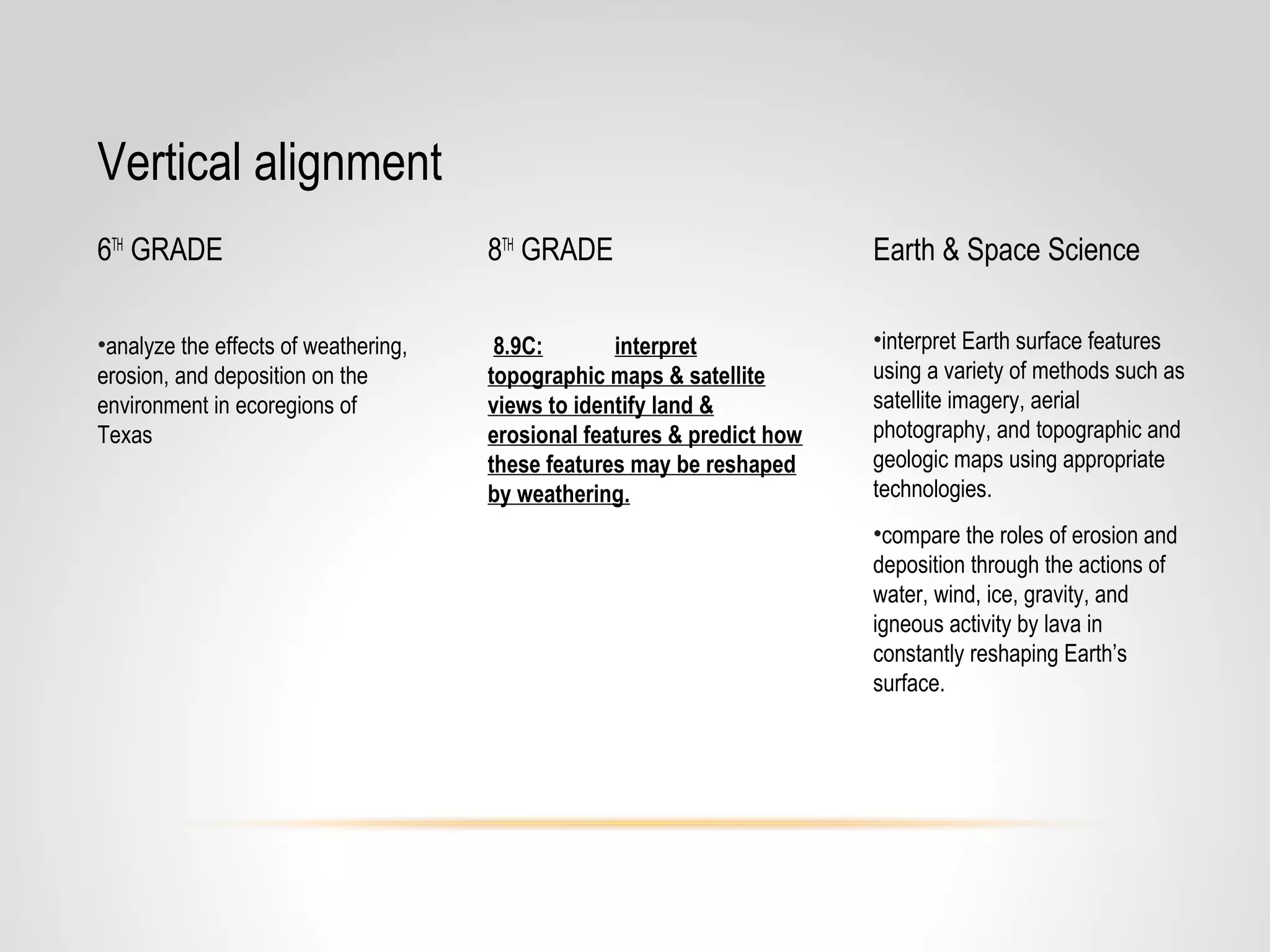
Vertical alignment 
6TH GRADE 
•analyze the effects of weathering, 
erosion, and deposition on the 
environment in ecoregions of 
Texas 
8TH GRADE 
8.9C: interpret 
topographic maps & satellite 
views to identify land & 
erosional features & predict how 
these features may be reshaped 
by weathering. 
Earth & Space Science 
•interpret Earth surface features 
using a variety of methods such as 
satellite imagery, aerial 
photography, and topographic and 
geologic maps using appropriate 
technologies. 
•compare the roles of erosion and 
deposition through the actions of 
water, wind, ice, gravity, and 
igneous activity by lava in 
constantly reshaping Earth’s 
surface.
PRIOR LEARNING 
• Weathering is the mechanical or chemical surface processes that break rocks into smaller and smaller pieces. 
• Weathering, erosion, and deposition occur in environments due to the forces of gravity, wind, ice, and water.
2014 STAAR-Released 
Question: 8.9C 
A 11% 
B* 61% 
C 20% 
D 7%
Correct 43% 
Incorrect 45% 
Correct Answer: 120
2013 STAAR-Released Question: 8.9C 
F 22% 
G 8% 
H* 64% 
J 5%
Correct 40% 
Incorrect 60% 
Correct Answer: 360
Based on the data and distractors, what key points should teachers 
emphasize during lessons? 
• Deposition increases the amount of sediment in an area. 
Activities to emphasize this point 
included in the curriculum: 
1.ScienceSaurus Reading: 
Weathering, Erosion, & Deposition 
Sections 188-190, 192 
2.ScienceFusion: Weathering, 
Erosion, and Deposition p. 368-385 
Activities to emphasize this point 
included in the curriculum: 
1.ScienceSaurus Reading: 
Weathering, Erosion, & Deposition 
Sections 188-190, 192 
2.ScienceFusion: Weathering, 
Erosion, and Deposition p. 368-385 
MMoosst tc ocommmmoonn d disistrtaracctotor r
Based on the data and distractors, what key points should teachers 
emphasize during lessons? 
• Determine the contour interval. 
• Find the difference between contour intervals. 
• Determine the elevation of the missing labels on a map. 
• The closer the contour lines, the steeper the elevation. 
Activities to emphasize this point 
included in the curriculum: 
1.Mapping the Mountain 
2.Mapping Mt. Capulin 
3.Contour Mapping Presentation 
4.How to Read a Topographic Map 
5.Topographic Map Worksheet 
Activities to emphasize this point 
included in the curriculum: 
1.Mapping the Mountain 
2.Mapping Mt. Capulin 
3.Contour Mapping Presentation 
4.How to Read a Topographic Map 
5.Topographic Map Worksheet
Components of a good lesson plan 
1. Engage Student Interest 
2. Review/Scaffold to TEKS 
3. Student-Centered Activities directly relating to the depth and complexity of the TEKS 
• Labs, Activities, Videos 
1. Organize and Practice Vocabulary 
2. Reading & Comprehension Strategies 
3. Writing Opportunities & Scaffolds 
4. Daily Listening & Speaking Opportunities 
5. Differentiation 
6. Formative Assessment & Reteach
Embedded in lessons: 
Engage Student Interest 
• Picture-Word 
Association Part I 
• Vocabulary Magic: 
Topographic Maps & 
Satellite Views 
• Video: 1964 Quake: 
The Great Alaska 
Earthquake
Recommended in lessons: 
Review / Scaffold to TEKS 
• Topographic Maps & Satellite Views 
Unit Overview 
• ScienceSaurus Reading: Weathering, 
Erosion, & Deposition Sections 188- 
190, 192 
• ScienceSaurus Reading: Topographic 
Maps Sections 172-174 
• ScienceFusion: Weathering, Erosion, 
and Deposition p. 368-385 
• ScienceFusion: Topographic Maps p. 
386-397 
• ScienceFusion: Images of Earth’s 
Surface p. 398-411
Embedded in lessons: 
Student-Centered Activities directly relating to the depth and complexity of the 
TEKS (Labs, Activities, Videos) 
• Mapping the Mountain 
• Mapping Mt. Capulin 
• How to Read a Topographic Map 
• Satellite Sense 
• Topographic Map Worksheet
Embedded in lessons: 
Organize and Practice Vocabulary 
• Topographic Maps & Satellite Views 
Unit Overview 
• Vocabulary Magic: Topographic 
Maps & Satellite Views 
• Picture-Word Association Part II 
• Vocabulary Review: Quick Draw, 
Quick Write Comparison, 
Concentration 
• The Rule of the V’s Two-Column 
Notes 
• Cloze Activity
Embedded in lessons: 
Reading & Comprehension Strategies 
• ScienceFusion: Weathering, Erosion, and Deposition p. 
368-385 
• ScienceFusion: Topographic Maps p. 386-397 
• ScienceFusion: Images of Earth’s Surface p. 398-411 
• ScienceSaurus Reading: Weathering, Erosion, & 
Deposition Sections 188-190, 192 
• ScienceSaurus Reading: Topographic Maps Sections 
172-174 
• Mapping Erosion Control 
• Comprehension Strategies 
• Student Companion Notebook p.105-114 
• Shared Reading Recommendation: Have each 
student in a pair read a paragraph at a time and 
then have the non-reader summarize the section. 
• Active Reading Strategies embedded in 
ScienceFusion Reading 
• Accommodated Reading Options
Embedded in lessons: 
Writing Opportunities & Scaffolds 
• Weathering, Erosion, And Deposition- Science Glossary 7.8B Quick Write Comparison 
• Concentric Circles 
• Contour Lines 
• Cloze Activity 
• Scaffolds: Sentence Frames, Word Bank
Embedded in lessons: 
Daily Listening & Speaking Opportunities 
In this picture I 
see… 
I think this picture might match 
the word … because…
• Special Education: 
1. Mixed-Ability Partners 
2. Science Glossary 
3. Vocabulary Magic Trailer for Review 
4. Multiple Views of Vocabulary Magic 
Trailer 
5. Word Bank 
6. Shared Reading 
7. Accommodated Reading 
8. Sentence Frames 
9. Fill-in-the-Blank Notes 
10. Closed Sentences 
11. Picture-Word Concentration 
• English Language Learners: 
1. Mixed-Ability Partners 
2. Dual Language Science Glossary 
3. Vocabulary Magic Trailer for Review 
4. Multiple Views of Vocabulary Magic 
Trailer 
5. Word Bank 
6. Glossary Instructional Strategies 
7. Shared Reading 
8. Sentence Frames 
9. Closed Sentences 
10. Picture-Word Concentration 
Embedded in lessons: 
Differentiation
Embedded in lessons: 
Formative Assessment 
• Vocabulary Review: Quick Draw, Quick 
Write Comparison, Cloze Activity, 
Concentration 
• Picture-Word Association Part II 
• Investigation Questions/Conclusions 
• Class Discussions 
• Journal Entries 
• Exit Tickets 
• Teacher-chosen ScienceFusion Satellite 
Image Question(s) 
• Topographic Maps Worksheet 
• Optional: You Be the Trail Expert 
Performance Assessment
Reteach Options 
• Topographic Maps & Satellite Views Unit 
Overview 
• ScienceSaurus Reading: Weathering, Soil, & 
Erosion Sections 188-190, 192 
• ScienceSaurus Reading: Topographic Maps 
Sections 172-174 
• ScienceFusion: Weathering, Erosion, and 
Deposition p. 368-385 
• ScienceFusion: Topographic Maps p. 386-397 
• ScienceFusion: Images of Earth’s Surface p. 398- 
411 
• ScienceFusion Unit 7 Lessons 4 & 5: Digital 
Lesson & Virtual Lab 
• Optional Activities
Higher level questions 
• “Research shows there’s a link between critical thinking skills and increased student achievement in the 
classroom.” (Moore & Stanley, 2010) 
• Higher level questions must be planned in order to be implemented effectively in the classroom. 
• Levels of Questions 
• Knowledge 
• Comprehension 
• Application 
• Analysis 
• Synthesis 
• Evaluation 
• Plan and provide a variety of questions at each level and build student knowledge and critical thinking by providing 
Higher Level Questions.
Lower Levels of questions
Higher Levels of questions
Knowledge Comprehension Application Analysis Synthesis Evaluate 
What is a contour 
line? 
What is a 
landform? 
Define 
weathering/erosion 
/deposition. 
What information 
does a topographic 
map provide? 
How does 
steepness of 
slope affect 
contour lines? 
How are 
landforms 
affected by 
weathering? 
How can a 
topographic map 
be used to 
identify land and 
erosional 
features? 
How can a 
satellite map be 
used to identify 
land and 
erosional 
features? 
How does the 
Earth’s surface 
change? 
What is the 
relationship 
between the 
closeness of 
contour lines on a 
topographic map 
and the landforms 
they represent? 
How would you 
improve 
topographic maps 
representation of 
landforms? 
How would you 
evaluate the 
accuracy of the 
contour lines on a 
topographic map?
Recommended Anchors of Support 
• Topographic Maps & Satellite Views Unit 
Overview 
• The Rule of the V’s Two-Column Notes 
• How to Read a Topographic Map 
• Satellite Sense 
• ScienceFusion: Visual Summary p. 382, 
396, 410 
• ScienceFusion: Visualize It! p. 370, 371, 
373, 376, 379, 380, 381, 389, 393,401, 
406, 407, 408, 409
Anchors of Support 
Other Resources 
•Interactive Word Wall- Current, working models with student contributions 
• Interactive Word Walls Article: http://learningcenter.nsta.org/files/ss1103_45.pdf 
• “Word walls can be arranged on cupboard doors or classroom walls, or hung from 
the ceiling with wire and string.” 
• “Maximum instructional potential and efficiency are achieved when interactive word-wall 
construction is aligned with lessons and students are allowed to participate in 
the process. As a result, walls are usually built over many days and are finished as 
a unit nears completion. Word walls support units and are changed or replaced as 
units change.” 
• Interactive Word Walls Rubric: Next Slide 
• ScienceFusion Textbook, Science Glossaries, Dual Language Science 
Glossaries
Academic vocabulary 
LESSON COMPONENTS PAGE 
CURRICULUM ROAD MAP
Core Content Coaching Grade 8 Topographic Maps & Satellite Views 14-15

Core Content Coaching Grade 8 Topographic Maps & Satellite Views 14-15

  • 1.
    Core Content Coaching Science Grade 8: Topographic Maps & Satellite Views
  • 2.
    To provide supportfor grade-level, unit content planning Purpose
  • 3.
    Resources for planning • Teacher Yearly Resource Document (or Yearly Itinerary) • CRM 4: Earth’s Features • Blank Pacing Calendar • 8th Grade 3rd Six Weeks Lessons: Topographic Maps & Satellite Views Pacing Guide • Computer with Internet Access
  • 4.
  • 5.
    Monday Tuesday WednesdayThursday Friday Nov. 10 Force & Motion (as needed) 11 Student Holiday 12 13 14 17 Newton’s Laws 18 19 20 21 24 Plate Tectonic Theory 25 26 Holiday 27 Holiday 28 Holiday Dec. 1 Plate Tectonics 2 3 4 5 8 Plate Tectonics 9 10 11 12 15 Topo Maps & Satellite Views 16 17 18 19 Student Holiday 3rd Six Weeks Planner (25 days)
  • 6.
    TEKS & Studentexpectations Content TEKS Skills TEKS 8.1A-8.9: Earth & space. The student knows that B, 8.2A, C-E, 8.3A-D, 8.4A natural events can impact Earth systems. The student is expected to: 8.9C: interpret topographic maps & satellite views to identify land & erosional features & predict how these features may be reshaped by weathering.
  • 7.
    CRM 4: TEKS& Acquisition section
  • 8.
    Interactive: Reading AMap http://www.nps.gov/webrangers/activities/readingmap/ Video: How to Read a Topographic Map & Geological Maps http://education-portal.com/academy/lesson/how-to-read-topographic-and-geologic-maps.html ScienceFusion Grade 8 Teacher Edition: Content Refresher: p. 437-438 Teacher Content support
  • 9.
    Vertical alignment 6THGRADE •analyze the effects of weathering, erosion, and deposition on the environment in ecoregions of Texas 8TH GRADE 8.9C: interpret topographic maps & satellite views to identify land & erosional features & predict how these features may be reshaped by weathering. Earth & Space Science •interpret Earth surface features using a variety of methods such as satellite imagery, aerial photography, and topographic and geologic maps using appropriate technologies. •compare the roles of erosion and deposition through the actions of water, wind, ice, gravity, and igneous activity by lava in constantly reshaping Earth’s surface.
  • 10.
    PRIOR LEARNING •Weathering is the mechanical or chemical surface processes that break rocks into smaller and smaller pieces. • Weathering, erosion, and deposition occur in environments due to the forces of gravity, wind, ice, and water.
  • 11.
    2014 STAAR-Released Question:8.9C A 11% B* 61% C 20% D 7%
  • 12.
    Correct 43% Incorrect45% Correct Answer: 120
  • 13.
    2013 STAAR-Released Question:8.9C F 22% G 8% H* 64% J 5%
  • 14.
    Correct 40% Incorrect60% Correct Answer: 360
  • 15.
    Based on thedata and distractors, what key points should teachers emphasize during lessons? • Deposition increases the amount of sediment in an area. Activities to emphasize this point included in the curriculum: 1.ScienceSaurus Reading: Weathering, Erosion, & Deposition Sections 188-190, 192 2.ScienceFusion: Weathering, Erosion, and Deposition p. 368-385 Activities to emphasize this point included in the curriculum: 1.ScienceSaurus Reading: Weathering, Erosion, & Deposition Sections 188-190, 192 2.ScienceFusion: Weathering, Erosion, and Deposition p. 368-385 MMoosst tc ocommmmoonn d disistrtaracctotor r
  • 16.
    Based on thedata and distractors, what key points should teachers emphasize during lessons? • Determine the contour interval. • Find the difference between contour intervals. • Determine the elevation of the missing labels on a map. • The closer the contour lines, the steeper the elevation. Activities to emphasize this point included in the curriculum: 1.Mapping the Mountain 2.Mapping Mt. Capulin 3.Contour Mapping Presentation 4.How to Read a Topographic Map 5.Topographic Map Worksheet Activities to emphasize this point included in the curriculum: 1.Mapping the Mountain 2.Mapping Mt. Capulin 3.Contour Mapping Presentation 4.How to Read a Topographic Map 5.Topographic Map Worksheet
  • 17.
    Components of agood lesson plan 1. Engage Student Interest 2. Review/Scaffold to TEKS 3. Student-Centered Activities directly relating to the depth and complexity of the TEKS • Labs, Activities, Videos 1. Organize and Practice Vocabulary 2. Reading & Comprehension Strategies 3. Writing Opportunities & Scaffolds 4. Daily Listening & Speaking Opportunities 5. Differentiation 6. Formative Assessment & Reteach
  • 18.
    Embedded in lessons: Engage Student Interest • Picture-Word Association Part I • Vocabulary Magic: Topographic Maps & Satellite Views • Video: 1964 Quake: The Great Alaska Earthquake
  • 19.
    Recommended in lessons: Review / Scaffold to TEKS • Topographic Maps & Satellite Views Unit Overview • ScienceSaurus Reading: Weathering, Erosion, & Deposition Sections 188- 190, 192 • ScienceSaurus Reading: Topographic Maps Sections 172-174 • ScienceFusion: Weathering, Erosion, and Deposition p. 368-385 • ScienceFusion: Topographic Maps p. 386-397 • ScienceFusion: Images of Earth’s Surface p. 398-411
  • 20.
    Embedded in lessons: Student-Centered Activities directly relating to the depth and complexity of the TEKS (Labs, Activities, Videos) • Mapping the Mountain • Mapping Mt. Capulin • How to Read a Topographic Map • Satellite Sense • Topographic Map Worksheet
  • 21.
    Embedded in lessons: Organize and Practice Vocabulary • Topographic Maps & Satellite Views Unit Overview • Vocabulary Magic: Topographic Maps & Satellite Views • Picture-Word Association Part II • Vocabulary Review: Quick Draw, Quick Write Comparison, Concentration • The Rule of the V’s Two-Column Notes • Cloze Activity
  • 22.
    Embedded in lessons: Reading & Comprehension Strategies • ScienceFusion: Weathering, Erosion, and Deposition p. 368-385 • ScienceFusion: Topographic Maps p. 386-397 • ScienceFusion: Images of Earth’s Surface p. 398-411 • ScienceSaurus Reading: Weathering, Erosion, & Deposition Sections 188-190, 192 • ScienceSaurus Reading: Topographic Maps Sections 172-174 • Mapping Erosion Control • Comprehension Strategies • Student Companion Notebook p.105-114 • Shared Reading Recommendation: Have each student in a pair read a paragraph at a time and then have the non-reader summarize the section. • Active Reading Strategies embedded in ScienceFusion Reading • Accommodated Reading Options
  • 23.
    Embedded in lessons: Writing Opportunities & Scaffolds • Weathering, Erosion, And Deposition- Science Glossary 7.8B Quick Write Comparison • Concentric Circles • Contour Lines • Cloze Activity • Scaffolds: Sentence Frames, Word Bank
  • 24.
    Embedded in lessons: Daily Listening & Speaking Opportunities In this picture I see… I think this picture might match the word … because…
  • 25.
    • Special Education: 1. Mixed-Ability Partners 2. Science Glossary 3. Vocabulary Magic Trailer for Review 4. Multiple Views of Vocabulary Magic Trailer 5. Word Bank 6. Shared Reading 7. Accommodated Reading 8. Sentence Frames 9. Fill-in-the-Blank Notes 10. Closed Sentences 11. Picture-Word Concentration • English Language Learners: 1. Mixed-Ability Partners 2. Dual Language Science Glossary 3. Vocabulary Magic Trailer for Review 4. Multiple Views of Vocabulary Magic Trailer 5. Word Bank 6. Glossary Instructional Strategies 7. Shared Reading 8. Sentence Frames 9. Closed Sentences 10. Picture-Word Concentration Embedded in lessons: Differentiation
  • 26.
    Embedded in lessons: Formative Assessment Formative Assessment • Vocabulary Review: Quick Draw, Quick Write Comparison, Cloze Activity, Concentration • Picture-Word Association Part II • Investigation Questions/Conclusions • Class Discussions • Journal Entries • Exit Tickets • Teacher-chosen ScienceFusion Satellite Image Question(s) • Topographic Maps Worksheet • Optional: You Be the Trail Expert Performance Assessment
  • 27.
    Reteach Options •Topographic Maps & Satellite Views Unit Overview • ScienceSaurus Reading: Weathering, Soil, & Erosion Sections 188-190, 192 • ScienceSaurus Reading: Topographic Maps Sections 172-174 • ScienceFusion: Weathering, Erosion, and Deposition p. 368-385 • ScienceFusion: Topographic Maps p. 386-397 • ScienceFusion: Images of Earth’s Surface p. 398- 411 • ScienceFusion Unit 7 Lessons 4 & 5: Digital Lesson & Virtual Lab • Optional Activities
  • 28.
    Higher level questions • “Research shows there’s a link between critical thinking skills and increased student achievement in the classroom.” (Moore & Stanley, 2010) • Higher level questions must be planned in order to be implemented effectively in the classroom. • Levels of Questions • Knowledge • Comprehension • Application • Analysis • Synthesis • Evaluation • Plan and provide a variety of questions at each level and build student knowledge and critical thinking by providing Higher Level Questions.
  • 29.
    Lower Levels ofquestions
  • 30.
  • 31.
    Knowledge Comprehension ApplicationAnalysis Synthesis Evaluate What is a contour line? What is a landform? Define weathering/erosion /deposition. What information does a topographic map provide? How does steepness of slope affect contour lines? How are landforms affected by weathering? How can a topographic map be used to identify land and erosional features? How can a satellite map be used to identify land and erosional features? How does the Earth’s surface change? What is the relationship between the closeness of contour lines on a topographic map and the landforms they represent? How would you improve topographic maps representation of landforms? How would you evaluate the accuracy of the contour lines on a topographic map?
  • 32.
    Recommended Anchors ofSupport • Topographic Maps & Satellite Views Unit Overview • The Rule of the V’s Two-Column Notes • How to Read a Topographic Map • Satellite Sense • ScienceFusion: Visual Summary p. 382, 396, 410 • ScienceFusion: Visualize It! p. 370, 371, 373, 376, 379, 380, 381, 389, 393,401, 406, 407, 408, 409
  • 33.
    Anchors of Support Other Resources •Interactive Word Wall- Current, working models with student contributions • Interactive Word Walls Article: http://learningcenter.nsta.org/files/ss1103_45.pdf • “Word walls can be arranged on cupboard doors or classroom walls, or hung from the ceiling with wire and string.” • “Maximum instructional potential and efficiency are achieved when interactive word-wall construction is aligned with lessons and students are allowed to participate in the process. As a result, walls are usually built over many days and are finished as a unit nears completion. Word walls support units and are changed or replaced as units change.” • Interactive Word Walls Rubric: Next Slide • ScienceFusion Textbook, Science Glossaries, Dual Language Science Glossaries
  • 35.
    Academic vocabulary LESSONCOMPONENTS PAGE CURRICULUM ROAD MAP

Editor's Notes

  • #7 What are the state standards for this Unit? Deconstruct the TEKS: Verb, Noun, and Context What does it mean to “interpret” & “predict” something?
  • #8 What should students know and be able to do?
  • #10 Note the development of the understanding of elements and compounds from 6th grade to high school.
  • #11 This information is located on the CRM and the Teacher Lesson Page. The Teacher Lesson Page contains the specific prior learning for the specific TEKS for this Unit.
  • #29 Edited from Critical Thinking and Formative Assessment: Increasing the Rigor in Your Classroom
  • #30 Edited from Critical Thinking and Formative Assessment: Increasing the Rigor in Your Classroom
  • #31 Edited from Critical Thinking and Formative Assessment: Increasing the Rigor in Your Classroom
  • #32 Guiding Questions are bold and italicized.
  • #36 What are the essential vocabulary for the unit?Are all necessary vocabulary accounted for in the acquiring and practicing opportunities?