Autonomic
Function Tests
Prof Vajira Weerasinghe
Professor of Physiology
Available at www.slideshare.net/vajira54
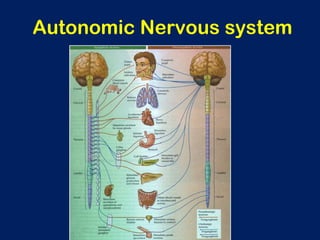
Autonomic Nervous system
Objectives
Describe the physiological basis of the following autonomic
function tests in relation to cardiovascular system
1. Heart rate variation during respiration
2. Heart rate variation during postural change
3. Valsalva manoeuvre (maneuver)
4. Cold pressor test
1. Heart rate variation during
respiration
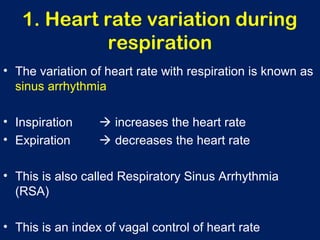
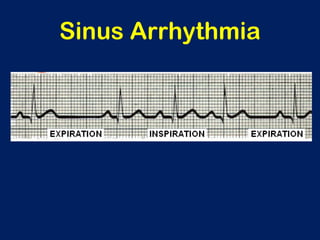
• The variation of heart rate with respiration is known as
sinus arrhythmia
• Inspiration  increases the heart rate
• Expiration  decreases the heart rate
• This is also called Respiratory Sinus Arrhythmia
(RSA)
• This is an index of vagal control of heart rate
Sinus Arrhythmia
Explanation for sinus
arrhythmia
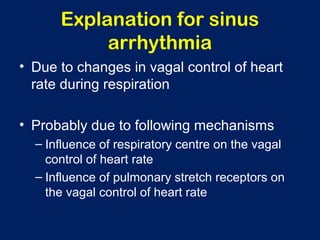
• Due to changes in vagal control of heart
rate during respiration
• Probably due to following mechanisms
– Influence of respiratory centre on the vagal
control of heart rate
– Influence of pulmonary stretch receptors on
the vagal control of heart rate
Heart rate variation during
respiration
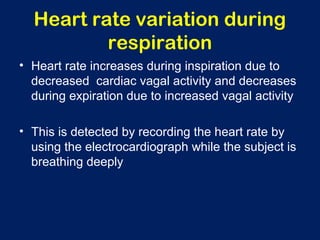
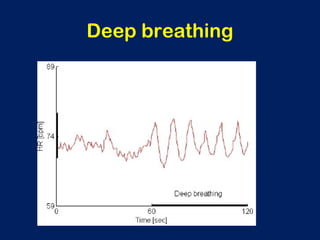
• Heart rate increases during inspiration due to
decreased cardiac vagal activity and decreases
during expiration due to increased vagal activity
• This is detected by recording the heart rate by
using the electrocardiograph while the subject is
breathing deeply
Deep breathing
Procedure
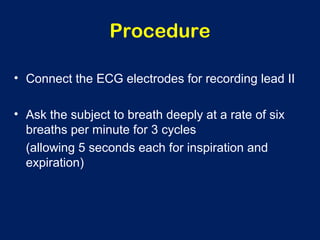
• Connect the ECG electrodes for recording lead II
• Ask the subject to breath deeply at a rate of six
breaths per minute for 3 cycles
(allowing 5 seconds each for inspiration and
expiration)
Procedure
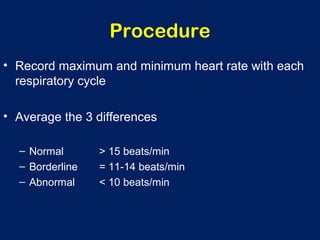
• Record maximum and minimum heart rate with each
respiratory cycle
• Average the 3 differences
– Normal > 15 beats/min
– Borderline = 11-14 beats/min
– Abnormal < 10 beats/min
Procedure
• Determine the expiration to inspiration
ratio (E:I ratio)
E:I ratio
• Mean of the maximum R-R intervals
during deep expiration to the mean of
minimum R-R intervals during deep
inspiration
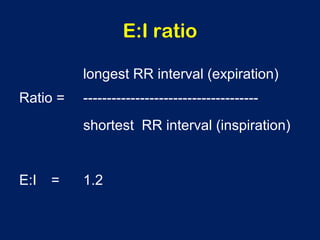
E:I ratio
longest RR interval (expiration)
Ratio = -------------------------------------
shortest RR interval (inspiration)
E:I = 1.2
2. Heart rate variation during
postural change
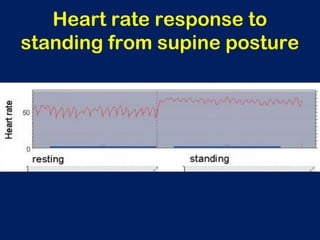
• Changing posture from supine to standing leads
to an increase in heart rate immediately, usually
by 10-20 beats per minute
Heart rate variation during
postural change
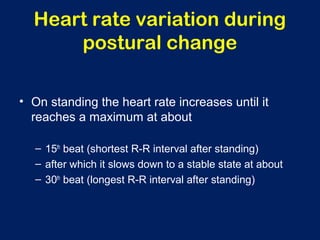
• On standing the heart rate increases until it
reaches a maximum at about
– 15th
beat (shortest R-R interval after standing)
– after which it slows down to a stable state at about
– 30th
beat (longest R-R interval after standing)
Heart rate response to
standing from supine posture
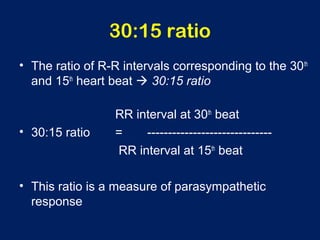
30:15 ratio
• The ratio of R-R intervals corresponding to the 30th
and 15th
heart beat  30:15 ratio
RR interval at 30th
beat
• 30:15 ratio = ------------------------------
RR interval at 15th
beat
• This ratio is a measure of parasympathetic
response
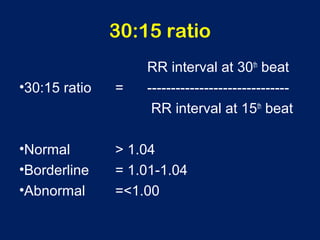
30:15 ratio
RR interval at 30th
beat
•30:15 ratio = ------------------------------
RR interval at 15th
beat
•Normal > 1.04
•Borderline = 1.01-1.04
•Abnormal =<1.00
3. Valsalva Manoeuvre
• Assesses integrity of the baroreceptor
reflex
• Measure of parasympathetic and
sympathetic function
• It is “forced expiration against a closed
glottis”
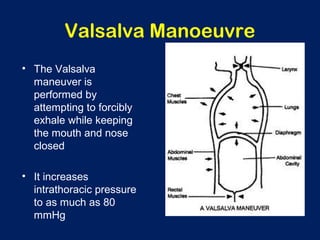
Valsalva Manoeuvre
• The Valsalva
maneuver is
performed by
attempting to forcibly
exhale while keeping
the mouth and nose
closed
• It increases
intrathoracic pressure
to as much as 80
mmHg
Procedure
• Perform the Valsalva manoeuvre (forced
expiration against a closed glottis) by asking the
subject to breathe forcefully into a mercury
manometer and maintain a pressure of 40
mmHg for 15 seconds
• Record the ECG throughout and for 30 seconds
after the procedure
Valsalva Manoeuvre
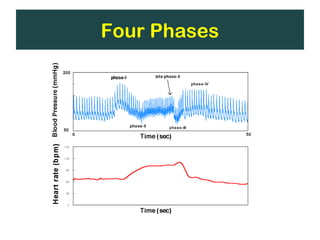
• 4 phases
– Phase I
– Phase II
– Phase III
– Phase IV
Four Phases
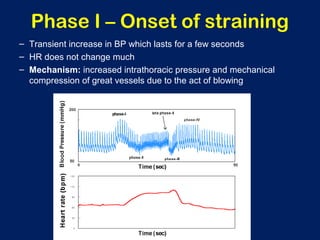
– Transient increase in BP which lasts for a few seconds
– HR does not change much
– Mechanism: increased intrathoracic pressure and mechanical
compression of great vessels due to the act of blowing
Phase I – Onset of straining
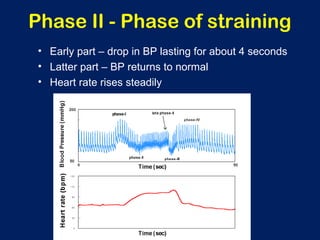
Phase II - Phase of straining
• Early part – drop in BP lasting for about 4 seconds
• Latter part – BP returns to normal
• Heart rate rises steadily
Mechanism
• Early part
– venous return decreases with compression of veins by
increased intrathoracic pressure central venous pressure
decreases  BP decreases
• Latter part
– drop in BP in early part will stimulate baroreceptor reflex 
increased sympathetic activity  increased peripheral
resistance  increased BP ( returns to normal )
• Heart rate increase steadily throughout this phase due to vagal
withdrawal in early part & sympathetic activation in latter part
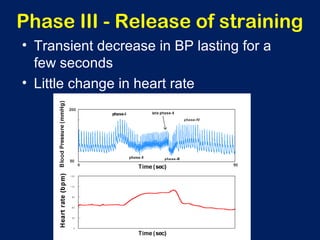
Phase III - Release of straining
• Transient decrease in BP lasting for a
few seconds
• Little change in heart rate
Mechanism
• Mechanical displacement of blood
into pulmonary vascular bed, which
was under increased intrathoracic
pressure  BP decreases
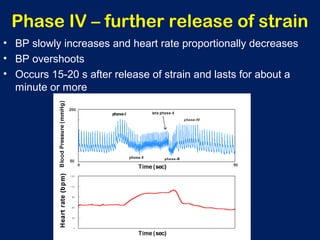
Phase IV – further release of strain
• BP slowly increases and heart rate proportionally decreases
• BP overshoots
• Occurs 15-20 s after release of strain and lasts for about a
minute or more
Mechanism
• Due to increase in venous return, stroke
volume and cardiac output
• With this high pressure there is no venous
return since no venous blood can enter
the thorax
• The blood in the lungs and heart will be
expelled at a higher pressure than normal
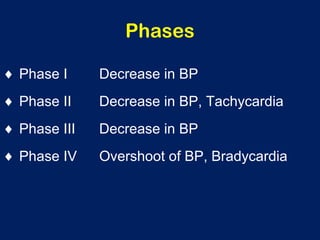
Phases
♦ Phase I Decrease in BP
♦ Phase II Decrease in BP, Tachycardia
♦ Phase III Decrease in BP
♦ Phase IV Overshoot of BP, Bradycardia
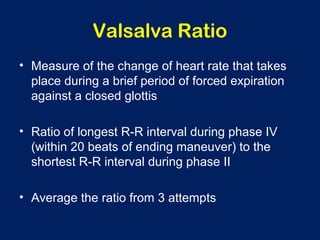
Valsalva Ratio
• Measure of the change of heart rate that takes
place during a brief period of forced expiration
against a closed glottis
• Ratio of longest R-R interval during phase IV
(within 20 beats of ending maneuver) to the
shortest R-R interval during phase II
• Average the ratio from 3 attempts
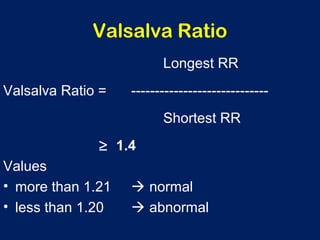
Valsalva Ratio
Longest RR
Valsalva Ratio = -----------------------------
Shortest RR
≥ 1.4
Values
• more than 1.21  normal
• less than 1.20  abnormal
Valsalva manoeuvre
• Valsalva maneuver evaluates
– 1. sympathetic adrenergic functions using the
blood pressure responses
– 2. cardiovagal (parasympathetic) functions
using the heart rate responses
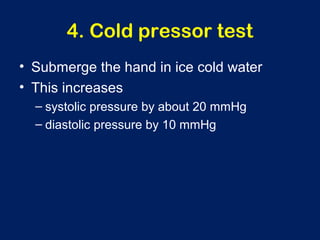
4. Cold pressor test
• Submerge the hand in ice cold water
• This increases
– systolic pressure by about 20 mmHg
– diastolic pressure by 10 mmHg
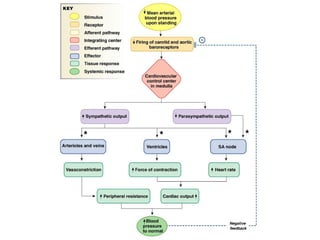
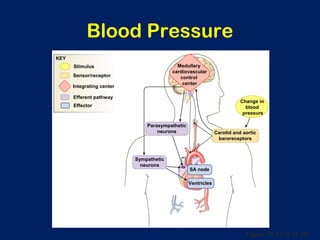
Medullary
cardiovascular
control
center
Carotid and aortic
baroreceptors
Change in
blood
pressure
Parasympathetic
neurons
Sympathetic
neurons
Veins
Arterioles
Ventricles
SA node
Integrating center
Stimulus
Efferent pathway
Effector
Sensor/receptor
KEY
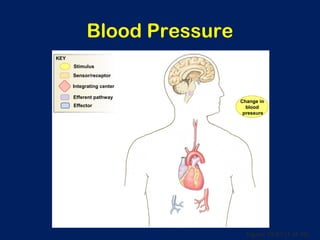
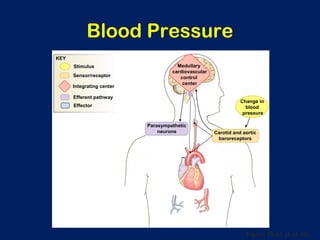
Figure 15-21 (1 of 10)
Blood Pressure
Change in
blood
pressure
Integrating center
Stimulus
Efferent pathway
Effector
Sensor/receptor
KEY
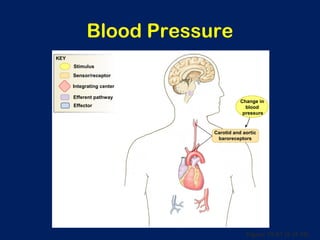
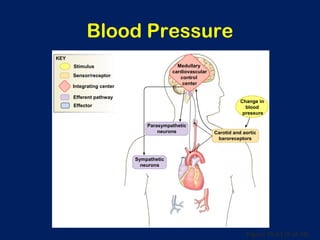
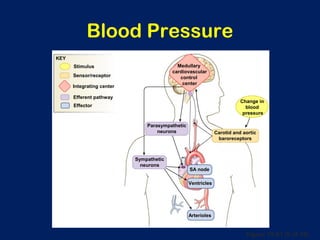
Figure 15-21 (2 of 10)
Blood Pressure
Carotid and aortic
baroreceptors
Change in
blood
pressure
Integrating center
Stimulus
Efferent pathway
Effector
Sensor/receptor
KEY
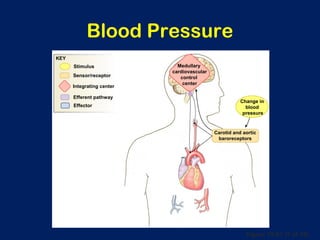
Figure 15-21 (3 of 10)
Blood Pressure
Medullary
cardiovascular
control
center
Carotid and aortic
baroreceptors
Change in
blood
pressure
Integrating center
Stimulus
Efferent pathway
Effector
Sensor/receptor
KEY
Figure 15-21 (4 of 10)
Blood Pressure
Medullary
cardiovascular
control
center
Carotid and aortic
baroreceptors
Change in
blood
pressure
Parasympathetic
neurons
Integrating center
Stimulus
Efferent pathway
Effector
Sensor/receptor
KEY
Figure 15-21 (5 of 10)
Blood Pressure
Medullary
cardiovascular
control
center
Carotid and aortic
baroreceptors
Change in
blood
pressure
Parasympathetic
neurons
Sympathetic
neurons
Integrating center
Stimulus
Efferent pathway
Effector
Sensor/receptor
KEY
Figure 15-21 (6 of 10)
Blood Pressure
Medullary
cardiovascular
control
center
Carotid and aortic
baroreceptors
Change in
blood
pressure
Parasympathetic
neurons
Sympathetic
neurons
SA node
Integrating center
Stimulus
Efferent pathway
Effector
Sensor/receptor
KEY
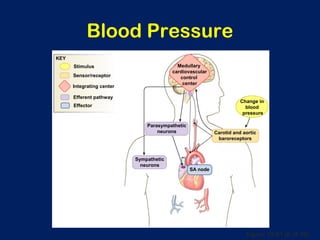
Figure 15-21 (7 of 10)
Blood Pressure
Medullary
cardiovascular
control
center
Carotid and aortic
baroreceptors
Change in
blood
pressure
Parasympathetic
neurons
Sympathetic
neurons
SA node
Integrating center
Stimulus
Efferent pathway
Effector
Sensor/receptor
KEY
Figure 15-21 (8 of 10)
Blood Pressure
Medullary
cardiovascular
control
center
Carotid and aortic
baroreceptors
Change in
blood
pressure
Parasympathetic
neurons
Sympathetic
neurons
Ventricles
SA node
Integrating center
Stimulus
Efferent pathway
Effector
Sensor/receptor
KEY
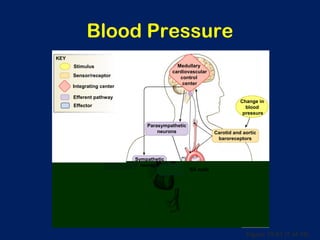
Figure 15-21 (9 of 10)
Blood Pressure
Medullary
cardiovascular
control
center
Carotid and aortic
baroreceptors
Change in
blood
pressure
Parasympathetic
neurons
Sympathetic
neurons
Arterioles
Ventricles
SA node
Integrating center
Stimulus
Efferent pathway
Effector
Sensor/receptor
KEY
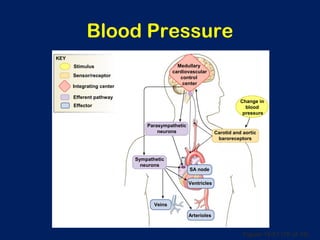
Figure 15-21 (10 of 10)
Blood Pressure
Medullary
cardiovascular
control
center
Carotid and aortic
baroreceptors
Change in
blood
pressure
Parasympathetic
neurons
Sympathetic
neurons
Veins
Arterioles
Ventricles
SA node
Integrating center
Stimulus
Efferent pathway
Effector
Sensor/receptor
KEY
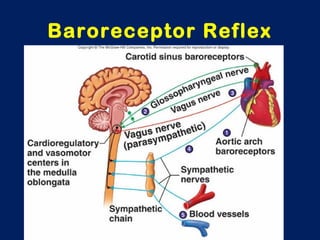
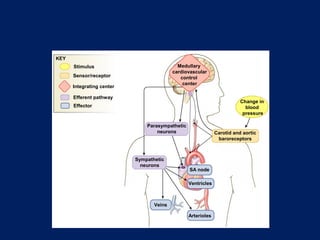
Baroreceptor Reflex
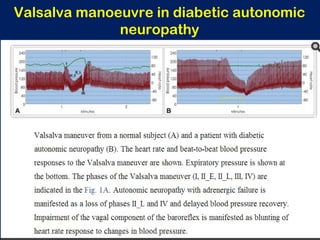
Valsalva manoeuvre in diabetic autonomic
neuropathy
Other ANS tests in CVS
• Head up tilt test (HUT)
– Heart rate and BP response
• BP Response to standing
• BP Response to sustained handgrip
• Plasma norepinephrine measured with the subject
supine and after a period of standing provides another
method of studying adrenergic function

Autonomic function tests

  • 1.
    Autonomic Function Tests Prof VajiraWeerasinghe Professor of Physiology Available at www.slideshare.net/vajira54
  • 2.
  • 3.
    Objectives Describe the physiologicalbasis of the following autonomic function tests in relation to cardiovascular system 1. Heart rate variation during respiration 2. Heart rate variation during postural change 3. Valsalva manoeuvre (maneuver) 4. Cold pressor test
  • 4.
    1. Heart ratevariation during respiration • The variation of heart rate with respiration is known as sinus arrhythmia • Inspiration  increases the heart rate • Expiration  decreases the heart rate • This is also called Respiratory Sinus Arrhythmia (RSA) • This is an index of vagal control of heart rate
  • 5.
  • 6.
    Explanation for sinus arrhythmia •Due to changes in vagal control of heart rate during respiration • Probably due to following mechanisms – Influence of respiratory centre on the vagal control of heart rate – Influence of pulmonary stretch receptors on the vagal control of heart rate
  • 7.
    Heart rate variationduring respiration • Heart rate increases during inspiration due to decreased cardiac vagal activity and decreases during expiration due to increased vagal activity • This is detected by recording the heart rate by using the electrocardiograph while the subject is breathing deeply
  • 8.
  • 9.
    Procedure • Connect theECG electrodes for recording lead II • Ask the subject to breath deeply at a rate of six breaths per minute for 3 cycles (allowing 5 seconds each for inspiration and expiration)
  • 10.
    Procedure • Record maximumand minimum heart rate with each respiratory cycle • Average the 3 differences – Normal > 15 beats/min – Borderline = 11-14 beats/min – Abnormal < 10 beats/min
  • 11.
    Procedure • Determine theexpiration to inspiration ratio (E:I ratio)
  • 12.
    E:I ratio • Meanof the maximum R-R intervals during deep expiration to the mean of minimum R-R intervals during deep inspiration
  • 13.
    E:I ratio longest RRinterval (expiration) Ratio = ------------------------------------- shortest RR interval (inspiration) E:I = 1.2
  • 14.
    2. Heart ratevariation during postural change • Changing posture from supine to standing leads to an increase in heart rate immediately, usually by 10-20 beats per minute
  • 16.
    Heart rate variationduring postural change • On standing the heart rate increases until it reaches a maximum at about – 15th beat (shortest R-R interval after standing) – after which it slows down to a stable state at about – 30th beat (longest R-R interval after standing)
  • 17.
    Heart rate responseto standing from supine posture
  • 18.
    30:15 ratio • Theratio of R-R intervals corresponding to the 30th and 15th heart beat  30:15 ratio RR interval at 30th beat • 30:15 ratio = ------------------------------ RR interval at 15th beat • This ratio is a measure of parasympathetic response
  • 19.
    30:15 ratio RR intervalat 30th beat •30:15 ratio = ------------------------------ RR interval at 15th beat •Normal > 1.04 •Borderline = 1.01-1.04 •Abnormal =<1.00
  • 20.
    3. Valsalva Manoeuvre •Assesses integrity of the baroreceptor reflex • Measure of parasympathetic and sympathetic function • It is “forced expiration against a closed glottis”
  • 21.
    Valsalva Manoeuvre • TheValsalva maneuver is performed by attempting to forcibly exhale while keeping the mouth and nose closed • It increases intrathoracic pressure to as much as 80 mmHg
  • 22.
    Procedure • Perform theValsalva manoeuvre (forced expiration against a closed glottis) by asking the subject to breathe forcefully into a mercury manometer and maintain a pressure of 40 mmHg for 15 seconds • Record the ECG throughout and for 30 seconds after the procedure
  • 23.
    Valsalva Manoeuvre • 4phases – Phase I – Phase II – Phase III – Phase IV
  • 24.
  • 25.
    – Transient increasein BP which lasts for a few seconds – HR does not change much – Mechanism: increased intrathoracic pressure and mechanical compression of great vessels due to the act of blowing Phase I – Onset of straining
  • 26.
    Phase II -Phase of straining • Early part – drop in BP lasting for about 4 seconds • Latter part – BP returns to normal • Heart rate rises steadily
  • 27.
    Mechanism • Early part –venous return decreases with compression of veins by increased intrathoracic pressure central venous pressure decreases  BP decreases • Latter part – drop in BP in early part will stimulate baroreceptor reflex  increased sympathetic activity  increased peripheral resistance  increased BP ( returns to normal ) • Heart rate increase steadily throughout this phase due to vagal withdrawal in early part & sympathetic activation in latter part
  • 28.
    Phase III -Release of straining • Transient decrease in BP lasting for a few seconds • Little change in heart rate
  • 29.
    Mechanism • Mechanical displacementof blood into pulmonary vascular bed, which was under increased intrathoracic pressure  BP decreases
  • 30.
    Phase IV –further release of strain • BP slowly increases and heart rate proportionally decreases • BP overshoots • Occurs 15-20 s after release of strain and lasts for about a minute or more
  • 31.
    Mechanism • Due toincrease in venous return, stroke volume and cardiac output
  • 32.
    • With thishigh pressure there is no venous return since no venous blood can enter the thorax • The blood in the lungs and heart will be expelled at a higher pressure than normal
  • 33.
    Phases ♦ Phase IDecrease in BP ♦ Phase II Decrease in BP, Tachycardia ♦ Phase III Decrease in BP ♦ Phase IV Overshoot of BP, Bradycardia
  • 34.
    Valsalva Ratio • Measureof the change of heart rate that takes place during a brief period of forced expiration against a closed glottis • Ratio of longest R-R interval during phase IV (within 20 beats of ending maneuver) to the shortest R-R interval during phase II • Average the ratio from 3 attempts
  • 35.
    Valsalva Ratio Longest RR ValsalvaRatio = ----------------------------- Shortest RR ≥ 1.4 Values • more than 1.21  normal • less than 1.20  abnormal
  • 36.
    Valsalva manoeuvre • Valsalvamaneuver evaluates – 1. sympathetic adrenergic functions using the blood pressure responses – 2. cardiovagal (parasympathetic) functions using the heart rate responses
  • 37.
    4. Cold pressortest • Submerge the hand in ice cold water • This increases – systolic pressure by about 20 mmHg – diastolic pressure by 10 mmHg
  • 38.
    Medullary cardiovascular control center Carotid and aortic baroreceptors Changein blood pressure Parasympathetic neurons Sympathetic neurons Veins Arterioles Ventricles SA node Integrating center Stimulus Efferent pathway Effector Sensor/receptor KEY
  • 39.
    Figure 15-21 (1of 10) Blood Pressure Change in blood pressure Integrating center Stimulus Efferent pathway Effector Sensor/receptor KEY
  • 40.
    Figure 15-21 (2of 10) Blood Pressure Carotid and aortic baroreceptors Change in blood pressure Integrating center Stimulus Efferent pathway Effector Sensor/receptor KEY
  • 41.
    Figure 15-21 (3of 10) Blood Pressure Medullary cardiovascular control center Carotid and aortic baroreceptors Change in blood pressure Integrating center Stimulus Efferent pathway Effector Sensor/receptor KEY
  • 42.
    Figure 15-21 (4of 10) Blood Pressure Medullary cardiovascular control center Carotid and aortic baroreceptors Change in blood pressure Parasympathetic neurons Integrating center Stimulus Efferent pathway Effector Sensor/receptor KEY
  • 43.
    Figure 15-21 (5of 10) Blood Pressure Medullary cardiovascular control center Carotid and aortic baroreceptors Change in blood pressure Parasympathetic neurons Sympathetic neurons Integrating center Stimulus Efferent pathway Effector Sensor/receptor KEY
  • 44.
    Figure 15-21 (6of 10) Blood Pressure Medullary cardiovascular control center Carotid and aortic baroreceptors Change in blood pressure Parasympathetic neurons Sympathetic neurons SA node Integrating center Stimulus Efferent pathway Effector Sensor/receptor KEY
  • 45.
    Figure 15-21 (7of 10) Blood Pressure Medullary cardiovascular control center Carotid and aortic baroreceptors Change in blood pressure Parasympathetic neurons Sympathetic neurons SA node Integrating center Stimulus Efferent pathway Effector Sensor/receptor KEY
  • 46.
    Figure 15-21 (8of 10) Blood Pressure Medullary cardiovascular control center Carotid and aortic baroreceptors Change in blood pressure Parasympathetic neurons Sympathetic neurons Ventricles SA node Integrating center Stimulus Efferent pathway Effector Sensor/receptor KEY
  • 47.
    Figure 15-21 (9of 10) Blood Pressure Medullary cardiovascular control center Carotid and aortic baroreceptors Change in blood pressure Parasympathetic neurons Sympathetic neurons Arterioles Ventricles SA node Integrating center Stimulus Efferent pathway Effector Sensor/receptor KEY
  • 48.
    Figure 15-21 (10of 10) Blood Pressure Medullary cardiovascular control center Carotid and aortic baroreceptors Change in blood pressure Parasympathetic neurons Sympathetic neurons Veins Arterioles Ventricles SA node Integrating center Stimulus Efferent pathway Effector Sensor/receptor KEY
  • 49.
  • 50.
    Valsalva manoeuvre indiabetic autonomic neuropathy
  • 51.
    Other ANS testsin CVS • Head up tilt test (HUT) – Heart rate and BP response • BP Response to standing • BP Response to sustained handgrip • Plasma norepinephrine measured with the subject supine and after a period of standing provides another method of studying adrenergic function