Motor system
Reflexes
Prof. Vajira Weerasinghe
Professor of Physiology
Faculty of Medicine
Motor Functions
• 1. Voluntary Functions
– Voluntary movement
• 2. Involuntary Functions
– Reflexes
What is a reflex?
• Response to a stimulus
• Involuntary, without significant
involvement of the brain
• Stimulus Response
Task:
Write down 3 reflexes
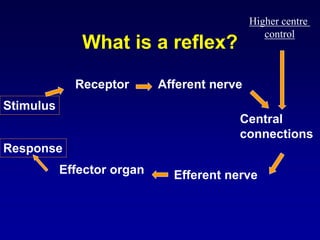
What is a reflex?
Stimulus
Effector organ
Response
Central
connections
Efferent nerve
Afferent nerveReceptor
Higher centre
control
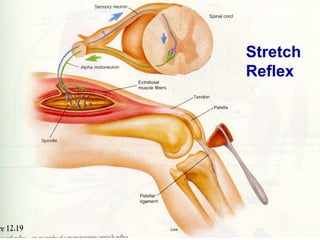
Stretch reflex
• This is a basic reflex present in the
spinal cord
• Stimulus: muscle stretch
• Response: contraction of the muscle
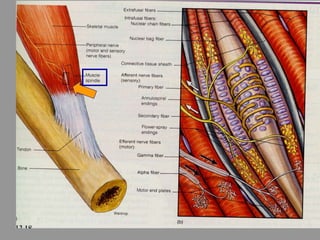
• Receptors: stretch receptors located
in the muscle spindle
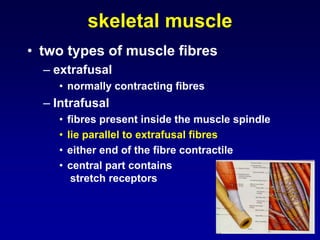
skeletal muscle
• two types of muscle fibres
– extrafusal
• normally contracting fibres
– Intrafusal
• fibres present inside the muscle spindle
• lie parallel to extrafusal fibres
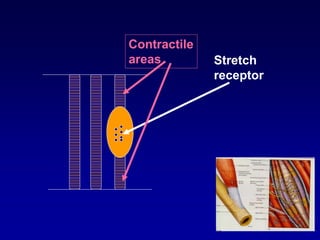
• either end of the fibre contractile
• central part contains
stretch receptors
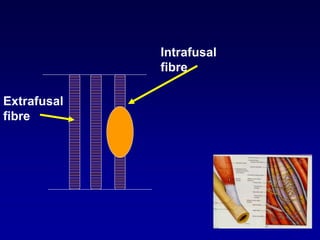
Extrafusal
fibre
Intrafusal
fibre
Contractile
areas Stretch
receptor
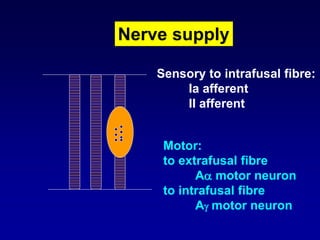
Nerve supply
Sensory to intrafusal fibre:
Ia afferent
II afferent
Motor:
to extrafusal fibre
A motor neuron
to intrafusal fibre
A motor neuron
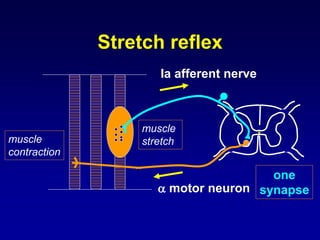
Ia afferent nerve
 motor neuron
one
synapse
muscle
stretchmuscle
contraction
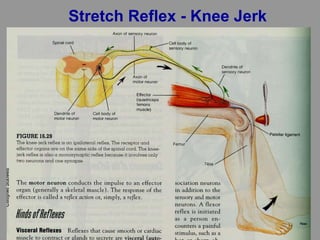
Stretch reflex
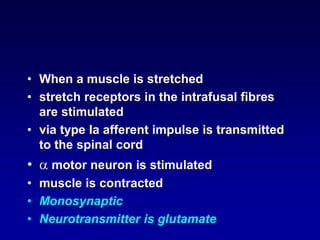
• When a muscle is stretched
• stretch receptors in the intrafusal fibres
are stimulated
• via type Ia afferent impulse is transmitted
to the spinal cord
•  motor neuron is stimulated
• muscle is contracted
• Monosynaptic
• Neurotransmitter is glutamate
Stretch
Reflex
Stretch Reflex - Knee Jerk
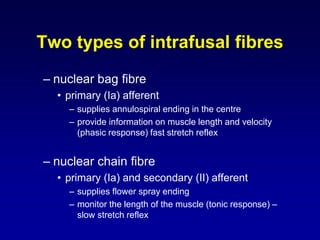
– nuclear bag fibre
• primary (Ia) afferent
– supplies annulospiral ending in the centre
– provide information on muscle length and velocity
(phasic response) fast stretch reflex
– nuclear chain fibre
• primary (Ia) and secondary (II) afferent
– supplies flower spray ending
– monitor the length of the muscle (tonic response) –
slow stretch reflex
Two types of intrafusal fibres
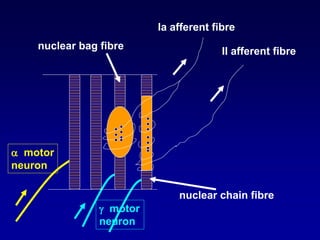
Ia afferent fibre
II afferent fibre
nuclear bag fibre
nuclear chain fibre
 motor
neuron
 motor
neuron
Importance of stretch reflex
• detects muscle length and changes
in muscle length
• Phasic stretch reflex
– Stretching the quadriceps muscle quickly (e.g. by tapping
the patellar tendon) evokes a discharge in the primary
afferent (Ia) fibres
– These form monosynaptic excitatory connections with motor
neurons supplying physiological extensors of the knee,
which contract briefly
• Tonic stretch reflex
– Passive bending of the joint elicits a discharge from the
group II afferents that increases the tone of physiological
extensor (antigravity) muscles
– Tonic stretch reflex is important for maintaining erect body
posture
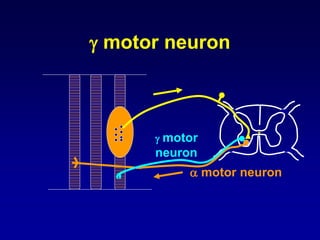
 motor neuron
• cell body is located in the anterior
horn
• motor neuron travels through the
motor nerve
• supplies the intrafusal fibres
(contractile elements at either end)
 motor neuron
 motor
neuron
 motor neuron
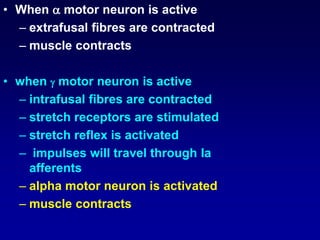
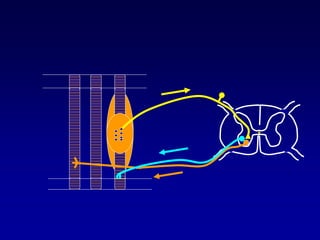
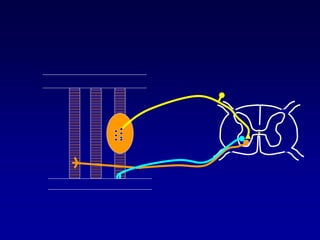
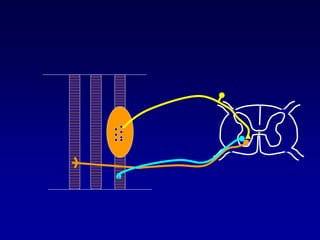
• When  motor neuron is active
– extrafusal fibres are contracted
– muscle contracts
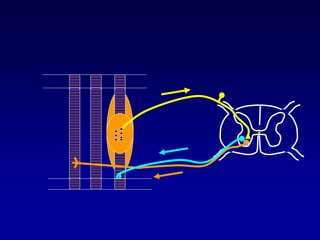
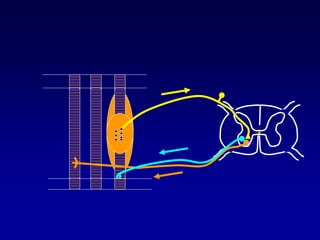
• when  motor neuron is active
– intrafusal fibres are contracted
– stretch receptors are stimulated
– stretch reflex is activated
– impulses will travel through Ia
afferents
– alpha motor neuron is activated
– muscle contracts
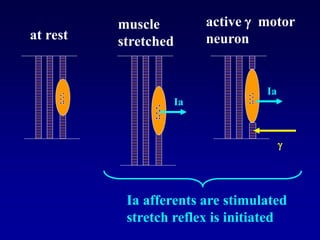
at rest
muscle
stretched
active  motor
neuron
Ia
Ia

Ia afferents are stimulated
stretch reflex is initiated
 motor neuron activity
• active all the time - mild contraction
• Maintain the sensitivity of the muscle
spindle to stretch
• modified by the descending pathways
• descending excitatory and inhibitory
influences
• sum effect is generally inhibitory in nature
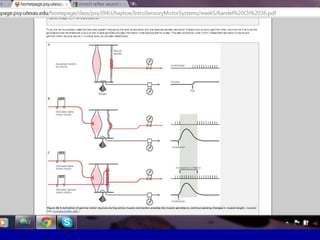
Alpha gamma co-activation
• gamma motoneurons are activated in parallel
with alpha motoneurons to maintain the firing
of spindle afferents when the extrafusal
muscles shorten
• Activity from brain centres often causes
simultaneous contraction of both extra- and
intrafusal fibres, thereby ensuring that the
spindle is sensitive to stretch at all muscle
lengths
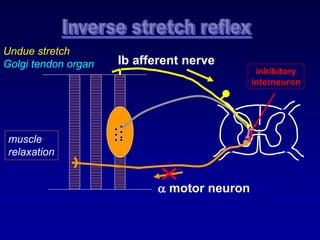
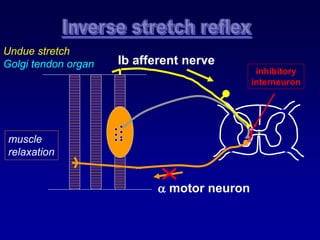
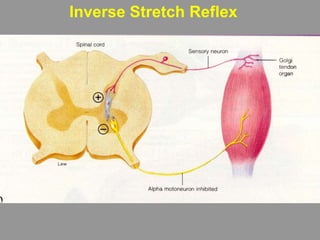
Inverse stretch reflex
• When the muscle is strongly
stretched -> muscle is relaxed
• Golgi tendon organs are stimulated
• Via type Ib afferents impulse is
transmitted to the spinal cord
• inhibitory interneuron is stimulated
•  motor neuron is inhibited
• muscle is relaxed
 motor neuron
Undue stretch
Golgi tendon organ
muscle
relaxation
Ib afferent nerve
inhibitory
interneuron
 motor neuron
Undue stretch
Golgi tendon organ
muscle
relaxation
Ib afferent nerve
inhibitory
interneuron
Inverse Stretch Reflex
Importance of inverse
stretch reflex
• detects muscle tension
Deep tendon reflexes (DTR)
• Biceps jerk
• Triceps jerk
• Supinator jerk
• Knee jerk
• Ankle jerk
• Jaw jerk
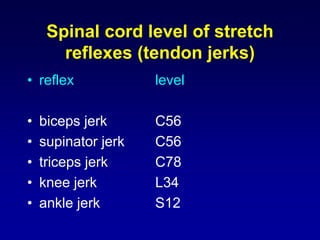
• reflex level
• biceps jerk C56
• supinator jerk C56
• triceps jerk C78
• knee jerk L34
• ankle jerk S12
Spinal cord level of stretch
reflexes (tendon jerks)
Superficial reflexes
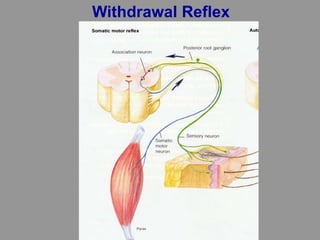
• Withdrawal reflex
• Superficial abdominal reflex
• Flexor plantar reflex
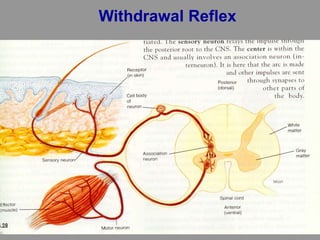
Withdrawal Reflex
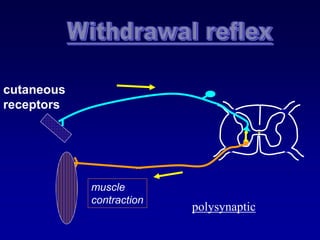
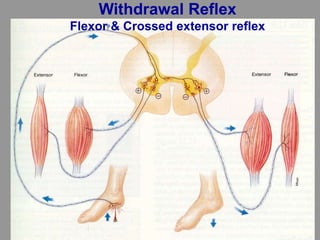
• Stimulus:
– cutaneous stimulation (usually noxious)
• Response:
– withdrawal of the hand
• Polysynaptic reflex
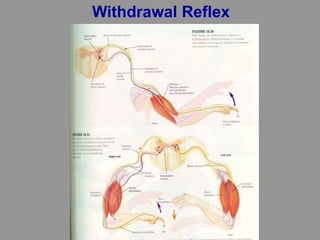
Withdrawal Reflex
muscle
contraction
cutaneous
receptors
polysynaptic
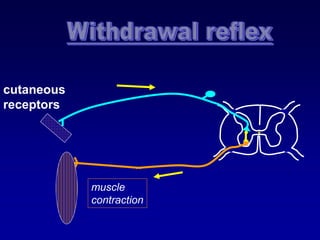
muscle
contraction
cutaneous
receptors
Withdrawal Reflex
• Elbow flexion, extension
• Wrist flexion, extension
• Forearm supination, pronation
• Shoulder adduction, abduction
• Hip flexion, extension
• Thigh adduction, abduction
• Knee flexion, extension
• Ankle dorsiflexion, plantar flexion
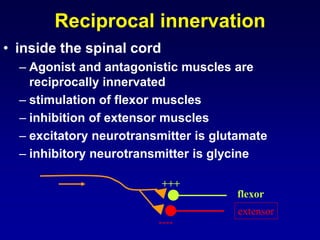
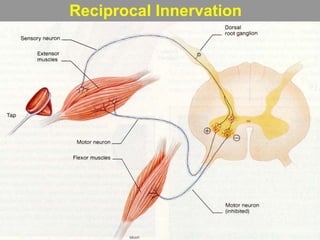
Reciprocal innervation
• inside the spinal cord
– Agonist and antagonistic muscles are
reciprocally innervated
– stimulation of flexor muscles
– inhibition of extensor muscles
– excitatory neurotransmitter is glutamate
– inhibitory neurotransmitter is glycine
flexor
extensor
+++
----
Reciprocal Innervation
Withdrawal Reflex
Flexor & Crossed extensor reflex
Withdrawal Reflex
Superficial abdominal
reflexes
• light scratch of the abdominal skin
• brisk unilateral contraction of the
abdominal wall
Flexor plantar reflex
• Scratching the sole of foot
• Plantar flexion
• Normal response
Primitive reflexes
Primitive reflexes
• These are reflexes present in
newborn babies but disappear as the
child develops
• They were evolutionarily primitive in
origin
• In adults these reflexes are inhibited
by the higher centres
Other primitive reflexes
• Moro reflex: startle reaction
• Walking/stepping reflex
• Sucking reflex
• Tonic neck reflex
• Palmar grasp reflex
Babinski sign
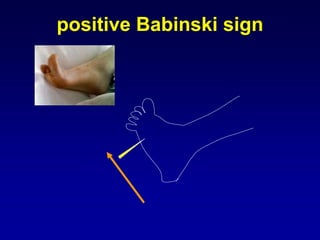
• when outer border of the sole of the foot is
scratched
• upward movement of big toe (dorsiflexion)
• fanning out of other toes
• also called extensor plantar reflex
• feature of
• upper motor neuron lesion
• seen in infants during 1st year of life (because of
immature corticospinal tract)
positive Babinski sign
Clinical Importance of reflexes
(tendon jerks)
• Locate a lesion in the motor system
• To differentiate upper motor neuron
lesion from a lower motor neuron
lesion

Motor system reflexes for students

  • 1.
    Motor system Reflexes Prof. VajiraWeerasinghe Professor of Physiology Faculty of Medicine
  • 2.
    Motor Functions • 1.Voluntary Functions – Voluntary movement • 2. Involuntary Functions – Reflexes
  • 3.
    What is areflex? • Response to a stimulus • Involuntary, without significant involvement of the brain • Stimulus Response Task: Write down 3 reflexes
  • 4.
    What is areflex? Stimulus Effector organ Response Central connections Efferent nerve Afferent nerveReceptor Higher centre control
  • 5.
    Stretch reflex • Thisis a basic reflex present in the spinal cord • Stimulus: muscle stretch • Response: contraction of the muscle • Receptors: stretch receptors located in the muscle spindle
  • 7.
    skeletal muscle • twotypes of muscle fibres – extrafusal • normally contracting fibres – Intrafusal • fibres present inside the muscle spindle • lie parallel to extrafusal fibres • either end of the fibre contractile • central part contains stretch receptors
  • 8.
  • 9.
  • 10.
    Nerve supply Sensory tointrafusal fibre: Ia afferent II afferent Motor: to extrafusal fibre A motor neuron to intrafusal fibre A motor neuron
  • 11.
    Ia afferent nerve motor neuron one synapse muscle stretchmuscle contraction Stretch reflex
  • 12.
    • When amuscle is stretched • stretch receptors in the intrafusal fibres are stimulated • via type Ia afferent impulse is transmitted to the spinal cord •  motor neuron is stimulated • muscle is contracted • Monosynaptic • Neurotransmitter is glutamate
  • 13.
  • 14.
  • 15.
    – nuclear bagfibre • primary (Ia) afferent – supplies annulospiral ending in the centre – provide information on muscle length and velocity (phasic response) fast stretch reflex – nuclear chain fibre • primary (Ia) and secondary (II) afferent – supplies flower spray ending – monitor the length of the muscle (tonic response) – slow stretch reflex Two types of intrafusal fibres
  • 16.
    Ia afferent fibre IIafferent fibre nuclear bag fibre nuclear chain fibre  motor neuron  motor neuron
  • 17.
    Importance of stretchreflex • detects muscle length and changes in muscle length
  • 18.
    • Phasic stretchreflex – Stretching the quadriceps muscle quickly (e.g. by tapping the patellar tendon) evokes a discharge in the primary afferent (Ia) fibres – These form monosynaptic excitatory connections with motor neurons supplying physiological extensors of the knee, which contract briefly • Tonic stretch reflex – Passive bending of the joint elicits a discharge from the group II afferents that increases the tone of physiological extensor (antigravity) muscles – Tonic stretch reflex is important for maintaining erect body posture
  • 19.
     motor neuron •cell body is located in the anterior horn • motor neuron travels through the motor nerve • supplies the intrafusal fibres (contractile elements at either end)
  • 20.
     motor neuron motor neuron  motor neuron
  • 21.
    • When motor neuron is active – extrafusal fibres are contracted – muscle contracts • when  motor neuron is active – intrafusal fibres are contracted – stretch receptors are stimulated – stretch reflex is activated – impulses will travel through Ia afferents – alpha motor neuron is activated – muscle contracts
  • 22.
    at rest muscle stretched active motor neuron Ia Ia  Ia afferents are stimulated stretch reflex is initiated
  • 28.
     motor neuronactivity • active all the time - mild contraction • Maintain the sensitivity of the muscle spindle to stretch • modified by the descending pathways • descending excitatory and inhibitory influences • sum effect is generally inhibitory in nature
  • 29.
    Alpha gamma co-activation •gamma motoneurons are activated in parallel with alpha motoneurons to maintain the firing of spindle afferents when the extrafusal muscles shorten • Activity from brain centres often causes simultaneous contraction of both extra- and intrafusal fibres, thereby ensuring that the spindle is sensitive to stretch at all muscle lengths
  • 31.
    Inverse stretch reflex •When the muscle is strongly stretched -> muscle is relaxed • Golgi tendon organs are stimulated • Via type Ib afferents impulse is transmitted to the spinal cord • inhibitory interneuron is stimulated •  motor neuron is inhibited • muscle is relaxed
  • 32.
     motor neuron Unduestretch Golgi tendon organ muscle relaxation Ib afferent nerve inhibitory interneuron
  • 33.
     motor neuron Unduestretch Golgi tendon organ muscle relaxation Ib afferent nerve inhibitory interneuron
  • 34.
  • 35.
    Importance of inverse stretchreflex • detects muscle tension
  • 36.
    Deep tendon reflexes(DTR) • Biceps jerk • Triceps jerk • Supinator jerk • Knee jerk • Ankle jerk • Jaw jerk
  • 37.
    • reflex level •biceps jerk C56 • supinator jerk C56 • triceps jerk C78 • knee jerk L34 • ankle jerk S12 Spinal cord level of stretch reflexes (tendon jerks)
  • 38.
    Superficial reflexes • Withdrawalreflex • Superficial abdominal reflex • Flexor plantar reflex
  • 39.
    Withdrawal Reflex • Stimulus: –cutaneous stimulation (usually noxious) • Response: – withdrawal of the hand • Polysynaptic reflex
  • 40.
  • 41.
  • 42.
  • 43.
  • 44.
    • Elbow flexion,extension • Wrist flexion, extension • Forearm supination, pronation • Shoulder adduction, abduction • Hip flexion, extension • Thigh adduction, abduction • Knee flexion, extension • Ankle dorsiflexion, plantar flexion
  • 45.
    Reciprocal innervation • insidethe spinal cord – Agonist and antagonistic muscles are reciprocally innervated – stimulation of flexor muscles – inhibition of extensor muscles – excitatory neurotransmitter is glutamate – inhibitory neurotransmitter is glycine flexor extensor +++ ----
  • 46.
  • 47.
    Withdrawal Reflex Flexor &Crossed extensor reflex
  • 48.
  • 49.
    Superficial abdominal reflexes • lightscratch of the abdominal skin • brisk unilateral contraction of the abdominal wall
  • 50.
    Flexor plantar reflex •Scratching the sole of foot • Plantar flexion • Normal response
  • 51.
  • 52.
    Primitive reflexes • Theseare reflexes present in newborn babies but disappear as the child develops • They were evolutionarily primitive in origin • In adults these reflexes are inhibited by the higher centres
  • 53.
    Other primitive reflexes •Moro reflex: startle reaction • Walking/stepping reflex • Sucking reflex • Tonic neck reflex • Palmar grasp reflex
  • 54.
    Babinski sign • whenouter border of the sole of the foot is scratched • upward movement of big toe (dorsiflexion) • fanning out of other toes • also called extensor plantar reflex • feature of • upper motor neuron lesion • seen in infants during 1st year of life (because of immature corticospinal tract)
  • 55.
  • 56.
    Clinical Importance ofreflexes (tendon jerks) • Locate a lesion in the motor system • To differentiate upper motor neuron lesion from a lower motor neuron lesion