Physiology of Hearing Prof. Vajira Weerasinghe  Dept of Physiology
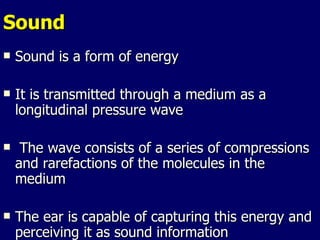
Sound Sound is a form of energy It is transmitted through a medium as a longitudinal pressure wave The wave consists of a series of compressions and rarefactions of the molecules in the medium  The ear is capable of capturing this energy and perceiving it as sound information
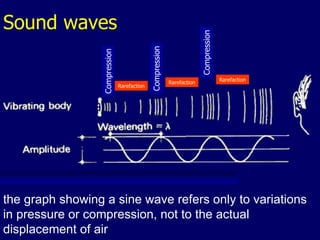
Compression the graph showing a sine wave refers only to variations in pressure or compression, not to the actual displacement of air Sound waves Compression Compression Rarefaction Rarefaction Rarefaction
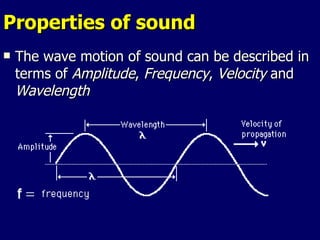
Properties of sound The wave motion of sound can be described in terms of  Amplitude ,  Frequency ,  Velocity  and  Wavelength  
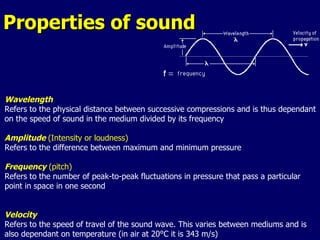
Properties of sound Wavelength Refers to the physical distance between successive compressions and is thus dependant on the speed of sound in the medium divided by its frequency Amplitude  (Intensity or loudness)  Refers to the difference between maximum and minimum pressure Frequency  (pitch) Refers to the number of peak-to-peak fluctuations in pressure that pass a particular point in space in one second Velocity Refers to the speed of travel of the sound wave. This varies between mediums and is also dependant on temperature (in air at 20°C it is 343 m/s)
Loudness (or amplitude) The intensity of sound is perceived as loudness It is measured on a relational scale with the unit of measurement being the decibel (after Alexander Graham Bell) Sound intensities require a standard sound level against which they are compared The standard sound pressure level (SPL = 0dB) is 0.0002 dynes/cm2 The decibel is a numeric value that represents sound intensity with respect to the reference sound pressure level
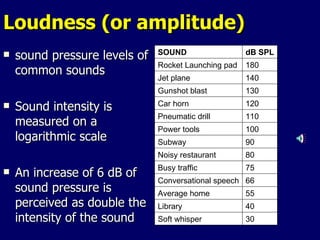
Loudness (or amplitude) sound pressure levels of common sounds Sound intensity is measured on a logarithmic scale An increase of 6 dB of sound pressure is perceived as double the intensity of the sound 30 Soft whisper 40 Library 55 Average home 66 Conversational speech 75 Busy traffic 80 Noisy restaurant 90 Subway 100 Power tools 110 Pneumatic drill 120 Car horn 130 Gunshot blast 140 Jet plane 180 Rocket Launching pad dB SPL SOUND
Frequency (or pitch) Frequency is perceived as the pitch of a sound The higher the frequency, the higher the pitch and vice versa The range of human hearing is said to be from 20 - 20,000 Hz The speech frequencies; those frequencies most important for human hearing are from approximately 250 - 4000 Hz
Listen to sound clips Sound spectrum analyser Neurolab  Songs with different frequencies
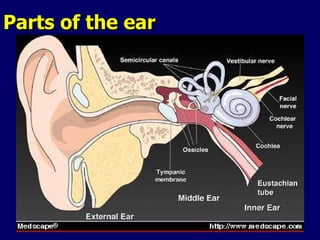
Transmission of sounds through the ear External ear Mostly through air (External acoustic meatus) Middle ear Through solid medium  - bone (ossicles) Inner ear Through fluid medium – endolymph (cochlea)
Parts of the ear
Air and bone conduction  There are two methods by which hair cells can be stimulated Air conduction  Sound stimulus travelling through the external and middle ear and activating the hair cells Bone conduction  Sound stimulus travelling though the bones of the skull activating the hair cells Whatever method it takes, the sound stimulus finally activate hair cells in the cochlea
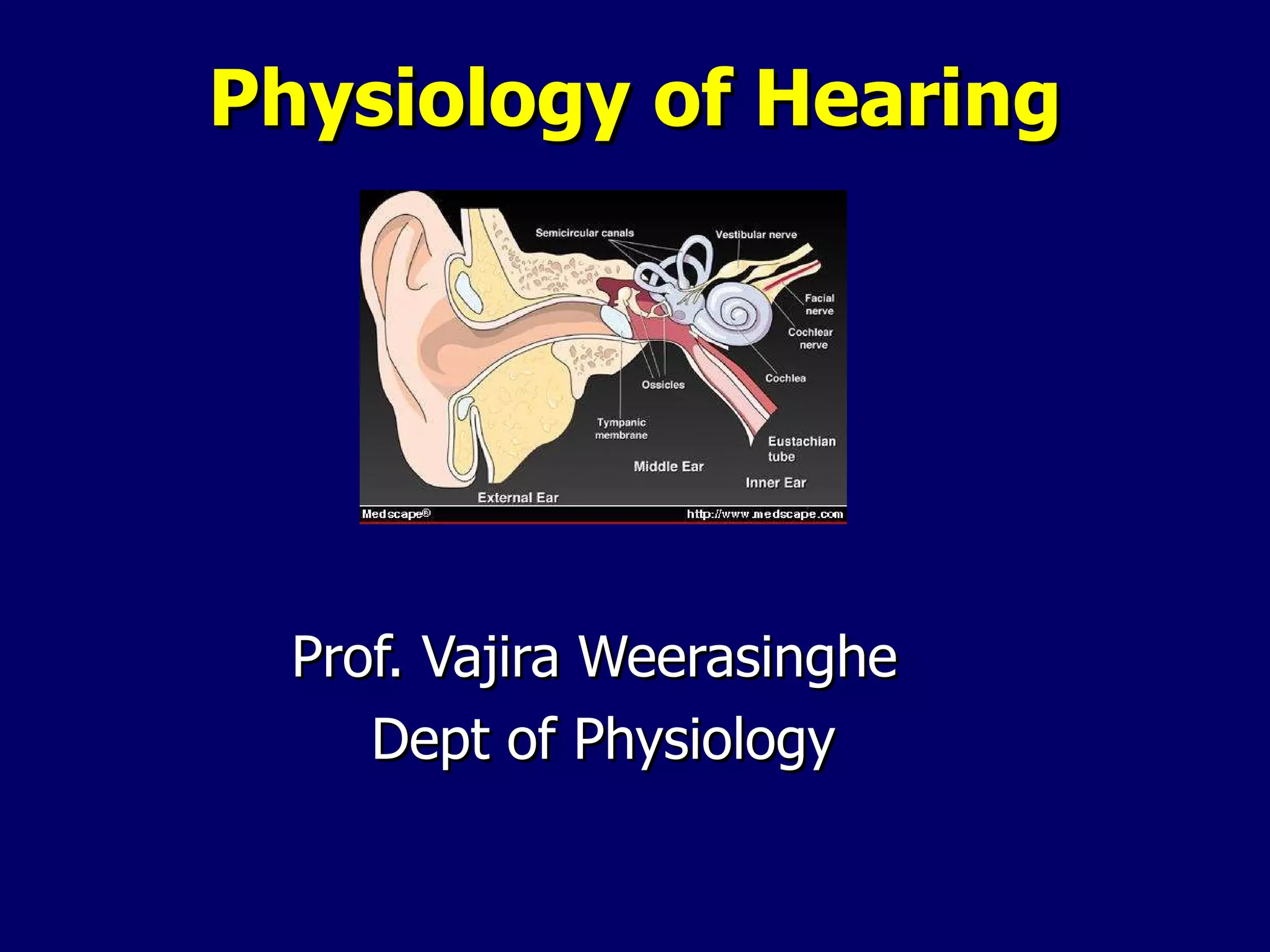
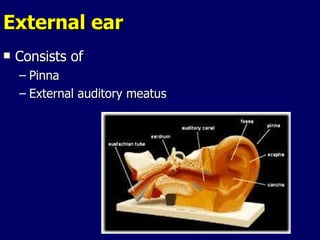
External ear Consists of  Pinna External auditory meatus
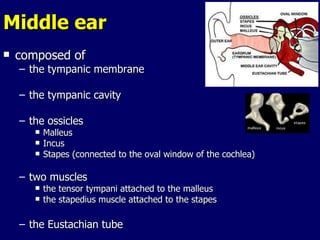
Middle ear composed of  the tympanic membrane the tympanic cavity the ossicles  Malleus Incus Stapes (connected to the oval window of the cochlea) two muscles the tensor tympani attached to the malleus  the stapedius muscle attached to the stapes  the Eustachian tube
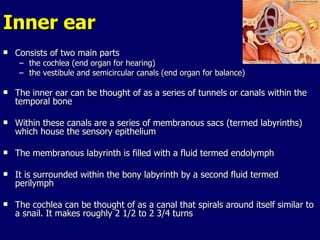
Inner ear Consists of two main parts the cochlea (end organ for hearing)  the vestibule and semicircular canals (end organ for balance) The inner ear can be thought of as a series of tunnels or canals within the temporal bone Within these canals are a series of membranous sacs (termed labyrinths) which house the sensory epithelium The membranous labyrinth is filled with a fluid termed endolymph It is surrounded within the bony labyrinth by a second fluid termed perilymph  The cochlea can be thought of as a canal that spirals around itself similar to a snail. It makes roughly 2 1/2 to 2 3/4 turns
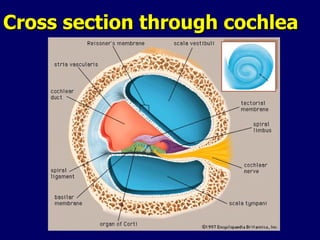
Cross section through cochlea
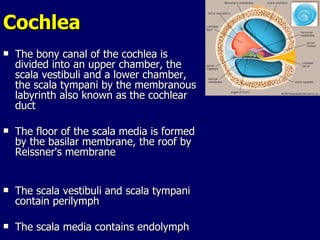
Cochlea The bony canal of the cochlea is divided into an upper chamber, the scala vestibuli and a lower chamber, the scala tympani by the membranous labyrinth also known as the cochlear duct The floor of the scala media is formed by the basilar membrane, the roof by Reissner's membrane The scala vestibuli and scala tympani contain perilymph The scala media contains endolymph
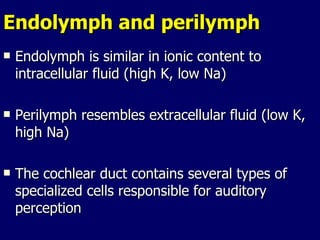
Endolymph and perilymph Endolymph is similar in ionic content to intracellular fluid (high K, low Na)  Perilymph resembles extracellular fluid (low K, high Na) The cochlear duct contains several types of specialized cells responsible for auditory perception
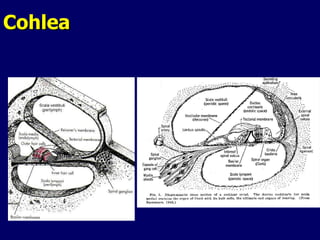
Cohlea
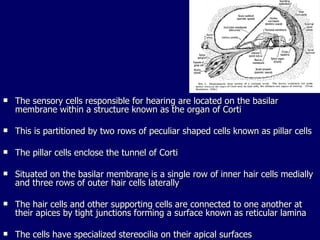
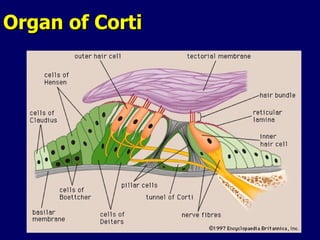
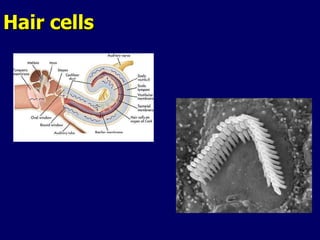
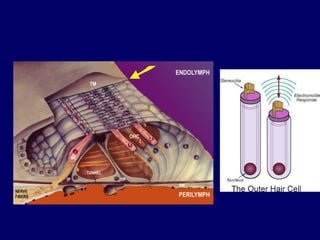
The sensory cells responsible for hearing are located on the basilar membrane within a structure known as the organ of Corti This is partitioned by two rows of peculiar shaped cells known as pillar cells The pillar cells enclose the tunnel of Corti Situated on the basilar membrane is a single row of inner hair cells medially and three rows of outer hair cells laterally The hair cells and other supporting cells are connected to one another at their apices by tight junctions forming a surface known as reticular lamina The cells have specialized stereocilia on their apical surfaces
Organ of Corti
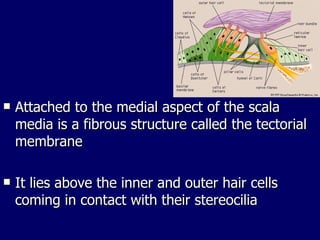
Attached to the medial aspect of the scala media is a fibrous structure called the tectorial membrane It lies above the inner and outer hair cells coming in contact with their stereocilia
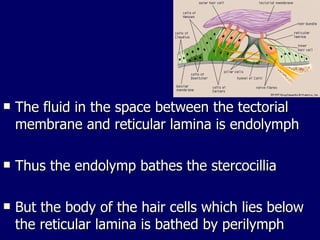
The fluid in the space between the tectorial membrane and reticular lamina is endolymph  Thus the endolymp bathes the stercocillia  But the body of the hair cells which lies below the reticular lamina is bathed by perilymph
Hair cells
 
Synapsing with the base of the hair cells are dendrites from the auditory nerve The auditory nerve leaves the cochlear and temporal bone via the internal auditory canal and travels to the brainstem
Transmission of sound waves The outer ear and external auditory canal act passively to capture the acoustic energy and direct it to the tympanic membrane There, the sound waves strike the tympanic membrane causing it to vibrate These mechanical vibrations are then transmitted via the ossicles to the perilymph of the inner ear The perilymph is stimulated by the mechanical (vibrations) energy vibrations to form a fluid wave within the cochlea
Middle ear The middle ear acts as an impendance-matching device Sound waves travel much easier through air (low impedance) than water (high impedance) If sound waves were directed at the oval window (water) almost all of the acoustic energy would be reflected back to the middle ear (air) and only 1% would enter the cochlea. This would be a very inefficient method.  To increase the efficiency of the system, the middle ear acts to transform the acoustic energy to mechanical energy which then stimulates the cochlear fluid
Middle ear  The middle ear also acts to increase the acoustic energy reaching the cochlea by essentially two mechanical phenomenon The area of the tympanic membrane is much greater than that of the stapes footplate (oval window) causing the force applied at the footplate per square area to be greater than the tympanic membrane  The ossicles act as a lever increasing once again the force applied at the stapes footplate Overall, the increase in sound energy reaching the cochlea is approximately 22 times
Cochlea The cochlea consists of a fluid filled bony canal within which lies the cochlear duct containing the sensory epithelium Energy enters the cochlea via the stapes bone at the oval window and is dissipated through a second opening (which is covered by a membrane) the round window Vibrations of the stapes footplate cause the perilymph to form a wave This wave travels the length of the cochlea It takes approximately 5 msec to travel the length of the cochlea
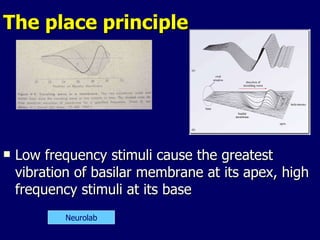
Cochlea As it passes the basilar membrane of the cochlear duct, the fluid wave causes the basilar membrane to move in a wave-like fashion (i.e. up and down) The wave form travels the length of the cochlea and is dissipated at the round window Due to changes in the mechanical properties of the basilar membrane, the amplitude of vibration changes as one travels along the basilar membrane
The place principle Low frequency stimuli cause the greatest vibration of basilar membrane at its apex, high frequency stimuli at its base Neurolab
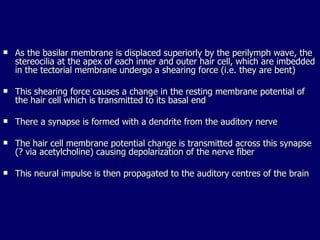
As the basilar membrane is displaced superiorly by the perilymph wave, the stereocilia at the apex of each inner and outer hair cell, which are imbedded in the tectorial membrane undergo a shearing force (i.e. they are bent) This shearing force causes a change in the resting membrane potential of the hair cell which is transmitted to its basal end There a synapse is formed with a dendrite from the auditory nerve The hair cell membrane potential change is transmitted across this synapse (? via acetylcholine) causing depolarization of the nerve fiber This neural impulse is then propagated to the auditory centres of the brain
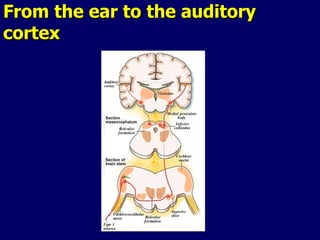
From the ear to the auditory cortex
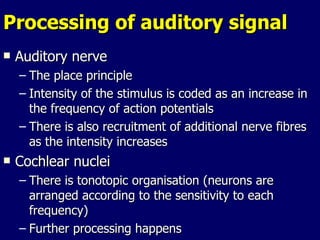
Processing of auditory signal Auditory nerve The place principle Intensity of the stimulus is coded as an increase in the frequency of action potentials There is also recruitment of additional nerve fibres as the intensity increases Cochlear nuclei There is tonotopic organisation (neurons are arranged according to the sensitivity to each frequency) Further processing happens
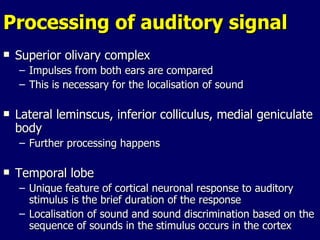
Processing of auditory signal Superior olivary complex Impulses from both ears are compared This is necessary for the localisation of sound  Lateral leminscus, inferior colliculus, medial geniculate body Further processing happens Temporal lobe Unique feature of cortical neuronal response to auditory stimulus is the brief duration of the response Localisation of sound and sound discrimination based on the sequence of sounds in the stimulus occurs in the cortex
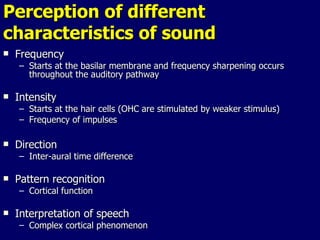
Perception of different characteristics of sound Frequency Starts at the basilar membrane and frequency sharpening occurs throughout the auditory pathway  Intensity Starts at the hair cells (OHC are stimulated by weaker stimulus) Frequency of impulses Direction Inter-aural time difference  Pattern recognition  Cortical function  Interpretation of speech Complex cortical phenomenon
Hearing loss Hearing can be defined as the ability to receive and process acoustic stimuli (i.e. sound) Hearing is an important function for communication and provides people with pleasurable experiences such as listening to music The loss of ability to hear has important consequences in ones day to day life and ability to function within the hearing culture (vs the deaf culture) Hearing loss can be broadly defined as the decreased ability to receive or process acoustic stimuli
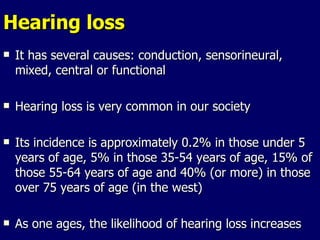
Hearing loss It has several causes: conduction, sensorineural, mixed, central or functional Hearing loss is very common in our society Its incidence is approximately 0.2% in those under 5 years of age, 5% in those 35-54 years of age, 15% of those 55-64 years of age and 40% (or more) in those over 75 years of age (in the west) As one ages, the likelihood of hearing loss increases
Conduction deafness (or conductive deafness) A conductive hearing loss exists when sound waves for any reason are not able to stimulate the sensory cells of the inner ear (i.e. cause a fluid wave within the cochlea) Examples of conditions causing a conductive hearing loss include  impacted wax external auditory canal atrecia perforation of the tympanic membrane ossicular discontinuity Otosclerosis Middle ear disease
Conduction deafness (or conductive deafness) In a conductive hearing loss, the sound waves cannot be transformed into a fluid wave within the cochlea, thus the sensory cells receive decreased or no stimulation The maximum conductive hearing loss is approximately 60 dB Many conductive hearing loss can cured
Sensorineural deafness or nerve deafness Sensorineural hearing loss occurs when the sensory cells of the cochlea (inner ear) or the auditory nerve fibers are dysfunctional The acoustic energy (sound wave) is not capable of being transformed inside the cochlea to nervous stimuli Reasons for this include  noise damage to the cochlea aging (presbycusis) ototoxic medications tumours such as an acoustic neuroma
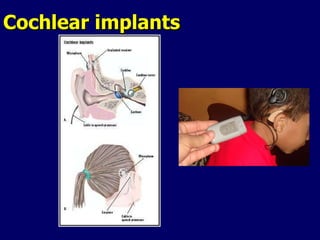
Sensorineural deafness or nerve deafness Hearing loss can be in excess of 100 dB Sensorineural hearing loss is, in general, cannot be cured Cochlear implants are available as a method of treatment
Cochlear implants
Mixed Hearing Loss Mixed hearing losses are simply the combination of a conductive and sensorineural hearing loss For example, an elderly person with presbycusis plus impacted wax (cerumen)  or a heavy metal musician with noise induced hearing loss who develops a perforated tympanic membrane
Central Hearing Loss Central hearing loss occurs in the auditory areas of the brainstem and higher levels (temporal lobe) Very little information is known about lesions that cause this type of impairment Persons with central hearing loss have normal hearing, but have difficulty with the processing of auditory information (word deafness)
Functional Hearing Loss Persons with functional hearing loss have no physiologic basis for a hearing deficit They are using their 'hearing loss' for secondary gain and are called malingerers This is occasionally seen in adolescents or persons appying for pension benefits as a result of hearing loss
All of the different types of hearing loss  can be present at birth, i.e. congenital  or acquired later on in life
Diagnosis of Hearing Loss The diagnosis of hearing loss can be relatively simple ("I can't hear from my right ear") to the more subtle (“Sunil seems to have difficulty saying some words") Auriscopic examination and identify the any structural defect in the ear canal  Tests of hearing need to be done
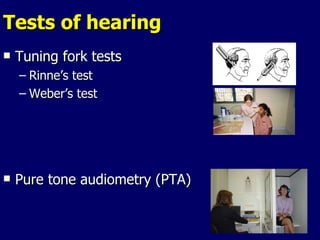
Tests of hearing  Tuning fork tests  Rinne’s test Weber’s test   Pure tone audiometry (PTA)

Hearing

  • 1.
    Physiology of HearingProf. Vajira Weerasinghe Dept of Physiology
  • 2.
    Sound Sound isa form of energy It is transmitted through a medium as a longitudinal pressure wave The wave consists of a series of compressions and rarefactions of the molecules in the medium The ear is capable of capturing this energy and perceiving it as sound information
  • 3.
    Compression the graphshowing a sine wave refers only to variations in pressure or compression, not to the actual displacement of air Sound waves Compression Compression Rarefaction Rarefaction Rarefaction
  • 4.
    Properties of soundThe wave motion of sound can be described in terms of Amplitude , Frequency , Velocity and Wavelength  
  • 5.
    Properties of soundWavelength Refers to the physical distance between successive compressions and is thus dependant on the speed of sound in the medium divided by its frequency Amplitude (Intensity or loudness) Refers to the difference between maximum and minimum pressure Frequency (pitch) Refers to the number of peak-to-peak fluctuations in pressure that pass a particular point in space in one second Velocity Refers to the speed of travel of the sound wave. This varies between mediums and is also dependant on temperature (in air at 20°C it is 343 m/s)
  • 6.
    Loudness (or amplitude)The intensity of sound is perceived as loudness It is measured on a relational scale with the unit of measurement being the decibel (after Alexander Graham Bell) Sound intensities require a standard sound level against which they are compared The standard sound pressure level (SPL = 0dB) is 0.0002 dynes/cm2 The decibel is a numeric value that represents sound intensity with respect to the reference sound pressure level
  • 7.
    Loudness (or amplitude)sound pressure levels of common sounds Sound intensity is measured on a logarithmic scale An increase of 6 dB of sound pressure is perceived as double the intensity of the sound 30 Soft whisper 40 Library 55 Average home 66 Conversational speech 75 Busy traffic 80 Noisy restaurant 90 Subway 100 Power tools 110 Pneumatic drill 120 Car horn 130 Gunshot blast 140 Jet plane 180 Rocket Launching pad dB SPL SOUND
  • 8.
    Frequency (or pitch)Frequency is perceived as the pitch of a sound The higher the frequency, the higher the pitch and vice versa The range of human hearing is said to be from 20 - 20,000 Hz The speech frequencies; those frequencies most important for human hearing are from approximately 250 - 4000 Hz
  • 9.
    Listen to soundclips Sound spectrum analyser Neurolab Songs with different frequencies
  • 10.
    Transmission of soundsthrough the ear External ear Mostly through air (External acoustic meatus) Middle ear Through solid medium - bone (ossicles) Inner ear Through fluid medium – endolymph (cochlea)
  • 11.
  • 12.
    Air and boneconduction There are two methods by which hair cells can be stimulated Air conduction Sound stimulus travelling through the external and middle ear and activating the hair cells Bone conduction Sound stimulus travelling though the bones of the skull activating the hair cells Whatever method it takes, the sound stimulus finally activate hair cells in the cochlea
  • 13.
    External ear Consistsof Pinna External auditory meatus
  • 14.
    Middle ear composedof the tympanic membrane the tympanic cavity the ossicles Malleus Incus Stapes (connected to the oval window of the cochlea) two muscles the tensor tympani attached to the malleus the stapedius muscle attached to the stapes the Eustachian tube
  • 15.
    Inner ear Consistsof two main parts the cochlea (end organ for hearing) the vestibule and semicircular canals (end organ for balance) The inner ear can be thought of as a series of tunnels or canals within the temporal bone Within these canals are a series of membranous sacs (termed labyrinths) which house the sensory epithelium The membranous labyrinth is filled with a fluid termed endolymph It is surrounded within the bony labyrinth by a second fluid termed perilymph The cochlea can be thought of as a canal that spirals around itself similar to a snail. It makes roughly 2 1/2 to 2 3/4 turns
  • 16.
  • 17.
    Cochlea The bonycanal of the cochlea is divided into an upper chamber, the scala vestibuli and a lower chamber, the scala tympani by the membranous labyrinth also known as the cochlear duct The floor of the scala media is formed by the basilar membrane, the roof by Reissner's membrane The scala vestibuli and scala tympani contain perilymph The scala media contains endolymph
  • 18.
    Endolymph and perilymphEndolymph is similar in ionic content to intracellular fluid (high K, low Na) Perilymph resembles extracellular fluid (low K, high Na) The cochlear duct contains several types of specialized cells responsible for auditory perception
  • 19.
  • 20.
    The sensory cellsresponsible for hearing are located on the basilar membrane within a structure known as the organ of Corti This is partitioned by two rows of peculiar shaped cells known as pillar cells The pillar cells enclose the tunnel of Corti Situated on the basilar membrane is a single row of inner hair cells medially and three rows of outer hair cells laterally The hair cells and other supporting cells are connected to one another at their apices by tight junctions forming a surface known as reticular lamina The cells have specialized stereocilia on their apical surfaces
  • 21.
  • 22.
    Attached to themedial aspect of the scala media is a fibrous structure called the tectorial membrane It lies above the inner and outer hair cells coming in contact with their stereocilia
  • 23.
    The fluid inthe space between the tectorial membrane and reticular lamina is endolymph Thus the endolymp bathes the stercocillia But the body of the hair cells which lies below the reticular lamina is bathed by perilymph
  • 24.
  • 25.
  • 26.
    Synapsing with thebase of the hair cells are dendrites from the auditory nerve The auditory nerve leaves the cochlear and temporal bone via the internal auditory canal and travels to the brainstem
  • 27.
    Transmission of soundwaves The outer ear and external auditory canal act passively to capture the acoustic energy and direct it to the tympanic membrane There, the sound waves strike the tympanic membrane causing it to vibrate These mechanical vibrations are then transmitted via the ossicles to the perilymph of the inner ear The perilymph is stimulated by the mechanical (vibrations) energy vibrations to form a fluid wave within the cochlea
  • 28.
    Middle ear Themiddle ear acts as an impendance-matching device Sound waves travel much easier through air (low impedance) than water (high impedance) If sound waves were directed at the oval window (water) almost all of the acoustic energy would be reflected back to the middle ear (air) and only 1% would enter the cochlea. This would be a very inefficient method. To increase the efficiency of the system, the middle ear acts to transform the acoustic energy to mechanical energy which then stimulates the cochlear fluid
  • 29.
    Middle ear The middle ear also acts to increase the acoustic energy reaching the cochlea by essentially two mechanical phenomenon The area of the tympanic membrane is much greater than that of the stapes footplate (oval window) causing the force applied at the footplate per square area to be greater than the tympanic membrane The ossicles act as a lever increasing once again the force applied at the stapes footplate Overall, the increase in sound energy reaching the cochlea is approximately 22 times
  • 30.
    Cochlea The cochleaconsists of a fluid filled bony canal within which lies the cochlear duct containing the sensory epithelium Energy enters the cochlea via the stapes bone at the oval window and is dissipated through a second opening (which is covered by a membrane) the round window Vibrations of the stapes footplate cause the perilymph to form a wave This wave travels the length of the cochlea It takes approximately 5 msec to travel the length of the cochlea
  • 31.
    Cochlea As itpasses the basilar membrane of the cochlear duct, the fluid wave causes the basilar membrane to move in a wave-like fashion (i.e. up and down) The wave form travels the length of the cochlea and is dissipated at the round window Due to changes in the mechanical properties of the basilar membrane, the amplitude of vibration changes as one travels along the basilar membrane
  • 32.
    The place principleLow frequency stimuli cause the greatest vibration of basilar membrane at its apex, high frequency stimuli at its base Neurolab
  • 33.
    As the basilarmembrane is displaced superiorly by the perilymph wave, the stereocilia at the apex of each inner and outer hair cell, which are imbedded in the tectorial membrane undergo a shearing force (i.e. they are bent) This shearing force causes a change in the resting membrane potential of the hair cell which is transmitted to its basal end There a synapse is formed with a dendrite from the auditory nerve The hair cell membrane potential change is transmitted across this synapse (? via acetylcholine) causing depolarization of the nerve fiber This neural impulse is then propagated to the auditory centres of the brain
  • 34.
    From the earto the auditory cortex
  • 35.
    Processing of auditorysignal Auditory nerve The place principle Intensity of the stimulus is coded as an increase in the frequency of action potentials There is also recruitment of additional nerve fibres as the intensity increases Cochlear nuclei There is tonotopic organisation (neurons are arranged according to the sensitivity to each frequency) Further processing happens
  • 36.
    Processing of auditorysignal Superior olivary complex Impulses from both ears are compared This is necessary for the localisation of sound Lateral leminscus, inferior colliculus, medial geniculate body Further processing happens Temporal lobe Unique feature of cortical neuronal response to auditory stimulus is the brief duration of the response Localisation of sound and sound discrimination based on the sequence of sounds in the stimulus occurs in the cortex
  • 37.
    Perception of differentcharacteristics of sound Frequency Starts at the basilar membrane and frequency sharpening occurs throughout the auditory pathway Intensity Starts at the hair cells (OHC are stimulated by weaker stimulus) Frequency of impulses Direction Inter-aural time difference Pattern recognition Cortical function Interpretation of speech Complex cortical phenomenon
  • 38.
    Hearing loss Hearingcan be defined as the ability to receive and process acoustic stimuli (i.e. sound) Hearing is an important function for communication and provides people with pleasurable experiences such as listening to music The loss of ability to hear has important consequences in ones day to day life and ability to function within the hearing culture (vs the deaf culture) Hearing loss can be broadly defined as the decreased ability to receive or process acoustic stimuli
  • 39.
    Hearing loss Ithas several causes: conduction, sensorineural, mixed, central or functional Hearing loss is very common in our society Its incidence is approximately 0.2% in those under 5 years of age, 5% in those 35-54 years of age, 15% of those 55-64 years of age and 40% (or more) in those over 75 years of age (in the west) As one ages, the likelihood of hearing loss increases
  • 40.
    Conduction deafness (orconductive deafness) A conductive hearing loss exists when sound waves for any reason are not able to stimulate the sensory cells of the inner ear (i.e. cause a fluid wave within the cochlea) Examples of conditions causing a conductive hearing loss include impacted wax external auditory canal atrecia perforation of the tympanic membrane ossicular discontinuity Otosclerosis Middle ear disease
  • 41.
    Conduction deafness (orconductive deafness) In a conductive hearing loss, the sound waves cannot be transformed into a fluid wave within the cochlea, thus the sensory cells receive decreased or no stimulation The maximum conductive hearing loss is approximately 60 dB Many conductive hearing loss can cured
  • 42.
    Sensorineural deafness ornerve deafness Sensorineural hearing loss occurs when the sensory cells of the cochlea (inner ear) or the auditory nerve fibers are dysfunctional The acoustic energy (sound wave) is not capable of being transformed inside the cochlea to nervous stimuli Reasons for this include noise damage to the cochlea aging (presbycusis) ototoxic medications tumours such as an acoustic neuroma
  • 43.
    Sensorineural deafness ornerve deafness Hearing loss can be in excess of 100 dB Sensorineural hearing loss is, in general, cannot be cured Cochlear implants are available as a method of treatment
  • 44.
  • 45.
    Mixed Hearing LossMixed hearing losses are simply the combination of a conductive and sensorineural hearing loss For example, an elderly person with presbycusis plus impacted wax (cerumen) or a heavy metal musician with noise induced hearing loss who develops a perforated tympanic membrane
  • 46.
    Central Hearing LossCentral hearing loss occurs in the auditory areas of the brainstem and higher levels (temporal lobe) Very little information is known about lesions that cause this type of impairment Persons with central hearing loss have normal hearing, but have difficulty with the processing of auditory information (word deafness)
  • 47.
    Functional Hearing LossPersons with functional hearing loss have no physiologic basis for a hearing deficit They are using their 'hearing loss' for secondary gain and are called malingerers This is occasionally seen in adolescents or persons appying for pension benefits as a result of hearing loss
  • 48.
    All of thedifferent types of hearing loss can be present at birth, i.e. congenital or acquired later on in life
  • 49.
    Diagnosis of HearingLoss The diagnosis of hearing loss can be relatively simple ("I can't hear from my right ear") to the more subtle (“Sunil seems to have difficulty saying some words") Auriscopic examination and identify the any structural defect in the ear canal Tests of hearing need to be done
  • 50.
    Tests of hearing Tuning fork tests Rinne’s test Weber’s test Pure tone audiometry (PTA)