Unit 10:  Industrial Revolution  and its effects on Europe
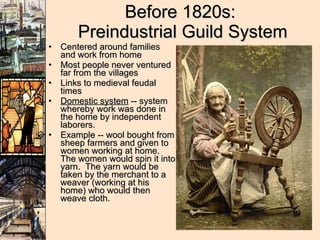
Before 1820s:  Preindustrial Guild System Centered around families and work from home Most people never ventured far from the villages Links to medieval feudal times Domestic system  -- system whereby work was done in the home by independent laborers.  Example -- wool bought from sheep farmers and given to women working at home.  The women would spin it into yarn.  The yarn would be taken by the merchant to a weaver (working at his home) who would then weave cloth.
Why Did Industrialization Begin in  England First?
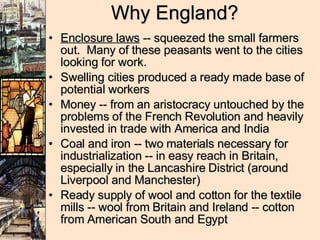
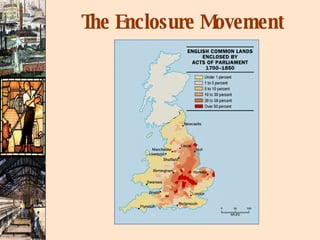
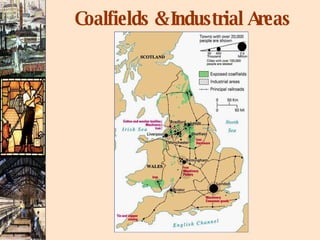
Why England? Enclosure laws  -- squeezed the small farmers out.  Many of these peasants went to the cities looking for work.  Swelling cities produced a ready made base of potential workers Money -- from an aristocracy untouched by the problems of the French Revolution and heavily invested in trade with America and India Coal and iron -- two materials necessary for industrialization -- in easy reach in Britain, especially in the Lancashire District (around Liverpool and Manchester) Ready supply of wool and cotton for the textile mills -- wool from Britain and Ireland -- cotton from American South and Egypt
The Enclosure Movement
Coalfields & Industrial Areas
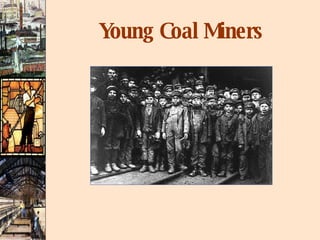
Young Coal Miners
Factory Production Concentrates production in one place [materials, labor]. Located near sources of power  [rather than labor or markets]. Requires a lot of capital investment [factory, machines, etc.] more than skilled labor.
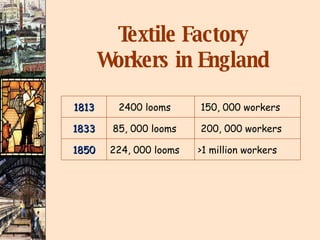
Textile Factory Workers in England 1813 2400 looms 150, 000 workers 1833 85, 000 looms 200, 000 workers 1850 224, 000 looms >1 million workers
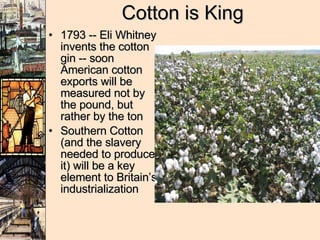
Cotton is King 1793 -- Eli Whitney invents the cotton gin -- soon American cotton exports will be measured not by the pound, but rather by the ton Southern Cotton (and the slavery needed to produce it) will be a key element to Britain’s industrialization
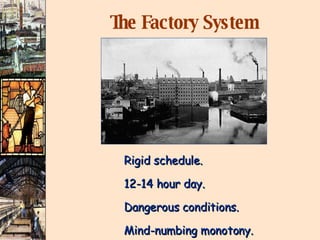
The Factory System Rigid schedule. 12-14 hour day. Dangerous conditions. Mind-numbing monotony.
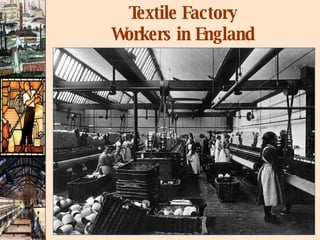
Textile Factory Workers in England
The "Haves": Bourgeoisie And the Riches of Capitalism
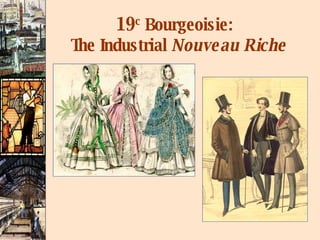
19 c  Bourgeoisie:  The Industrial  Nouveau Riche
Capitalism Based on factories and production -- looks to make money for those in charge, not the workers -- workers become simply part of the machine Bourgeoisie -- begins to develop a social consciousness -- the class sees itself as in charge of the country Economic personification of classical liberal governmental philosophy Laissez-faire economics  -- "hands off" -- no government intervention -- laws of supply and demand will drive economic cycles "invisible hand"  -- idea proposed by Adam Smith that competition and free markets will hold prices down and drive the economy In an age of economic growth -- shouldn't the people causing the growth have all the power and say?
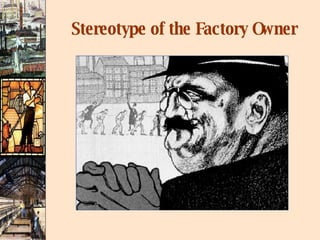
Stereotype of the Factory Owner
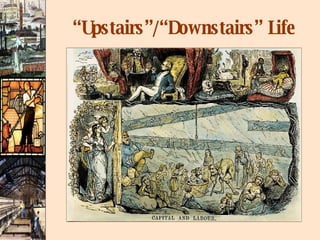
“ Upstairs”/“Downstairs” Life
The "Have-Nots": The Proletatiat
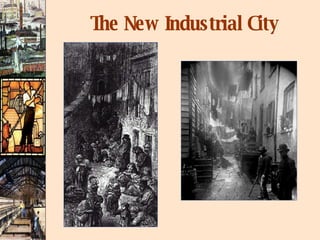
The Proletariat Working conditions were terrible in the new factories.  Workers often worked long shifts 7 days a week  No labor laws at the time -- very dangerous and unsanitary conditions Living conditions -- slums -- workers living like animals -- crowded into dirty sections of the city -- malnourished and pitiful Businessmen felt that it was their job to make as much money for themselves and save expenses Workers didn't matter  -- (story from  the Jungle  in class) Some political and philosophical leaders felt that society itself must accept responsibility for the workers Problem -- although the working class lived in misery, their numbers were constantly expanding, not only from more people moving to the cities, but also from the agricultural revolution
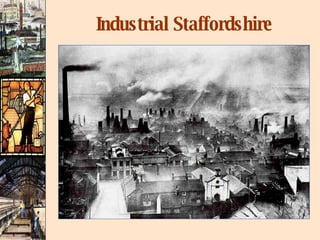
Industrial Staffordshire
The New Industrial City
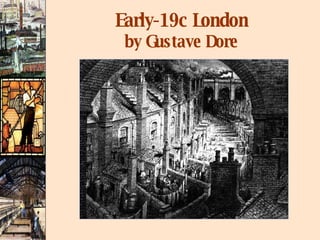
Early-19c London by Gustave Dore
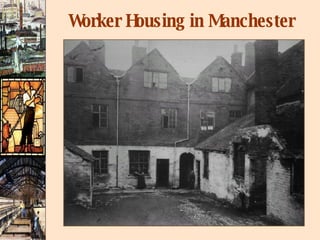
Worker Housing in Manchester
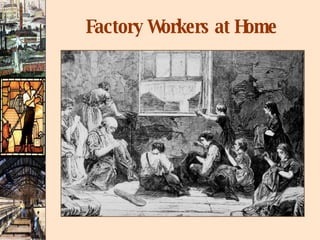
Factory Workers at Home
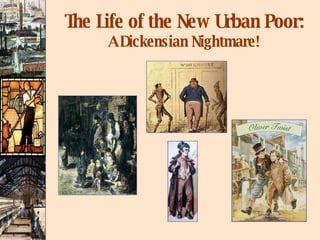
The Life of the New Urban Poor:  A Dickensian Nightmare!
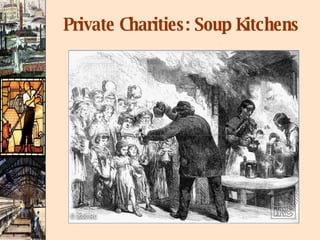
Private Charities: Soup Kitchens
Protests / Reformers
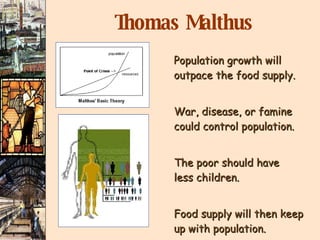
Thomas Malthus Population growth will outpace the food supply. War, disease, or famine could control population. The poor should have  less children. Food supply will then keep up with population.
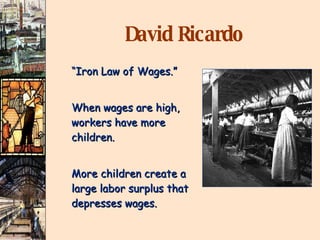
David Ricardo “ Iron Law of Wages.” When wages are high, workers have more children. More children create a large labor surplus that depresses wages.
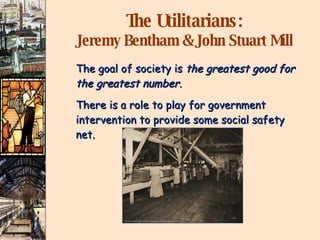
The Utilitarians: Jeremy Bentham & John Stuart Mill The goal of society is  the greatest good for the greatest number. There is a role to play for government  intervention to provide some social safety net.
Charles Dickens Pacifist Socialist Wanted bourgeoisie to work with proletariat to improve living conditions A Christmas Carol –  hard on Scrooge -- symbol of capitalism Bob Cratchit – symbol of the working class Other characters – symbols of the lower working class Ghosts : represent the socialist reformers (different ghosts bring different warnings – from pacifist ones to death itself)
The Socialists:   Utopians & Marxists People as a society would operate and own the means of production, not individuals. Their goal was a society that benefited  everyone, not just a rich, well-connected few. Tried to build perfect communities [ utopias ].
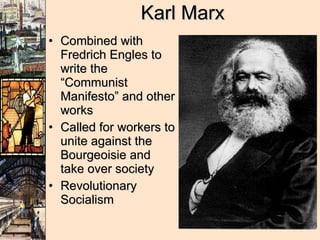
Karl Marx Combined with Fredrich Engles to write the “Communist Manifesto” and other works  Called for workers to unite against the Bourgeoisie and take over society Revolutionary Socialism
Communist Manifesto history was the story of a constant struggle between the classes Marx saw no difference between French workers, German workers and British workers -- runs counter to nationalism Governmental systems were created to serve whatever class was in power – revolutions brought down the old systems Absolutism -- Aristocracy -- French Revolution brought it down Capitalism -- Bourgeoisie Socialism -- Proletariat Communism -- everyone equal Marx saw a series of revolutions as part of the natural order of things.  Europe, according to his model, was perched on the edge of another revolution, one that would bring Socialism and the workers to power. Eventually, socialism would EVOLVE into communism where everyone was equal Under communism -- no private property -- no government -- no class distinctions (has never been achieved)
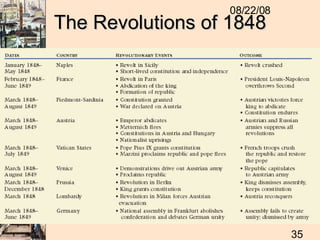
The Revolutions of 1848 06/04/09
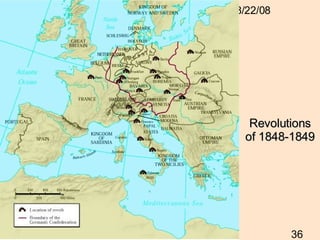
Revolutions of 1848-1849 06/04/09
Revolution of 1848 in France February -- proclamation of Second Republic Bourgeoisie lead revolution against Louis Phillipe and force him to abdicate Reforms promised under the new constitution – and never delivered and the Workers sent into camps to await reforms that will never come June Days Worker counter-revolution against the govt. Brutally repressed by the government Louis Napoleon comes to power as the champion of the Conservatives (Bourgeoisie now fear a socialist revolution)  By 1852 – Louis Napoleon is declared Napoleon III (with absolute power) and the French become an empire again.  Revolution fails – Bourgeoisie will turn to nationalism
Revolutions in Germanic Europe Revolution in Prussia (Berlin) -- Calls come for a united Germany under Bourgeois Leadership Grossdeutsch – large Germany to include Hapsburg empire Kleindeutsch – smaller Germany excludes it Frankfurt Parliament (1848-1849) Write an idealistic constitution unifying Germany Arguments and time worked against them Junkers  (Nobility) – Want unification, but not a Constitutional Monarchy Austria (Hapsburg Lands) Multinational Empire (over 500 yrs old) in an age of nationalism Hungarian nationalism fractures the Empire and shows cracks that will eventually tear the Hapsburg Empire apart Declaration of Hungarian independence encourages Czechs, Croatia, and Transylvania and others.  Revolution collapses when the Russians invade Hungary to help the Austrians (even though the two empires hated each other) put down the revolt.  The Russians don’t want the revolution to spread.
Roman Revolution of 1848 Papal States and Pius IX – absolutely opposed to liberal reforms – He believes that the papacy is God’s mouthpiece Uprisings in Sicily, Venice and Milan  Revolution in Rome to get rid of Pius IX – Pope flees to the safety of a palace outside the city Garibaldi and Mazzini establish Roman republic Short Lived – Napoleon III will send French troops to restore the pope Italy will be united by conservatives (Cavour) and by a war against the Pope – this won’t occur for over another decade (final unification in 1870)
The Results of  Industrialization at the end of the 19c
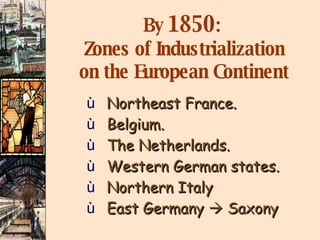
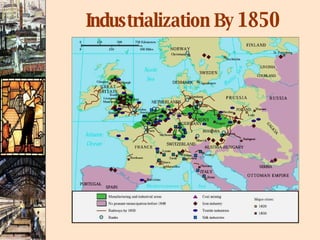
By  1850 :  Zones of Industrialization on the European Continent Northeast France. Belgium. The Netherlands. Western German states. Northern Italy East Germany    Saxony
Industrialization By  1850
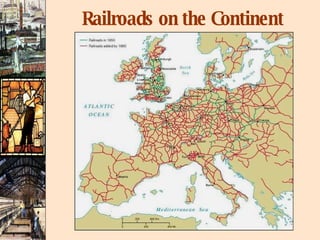
Railroads on the Continent
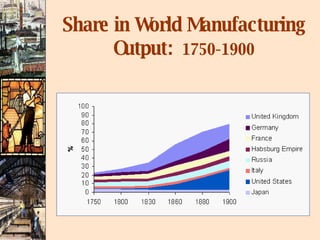
Share in World Manufacturing Output:  1750-1900

World History Unit10 Industrial Revolution

  • 1.
    Unit 10: Industrial Revolution and its effects on Europe
  • 2.
    Before 1820s: Preindustrial Guild System Centered around families and work from home Most people never ventured far from the villages Links to medieval feudal times Domestic system -- system whereby work was done in the home by independent laborers. Example -- wool bought from sheep farmers and given to women working at home. The women would spin it into yarn. The yarn would be taken by the merchant to a weaver (working at his home) who would then weave cloth.
  • 3.
    Why Did IndustrializationBegin in England First?
  • 4.
    Why England? Enclosurelaws -- squeezed the small farmers out. Many of these peasants went to the cities looking for work. Swelling cities produced a ready made base of potential workers Money -- from an aristocracy untouched by the problems of the French Revolution and heavily invested in trade with America and India Coal and iron -- two materials necessary for industrialization -- in easy reach in Britain, especially in the Lancashire District (around Liverpool and Manchester) Ready supply of wool and cotton for the textile mills -- wool from Britain and Ireland -- cotton from American South and Egypt
  • 5.
  • 6.
  • 7.
  • 8.
    Factory Production Concentratesproduction in one place [materials, labor]. Located near sources of power [rather than labor or markets]. Requires a lot of capital investment [factory, machines, etc.] more than skilled labor.
  • 9.
    Textile Factory Workersin England 1813 2400 looms 150, 000 workers 1833 85, 000 looms 200, 000 workers 1850 224, 000 looms >1 million workers
  • 10.
    Cotton is King1793 -- Eli Whitney invents the cotton gin -- soon American cotton exports will be measured not by the pound, but rather by the ton Southern Cotton (and the slavery needed to produce it) will be a key element to Britain’s industrialization
  • 11.
    The Factory SystemRigid schedule. 12-14 hour day. Dangerous conditions. Mind-numbing monotony.
  • 12.
  • 13.
    The "Haves": BourgeoisieAnd the Riches of Capitalism
  • 14.
    19 c Bourgeoisie: The Industrial Nouveau Riche
  • 15.
    Capitalism Based onfactories and production -- looks to make money for those in charge, not the workers -- workers become simply part of the machine Bourgeoisie -- begins to develop a social consciousness -- the class sees itself as in charge of the country Economic personification of classical liberal governmental philosophy Laissez-faire economics -- "hands off" -- no government intervention -- laws of supply and demand will drive economic cycles "invisible hand" -- idea proposed by Adam Smith that competition and free markets will hold prices down and drive the economy In an age of economic growth -- shouldn't the people causing the growth have all the power and say?
  • 16.
    Stereotype of theFactory Owner
  • 17.
  • 18.
  • 19.
    The Proletariat Workingconditions were terrible in the new factories. Workers often worked long shifts 7 days a week No labor laws at the time -- very dangerous and unsanitary conditions Living conditions -- slums -- workers living like animals -- crowded into dirty sections of the city -- malnourished and pitiful Businessmen felt that it was their job to make as much money for themselves and save expenses Workers didn't matter -- (story from the Jungle in class) Some political and philosophical leaders felt that society itself must accept responsibility for the workers Problem -- although the working class lived in misery, their numbers were constantly expanding, not only from more people moving to the cities, but also from the agricultural revolution
  • 20.
  • 21.
  • 22.
    Early-19c London byGustave Dore
  • 23.
  • 24.
  • 25.
    The Life ofthe New Urban Poor: A Dickensian Nightmare!
  • 26.
  • 27.
  • 28.
    Thomas Malthus Populationgrowth will outpace the food supply. War, disease, or famine could control population. The poor should have less children. Food supply will then keep up with population.
  • 29.
    David Ricardo “Iron Law of Wages.” When wages are high, workers have more children. More children create a large labor surplus that depresses wages.
  • 30.
    The Utilitarians: JeremyBentham & John Stuart Mill The goal of society is the greatest good for the greatest number. There is a role to play for government intervention to provide some social safety net.
  • 31.
    Charles Dickens PacifistSocialist Wanted bourgeoisie to work with proletariat to improve living conditions A Christmas Carol – hard on Scrooge -- symbol of capitalism Bob Cratchit – symbol of the working class Other characters – symbols of the lower working class Ghosts : represent the socialist reformers (different ghosts bring different warnings – from pacifist ones to death itself)
  • 32.
    The Socialists: Utopians & Marxists People as a society would operate and own the means of production, not individuals. Their goal was a society that benefited everyone, not just a rich, well-connected few. Tried to build perfect communities [ utopias ].
  • 33.
    Karl Marx Combinedwith Fredrich Engles to write the “Communist Manifesto” and other works Called for workers to unite against the Bourgeoisie and take over society Revolutionary Socialism
  • 34.
    Communist Manifesto historywas the story of a constant struggle between the classes Marx saw no difference between French workers, German workers and British workers -- runs counter to nationalism Governmental systems were created to serve whatever class was in power – revolutions brought down the old systems Absolutism -- Aristocracy -- French Revolution brought it down Capitalism -- Bourgeoisie Socialism -- Proletariat Communism -- everyone equal Marx saw a series of revolutions as part of the natural order of things. Europe, according to his model, was perched on the edge of another revolution, one that would bring Socialism and the workers to power. Eventually, socialism would EVOLVE into communism where everyone was equal Under communism -- no private property -- no government -- no class distinctions (has never been achieved)
  • 35.
    The Revolutions of1848 06/04/09
  • 36.
  • 37.
    Revolution of 1848in France February -- proclamation of Second Republic Bourgeoisie lead revolution against Louis Phillipe and force him to abdicate Reforms promised under the new constitution – and never delivered and the Workers sent into camps to await reforms that will never come June Days Worker counter-revolution against the govt. Brutally repressed by the government Louis Napoleon comes to power as the champion of the Conservatives (Bourgeoisie now fear a socialist revolution) By 1852 – Louis Napoleon is declared Napoleon III (with absolute power) and the French become an empire again. Revolution fails – Bourgeoisie will turn to nationalism
  • 38.
    Revolutions in GermanicEurope Revolution in Prussia (Berlin) -- Calls come for a united Germany under Bourgeois Leadership Grossdeutsch – large Germany to include Hapsburg empire Kleindeutsch – smaller Germany excludes it Frankfurt Parliament (1848-1849) Write an idealistic constitution unifying Germany Arguments and time worked against them Junkers (Nobility) – Want unification, but not a Constitutional Monarchy Austria (Hapsburg Lands) Multinational Empire (over 500 yrs old) in an age of nationalism Hungarian nationalism fractures the Empire and shows cracks that will eventually tear the Hapsburg Empire apart Declaration of Hungarian independence encourages Czechs, Croatia, and Transylvania and others. Revolution collapses when the Russians invade Hungary to help the Austrians (even though the two empires hated each other) put down the revolt. The Russians don’t want the revolution to spread.
  • 39.
    Roman Revolution of1848 Papal States and Pius IX – absolutely opposed to liberal reforms – He believes that the papacy is God’s mouthpiece Uprisings in Sicily, Venice and Milan Revolution in Rome to get rid of Pius IX – Pope flees to the safety of a palace outside the city Garibaldi and Mazzini establish Roman republic Short Lived – Napoleon III will send French troops to restore the pope Italy will be united by conservatives (Cavour) and by a war against the Pope – this won’t occur for over another decade (final unification in 1870)
  • 40.
    The Results of Industrialization at the end of the 19c
  • 41.
    By 1850: Zones of Industrialization on the European Continent Northeast France. Belgium. The Netherlands. Western German states. Northern Italy East Germany  Saxony
  • 42.
  • 43.
  • 44.
    Share in WorldManufacturing Output: 1750-1900