Ch. 3 Section 1
Europeans were exposed to other 
lands before the 1400’s but for the 
most part were not interested in 
exploration.
the Crusades in the 
Holy Lands in the 
1100’s and the Italian 
trader Marco Polo 
reached the court of 
Kublai Khan in 
China. This all 
changed in the early 
1400’s with 
Europeans’ desire to 
spread Christianity, 
gain wealth from 
trade combined with 
new sailing 
technology spurred 
an age of European 
exploration.
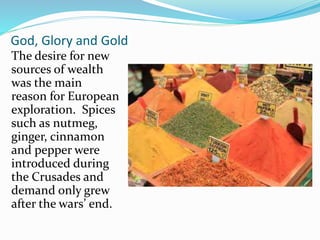
God, Glory and Gold 
The desire for new 
sources of wealth 
was the main 
reason for European 
exploration. Spices 
such as nutmeg, 
ginger, cinnamon 
and pepper were 
introduced during 
the Crusades and 
demand only grew 
after the wars’ end.
The Muslims and Italians controlled 
the trade of goods from East to West. 
Muslims sold Asian goods to Italian 
merchants, who controlled trade 
across the land routes of the 
Mediterranean region.
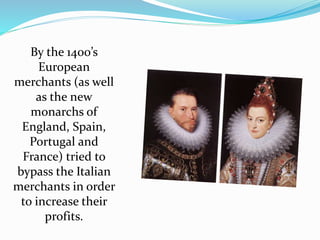
By the 1400’s 
European 
merchants (as well 
as the new 
monarchs of 
England, Spain, 
Portugal and 
France) tried to 
bypass the Italian 
merchants in order 
to increase their 
profits.
 The desire to spread Christianity 
also fueled European exploration. 
The Crusades left hostilities 
between Christians and Muslims. 
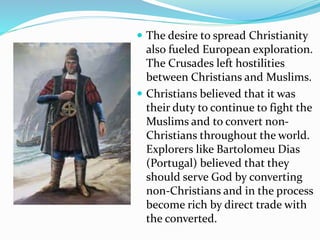
 Christians believed that it was 
their duty to continue to fight the 
Muslims and to convert non- 
Christians throughout the world. 
Explorers like Bartolomeu Dias 
(Portugal) believed that they 
should serve God by converting 
non-Christians and in the process 
become rich by direct trade with 
the converted.
Technology 
Technological advances enabled the 
explorers to pursue their goals of “God, 
glory and gold.” Before the 1400’s, ships 
could not sail against the wind, making 
long trans-oceanic voyages nearly 
impossible.
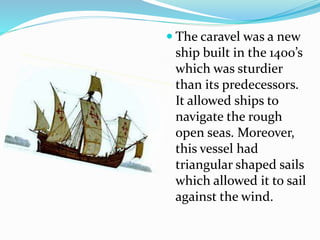
 The caravel was a new 
ship built in the 1400’s 
which was sturdier 
than its predecessors. 
It allowed ships to 
navigate the rough 
open seas. Moreover, 
this vessel had 
triangular shaped sails 
which allowed it to sail 
against the wind.
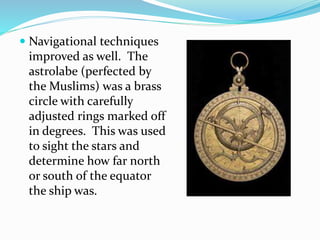
 Navigational techniques 
improved as well. The 
astrolabe (perfected by 
the Muslims) was a brass 
circle with carefully 
adjusted rings marked off 
in degrees. This was used 
to sight the stars and 
determine how far north 
or south of the equator 
the ship was.
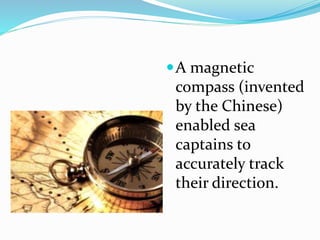
A magnetic 
compass (invented 
by the Chinese) 
enabled sea 
captains to 
accurately track 
their direction.

3.1 europeans explore the east

  • 1.
  • 2.
    Europeans were exposedto other lands before the 1400’s but for the most part were not interested in exploration.
  • 3.
    the Crusades inthe Holy Lands in the 1100’s and the Italian trader Marco Polo reached the court of Kublai Khan in China. This all changed in the early 1400’s with Europeans’ desire to spread Christianity, gain wealth from trade combined with new sailing technology spurred an age of European exploration.
  • 4.
    God, Glory andGold The desire for new sources of wealth was the main reason for European exploration. Spices such as nutmeg, ginger, cinnamon and pepper were introduced during the Crusades and demand only grew after the wars’ end.
  • 5.
    The Muslims andItalians controlled the trade of goods from East to West. Muslims sold Asian goods to Italian merchants, who controlled trade across the land routes of the Mediterranean region.
  • 6.
    By the 1400’s European merchants (as well as the new monarchs of England, Spain, Portugal and France) tried to bypass the Italian merchants in order to increase their profits.
  • 7.
     The desireto spread Christianity also fueled European exploration. The Crusades left hostilities between Christians and Muslims.  Christians believed that it was their duty to continue to fight the Muslims and to convert non- Christians throughout the world. Explorers like Bartolomeu Dias (Portugal) believed that they should serve God by converting non-Christians and in the process become rich by direct trade with the converted.
  • 8.
    Technology Technological advancesenabled the explorers to pursue their goals of “God, glory and gold.” Before the 1400’s, ships could not sail against the wind, making long trans-oceanic voyages nearly impossible.
  • 9.
     The caravelwas a new ship built in the 1400’s which was sturdier than its predecessors. It allowed ships to navigate the rough open seas. Moreover, this vessel had triangular shaped sails which allowed it to sail against the wind.
  • 10.
     Navigational techniques improved as well. The astrolabe (perfected by the Muslims) was a brass circle with carefully adjusted rings marked off in degrees. This was used to sight the stars and determine how far north or south of the equator the ship was.
  • 11.
    A magnetic compass(invented by the Chinese) enabled sea captains to accurately track their direction.