Why Did Industrialization Begin in  England First?
How it Began? The Continental movement and the  British Agricultural Revolution  made  food production more efficient and less labor-intensive,  encouraging the surplus population who could no longer find employment in  agriculture  into  cottage industry , for example  weaving , and in the longer term into the cities and the newly-developed  factories .  The  colonial expansion  of the 17th century with the accompanying development of international  trade , creation of  financial markets  and accumulation of  capital  are also cited as factors.
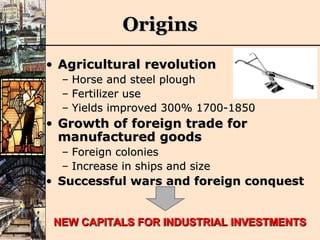
Origins Agricultural revolution Horse and steel plough Fertilizer use Yields improved 300% 1700-1850 Growth of foreign trade for manufactured goods Foreign colonies Increase in ships and size Successful wars and foreign conquest NEW CAPITALS FOR INDUSTRIAL INVESTMENTS
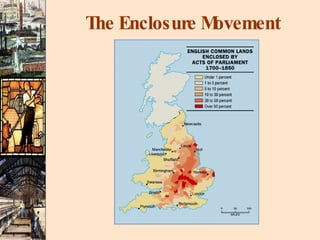
The Enclosure Movement
“ Enclosed” Lands Today
Origins – Why England? Factors in England No civil strife Government favored trade Laissez faire Large middle class Island geography Mobile population  Everyone lived within 20 miles of navigable river Tradition of experimental science Weak guilds
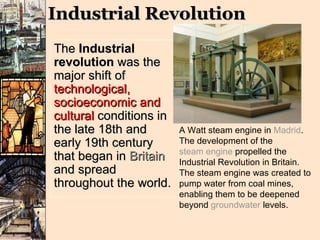
Industrial Revolution The  Industrial revolution  was the major shift of  technological, socioeconomic and cultural  conditions in the late 18th and early 19th century that began in  Britain  and spread throughout the world.  A Watt steam engine in  Madrid . The development of the  steam engine  propelled the Industrial Revolution in Britain. The steam engine was created to pump water from coal mines, enabling them to be deepened beyond  groundwater  levels.
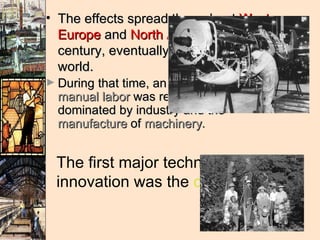
The effects spread throughout  Western Europe  and  North America  during the 19th century, eventually affecting most of the world.  During that time, an  economy  based on  manual labor  was replaced by one dominated by industry and the  manufacture  of  machinery .  The first major technological innovation was the  cotton gin .
New Inventions of the Industrial Revolution
While the  spinning jenny  is frequently pointed to as the first, major technological innovation of the industrial revolution, the  i nvention  that really drove the revolution in the eighteenth century was invented several decades earlier:  the STEAM ENGINE .  Along with the growth in the cotton industry, the steel industry began to grow by leaps and bounds. This was largely due to a quirk in English geography: England sits on vast quantities of coal, a carbon based mineral derived from ancient life forms.   
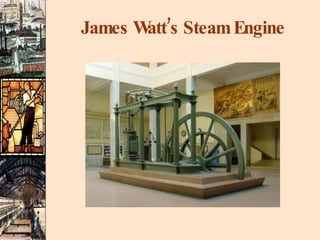
James Watt’s Steam Engine
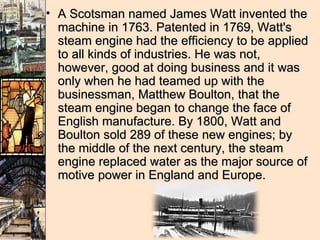
A Scotsman named James Watt invented the machine in 1763. Patented in 1769, Watt's steam engine had the efficiency to be applied to all kinds of industries. He was not, however, good at doing business and it was only when he had teamed up with the businessman, Matthew Boulton, that the steam engine began to change the face of English manufacture. By 1800, Watt and Boulton sold 289 of these new engines; by the middle of the next century, the steam engine replaced water as the major source of motive power in England and Europe.
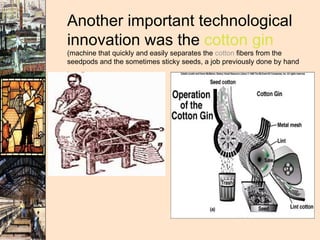
Another important technological innovation was the  cotton gin  (machine that quickly and easily separates the  cotton  fibers from the seedpods and the sometimes sticky seeds, a job previously done by hand .
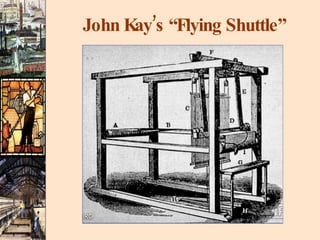
John Kay’s “Flying Shuttle”
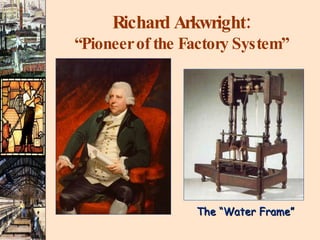
Richard Arkwright: “Pioneer of the Factory System” The “Water Frame”
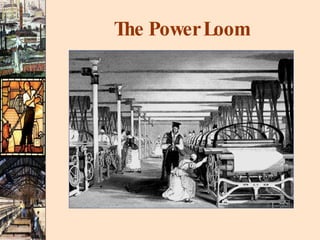
The Power Loom
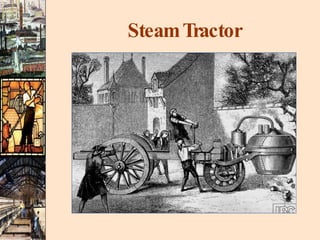
Steam Tractor
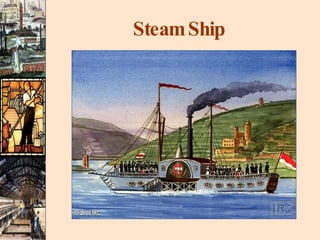
Steam Ship
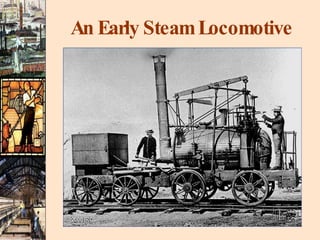
An Early Steam Locomotive
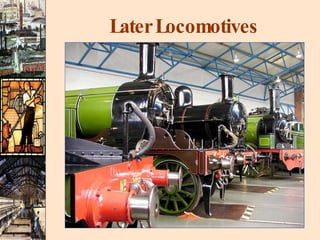
Later Locomotives
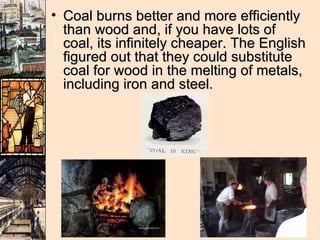
Coal burns better and more efficiently than wood and, if you have lots of coal, its infinitely cheaper. The English figured out that they could substitute coal for wood in the melting of metals, including iron and steel.
Industrial England: "Workshop of the World" That Nation of Shopkeepers!     -- Napoleon Bonaparte
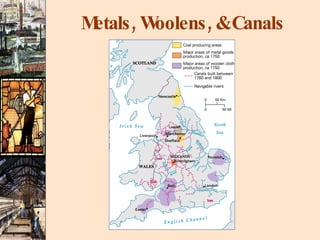
Metals, Woolens, & Canals
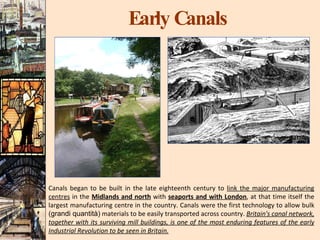
Early Canals Canals began to be built in the late eighteenth century to  link the major manufacturing centres  in the  Midlands and north  with  seaports and with London , at that time itself the largest manufacturing centre in the country. Canals were the first technology to allow bulk  (grandi quantità)  materials to be easily transported across country.  Britain's canal network, together with its surviving mill buildings, is one of the most enduring features of the early Industrial Revolution to be seen in Britain.
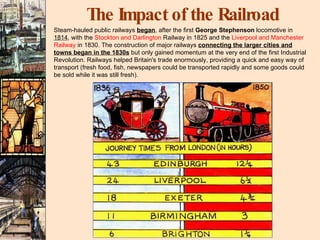
The Impact of the Railroad Steam-hauled public railways  began , after the first  George Stephenson  locomotive in  1814 , with the  Stockton and Darlington  Railway in 1825 and the  Liverpool and Manchester Railway  in 1830. The construction of major railways  connecting the larger cities and towns began in the 1830s  but only gained momentum at the very end of the first Industrial Revolution. Railways helped Britain's trade enormously, providing a quick and easy way of transport (fresh food, fish, newspapers could be transported rapidly and some goods could be sold while it was still fresh).
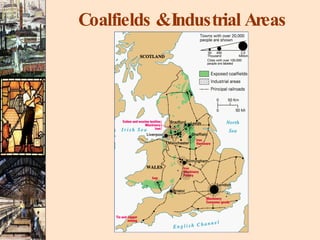
Coalfields & Industrial Areas
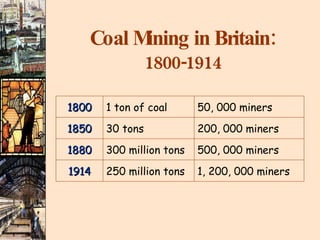
Coal Mining in Britain: 1800-1914 1800 1 ton of coal 50, 000 miners 1850 30 tons 200, 000 miners 1880 300 million tons 500, 000 miners 1914 250 million tons 1, 200, 000 miners
Factory Production Concentrates production in one place [materials, labor]. Located near sources of power  [rather than labor or markets]. Requires a lot of capital investment [factory, machines, etc.] more than skilled labor. Only 10% of English industry in  1850.
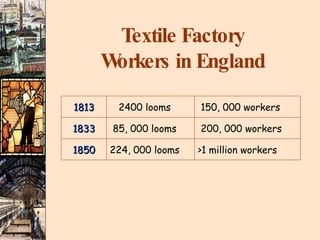
Textile Factory Workers in England 1813 2400 looms 150, 000 workers 1833 85, 000 looms 200, 000 workers 1850 224, 000 looms >1 million workers
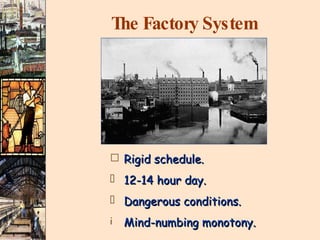
The Factory System Rigid schedule. 12-14 hour day. Dangerous conditions. Mind-numbing monotony.
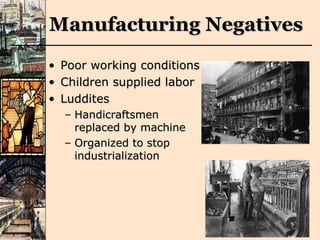
Manufacturing Negatives Poor working conditions Children supplied labor Luddites Handicraftsmen replaced by machine Organized to stop industrialization
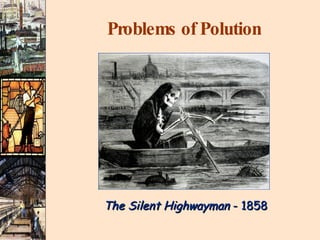
Problems of Polution The Silent Highwayman  - 1858
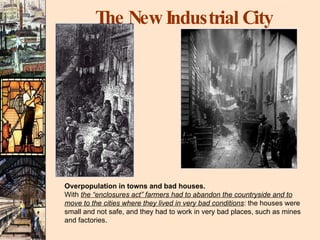
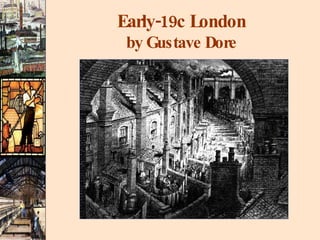
The New Industrial City Overpopulation in towns and bad houses. With  the “enclosures act” farmers had to abandon the countryside and to move to the cities where they lived in very bad conditions : the houses were small and not safe, and they had to work in very bad places, such as mines and factories.
Early-19c London by Gustave Dore
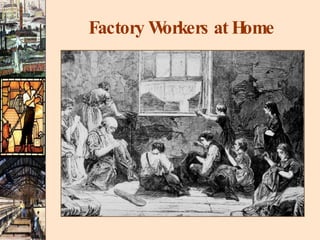
Factory Workers at Home
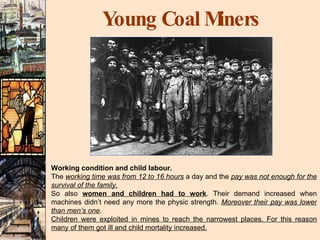
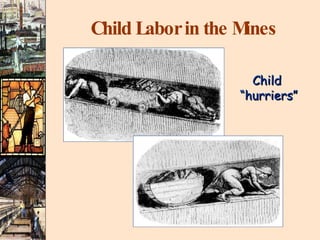
Young Coal Miners Working condition and child labour. The  working time was from 12 to 16 hours  a day and the  pay was not enough for the survival of the family. So also  women and children had to work . Their demand increased when machines didn’t need any more the physic strength.  Moreover their pay was lower than men’s one . Children were exploited in mines to reach the narrowest places. For this reason many of them got ill and child mortality increased.
Child Labor in the Mines Child  “hurriers”
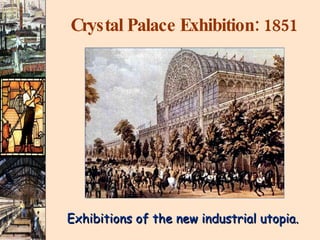
Crystal Palace Exhibition: 1851 Exhibitions of the new industrial utopia.
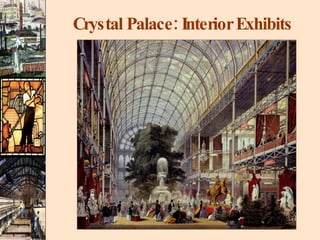
Crystal Palace: Interior Exhibits
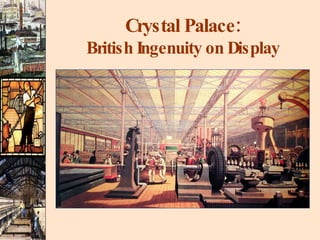
Crystal Palace: British Ingenuity on Display
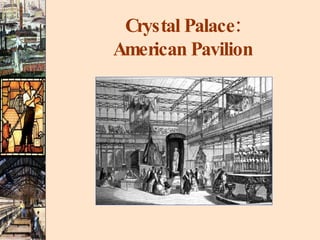
Crystal Palace: American Pavilion
The "Haves": Bourgeois Life Thrived on the Luxuries of the Industrial Revolution
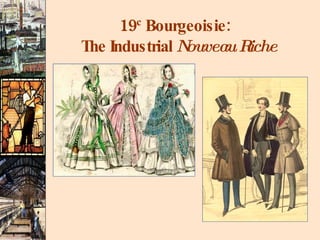
19 c  Bourgeoisie:  The Industrial  Nouveau Riche
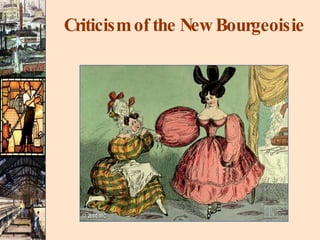
Criticism of the New Bourgeoisie
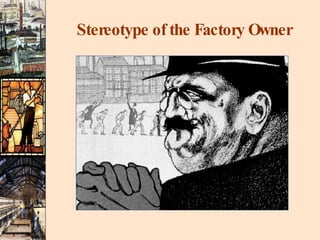
Stereotype of the Factory Owner
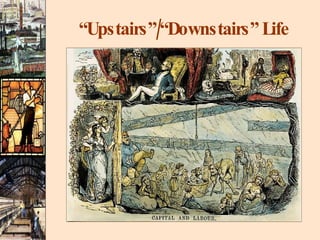
“ Upstairs”/“Downstairs” Life
The "Have-Nots": The Poor, The Over-Worked, & the Destitute
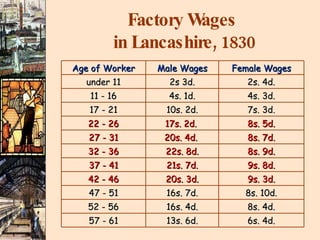
Factory Wages  in Lancashire, 1830 Age of Worker Male Wages Female Wages under 11 2s 3d. 2s. 4d. 11 - 16 4s. 1d. 4s. 3d. 17 - 21 10s. 2d. 7s. 3d. 22 - 26 17s. 2d.  8s. 5d. 27 - 31 20s. 4d.  8s. 7d. 32 - 36 22s. 8d. 8s. 9d. 37 - 41 21s. 7d. 9s. 8d. 42 - 46 20s. 3d. 9s. 3d. 47 - 51 16s. 7d. 8s. 10d. 52 - 56 16s. 4d. 8s. 4d. 57 - 61 13s. 6d. 6s. 4d.
Private Charities: Soup Kitchens
Protests / Reformers
The Luddites:  1811-1816   Ned Ludd  [a mythical figure supposed to live in Sherwood Forest] The introduction of machines caused the unemployment of many craftsmen and weavers  who could  no longer complete  with features that required  time to produce more products and cloth than them. So the  unemployed workers began destroying features and machines that had token their job . These attackers became known as  Luddites , supposedly followers of  Ned Ludd , a folklore figure. The first attack wan in 1811.
The Luddites
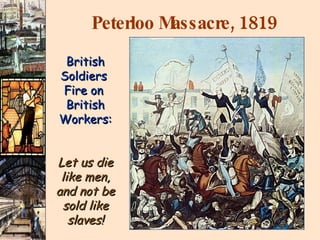
British Soldiers  Fire on  British Workers: Let us die like men, and not be sold like slaves! Peterloo Massacre,  1819
The Socialists:   Utopians & Marxists People as a society would operate and own the means of production, not individuals. Their goal was a society that benefited  everyone, not just a rich, well-connected few. Tried to build perfect communities [ utopias ].
The Results of  Industrialization at the end of the 19c
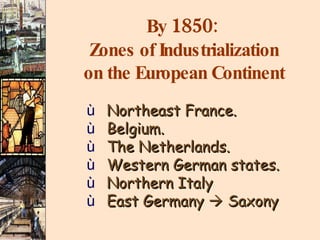
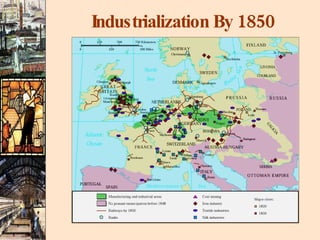
By  1850 :  Zones of Industrialization on the European Continent Northeast France. Belgium. The Netherlands. Western German states. Northern Italy East Germany    Saxony
Industrialization By  1850
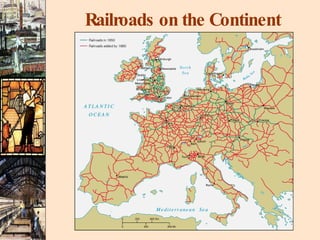
Railroads on the Continent
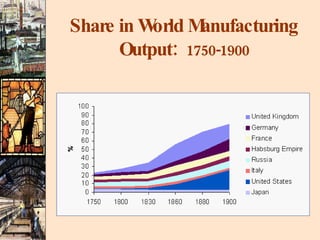
Share in World Manufacturing Output:  1750-1900
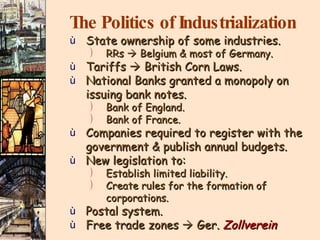
The Politics of Industrialization State ownership of some industries. RRs    Belgium & most of Germany. Tariffs    British Corn Laws. National Banks granted a monopoly on  issuing bank notes. Bank of England. Bank of France. Companies required to register with the government & publish annual budgets. New legislation to: Establish limited liability. Create rules for the formation of corporations. Postal system. Free trade zones    Ger.  Zollverein

The Industrial Revolution Presentation

  • 1.
  • 2.
    Why Did IndustrializationBegin in England First?
  • 3.
    How it Began?The Continental movement and the British Agricultural Revolution made food production more efficient and less labor-intensive, encouraging the surplus population who could no longer find employment in agriculture into cottage industry , for example weaving , and in the longer term into the cities and the newly-developed factories . The colonial expansion of the 17th century with the accompanying development of international trade , creation of financial markets and accumulation of capital are also cited as factors.
  • 4.
    Origins Agricultural revolutionHorse and steel plough Fertilizer use Yields improved 300% 1700-1850 Growth of foreign trade for manufactured goods Foreign colonies Increase in ships and size Successful wars and foreign conquest NEW CAPITALS FOR INDUSTRIAL INVESTMENTS
  • 5.
  • 6.
  • 7.
    Origins – WhyEngland? Factors in England No civil strife Government favored trade Laissez faire Large middle class Island geography Mobile population Everyone lived within 20 miles of navigable river Tradition of experimental science Weak guilds
  • 8.
    Industrial Revolution The Industrial revolution was the major shift of technological, socioeconomic and cultural conditions in the late 18th and early 19th century that began in Britain and spread throughout the world. A Watt steam engine in Madrid . The development of the steam engine propelled the Industrial Revolution in Britain. The steam engine was created to pump water from coal mines, enabling them to be deepened beyond groundwater levels.
  • 9.
    The effects spreadthroughout Western Europe and North America during the 19th century, eventually affecting most of the world. During that time, an economy based on manual labor was replaced by one dominated by industry and the manufacture of machinery . The first major technological innovation was the cotton gin .
  • 10.
    New Inventions ofthe Industrial Revolution
  • 11.
    While the spinning jenny is frequently pointed to as the first, major technological innovation of the industrial revolution, the i nvention that really drove the revolution in the eighteenth century was invented several decades earlier: the STEAM ENGINE . Along with the growth in the cotton industry, the steel industry began to grow by leaps and bounds. This was largely due to a quirk in English geography: England sits on vast quantities of coal, a carbon based mineral derived from ancient life forms.  
  • 12.
  • 13.
    A Scotsman namedJames Watt invented the machine in 1763. Patented in 1769, Watt's steam engine had the efficiency to be applied to all kinds of industries. He was not, however, good at doing business and it was only when he had teamed up with the businessman, Matthew Boulton, that the steam engine began to change the face of English manufacture. By 1800, Watt and Boulton sold 289 of these new engines; by the middle of the next century, the steam engine replaced water as the major source of motive power in England and Europe.
  • 14.
    Another important technologicalinnovation was the cotton gin (machine that quickly and easily separates the  cotton  fibers from the seedpods and the sometimes sticky seeds, a job previously done by hand .
  • 15.
  • 16.
    Richard Arkwright: “Pioneerof the Factory System” The “Water Frame”
  • 17.
  • 18.
  • 19.
  • 20.
    An Early SteamLocomotive
  • 21.
  • 22.
    Coal burns betterand more efficiently than wood and, if you have lots of coal, its infinitely cheaper. The English figured out that they could substitute coal for wood in the melting of metals, including iron and steel.
  • 23.
    Industrial England: "Workshopof the World" That Nation of Shopkeepers! -- Napoleon Bonaparte
  • 24.
  • 25.
    Early Canals Canalsbegan to be built in the late eighteenth century to link the major manufacturing centres in the Midlands and north with seaports and with London , at that time itself the largest manufacturing centre in the country. Canals were the first technology to allow bulk (grandi quantità) materials to be easily transported across country. Britain's canal network, together with its surviving mill buildings, is one of the most enduring features of the early Industrial Revolution to be seen in Britain.
  • 26.
    The Impact ofthe Railroad Steam-hauled public railways began , after the first George Stephenson locomotive in 1814 , with the Stockton and Darlington Railway in 1825 and the Liverpool and Manchester Railway in 1830. The construction of major railways connecting the larger cities and towns began in the 1830s but only gained momentum at the very end of the first Industrial Revolution. Railways helped Britain's trade enormously, providing a quick and easy way of transport (fresh food, fish, newspapers could be transported rapidly and some goods could be sold while it was still fresh).
  • 27.
  • 28.
    Coal Mining inBritain: 1800-1914 1800 1 ton of coal 50, 000 miners 1850 30 tons 200, 000 miners 1880 300 million tons 500, 000 miners 1914 250 million tons 1, 200, 000 miners
  • 29.
    Factory Production Concentratesproduction in one place [materials, labor]. Located near sources of power [rather than labor or markets]. Requires a lot of capital investment [factory, machines, etc.] more than skilled labor. Only 10% of English industry in 1850.
  • 30.
    Textile Factory Workersin England 1813 2400 looms 150, 000 workers 1833 85, 000 looms 200, 000 workers 1850 224, 000 looms >1 million workers
  • 31.
    The Factory SystemRigid schedule. 12-14 hour day. Dangerous conditions. Mind-numbing monotony.
  • 32.
    Manufacturing Negatives Poorworking conditions Children supplied labor Luddites Handicraftsmen replaced by machine Organized to stop industrialization
  • 33.
    Problems of PolutionThe Silent Highwayman - 1858
  • 34.
    The New IndustrialCity Overpopulation in towns and bad houses. With the “enclosures act” farmers had to abandon the countryside and to move to the cities where they lived in very bad conditions : the houses were small and not safe, and they had to work in very bad places, such as mines and factories.
  • 35.
    Early-19c London byGustave Dore
  • 36.
  • 37.
    Young Coal MinersWorking condition and child labour. The working time was from 12 to 16 hours a day and the pay was not enough for the survival of the family. So also women and children had to work . Their demand increased when machines didn’t need any more the physic strength. Moreover their pay was lower than men’s one . Children were exploited in mines to reach the narrowest places. For this reason many of them got ill and child mortality increased.
  • 38.
    Child Labor inthe Mines Child “hurriers”
  • 39.
    Crystal Palace Exhibition:1851 Exhibitions of the new industrial utopia.
  • 40.
  • 41.
    Crystal Palace: BritishIngenuity on Display
  • 42.
  • 43.
    The "Haves": BourgeoisLife Thrived on the Luxuries of the Industrial Revolution
  • 44.
    19 c Bourgeoisie: The Industrial Nouveau Riche
  • 45.
    Criticism of theNew Bourgeoisie
  • 46.
    Stereotype of theFactory Owner
  • 47.
  • 48.
    The "Have-Nots": ThePoor, The Over-Worked, & the Destitute
  • 49.
    Factory Wages in Lancashire, 1830 Age of Worker Male Wages Female Wages under 11 2s 3d. 2s. 4d. 11 - 16 4s. 1d. 4s. 3d. 17 - 21 10s. 2d. 7s. 3d. 22 - 26 17s. 2d. 8s. 5d. 27 - 31 20s. 4d. 8s. 7d. 32 - 36 22s. 8d. 8s. 9d. 37 - 41 21s. 7d. 9s. 8d. 42 - 46 20s. 3d. 9s. 3d. 47 - 51 16s. 7d. 8s. 10d. 52 - 56 16s. 4d. 8s. 4d. 57 - 61 13s. 6d. 6s. 4d.
  • 50.
  • 51.
  • 52.
    The Luddites: 1811-1816 Ned Ludd [a mythical figure supposed to live in Sherwood Forest] The introduction of machines caused the unemployment of many craftsmen and weavers who could no longer complete with features that required time to produce more products and cloth than them. So the unemployed workers began destroying features and machines that had token their job . These attackers became known as Luddites , supposedly followers of Ned Ludd , a folklore figure. The first attack wan in 1811.
  • 53.
  • 54.
    British Soldiers Fire on British Workers: Let us die like men, and not be sold like slaves! Peterloo Massacre, 1819
  • 55.
    The Socialists: Utopians & Marxists People as a society would operate and own the means of production, not individuals. Their goal was a society that benefited everyone, not just a rich, well-connected few. Tried to build perfect communities [ utopias ].
  • 56.
    The Results of Industrialization at the end of the 19c
  • 57.
    By 1850: Zones of Industrialization on the European Continent Northeast France. Belgium. The Netherlands. Western German states. Northern Italy East Germany  Saxony
  • 58.
  • 59.
  • 60.
    Share in WorldManufacturing Output: 1750-1900
  • 61.
    The Politics ofIndustrialization State ownership of some industries. RRs  Belgium & most of Germany. Tariffs  British Corn Laws. National Banks granted a monopoly on issuing bank notes. Bank of England. Bank of France. Companies required to register with the government & publish annual budgets. New legislation to: Establish limited liability. Create rules for the formation of corporations. Postal system. Free trade zones  Ger. Zollverein