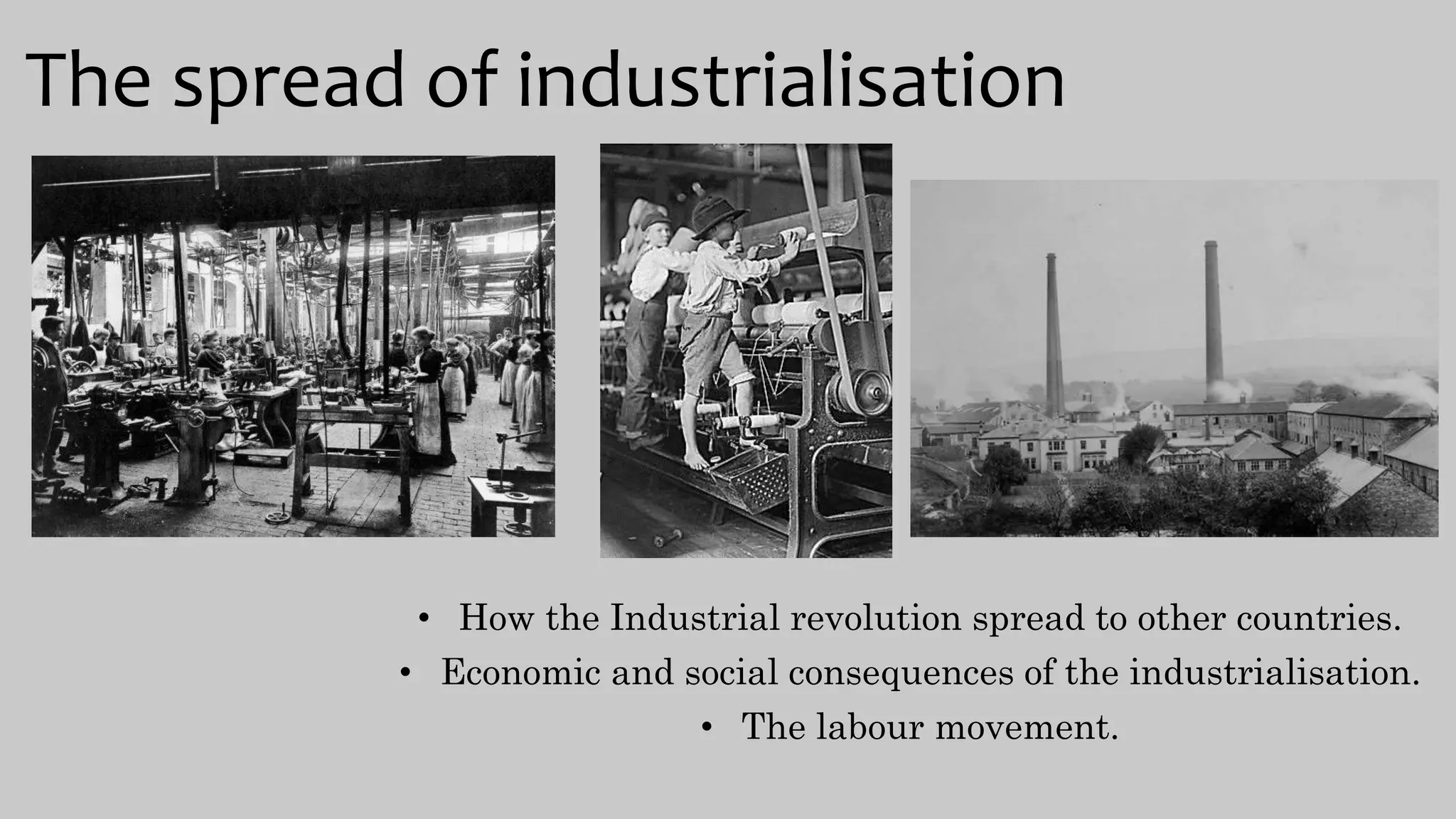
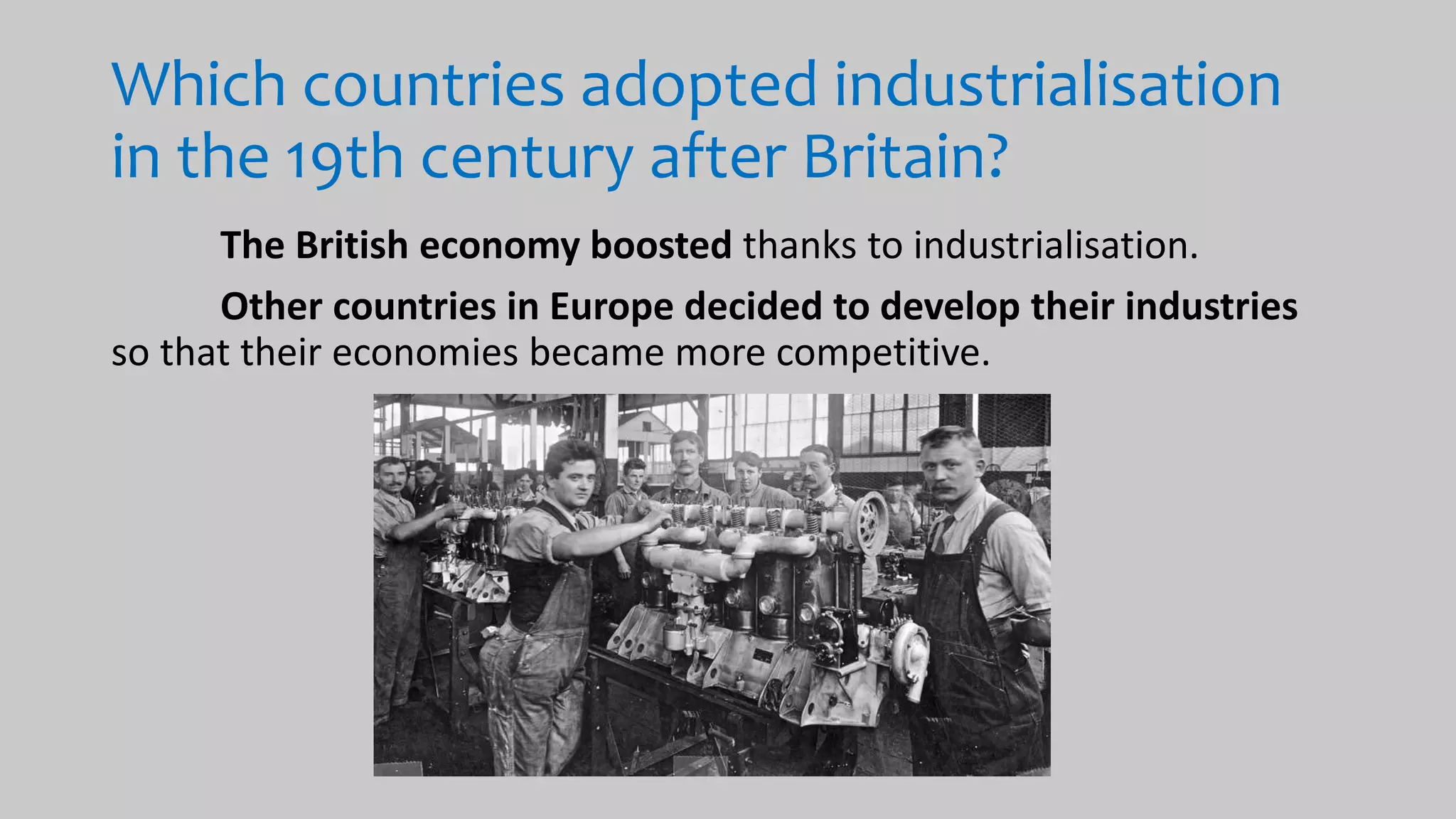
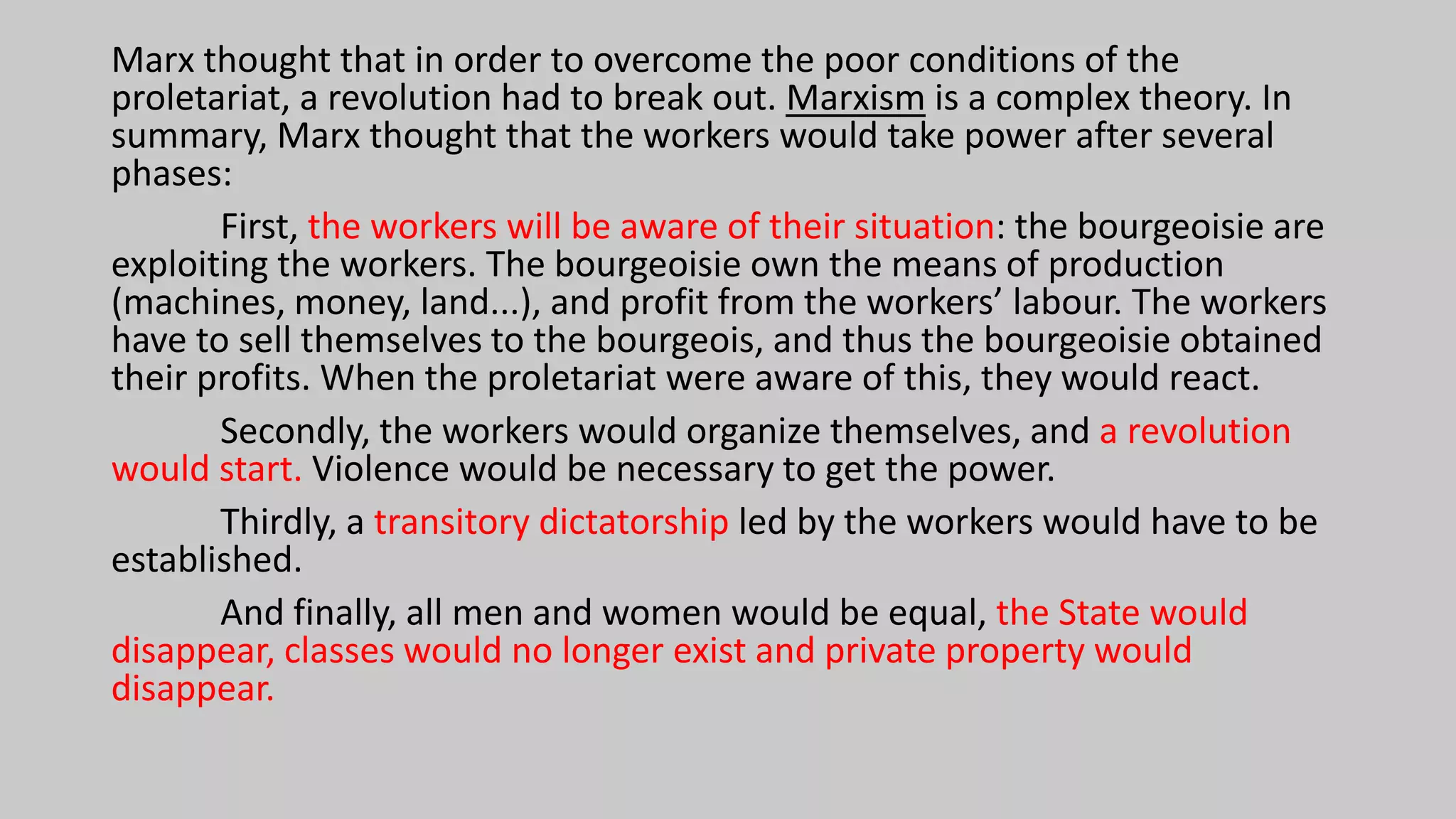
The spread of industrialisation
• How the Industrial revolution spread to other countries.
• Economic and social consequences of the industrialisation.
• The labour movement.
Which countries adopted industrialisation
in the 19th century after Britain?
The British economy boosted thanks to industrialisation.
Other countries in Europe decided to develop their industries
so that their economies became more competitive.
Europe
In France, textile industries were located in the North.
After its independence, Belgium experienced a rapid industrial growth thanks to
the abundance of coal, thus permitting the opening of textile and metallurgy
industries.
Switzerland developed important high-precision machines industries (watches) and
other luxury products.
Germany had abundant coal resources to the West of the country (Ruhr). Industries
appeared also in the East (Saxony and Silesia) especially after the unification.
Other countries in Europe commenced their industrialisation at the end of the 19th
century, but did not develop a very strong industry (Russia, Spain, Italy, Austria-
Hungary, etc.)
The United States
The US had vast areas for growing cotton in the South,
abundance of minerals and a high demand thanks to the immigration.
The main industries were located in the North East.
Japan
Japan began its industrialisation in 1868 during the Meiji period
when the country definetely abandoned the feudal system.
These two countries started their industrialisation later, but it
was very fast. By the end of the 19th century, the US had surpassed
the British economy.
Consequences of the industrial revolution
Trade developed tremendously:
Thanks to the development of railways and steamboats:
- Raw materials were imported from all over the world into
Europe.
- Internal demand was satisfied more quickly.
- Final products were shipped and exported all over the world.
More sales, more money! More money, the economy boosted!
And profits were reinvested in creating more
industries, because the demand increased all
the time. This made the economy grow and
grow!
In order to create a large industry, a lot of money
was needed. The first modern companies appeared
Usually, one person did not have enough money to buy the
machines and buildings that were needed to open a large factory.
In order to obtain the investments, two different types of
companies appeared:
Limited partnerships
Limited companies
partners provided capital
others administered it
capital was divided into shares
profit and risk was divided according to
the number of shares
What is a share?
A share is each of the equal parts into which the capital stock of a
company is divided.
Shares were bought and sold in the stock markets
(or stock exchange)
Old London stock exchange building
Banks kept the deposits of their clients, and lend the
money to other people (sometimes to open new
businesses). This also helped the economy grow!
Old bank notes
Industrialisation created a new economic
system: capitalism
What is capitalism?
An economic system in which the means of
production (land, machines, buildings,
money, etc.) and distribution are privately or
corporately owned (owned by a company)
and economic development occurs thanks to
the accumulation and reinvestment of profits
gained in a free market.
Yes!
Free trade!
What were the social consequences of the
industrial revolution? The class system
With the industrial revolution the position of each individual in the
society depended on wealth, not birth as in the Old Regime.
The nobility did not disappear, but they lost their privileges. Many kept
being very rich though, and even opened their own businesses.
The bourgeoisie rose as a social group.
And the industrial workers (proletariat) appeared as a new social class.
Peasants continued to be numerous, but not as numerous as in the
past.
The rise of the bourgeoisie
During the Industrial revolution, the bourgeoisie became the successful
social group. Its members:
Gained political power.
Became wealthy in most cases.
Were well educated because most of their members
attended secondary school and some universities.
Shared certain values, including: family, work, success and
politeness.
The bourgeoisie was divided into two groups:
a) Upper industrial and
commercial
bourgeoisie: they
controlled large
businesses (banks,
insurance companies...)
and large industries.
- They lived in large
houses in the best
neighbourhoods, and
led a life of luxury and
comfort.
An upper bourgeois house in the 19th century
looked like this
b) Middle class (or petite bourgeoisie): small merchants,
shop owners, civil servants, doctors, journalists,
teachers...
Members of the bourgeoisie lived in neighbourhoods far
from industries, with wide avenues, parks, lighting,
cafés, shops, theatres, etc.
The Opera in Paris
And what about the proletariat, the industrial
workers?
Many people became unemployed after the agricultural revolution,
because they were no longer needed in the fields. They migrated to the
cities, where new jobs in the industries were being offered.
Their working conditions were horrible:
• They lived in slums (areas near the factories with muddy streets, and
houses with no heating or running water) or near the ports.
• They worked very long hours (about 12, and even 16 hours every day).
• They received a very low salary which wasn’t enough to lead a decent life.
• They had no holidays, pension, medical insurance or unemployment
benefits.
• They could not go on strike. It was illegal by law.
• They could be fired easily. Unemployment was high.
• They breathed the smokes coming from the factories, and their jobs were
very unsafe because of the machines they had to manipulate.
• They did very repetitive tasks which alienated them as human beings.
Slums in the
industrial revolution
Unfortunately, it was
legal for children to work
Children were
frequently hit, and
forced to do some
of the worst jobs
like pulling coal
wagons in the
mines, or
sweeping the
chimneys.
The labour movement
The appalling working conditions made the
proletariat react.
Workers organized themselves, and started to
ask for better working conditions as well as
protective legislation.
In the beginning, some workers
thought that machines should be destroyed.
Machines were to blame for their situation.
These people were called the luddites
Also, the workers created friendly societies. Members paid a little bit of
money (a fee) and received aid in case of job loss, illness or accidents.
Later, trade unions were created. They wanted to improve
working conditions by:
- limit the number of hours at work.
- increase salaries.
- obtaining universal suffrage.
- have the right to protest, and go on strike.
Trade unions were legalized in the UK in 1825.
However, employers ignored the petitions of workers frequently,
and strikes were used as a form of protest.
Koehler: The strike
(1886)
Chartism
The chartists were a movement that appeared in England in 1838.
They demanded universal male suffrage, and the legalization of political
parties which defended worker’s rights. Chartism defended that being
in the Parliament was the right way to improve the workers’ conditions.
Socialism
Socialism is a political and economic theory elaborated by two German
philosophers: Karl Marx and Friederich Engels.
Marx thought that in order to overcome the poor conditions of the
proletariat, a revolution had to break out. Marxism is a complex theory. In
summary, Marx thought that the workers would take power after several
phases:
First, the workers will be aware of their situation: the bourgeoisie are
exploiting the workers. The bourgeoisie own the means of production
(machines, money, land...), and profit from the workers’ labour. The workers
have to sell themselves to the bourgeois, and thus the bourgeoisie obtained
their profits. When the proletariat were aware of this, they would react.
Secondly, the workers would organize themselves, and a revolution
would start. Violence would be necessary to get the power.
Thirdly, a transitory dictatorship led by the workers would have to be
established.
And finally, all men and women would be equal, the State would
disappear, classes would no longer exist and private property would
disappear.
Anarchism
Anarchists (like Proudhon and Bakunin) thought that all men and
women are good. However, they become bad because of the horrible
working conditions they are suffering in the industrial revolution.
Individual freedom is the most important value in anarchism. In order
to achieve freedom, the State, private property and religion should be
abolished.
When the State disappears, small communities would be established.
Everybody would be equal in the community, and all members would
happily contribute to the production of goods.
The First International (1864)
Marx and the anarchists thought that all workers in the world had a
common cause: to fight against capitalism.
In 1864, the First International Working’s association was founded in
London. Their objectives were to organize the fight against capitalism at
an international level.
However, the anarchists left the First International due to internal
disputes with Karl Marx.

2. The spread of industrialisation

  • 1.
    The spread ofindustrialisation • How the Industrial revolution spread to other countries. • Economic and social consequences of the industrialisation. • The labour movement.
  • 2.
    Which countries adoptedindustrialisation in the 19th century after Britain? The British economy boosted thanks to industrialisation. Other countries in Europe decided to develop their industries so that their economies became more competitive.
  • 3.
    Europe In France, textileindustries were located in the North. After its independence, Belgium experienced a rapid industrial growth thanks to the abundance of coal, thus permitting the opening of textile and metallurgy industries. Switzerland developed important high-precision machines industries (watches) and other luxury products. Germany had abundant coal resources to the West of the country (Ruhr). Industries appeared also in the East (Saxony and Silesia) especially after the unification. Other countries in Europe commenced their industrialisation at the end of the 19th century, but did not develop a very strong industry (Russia, Spain, Italy, Austria- Hungary, etc.)
  • 4.
    The United States TheUS had vast areas for growing cotton in the South, abundance of minerals and a high demand thanks to the immigration. The main industries were located in the North East. Japan Japan began its industrialisation in 1868 during the Meiji period when the country definetely abandoned the feudal system. These two countries started their industrialisation later, but it was very fast. By the end of the 19th century, the US had surpassed the British economy.
  • 5.
    Consequences of theindustrial revolution Trade developed tremendously: Thanks to the development of railways and steamboats: - Raw materials were imported from all over the world into Europe. - Internal demand was satisfied more quickly. - Final products were shipped and exported all over the world. More sales, more money! More money, the economy boosted!
  • 6.
    And profits werereinvested in creating more industries, because the demand increased all the time. This made the economy grow and grow!
  • 7.
    In order tocreate a large industry, a lot of money was needed. The first modern companies appeared Usually, one person did not have enough money to buy the machines and buildings that were needed to open a large factory. In order to obtain the investments, two different types of companies appeared: Limited partnerships Limited companies partners provided capital others administered it capital was divided into shares profit and risk was divided according to the number of shares
  • 8.
    What is ashare? A share is each of the equal parts into which the capital stock of a company is divided.
  • 9.
    Shares were boughtand sold in the stock markets (or stock exchange) Old London stock exchange building
  • 10.
    Banks kept thedeposits of their clients, and lend the money to other people (sometimes to open new businesses). This also helped the economy grow! Old bank notes
  • 11.
    Industrialisation created anew economic system: capitalism What is capitalism? An economic system in which the means of production (land, machines, buildings, money, etc.) and distribution are privately or corporately owned (owned by a company) and economic development occurs thanks to the accumulation and reinvestment of profits gained in a free market. Yes! Free trade!
  • 12.
    What were thesocial consequences of the industrial revolution? The class system With the industrial revolution the position of each individual in the society depended on wealth, not birth as in the Old Regime. The nobility did not disappear, but they lost their privileges. Many kept being very rich though, and even opened their own businesses. The bourgeoisie rose as a social group. And the industrial workers (proletariat) appeared as a new social class. Peasants continued to be numerous, but not as numerous as in the past.
  • 13.
    The rise ofthe bourgeoisie During the Industrial revolution, the bourgeoisie became the successful social group. Its members: Gained political power. Became wealthy in most cases. Were well educated because most of their members attended secondary school and some universities. Shared certain values, including: family, work, success and politeness.
  • 14.
    The bourgeoisie wasdivided into two groups: a) Upper industrial and commercial bourgeoisie: they controlled large businesses (banks, insurance companies...) and large industries. - They lived in large houses in the best neighbourhoods, and led a life of luxury and comfort.
  • 15.
    An upper bourgeoishouse in the 19th century looked like this
  • 16.
    b) Middle class(or petite bourgeoisie): small merchants, shop owners, civil servants, doctors, journalists, teachers...
  • 17.
    Members of thebourgeoisie lived in neighbourhoods far from industries, with wide avenues, parks, lighting, cafés, shops, theatres, etc. The Opera in Paris
  • 18.
    And what aboutthe proletariat, the industrial workers?
  • 19.
    Many people becameunemployed after the agricultural revolution, because they were no longer needed in the fields. They migrated to the cities, where new jobs in the industries were being offered. Their working conditions were horrible: • They lived in slums (areas near the factories with muddy streets, and houses with no heating or running water) or near the ports. • They worked very long hours (about 12, and even 16 hours every day). • They received a very low salary which wasn’t enough to lead a decent life. • They had no holidays, pension, medical insurance or unemployment benefits. • They could not go on strike. It was illegal by law. • They could be fired easily. Unemployment was high. • They breathed the smokes coming from the factories, and their jobs were very unsafe because of the machines they had to manipulate. • They did very repetitive tasks which alienated them as human beings.
  • 21.
  • 22.
    Unfortunately, it was legalfor children to work
  • 23.
    Children were frequently hit,and forced to do some of the worst jobs like pulling coal wagons in the mines, or sweeping the chimneys.
  • 24.
    The labour movement Theappalling working conditions made the proletariat react. Workers organized themselves, and started to ask for better working conditions as well as protective legislation. In the beginning, some workers thought that machines should be destroyed. Machines were to blame for their situation. These people were called the luddites
  • 25.
    Also, the workerscreated friendly societies. Members paid a little bit of money (a fee) and received aid in case of job loss, illness or accidents. Later, trade unions were created. They wanted to improve working conditions by: - limit the number of hours at work. - increase salaries. - obtaining universal suffrage. - have the right to protest, and go on strike. Trade unions were legalized in the UK in 1825.
  • 26.
    However, employers ignoredthe petitions of workers frequently, and strikes were used as a form of protest. Koehler: The strike (1886)
  • 27.
    Chartism The chartists werea movement that appeared in England in 1838. They demanded universal male suffrage, and the legalization of political parties which defended worker’s rights. Chartism defended that being in the Parliament was the right way to improve the workers’ conditions.
  • 28.
    Socialism Socialism is apolitical and economic theory elaborated by two German philosophers: Karl Marx and Friederich Engels.
  • 29.
    Marx thought thatin order to overcome the poor conditions of the proletariat, a revolution had to break out. Marxism is a complex theory. In summary, Marx thought that the workers would take power after several phases: First, the workers will be aware of their situation: the bourgeoisie are exploiting the workers. The bourgeoisie own the means of production (machines, money, land...), and profit from the workers’ labour. The workers have to sell themselves to the bourgeois, and thus the bourgeoisie obtained their profits. When the proletariat were aware of this, they would react. Secondly, the workers would organize themselves, and a revolution would start. Violence would be necessary to get the power. Thirdly, a transitory dictatorship led by the workers would have to be established. And finally, all men and women would be equal, the State would disappear, classes would no longer exist and private property would disappear.
  • 30.
    Anarchism Anarchists (like Proudhonand Bakunin) thought that all men and women are good. However, they become bad because of the horrible working conditions they are suffering in the industrial revolution. Individual freedom is the most important value in anarchism. In order to achieve freedom, the State, private property and religion should be abolished. When the State disappears, small communities would be established. Everybody would be equal in the community, and all members would happily contribute to the production of goods.
  • 31.
    The First International(1864) Marx and the anarchists thought that all workers in the world had a common cause: to fight against capitalism. In 1864, the First International Working’s association was founded in London. Their objectives were to organize the fight against capitalism at an international level. However, the anarchists left the First International due to internal disputes with Karl Marx.