The Industrial Revolution From England to North America to the World
The First Industrial Nation
Why did the Industrial Revolution begin In England? Natural resources such as coal, iron ore, and developed farmlands New technologies such as the steam engine and textile machines Population growth due to previous agricultural boom Business class risked their  capital  to start new ventures.
The Enclosure Movement
 
 
Cottage System VS. Factory System
Mostly female workers manning the machines at a factory producing stockings
Technological Advancements
Jethro Tull’s Seed Drill
James Watt’s Steam Engine Scottish inventor and mechanical engineer Improved upon Newcomen steam engine by using condenser Key power source of the Industrial Revolution
 
Bessemer’s Smelting Process Bessemer Process was the first inexpensive industrial process for the mass production of steel Removed impurities from the iron by blowing air through it Allowed the manufacture of bridges, railroads, skyscrapers, and large ships
 
Interchangeable parts
The Wizard of Menlo Park Thomas Edison-American Inventor, Scientist, and Businessman Invented the Phonograph, motion picture camera, and the long-lasting practical electric lightbulb
 
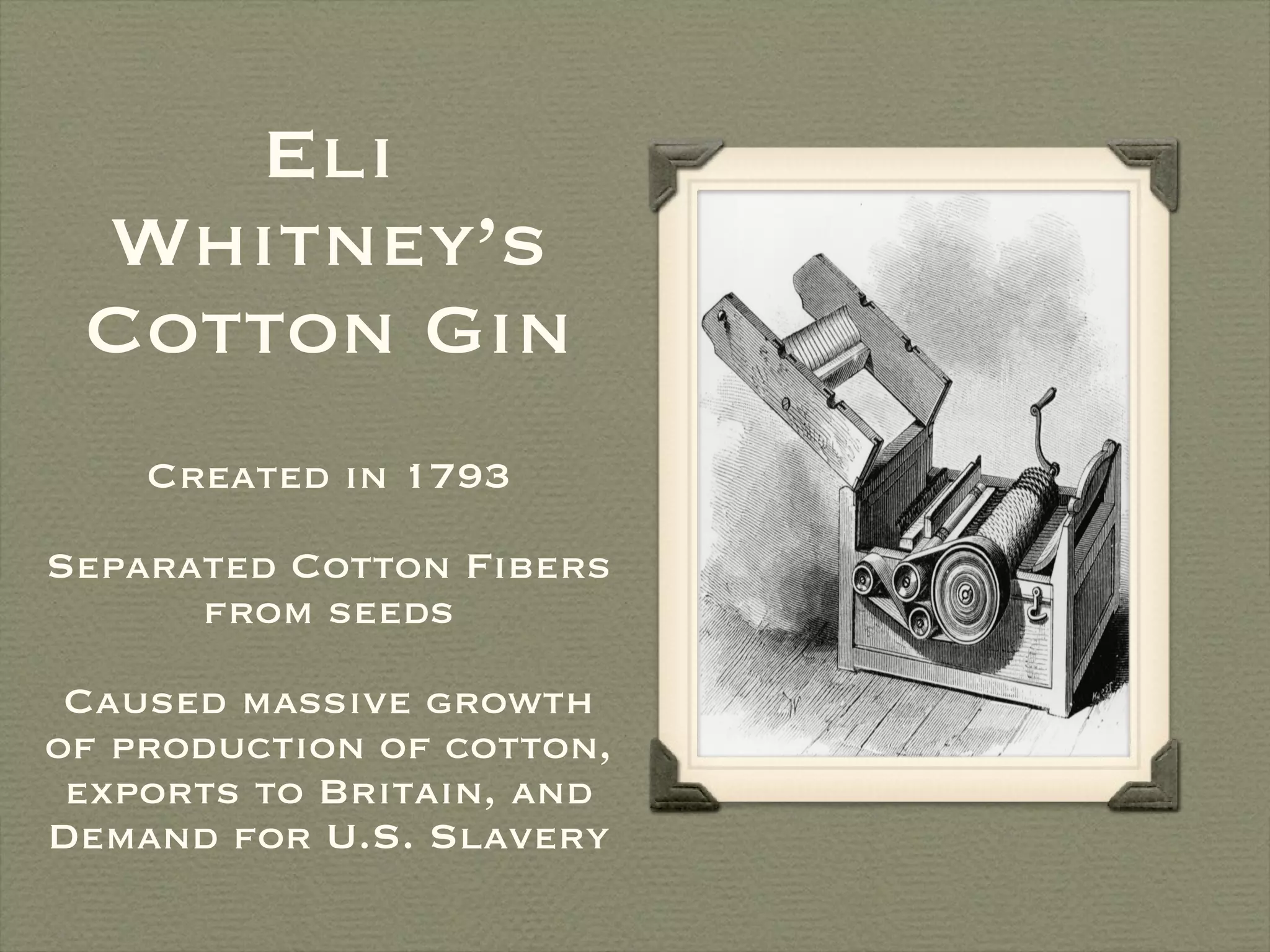
Eli Whitney’s Cotton Gin Created in 1793 Separated Cotton Fibers from seeds Caused massive growth of production of cotton, exports to Britain, and Demand for U.S. Slavery
The Spinning Jenny Invented by James Hargreaves in 1764 Produced several threads at the same time Were Later Powered by Water, and then Steam Engine
John Kay’s Flying Shuttle “ a speed which cannot be imagined, so great that the shuttle can only be seen like a tiny cloud which disappears the same instant.” A wheeled shuttle that greatly accelerated weaving by passing thread between warps very quickly
Advancements in Science and Medicine
Louis Pasteur and Germ Theory French chemist and microbiologist, known as one of the fathers of microbiology Supported the germ theory theory of disease Invented a method to stop milk and wine from causing sickness
The Great and Terrible Scourge Erupted in epidemics every 10 years in densely populated areas Edward Jenner developed vaccine Used samples of cowpox disease from women who had worked with cows
The Transportation Revolution
Stephenson’s “Rocket”
 
Robert Fulton’s Steamship
“ Any color-so long as it’s black.” Henry Ford-American Industrialist Used the assembly line technique of mass production Revolutionized transportation
The Wright Brothers
Impacts of the Industrial Revolution
 
An English Mill Town
Urbanization mass migration of people from rural areas to cities Rapid growth of cities due to industrial demand of workers
Blessing or Curse? The Standard of living increased overall for most people But a new way of living brought new problems


Child Labor and Unsafe Work Conditions
 
Newsies
Miners
A Culture of domesticity
Women’s Roles and Suffrage Women begin to take jobs in factories performing manual labor and skilled crafts Women are always paid less than men and not much more than children Women begin to organize for equal rights and suffrage
 
 
The Opposition to Women
 
Capitalism and Market Competition
Labor Unions
New Ways of Thinking
“ Survival of the Fittest”
Questions to think about... What are some of the causes and effects of the Industrial Revolution? How did the standard of living increase and decrease during the Industrial Revolution? What are some of the benefits and drawbacks of philosophers like Smith, Marx, Owen, Bentham? How do we still benefit today from inventions from the Industrial Revolution?

Industrial Revolution Powerpoint

  • 1.
    The Industrial RevolutionFrom England to North America to the World
  • 2.
  • 3.
    Why did theIndustrial Revolution begin In England? Natural resources such as coal, iron ore, and developed farmlands New technologies such as the steam engine and textile machines Population growth due to previous agricultural boom Business class risked their capital to start new ventures.
  • 4.
  • 5.
  • 6.
  • 7.
    Cottage System VS.Factory System
  • 8.
    Mostly female workersmanning the machines at a factory producing stockings
  • 9.
  • 10.
  • 11.
    James Watt’s SteamEngine Scottish inventor and mechanical engineer Improved upon Newcomen steam engine by using condenser Key power source of the Industrial Revolution
  • 12.
  • 13.
    Bessemer’s Smelting ProcessBessemer Process was the first inexpensive industrial process for the mass production of steel Removed impurities from the iron by blowing air through it Allowed the manufacture of bridges, railroads, skyscrapers, and large ships
  • 14.
  • 15.
  • 16.
    The Wizard ofMenlo Park Thomas Edison-American Inventor, Scientist, and Businessman Invented the Phonograph, motion picture camera, and the long-lasting practical electric lightbulb
  • 17.
  • 18.
    Eli Whitney’s CottonGin Created in 1793 Separated Cotton Fibers from seeds Caused massive growth of production of cotton, exports to Britain, and Demand for U.S. Slavery
  • 19.
    The Spinning JennyInvented by James Hargreaves in 1764 Produced several threads at the same time Were Later Powered by Water, and then Steam Engine
  • 20.
    John Kay’s FlyingShuttle “ a speed which cannot be imagined, so great that the shuttle can only be seen like a tiny cloud which disappears the same instant.” A wheeled shuttle that greatly accelerated weaving by passing thread between warps very quickly
  • 21.
  • 22.
    Louis Pasteur andGerm Theory French chemist and microbiologist, known as one of the fathers of microbiology Supported the germ theory theory of disease Invented a method to stop milk and wine from causing sickness
  • 23.
    The Great andTerrible Scourge Erupted in epidemics every 10 years in densely populated areas Edward Jenner developed vaccine Used samples of cowpox disease from women who had worked with cows
  • 24.
  • 25.
  • 26.
  • 27.
  • 28.
    “ Any color-solong as it’s black.” Henry Ford-American Industrialist Used the assembly line technique of mass production Revolutionized transportation
  • 29.
  • 30.
    Impacts of theIndustrial Revolution
  • 31.
  • 32.
  • 33.
    Urbanization mass migrationof people from rural areas to cities Rapid growth of cities due to industrial demand of workers
  • 34.
    Blessing or Curse?The Standard of living increased overall for most people But a new way of living brought new problems
  • 35.
  • 36.
  • 37.
  • 38.
  • 39.
  • 40.
  • 41.
    Child Labor andUnsafe Work Conditions
  • 42.
  • 43.
  • 44.
  • 45.
    A Culture ofdomesticity
  • 46.
    Women’s Roles andSuffrage Women begin to take jobs in factories performing manual labor and skilled crafts Women are always paid less than men and not much more than children Women begin to organize for equal rights and suffrage
  • 47.
  • 48.
  • 49.
  • 50.
  • 51.
  • 52.
  • 53.
    New Ways ofThinking
  • 54.
    “ Survival ofthe Fittest”
  • 55.
    Questions to thinkabout... What are some of the causes and effects of the Industrial Revolution? How did the standard of living increase and decrease during the Industrial Revolution? What are some of the benefits and drawbacks of philosophers like Smith, Marx, Owen, Bentham? How do we still benefit today from inventions from the Industrial Revolution?