Transportation Revolution By: Emily
What was the Transportation Revolution Segment of the Industrial Revolution Improvements in transportation technology War of 1812 and  the Panic of 1819
Roads and Turnpikes Dirt roads provided the major form of transportation in the late 18th century. Wooden bridges were constructed to overcome bad weather. In 1775 it took one week to travel from Boston to New York, but by 1800 it only took four days. Difficult maintenance and  high expenses led to the  demise of roads as the ideal form of  transportation.
Canals Canals linked interior areas to natural waterways. The Erie Canal was completed in 1825 and was the longest canal in the world.  Canals proved to be unsuccessful because of competition from other transportation methods.
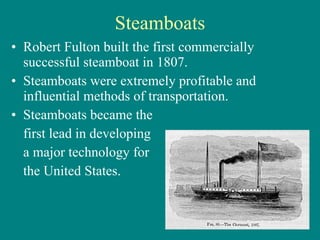
Steamboats Robert Fulton built the first commercially successful steamboat in 1807. Steamboats were extremely profitable and influential methods of transportation. Steamboats became the  first lead in developing  a major technology for  the United States.
Railroads The first domestic locomotive was built by Horatio Allen in 1829. Improvements of English railroad technology helped to make railroads successful in America. Railroads could reach places that water systems couldn’t, so they soon extended all over the country.
Effects of the Transportation Revolution Diminished western isolation Cost to transport good dropped significantly Marketing grew along with market towns Increased trade volume increased the pace of business

Transportation Revolution

  • 1.
  • 2.
    What was theTransportation Revolution Segment of the Industrial Revolution Improvements in transportation technology War of 1812 and the Panic of 1819
  • 3.
    Roads and TurnpikesDirt roads provided the major form of transportation in the late 18th century. Wooden bridges were constructed to overcome bad weather. In 1775 it took one week to travel from Boston to New York, but by 1800 it only took four days. Difficult maintenance and high expenses led to the demise of roads as the ideal form of transportation.
  • 4.
    Canals Canals linkedinterior areas to natural waterways. The Erie Canal was completed in 1825 and was the longest canal in the world. Canals proved to be unsuccessful because of competition from other transportation methods.
  • 5.
    Steamboats Robert Fultonbuilt the first commercially successful steamboat in 1807. Steamboats were extremely profitable and influential methods of transportation. Steamboats became the first lead in developing a major technology for the United States.
  • 6.
    Railroads The firstdomestic locomotive was built by Horatio Allen in 1829. Improvements of English railroad technology helped to make railroads successful in America. Railroads could reach places that water systems couldn’t, so they soon extended all over the country.
  • 7.
    Effects of theTransportation Revolution Diminished western isolation Cost to transport good dropped significantly Marketing grew along with market towns Increased trade volume increased the pace of business

Editor's Notes

  • #3 The transportation revolution was the specific improvement in transportation technology from 1790 to 1850 within the Industrial Revolution. Events such as the War of 1812 and the Panic of 1819 alerted many of the need for a more effective method of transportation of goods. The development of roads, canals, steam boats, railroads, and improvements to these transportation methods formed the basis for the American Transportation Revolution.
  • #4 Roads and turnpikes was the first major form of transportation in late 18th century America. In 1775 it took one week to take a trip from Boston to New York, but by 1800 it only took four days. Weather proved to be a serious problem for these roads, so wooden planks and bridges were constructed to make these roads accessible in all types of weather; however, this solution was expensive and there was still very limited capacity for horse-drawn wagons. Transportation by water seemed to be the ideal solution to these problems, so much effort was put into finding an accessible form a water transportation in the following years.
  • #5 Canals were the first method of successful water transportation for Americans. The very first canal was constructed in 1800, and by 1825 the successful Erie Canal was completed. At 363 miles long, it was the longest canal in the world and a landmark for American transportation at the time. Most other canals: however, were unsuccessful due to competition from more efficient waterways that prevented their success.
  • #6 Benjamin Franklin speculated about the idea of a steamboat as early as 1785, but the first commercially successful steamboat was built in 1807 by Robert Fulton. This steamboat was named the Clermont, it was 133 feet long, and it was designed primarily for comfort for the passengers and speed. The key innovation that made steamboats a reality was the pressure steam engine from Oliver Evans in 1801. The steamboat became a very profitable and successful method of transportation for Americans, and it gave the United States its first lead in developing a major technology.
  • #7 Perhaps the most successful and significant development of the Transportation Revolution was the railroad. The first domestic locomotive was built by Horatio Allen in 1829 and quickly after, short lines of railroad track were being created to connect people to the major river systems. The English railroad system was the model for the Americans, but certain improvements such as engines that burned anthracite, building tracks with the T-rail method, and equalizing the lever suspension, helped to improve problems with long distances and the expense of the iron to build the tracks. Railroads could reach places that the waterways couldn’t and although they started small, railroads eventually extended and connected to form international tracks that connected the major American cities.
  • #8 The Transportation Revolution had a very significant effect on the American people. The west was no longer isolated from the rest of the country, and it grew to become an important commercial producer as well.