 The Past? Dates? Events? People?
 A class that helps students prepare for
college and the SATs?
 Something students need to take so that
Coach Flo has a job?
 Something to sleep through?
 History is a story that tells us who
we are … by telling us who we were.
 The story must tie facts together,
but there is no need to have all the
information to tell the story
 Stories from the past combine to
help us tell our story
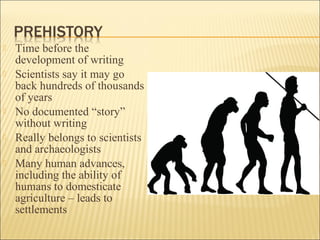
 Time before the
development of writing
 Scientists say it may go
back hundreds of thousands
of years
 No documented “story”
without writing
 Really belongs to scientists
and archaeologists
 Many human advances,
including the ability of
humans to domesticate
agriculture – leads to
settlements
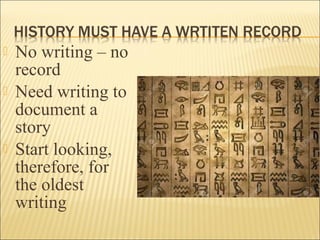
 No writing – no
record
 Need writing to
document a
story
 Start looking,
therefore, for
the oldest
writing
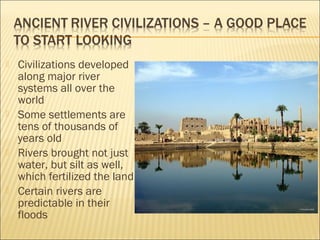
 Civilizations developed
along major river
systems all over the
world
 Some settlements are
tens of thousands of
years old
 Rivers brought not just
water, but silt as well,
which fertilized the land
 Certain rivers are
predictable in their
floods
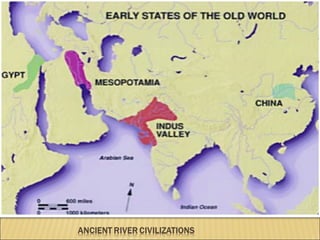
 Mesopotamia: Tigris and Euphrates
 Egyptian: Nile
 Indian: Indus
 Chinese: Yellow
Look for the
oldest writing
system
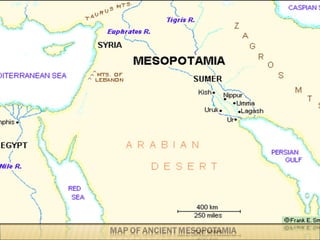
 Also at times called Ancient Sumeria and / or
Ancient Babylonia (depended on the different
empires found there)
 Tigris and Euphrates Rivers
 Modern Day Iraq
 Writing: Cuneiform (Wedge-shaped writing)
 Government: City-states
 Religion: polytheistic and tied to nature
 Epic of Gilgamesh: Flood story
 Hammurabi's Code: equality before the law
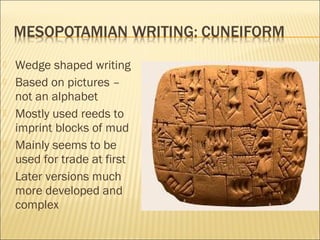
 Wedge shaped writing
 Based on pictures –
not an alphabet
 Mostly used reeds to
imprint blocks of mud
 Mainly seems to be
used for trade at first
 Later versions much
more developed and
complex
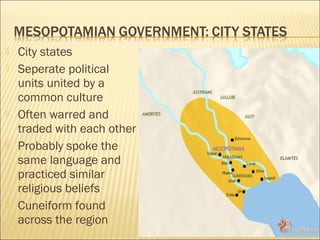
 City states
 Seperate political
units united by a
common culture
 Often warred and
traded with each other
 Probably spoke the
same language and
practiced similar
religious beliefs
 Cuneiform found
across the region
 Many different gods and
goddesses
 Often tied to nature
 Men trying to explain the
world around them
 Gods and Goddesses
appear in human form –
humans often see God in
the images they see
 Ancient people – primitive
– not stupid
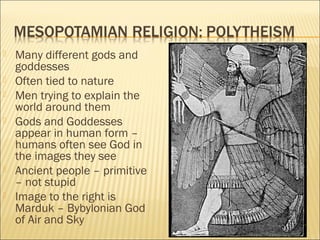
 Image to the right is
Marduk – Bybylonian God
of Air and Sky
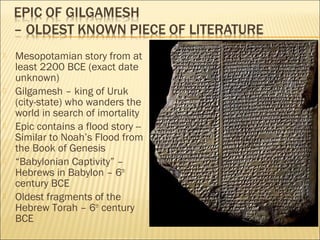
 Mesopotamian story from at
least 2200 BCE (exact date
unknown)
 Gilgamesh – king of Uruk
(city-state) who wanders the
world in search of imortality
 Epic contains a flood story --
Similar to Noah’s Flood from
the Book of Genesis
 “Babylonian Captivity” –
Hebrews in Babylon – 6th
century BCE
 Oldest fragments of the
Hebrew Torah – 6th
century
BCE
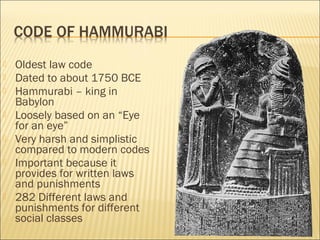
 Oldest law code
 Dated to about 1750 BCE
 Hammurabi – king in
Babylon
 Loosely based on an “Eye
for an eye”
 Very harsh and simplistic
compared to modern codes
 Important because it
provides for written laws
and punishments
 282 Different laws and
punishments for different
social classes
 Nile River: flows north from the highlands of Ethiopia to
the Med – civilization develops only along the river
 Settlements in Egypt are probably older than in
Mesopotamia, but writing developed later
 Religion: polytheistic with Pharaoh (king) as son of Re
 Government: first empire (multiple nations – one ruler) –
Nile runs from Black Africa to Arab Africa
 Writing System: Hieroglyphics (picture writing) – has
thousands of characters – much more sophisticated than
Mesopotamian cuneiform
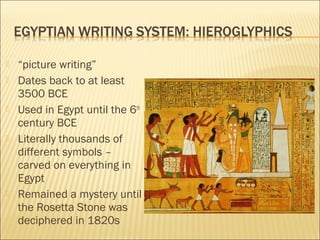
 “picture writing”
 Dates back to at least
3500 BCE
 Used in Egypt until the 6th
century BCE
 Literally thousands of
different symbols –
carved on everything in
Egypt
 Remained a mystery until
the Rosetta Stone was
deciphered in 1820s
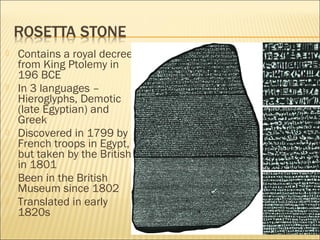
 Contains a royal decree
from King Ptolemy in
196 BCE
 In 3 languages –
Hieroglyphs, Demotic
(late Egyptian) and
Greek
 Discovered in 1799 by
French troops in Egypt,
but taken by the British
in 1801
 Been in the British
Museum since 1802
 Translated in early
1820s
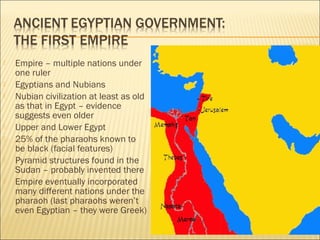
 Empire – multiple nations under
one ruler
 Egyptians and Nubians
 Nubian civilization at least as old
as that in Egypt – evidence
suggests even older
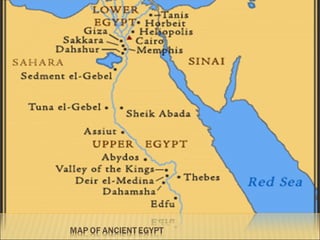
 Upper and Lower Egypt
 25% of the pharaohs known to
be black (facial features)
 Pyramid structures found in the
Sudan – probably invented there
 Empire eventually incorporated
many different nations under the
pharaoh (last pharaohs weren’t
even Egyptian – they were Greek)
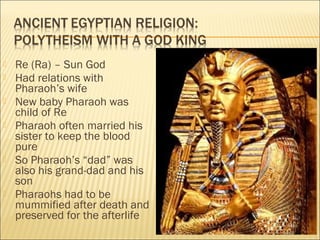
 Re (Ra) – Sun God
 Had relations with
Pharaoh’s wife
 New baby Pharaoh was
child of Re
 Pharaoh often married his
sister to keep the blood
pure
 So Pharaoh’s “dad” was
also his grand-dad and his
son
 Pharaohs had to be
mummified after death and
preserved for the afterlife
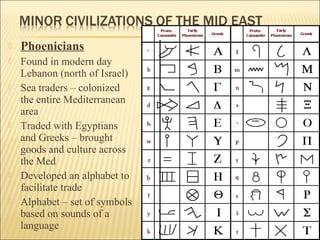
 Phoenicians
 Found in modern day
Lebanon (north of Israel)
 Sea traders – colonized
the entire Mediterranean
area
 Traded with Egyptians
and Greeks – brought
goods and culture across
the Med
 Developed an alphabet to
facilitate trade
 Alphabet – set of symbols
based on sounds of a
language
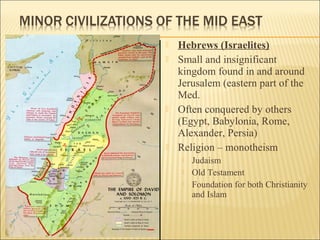
 Hebrews (Israelites)
 Small and insignificant
kingdom found in and around
Jerusalem (eastern part of the
Med.
 Often conquered by others
(Egypt, Babylonia, Rome,
Alexander, Persia)
 Religion – monotheism
 Judaism
 Old Testament
 Foundation for both Christianity
and Islam
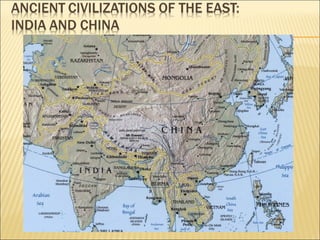
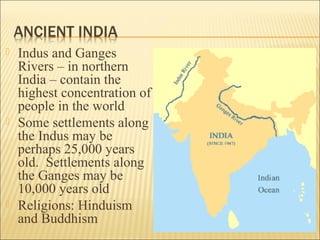
 Indus and Ganges
Rivers – in northern
India – contain the
highest concentration of
people in the world
 Some settlements along
the Indus may be
perhaps 25,000 years
old. Settlements along
the Ganges may be
10,000 years old
 Religions: Hinduism
and Buddhism
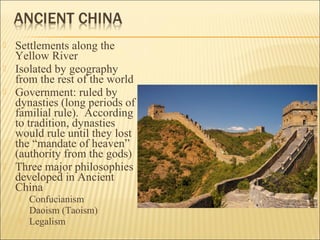
 Settlements along the
Yellow River
 Isolated by geography
from the rest of the world
 Government: ruled by
dynasties (long periods of
familial rule). According
to tradition, dynasties
would rule until they lost
the “mandate of heaven”
(authority from the gods)
 Three major philosophies
developed in Ancient
China
 Confucianism
 Daoism (Taoism)
 Legalism
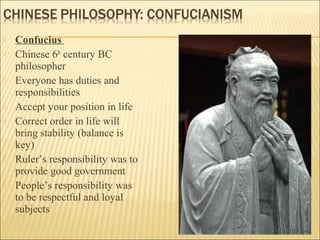
 Confucius
 Chinese 6th
century BC
philosopher
 Everyone has duties and
responsibilities
 Accept your position in life
 Correct order in life will
bring stability (balance is
key)
 Ruler’s responsibility was to
provide good government
 People’s responsibility was
to be respectful and loyal
subjects
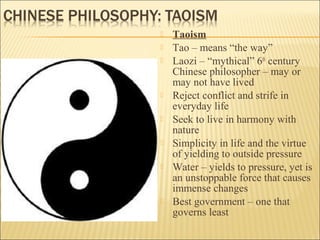
 Taoism
 Tao – means “the way”
 Laozi – “mythical” 6th
century
Chinese philosopher – may or
may not have lived
 Reject conflict and strife in
everyday life
 Seek to live in harmony with
nature
 Simplicity in life and the virtue
of yielding to outside pressure
 Water – yields to pressure, yet is
an unstoppable force that causes
immense changes
 Best government – one that
governs least
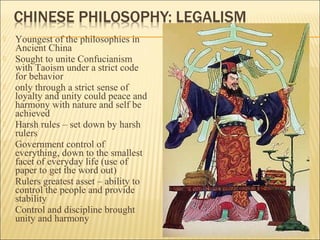
 Youngest of the philosophies in
Ancient China
 Sought to unite Confucianism
with Taoism under a strict code
for behavior
 only through a strict sense of
loyalty and unity could peace and
harmony with nature and self be
achieved
 Harsh rules – set down by harsh
rulers
 Government control of
everything, down to the smallest
facet of everyday life (use of
paper to get the word out)
 Rulers greatest asset – ability to
control the people and provide
stability
 Control and discipline brought
unity and harmony
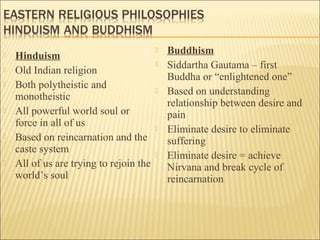
 Hinduism
 Old Indian religion
 Both polytheistic and
monotheistic
 All powerful world soul or
force in all of us
 Based on reincarnation and the
caste system
 All of us are trying to rejoin the
world’s soul
 Buddhism
 Siddartha Gautama – first
Buddha or “enlightened one”
 Based on understanding
relationship between desire and
pain
 Eliminate desire to eliminate
suffering
 Eliminate desire = achieve
Nirvana and break cycle of
reincarnation
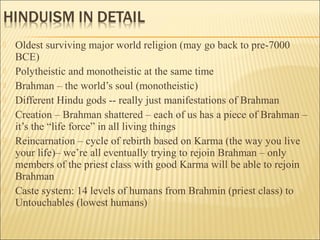
 Oldest surviving major world religion (may go back to pre-7000
BCE)
 Polytheistic and monotheistic at the same time
 Brahman – the world’s soul (monotheistic)
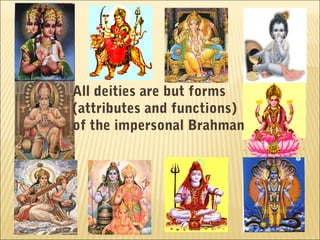
 Different Hindu gods -- really just manifestations of Brahman
 Creation – Brahman shattered – each of us has a piece of Brahman –
it’s the “life force” in all living things
 Reincarnation – cycle of rebirth based on Karma (the way you live
your life)– we’re all eventually trying to rejoin Brahman – only
members of the priest class with good Karma will be able to rejoin
Brahman
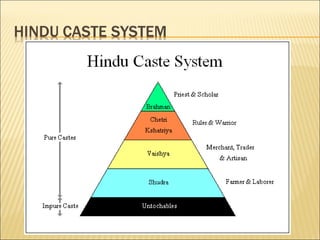
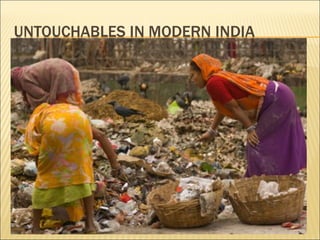
 Caste system: 14 levels of humans from Brahmin (priest class) to
Untouchables (lowest humans)
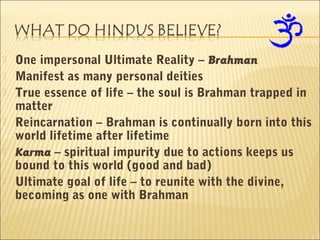
 One impersonal Ultimate Reality – Brahman
 Manifest as many personal deities
 True essence of life – the soul is Brahman trapped in
matter
 Reincarnation – Brahman is continually born into this
world lifetime after lifetime
 Karma – spiritual impurity due to actions keeps us
bound to this world (good and bad)
 Ultimate goal of life – to reunite with the divine,
becoming as one with Brahman
All deities are but forms
(attributes and functions)
of the impersonal Brahman
 Siddhartha Gautama – Hindu prince who had a crisis of faith and
walked among the people and observed the world
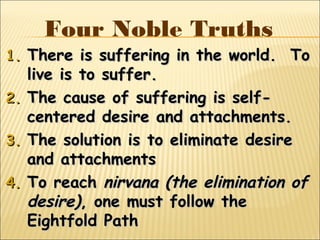
 Four Noble Truths
 Everyone suffers
 Suffering is caused by desire
 To eliminate suffering – eliminate desire
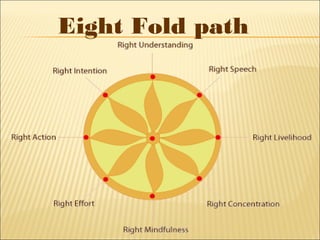
 To eliminate desire – follow the Eight fold path to righteousness
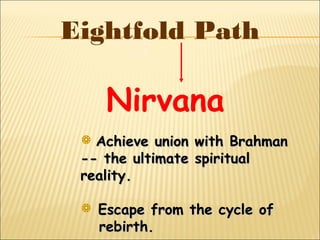
 Eliminating desire would thus allow a person to become
“enlightened” or a Buddha. This was called achieving a state called
Nirvana
 Achieve Nirvana and break the cycle of reincarnation and join the
world’s soul
 Anyone not achieving Nirvana would ensure their good Karma and
would go up on the ladder of reincarnation
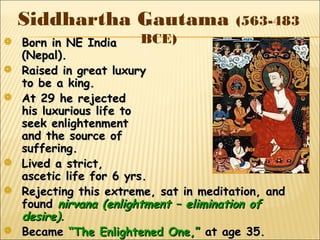
Siddhartha Gautama (563-483
BCE) Born in NE IndiaBorn in NE India
(Nepal).(Nepal).
 Raised in great luxuryRaised in great luxury
to be a king.to be a king.
 At 29 he rejectedAt 29 he rejected
his luxurious life tohis luxurious life to
seek enlightenmentseek enlightenment
and the source ofand the source of
suffering.suffering.
 Lived a strict,Lived a strict,
ascetic life for 6 yrs.ascetic life for 6 yrs.
 Rejecting this extreme, sat in meditation, andRejecting this extreme, sat in meditation, and
foundfound nirvana (enlightment – elimination ofnirvana (enlightment – elimination of
desire)desire)..
 BecameBecame “The Enlightened One,”“The Enlightened One,” at age 35.at age 35.
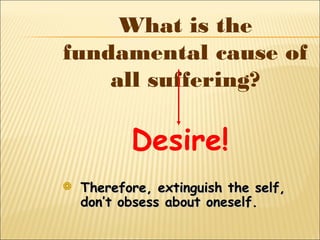
What is the
fundamental cause of
all suffering?
Desire!
 Therefore, extinguish the self,Therefore, extinguish the self,
don’t obsess about oneself.don’t obsess about oneself.
Four Noble Truths
1.1. There is suffering in the world. ToThere is suffering in the world. To
live is to suffer.live is to suffer.
2.2. The cause of suffering is self-The cause of suffering is self-
centered desire and attachments.centered desire and attachments.
3.3. The solution is to eliminate desireThe solution is to eliminate desire
and attachmentsand attachments
4.4. To reachTo reach nirvana (the elimination ofnirvana (the elimination of
desire)desire), one must follow the, one must follow the
Eightfold PathEightfold Path
Eight Fold path
Eightfold Path
Nirvana
 Achieve union with BrahmanAchieve union with Brahman
-- the ultimate spiritual-- the ultimate spiritual
reality.reality.
 Escape from the cycle ofEscape from the cycle of
rebirth.rebirth.
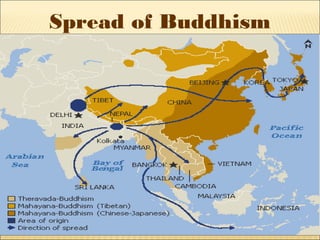
Spread of Buddhism
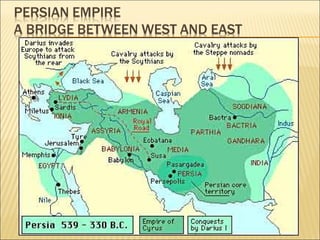
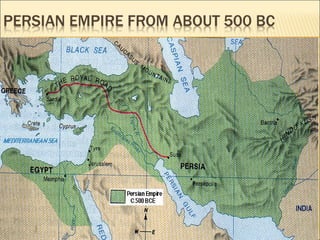
 Ancient powerful empire (550 BC to 350 BC) centered in
modern day Iran
 Stretched from the steps of India to the Greek world –
largest empire of its time
 Absolute power to the God King, but also had the the first
ideas behind Local Autonomy as a way to govern its
empire
 Local autonomy – idea that local rulers could control their
people while still paying allegiance to the central authority.
Local laws could be maintained.
 ran into Greek colonies in what is today Turkey (ancient
Anatolia) and fought a protracted war against the united
Greek city states – it’s a war that Persia will lose.
Unit 1  - ancient civilizations

Unit 1 - ancient civilizations

  • 2.
     The Past?Dates? Events? People?  A class that helps students prepare for college and the SATs?  Something students need to take so that Coach Flo has a job?  Something to sleep through?
  • 3.
     History isa story that tells us who we are … by telling us who we were.  The story must tie facts together, but there is no need to have all the information to tell the story  Stories from the past combine to help us tell our story
  • 4.
     Time beforethe development of writing  Scientists say it may go back hundreds of thousands of years  No documented “story” without writing  Really belongs to scientists and archaeologists  Many human advances, including the ability of humans to domesticate agriculture – leads to settlements
  • 5.
     No writing– no record  Need writing to document a story  Start looking, therefore, for the oldest writing
  • 6.
     Civilizations developed alongmajor river systems all over the world  Some settlements are tens of thousands of years old  Rivers brought not just water, but silt as well, which fertilized the land  Certain rivers are predictable in their floods
  • 7.
     Mesopotamia: Tigrisand Euphrates  Egyptian: Nile  Indian: Indus  Chinese: Yellow
  • 9.
    Look for the oldestwriting system
  • 10.
     Also attimes called Ancient Sumeria and / or Ancient Babylonia (depended on the different empires found there)  Tigris and Euphrates Rivers  Modern Day Iraq  Writing: Cuneiform (Wedge-shaped writing)  Government: City-states  Religion: polytheistic and tied to nature  Epic of Gilgamesh: Flood story  Hammurabi's Code: equality before the law
  • 12.
     Wedge shapedwriting  Based on pictures – not an alphabet  Mostly used reeds to imprint blocks of mud  Mainly seems to be used for trade at first  Later versions much more developed and complex
  • 13.
     City states Seperate political units united by a common culture  Often warred and traded with each other  Probably spoke the same language and practiced similar religious beliefs  Cuneiform found across the region
  • 14.
     Many differentgods and goddesses  Often tied to nature  Men trying to explain the world around them  Gods and Goddesses appear in human form – humans often see God in the images they see  Ancient people – primitive – not stupid  Image to the right is Marduk – Bybylonian God of Air and Sky
  • 15.
     Mesopotamian storyfrom at least 2200 BCE (exact date unknown)  Gilgamesh – king of Uruk (city-state) who wanders the world in search of imortality  Epic contains a flood story -- Similar to Noah’s Flood from the Book of Genesis  “Babylonian Captivity” – Hebrews in Babylon – 6th century BCE  Oldest fragments of the Hebrew Torah – 6th century BCE
  • 16.
     Oldest lawcode  Dated to about 1750 BCE  Hammurabi – king in Babylon  Loosely based on an “Eye for an eye”  Very harsh and simplistic compared to modern codes  Important because it provides for written laws and punishments  282 Different laws and punishments for different social classes
  • 18.
     Nile River:flows north from the highlands of Ethiopia to the Med – civilization develops only along the river  Settlements in Egypt are probably older than in Mesopotamia, but writing developed later  Religion: polytheistic with Pharaoh (king) as son of Re  Government: first empire (multiple nations – one ruler) – Nile runs from Black Africa to Arab Africa  Writing System: Hieroglyphics (picture writing) – has thousands of characters – much more sophisticated than Mesopotamian cuneiform
  • 20.
     “picture writing” Dates back to at least 3500 BCE  Used in Egypt until the 6th century BCE  Literally thousands of different symbols – carved on everything in Egypt  Remained a mystery until the Rosetta Stone was deciphered in 1820s
  • 21.
     Contains aroyal decree from King Ptolemy in 196 BCE  In 3 languages – Hieroglyphs, Demotic (late Egyptian) and Greek  Discovered in 1799 by French troops in Egypt, but taken by the British in 1801  Been in the British Museum since 1802  Translated in early 1820s
  • 22.
     Empire –multiple nations under one ruler  Egyptians and Nubians  Nubian civilization at least as old as that in Egypt – evidence suggests even older  Upper and Lower Egypt  25% of the pharaohs known to be black (facial features)  Pyramid structures found in the Sudan – probably invented there  Empire eventually incorporated many different nations under the pharaoh (last pharaohs weren’t even Egyptian – they were Greek)
  • 23.
     Re (Ra)– Sun God  Had relations with Pharaoh’s wife  New baby Pharaoh was child of Re  Pharaoh often married his sister to keep the blood pure  So Pharaoh’s “dad” was also his grand-dad and his son  Pharaohs had to be mummified after death and preserved for the afterlife
  • 24.
     Phoenicians  Foundin modern day Lebanon (north of Israel)  Sea traders – colonized the entire Mediterranean area  Traded with Egyptians and Greeks – brought goods and culture across the Med  Developed an alphabet to facilitate trade  Alphabet – set of symbols based on sounds of a language
  • 25.
     Hebrews (Israelites) Small and insignificant kingdom found in and around Jerusalem (eastern part of the Med.  Often conquered by others (Egypt, Babylonia, Rome, Alexander, Persia)  Religion – monotheism  Judaism  Old Testament  Foundation for both Christianity and Islam
  • 27.
     Indus andGanges Rivers – in northern India – contain the highest concentration of people in the world  Some settlements along the Indus may be perhaps 25,000 years old. Settlements along the Ganges may be 10,000 years old  Religions: Hinduism and Buddhism
  • 28.
     Settlements alongthe Yellow River  Isolated by geography from the rest of the world  Government: ruled by dynasties (long periods of familial rule). According to tradition, dynasties would rule until they lost the “mandate of heaven” (authority from the gods)  Three major philosophies developed in Ancient China  Confucianism  Daoism (Taoism)  Legalism
  • 29.
     Confucius  Chinese6th century BC philosopher  Everyone has duties and responsibilities  Accept your position in life  Correct order in life will bring stability (balance is key)  Ruler’s responsibility was to provide good government  People’s responsibility was to be respectful and loyal subjects
  • 30.
     Taoism  Tao– means “the way”  Laozi – “mythical” 6th century Chinese philosopher – may or may not have lived  Reject conflict and strife in everyday life  Seek to live in harmony with nature  Simplicity in life and the virtue of yielding to outside pressure  Water – yields to pressure, yet is an unstoppable force that causes immense changes  Best government – one that governs least
  • 31.
     Youngest ofthe philosophies in Ancient China  Sought to unite Confucianism with Taoism under a strict code for behavior  only through a strict sense of loyalty and unity could peace and harmony with nature and self be achieved  Harsh rules – set down by harsh rulers  Government control of everything, down to the smallest facet of everyday life (use of paper to get the word out)  Rulers greatest asset – ability to control the people and provide stability  Control and discipline brought unity and harmony
  • 33.
     Hinduism  OldIndian religion  Both polytheistic and monotheistic  All powerful world soul or force in all of us  Based on reincarnation and the caste system  All of us are trying to rejoin the world’s soul  Buddhism  Siddartha Gautama – first Buddha or “enlightened one”  Based on understanding relationship between desire and pain  Eliminate desire to eliminate suffering  Eliminate desire = achieve Nirvana and break cycle of reincarnation
  • 34.
     Oldest survivingmajor world religion (may go back to pre-7000 BCE)  Polytheistic and monotheistic at the same time  Brahman – the world’s soul (monotheistic)  Different Hindu gods -- really just manifestations of Brahman  Creation – Brahman shattered – each of us has a piece of Brahman – it’s the “life force” in all living things  Reincarnation – cycle of rebirth based on Karma (the way you live your life)– we’re all eventually trying to rejoin Brahman – only members of the priest class with good Karma will be able to rejoin Brahman  Caste system: 14 levels of humans from Brahmin (priest class) to Untouchables (lowest humans)
  • 35.
     One impersonalUltimate Reality – Brahman  Manifest as many personal deities  True essence of life – the soul is Brahman trapped in matter  Reincarnation – Brahman is continually born into this world lifetime after lifetime  Karma – spiritual impurity due to actions keeps us bound to this world (good and bad)  Ultimate goal of life – to reunite with the divine, becoming as one with Brahman
  • 38.
    All deities arebut forms (attributes and functions) of the impersonal Brahman
  • 39.
     Siddhartha Gautama– Hindu prince who had a crisis of faith and walked among the people and observed the world  Four Noble Truths  Everyone suffers  Suffering is caused by desire  To eliminate suffering – eliminate desire  To eliminate desire – follow the Eight fold path to righteousness  Eliminating desire would thus allow a person to become “enlightened” or a Buddha. This was called achieving a state called Nirvana  Achieve Nirvana and break the cycle of reincarnation and join the world’s soul  Anyone not achieving Nirvana would ensure their good Karma and would go up on the ladder of reincarnation
  • 40.
    Siddhartha Gautama (563-483 BCE)Born in NE IndiaBorn in NE India (Nepal).(Nepal).  Raised in great luxuryRaised in great luxury to be a king.to be a king.  At 29 he rejectedAt 29 he rejected his luxurious life tohis luxurious life to seek enlightenmentseek enlightenment and the source ofand the source of suffering.suffering.  Lived a strict,Lived a strict, ascetic life for 6 yrs.ascetic life for 6 yrs.  Rejecting this extreme, sat in meditation, andRejecting this extreme, sat in meditation, and foundfound nirvana (enlightment – elimination ofnirvana (enlightment – elimination of desire)desire)..  BecameBecame “The Enlightened One,”“The Enlightened One,” at age 35.at age 35.
  • 41.
    What is the fundamentalcause of all suffering? Desire!  Therefore, extinguish the self,Therefore, extinguish the self, don’t obsess about oneself.don’t obsess about oneself.
  • 42.
    Four Noble Truths 1.1.There is suffering in the world. ToThere is suffering in the world. To live is to suffer.live is to suffer. 2.2. The cause of suffering is self-The cause of suffering is self- centered desire and attachments.centered desire and attachments. 3.3. The solution is to eliminate desireThe solution is to eliminate desire and attachmentsand attachments 4.4. To reachTo reach nirvana (the elimination ofnirvana (the elimination of desire)desire), one must follow the, one must follow the Eightfold PathEightfold Path
  • 43.
  • 44.
    Eightfold Path Nirvana  Achieveunion with BrahmanAchieve union with Brahman -- the ultimate spiritual-- the ultimate spiritual reality.reality.  Escape from the cycle ofEscape from the cycle of rebirth.rebirth.
  • 45.
  • 48.
     Ancient powerfulempire (550 BC to 350 BC) centered in modern day Iran  Stretched from the steps of India to the Greek world – largest empire of its time  Absolute power to the God King, but also had the the first ideas behind Local Autonomy as a way to govern its empire  Local autonomy – idea that local rulers could control their people while still paying allegiance to the central authority. Local laws could be maintained.  ran into Greek colonies in what is today Turkey (ancient Anatolia) and fought a protracted war against the united Greek city states – it’s a war that Persia will lose.