JapaneseInternment
1942-1946
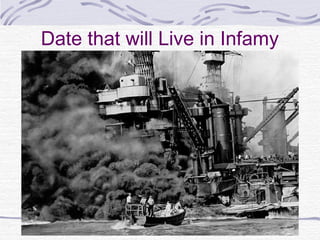
Date that will Live in Infamy
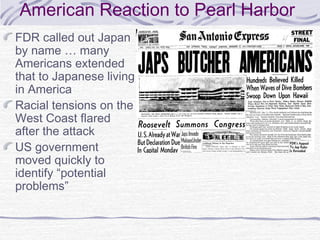
American Reaction to Pearl Harbor
FDR called out Japan
by name … many
Americans extended
that to Japanese living
in America
Racial tensions on the
West Coast flared
after the attack
US government
moved quickly to
identify “potential
problems”
“Of all the races ineligible tO [sic]
citizenship, the Japanese are the least
assimilable and the mOst dangerOus tO
the cOuntry. … they cOme … fOr the
purpOse Of cOlOnizing and establishing
here the prOud yamatO race. they never
cease tO be Japanese.”
-Valentine S. McClatchy,
A wealthy California Newspaper
owner testifying to Congress.
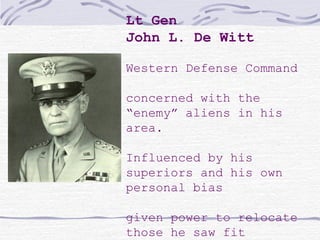
Lt Gen
John L. De Witt
Western Defense Command
concerned with the
“enemy” aliens in his
area.
Influenced by his
superiors and his own
personal bias
given power to relocate
those he saw fit
“A Jap is a Jap. They are a
dangerous element … There is no
way to determine their loyalty …
It makes no difference whether
he is an American; theoretically
he is still a Japanese, and you
can’t change him … by giving him
a piece of paper.”
General De Witt,
speaking to Congress.
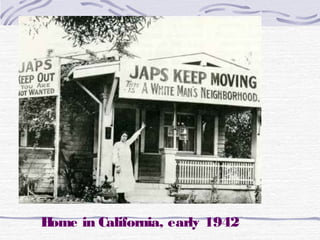
Home in California, early 1942
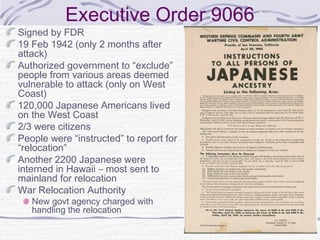
Executive Order 9066
Signed by FDR
19 Feb 1942 (only 2 months after
attack)
Authorized government to “exclude”
people from various areas deemed
vulnerable to attack (only on West
Coast)
120,000 Japanese Americans lived
on the West Coast
2/3 were citizens
People were “instructed” to report for
“relocation”
Another 2200 Japanese were
interned in Hawaii – most sent to
mainland for relocation
War Relocation Authority
New govt agency charged with
handling the relocation
US Government
Propaganda Film 1942
approx. 10 min long
https://www.youtube.com/watch?
v=BK6ZtcLocaA
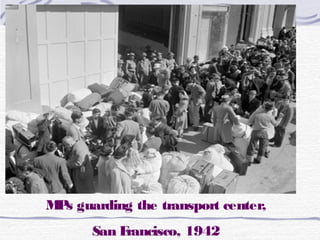
MPs guarding the transport center,
San Francisco, 1942
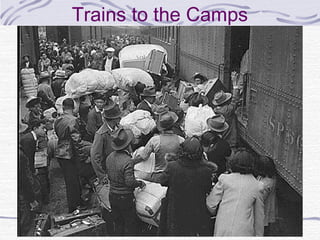
Trains to the Camps
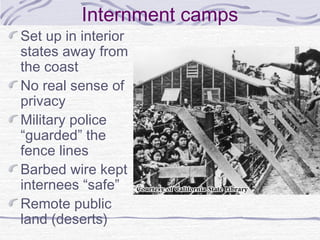
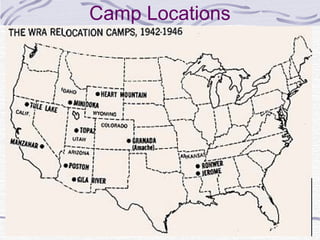
Internment camps
Set up in interior
states away from
the coast
No real sense of
privacy
Military police
“guarded” the
fence lines
Barbed wire kept
internees “safe”
Remote public
land (deserts)
Camp Locations
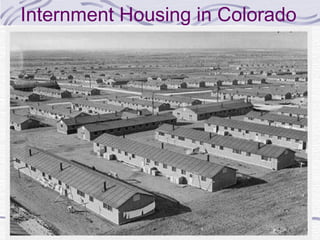
Internment Housing in Colorado
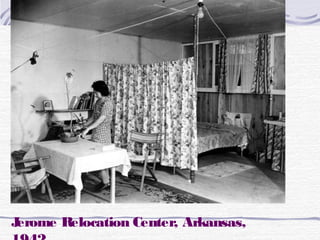
Jerome Relocation Center, Arkansas,
Fred Korematsu challenged the
legality of the internment order
Korematsu v. United States (1944)
Supreme court held that although the
executive order and the relocation
were “questionable”, the right of the
government to exclude people from
areas was justified during
circumstances of “emergency and
peril”
Korematsu conviction was later
overturned in 1983 due to an “ethics
lapse” by the Justice Dept.
(it withheld evidence)
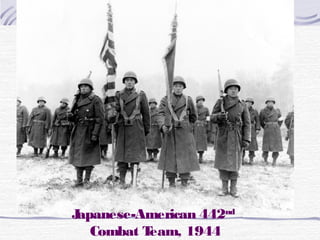
Japanese-American 442nd
Combat Team, 1944
“[Though Japanese
internment] was
justified to us on the
grounds that the
Japanese were
potentially disloyal,
the record does not
disclose a single
case of Japanese
disloyalty.”
-Henry Steele Commager
famous American historian
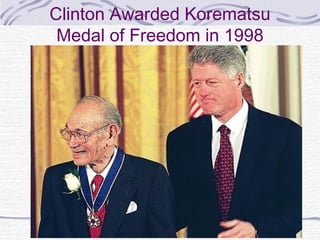
Clinton Awarded Korematsu
Medal of Freedom in 1998

Japanese internment

  • 1.
  • 2.
    Date that willLive in Infamy
  • 3.
    American Reaction toPearl Harbor FDR called out Japan by name … many Americans extended that to Japanese living in America Racial tensions on the West Coast flared after the attack US government moved quickly to identify “potential problems”
  • 4.
    “Of all theraces ineligible tO [sic] citizenship, the Japanese are the least assimilable and the mOst dangerOus tO the cOuntry. … they cOme … fOr the purpOse Of cOlOnizing and establishing here the prOud yamatO race. they never cease tO be Japanese.” -Valentine S. McClatchy, A wealthy California Newspaper owner testifying to Congress.
  • 5.
    Lt Gen John L.De Witt Western Defense Command concerned with the “enemy” aliens in his area. Influenced by his superiors and his own personal bias given power to relocate those he saw fit
  • 6.
    “A Jap isa Jap. They are a dangerous element … There is no way to determine their loyalty … It makes no difference whether he is an American; theoretically he is still a Japanese, and you can’t change him … by giving him a piece of paper.” General De Witt, speaking to Congress.
  • 7.
  • 8.
    Executive Order 9066 Signedby FDR 19 Feb 1942 (only 2 months after attack) Authorized government to “exclude” people from various areas deemed vulnerable to attack (only on West Coast) 120,000 Japanese Americans lived on the West Coast 2/3 were citizens People were “instructed” to report for “relocation” Another 2200 Japanese were interned in Hawaii – most sent to mainland for relocation War Relocation Authority New govt agency charged with handling the relocation
  • 9.
    US Government Propaganda Film1942 approx. 10 min long https://www.youtube.com/watch? v=BK6ZtcLocaA
  • 10.
    MPs guarding thetransport center, San Francisco, 1942
  • 11.
  • 12.
    Internment camps Set upin interior states away from the coast No real sense of privacy Military police “guarded” the fence lines Barbed wire kept internees “safe” Remote public land (deserts)
  • 13.
  • 14.
  • 15.
  • 16.
    Fred Korematsu challengedthe legality of the internment order Korematsu v. United States (1944) Supreme court held that although the executive order and the relocation were “questionable”, the right of the government to exclude people from areas was justified during circumstances of “emergency and peril” Korematsu conviction was later overturned in 1983 due to an “ethics lapse” by the Justice Dept. (it withheld evidence)
  • 17.
  • 18.
    “[Though Japanese internment] was justifiedto us on the grounds that the Japanese were potentially disloyal, the record does not disclose a single case of Japanese disloyalty.” -Henry Steele Commager famous American historian
  • 19.

Editor's Notes

  • #8 What do you see in this photograph? a home in California that has multiple signs saying, “Japs Keep Moving, This is a White Man’s Neighborhood” and “Japs Keep Out You are Not Wanted” Who and why might someone put a sign like this on their home? a white person might possibly put a sign like this on their home they might put a sign like this on their home because they want the Japanese-Americans or Japanese immigrants out of their neighborhoods because they are “dangerous” and “enemies” What could this tell us about the general population on the west coast? these signs could tell us that the white people were very prejudiced against those of Japanese ancestry and don’t want them to live near them and want nothing to do with them http://education.eastwestcenter.org/asiapacificed/ph2006/PH2006projects/7_clip_image001.jpg
  • #11 People were allowed to take “only what we could carry.” Could you pack everything you wanted to take with you for who knows how long in one suitcase? (By the way: no electronics of any kind allowed.) No, I couldn’t. I could take one suitcase full of my most prized possessions, but it wouldn’t be enough for ALL of what I would want to take. http://static.howstuffworks.com/gif/japanese-internment-camp-2.jpg
  • #12 What do you see in this photograph? I see a train and a person inside a cargo car with men around the door on the outside with piles of luggage (suitcases, bundles, etc.) It looks like chaos! Where do you think these people are going? I think these people are going to assembly centers or relocation/internment camps to live for the duration of the war. Do you think this looks organized? Not really. I would be worried about my luggage being lost and, since I’m going somewhere I don’t know http://questgarden.com/12/37/9/051210192950/
  • #16 What do you see in this photograph? A room in a barracks. There is a woman. The room looks fairly nice, with some homey touches. The room has, sort of, been separated into two rooms by the way of a decorative sheet/drape. Do you think it would be easy to make a room like this feel like home? Probably not. I doubt the government would have provided such items to the people in the camps, so they must have, through some means or other, managed to get their own homey touches. MAIL ORDER CATALOGUES How many people do you think would be expected to live in a room like this? Up to around 10 people in a family could be expected to live in this area http://americanhistory.si.edu/perfectunion/non-flash/internment_barracks.html
  • #18 442nd Regimental Combat Teamunit composed mostly of Japanese Americans who fought in Europe in WWIIunit became the most highly decorated regiment in the history of the US Armed Forces, including 21 Medal of Honor recipients. What do you see in this photograph? The 442nd Regimental Combat Team, a unit comprised mostly of Japanese American soldiers; J-A soldiers Why might some of the Japanese-American men be allowed to leave the camps to join the war effort? The draft—the US needed soldiers Do you think it was a good idea that the US military let what they classified as “enemies” fight for them in war? I think it’s a little silly that the US trusted hundreds of “enemies” together in one group to fight, especially if they were to be sent to Japan http://americanhistory.si.edu/perfectunion/experience/index.html