Workshop: Educational Technology 
Opportunities for KFUPM 
M.S. Vijay Kumar, vkumar@mit.edu 
Brandon Muramatsu, mura@mit.edu 
Monday, August 25, 2014 
Cite as: Kumar, V. & Muramatsu, B. (2014a, August). Educational technology opportunities for KFUPM. 
Workshop presented at KFUPM. Dhahran, Saudi Arabia. 
Unless otherwise specified this work is licensed under a Creative Commons Attribution 4.0 International License. 1
Agenda 
 Part 1: Introduction 
 Part 2: Discussion of the Morning Keynote 
 Break 
 Part 3: Review Pedagogical Goals & Examples of 
Educational Technologies 
 Part 4: Summary 
Unless otherwise specified this work is licensed under a Creative Commons Attribution 4.0 International License. 
2
Part 1: Introduction 
Unless otherwise specified this work is licensed under a Creative Commons Attribution 4.0 International License. 
3
Goals & Objectives for the Workshops 
 Help you understand how we think about 
educational technologies, and how they support 
pedagogy and learning 
 See some examples of educational technologies, to 
help you understand a range of possibilities 
 Identify how KFUPM can implement online / digital 
learning 
Unless otherwise specified this work is licensed under a Creative Commons Attribution 4.0 International License. 
4
Goals for this Afternoon 
 Discuss the morning keynote 
 Identify teaching and learning issues at KFUPM and 
understand what you’re doing to address them 
 Begin to discuss how education technology and 
online / digital learning may impact these issues 
Unless otherwise specified this work is licensed under a Creative Commons Attribution 4.0 International License. 
5
Key Takeaways 
 Education technology in the service of pedagogy 
 Innovate (experiment at course and department-level) 
to impact the whole (university) 
Unless otherwise specified this work is licensed under a Creative Commons Attribution 4.0 International License. 
6
Vijay’s Background 
 B.Tech. in Chemical Engineering, M.S. in Industrial 
Management & Ed.D. in Future Studies in Education 
 Research in educational technology innovation diffusion 
 Taught courses in introductory programming, data 
communications, instructional computing, future 
studies, and teacher education 
 30+ years in EdTech – Developing, managing, & 
innovating educational uses of Information 
Technologies 
 10+ years in Open Education: Open Educational Resources and 
OpenCourseWare 
Unless otherwise specified this work is licensed under a Creative Commons Attribution 4.0 International License. 
7
Brandon’s Background 
 B.S. & M.S. in Mechanical Engineering 
 Taught multimedia design and open education 
 20 years in EdTech 
 ~10 years in educational digital libraries: Collections, nationwide 
collaborations, quality and peer review 
 10+ years in Open Education: Open Educational Resources and 
OpenCourseWare 
 “Been There, Done That” 
 Multimedia courseware design and course support, course design, 
video production software design, digital libraries, metadata, 
learning objects, open educational resources/OpenCourseWare, 
… 
Unless otherwise specified this work is licensed under a Creative Commons Attribution 4.0 International License. 
8
About you! 
 Name 
 Department 
 What do you hope to get out of the workshop? 
Unless otherwise specified this work is licensed under a Creative Commons Attribution 4.0 International License. 
9
Part 2: Discussion of the 
Morning Keynote 
Unless otherwise specified this work is licensed under a Creative Commons Attribution 4.0 International License. 
10
Framing the Discussion 
 General reactions? 
 Any questions? 
 Anything you’d like us to elaborate on in particular? 
 (E.g., embedded assessment) 
Unless otherwise specified this work is licensed under a Creative Commons Attribution 4.0 International License. 
11
Framing the Discussion (cont.) 
 Any approaches or applications that could be easily 
adopted for the course you’re teaching, or at 
KFUPM? 
 Are you doing anything similar now? Please 
describe what you’re doing. 
 Are there any barriers to doing any of these things? 
Unless otherwise specified this work is licensed under a Creative Commons Attribution 4.0 International License. 
12
Break 
Unless otherwise specified this work is licensed under a Creative Commons Attribution 4.0 International License. 
13
Part 3: Review Pedagogical Goals & 
Examples of Educational Technologies 
Unless otherwise specified this work is licensed under a Creative Commons Attribution 4.0 International License. 
14
MIT’s Approach 
 Our approach at MIT is technology in the service of 
pedagogy 
 Educational technology is not new 
 Digital learning is becoming more dominant 
 Current era is based in research and development going back 
to the 1960s 
Unless otherwise specified this work is licensed under a Creative Commons Attribution 4.0 International License. 
15
EdTech Strategy at MIT 
 Support faculty and students with experimenting 
and adopting innovative practices in teaching and 
learning 
 Innovative approach in delivering General Ed requirements 
 Make powerful tools and experiments accessible to students 
 Leverage content and resources across courses and programs 
 Facilitate hands-on learning in new ways 
 Develop educationally valuable software tools 
Unless otherwise specified this work is licensed under a Creative Commons Attribution 4.0 International License. 
16
EdTech Strategy at MIT 
 Inform development of educational infrastructure 
and services 
 Develop platforms (not one-offs) that render sustainability 
 Implement test-beds for promising educational technologies 
and new services, to advance teaching and learning 
 Develop plans for the incubation, early implementation, and the 
transitioning of delivery systems to long-term core service 
providers 
 Support a shift to more blended and online learning 
experiences 
Unless otherwise specified this work is licensed under a Creative Commons Attribution 4.0 International License. 
17
Review of Pedagogical Goals 
 Active & hands-on 
learning 
 Increasing lab 
experiences 
 Authentic lab / 
research 
experiences 
 Improve mastery of 
concepts 
 Deeper learning 
through simulations 
& visualizations 
 Modularity 
 Sharing how we 
teach 
Unless otherwise specified this work is licensed under a Creative Commons Attribution 4.0 International License. 
18
Active & Hands-on Learning / Engagement 
 Active and hands-on learning in a large in-person 
class, traditionally a large lecture class 
 TEAL–Technology Enabled Active Learning 
 Studio format, redesigned course and two classrooms 
 Small group teams, desktop lab experiments & simulations 
Unless otherwise specified this work is licensed under a Creative Commons Attribution 4.0 International License. 
Photos courtesy of MIT/Microsoft Research iCampus Alliance 
19
Active & Hands-on Learning / Engagement 
 Active and hands-on learning in the humanities 
 Visualizing Cultures 
 Shared access to primary source materials via web 
 Communications and community 
Unless otherwise specified this work is licensed under a Creative Commons Attribution 4.0 International License. 
20 
visualizingcultures.mit.edu 
Image courtesy of Visualizing Cultures
Increasing Lab (Hands-on) Experiences 
 Increase lab experiences 
 iLabs 
 Can access “real” experiences without being in the physical lab 
 Order of magnitude more and more sophisticated lab 
experiences 
 International network / community providing access to physical 
labs over the Web 
Photos courtesy of MIT/Microsoft Research iCampus Alliance 
Unless otherwise specified this work is licensed under a Creative Commons Attribution 4.0 International License. 
21
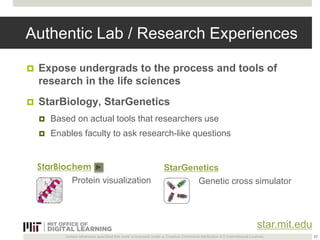
Authentic Lab / Research Experiences 
 Expose undergrads to the process and tools of 
research in the life sciences 
 StarBiology, StarGenetics 
 Based on actual tools that researchers use 
 Enables faculty to ask research-like questions 
Unless otherwise specified this work is licensed under a Creative Commons Attribution 4.0 International License. 
22 
StarBiochem StarGenetics 
Protein visualization Genetic cross simulator 
star.mit.edu
Modularity 
 Enable students to take a specific module 
 Flexibility for research / study abroad 
 Review or focus on specific concepts 
 Modularity “experiments” 
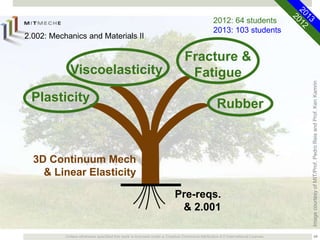
 i2.002: Mechanical Engineering, core tree and 4 branches 
 Chemistry Bridge: Challenging concepts and bridges to other 
courses 
 MITx Courses: 6.00.1x & 6.00.2x; 18.01.1x-18.01.3x 
Unless otherwise specified this work is licensed under a Creative Commons Attribution 4.0 International License. 
23
2.002 Mechanics and Materials 
Viscoelasticity 
Unless otherwise specified this work is licensed under a Creative Commons Attribution 4.0 International License. 
24 
Plasticity 
Fracture & 
Fatigue 
Rubber 
3D Continuum Mech 
& Linear Elasticity 
Pre-reqs. 
& 2.001 
2.002: Mechanics and Materials II 
2012: 64 students 
2013: 103 students 
Image courtesy of MIT/Prof. Pedro Reis and Prof. Ken Kamrin
Chemistry Bridge 
Unless otherwise specified this work is licensed under a Creative Commons Attribution 4.0 International License. 
Image courtesy of MIT/Prof. John Essigmann 
25
Improve Mastery of Concepts 
 Enable students to check their understanding / 
mastery of concepts directly in course materials 
 Primarily for formative (self-check, understanding) not 
summative (exams or formal assignments) 
 Strengthened by tie to learning outcomes, content 
 “Embedded Assessment” 
 MITx Courses 
 Open Embedded Assessment: Assessments anywhere, 
anytime 
Unless otherwise specified this work is licensed under a Creative Commons Attribution 4.0 International License. 
26
Auto-scored Exercises: Chemistry 
Unless otherwise specified this work is licensed under a Creative Commons Attribution 4.0 International License. 
Video courtesy of edX 
27
Virtual Laboratory: Electric Circuits 
Unless otherwise specified this work is licensed under a Creative Commons Attribution 4.0 International License. 
Video courtesy of edX 
28
Open Embedded Assessment 
 Screenshot 
 Demo www.openassessments.org 
Unless otherwise specified this work is licensed under a Creative Commons Attribution 4.0 International License. 
29
Deeper Learning 
 Enable deeper learning through visualizations 
 MIT ARTEMiS (mit-artemis.org) 
 Develops visualizations to enable students to “see” and 
experience concepts to promote deeper learning 
Unless otherwise specified this work is licensed under a Creative Commons Attribution 4.0 International License. 
30 
3D Interactive Tectonics Fluvial Environment 
Images courtesy of MIT ARTEMiS
Deeper Learning 
 Enable deeper learning through simulations 
 Mathlets (mathlets.org) 
 Interactive web apps that enable students to simulate 
mathematical concepts 
 Relate math to systems behavior; transference to other 
disciplines 
Unless otherwise specified this work is licensed under a Creative Commons Attribution 4.0 International License. 
31 
Amplitude and Phase: First Order 
Image courtesy of MIT/Prof. Haynes Miller
Sharing How we Teach 
 Involving and sharing how we teach 
 MIT OpenCourseWare 
 Sharing our course materials, with the world, and with 
colleagues across campus 
 OCW Educator: “This course at MIT” 
Unless otherwise specified this work is licensed under a Creative Commons Attribution 4.0 International License. 
32
OCW Educator: Biology 7.013 
 http://ocw.mit.edu/courses/biology/7-013- 
introductory-biology-spring-2013/this-course-at-mit/ 
Unless otherwise specified this work is licensed under a Creative Commons Attribution 4.0 International License. 
33
Review: Pedagogical Goals 
 Active & hands-on 
learning 
 Increasing lab 
experiences 
 Authentic lab / 
research 
experiences 
 Improve mastery of 
concepts 
 Deeper learning 
through simulations 
& visualizations 
 Modularity 
 Sharing how we 
teach 
Unless otherwise specified this work is licensed under a Creative Commons Attribution 4.0 International License. 
34
Teaching and Learning Issues? 
 Which of these are 
concerns for you? 
 How are you 
addressing these now? 
 Can you imagine using 
one of the approaches 
we’ve mentioned to 
help address these 
concerns? 
 Are there other issues 
that we haven’t 
mentioned? 
Unless otherwise specified this work is licensed under a Creative Commons Attribution 4.0 International License. 
35
Part 4: Summary 
Unless otherwise specified this work is licensed under a Creative Commons Attribution 4.0 International License. 
36
Key Takeaways 
 Education technology in the service of pedagogy 
 Innovate (experiment at course and department-level) 
to impact the whole (university) 
Unless otherwise specified this work is licensed under a Creative Commons Attribution 4.0 International License. 
37
Workshop: Educational Technology 
Opportunities for KFUPM 
M.S. Vijay Kumar, vkumar@mit.edu 
Brandon Muramatsu, mura@mit.edu 
Cite as: Kumar, V. & Muramatsu, B. (2014a, August). Educational technology opportunities for KFUPM. 
Workshop presented at KFUPM. Dhahran, Saudi Arabia. 
Unless otherwise specified this work is licensed under a Creative Commons Attribution 4.0 International License. 38

Workshop: Educational Technology Opportunities for KFUPM

  • 1.
    Workshop: Educational Technology Opportunities for KFUPM M.S. Vijay Kumar, vkumar@mit.edu Brandon Muramatsu, mura@mit.edu Monday, August 25, 2014 Cite as: Kumar, V. & Muramatsu, B. (2014a, August). Educational technology opportunities for KFUPM. Workshop presented at KFUPM. Dhahran, Saudi Arabia. Unless otherwise specified this work is licensed under a Creative Commons Attribution 4.0 International License. 1
  • 2.
    Agenda  Part1: Introduction  Part 2: Discussion of the Morning Keynote  Break  Part 3: Review Pedagogical Goals & Examples of Educational Technologies  Part 4: Summary Unless otherwise specified this work is licensed under a Creative Commons Attribution 4.0 International License. 2
  • 3.
    Part 1: Introduction Unless otherwise specified this work is licensed under a Creative Commons Attribution 4.0 International License. 3
  • 4.
    Goals & Objectivesfor the Workshops  Help you understand how we think about educational technologies, and how they support pedagogy and learning  See some examples of educational technologies, to help you understand a range of possibilities  Identify how KFUPM can implement online / digital learning Unless otherwise specified this work is licensed under a Creative Commons Attribution 4.0 International License. 4
  • 5.
    Goals for thisAfternoon  Discuss the morning keynote  Identify teaching and learning issues at KFUPM and understand what you’re doing to address them  Begin to discuss how education technology and online / digital learning may impact these issues Unless otherwise specified this work is licensed under a Creative Commons Attribution 4.0 International License. 5
  • 6.
    Key Takeaways Education technology in the service of pedagogy  Innovate (experiment at course and department-level) to impact the whole (university) Unless otherwise specified this work is licensed under a Creative Commons Attribution 4.0 International License. 6
  • 7.
    Vijay’s Background B.Tech. in Chemical Engineering, M.S. in Industrial Management & Ed.D. in Future Studies in Education  Research in educational technology innovation diffusion  Taught courses in introductory programming, data communications, instructional computing, future studies, and teacher education  30+ years in EdTech – Developing, managing, & innovating educational uses of Information Technologies  10+ years in Open Education: Open Educational Resources and OpenCourseWare Unless otherwise specified this work is licensed under a Creative Commons Attribution 4.0 International License. 7
  • 8.
    Brandon’s Background B.S. & M.S. in Mechanical Engineering  Taught multimedia design and open education  20 years in EdTech  ~10 years in educational digital libraries: Collections, nationwide collaborations, quality and peer review  10+ years in Open Education: Open Educational Resources and OpenCourseWare  “Been There, Done That”  Multimedia courseware design and course support, course design, video production software design, digital libraries, metadata, learning objects, open educational resources/OpenCourseWare, … Unless otherwise specified this work is licensed under a Creative Commons Attribution 4.0 International License. 8
  • 9.
    About you! Name  Department  What do you hope to get out of the workshop? Unless otherwise specified this work is licensed under a Creative Commons Attribution 4.0 International License. 9
  • 10.
    Part 2: Discussionof the Morning Keynote Unless otherwise specified this work is licensed under a Creative Commons Attribution 4.0 International License. 10
  • 11.
    Framing the Discussion  General reactions?  Any questions?  Anything you’d like us to elaborate on in particular?  (E.g., embedded assessment) Unless otherwise specified this work is licensed under a Creative Commons Attribution 4.0 International License. 11
  • 12.
    Framing the Discussion(cont.)  Any approaches or applications that could be easily adopted for the course you’re teaching, or at KFUPM?  Are you doing anything similar now? Please describe what you’re doing.  Are there any barriers to doing any of these things? Unless otherwise specified this work is licensed under a Creative Commons Attribution 4.0 International License. 12
  • 13.
    Break Unless otherwisespecified this work is licensed under a Creative Commons Attribution 4.0 International License. 13
  • 14.
    Part 3: ReviewPedagogical Goals & Examples of Educational Technologies Unless otherwise specified this work is licensed under a Creative Commons Attribution 4.0 International License. 14
  • 15.
    MIT’s Approach Our approach at MIT is technology in the service of pedagogy  Educational technology is not new  Digital learning is becoming more dominant  Current era is based in research and development going back to the 1960s Unless otherwise specified this work is licensed under a Creative Commons Attribution 4.0 International License. 15
  • 16.
    EdTech Strategy atMIT  Support faculty and students with experimenting and adopting innovative practices in teaching and learning  Innovative approach in delivering General Ed requirements  Make powerful tools and experiments accessible to students  Leverage content and resources across courses and programs  Facilitate hands-on learning in new ways  Develop educationally valuable software tools Unless otherwise specified this work is licensed under a Creative Commons Attribution 4.0 International License. 16
  • 17.
    EdTech Strategy atMIT  Inform development of educational infrastructure and services  Develop platforms (not one-offs) that render sustainability  Implement test-beds for promising educational technologies and new services, to advance teaching and learning  Develop plans for the incubation, early implementation, and the transitioning of delivery systems to long-term core service providers  Support a shift to more blended and online learning experiences Unless otherwise specified this work is licensed under a Creative Commons Attribution 4.0 International License. 17
  • 18.
    Review of PedagogicalGoals  Active & hands-on learning  Increasing lab experiences  Authentic lab / research experiences  Improve mastery of concepts  Deeper learning through simulations & visualizations  Modularity  Sharing how we teach Unless otherwise specified this work is licensed under a Creative Commons Attribution 4.0 International License. 18
  • 19.
    Active & Hands-onLearning / Engagement  Active and hands-on learning in a large in-person class, traditionally a large lecture class  TEAL–Technology Enabled Active Learning  Studio format, redesigned course and two classrooms  Small group teams, desktop lab experiments & simulations Unless otherwise specified this work is licensed under a Creative Commons Attribution 4.0 International License. Photos courtesy of MIT/Microsoft Research iCampus Alliance 19
  • 20.
    Active & Hands-onLearning / Engagement  Active and hands-on learning in the humanities  Visualizing Cultures  Shared access to primary source materials via web  Communications and community Unless otherwise specified this work is licensed under a Creative Commons Attribution 4.0 International License. 20 visualizingcultures.mit.edu Image courtesy of Visualizing Cultures
  • 21.
    Increasing Lab (Hands-on)Experiences  Increase lab experiences  iLabs  Can access “real” experiences without being in the physical lab  Order of magnitude more and more sophisticated lab experiences  International network / community providing access to physical labs over the Web Photos courtesy of MIT/Microsoft Research iCampus Alliance Unless otherwise specified this work is licensed under a Creative Commons Attribution 4.0 International License. 21
  • 22.
    Authentic Lab /Research Experiences  Expose undergrads to the process and tools of research in the life sciences  StarBiology, StarGenetics  Based on actual tools that researchers use  Enables faculty to ask research-like questions Unless otherwise specified this work is licensed under a Creative Commons Attribution 4.0 International License. 22 StarBiochem StarGenetics Protein visualization Genetic cross simulator star.mit.edu
  • 23.
    Modularity  Enablestudents to take a specific module  Flexibility for research / study abroad  Review or focus on specific concepts  Modularity “experiments”  i2.002: Mechanical Engineering, core tree and 4 branches  Chemistry Bridge: Challenging concepts and bridges to other courses  MITx Courses: 6.00.1x & 6.00.2x; 18.01.1x-18.01.3x Unless otherwise specified this work is licensed under a Creative Commons Attribution 4.0 International License. 23
  • 24.
    2.002 Mechanics andMaterials Viscoelasticity Unless otherwise specified this work is licensed under a Creative Commons Attribution 4.0 International License. 24 Plasticity Fracture & Fatigue Rubber 3D Continuum Mech & Linear Elasticity Pre-reqs. & 2.001 2.002: Mechanics and Materials II 2012: 64 students 2013: 103 students Image courtesy of MIT/Prof. Pedro Reis and Prof. Ken Kamrin
  • 25.
    Chemistry Bridge Unlessotherwise specified this work is licensed under a Creative Commons Attribution 4.0 International License. Image courtesy of MIT/Prof. John Essigmann 25
  • 26.
    Improve Mastery ofConcepts  Enable students to check their understanding / mastery of concepts directly in course materials  Primarily for formative (self-check, understanding) not summative (exams or formal assignments)  Strengthened by tie to learning outcomes, content  “Embedded Assessment”  MITx Courses  Open Embedded Assessment: Assessments anywhere, anytime Unless otherwise specified this work is licensed under a Creative Commons Attribution 4.0 International License. 26
  • 27.
    Auto-scored Exercises: Chemistry Unless otherwise specified this work is licensed under a Creative Commons Attribution 4.0 International License. Video courtesy of edX 27
  • 28.
    Virtual Laboratory: ElectricCircuits Unless otherwise specified this work is licensed under a Creative Commons Attribution 4.0 International License. Video courtesy of edX 28
  • 29.
    Open Embedded Assessment  Screenshot  Demo www.openassessments.org Unless otherwise specified this work is licensed under a Creative Commons Attribution 4.0 International License. 29
  • 30.
    Deeper Learning Enable deeper learning through visualizations  MIT ARTEMiS (mit-artemis.org)  Develops visualizations to enable students to “see” and experience concepts to promote deeper learning Unless otherwise specified this work is licensed under a Creative Commons Attribution 4.0 International License. 30 3D Interactive Tectonics Fluvial Environment Images courtesy of MIT ARTEMiS
  • 31.
    Deeper Learning Enable deeper learning through simulations  Mathlets (mathlets.org)  Interactive web apps that enable students to simulate mathematical concepts  Relate math to systems behavior; transference to other disciplines Unless otherwise specified this work is licensed under a Creative Commons Attribution 4.0 International License. 31 Amplitude and Phase: First Order Image courtesy of MIT/Prof. Haynes Miller
  • 32.
    Sharing How weTeach  Involving and sharing how we teach  MIT OpenCourseWare  Sharing our course materials, with the world, and with colleagues across campus  OCW Educator: “This course at MIT” Unless otherwise specified this work is licensed under a Creative Commons Attribution 4.0 International License. 32
  • 33.
    OCW Educator: Biology7.013  http://ocw.mit.edu/courses/biology/7-013- introductory-biology-spring-2013/this-course-at-mit/ Unless otherwise specified this work is licensed under a Creative Commons Attribution 4.0 International License. 33
  • 34.
    Review: Pedagogical Goals  Active & hands-on learning  Increasing lab experiences  Authentic lab / research experiences  Improve mastery of concepts  Deeper learning through simulations & visualizations  Modularity  Sharing how we teach Unless otherwise specified this work is licensed under a Creative Commons Attribution 4.0 International License. 34
  • 35.
    Teaching and LearningIssues?  Which of these are concerns for you?  How are you addressing these now?  Can you imagine using one of the approaches we’ve mentioned to help address these concerns?  Are there other issues that we haven’t mentioned? Unless otherwise specified this work is licensed under a Creative Commons Attribution 4.0 International License. 35
  • 36.
    Part 4: Summary Unless otherwise specified this work is licensed under a Creative Commons Attribution 4.0 International License. 36
  • 37.
    Key Takeaways Education technology in the service of pedagogy  Innovate (experiment at course and department-level) to impact the whole (university) Unless otherwise specified this work is licensed under a Creative Commons Attribution 4.0 International License. 37
  • 38.
    Workshop: Educational Technology Opportunities for KFUPM M.S. Vijay Kumar, vkumar@mit.edu Brandon Muramatsu, mura@mit.edu Cite as: Kumar, V. & Muramatsu, B. (2014a, August). Educational technology opportunities for KFUPM. Workshop presented at KFUPM. Dhahran, Saudi Arabia. Unless otherwise specified this work is licensed under a Creative Commons Attribution 4.0 International License. 38