Teaching with Technology UpdatesPresentation for Council of DeansFaculty Development and Instructional Design CenterJuly 14, 2010
Presentation GoalsShare information on supported instructional technologiesHighlight new features now available in Blackboard and Wimba Classroom Explore emerging “cloud” technologies that are becoming increasingly popular in higher education today Discuss implications for use of “cloud” technologies in teaching
Supported Technologies
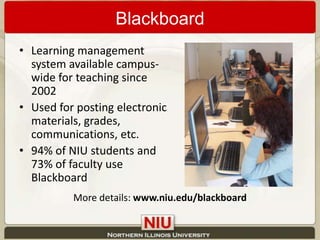
BlackboardLearning management system available campus-wide for teaching since 2002Used for posting electronic materials, grades, communications, etc. 94% of NIU students and 73% of faculty use Blackboard More details: www.niu.edu/blackboard
Use of Blackboard by (individual) Students21,447Usage % for spring ‘10 with 22,705 enrolled is 94.46% of total number of students
Use of Blackboard by (individual) Faculty/Staff/TAs to Teach1,205Usage % for spring ‘10 with 1,661* faculty/instructors/TA/teaching staff is 72.45%*1,661 includes only those providing direct instruction
Number of Course Sections in Blackboard2,269Usage % for spring ‘10 with 5,378* sections is 42.2%*No. of course sections including thesis, dissertation, and independent studies is 5,378
Number of Enrollments in Blackboard77,580Students enrolled in several courses in a semester that use Blackboard
Blackboard Portfolio ToolBundled with current Blackboard Content System that NIU has licensed (no additional cost)Limited customizationAt the recommendation of NIU Computing Facilities Advisory Committee (CFAC), faculty input is being sought for implementationFaculty pilot this summer and fall
Blackboard Portfolio Tool
Portfolio FeaturesStore portfolio artifacts in the Blackboard Content CollectionCreate portfolio for either personal  (student, faculty, staff) accomplishments or course requirementsLink to coursework artifacts in BlackboardUse pre-configured portfolio templates
Portfolio Features (cont.)Share portfolio with faculty for commentsShare portfolio with other classmates as well as non-NIU usersControl access to who can view portfolio and for what duration of timeExport portfolio for offline access outside Blackboard or archive to CD
Upgrade to Blackboard 9.1Major upgrade planned for May 2011Redesigned interfaceMany new requested features addedTesting beginning this summer, support materials and training to be developed this fallFaculty pilot of Blackboard 9.1 during Spring 2011More details coming this fall
Wimba ClassroomLive collaboration with studentsFully-integrated with Blackboard but also available for access without Blackboard loginArchives available for online or on-demand offline or mobile viewing
CPS (e-Instruction Clickers)Student response system allowing faculty to receive feedback from students wirelesslyCan be used in conjunction with Blackboard with results from class assessments automatically uploaded to Blackboard Grade Center
New Blackboard Features Now Available
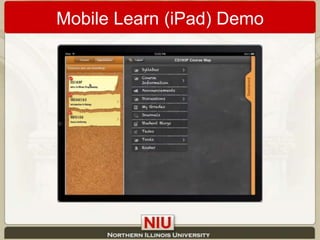
Blackboard Mobile LearnMore details: www.niu.edu/blackboard/mobile
Mobile Learn (iPad) Demo
Blackboard Mobile LearnThrough a partnership with Sprint, Blackboard currently only offers the free Mobile Learn app on Android and BlackBerry devices on the Sprint network in addition to iPad, iPhone, and iPod Touch over Wi-FiAdditional apps and access on other networks available for licensingMore details: www.niu.edu/blackboard/mobile
New Wimba Classroom Features Now Available
Increased Video Device SupportWhile Wimba previously only recognized specific USB web cameras, existing video hardware and infrastructure can now be leveraged. If your computer supports the video camera, so does Wimba Classroom! Data cameras and video equipment used for other specialized lab procedures, such as those used in the physical and health sciences, can now be used with Wimba Classroom.
Higher Quality VideoDefault window size and video window encoding size have been doubled The default video encoding bit rate has also been doubled
Archive ReminderPresenter is reminded to start archive at beginning of session
Hand Raised ChimeChime is now played when a hand is raised to alert presenters when students raise their hand
Shortened Guest Access LinkShortened link for easier distribution to guests via email
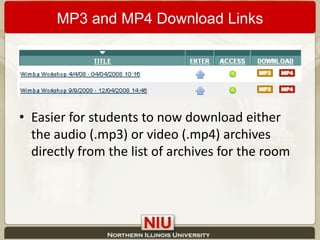
MP3 and MP4 Download LinksEasier for students to now download either the audio (.mp3) or video (.mp4) archives directly from the list of archives for the room
Teaching in the “Cloud”
Educause.edu/cloudcomputing
What is Cloud Computing?IT Perspective: delivery of scalable IT resources of the Internet, as opposed to hosting and operating resources locally on a college or university networkUser Perspective: accessing, creating, and consuming content using web-based software services available from any Internet-connected computer; content  and even software is hosted completely online
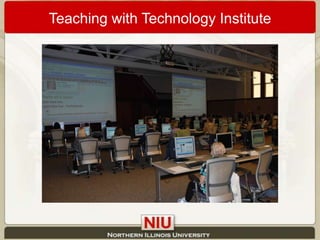
Teaching with Technology Institute
Teaching with Technology InstituteCollaborating in the Cloud (Google Wave)Creating Tutorials in the Cloud (Screenr, Screencast-o-Matic)Writing in the Cloud (Wikis, Blogs)Presenting in the Cloud (Prezi, Slideshare)
Technology Showcase     Featured hands-on opportunity with new technologies, including: Tablet PC, Kindle, iPad, iPod Touch, iPod Nano, clickers, netbook
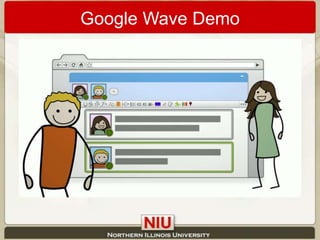
Google WaveWeb-based application representing a rethinking of electronic communicationRather than sending separate copies of multiple messages to different people, content resides in a single spacePart conversation, part document creation, combining features of both synchronous and asynchronous communicationswave.google.com
Google Wave Demo
ScreencastDigital recording of computer screen output, often containing audio narrationWhy use a screencast?Demonstrate and teach software featuresDemonstrate technology steps or processesProviding “virtual tour” of Blackboard course
Screencasting Demo
BlogOnline chronological collection of personal commentary and linksEasy to create and use from anywhere with an Internet connection, including mobile devicesEducational ApplicationsJournal development of ideasInteract outside the “walls” of Blackboard
Sample Blogbit.ly/twti2010blog
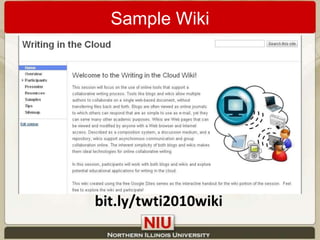
WikiWeb page that can be viewed and modified by anyone with access to the InternetCollaborative documentconstructionEducational ApplicationsClass or topic web siteGroup project presentation alternative Collaborative data collection / analysisPeer editing and review
Sample Wikibit.ly/twti2010wiki
Presentation Toolsslideshare.netprezi.com
Implications for Use of “Cloud” Technologies in Teaching
RealitiesInstructional technologies continue to advance rapidlyTechnology use variesStudents are using these technologies and expecting to use them in learningFaculty are experimenting with new technologies that may not be officially supported by the institutionNew faculty may bring different technology expectations
Questions for ConsiderationHow does the institution support emerging technologies?Are “free” tools available from Google and others truly free?How are openness and opportunities for inter-institutional collaboration managed?How is student data protected?When “walls” are removed, what must be considered?
SummaryFaculty Development’s focus:Promote technology for enhancing teaching and learning, and not just for the sake of using new technologyRecommend technology that can be learned quickly and easily, and is free or affordableEmerging Trends in Learning TechnologiesIncrease in the use of mobile and “cloud” technologiesIncrease in more platform-independent learning toolsBlurring lines between the use of institutional and non-institutional technology (e.g. email)

Teaching with Technology Updates 2010

  • 1.
    Teaching with TechnologyUpdatesPresentation for Council of DeansFaculty Development and Instructional Design CenterJuly 14, 2010
  • 2.
    Presentation GoalsShare informationon supported instructional technologiesHighlight new features now available in Blackboard and Wimba Classroom Explore emerging “cloud” technologies that are becoming increasingly popular in higher education today Discuss implications for use of “cloud” technologies in teaching
  • 3.
  • 4.
    BlackboardLearning management systemavailable campus-wide for teaching since 2002Used for posting electronic materials, grades, communications, etc. 94% of NIU students and 73% of faculty use Blackboard More details: www.niu.edu/blackboard
  • 5.
    Use of Blackboardby (individual) Students21,447Usage % for spring ‘10 with 22,705 enrolled is 94.46% of total number of students
  • 6.
    Use of Blackboardby (individual) Faculty/Staff/TAs to Teach1,205Usage % for spring ‘10 with 1,661* faculty/instructors/TA/teaching staff is 72.45%*1,661 includes only those providing direct instruction
  • 7.
    Number of CourseSections in Blackboard2,269Usage % for spring ‘10 with 5,378* sections is 42.2%*No. of course sections including thesis, dissertation, and independent studies is 5,378
  • 8.
    Number of Enrollmentsin Blackboard77,580Students enrolled in several courses in a semester that use Blackboard
  • 9.
    Blackboard Portfolio ToolBundledwith current Blackboard Content System that NIU has licensed (no additional cost)Limited customizationAt the recommendation of NIU Computing Facilities Advisory Committee (CFAC), faculty input is being sought for implementationFaculty pilot this summer and fall
  • 10.
  • 11.
    Portfolio FeaturesStore portfolioartifacts in the Blackboard Content CollectionCreate portfolio for either personal (student, faculty, staff) accomplishments or course requirementsLink to coursework artifacts in BlackboardUse pre-configured portfolio templates
  • 12.
    Portfolio Features (cont.)Shareportfolio with faculty for commentsShare portfolio with other classmates as well as non-NIU usersControl access to who can view portfolio and for what duration of timeExport portfolio for offline access outside Blackboard or archive to CD
  • 13.
    Upgrade to Blackboard9.1Major upgrade planned for May 2011Redesigned interfaceMany new requested features addedTesting beginning this summer, support materials and training to be developed this fallFaculty pilot of Blackboard 9.1 during Spring 2011More details coming this fall
  • 14.
    Wimba ClassroomLive collaborationwith studentsFully-integrated with Blackboard but also available for access without Blackboard loginArchives available for online or on-demand offline or mobile viewing
  • 15.
    CPS (e-Instruction Clickers)Studentresponse system allowing faculty to receive feedback from students wirelesslyCan be used in conjunction with Blackboard with results from class assessments automatically uploaded to Blackboard Grade Center
  • 16.
  • 17.
    Blackboard Mobile LearnMoredetails: www.niu.edu/blackboard/mobile
  • 18.
  • 19.
    Blackboard Mobile LearnThrougha partnership with Sprint, Blackboard currently only offers the free Mobile Learn app on Android and BlackBerry devices on the Sprint network in addition to iPad, iPhone, and iPod Touch over Wi-FiAdditional apps and access on other networks available for licensingMore details: www.niu.edu/blackboard/mobile
  • 20.
    New Wimba ClassroomFeatures Now Available
  • 21.
    Increased Video DeviceSupportWhile Wimba previously only recognized specific USB web cameras, existing video hardware and infrastructure can now be leveraged. If your computer supports the video camera, so does Wimba Classroom! Data cameras and video equipment used for other specialized lab procedures, such as those used in the physical and health sciences, can now be used with Wimba Classroom.
  • 22.
    Higher Quality VideoDefaultwindow size and video window encoding size have been doubled The default video encoding bit rate has also been doubled
  • 23.
    Archive ReminderPresenter isreminded to start archive at beginning of session
  • 24.
    Hand Raised ChimeChimeis now played when a hand is raised to alert presenters when students raise their hand
  • 25.
    Shortened Guest AccessLinkShortened link for easier distribution to guests via email
  • 26.
    MP3 and MP4Download LinksEasier for students to now download either the audio (.mp3) or video (.mp4) archives directly from the list of archives for the room
  • 27.
    Teaching in the“Cloud”
  • 28.
  • 29.
    What is CloudComputing?IT Perspective: delivery of scalable IT resources of the Internet, as opposed to hosting and operating resources locally on a college or university networkUser Perspective: accessing, creating, and consuming content using web-based software services available from any Internet-connected computer; content and even software is hosted completely online
  • 30.
  • 31.
    Teaching with TechnologyInstituteCollaborating in the Cloud (Google Wave)Creating Tutorials in the Cloud (Screenr, Screencast-o-Matic)Writing in the Cloud (Wikis, Blogs)Presenting in the Cloud (Prezi, Slideshare)
  • 32.
    Technology Showcase Featured hands-on opportunity with new technologies, including: Tablet PC, Kindle, iPad, iPod Touch, iPod Nano, clickers, netbook
  • 33.
    Google WaveWeb-based applicationrepresenting a rethinking of electronic communicationRather than sending separate copies of multiple messages to different people, content resides in a single spacePart conversation, part document creation, combining features of both synchronous and asynchronous communicationswave.google.com
  • 34.
  • 35.
    ScreencastDigital recording ofcomputer screen output, often containing audio narrationWhy use a screencast?Demonstrate and teach software featuresDemonstrate technology steps or processesProviding “virtual tour” of Blackboard course
  • 36.
  • 37.
    BlogOnline chronological collectionof personal commentary and linksEasy to create and use from anywhere with an Internet connection, including mobile devicesEducational ApplicationsJournal development of ideasInteract outside the “walls” of Blackboard
  • 38.
  • 39.
    WikiWeb page thatcan be viewed and modified by anyone with access to the InternetCollaborative documentconstructionEducational ApplicationsClass or topic web siteGroup project presentation alternative Collaborative data collection / analysisPeer editing and review
  • 40.
  • 41.
  • 42.
    Implications for Useof “Cloud” Technologies in Teaching
  • 43.
    RealitiesInstructional technologies continueto advance rapidlyTechnology use variesStudents are using these technologies and expecting to use them in learningFaculty are experimenting with new technologies that may not be officially supported by the institutionNew faculty may bring different technology expectations
  • 44.
    Questions for ConsiderationHowdoes the institution support emerging technologies?Are “free” tools available from Google and others truly free?How are openness and opportunities for inter-institutional collaboration managed?How is student data protected?When “walls” are removed, what must be considered?
  • 45.
    SummaryFaculty Development’s focus:Promotetechnology for enhancing teaching and learning, and not just for the sake of using new technologyRecommend technology that can be learned quickly and easily, and is free or affordableEmerging Trends in Learning TechnologiesIncrease in the use of mobile and “cloud” technologiesIncrease in more platform-independent learning toolsBlurring lines between the use of institutional and non-institutional technology (e.g. email)