Administrative and Infrastructure Issues
for Online Courses
M.S. Vijay Kumar
Brandon Muramatsu
September 15, 2013
1Unless otherwise specified this work is licensed under a Creative Commons Attribution 3.0 License.
Cite as: Kumar, V. & Muramatsu, B. (2013a, September). Administrative and infrastructure issues for online
courses. Workshop presented to the EDC Pre-STEP Program. Lahore: Pakistan.
Unless otherwise specified this work is licensed under a Creative Commons Attribution 3.0 License.
Admin/Infrastructure Workshop Agenda
 Part 1: Introduction
 Part 2: Setting the Stage
 Global drivers, Possible projects
 Part 3: Framing the Process
 Lunch
 Part 4: Activity
2
Unless otherwise specified this work is licensed under a Creative Commons Attribution 3.0 License.
Goals and Objectives
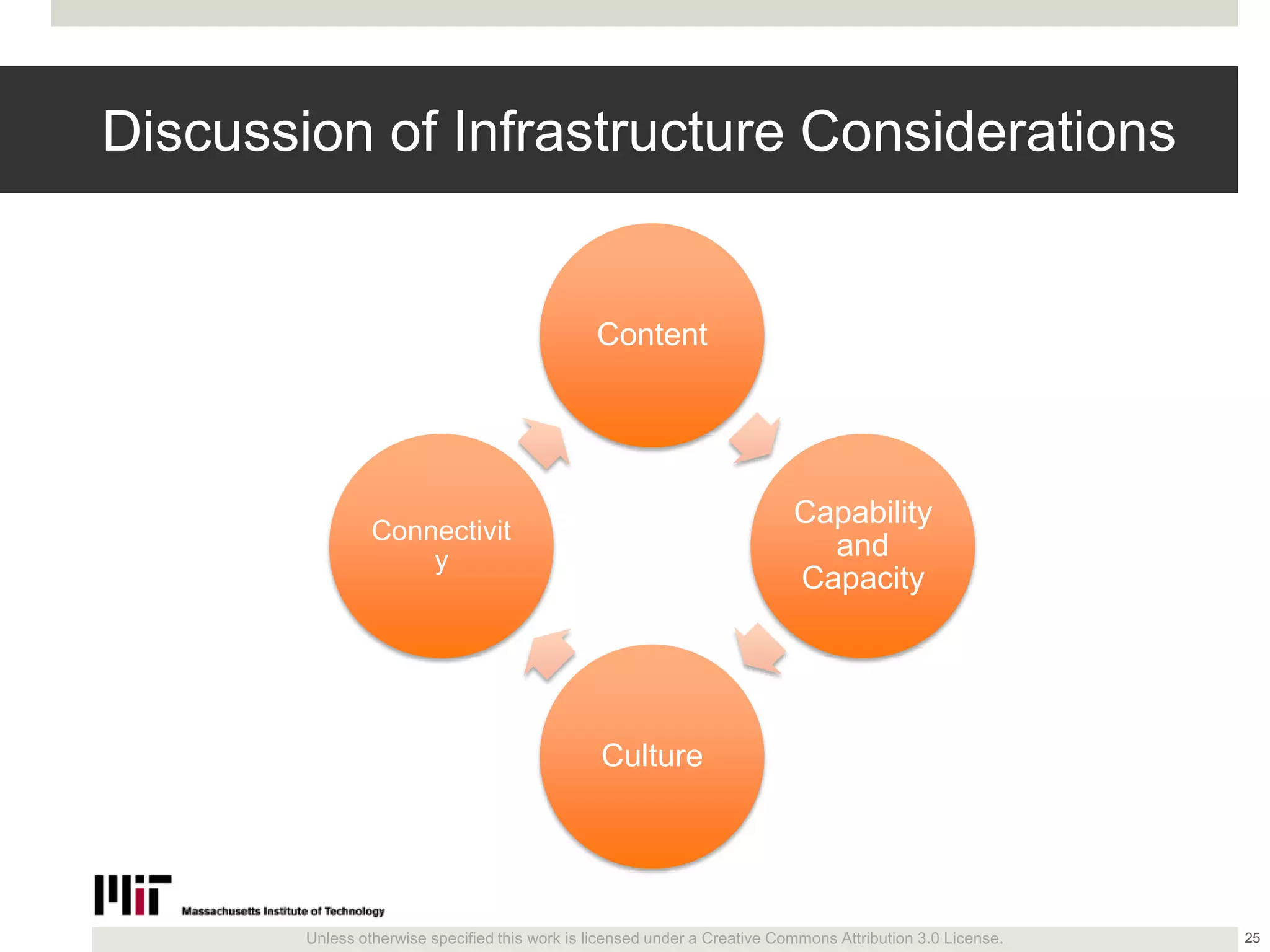
 Understand the infrastructure issues involved with
online program development and delivery with
building capacity at the individual and
organizational levels
 We’ll focus on: Culture, Content, Capability and
Capacity, Connectivity
3
Unless otherwise specified this work is licensed under a Creative Commons Attribution 3.0 License.
Today’s Activity
 You are part of a team planning to move toward an
online B.Ed. Teacher Education Program at your
university.
 What are the roles, who should be the members of the team?
 What are the broad areas (finances, staffing, support the
curriculum, promoting the program, etc.) you need to consider?
 Pick a project (or two) around which to base your proposal
 Presentation to your Vice Chancellor (the group)
4
Part 1: Introductions
5
Unless otherwise specified this work is licensed under a Creative Commons Attribution 3.0 License.
Vijay’s Background
 B.Tech. in Chemical Engineering, M.S. in Industrial
Management & Ed.D. in Future Studies in
Education
 Taught courses in Instructional Computing,
Educational Planning, Teacher Education
 30+ years in EdTech – Developing, Managing,
Innovating educational uses of Information
Technologies
 13+ years in Open Education: Open Educational Resources
and OpenCourseWare
6
Unless otherwise specified this work is licensed under a Creative Commons Attribution 3.0 License.
Brandon’s Background
 B.S. & M.S. in Mechanical Engineering
 Taught multimedia design and open education
 20 years in EdTech
 ~10 years in educational digital libraries: Collections, nationwide
collaborations, quality and peer review
 9+ years in Open Education: Open Educational Resources and
OpenCourseWare
 ―Been There, Done That‖
 Multimedia courseware design and course support, course design,
video production software design, digital libraries, metadata,
learning objects, open educational resources/OpenCourseWare,
…
7
Part 2: Setting the Stage
8
Unless otherwise specified this work is licensed under a Creative Commons Attribution 3.0 License.
Global Events Affecting Education…
 Global financial crisis
 Dramatic reduction in education budgets, continuing rise in
costs, and rise in student loan debt
 Changing perceptions of the value of a university
degree
 Rush for development in many countries
 Scale of the numbers of students eligible for education but for
whom there is no capacity
9
Unless otherwise specified this work is licensed under a Creative Commons Attribution 3.0 License.
A Time of Change…
 Rise of competency-based education / prior learning
assessment
 Recognition of the ―half-life‖ of learning in many
disciplines
 Transition to continual learning in many career paths
 Rapidly changing learner attributes
 Rise of openly accessible learning materials and
opportunities, at scale
 Wikipedia, Open Educational Resources, OpenCourseWare,
Creative Commons licensing
 Khan Academy, Codecademy
10
CC-BY • Adapted From: Muramatsu, B. (2013, April). Rethinking education: Course consumption &
21st century learning. Invited Presentation at Harvard Business Publishing, April 22, 2013.
Unless otherwise specified this work is licensed under a Creative Commons Attribution 3.0 License. 11
Unless otherwise specified this work is licensed under a Creative Commons Attribution 3.0 License.
Local Issues
 Reliability of electricity
 Security
12
Unless otherwise specified this work is licensed under a Creative Commons Attribution 3.0 License.
Our Approach
 Our approach is technology in the service of
pedagogy
 Educational technology is not new
 Digital learning is becoming more dominant
 Current era is based in research and development going back
to the 1960s
 Online learning is not new
 Current era begins in the mid-/late-1990s
13
Part 2: Today / Current State
14
Unless otherwise specified this work is licensed under a Creative Commons Attribution 3.0 License.
What organizations are involved with
providing / supporting infrastructure at
your university?
15
Unless otherwise specified this work is licensed under a Creative Commons Attribution 3.0 License.
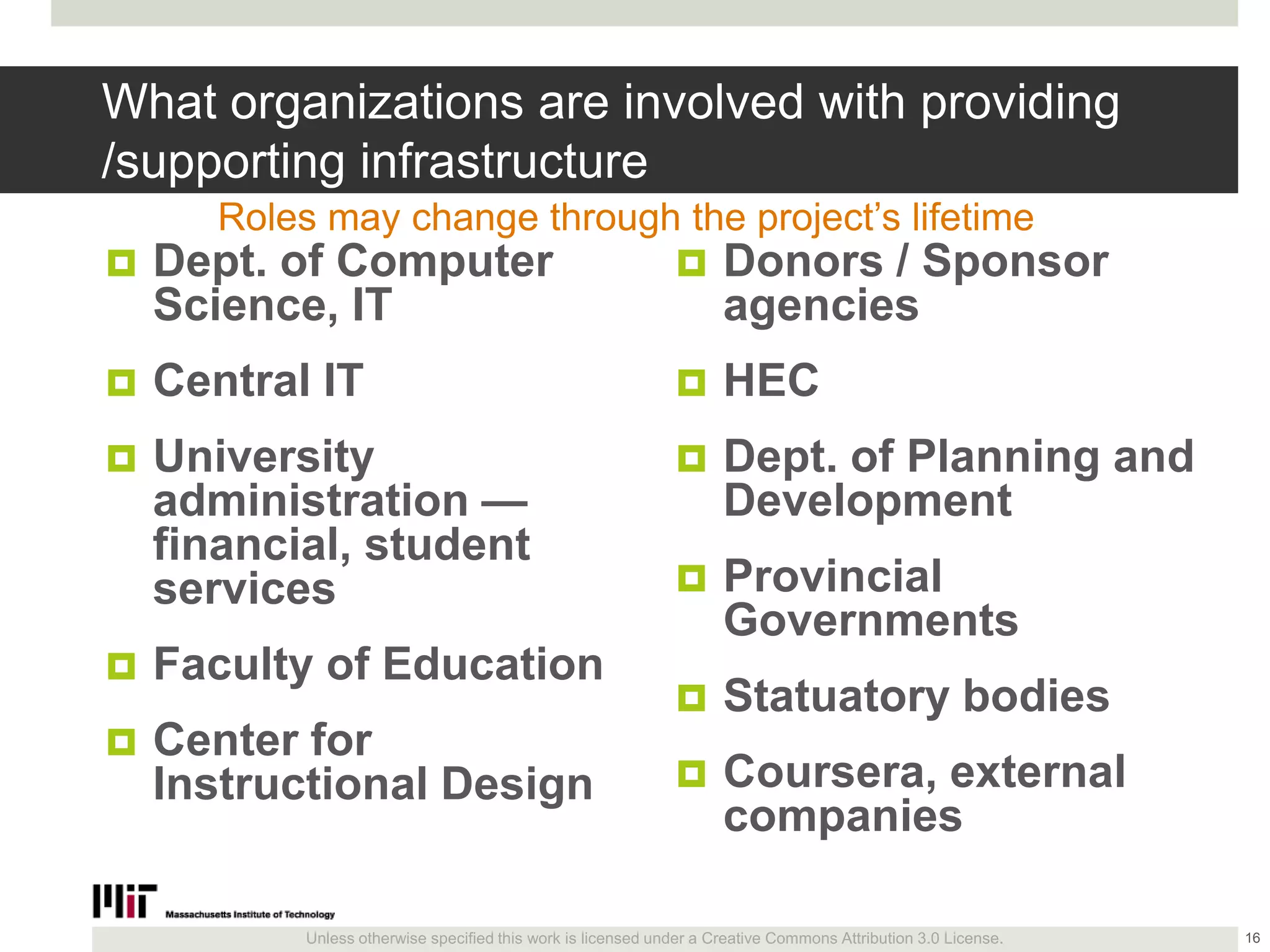
What organizations are involved with providing
/supporting infrastructure
 Dept. of Computer
Science, IT
 Central IT
 University
administration —
financial, student
services
 Faculty of Education
 Center for
Instructional Design
 Donors / Sponsor
agencies
 HEC
 Dept. of Planning and
Development
 Provincial
Governments
 Statuatory bodies
 Coursera, external
companies
16
Roles may change through the project’s lifetime
Unless otherwise specified this work is licensed under a Creative Commons Attribution 3.0 License.
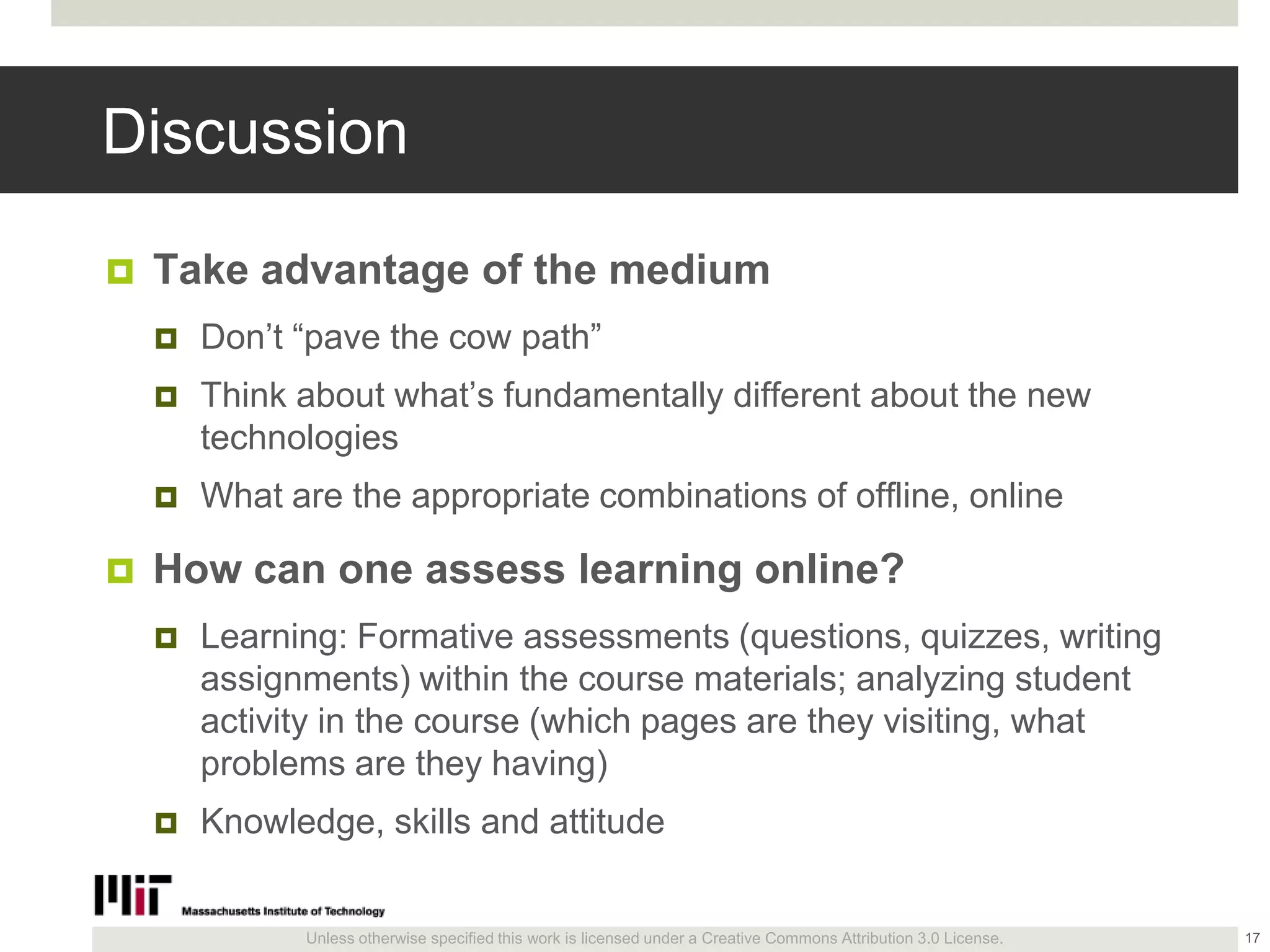
Discussion
 Take advantage of the medium
 Don’t ―pave the cow path‖
 Think about what’s fundamentally different about the new
technologies
 What are the appropriate combinations of offline, online
 How can one assess learning online?
 Learning: Formative assessments (questions, quizzes, writing
assignments) within the course materials; analyzing student
activity in the course (which pages are they visiting, what
problems are they having)
 Knowledge, skills and attitude
17
Unless otherwise specified this work is licensed under a Creative Commons Attribution 3.0 License.
Discussion
 Practical
 Microteaching: Record the teaching, and put online for
feedback
 Trade-offs
 What are your priorities, how will technologies benefit you?
 Educational Technology
 Moving from supporting role, to fear that it’s replacing teaching
18
Unless otherwise specified this work is licensed under a Creative Commons Attribution 3.0 License.
Discussion
 Shift to Learning from Teaching
 Understanding there are many reasons for individuals wanting
to learn
 Answer the question: ―What combinations of in-person,
online are effective in supporting learning?‖
19
Unless otherwise specified this work is licensed under a Creative Commons Attribution 3.0 License.
Discussion
 Challenge: Online courses will involve regular
electricity, technicians, staff to run the courses, etc.
 Do you need to do it all yourself? All at once?
 Can you offer courses developed elsewhere?
 Can you partner with other institutions?
 Services in the cloud?
 ―Do no harm‖ – It doesn’t have to be perfect, just good enough
20
Unless otherwise specified this work is licensed under a Creative Commons Attribution 3.0 License.
Discussion
 Challenge: Quality in online courses
 Challenge: Student acceptance of a course
 Understand your audience: Then test early and often (with
students, the technology)
 Challenge: Multiple universities offering the same
courses
 Collaborate instead of compete, consortium?
 Credit transfer?
 Different courses have different values and assumptions
 What areas are efficient to share? Content production?
Assessment? Facilitation?
21
Unless otherwise specified this work is licensed under a Creative Commons Attribution 3.0 License.
Discussion
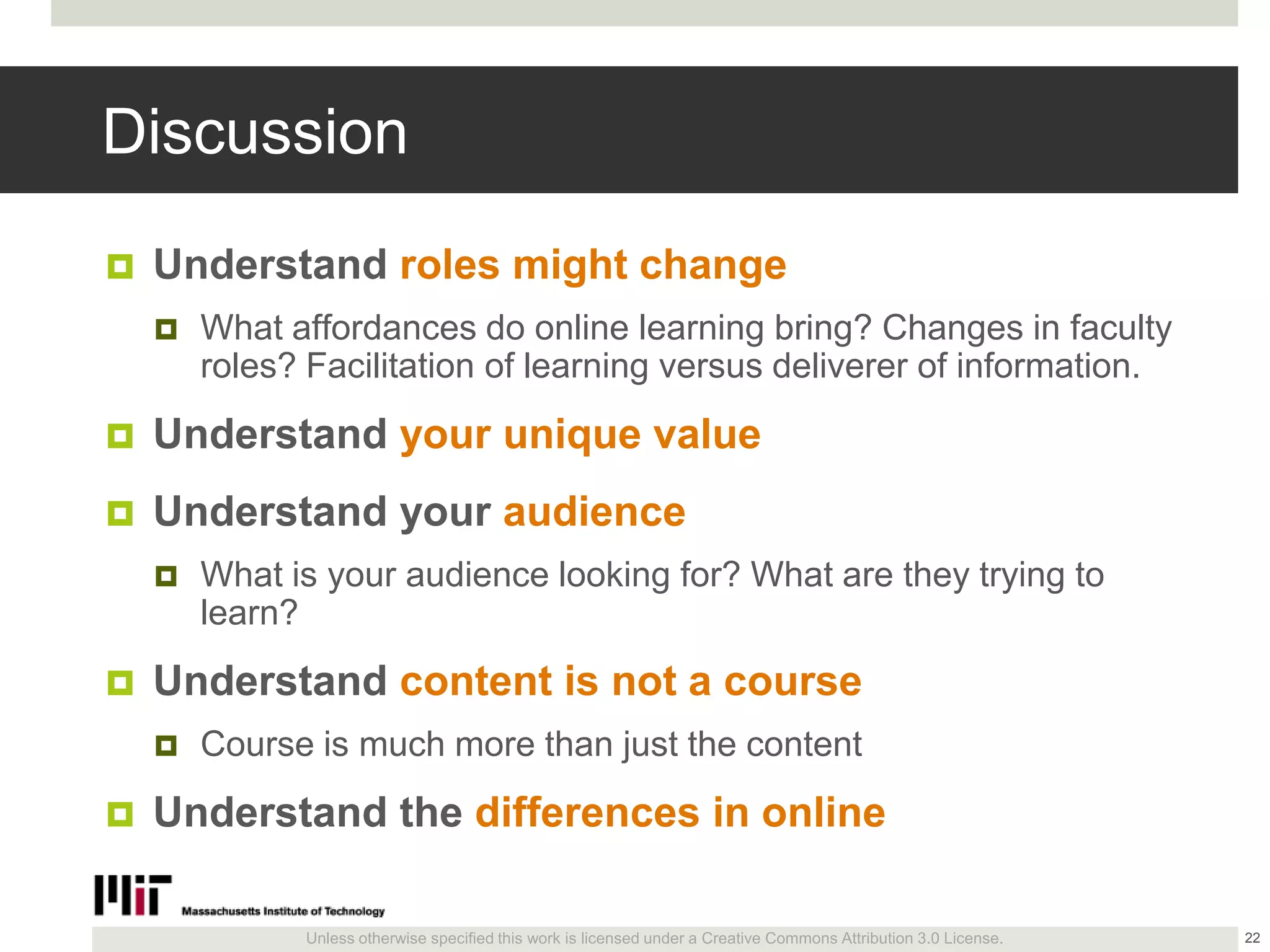
 Understand roles might change
 What affordances do online learning bring? Changes in faculty
roles? Facilitation of learning versus deliverer of information.
 Understand your unique value
 Understand your audience
 What is your audience looking for? What are they trying to
learn?
 Understand content is not a course
 Course is much more than just the content
 Understand the differences in online
22
Part 3: Framing the Process
23
Unless otherwise specified this work is licensed under a Creative Commons Attribution 3.0 License.
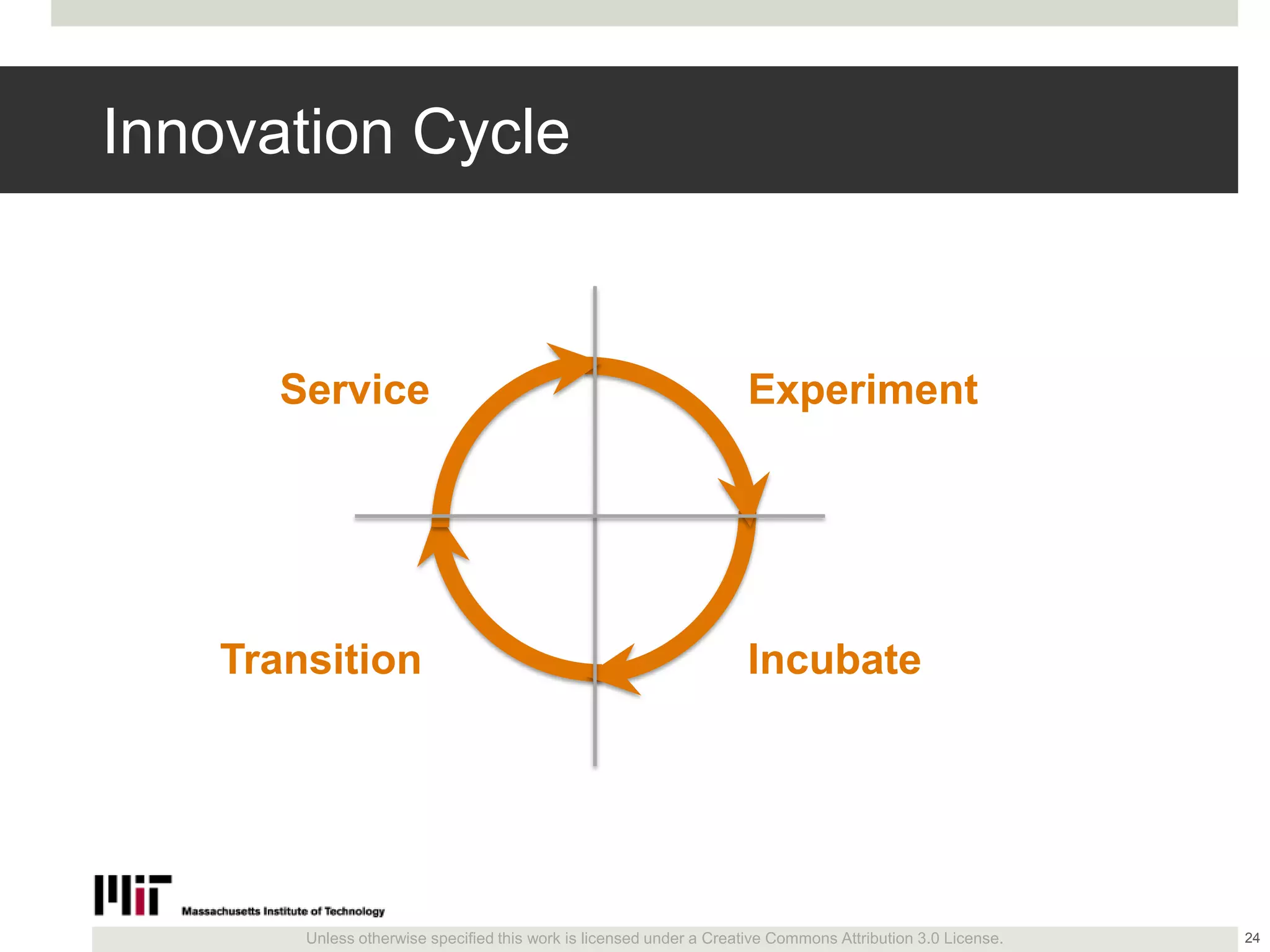
Innovation Cycle
24
Experiment
Incubate
Service
Transition
Unless otherwise specified this work is licensed under a Creative Commons Attribution 3.0 License.
Discussion of Infrastructure Considerations
Content
Capability
and
Capacity
Culture
Connectivit
y
25
Unless otherwise specified this work is licensed under a Creative Commons Attribution 3.0 License.
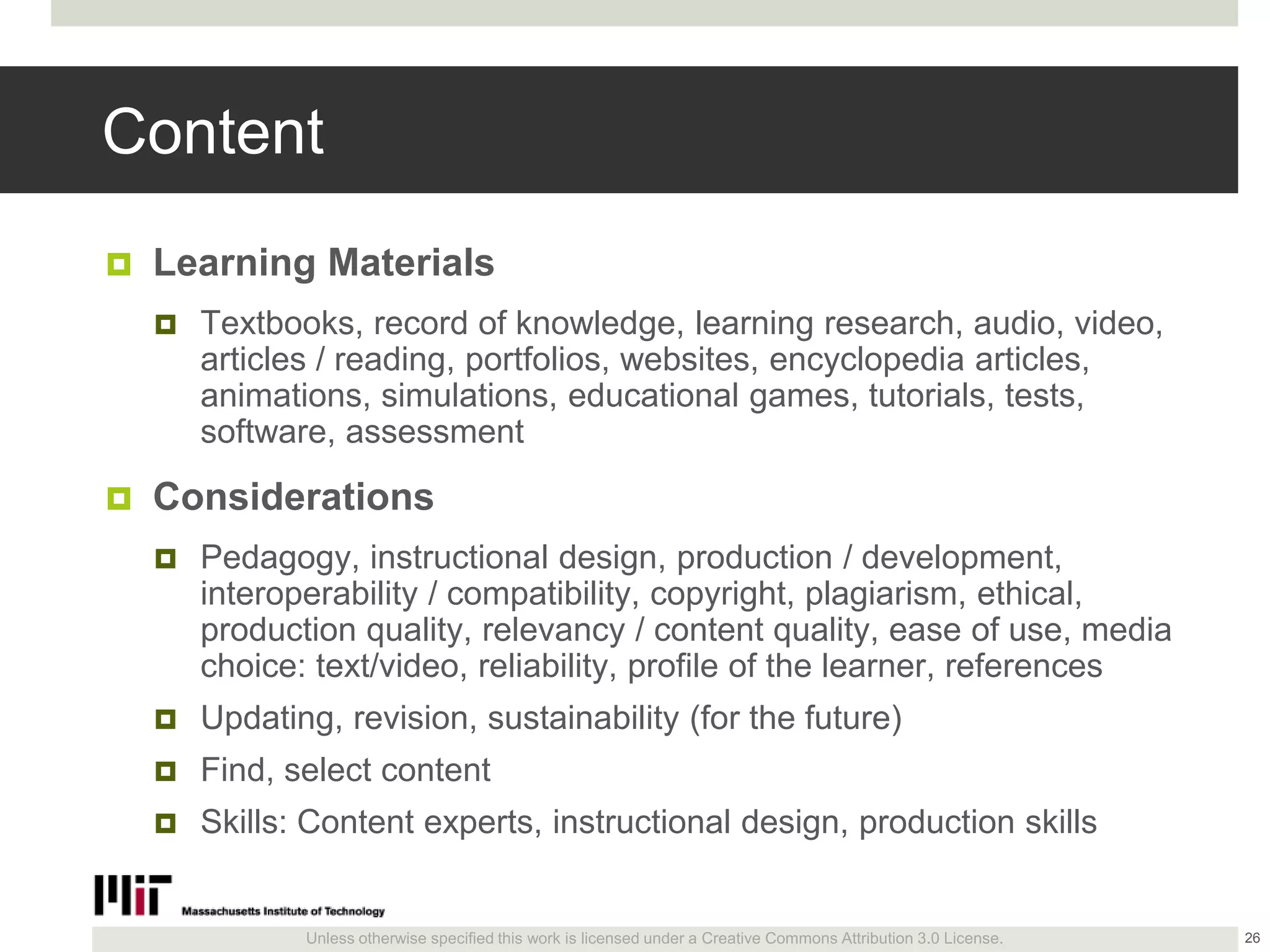
Content
 Learning Materials
 Textbooks, record of knowledge, learning research, audio, video,
articles / reading, portfolios, websites, encyclopedia articles,
animations, simulations, educational games, tutorials, tests,
software, assessment
 Considerations
 Pedagogy, instructional design, production / development,
interoperability / compatibility, copyright, plagiarism, ethical,
production quality, relevancy / content quality, ease of use, media
choice: text/video, reliability, profile of the learner, references
 Updating, revision, sustainability (for the future)
 Find, select content
 Skills: Content experts, instructional design, production skills
26
Unless otherwise specified this work is licensed under a Creative Commons Attribution 3.0 License.
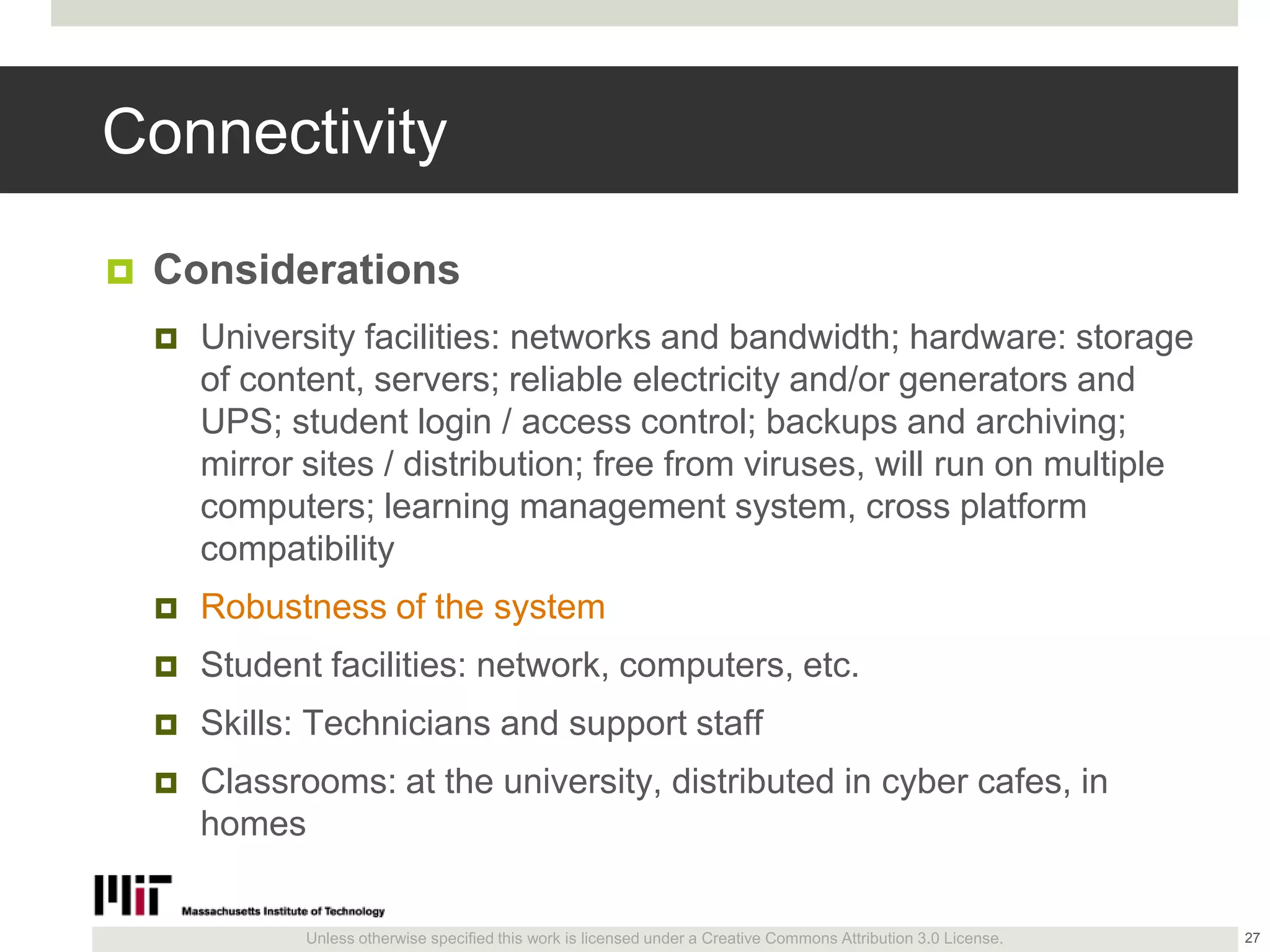
Connectivity
 Considerations
 University facilities: networks and bandwidth; hardware: storage
of content, servers; reliable electricity and/or generators and
UPS; student login / access control; backups and archiving;
mirror sites / distribution; free from viruses, will run on multiple
computers; learning management system, cross platform
compatibility
 Robustness of the system
 Student facilities: network, computers, etc.
 Skills: Technicians and support staff
 Classrooms: at the university, distributed in cyber cafes, in
homes
27
Unless otherwise specified this work is licensed under a Creative Commons Attribution 3.0 License.
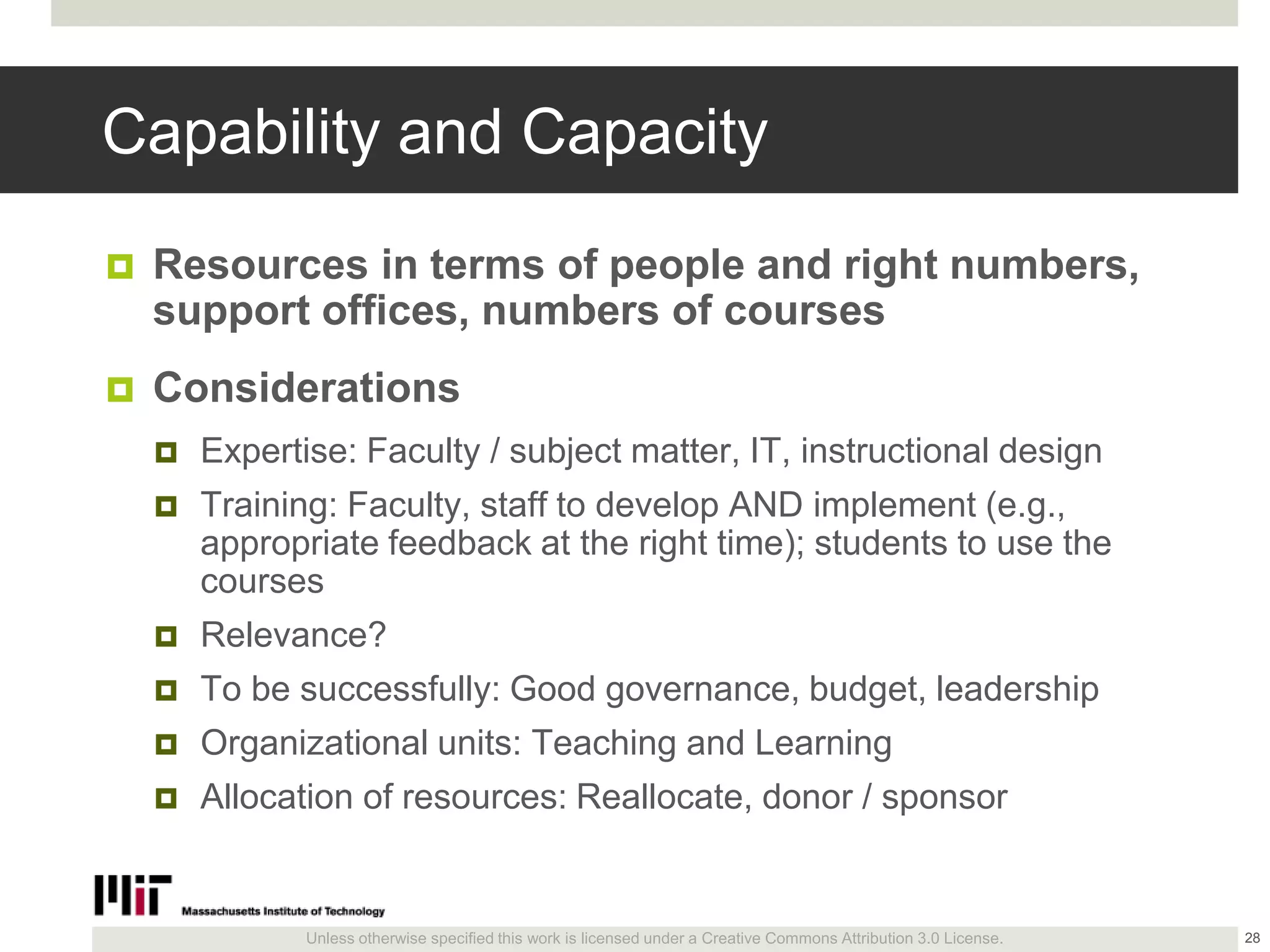
Capability and Capacity
 Resources in terms of people and right numbers,
support offices, numbers of courses
 Considerations
 Expertise: Faculty / subject matter, IT, instructional design
 Training: Faculty, staff to develop AND implement (e.g.,
appropriate feedback at the right time); students to use the
courses
 Relevance?
 To be successfully: Good governance, budget, leadership
 Organizational units: Teaching and Learning
 Allocation of resources: Reallocate, donor / sponsor
28
Unless otherwise specified this work is licensed under a Creative Commons Attribution 3.0 License.
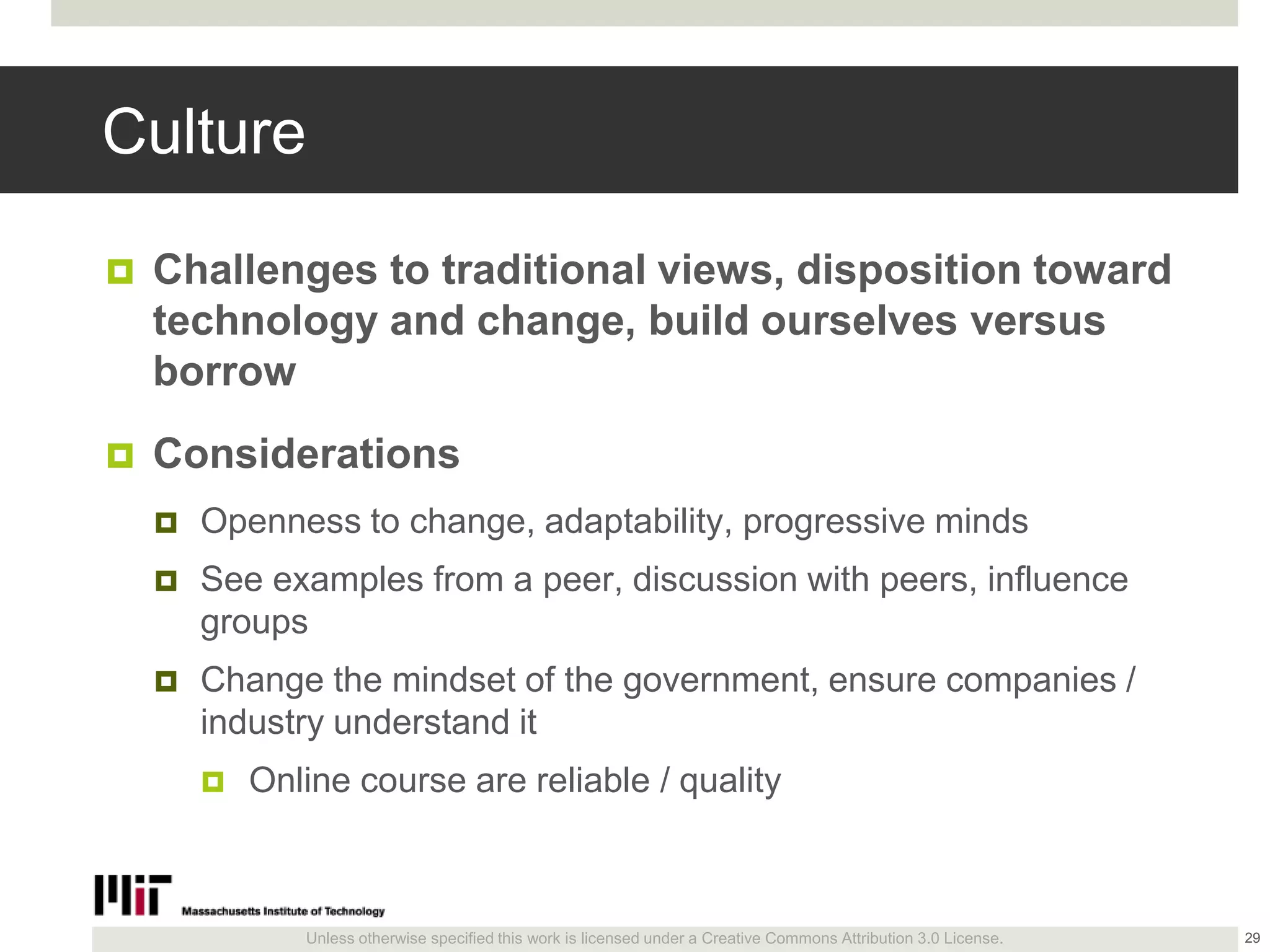
Culture
 Challenges to traditional views, disposition toward
technology and change, build ourselves versus
borrow
 Considerations
 Openness to change, adaptability, progressive minds
 See examples from a peer, discussion with peers, influence
groups
 Change the mindset of the government, ensure companies /
industry understand it
 Online course are reliable / quality
29
Unless otherwise specified this work is licensed under a Creative Commons Attribution 3.0 License.
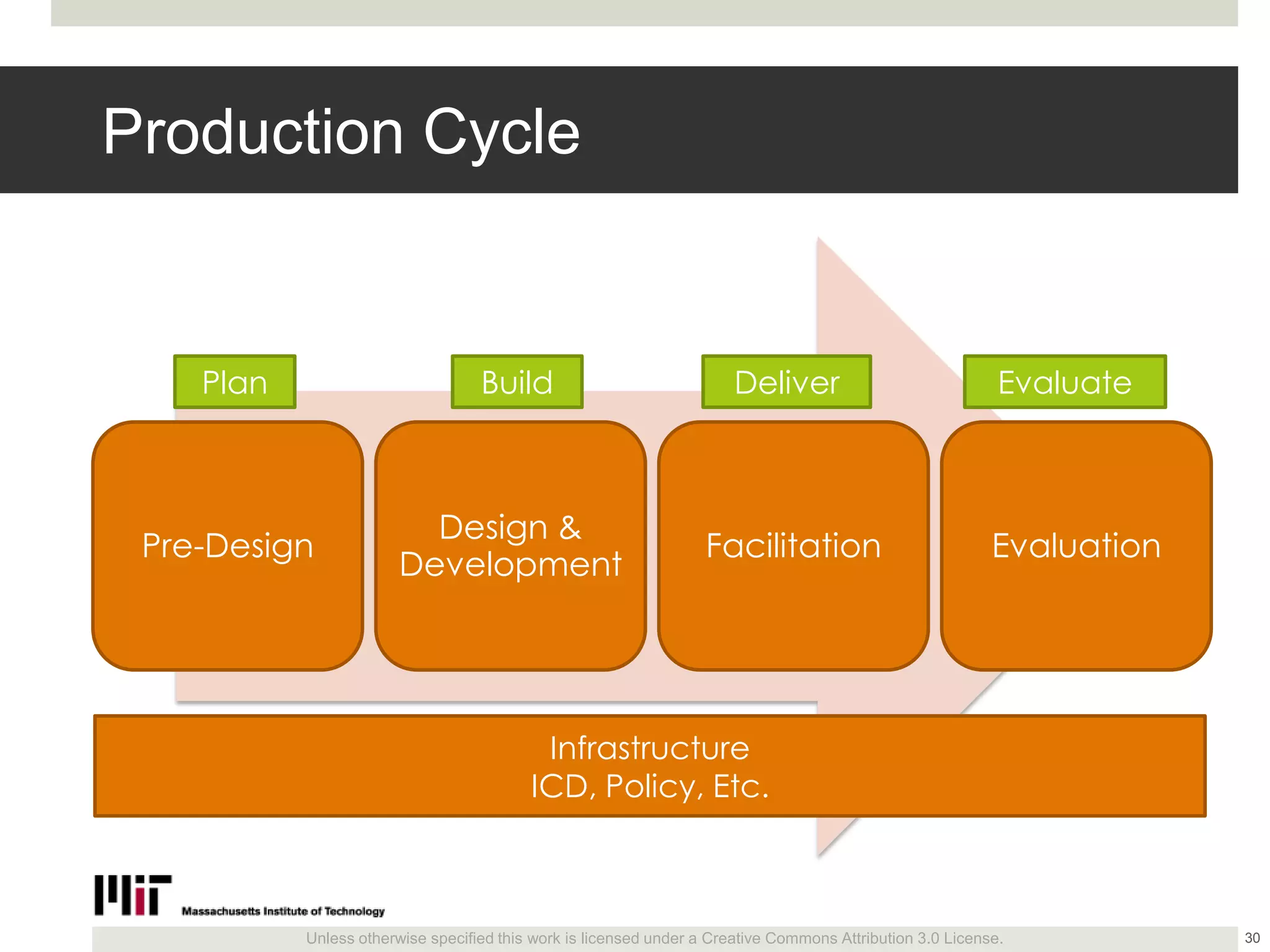
Production Cycle
Pre-Design
Design &
Development
Facilitation Evaluation
30
Infrastructure
ICD, Policy, Etc.
Plan Build Deliver Evaluate
Unless otherwise specified this work is licensed under a Creative Commons Attribution 3.0 License.
Discussion: Course Design Process
 Universities have set process to design process
 Committee of courses, Chair of department appoints subject expertise and
curriculum experts, Teams meet and suggest course, goes to dean, etc.
 Bottom up: faculty and students identify the needs,
 Process
 Themes / Big Ideas
 Learning outcomes
 Objectives
 Faculty members write the scripts
 Experts: Subject expert and curriculum expert (pedagogy,
instructional design), educational technology (from different
departments)
31
Unless otherwise specified this work is licensed under a Creative Commons Attribution 3.0 License.
Discussion
 Experiments and Impact Studies
 Demonstrate that outcomes are as good, if not better, can get
jobs, do knowledge updates
 Think with the end in mind
 Get good jobs, or good higher education
 Replace correspondence with online programs
32
Unless otherwise specified this work is licensed under a Creative Commons Attribution 3.0 License.
What do you tell your Vice Chancellor?
 Cheaper without losing value
 Revenue generation
 Larger audiences with proportionate increase in cost
 Experiment?
 Identify industry/companies that will hire 50% (or some number)
of the graduates – produce the quality that they’re going to hire
 Perhaps start areas with less risk
 For example with non-credit courses, professional
development
 Be mindful of inadvertently limiting application – ―It can only
be done for these specific areas‖
33
Lunch
34
Unless otherwise specified this work is licensed under a Creative Commons Attribution 3.0 License.
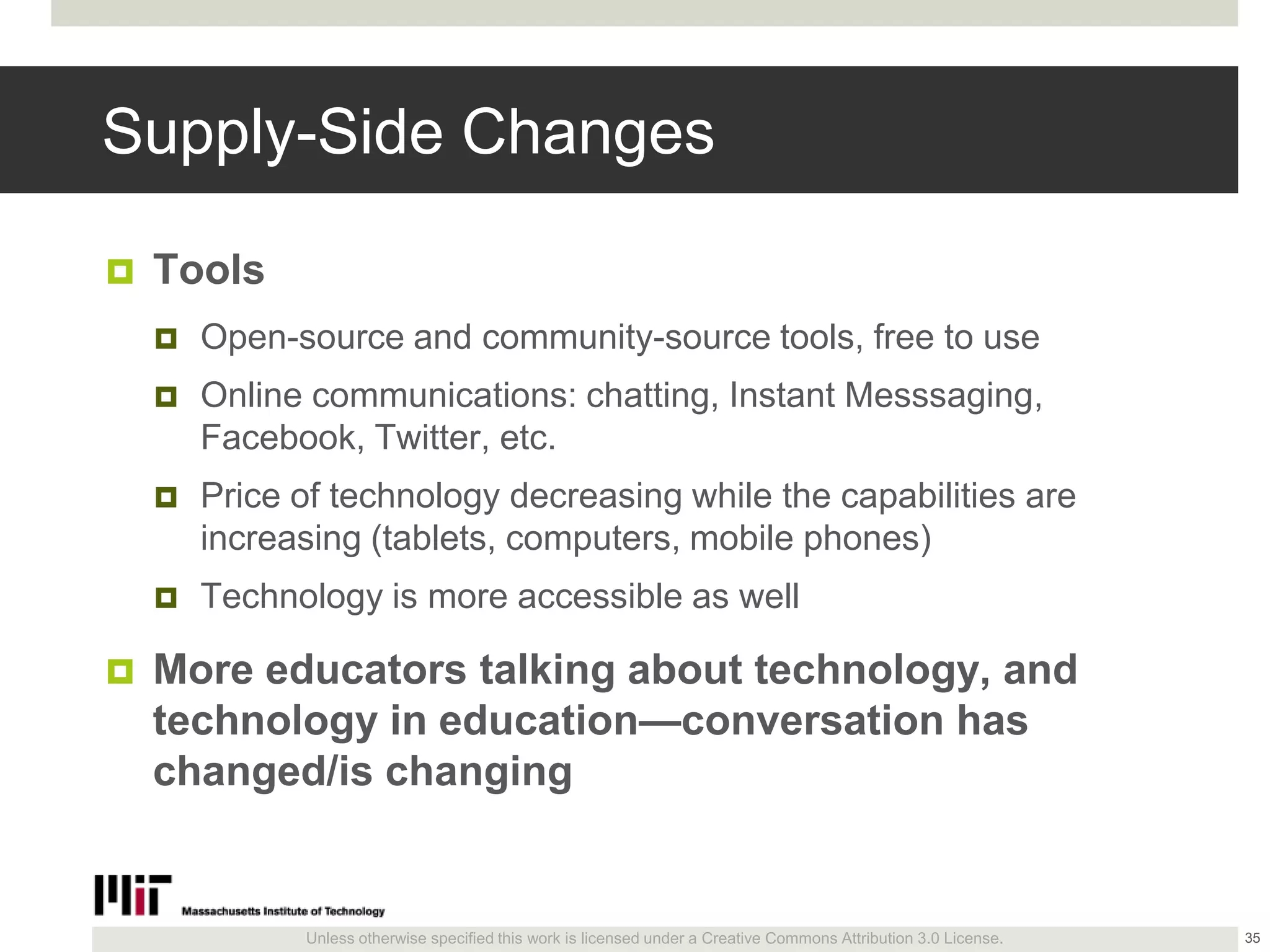
Supply-Side Changes
 Tools
 Open-source and community-source tools, free to use
 Online communications: chatting, Instant Messsaging,
Facebook, Twitter, etc.
 Price of technology decreasing while the capabilities are
increasing (tablets, computers, mobile phones)
 Technology is more accessible as well
 More educators talking about technology, and
technology in education—conversation has
changed/is changing
35
Unless otherwise specified this work is licensed under a Creative Commons Attribution 3.0 License.
Changes…
 Shift from scarcity to abundance
 There’s lots of content available
 Networks/access means we’re not limited to physical classrooms
 Institutions are predicated on the notion of scarcity
 Example: Video production
 Economic Needs -> Living and Learning at the same
time
 Demand side: Individuals aren’t able to take full degree programs,
or want to take a course while riding the bus
 4 year degrees? Shorter? What expectations do we
have, should we have?
36
Unless otherwise specified this work is licensed under a Creative Commons Attribution 3.0 License.
Today’s Activity
 You are part of a team planning to move toward an
online B.Ed. Teacher Education Program at your
university.
 What are the roles, who should be the members of the team?
 What are the broad areas (finances, staffing, support the
curriculum, promoting the program, etc.) you need to consider?
 Pick a project (or two) around which to base your proposal
 Presentation to your Vice Chancellor (the group)
37
Unless otherwise specified this work is licensed under a Creative Commons Attribution 3.0 License.
Group #4: B.Ed. Online Program
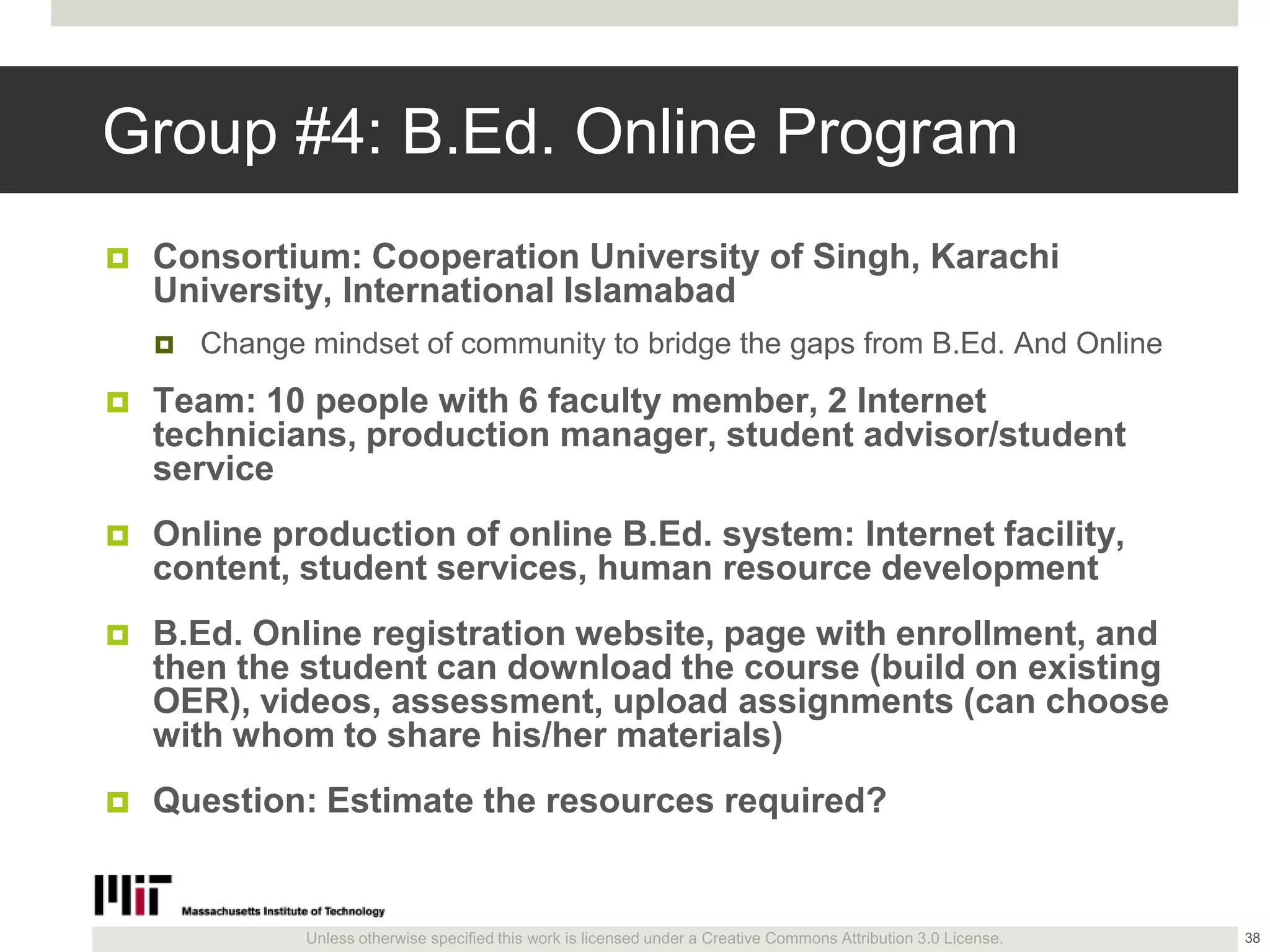
 Consortium: Cooperation University of Singh, Karachi
University, International Islamabad
 Change mindset of community to bridge the gaps from B.Ed. And Online
 Team: 10 people with 6 faculty member, 2 Internet
technicians, production manager, student advisor/student
service
 Online production of online B.Ed. system: Internet facility,
content, student services, human resource development
 B.Ed. Online registration website, page with enrollment, and
then the student can download the course (build on existing
OER), videos, assessment, upload assignments (can choose
with whom to share his/her materials)
 Question: Estimate the resources required?
38
Unless otherwise specified this work is licensed under a Creative Commons Attribution 3.0 License.
Group #2: B.Ed. Online Program
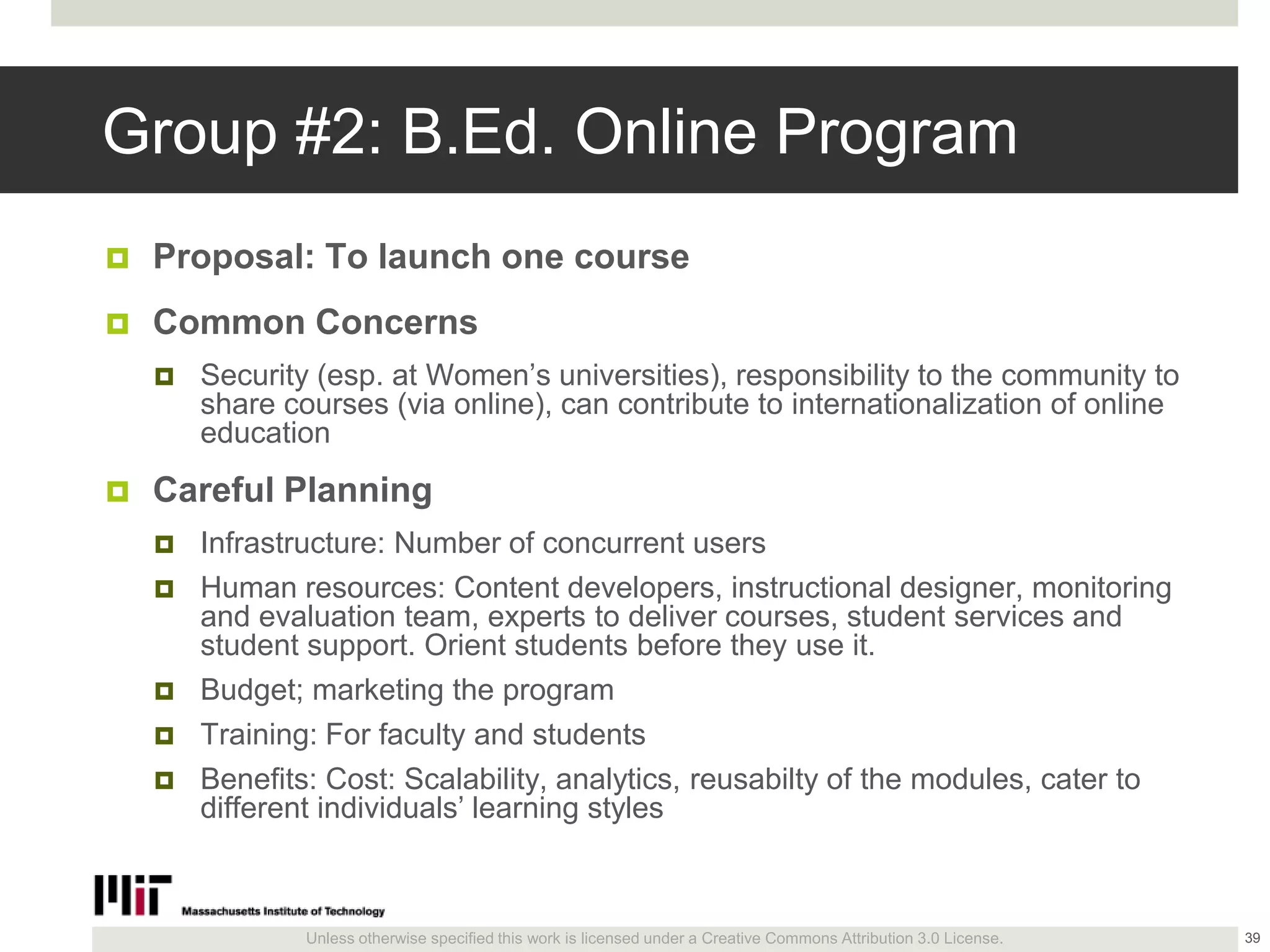
 Proposal: To launch one course
 Common Concerns
 Security (esp. at Women’s universities), responsibility to the community to
share courses (via online), can contribute to internationalization of online
education
 Careful Planning
 Infrastructure: Number of concurrent users
 Human resources: Content developers, instructional designer, monitoring
and evaluation team, experts to deliver courses, student services and
student support. Orient students before they use it.
 Budget; marketing the program
 Training: For faculty and students
 Benefits: Cost: Scalability, analytics, reusabilty of the modules, cater to
different individuals’ learning styles
39
Unless otherwise specified this work is licensed under a Creative Commons Attribution 3.0 License.
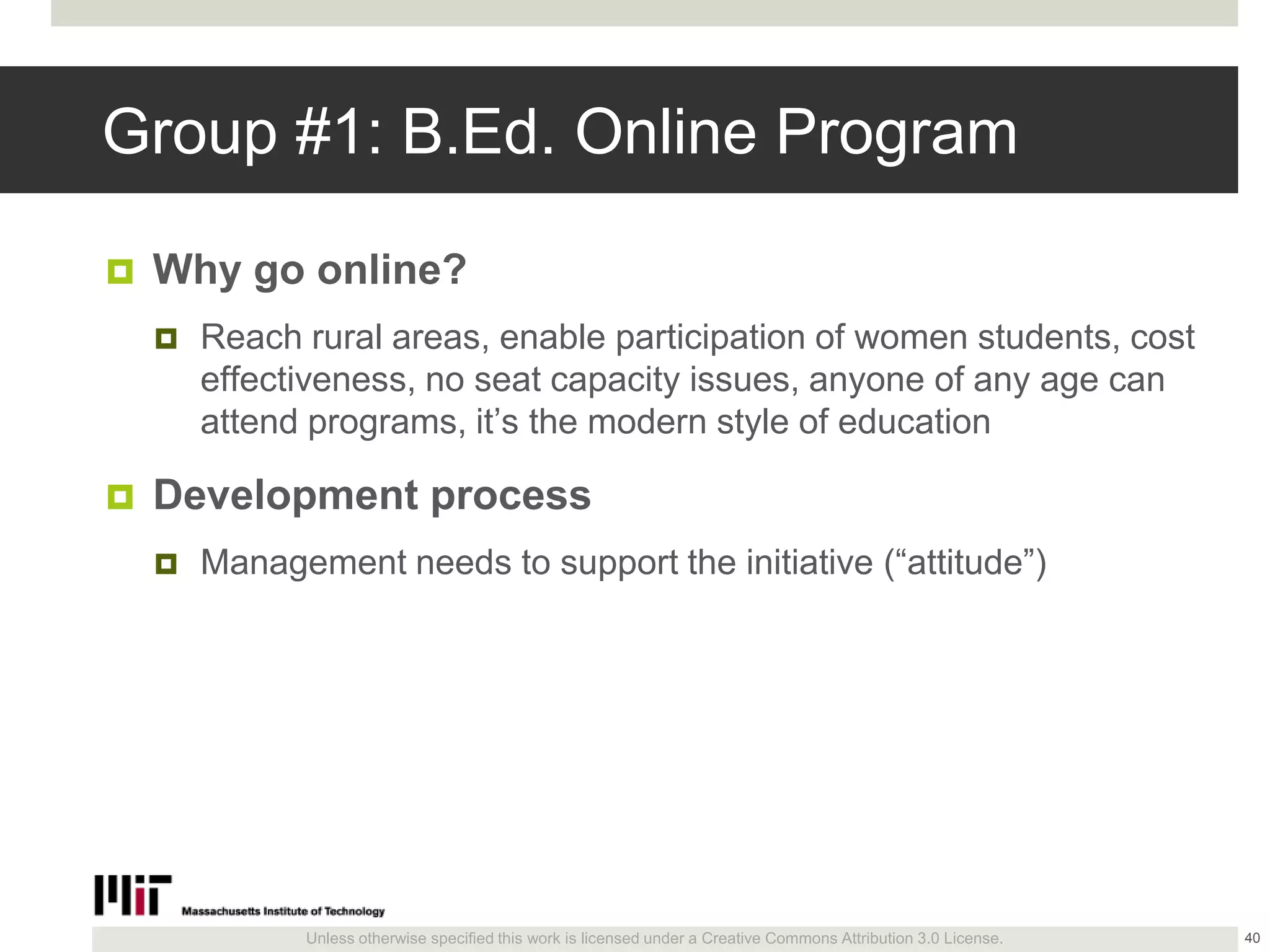
Group #1: B.Ed. Online Program
 Why go online?
 Reach rural areas, enable participation of women students, cost
effectiveness, no seat capacity issues, anyone of any age can
attend programs, it’s the modern style of education
 Development process
 Management needs to support the initiative (―attitude‖)
40
Unless otherwise specified this work is licensed under a Creative Commons Attribution 3.0 License.
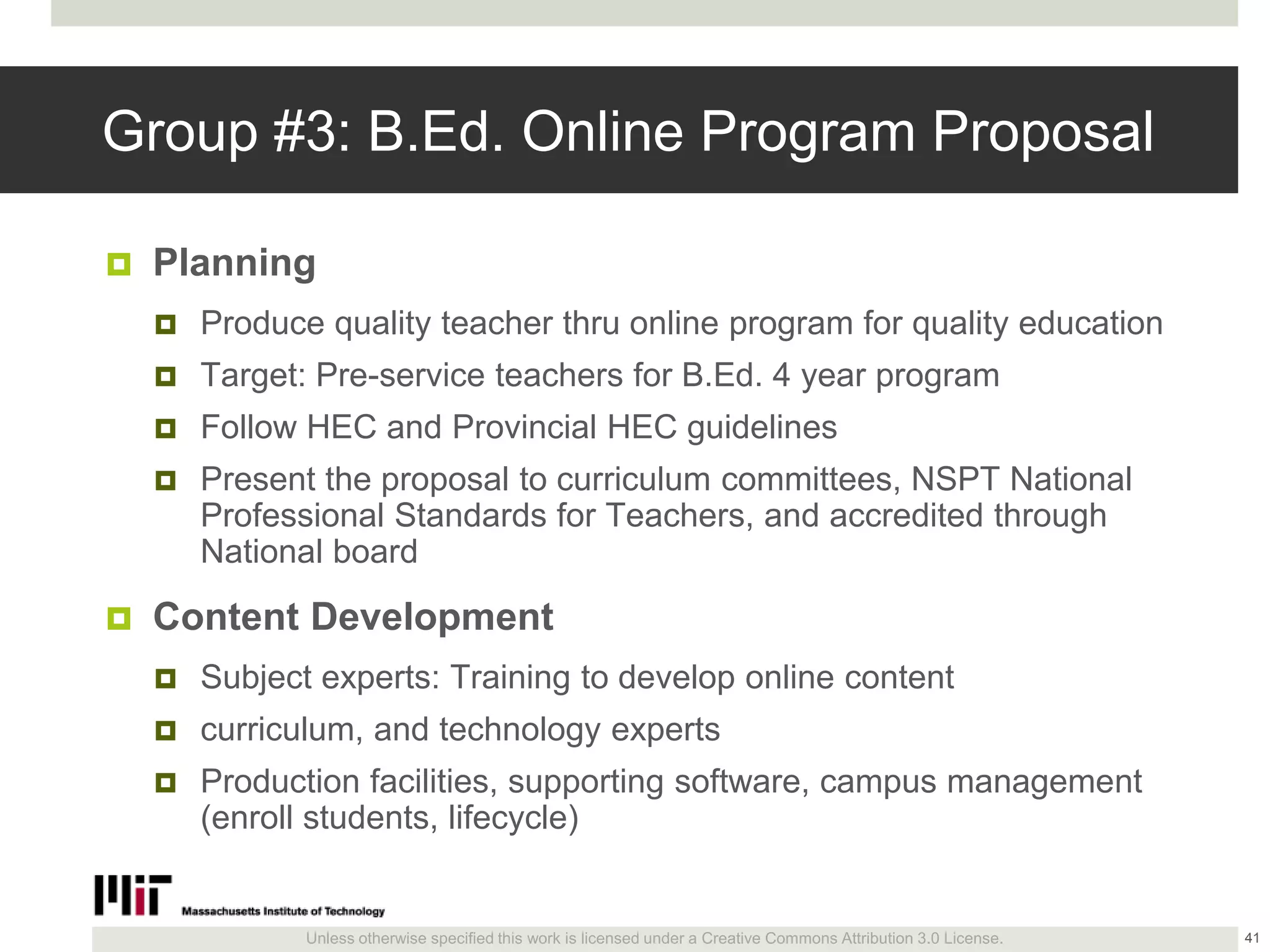
Group #3: B.Ed. Online Program Proposal
 Planning
 Produce quality teacher thru online program for quality education
 Target: Pre-service teachers for B.Ed. 4 year program
 Follow HEC and Provincial HEC guidelines
 Present the proposal to curriculum committees, NSPT National
Professional Standards for Teachers, and accredited through
National board
 Content Development
 Subject experts: Training to develop online content
 curriculum, and technology experts
 Production facilities, supporting software, campus management
(enroll students, lifecycle)
41
Unless otherwise specified this work is licensed under a Creative Commons Attribution 3.0 License.
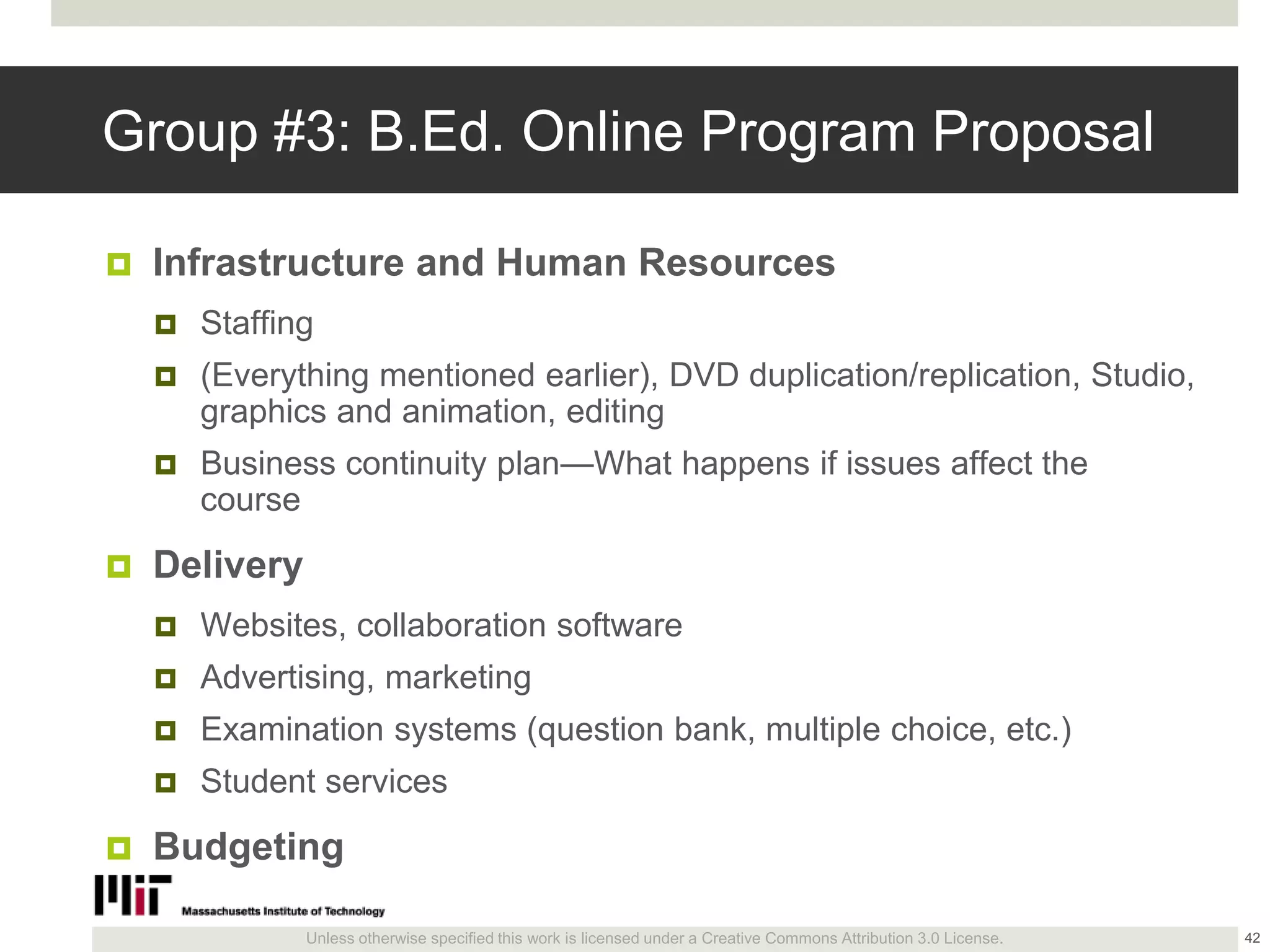
Group #3: B.Ed. Online Program Proposal
 Infrastructure and Human Resources
 Staffing
 (Everything mentioned earlier), DVD duplication/replication, Studio,
graphics and animation, editing
 Business continuity plan—What happens if issues affect the
course
 Delivery
 Websites, collaboration software
 Advertising, marketing
 Examination systems (question bank, multiple choice, etc.)
 Student services
 Budgeting
42
Unless otherwise specified this work is licensed under a Creative Commons Attribution 3.0 License.
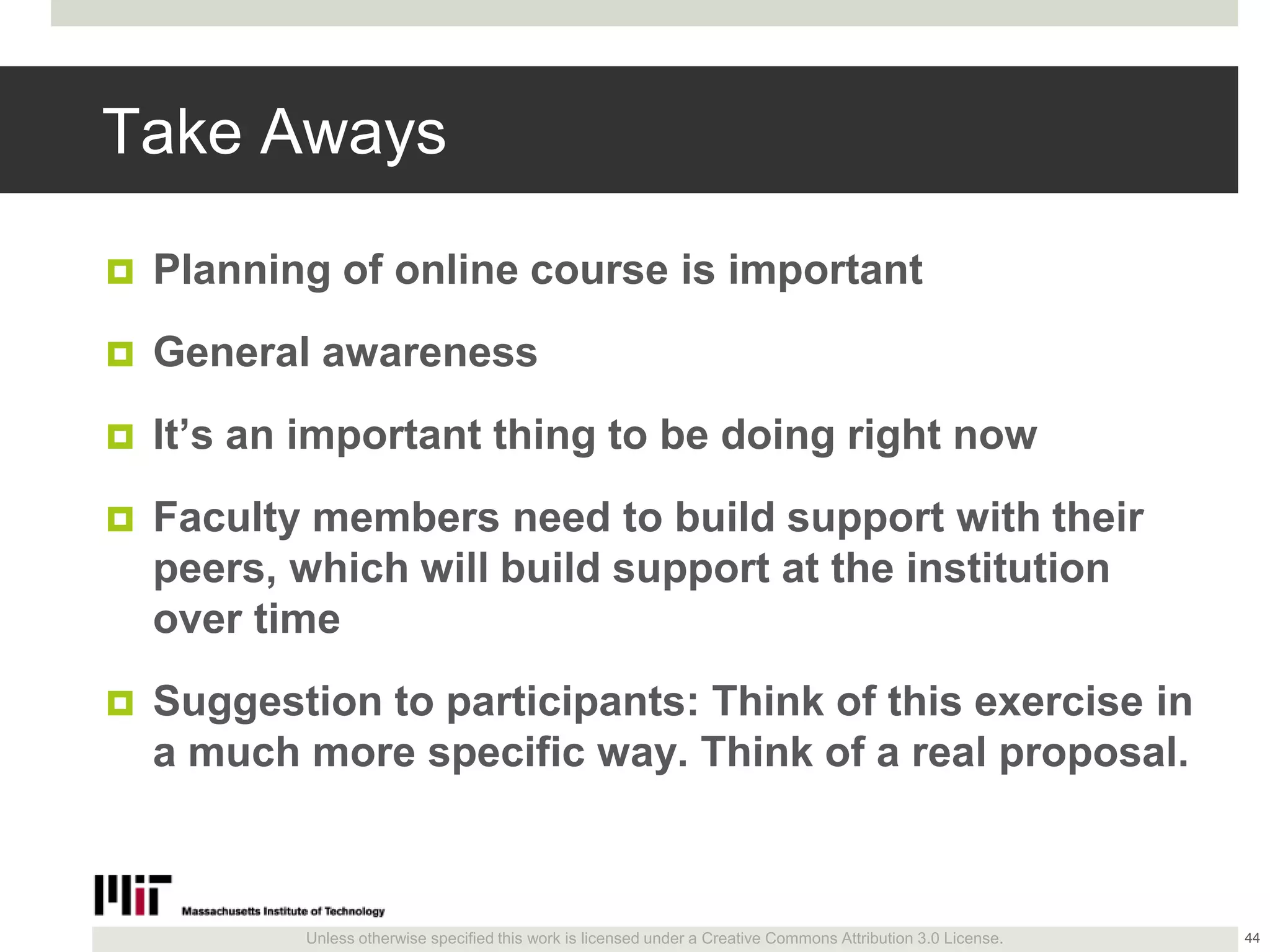
Questions
 Develop higher order learning
 And the assessments need to match those learning higher order
skills
 What are the differences between Virtual University
Courses and online courses
 Bilingual courses
 Entirely online
 Don’t generalize as a question of ―Quality‖, but rather
the set of questions that should be asked
 Efficient (learners’ time and teacher’s time)
 For a course learning outcomes are met
43
Unless otherwise specified this work is licensed under a Creative Commons Attribution 3.0 License.
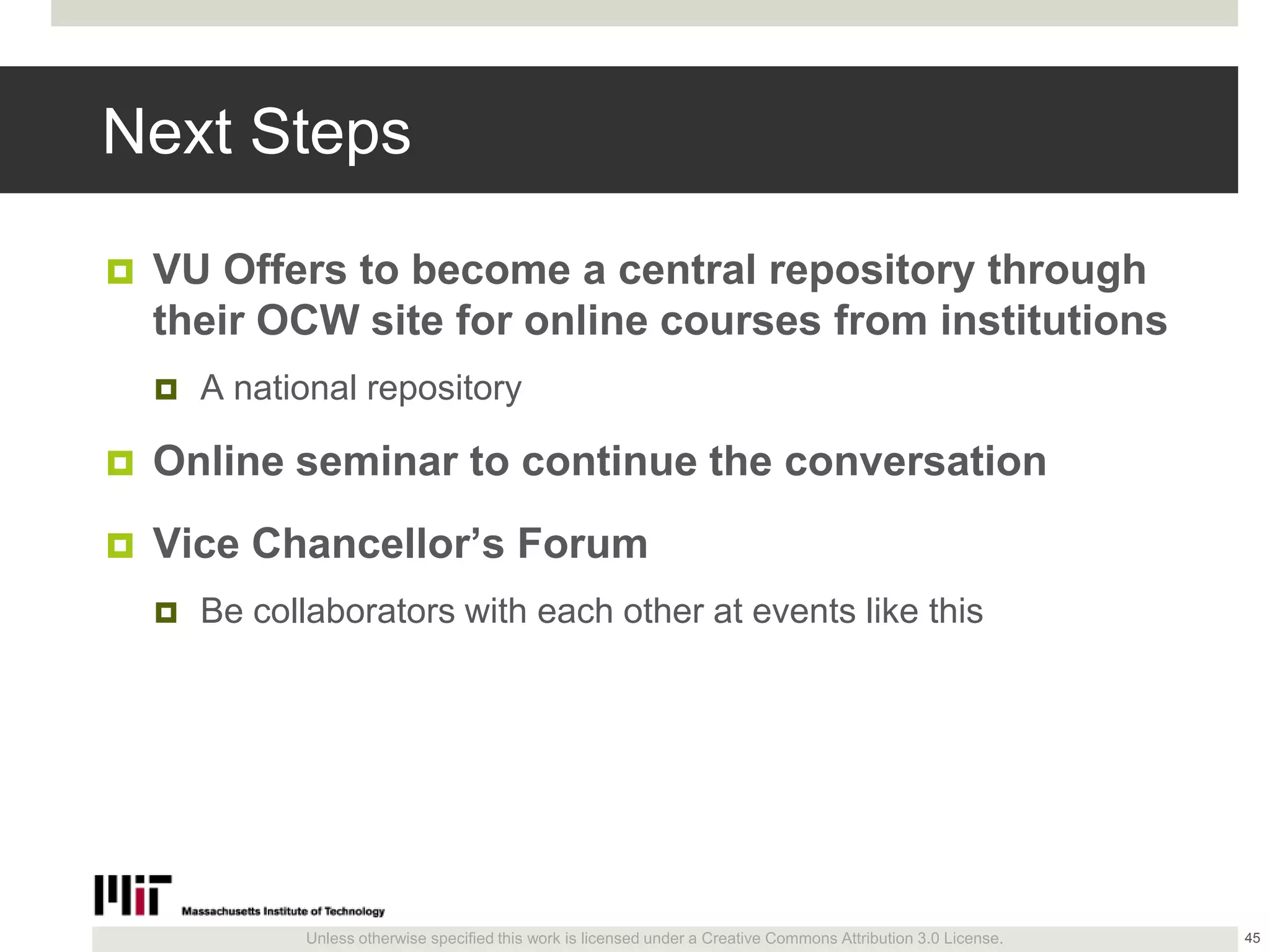
Take Aways
 Planning of online course is important
 General awareness
 It’s an important thing to be doing right now
 Faculty members need to build support with their
peers, which will build support at the institution
over time
 Suggestion to participants: Think of this exercise in
a much more specific way. Think of a real proposal.
44
Unless otherwise specified this work is licensed under a Creative Commons Attribution 3.0 License.
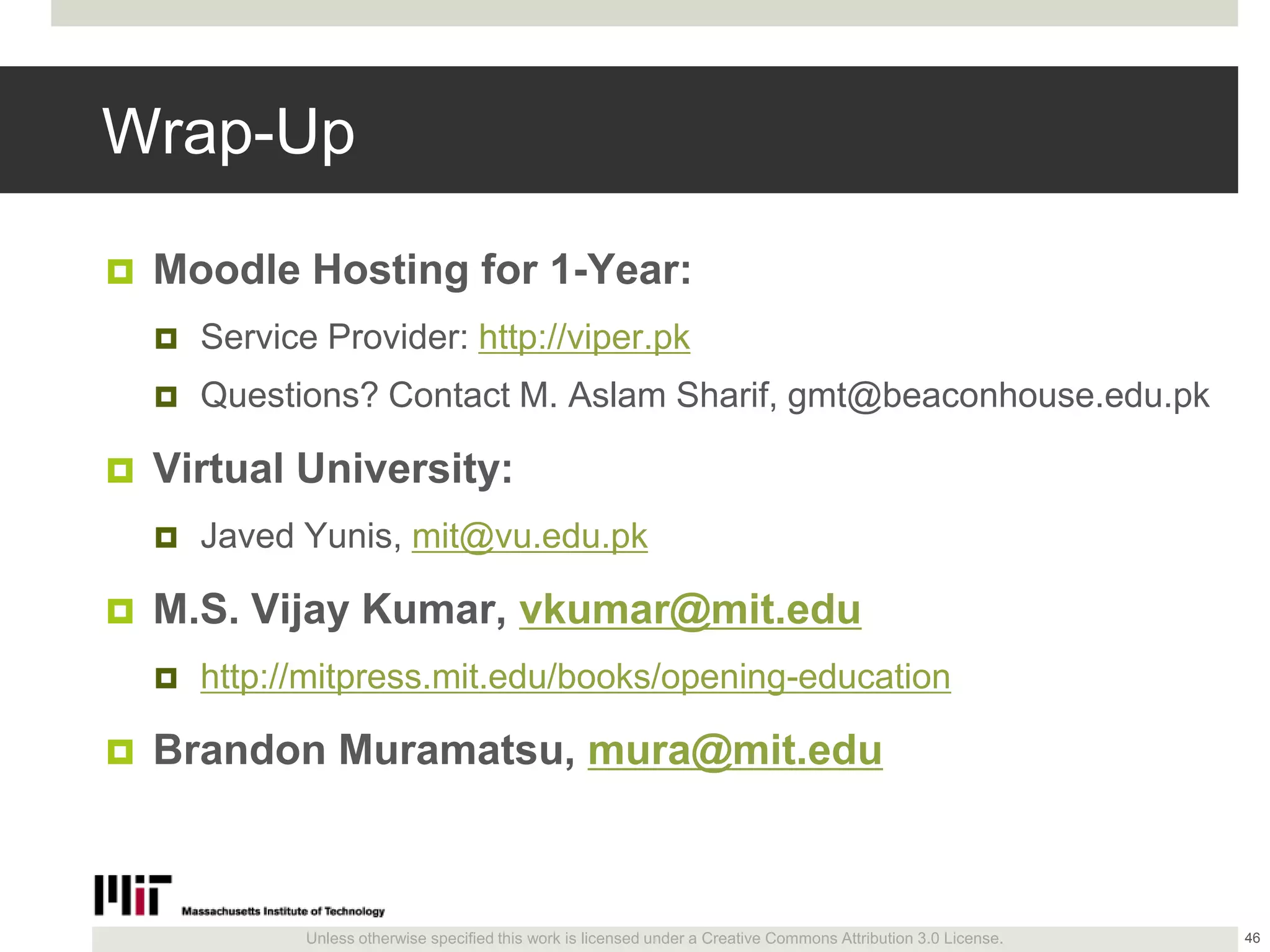
Next Steps
 VU Offers to become a central repository through
their OCW site for online courses from institutions
 A national repository
 Online seminar to continue the conversation
 Vice Chancellor’s Forum
 Be collaborators with each other at events like this
45
Unless otherwise specified this work is licensed under a Creative Commons Attribution 3.0 License.
Wrap-Up
 Moodle Hosting for 1-Year:
 Service Provider: http://viper.pk
 Questions? Contact M. Aslam Sharif, gmt@beaconhouse.edu.pk
 Virtual University:
 Javed Yunis, mit@vu.edu.pk
 M.S. Vijay Kumar, vkumar@mit.edu
 http://mitpress.mit.edu/books/opening-education
 Brandon Muramatsu, mura@mit.edu
46

Administrative and Infrastructure Issues for Online Courses

  • 1.
    Administrative and InfrastructureIssues for Online Courses M.S. Vijay Kumar Brandon Muramatsu September 15, 2013 1Unless otherwise specified this work is licensed under a Creative Commons Attribution 3.0 License. Cite as: Kumar, V. & Muramatsu, B. (2013a, September). Administrative and infrastructure issues for online courses. Workshop presented to the EDC Pre-STEP Program. Lahore: Pakistan.
  • 2.
    Unless otherwise specifiedthis work is licensed under a Creative Commons Attribution 3.0 License. Admin/Infrastructure Workshop Agenda  Part 1: Introduction  Part 2: Setting the Stage  Global drivers, Possible projects  Part 3: Framing the Process  Lunch  Part 4: Activity 2
  • 3.
    Unless otherwise specifiedthis work is licensed under a Creative Commons Attribution 3.0 License. Goals and Objectives  Understand the infrastructure issues involved with online program development and delivery with building capacity at the individual and organizational levels  We’ll focus on: Culture, Content, Capability and Capacity, Connectivity 3
  • 4.
    Unless otherwise specifiedthis work is licensed under a Creative Commons Attribution 3.0 License. Today’s Activity  You are part of a team planning to move toward an online B.Ed. Teacher Education Program at your university.  What are the roles, who should be the members of the team?  What are the broad areas (finances, staffing, support the curriculum, promoting the program, etc.) you need to consider?  Pick a project (or two) around which to base your proposal  Presentation to your Vice Chancellor (the group) 4
  • 5.
  • 6.
    Unless otherwise specifiedthis work is licensed under a Creative Commons Attribution 3.0 License. Vijay’s Background  B.Tech. in Chemical Engineering, M.S. in Industrial Management & Ed.D. in Future Studies in Education  Taught courses in Instructional Computing, Educational Planning, Teacher Education  30+ years in EdTech – Developing, Managing, Innovating educational uses of Information Technologies  13+ years in Open Education: Open Educational Resources and OpenCourseWare 6
  • 7.
    Unless otherwise specifiedthis work is licensed under a Creative Commons Attribution 3.0 License. Brandon’s Background  B.S. & M.S. in Mechanical Engineering  Taught multimedia design and open education  20 years in EdTech  ~10 years in educational digital libraries: Collections, nationwide collaborations, quality and peer review  9+ years in Open Education: Open Educational Resources and OpenCourseWare  ―Been There, Done That‖  Multimedia courseware design and course support, course design, video production software design, digital libraries, metadata, learning objects, open educational resources/OpenCourseWare, … 7
  • 8.
    Part 2: Settingthe Stage 8
  • 9.
    Unless otherwise specifiedthis work is licensed under a Creative Commons Attribution 3.0 License. Global Events Affecting Education…  Global financial crisis  Dramatic reduction in education budgets, continuing rise in costs, and rise in student loan debt  Changing perceptions of the value of a university degree  Rush for development in many countries  Scale of the numbers of students eligible for education but for whom there is no capacity 9
  • 10.
    Unless otherwise specifiedthis work is licensed under a Creative Commons Attribution 3.0 License. A Time of Change…  Rise of competency-based education / prior learning assessment  Recognition of the ―half-life‖ of learning in many disciplines  Transition to continual learning in many career paths  Rapidly changing learner attributes  Rise of openly accessible learning materials and opportunities, at scale  Wikipedia, Open Educational Resources, OpenCourseWare, Creative Commons licensing  Khan Academy, Codecademy 10 CC-BY • Adapted From: Muramatsu, B. (2013, April). Rethinking education: Course consumption & 21st century learning. Invited Presentation at Harvard Business Publishing, April 22, 2013.
  • 11.
    Unless otherwise specifiedthis work is licensed under a Creative Commons Attribution 3.0 License. 11
  • 12.
    Unless otherwise specifiedthis work is licensed under a Creative Commons Attribution 3.0 License. Local Issues  Reliability of electricity  Security 12
  • 13.
    Unless otherwise specifiedthis work is licensed under a Creative Commons Attribution 3.0 License. Our Approach  Our approach is technology in the service of pedagogy  Educational technology is not new  Digital learning is becoming more dominant  Current era is based in research and development going back to the 1960s  Online learning is not new  Current era begins in the mid-/late-1990s 13
  • 14.
    Part 2: Today/ Current State 14
  • 15.
    Unless otherwise specifiedthis work is licensed under a Creative Commons Attribution 3.0 License. What organizations are involved with providing / supporting infrastructure at your university? 15
  • 16.
    Unless otherwise specifiedthis work is licensed under a Creative Commons Attribution 3.0 License. What organizations are involved with providing /supporting infrastructure  Dept. of Computer Science, IT  Central IT  University administration — financial, student services  Faculty of Education  Center for Instructional Design  Donors / Sponsor agencies  HEC  Dept. of Planning and Development  Provincial Governments  Statuatory bodies  Coursera, external companies 16 Roles may change through the project’s lifetime
  • 17.
    Unless otherwise specifiedthis work is licensed under a Creative Commons Attribution 3.0 License. Discussion  Take advantage of the medium  Don’t ―pave the cow path‖  Think about what’s fundamentally different about the new technologies  What are the appropriate combinations of offline, online  How can one assess learning online?  Learning: Formative assessments (questions, quizzes, writing assignments) within the course materials; analyzing student activity in the course (which pages are they visiting, what problems are they having)  Knowledge, skills and attitude 17
  • 18.
    Unless otherwise specifiedthis work is licensed under a Creative Commons Attribution 3.0 License. Discussion  Practical  Microteaching: Record the teaching, and put online for feedback  Trade-offs  What are your priorities, how will technologies benefit you?  Educational Technology  Moving from supporting role, to fear that it’s replacing teaching 18
  • 19.
    Unless otherwise specifiedthis work is licensed under a Creative Commons Attribution 3.0 License. Discussion  Shift to Learning from Teaching  Understanding there are many reasons for individuals wanting to learn  Answer the question: ―What combinations of in-person, online are effective in supporting learning?‖ 19
  • 20.
    Unless otherwise specifiedthis work is licensed under a Creative Commons Attribution 3.0 License. Discussion  Challenge: Online courses will involve regular electricity, technicians, staff to run the courses, etc.  Do you need to do it all yourself? All at once?  Can you offer courses developed elsewhere?  Can you partner with other institutions?  Services in the cloud?  ―Do no harm‖ – It doesn’t have to be perfect, just good enough 20
  • 21.
    Unless otherwise specifiedthis work is licensed under a Creative Commons Attribution 3.0 License. Discussion  Challenge: Quality in online courses  Challenge: Student acceptance of a course  Understand your audience: Then test early and often (with students, the technology)  Challenge: Multiple universities offering the same courses  Collaborate instead of compete, consortium?  Credit transfer?  Different courses have different values and assumptions  What areas are efficient to share? Content production? Assessment? Facilitation? 21
  • 22.
    Unless otherwise specifiedthis work is licensed under a Creative Commons Attribution 3.0 License. Discussion  Understand roles might change  What affordances do online learning bring? Changes in faculty roles? Facilitation of learning versus deliverer of information.  Understand your unique value  Understand your audience  What is your audience looking for? What are they trying to learn?  Understand content is not a course  Course is much more than just the content  Understand the differences in online 22
  • 23.
    Part 3: Framingthe Process 23
  • 24.
    Unless otherwise specifiedthis work is licensed under a Creative Commons Attribution 3.0 License. Innovation Cycle 24 Experiment Incubate Service Transition
  • 25.
    Unless otherwise specifiedthis work is licensed under a Creative Commons Attribution 3.0 License. Discussion of Infrastructure Considerations Content Capability and Capacity Culture Connectivit y 25
  • 26.
    Unless otherwise specifiedthis work is licensed under a Creative Commons Attribution 3.0 License. Content  Learning Materials  Textbooks, record of knowledge, learning research, audio, video, articles / reading, portfolios, websites, encyclopedia articles, animations, simulations, educational games, tutorials, tests, software, assessment  Considerations  Pedagogy, instructional design, production / development, interoperability / compatibility, copyright, plagiarism, ethical, production quality, relevancy / content quality, ease of use, media choice: text/video, reliability, profile of the learner, references  Updating, revision, sustainability (for the future)  Find, select content  Skills: Content experts, instructional design, production skills 26
  • 27.
    Unless otherwise specifiedthis work is licensed under a Creative Commons Attribution 3.0 License. Connectivity  Considerations  University facilities: networks and bandwidth; hardware: storage of content, servers; reliable electricity and/or generators and UPS; student login / access control; backups and archiving; mirror sites / distribution; free from viruses, will run on multiple computers; learning management system, cross platform compatibility  Robustness of the system  Student facilities: network, computers, etc.  Skills: Technicians and support staff  Classrooms: at the university, distributed in cyber cafes, in homes 27
  • 28.
    Unless otherwise specifiedthis work is licensed under a Creative Commons Attribution 3.0 License. Capability and Capacity  Resources in terms of people and right numbers, support offices, numbers of courses  Considerations  Expertise: Faculty / subject matter, IT, instructional design  Training: Faculty, staff to develop AND implement (e.g., appropriate feedback at the right time); students to use the courses  Relevance?  To be successfully: Good governance, budget, leadership  Organizational units: Teaching and Learning  Allocation of resources: Reallocate, donor / sponsor 28
  • 29.
    Unless otherwise specifiedthis work is licensed under a Creative Commons Attribution 3.0 License. Culture  Challenges to traditional views, disposition toward technology and change, build ourselves versus borrow  Considerations  Openness to change, adaptability, progressive minds  See examples from a peer, discussion with peers, influence groups  Change the mindset of the government, ensure companies / industry understand it  Online course are reliable / quality 29
  • 30.
    Unless otherwise specifiedthis work is licensed under a Creative Commons Attribution 3.0 License. Production Cycle Pre-Design Design & Development Facilitation Evaluation 30 Infrastructure ICD, Policy, Etc. Plan Build Deliver Evaluate
  • 31.
    Unless otherwise specifiedthis work is licensed under a Creative Commons Attribution 3.0 License. Discussion: Course Design Process  Universities have set process to design process  Committee of courses, Chair of department appoints subject expertise and curriculum experts, Teams meet and suggest course, goes to dean, etc.  Bottom up: faculty and students identify the needs,  Process  Themes / Big Ideas  Learning outcomes  Objectives  Faculty members write the scripts  Experts: Subject expert and curriculum expert (pedagogy, instructional design), educational technology (from different departments) 31
  • 32.
    Unless otherwise specifiedthis work is licensed under a Creative Commons Attribution 3.0 License. Discussion  Experiments and Impact Studies  Demonstrate that outcomes are as good, if not better, can get jobs, do knowledge updates  Think with the end in mind  Get good jobs, or good higher education  Replace correspondence with online programs 32
  • 33.
    Unless otherwise specifiedthis work is licensed under a Creative Commons Attribution 3.0 License. What do you tell your Vice Chancellor?  Cheaper without losing value  Revenue generation  Larger audiences with proportionate increase in cost  Experiment?  Identify industry/companies that will hire 50% (or some number) of the graduates – produce the quality that they’re going to hire  Perhaps start areas with less risk  For example with non-credit courses, professional development  Be mindful of inadvertently limiting application – ―It can only be done for these specific areas‖ 33
  • 34.
  • 35.
    Unless otherwise specifiedthis work is licensed under a Creative Commons Attribution 3.0 License. Supply-Side Changes  Tools  Open-source and community-source tools, free to use  Online communications: chatting, Instant Messsaging, Facebook, Twitter, etc.  Price of technology decreasing while the capabilities are increasing (tablets, computers, mobile phones)  Technology is more accessible as well  More educators talking about technology, and technology in education—conversation has changed/is changing 35
  • 36.
    Unless otherwise specifiedthis work is licensed under a Creative Commons Attribution 3.0 License. Changes…  Shift from scarcity to abundance  There’s lots of content available  Networks/access means we’re not limited to physical classrooms  Institutions are predicated on the notion of scarcity  Example: Video production  Economic Needs -> Living and Learning at the same time  Demand side: Individuals aren’t able to take full degree programs, or want to take a course while riding the bus  4 year degrees? Shorter? What expectations do we have, should we have? 36
  • 37.
    Unless otherwise specifiedthis work is licensed under a Creative Commons Attribution 3.0 License. Today’s Activity  You are part of a team planning to move toward an online B.Ed. Teacher Education Program at your university.  What are the roles, who should be the members of the team?  What are the broad areas (finances, staffing, support the curriculum, promoting the program, etc.) you need to consider?  Pick a project (or two) around which to base your proposal  Presentation to your Vice Chancellor (the group) 37
  • 38.
    Unless otherwise specifiedthis work is licensed under a Creative Commons Attribution 3.0 License. Group #4: B.Ed. Online Program  Consortium: Cooperation University of Singh, Karachi University, International Islamabad  Change mindset of community to bridge the gaps from B.Ed. And Online  Team: 10 people with 6 faculty member, 2 Internet technicians, production manager, student advisor/student service  Online production of online B.Ed. system: Internet facility, content, student services, human resource development  B.Ed. Online registration website, page with enrollment, and then the student can download the course (build on existing OER), videos, assessment, upload assignments (can choose with whom to share his/her materials)  Question: Estimate the resources required? 38
  • 39.
    Unless otherwise specifiedthis work is licensed under a Creative Commons Attribution 3.0 License. Group #2: B.Ed. Online Program  Proposal: To launch one course  Common Concerns  Security (esp. at Women’s universities), responsibility to the community to share courses (via online), can contribute to internationalization of online education  Careful Planning  Infrastructure: Number of concurrent users  Human resources: Content developers, instructional designer, monitoring and evaluation team, experts to deliver courses, student services and student support. Orient students before they use it.  Budget; marketing the program  Training: For faculty and students  Benefits: Cost: Scalability, analytics, reusabilty of the modules, cater to different individuals’ learning styles 39
  • 40.
    Unless otherwise specifiedthis work is licensed under a Creative Commons Attribution 3.0 License. Group #1: B.Ed. Online Program  Why go online?  Reach rural areas, enable participation of women students, cost effectiveness, no seat capacity issues, anyone of any age can attend programs, it’s the modern style of education  Development process  Management needs to support the initiative (―attitude‖) 40
  • 41.
    Unless otherwise specifiedthis work is licensed under a Creative Commons Attribution 3.0 License. Group #3: B.Ed. Online Program Proposal  Planning  Produce quality teacher thru online program for quality education  Target: Pre-service teachers for B.Ed. 4 year program  Follow HEC and Provincial HEC guidelines  Present the proposal to curriculum committees, NSPT National Professional Standards for Teachers, and accredited through National board  Content Development  Subject experts: Training to develop online content  curriculum, and technology experts  Production facilities, supporting software, campus management (enroll students, lifecycle) 41
  • 42.
    Unless otherwise specifiedthis work is licensed under a Creative Commons Attribution 3.0 License. Group #3: B.Ed. Online Program Proposal  Infrastructure and Human Resources  Staffing  (Everything mentioned earlier), DVD duplication/replication, Studio, graphics and animation, editing  Business continuity plan—What happens if issues affect the course  Delivery  Websites, collaboration software  Advertising, marketing  Examination systems (question bank, multiple choice, etc.)  Student services  Budgeting 42
  • 43.
    Unless otherwise specifiedthis work is licensed under a Creative Commons Attribution 3.0 License. Questions  Develop higher order learning  And the assessments need to match those learning higher order skills  What are the differences between Virtual University Courses and online courses  Bilingual courses  Entirely online  Don’t generalize as a question of ―Quality‖, but rather the set of questions that should be asked  Efficient (learners’ time and teacher’s time)  For a course learning outcomes are met 43
  • 44.
    Unless otherwise specifiedthis work is licensed under a Creative Commons Attribution 3.0 License. Take Aways  Planning of online course is important  General awareness  It’s an important thing to be doing right now  Faculty members need to build support with their peers, which will build support at the institution over time  Suggestion to participants: Think of this exercise in a much more specific way. Think of a real proposal. 44
  • 45.
    Unless otherwise specifiedthis work is licensed under a Creative Commons Attribution 3.0 License. Next Steps  VU Offers to become a central repository through their OCW site for online courses from institutions  A national repository  Online seminar to continue the conversation  Vice Chancellor’s Forum  Be collaborators with each other at events like this 45
  • 46.
    Unless otherwise specifiedthis work is licensed under a Creative Commons Attribution 3.0 License. Wrap-Up  Moodle Hosting for 1-Year:  Service Provider: http://viper.pk  Questions? Contact M. Aslam Sharif, gmt@beaconhouse.edu.pk  Virtual University:  Javed Yunis, mit@vu.edu.pk  M.S. Vijay Kumar, vkumar@mit.edu  http://mitpress.mit.edu/books/opening-education  Brandon Muramatsu, mura@mit.edu 46

Editor's Notes

  • #2 Cite as: Kumar, V. & Muramatsu, B. (2013b, September). Administrative and infrastructure issues for online courses. Workshop presented to the EDC Pre-STEP Program. Lahore: Pakistan. Unless otherwise specified this work is licensed under a Creative Commons Attribution 3.0 License.
  • #12 Creator has requested no credit
  • #27 Learning Resources, Pedagogy, Development, Use
  • #28 Network (satellites, bandwidth), Computers / mobile phones / tablets, SoftwareAvailability and configuration of central classrooms, regional sites
  • #29 kills in course development, technology, assessment, subject expertiseResources in terms of people and right numbers, support offices, numbers of courses
  • #41 VU: 1 teachers:300 students