Technology-enhanced research: musing the potential Gráinne Conole,  The Open University, UK PRiE conference Liverpool John Moores University, 27/06/09 Blog: www.e4innovation.com
Technology-mediated research Reflections on  what a "technology-enhanced" research context might mean Snapshot of  the changing nature  of: technology, data/content/knowledge and researchers  Some  case study examples Questions on  future perspectives
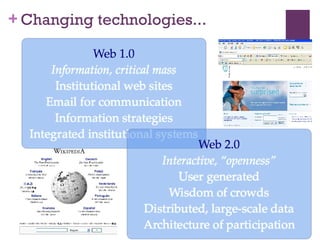
Changing technologies...
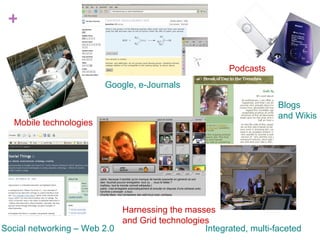
Mobile technologies Blogs  and Wikis Integrated, multi-faceted Social networking – Web 2.0 Harnessing the masses and Grid technologies Google, e-Journals Podcasts
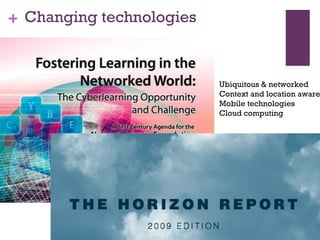
Changing technologies Ubiquitous & networked Context and location aware Mobile technologies Cloud computing
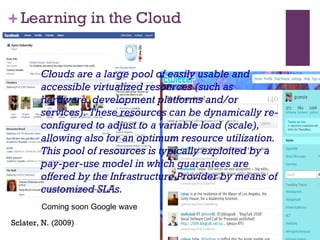
Learning in the Cloud Sclater, N. (2009) Clouds are a large pool of easily usable and accessible virtualized resources (such as hardware, development platforms and/or services). These resources can be dynamically re-configured to adjust to a variable load (scale), allowing also for an optimum resource utilization. This pool of resources is typically exploited by a pay-per-use model in which guarantees are offered by the Infrastructure Provider by means of customized SLAs. Coming soon Google wave
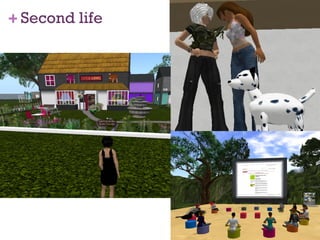
Second life
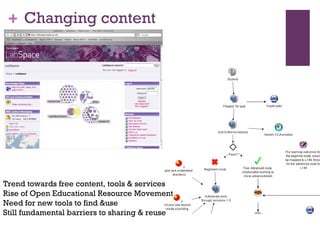
Changing content Trend towards free content, tools & services Rise of Open Educational Resource Movement Need for new tools to find &use Still fundamental barriers to sharing & reuse
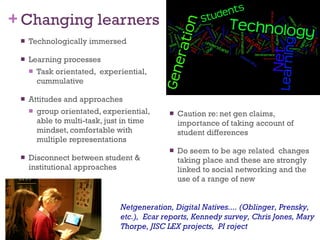
Changing learners Technologically immersed Learning processes Task orientated,  experiential, cummulative Attitudes and approaches group orientated, experiential, able to multi-task, just in time mindset, comfortable with multiple representations Disconnect between student & institutional approaches Caution re: net gen claims, importance of taking account of student differences Do seem to be age related  changes taking place and these are strongly linked to social networking and the use of a range of new  Netgeneration, Digital Natives.... (Oblinger, Prensky, etc.),  Ecar reports, Kennedy survey, Chris Jones, Mary Thorpe, JISC LEX projects,  PI roject
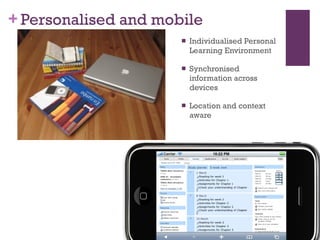
Personalised and mobile Individualised Personal Learning Environment Synchronised information across devices Location and context aware
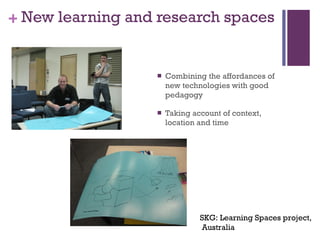
New learning and research spaces Combining the affordances of new technologies with good pedagogy Taking account of context, location and time  SKG: Learning Spaces project, Australia
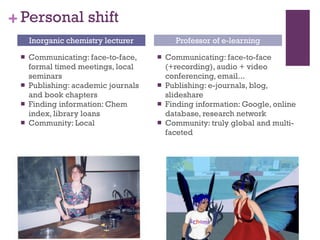
Personal shift Communicating: face-to-face, formal timed meetings, local seminars Publishing: academic journals and book chapters Finding information: Chem index, library loans Community: Local Communicating: face-to-face (+recording), audio + video conferencing, email... Publishing: e-journals, blog, slideshare Finding information: Google, online database, research network Community: truly global and multi-faceted Inorganic chemistry lecturer Professor of e-learning
Case studies Scaffolded:  VEOU - Virtual CPD and scaffolded support for publication Open:  E-Bank - towards truly "Open research” Cumulative:  CCK08 and Course-to-discourse - Education for free!  Social:  Cloudworks  - social networking for an educational context
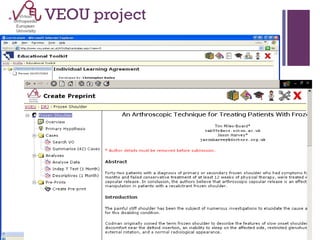
VEOU project
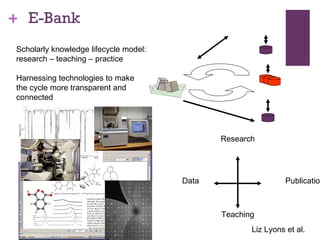
E-Bank Liz Lyons et al. Scholarly knowledge lifecycle model:  research – teaching – practice Harnessing technologies to make  the cycle more transparent and connected Data Publication Research Teaching
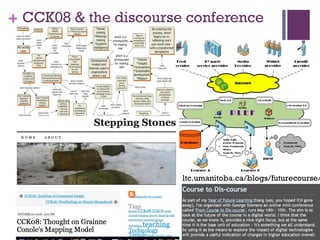
CCK08 & the discourse conference ltc.umanitoba.ca/blogs/futurecourse/
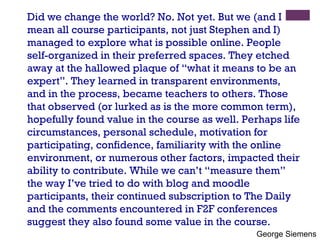
Did we change the world? No. Not yet. But we (and I mean all course participants, not just Stephen and I) managed to explore what is possible online. People self-organized in their preferred spaces. They etched away at the hallowed plaque of “what it means to be an expert”. They learned in transparent environments, and in the process, became teachers to others. Those that observed (or lurked as is the more common term), hopefully found value in the course as well. Perhaps life circumstances, personal schedule, motivation for participating, confidence, familiarity with the online environment, or numerous other factors, impacted their ability to contribute. While we can’t “measure them” the way I’ve tried to do with blog and moodle participants, their continued subscription to The Daily and the comments encountered in F2F conferences suggest they also found some value in the course. George Siemens
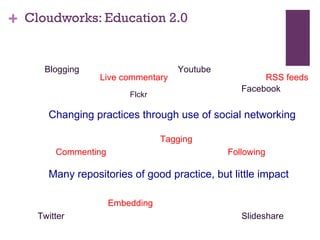
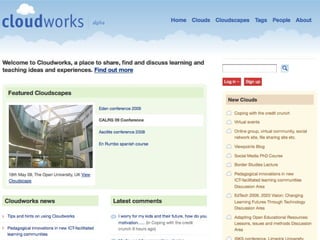
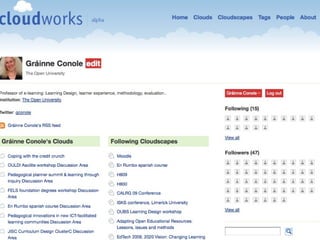
Cloudworks: Education 2.0 Changing practices through use of social networking Many repositories of good practice, but little impact Blogging Facebook Twitter Slideshare Flckr Youtube Commenting Live commentary Tagging RSS feeds Embedding Following
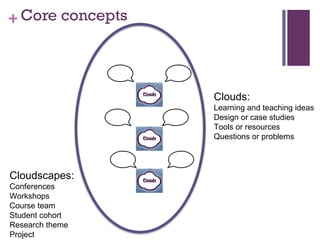
Core concepts Clouds:  Learning and teaching ideas Design or case studies Tools or resources Questions or problems Cloudscapes: Conferences Workshops Course team Student cohort Research theme Project
 
 
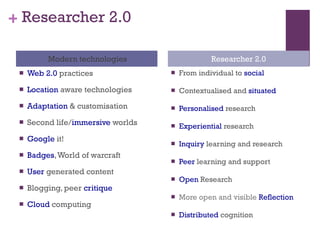
Researcher 2.0 Modern technologies Researcher 2.0 Web 2.0  practices Location  aware technologies Adaptation  & customisation Second life/ immersive  worlds Google  it! Badges , World of warcraft  User  generated content Blogging, peer  critique Cloud  computing From individual to  social Contextualised and  situated Personalised  research Experiential  research Inquiry  learning and research Peer  learning and support Open  Research More open and visible  Reflection Distributed  cognition
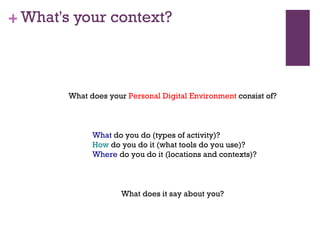
What's your context? What does your  Personal Digital Environment  consist of? What does it say about you? What  do you do (types of activity)? How  do you do it (what tools do you use)? Where  do you do it (locations and contexts)?
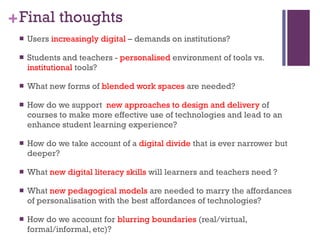
Final thoughts Users  increasingly digital  – demands on institutions?  Students and teachers -  personalised  environment of tools vs.  institutional  tools?  What new forms of  blended work spaces  are needed? How do we support  new approaches to design and delivery  of courses to make more effective use of technologies and lead to an enhance student learning experience? How do we take account of a  digital divide  that is ever narrower but deeper? What  new digital literacy skills  will learners and teachers need ?  What  new pedagogical models  are needed to marry the affordances of personalisation with the best affordances of technologies? How do we account for  blurring boundaries  (real/virtual, formal/informal, etc)?

Conole Prie Conference

  • 1.
    Technology-enhanced research: musingthe potential Gráinne Conole, The Open University, UK PRiE conference Liverpool John Moores University, 27/06/09 Blog: www.e4innovation.com
  • 2.
    Technology-mediated research Reflectionson what a "technology-enhanced" research context might mean Snapshot of the changing nature of: technology, data/content/knowledge and researchers Some case study examples Questions on future perspectives
  • 3.
  • 4.
    Mobile technologies Blogs and Wikis Integrated, multi-faceted Social networking – Web 2.0 Harnessing the masses and Grid technologies Google, e-Journals Podcasts
  • 5.
    Changing technologies Ubiquitous& networked Context and location aware Mobile technologies Cloud computing
  • 6.
    Learning in theCloud Sclater, N. (2009) Clouds are a large pool of easily usable and accessible virtualized resources (such as hardware, development platforms and/or services). These resources can be dynamically re-configured to adjust to a variable load (scale), allowing also for an optimum resource utilization. This pool of resources is typically exploited by a pay-per-use model in which guarantees are offered by the Infrastructure Provider by means of customized SLAs. Coming soon Google wave
  • 7.
  • 8.
    Changing content Trendtowards free content, tools & services Rise of Open Educational Resource Movement Need for new tools to find &use Still fundamental barriers to sharing & reuse
  • 9.
    Changing learners Technologicallyimmersed Learning processes Task orientated, experiential, cummulative Attitudes and approaches group orientated, experiential, able to multi-task, just in time mindset, comfortable with multiple representations Disconnect between student & institutional approaches Caution re: net gen claims, importance of taking account of student differences Do seem to be age related changes taking place and these are strongly linked to social networking and the use of a range of new Netgeneration, Digital Natives.... (Oblinger, Prensky, etc.), Ecar reports, Kennedy survey, Chris Jones, Mary Thorpe, JISC LEX projects, PI roject
  • 10.
    Personalised and mobileIndividualised Personal Learning Environment Synchronised information across devices Location and context aware
  • 11.
    New learning andresearch spaces Combining the affordances of new technologies with good pedagogy Taking account of context, location and time SKG: Learning Spaces project, Australia
  • 12.
    Personal shift Communicating:face-to-face, formal timed meetings, local seminars Publishing: academic journals and book chapters Finding information: Chem index, library loans Community: Local Communicating: face-to-face (+recording), audio + video conferencing, email... Publishing: e-journals, blog, slideshare Finding information: Google, online database, research network Community: truly global and multi-faceted Inorganic chemistry lecturer Professor of e-learning
  • 13.
    Case studies Scaffolded: VEOU - Virtual CPD and scaffolded support for publication Open: E-Bank - towards truly "Open research” Cumulative: CCK08 and Course-to-discourse - Education for free! Social: Cloudworks - social networking for an educational context
  • 14.
  • 15.
    E-Bank Liz Lyonset al. Scholarly knowledge lifecycle model: research – teaching – practice Harnessing technologies to make the cycle more transparent and connected Data Publication Research Teaching
  • 16.
    CCK08 & thediscourse conference ltc.umanitoba.ca/blogs/futurecourse/
  • 17.
    Did we changethe world? No. Not yet. But we (and I mean all course participants, not just Stephen and I) managed to explore what is possible online. People self-organized in their preferred spaces. They etched away at the hallowed plaque of “what it means to be an expert”. They learned in transparent environments, and in the process, became teachers to others. Those that observed (or lurked as is the more common term), hopefully found value in the course as well. Perhaps life circumstances, personal schedule, motivation for participating, confidence, familiarity with the online environment, or numerous other factors, impacted their ability to contribute. While we can’t “measure them” the way I’ve tried to do with blog and moodle participants, their continued subscription to The Daily and the comments encountered in F2F conferences suggest they also found some value in the course. George Siemens
  • 18.
    Cloudworks: Education 2.0Changing practices through use of social networking Many repositories of good practice, but little impact Blogging Facebook Twitter Slideshare Flckr Youtube Commenting Live commentary Tagging RSS feeds Embedding Following
  • 19.
    Core concepts Clouds: Learning and teaching ideas Design or case studies Tools or resources Questions or problems Cloudscapes: Conferences Workshops Course team Student cohort Research theme Project
  • 20.
  • 21.
  • 22.
    Researcher 2.0 Moderntechnologies Researcher 2.0 Web 2.0 practices Location aware technologies Adaptation & customisation Second life/ immersive worlds Google it! Badges , World of warcraft User generated content Blogging, peer critique Cloud computing From individual to social Contextualised and situated Personalised research Experiential research Inquiry learning and research Peer learning and support Open Research More open and visible Reflection Distributed cognition
  • 23.
    What's your context?What does your Personal Digital Environment consist of? What does it say about you? What do you do (types of activity)? How do you do it (what tools do you use)? Where do you do it (locations and contexts)?
  • 24.
    Final thoughts Users increasingly digital – demands on institutions? Students and teachers - personalised environment of tools vs. institutional tools? What new forms of blended work spaces are needed? How do we support new approaches to design and delivery of courses to make more effective use of technologies and lead to an enhance student learning experience? How do we take account of a digital divide that is ever narrower but deeper? What new digital literacy skills will learners and teachers need ? What new pedagogical models are needed to marry the affordances of personalisation with the best affordances of technologies? How do we account for blurring boundaries (real/virtual, formal/informal, etc)?

Editor's Notes

  • #7 Our learning systems are increasingly accessible from mobile devices, allowing students for example, to: find out administrative details such as where the tutorial they’re about to attend is read small chunks of course content on the train take a quiz to test their knowledge while on holiday We believe that in the next few years most students will possess a device like this – and many will want to learn using them.