


WELCOME
mICF Collaborative
WORKSHOP 2
2-4 June 2015
Helsinki, Finland
@icfmobile
Successful consensus-based
partnerships develop solid
trust relationships
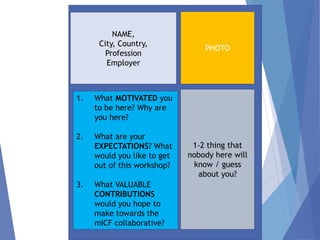
NAME,
City, Country,
Profession
Employer
1-2 thing that
nobody here will
know / guess
about you?
PHOTO
1. What MOTIVATED you
to be here? Why are
you here?
2. What are your
EXPECTATIONS? What
would you like to get
out of this workshop?
3. What VALUABLE
CONTRIBUTIONS
would you hope to
make towards the
mICF collaborative?
Getting on the
same page
@icfmobile
ICF Spring: Part of the
health revolution
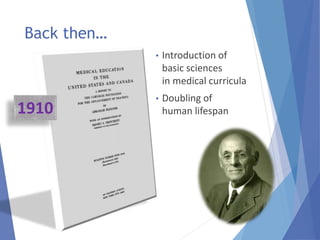
Back then…
• Introduction of
basic sciences
in medical curricula
• Doubling of
human lifespan1910
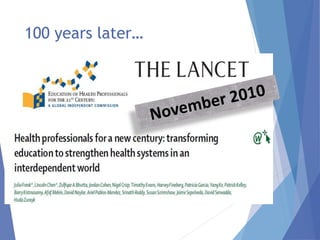
100 years later…
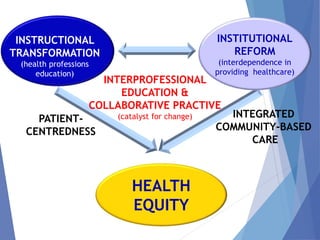
HEALTH
EQUITY
PATIENT-
CENTREDNESS
INTEGRATED
COMMUNITY-BASED
CARE
INTERPROFESSIONAL
EDUCATION &
COLLABORATIVE PRACTIVE
(catalyst for change)
INSTRUCTIONAL
TRANSFORMATION
(health professions
education)
INSTITUTIONAL
REFORM
(interdependence in
providing healthcare)
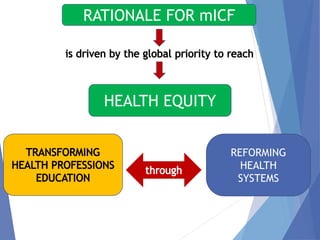
RATIONALE FOR mICF
REFORMING
HEALTH
SYSTEMS
HEALTH EQUITY
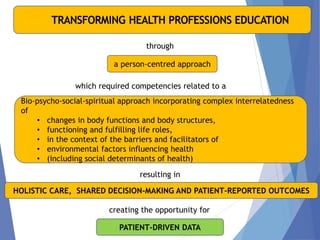
Bio-psycho-social-spiritual approach incorporating complex interrelatedness
of
• changes in body functions and body structures,
• functioning and fulfilling life roles,
• in the context of the barriers and facilitators of
• environmental factors influencing health
• (including social determinants of health)
which required competencies related to a
a person-centred approach
HOLISTIC CARE, SHARED DECISION-MAKING AND PATIENT-REPORTED OUTCOMES
resulting in
through
creating the opportunity for
PATIENT-DRIVEN DATA
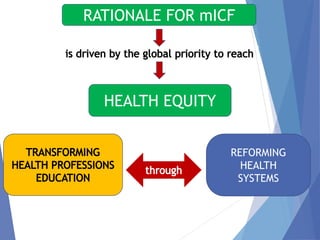
RATIONALE FOR mICF
HEALTH EQUITY
REFORMING
HEALTH
SYSTEMS
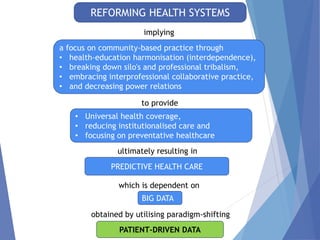
implying
to provide
ultimately resulting in
which is dependent on
obtained by utilising paradigm-shifting
REFORMING HEALTH SYSTEMS
BIG DATA
PREDICTIVE HEALTH CARE
• Universal health coverage,
• reducing institutionalised care and
• focusing on preventative healthcare
a focus on community-based practice through
• health-education harmonisation (interdependence),
• breaking down silo's and professional tribalism,
• embracing interprofessional collaborative practice,
• and decreasing power relations
PATIENT-DRIVEN DATA
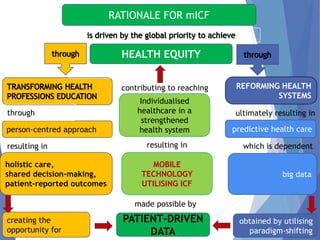
RATIONALE FOR mICF
REFORMING HEALTH
SYSTEMS
ultimately resulting in
predictive health careperson-centred approach
holistic care,
shared decision-making,
patient-reported outcomes
resulting in
through
big data
which is dependent
made possible by
resulting in
contributing to reaching
Individualised
healthcare in a
strengthened
health system
MOBILE
TECHNOLOGY
UTILISING ICF
PATIENT-DRIVEN
DATA
creating the
opportunity for
obtained by utilising
paradigm-shifting
HEALTH EQUITY
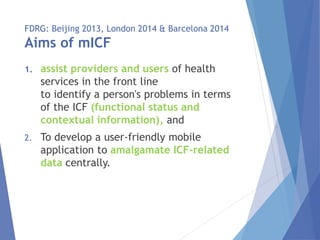
FDRG: Beijing 2013, London 2014 & Barcelona 2014
Aims of mICF
1. assist providers and users of health
services in the front line
to identify a person's problems in terms
of the ICF (functional status and
contextual information), and
2. To develop a user-friendly mobile
application to amalgamate ICF-related
data centrally.
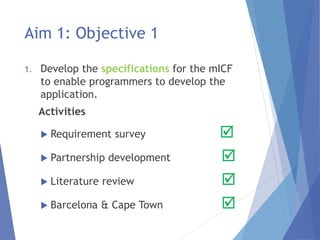
Aim 1: Objective 1
1. Develop the specifications for the mICF
to enable programmers to develop the
application.
Activities
 Requirement survey 
 Partnership development 
 Literature review 
 Barcelona & Cape Town 
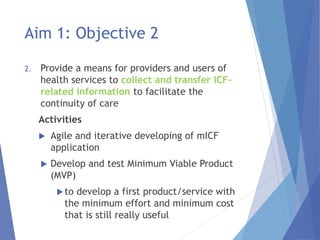
Aim 1: Objective 2
2. Provide a means for providers and users of
health services to collect and transfer ICF-
related information to facilitate the
continuity of care
Activities
 Agile and iterative developing of mICF
application
 Develop and test Minimum Viable Product
(MVP)
to develop a first product/service with
the minimum effort and minimum cost
that is still really useful
Aims 2: Objectives and Activities
To investigate the development of a user-
friendly mobile application to amalgamate
ICF-related data centrally
1. Convey information securely between
service
2. Ensure a sustainable and cost-effective
platform
3. Facilitate administration and reporting
4. Providing person-centred feedback to
inform shared decision-making
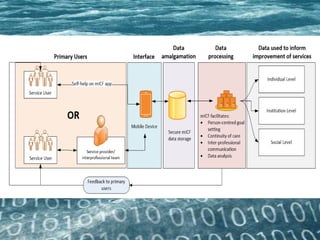
Mobile ICF enhanced with
Big Data Analytics
Private and Confidential Copyright Novolibri 2014
It is envisaged that the mICF
will
 ensure accurate and efficient capture of
functional status and contextual information,
 convey information securely between service
providers in different service settings,
 facilitate clinical decision-making by making
person-centred data readily available,
 facilitate administration and reporting
through the aggregation of the data and
 minimise the need for repeat data collection.
The envisaged benefits of the
mICF would be to:
 Empower providers and users of health and
related services
 Enable continuity of care
 Capture the interactions between ICF
components to facilitate
 Understanding of the complexity of interactions
between health and contextual factors
 Person-centred decision-making and goal
setting
 Interprofessional and transprofessional
collaborative practice
 Amalgamate data to help strengthen systems.
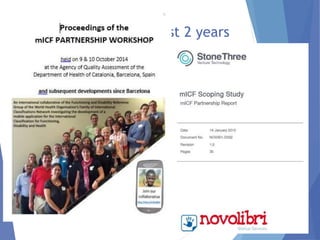
Progress made over past 2 years
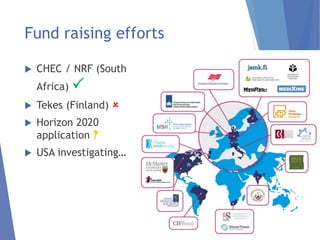
Fund raising efforts
 CHEC / NRF (South
Africa) 
 Tekes (Finland) 
 Horizon 2020
application 
 USA investigating…
“mICF can be a game changer in
addressing health inequity by
facilitating the necessary institutional
reform as well as the transformation of
health professions education by utilising
patient-driven and patient-owned data to
optimise individualised healthcare and to
strengthen health systems.
It could facilitate the dawn of a new era
of universally affordable, accessible,
personalised, predictive, sustainable,
integrated, community-based
interprofessional and transprofessional
health and social care”
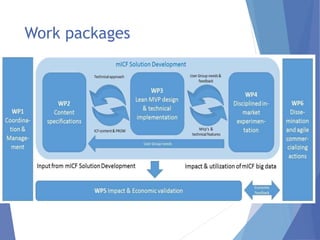
Work packages
WP 1: Coordination and management
 Ensure the effective and efficient
execution of work program according to
the time plan and budget
 Provide efficient financial management
and oversight
 Ensure the achievement of mICF’s
objectives as outlined in the work plan
 Report to and liaise proactively with
funders and all mICF partnership
WP2: Content specifications
The overall goal of this work package is to
provide evidence-based ICF-related content
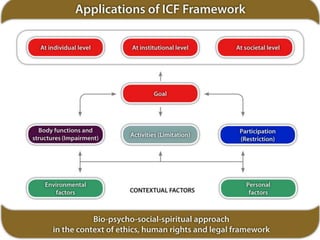
— based on a bio-psycho-social-spiritual
approach in the context of an ethical,
human rights and legal framework — for the
development of mICF.
 The specific objectives of WP2 are to
define ICF-related content for different
patient journeys (e.g. Older persons,
adults with chronic diseases, vulnerable
children and youth) by:
Specific objectives of WP2
 Embedding the content in the context of ethics,
human rights and legislation
 Developing and refining questions (i.e. what
questions to ask and how to ask it)
 Identifying appropriate responses to the
potential answers to questions (i.e. identify the
qualifiers)
 Selecting relevant patient-reported outcome
measures i.e. PROMs
Specific objectives of WP2
 Determining ways to use ICF and PROMs in
optimising a service user’s assessment, enabling
shared decision-making and interprofessional
goal setting.
 Utilising technology to link the use of natural
language to ICF codes and qualifiers.
 Translating the content to other languages
 Refine the content specifications based on
iterative development cycles (WP3) and feedback
from the disciplined in-market experimentation
(WP4).
WP3: Lean minimum viable product (MVP)
design and technical implementation
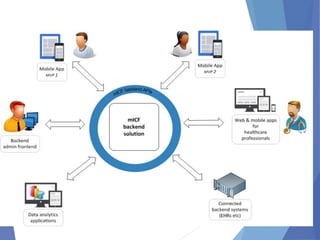
 specify and create the technical service design
and implementation for the minimum viable
product (MVP) service platform, including
 the mobile solution on selected terminals
 as well as the backend solution for integrated
care by applying lean, agile, iterative and
continuous, interactive person-centred service
design methods.
 For that, Service Design Toolkit (91) and lean
UX methods will be used in close collaboration
with WP2 and WP4.
 design and implementation of the Big Data and
computer modelling platform that will be used to
process and analyse ICF assessment data.
WP3: Objectives for main phases
of (technical) design process are
 Learning: learn the user needs based on
tests and feedback.
 Creating: collaborative ideation and
creation of solutions that support
findings.
 Testing: test/experiment the solutions in
a relevant way and collect/analyse
feedback.
WP3 Description of work tasks
1. MVP development project management
2. Specifications of the MVP
3. Mobile solution (front end) development and
prototyping
4. Backend service platform development
5. End-to-End testing and product development
environment
6. Big Data analytics solution & integrated care
GUI
7. Hosting and maintaining the backend & Big
Data services
WP4 Disciplined in-market
experimentation
Objectives
 Users of the mICF
 Define and implement metrics to assess
user experience and data validity in
different user groups, e.g. older persons,
adults with chronic diseases enrolled in
community based rehabilitation,
vulnerable children and youth
 Define which requirements are to be
fulfilled in order to accept a part of mICF
to be released to clinical and scientific
use
WP4 Disciplined in-market
experimentation
Tasks
 Field test preparation
 Train clinician users in the use of ICF
 Capture feedback regarding usability data
from users
 Capture feedback regarding discrepancies
of data entry between patient users and
clinicians
 Compile data from the different test sites
WP 5: Impact and
economic evaluation
 Cost and effect analysis post-6 months of usage
of the mICF by user group individuals (e.g. older
persons, adults, and children or their caregivers)
and healthcare professionals in various
countries.
 Through quantitative and qualitative methods
measure the impact of the mICF on user groups
(e.g. older persons, adults and children or their
caregivers).
 Compare the satisfaction of healthcare
professionals’ use of the mICF product to
current products used by healthcare
professionals.
WP 5: Impact and
economic evaluation
 Demonstrate the interoperability of the mICF
with other electronic health record products.
 Share the findings of the impact and cost
evaluation as soon as data is analysed (linkage
to WP6).
 Conduct economic evaluation; benefits,
effectiveness and costs of mICF use.
WP6: Dissemination and Market
Introduction
 Application of appropriate commercialisation
techniques to guide the project from the
 (1) innovation phase, through the
 (2) incubation phase with agile
commercialisation, to an
 (3) acceleration (or scaling) phase.
 The most important outcome is a mature
offering with sustainable benefits that are
repeatable in a market segment that responds
predictably and that yield a critical mass of
references representative of an early
majority of the technology adoption curve.
WP6: Dissemination and Market
Introduction
 Continuous dissemination of research and
development results (e.g. mICF website,
social media, training events, user
support, presentations, academic and
non-academic publications)
 Implementation of a pragmatic marketing
strategy addressing the “4 Ps”, namely
Product, Place (Distribution or Sales
Channel), Promotion and Price.
 Creating the blueprint for a marketing
and early sales organisation
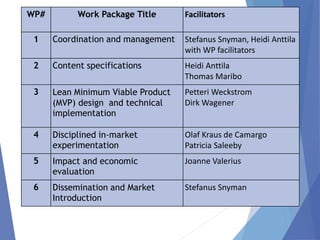
WP# Work Package Title Facilitators
1 Coordination and management Stefanus Snyman, Heidi Anttila
with WP facilitators
2 Content specifications Heidi Anttila
Thomas Maribo
3 Lean Minimum Viable Product
(MVP) design and technical
implementation
Petteri Weckstrom
Dirk Wagener
4 Disciplined in-market
experimentation
Olaf Kraus de Camargo
Patricia Saleeby
5 Impact and economic
evaluation
Joanne Valerius
6 Dissemination and Market
Introduction
Stefanus Snyman
Work groups for Helsinki
 Content specification (WP 2) [Heidi & Thomas]
 Questions, answers & Proms
 IT Team (WP3) [Petteri & Dirk]
 Get everything ready for the word “go”
 Research and Literature (WP 4 & 5) [Olaf & Joanne]
 Overall research framework
 “Generic” funding proposal
 Finish outstanding articles
 Prepare Manchester abstracts (due date 15 June)
 “Contract research” from other WPs
DISCUSSION
@icfmobile

mICF Workshop 3 June 2015 (Overview PowerPoint)

  • 1.
    WELCOME mICF Collaborative WORKSHOP 2 2-4June 2015 Helsinki, Finland @icfmobile
  • 2.
  • 3.
    NAME, City, Country, Profession Employer 1-2 thingthat nobody here will know / guess about you? PHOTO 1. What MOTIVATED you to be here? Why are you here? 2. What are your EXPECTATIONS? What would you like to get out of this workshop? 3. What VALUABLE CONTRIBUTIONS would you hope to make towards the mICF collaborative?
  • 4.
    Getting on the samepage @icfmobile
  • 6.
    ICF Spring: Partof the health revolution
  • 8.
    Back then… • Introductionof basic sciences in medical curricula • Doubling of human lifespan1910
  • 9.
  • 10.
    HEALTH EQUITY PATIENT- CENTREDNESS INTEGRATED COMMUNITY-BASED CARE INTERPROFESSIONAL EDUCATION & COLLABORATIVE PRACTIVE (catalystfor change) INSTRUCTIONAL TRANSFORMATION (health professions education) INSTITUTIONAL REFORM (interdependence in providing healthcare)
  • 11.
  • 12.
    Bio-psycho-social-spiritual approach incorporatingcomplex interrelatedness of • changes in body functions and body structures, • functioning and fulfilling life roles, • in the context of the barriers and facilitators of • environmental factors influencing health • (including social determinants of health) which required competencies related to a a person-centred approach HOLISTIC CARE, SHARED DECISION-MAKING AND PATIENT-REPORTED OUTCOMES resulting in through creating the opportunity for PATIENT-DRIVEN DATA
  • 13.
    RATIONALE FOR mICF HEALTHEQUITY REFORMING HEALTH SYSTEMS
  • 14.
    implying to provide ultimately resultingin which is dependent on obtained by utilising paradigm-shifting REFORMING HEALTH SYSTEMS BIG DATA PREDICTIVE HEALTH CARE • Universal health coverage, • reducing institutionalised care and • focusing on preventative healthcare a focus on community-based practice through • health-education harmonisation (interdependence), • breaking down silo's and professional tribalism, • embracing interprofessional collaborative practice, • and decreasing power relations PATIENT-DRIVEN DATA
  • 15.
    RATIONALE FOR mICF REFORMINGHEALTH SYSTEMS ultimately resulting in predictive health careperson-centred approach holistic care, shared decision-making, patient-reported outcomes resulting in through big data which is dependent made possible by resulting in contributing to reaching Individualised healthcare in a strengthened health system MOBILE TECHNOLOGY UTILISING ICF PATIENT-DRIVEN DATA creating the opportunity for obtained by utilising paradigm-shifting HEALTH EQUITY
  • 16.
    FDRG: Beijing 2013,London 2014 & Barcelona 2014 Aims of mICF 1. assist providers and users of health services in the front line to identify a person's problems in terms of the ICF (functional status and contextual information), and 2. To develop a user-friendly mobile application to amalgamate ICF-related data centrally.
  • 17.
    Aim 1: Objective1 1. Develop the specifications for the mICF to enable programmers to develop the application. Activities  Requirement survey   Partnership development   Literature review   Barcelona & Cape Town 
  • 18.
    Aim 1: Objective2 2. Provide a means for providers and users of health services to collect and transfer ICF- related information to facilitate the continuity of care Activities  Agile and iterative developing of mICF application  Develop and test Minimum Viable Product (MVP) to develop a first product/service with the minimum effort and minimum cost that is still really useful
  • 19.
    Aims 2: Objectivesand Activities To investigate the development of a user- friendly mobile application to amalgamate ICF-related data centrally 1. Convey information securely between service 2. Ensure a sustainable and cost-effective platform 3. Facilitate administration and reporting 4. Providing person-centred feedback to inform shared decision-making
  • 20.
    Mobile ICF enhancedwith Big Data Analytics Private and Confidential Copyright Novolibri 2014
  • 22.
    It is envisagedthat the mICF will  ensure accurate and efficient capture of functional status and contextual information,  convey information securely between service providers in different service settings,  facilitate clinical decision-making by making person-centred data readily available,  facilitate administration and reporting through the aggregation of the data and  minimise the need for repeat data collection.
  • 23.
    The envisaged benefitsof the mICF would be to:  Empower providers and users of health and related services  Enable continuity of care  Capture the interactions between ICF components to facilitate  Understanding of the complexity of interactions between health and contextual factors  Person-centred decision-making and goal setting  Interprofessional and transprofessional collaborative practice  Amalgamate data to help strengthen systems.
  • 24.
    Progress made overpast 2 years
  • 25.
    Fund raising efforts CHEC / NRF (South Africa)   Tekes (Finland)   Horizon 2020 application   USA investigating…
  • 26.
    “mICF can bea game changer in addressing health inequity by facilitating the necessary institutional reform as well as the transformation of health professions education by utilising patient-driven and patient-owned data to optimise individualised healthcare and to strengthen health systems. It could facilitate the dawn of a new era of universally affordable, accessible, personalised, predictive, sustainable, integrated, community-based interprofessional and transprofessional health and social care”
  • 27.
  • 28.
    WP 1: Coordinationand management  Ensure the effective and efficient execution of work program according to the time plan and budget  Provide efficient financial management and oversight  Ensure the achievement of mICF’s objectives as outlined in the work plan  Report to and liaise proactively with funders and all mICF partnership
  • 29.
    WP2: Content specifications Theoverall goal of this work package is to provide evidence-based ICF-related content — based on a bio-psycho-social-spiritual approach in the context of an ethical, human rights and legal framework — for the development of mICF.  The specific objectives of WP2 are to define ICF-related content for different patient journeys (e.g. Older persons, adults with chronic diseases, vulnerable children and youth) by:
  • 30.
    Specific objectives ofWP2  Embedding the content in the context of ethics, human rights and legislation  Developing and refining questions (i.e. what questions to ask and how to ask it)  Identifying appropriate responses to the potential answers to questions (i.e. identify the qualifiers)  Selecting relevant patient-reported outcome measures i.e. PROMs
  • 31.
    Specific objectives ofWP2  Determining ways to use ICF and PROMs in optimising a service user’s assessment, enabling shared decision-making and interprofessional goal setting.  Utilising technology to link the use of natural language to ICF codes and qualifiers.  Translating the content to other languages  Refine the content specifications based on iterative development cycles (WP3) and feedback from the disciplined in-market experimentation (WP4).
  • 32.
    WP3: Lean minimumviable product (MVP) design and technical implementation  specify and create the technical service design and implementation for the minimum viable product (MVP) service platform, including  the mobile solution on selected terminals  as well as the backend solution for integrated care by applying lean, agile, iterative and continuous, interactive person-centred service design methods.  For that, Service Design Toolkit (91) and lean UX methods will be used in close collaboration with WP2 and WP4.  design and implementation of the Big Data and computer modelling platform that will be used to process and analyse ICF assessment data.
  • 34.
    WP3: Objectives formain phases of (technical) design process are  Learning: learn the user needs based on tests and feedback.  Creating: collaborative ideation and creation of solutions that support findings.  Testing: test/experiment the solutions in a relevant way and collect/analyse feedback.
  • 35.
    WP3 Description ofwork tasks 1. MVP development project management 2. Specifications of the MVP 3. Mobile solution (front end) development and prototyping 4. Backend service platform development 5. End-to-End testing and product development environment 6. Big Data analytics solution & integrated care GUI 7. Hosting and maintaining the backend & Big Data services
  • 36.
    WP4 Disciplined in-market experimentation Objectives Users of the mICF  Define and implement metrics to assess user experience and data validity in different user groups, e.g. older persons, adults with chronic diseases enrolled in community based rehabilitation, vulnerable children and youth  Define which requirements are to be fulfilled in order to accept a part of mICF to be released to clinical and scientific use
  • 37.
    WP4 Disciplined in-market experimentation Tasks Field test preparation  Train clinician users in the use of ICF  Capture feedback regarding usability data from users  Capture feedback regarding discrepancies of data entry between patient users and clinicians  Compile data from the different test sites
  • 38.
    WP 5: Impactand economic evaluation  Cost and effect analysis post-6 months of usage of the mICF by user group individuals (e.g. older persons, adults, and children or their caregivers) and healthcare professionals in various countries.  Through quantitative and qualitative methods measure the impact of the mICF on user groups (e.g. older persons, adults and children or their caregivers).  Compare the satisfaction of healthcare professionals’ use of the mICF product to current products used by healthcare professionals.
  • 39.
    WP 5: Impactand economic evaluation  Demonstrate the interoperability of the mICF with other electronic health record products.  Share the findings of the impact and cost evaluation as soon as data is analysed (linkage to WP6).  Conduct economic evaluation; benefits, effectiveness and costs of mICF use.
  • 40.
    WP6: Dissemination andMarket Introduction  Application of appropriate commercialisation techniques to guide the project from the  (1) innovation phase, through the  (2) incubation phase with agile commercialisation, to an  (3) acceleration (or scaling) phase.  The most important outcome is a mature offering with sustainable benefits that are repeatable in a market segment that responds predictably and that yield a critical mass of references representative of an early majority of the technology adoption curve.
  • 41.
    WP6: Dissemination andMarket Introduction  Continuous dissemination of research and development results (e.g. mICF website, social media, training events, user support, presentations, academic and non-academic publications)  Implementation of a pragmatic marketing strategy addressing the “4 Ps”, namely Product, Place (Distribution or Sales Channel), Promotion and Price.  Creating the blueprint for a marketing and early sales organisation
  • 42.
    WP# Work PackageTitle Facilitators 1 Coordination and management Stefanus Snyman, Heidi Anttila with WP facilitators 2 Content specifications Heidi Anttila Thomas Maribo 3 Lean Minimum Viable Product (MVP) design and technical implementation Petteri Weckstrom Dirk Wagener 4 Disciplined in-market experimentation Olaf Kraus de Camargo Patricia Saleeby 5 Impact and economic evaluation Joanne Valerius 6 Dissemination and Market Introduction Stefanus Snyman
  • 43.
    Work groups forHelsinki  Content specification (WP 2) [Heidi & Thomas]  Questions, answers & Proms  IT Team (WP3) [Petteri & Dirk]  Get everything ready for the word “go”  Research and Literature (WP 4 & 5) [Olaf & Joanne]  Overall research framework  “Generic” funding proposal  Finish outstanding articles  Prepare Manchester abstracts (due date 15 June)  “Contract research” from other WPs
  • 44.