

1
Practical competences in engineering
and Technology Enhanced Learning,
MOOCs and emerging areas at IEEE
Education Society
Manuel Castro
UNED / DIEEC Professor
IEEE Fellow
IEEE Education Society President
mcastro@ieec.uned.es
http://www.slideshare.net/mmmcastro/
2
Engineering vision is being updated with the practical and
virtual knowledge ubiquitously and pervasively. New
techniques and access to the laboratories and practical
instruments as well as more and better virtual tools allows a
new vision on the sharing of knowledge fueled by the new
tendency in Open and Shareable contents and usability
New laboratories, repositories, federations and projects are
being spread out along the institutions and along the world
to follow the new open and share paradigm, sometimes free
and some times under a low cost, but always having in mind
a shareable capacity to allow the best practice engineering
work and perception
3
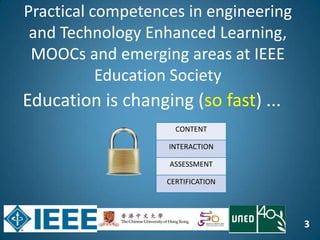
Education is changing (so fast) ...
CONTENT
INTERACTION
ASSESSMENT
CERTIFICATION
Practical competences in engineering
and Technology Enhanced Learning,
MOOCs and emerging areas at IEEE
Education Society
4
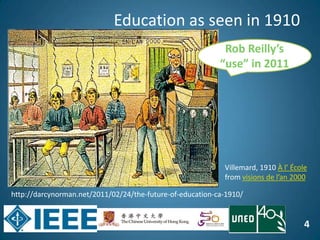
Education as seen in 1910
Rob Reilly’s
“use” in 2011
http://darcynorman.net/2011/02/24/the-future-of-education-ca-1910/
Villemard, 1910 À l’ École
from visions de l’an 2000
5
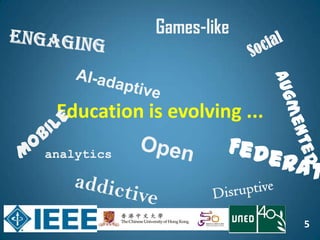
Education is evolving ...
Games-like
analytics
6
Open education new initiatives
Practical competences in engineering
and Technology Enhanced Learning,
MOOCs and emerging areas at IEEE
Education Society
7
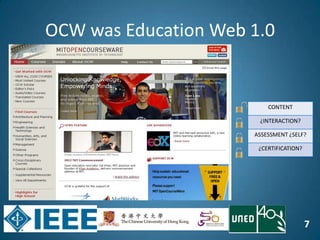
OCW was Education Web 1.0
CONTENT
¿INTERACTION?
ASSESSMENT ¿SELF?
¿CERTIFICATION?
8
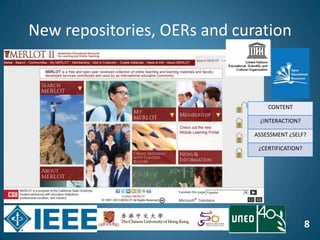
New repositories, OERs and curation
CONTENT
¿INTERACTION?
ASSESSMENT ¿SELF?
¿CERTIFICATION?
9
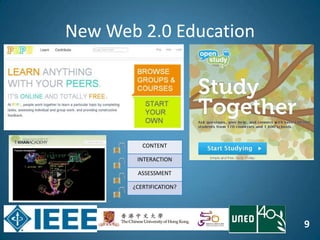
New Web 2.0 Education
CONTENT
INTERACTION
ASSESSMENT
¿CERTIFICATION?
10
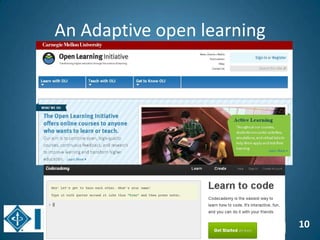
An Adaptive open learning
11
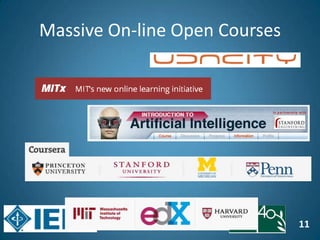
Massive On-line Open Courses
12
q
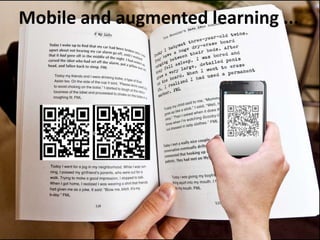
Mobile and augmented learning ...
13
Enriched ebooks
14
iBooksU
15
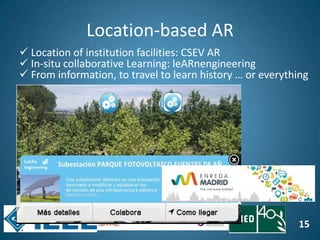
Location-based AR
 Location of institution facilities: CSEV AR
 In-situ collaborative Learning: leARnengineering
 From information, to travel to learn history … or everything
16
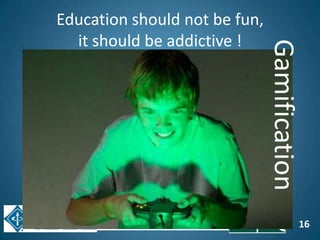
Education should not be fun,
it should be addictive !
Gamification
17
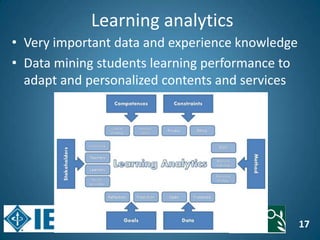
Learning analytics
• Very important data and experience knowledge
• Data mining students learning performance to
adapt and personalized contents and services
18
More tendencies
Blended Learning – More Learning to Blend
• Video as new paradigm
– Follows traditional face-to-face paradigm
• Flipped classroom
• Google Hangouts
• Higher impact of social media
– Immediate access to student life
• Expected Web 3.0
– Semantic browsing and navigation
19
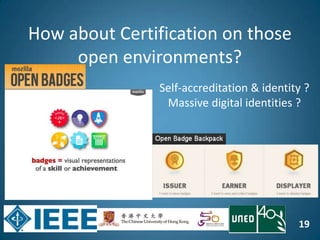
How about Certification on those
open environments?
Self-accreditation & identity ?
Massive digital identities ?
20
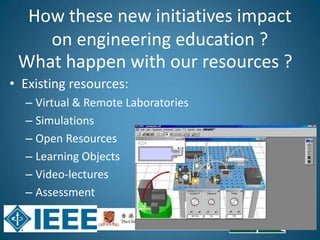
What happen with our resources ?
• Existing resources:
– Virtual & Remote Laboratories
– Simulations
– Open Resources
– Learning Objects
– Video-lectures
– Assessment
How these new initiatives impact
on engineering education ?
21
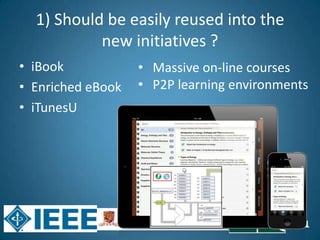
1) Should be easily reused into the
new initiatives ?
• iBook
• Enriched eBook
• iTunesU
• Massive on-line courses
• P2P learning environments
22
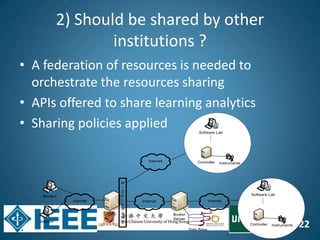
2) Should be shared by other
institutions ?
• A federation of resources is needed to
orchestrate the resources sharing
• APIs offered to share learning analytics
• Sharing policies applied
Internet
Student
Student
Internet
Broker
Server
Data Base
?
?
InstrumentsController
Software Lab
LMS
M
I
D
D
L
E
W
A
R
E
Internet
Internet
?
?
InstrumentsController
Software Lab
23
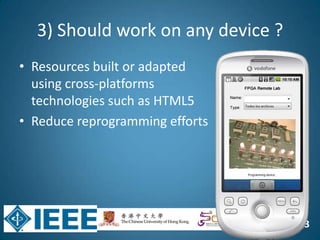
3) Should work on any device ?
• Resources built or adapted
using cross-platforms
technologies such as HTML5
• Reduce reprogramming efforts
24
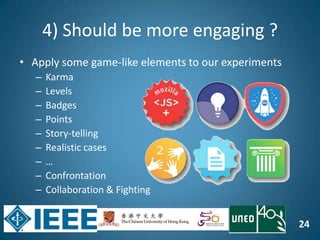
4) Should be more engaging ?
• Apply some game-like elements to our experiments
– Karma
– Levels
– Badges
– Points
– Story-telling
– Realistic cases
– …
– Confrontation
– Collaboration & Fighting
..
25
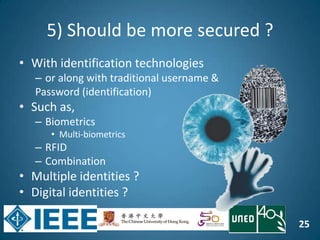
5) Should be more secured ?
• With identification technologies
– or along with traditional username &
Password (identification)
• Such as,
– Biometrics
• Multi-biometrics
– RFID
– Combination
• Multiple identities ?
• Digital identities ?
26
But we have a long way to walk ...
- Challenges -
27
Online Labs as Open E-learning
Resources
• Traditional laboratories were the only
possibility that allowed students to carry out
experiments and get the needed skills for their
future jobs
• The improvement in communication networks
and programming languages were key factors
in the evolution from traditional Laboratories
to online Labs
28
Online Labs as Open E-learning
Resources
• Currently, there are a great number of Virtual
and Remote Labs on Web
– Virtual Web Labs  Virtual web labs are
applications installed in a web server and
accessed over Internet
– Remote Web Labs  are applications which allow
student to manipulate hardware through a Web
browser over Internet
29
Online Labs as Open E-learning
Resources
Virtual and Remote Labs are not mutually exclusive.
They can be combined in the learning process. For
instance:
– A Virtual Web Lab can be used to teach students how
to hand the instruments and carry out tasks that can
damage these
– A Remote Web Lab can be used when students have
learnt of management of instruments
A new resource to consider inside Blended
Learning !!!!
30
Online Labs as Open E-learning
Resources
• Virtual and Remote Labs can be used in many
educational fields, such as:
– Electronic and Control
– Electrical Engineering
– Chemistry
– Physics
– Anatomy
– Biology
– Education
– …
31
Examples of Virtual and Remote Web
Labs
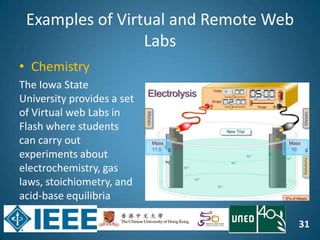
• Chemistry
The Iowa State
University provides a set
of Virtual web Labs in
Flash where students
can carry out
experiments about
electrochemistry, gas
laws, stoichiometry, and
acid-base equilibria
32
Examples of Virtual and Remote Web
Labs
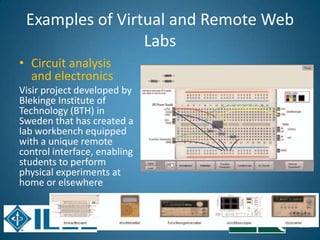
• Circuit analysis
and electronics
Visir project developed by
Blekinge Institute of
Technology (BTH) in
Sweden that has created a
lab workbench equipped
with a unique remote
control interface, enabling
students to perform
physical experiments at
home or elsewhere
33
Examples of Virtual and Remote Web
Labs
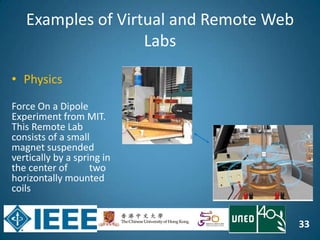
• Physics
Force On a Dipole
Experiment from MIT.
This Remote Lab
consists of a small
magnet suspended
vertically by a spring in
the center of two
horizontally mounted
coils
34
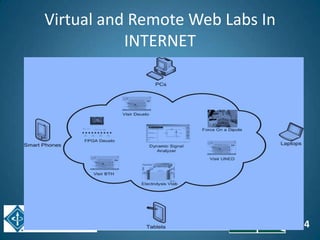
Virtual and Remote Web Labs In
INTERNET
35
Sharing Virtual and Remote Web Labs
Currently, there are two main solutions:
– Shared architectures
• iLab Shared Architecture (ISA)
• WebLab-Deusto Architecture
• SAHARA
– E-learning standards
• W3C´s Resource Description Framework (RDF) &
Dublin Core (Lab2go)
• SCORM (LILA)
IEEE Education Society
Working Group on
“Standard for Networked
Smart Learning for
Online Laboratories”
(PAR No. P.1876)
36
Sharing Virtual and Remote Web Labs
Shared architectures provide a unifying software
framework that can support access to a wide variety of
online laboratories. Users and the online laboratories
can be globally distributed across an arbitrary number
of locations linked only by the Internet
• iLab Shared Architecture (ISA)
• WebLab-Deusto Architecture
• SAHARA
• Go-Lab
37
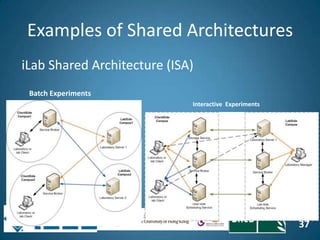
Examples of Shared Architectures
iLab Shared Architecture (ISA)
Batch Experiments
Interactive Experiments
38
Examples of Shared Architectures
iLab Shared Architecture (ISA). At this moment
is implemented in:
- Africa ( Uganda, Nigeria, Tanzania)
- Asia (China)
- Europe (Austria, Stuttgart, Brasov, …)
- Australia (Queensland, Melbourne)
- USA (Massachusetts)
39
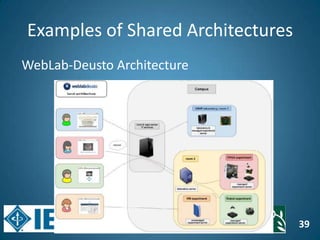
Examples of Shared Architectures
WebLab-Deusto Architecture
40
Examples of Shared Architectures
WebLab-Deusto Architecture is implemented in:
- Deusto
- DIEEC (UNED)
Some of the laboratories are:
– FPGA
– Visir
– Managing a Robot
41
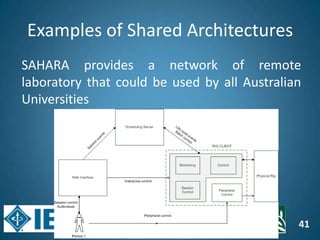
Examples of Shared Architectures
SAHARA provides a network of remote
laboratory that could be used by all Australian
Universities
42
Examples of Shared Architectures
SAHARA is being used by:
– Curtin University of Technology
– Queensland University of Technology
– RMIT University, University of South Australia
– The University of Technology, Sydney
43
Examples of Shared Environment
Go-Lab is under development to provide:
– Teachers
– Students
– Remote and Virtual Labs providers
the easiest and best framework to interact
inside an emerging learning and educational
assessed world
44
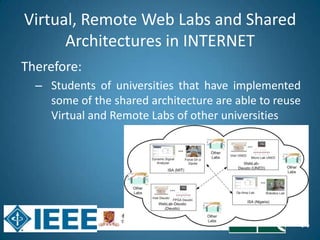
Virtual, Remote Web Labs and Shared
Architectures in INTERNET
Therefore:
– Students of universities that have implemented
some of the shared architecture are able to reuse
Virtual and Remote Labs of other universities
45
Challenges of Shared Architectures
• Currently these architectures are not able to
speak (too much) each other. It is necessary to:
– sponsor the design of an efficient mechanism for
sharing, exchanging and trading access to online
labs by creation of a global network of shareable
experiments
– lead the evolution of an architecture that enables
the sharing of online labs by unified standards
46
Challenges of Shared Architectures
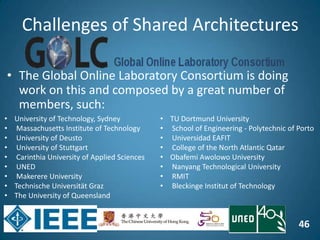
• The Global Online Laboratory Consortium is doing
work on this and composed by a great number of
members, such:
• University of Technology, Sydney
• Massachusetts Institute of Technology
• University of Deusto
• University of Stuttgart
• Carinthia University of Applied Sciences
• UNED
• Makerere University
• Technische Universität Graz
• The University of Queensland
• TU Dortmund University
• School of Engineering - Polytechnic of Porto
• Universidad EAFIT
• College of the North Atlantic Qatar
• Obafemi Awolowo University
• Nanyang Technological University
• RMIT
• Bleckinge Institut of Technology
47
Using E-Learning Standards
The use of E-learning Standards make easier:
– Interoperability  offer e-learning resources on
different platforms
– Migration among different versions of e-learning
platforms
– Search and Reuse of E-learning Resources
48
Using E-Learning Standards
Some of well-known e-learning standards are:
– Dublin Core & LOM IEEE
Both define a set of metadata which allow describing e-
learning resources
– IMS Content packaging & SCORM. Both define how
to pack e-learning resources to create more complex
e-learning objects
– IMS Learning Design supports the use of a wide
range of pedagogies in online learning
– IMS Question and Test Interoperability describes a
data model for the representation of question
(assessmentItem) and test (assessmentTest) data and
their corresponding results reports
49
E-Learning Standards & Online Labs
Virtual and Remote Web Labs are enriched e-
learning resources and therefore can be used
with e-learning standards
• Some example of the use of e-learning
standards and Online Labs are:
– Lab2go Project
– LILA Project
50
E-Learning Standards & Online Labs
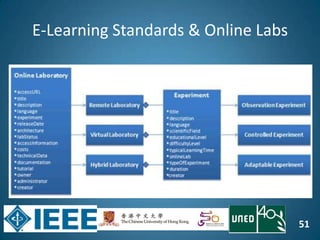
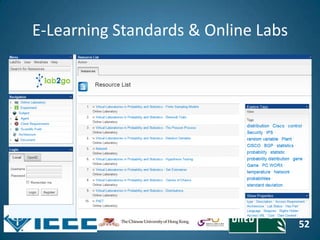
• Lab2go project has created a generic model
ontology consisting of various properties to
add laboratories such as remote laboratories,
virtual laboratories, experiments, access URL,
status, cost, release date, languages,
description, administrator, etc.
– This project adopts basic terminology and data
types from Dublin Core
51
E-Learning Standards & Online Labs
52
E-Learning Standards & Online Labs
53
E-Learning Standards & Online Labs
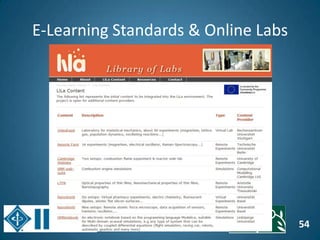
• LILA project. Consists of a web server running
the LiLa portal and a database for keeping the
experiments, and a second database for the
booking and reservation time slots and the
corresponding booking and reservation codes.
Experiments are, as already described earlier,
represented by SCORM packages
54
E-Learning Standards & Online Labs
55
Challenges of E-Learning Standards &
Online Labs
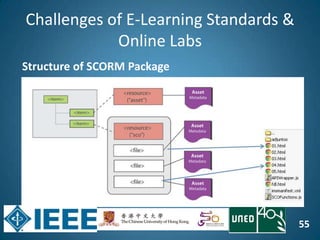
Structure of SCORM Package
56
Challenges of E-Learning Standards &
Online Labs
• Although SCORM is used to pack e-learning
resources. Several issues must be considered:
– The packaging of rich multimedia and interactive e-
learning content is restricted by current online
learning environment that uses SCORM
– SCORM should have an authentication mechanism,
particularly to Protect Assessment Data
– SCORM should use current programming standards. It
is recommended that SCORM use a RESTful API to
decentralize the architecture
57
Challenges of E-Learning Standards &
Online Labs
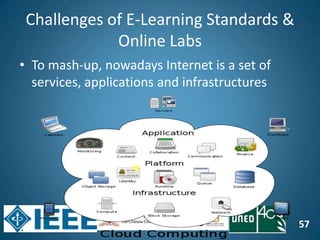
• To mash-up, nowadays Internet is a set of
services, applications and infrastructures
58
E-Learning Standards & Online Labs
• Therefore new e-learning standards are being
developed such as Next Generation SCORM
focus on:
– Tracking of detailed learner interactions and
learner performance characteristics that are richer
in scope and depth than assessments involving
score thresholds
– Tracking of out-of-browser content to include
games, simulations, virtual worlds and mobile
apps
59
E-Learning Standards & Online Labs
– Launching and tracking of multi-modal content
that renders intelligently based on device (ex.
tablet, smart phone, laptop) not only in LMS
– Accessing to learner data during or after the
learner experiences the content
– Hosted content via a Content as a Service (CaaS)
model
60
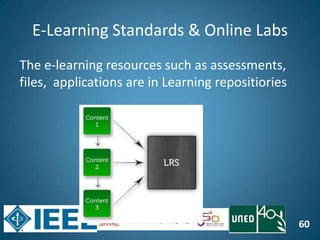
E-Learning Standards & Online Labs
The e-learning resources such as assessments,
files, applications are in Learning repositiories
61
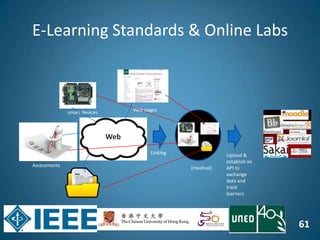
E-Learning Standards & Online Labs
Web pages
Assessments
smart devices
WEB
Linking
(mashup)
Upload &
establish an
API to
exchange
data and
track
learners
Web
62
Online Labs & Education
Virtual and Remote Web Labs are e-learning
resources, and they must be used along with
other e-learning resources & services, such as:
– Assessments
– Forums
– User tracking
– Tutorials (Web, PDF, etc.)
63
Online Labs & Education
• As it has been SCORM can be used In LMS
SCORM Complaint
• Other possibility is that Virtual, Remote Web Labs
and Shared architecture provide a set of APIs and
these can be used by e-learning systems
64
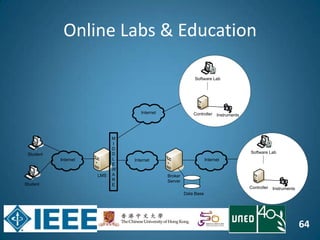
Online Labs & Education
Internet
Student
Student
Internet
Broker
Server
Data Base
?
?
InstrumentsController
Software Lab
LMS
M
I
D
D
L
E
W
A
R
E
Internet
Internet
?
?
InstrumentsController
Software Lab
65
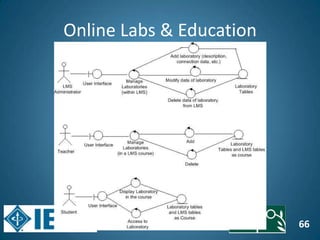
Online Labs & Education
• To do this, the main idea is to create an
activity or module in a LMS ( the less code
possible to allow being translate a some LMS)
• And the main goal is to split the creation of
learning scenarios in different roles
66
Online Labs & Education
67
Online Labs & Education
• This idea has been developed for DIEEC group
from UNED
• This idea is evolving a new concepts and issue
such as:
• Use of new e-learning standards
• There are institutions which use other e-learning
system and free courses and communities
68
Online Labs & Education
• Virtual and Remote labs must be able to be elements
of these courses and communities
• Challenges, such as:
• Open access
• Security
• Ubiquity
• E-learning Services
• Must be reconsidered with new ideas, Standards and
architectures >>>>> and >>> MOOCs
69
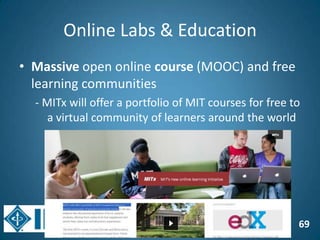
Online Labs & Education
• Massive open online course (MOOC) and free
learning communities
- MITx will offer a portfolio of MIT courses for free to
a virtual community of learners around the world
70
Online Labs & Education
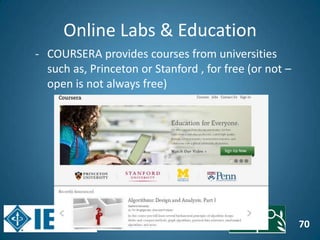
- COURSERA provides courses from universities
such as, Princeton or Stanford , for free (or not –
open is not always free)
71
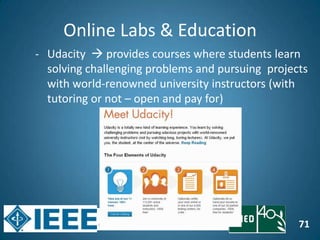
Online Labs & Education
- Udacity  provides courses where students learn
solving challenging problems and pursuing projects
with world-renowned university instructors (with
tutoring or not – open and pay for)
72
Online Labs & Education
- Harvard University and the Massachusetts Institute
of Technology (MIT) have developed edX. The two
institutions will collaborate to enhance campus-
based teaching and learning and build a global
community of online learners
73
Online Labs & Education
- unX – UNED, Massachusetts Institute of
Technology, CSEV, Telefonica and Banco Santander
are collaborating on a project of higher education
on line for Spanish- and Portuguese-speaking
countries to simplify and have easy Industry-related
activities and collaborative environment in
economics activities
74
Online Labs & Education - convergence
• Open environment introduction, OCW and MOOC
• Communications evolution
• Social network and media evolution in education
• Mobility and ubiquitu evolution on the learning
• Collaborative environment evolution
• Web 1.0 to 2.0
• Repositories or environments
75
Online Labs & Education - convergence
• MOOC (Massive Open On-line Courses)
• Courses or not ?
• Open or not ?
• Free or not ?
• On-line or not ?
• Massive or not ?
76
Online Labs & Education - convergence
• Courses organization, learning activities and follow-up
• Topic election and contents
• Student interest and motivation
• Teaching work / Learning organization
• Material recording and metadata
• Tutoring, Curator, Motivation, Facilitator,
Collaboration, Assesment, Evaluation,
Certification
• Platform selection and tools
• Laboratories
• Roles and implication
77
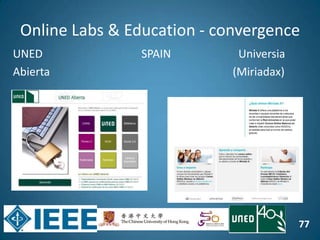
Online Labs & Education - convergence
UNED
Abierta
SPAIN Universia
(Miriadax)
78
Online Labs & Education - convergence
• Certification
• Karma and course activity
• Follow-up
• Badges (digital certificates)
• Identity accreditation
• Classical (paper) certificates
• Tests and classical evaluation
79
Online Labs & Education - convergence
• Business model for Universities, Companies … and the teacher
• Corporate image
• Corporate interet (awards, innovation, projects,
recongition, networking, etc.)
• Dissemination and public image
• Accrediations
• Finance issues
80
Online Labs & Education - convergence
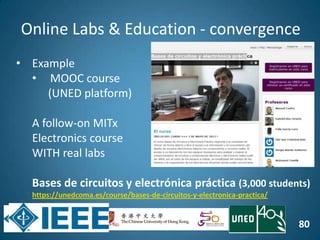
• Example
• MOOC course
(UNED platform)
A follow-on MITx
Electronics course
WITH real labs
Bases de circuitos y electrónica práctica (3,000 students)
https://unedcoma.es/course/bases-de-circuitos-y-electronica-practica/
81
New Ideas to Create Education Services
According to IEEE Technology Time Machine (2011)
several ideas and concepts must be considered
• IoT
• Cloud (Service)
Computing
• Mobile and
ubiquous systems
• Security
• Smart Grids
• Healt & Biosystems
82
“Internet of Things (IoT) refers to the vision that
in the next 20 years, a revolution in device-to-
device communication will take place that will
be comparable to the revolution in person-to-
person communication that erupted in the last
two decades with the Internet and World Wide
Web”
New Ideas to Create Education Services
83
We will be able to browse Internet of “things” just
as today we search for information. We will be able
to create environments out of things, just as today
we can mash up services and information
This “things” have embedded intelligence, an
embodiment of the IoT can function quite
autonomously, making decisions and taking actions
that would normally require human activity
New Ideas to Create Education Services
84
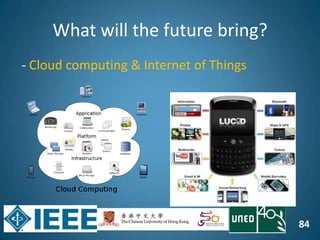
What will the future bring?
- Cloud computing & Internet of Things
85
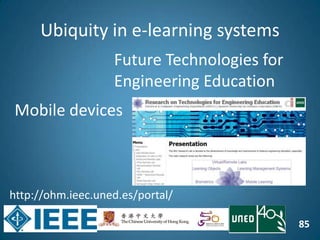
Ubiquity in e-learning systems
Mobile devices
Future Technologies for
Engineering Education
http://ohm.ieec.uned.es/portal/
86
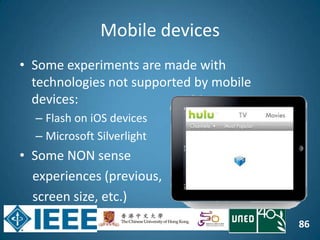
Mobile devices
• Some experiments are made with
technologies not supported by mobile
devices:
– Flash on iOS devices
– Microsoft Silverlight
• Some NON sense
experiences (previous,
screen size, etc.)
87
Mobile devices
• Ways of using experiments on mobile
devices:
–Native app (iOS or Android) for the
experiment
• Provides more control over the device
capabilities
• Expensive to create and maintain
• Specific development for each platform
88
Mobile devices
• Ways of using experiments on mobile
devices:
–Integrated on an enriched ebook
• It allows its use together with the theory and
assessment
–Web-based experiment adapted to mobile
device
• Reduces development efforts
89
Mobile Web adaptations
• Provide a proper layout
• Developers should think what is actually going to
be used from a mobile device, and how may the
user see it in a small screen
• Provide the required contents. Developers should
think what contents are going to be migrated to
the mobile version
• Avoid plug-ins. Some plug-ins are not available in
all devices, such as Flash or Microsoft Silverlight
90
• According to “Biometric Market Forecast to
2014”, biometric technologies:
– Widely accepted
– Adopted in POS, ATM, border security and so on
Security in e-learning systems
91
Biometric Technology
• Fingerprint recognition dominates the world
market of biometric technology
• Companies search for application
with a fast integration
• The biometric authentication security
architecture multilayer would be the future of
network security
92
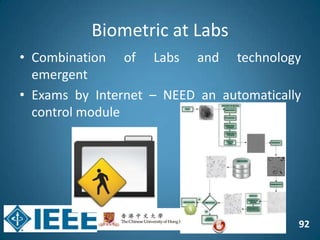
Biometric at Labs
• Combination of Labs and technology
emergent
• Exams by Internet – NEED an automatically
control module
93
Biometric at Labs – Real case
• Results – a positive trend of the use of
biometric control as a way of access to e-
learning activities
• Safer, easier and faster
• Some biometric technologies are integrated in
our laptops – best-known
94
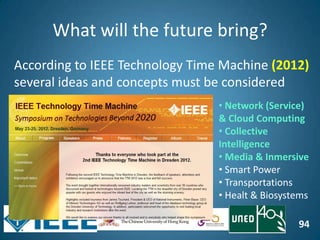
What will the future bring?
According to IEEE Technology Time Machine (2012)
several ideas and concepts must be considered
• Network (Service)
& Cloud Computing
• Collective
Intelligence
• Media & Inmersive
• Smart Power
• Transportations
• Healt & Biosystems
95
What will the future bring?
Collective Intelligence
Emerges from collaboration and competition of
multiple individuals
“In a changing and dynamic world, high-resolution and
timely geospatial information with global access and
coverage becomes increasingly important”
96
What will the future bring?
Future Connectivity and networks 
• we will have faster connectivity, both wireless
and wireline, we will be using cell phones and
other devices, we will be living in a world
• seamless ubiquitous access to information and
services
97
What will the future bring?
- Future of Media
• How will information be acquired, paid, and
distributed in the future
• What is the impact of ubiquitous connectivity
and connected users on future developments
98
Conclusions
• Mashup of acronyms, letters, technologies, …,
to enhance learning and teaching
• Some initiatives has been developed to SHARE
laboratories and be used in learning
management system
- iLab, Labshare, WebLab-Deusto, Go-Lab
- LILA, UNED (DIEEC) Project
our PhDs will be the future with our support
99
Conclusions
But new issues must be considered to:
• Should work on any device, such as (e-books, smart
phones, tablets, PCs, etc.)
• Should be used along with other e-learning services and
different platforms (LMS, Massive online Courses, etc)
• Should be shared by other institutions. Ideas such as
Cloud computing, Federation, new e-learning and
Internet of things must be considered
• Should be more secured (biometric methods) and
certified
100
ACKNOWLEDGMENT
European Funded projects
• Go-Lab “Global Online Science Labs for Inquiry Learning at
School” –FP7 Program - FP7-ICT-2011-8 - Project number
317601
• RIPLECS “Remote-labs access in Internet-based
Performance-centred Learning Environment for Curriculum
Support” 517836-LLP-1-2011-1-ES-ERASMUS-ESMO
• PAC PAC - Performance-centered Adaptive Curriculum for
Employment Needs - 517742-LLP-1-2011-1-BG-ERASMUS-
ECUE
• e-Madrid Network, S2009/TIC-1650, “Investigación y
Desarrollo de tecnologías para el e-Learning en la
Comunidad de Madrid”
• DIEEC/UNED team: Elio / Mohamed / Félix / Alberto /
Gabi / Sergio / Maria Jose / Clara / Charo
101
Practical competences in engineering
and Technology Enhanced Learning,
MOOCs and emerging areas at IEEE
Education Society
Thank for your attention - Comments ? Questions ?
Manuel Castro
UNED / DIEEC Professor
IEEE Fellow
IEEE Education Society President
mcastro@ieec.uned.es
http://www.slideshare.net/mmmcastro/

Ppt hk pres_final

  • 1.
    1 Practical competences inengineering and Technology Enhanced Learning, MOOCs and emerging areas at IEEE Education Society Manuel Castro UNED / DIEEC Professor IEEE Fellow IEEE Education Society President mcastro@ieec.uned.es http://www.slideshare.net/mmmcastro/
  • 2.
    2 Engineering vision isbeing updated with the practical and virtual knowledge ubiquitously and pervasively. New techniques and access to the laboratories and practical instruments as well as more and better virtual tools allows a new vision on the sharing of knowledge fueled by the new tendency in Open and Shareable contents and usability New laboratories, repositories, federations and projects are being spread out along the institutions and along the world to follow the new open and share paradigm, sometimes free and some times under a low cost, but always having in mind a shareable capacity to allow the best practice engineering work and perception
  • 3.
    3 Education is changing(so fast) ... CONTENT INTERACTION ASSESSMENT CERTIFICATION Practical competences in engineering and Technology Enhanced Learning, MOOCs and emerging areas at IEEE Education Society
  • 4.
    4 Education as seenin 1910 Rob Reilly’s “use” in 2011 http://darcynorman.net/2011/02/24/the-future-of-education-ca-1910/ Villemard, 1910 À l’ École from visions de l’an 2000
  • 5.
    5 Education is evolving... Games-like analytics
  • 6.
    6 Open education newinitiatives Practical competences in engineering and Technology Enhanced Learning, MOOCs and emerging areas at IEEE Education Society
  • 7.
    7 OCW was EducationWeb 1.0 CONTENT ¿INTERACTION? ASSESSMENT ¿SELF? ¿CERTIFICATION?
  • 8.
    8 New repositories, OERsand curation CONTENT ¿INTERACTION? ASSESSMENT ¿SELF? ¿CERTIFICATION?
  • 9.
    9 New Web 2.0Education CONTENT INTERACTION ASSESSMENT ¿CERTIFICATION?
  • 10.
  • 11.
  • 12.
  • 13.
  • 14.
  • 15.
    15 Location-based AR  Locationof institution facilities: CSEV AR  In-situ collaborative Learning: leARnengineering  From information, to travel to learn history … or everything
  • 16.
    16 Education should notbe fun, it should be addictive ! Gamification
  • 17.
    17 Learning analytics • Veryimportant data and experience knowledge • Data mining students learning performance to adapt and personalized contents and services
  • 18.
    18 More tendencies Blended Learning– More Learning to Blend • Video as new paradigm – Follows traditional face-to-face paradigm • Flipped classroom • Google Hangouts • Higher impact of social media – Immediate access to student life • Expected Web 3.0 – Semantic browsing and navigation
  • 19.
    19 How about Certificationon those open environments? Self-accreditation & identity ? Massive digital identities ?
  • 20.
    20 What happen withour resources ? • Existing resources: – Virtual & Remote Laboratories – Simulations – Open Resources – Learning Objects – Video-lectures – Assessment How these new initiatives impact on engineering education ?
  • 21.
    21 1) Should beeasily reused into the new initiatives ? • iBook • Enriched eBook • iTunesU • Massive on-line courses • P2P learning environments
  • 22.
    22 2) Should beshared by other institutions ? • A federation of resources is needed to orchestrate the resources sharing • APIs offered to share learning analytics • Sharing policies applied Internet Student Student Internet Broker Server Data Base ? ? InstrumentsController Software Lab LMS M I D D L E W A R E Internet Internet ? ? InstrumentsController Software Lab
  • 23.
    23 3) Should workon any device ? • Resources built or adapted using cross-platforms technologies such as HTML5 • Reduce reprogramming efforts
  • 24.
    24 4) Should bemore engaging ? • Apply some game-like elements to our experiments – Karma – Levels – Badges – Points – Story-telling – Realistic cases – … – Confrontation – Collaboration & Fighting ..
  • 25.
    25 5) Should bemore secured ? • With identification technologies – or along with traditional username & Password (identification) • Such as, – Biometrics • Multi-biometrics – RFID – Combination • Multiple identities ? • Digital identities ?
  • 26.
    26 But we havea long way to walk ... - Challenges -
  • 27.
    27 Online Labs asOpen E-learning Resources • Traditional laboratories were the only possibility that allowed students to carry out experiments and get the needed skills for their future jobs • The improvement in communication networks and programming languages were key factors in the evolution from traditional Laboratories to online Labs
  • 28.
    28 Online Labs asOpen E-learning Resources • Currently, there are a great number of Virtual and Remote Labs on Web – Virtual Web Labs  Virtual web labs are applications installed in a web server and accessed over Internet – Remote Web Labs  are applications which allow student to manipulate hardware through a Web browser over Internet
  • 29.
    29 Online Labs asOpen E-learning Resources Virtual and Remote Labs are not mutually exclusive. They can be combined in the learning process. For instance: – A Virtual Web Lab can be used to teach students how to hand the instruments and carry out tasks that can damage these – A Remote Web Lab can be used when students have learnt of management of instruments A new resource to consider inside Blended Learning !!!!
  • 30.
    30 Online Labs asOpen E-learning Resources • Virtual and Remote Labs can be used in many educational fields, such as: – Electronic and Control – Electrical Engineering – Chemistry – Physics – Anatomy – Biology – Education – …
  • 31.
    31 Examples of Virtualand Remote Web Labs • Chemistry The Iowa State University provides a set of Virtual web Labs in Flash where students can carry out experiments about electrochemistry, gas laws, stoichiometry, and acid-base equilibria
  • 32.
    32 Examples of Virtualand Remote Web Labs • Circuit analysis and electronics Visir project developed by Blekinge Institute of Technology (BTH) in Sweden that has created a lab workbench equipped with a unique remote control interface, enabling students to perform physical experiments at home or elsewhere
  • 33.
    33 Examples of Virtualand Remote Web Labs • Physics Force On a Dipole Experiment from MIT. This Remote Lab consists of a small magnet suspended vertically by a spring in the center of two horizontally mounted coils
  • 34.
    34 Virtual and RemoteWeb Labs In INTERNET
  • 35.
    35 Sharing Virtual andRemote Web Labs Currently, there are two main solutions: – Shared architectures • iLab Shared Architecture (ISA) • WebLab-Deusto Architecture • SAHARA – E-learning standards • W3C´s Resource Description Framework (RDF) & Dublin Core (Lab2go) • SCORM (LILA) IEEE Education Society Working Group on “Standard for Networked Smart Learning for Online Laboratories” (PAR No. P.1876)
  • 36.
    36 Sharing Virtual andRemote Web Labs Shared architectures provide a unifying software framework that can support access to a wide variety of online laboratories. Users and the online laboratories can be globally distributed across an arbitrary number of locations linked only by the Internet • iLab Shared Architecture (ISA) • WebLab-Deusto Architecture • SAHARA • Go-Lab
  • 37.
    37 Examples of SharedArchitectures iLab Shared Architecture (ISA) Batch Experiments Interactive Experiments
  • 38.
    38 Examples of SharedArchitectures iLab Shared Architecture (ISA). At this moment is implemented in: - Africa ( Uganda, Nigeria, Tanzania) - Asia (China) - Europe (Austria, Stuttgart, Brasov, …) - Australia (Queensland, Melbourne) - USA (Massachusetts)
  • 39.
    39 Examples of SharedArchitectures WebLab-Deusto Architecture
  • 40.
    40 Examples of SharedArchitectures WebLab-Deusto Architecture is implemented in: - Deusto - DIEEC (UNED) Some of the laboratories are: – FPGA – Visir – Managing a Robot
  • 41.
    41 Examples of SharedArchitectures SAHARA provides a network of remote laboratory that could be used by all Australian Universities
  • 42.
    42 Examples of SharedArchitectures SAHARA is being used by: – Curtin University of Technology – Queensland University of Technology – RMIT University, University of South Australia – The University of Technology, Sydney
  • 43.
    43 Examples of SharedEnvironment Go-Lab is under development to provide: – Teachers – Students – Remote and Virtual Labs providers the easiest and best framework to interact inside an emerging learning and educational assessed world
  • 44.
    44 Virtual, Remote WebLabs and Shared Architectures in INTERNET Therefore: – Students of universities that have implemented some of the shared architecture are able to reuse Virtual and Remote Labs of other universities
  • 45.
    45 Challenges of SharedArchitectures • Currently these architectures are not able to speak (too much) each other. It is necessary to: – sponsor the design of an efficient mechanism for sharing, exchanging and trading access to online labs by creation of a global network of shareable experiments – lead the evolution of an architecture that enables the sharing of online labs by unified standards
  • 46.
    46 Challenges of SharedArchitectures • The Global Online Laboratory Consortium is doing work on this and composed by a great number of members, such: • University of Technology, Sydney • Massachusetts Institute of Technology • University of Deusto • University of Stuttgart • Carinthia University of Applied Sciences • UNED • Makerere University • Technische Universität Graz • The University of Queensland • TU Dortmund University • School of Engineering - Polytechnic of Porto • Universidad EAFIT • College of the North Atlantic Qatar • Obafemi Awolowo University • Nanyang Technological University • RMIT • Bleckinge Institut of Technology
  • 47.
    47 Using E-Learning Standards Theuse of E-learning Standards make easier: – Interoperability  offer e-learning resources on different platforms – Migration among different versions of e-learning platforms – Search and Reuse of E-learning Resources
  • 48.
    48 Using E-Learning Standards Someof well-known e-learning standards are: – Dublin Core & LOM IEEE Both define a set of metadata which allow describing e- learning resources – IMS Content packaging & SCORM. Both define how to pack e-learning resources to create more complex e-learning objects – IMS Learning Design supports the use of a wide range of pedagogies in online learning – IMS Question and Test Interoperability describes a data model for the representation of question (assessmentItem) and test (assessmentTest) data and their corresponding results reports
  • 49.
    49 E-Learning Standards &Online Labs Virtual and Remote Web Labs are enriched e- learning resources and therefore can be used with e-learning standards • Some example of the use of e-learning standards and Online Labs are: – Lab2go Project – LILA Project
  • 50.
    50 E-Learning Standards &Online Labs • Lab2go project has created a generic model ontology consisting of various properties to add laboratories such as remote laboratories, virtual laboratories, experiments, access URL, status, cost, release date, languages, description, administrator, etc. – This project adopts basic terminology and data types from Dublin Core
  • 51.
  • 52.
  • 53.
    53 E-Learning Standards &Online Labs • LILA project. Consists of a web server running the LiLa portal and a database for keeping the experiments, and a second database for the booking and reservation time slots and the corresponding booking and reservation codes. Experiments are, as already described earlier, represented by SCORM packages
  • 54.
  • 55.
    55 Challenges of E-LearningStandards & Online Labs Structure of SCORM Package
  • 56.
    56 Challenges of E-LearningStandards & Online Labs • Although SCORM is used to pack e-learning resources. Several issues must be considered: – The packaging of rich multimedia and interactive e- learning content is restricted by current online learning environment that uses SCORM – SCORM should have an authentication mechanism, particularly to Protect Assessment Data – SCORM should use current programming standards. It is recommended that SCORM use a RESTful API to decentralize the architecture
  • 57.
    57 Challenges of E-LearningStandards & Online Labs • To mash-up, nowadays Internet is a set of services, applications and infrastructures
  • 58.
    58 E-Learning Standards &Online Labs • Therefore new e-learning standards are being developed such as Next Generation SCORM focus on: – Tracking of detailed learner interactions and learner performance characteristics that are richer in scope and depth than assessments involving score thresholds – Tracking of out-of-browser content to include games, simulations, virtual worlds and mobile apps
  • 59.
    59 E-Learning Standards &Online Labs – Launching and tracking of multi-modal content that renders intelligently based on device (ex. tablet, smart phone, laptop) not only in LMS – Accessing to learner data during or after the learner experiences the content – Hosted content via a Content as a Service (CaaS) model
  • 60.
    60 E-Learning Standards &Online Labs The e-learning resources such as assessments, files, applications are in Learning repositiories
  • 61.
    61 E-Learning Standards &Online Labs Web pages Assessments smart devices WEB Linking (mashup) Upload & establish an API to exchange data and track learners Web
  • 62.
    62 Online Labs &Education Virtual and Remote Web Labs are e-learning resources, and they must be used along with other e-learning resources & services, such as: – Assessments – Forums – User tracking – Tutorials (Web, PDF, etc.)
  • 63.
    63 Online Labs &Education • As it has been SCORM can be used In LMS SCORM Complaint • Other possibility is that Virtual, Remote Web Labs and Shared architecture provide a set of APIs and these can be used by e-learning systems
  • 64.
    64 Online Labs &Education Internet Student Student Internet Broker Server Data Base ? ? InstrumentsController Software Lab LMS M I D D L E W A R E Internet Internet ? ? InstrumentsController Software Lab
  • 65.
    65 Online Labs &Education • To do this, the main idea is to create an activity or module in a LMS ( the less code possible to allow being translate a some LMS) • And the main goal is to split the creation of learning scenarios in different roles
  • 66.
  • 67.
    67 Online Labs &Education • This idea has been developed for DIEEC group from UNED • This idea is evolving a new concepts and issue such as: • Use of new e-learning standards • There are institutions which use other e-learning system and free courses and communities
  • 68.
    68 Online Labs &Education • Virtual and Remote labs must be able to be elements of these courses and communities • Challenges, such as: • Open access • Security • Ubiquity • E-learning Services • Must be reconsidered with new ideas, Standards and architectures >>>>> and >>> MOOCs
  • 69.
    69 Online Labs &Education • Massive open online course (MOOC) and free learning communities - MITx will offer a portfolio of MIT courses for free to a virtual community of learners around the world
  • 70.
    70 Online Labs &Education - COURSERA provides courses from universities such as, Princeton or Stanford , for free (or not – open is not always free)
  • 71.
    71 Online Labs &Education - Udacity  provides courses where students learn solving challenging problems and pursuing projects with world-renowned university instructors (with tutoring or not – open and pay for)
  • 72.
    72 Online Labs &Education - Harvard University and the Massachusetts Institute of Technology (MIT) have developed edX. The two institutions will collaborate to enhance campus- based teaching and learning and build a global community of online learners
  • 73.
    73 Online Labs &Education - unX – UNED, Massachusetts Institute of Technology, CSEV, Telefonica and Banco Santander are collaborating on a project of higher education on line for Spanish- and Portuguese-speaking countries to simplify and have easy Industry-related activities and collaborative environment in economics activities
  • 74.
    74 Online Labs &Education - convergence • Open environment introduction, OCW and MOOC • Communications evolution • Social network and media evolution in education • Mobility and ubiquitu evolution on the learning • Collaborative environment evolution • Web 1.0 to 2.0 • Repositories or environments
  • 75.
    75 Online Labs &Education - convergence • MOOC (Massive Open On-line Courses) • Courses or not ? • Open or not ? • Free or not ? • On-line or not ? • Massive or not ?
  • 76.
    76 Online Labs &Education - convergence • Courses organization, learning activities and follow-up • Topic election and contents • Student interest and motivation • Teaching work / Learning organization • Material recording and metadata • Tutoring, Curator, Motivation, Facilitator, Collaboration, Assesment, Evaluation, Certification • Platform selection and tools • Laboratories • Roles and implication
  • 77.
    77 Online Labs &Education - convergence UNED Abierta SPAIN Universia (Miriadax)
  • 78.
    78 Online Labs &Education - convergence • Certification • Karma and course activity • Follow-up • Badges (digital certificates) • Identity accreditation • Classical (paper) certificates • Tests and classical evaluation
  • 79.
    79 Online Labs &Education - convergence • Business model for Universities, Companies … and the teacher • Corporate image • Corporate interet (awards, innovation, projects, recongition, networking, etc.) • Dissemination and public image • Accrediations • Finance issues
  • 80.
    80 Online Labs &Education - convergence • Example • MOOC course (UNED platform) A follow-on MITx Electronics course WITH real labs Bases de circuitos y electrónica práctica (3,000 students) https://unedcoma.es/course/bases-de-circuitos-y-electronica-practica/
  • 81.
    81 New Ideas toCreate Education Services According to IEEE Technology Time Machine (2011) several ideas and concepts must be considered • IoT • Cloud (Service) Computing • Mobile and ubiquous systems • Security • Smart Grids • Healt & Biosystems
  • 82.
    82 “Internet of Things(IoT) refers to the vision that in the next 20 years, a revolution in device-to- device communication will take place that will be comparable to the revolution in person-to- person communication that erupted in the last two decades with the Internet and World Wide Web” New Ideas to Create Education Services
  • 83.
    83 We will beable to browse Internet of “things” just as today we search for information. We will be able to create environments out of things, just as today we can mash up services and information This “things” have embedded intelligence, an embodiment of the IoT can function quite autonomously, making decisions and taking actions that would normally require human activity New Ideas to Create Education Services
  • 84.
    84 What will thefuture bring? - Cloud computing & Internet of Things
  • 85.
    85 Ubiquity in e-learningsystems Mobile devices Future Technologies for Engineering Education http://ohm.ieec.uned.es/portal/
  • 86.
    86 Mobile devices • Someexperiments are made with technologies not supported by mobile devices: – Flash on iOS devices – Microsoft Silverlight • Some NON sense experiences (previous, screen size, etc.)
  • 87.
    87 Mobile devices • Waysof using experiments on mobile devices: –Native app (iOS or Android) for the experiment • Provides more control over the device capabilities • Expensive to create and maintain • Specific development for each platform
  • 88.
    88 Mobile devices • Waysof using experiments on mobile devices: –Integrated on an enriched ebook • It allows its use together with the theory and assessment –Web-based experiment adapted to mobile device • Reduces development efforts
  • 89.
    89 Mobile Web adaptations •Provide a proper layout • Developers should think what is actually going to be used from a mobile device, and how may the user see it in a small screen • Provide the required contents. Developers should think what contents are going to be migrated to the mobile version • Avoid plug-ins. Some plug-ins are not available in all devices, such as Flash or Microsoft Silverlight
  • 90.
    90 • According to“Biometric Market Forecast to 2014”, biometric technologies: – Widely accepted – Adopted in POS, ATM, border security and so on Security in e-learning systems
  • 91.
    91 Biometric Technology • Fingerprintrecognition dominates the world market of biometric technology • Companies search for application with a fast integration • The biometric authentication security architecture multilayer would be the future of network security
  • 92.
    92 Biometric at Labs •Combination of Labs and technology emergent • Exams by Internet – NEED an automatically control module
  • 93.
    93 Biometric at Labs– Real case • Results – a positive trend of the use of biometric control as a way of access to e- learning activities • Safer, easier and faster • Some biometric technologies are integrated in our laptops – best-known
  • 94.
    94 What will thefuture bring? According to IEEE Technology Time Machine (2012) several ideas and concepts must be considered • Network (Service) & Cloud Computing • Collective Intelligence • Media & Inmersive • Smart Power • Transportations • Healt & Biosystems
  • 95.
    95 What will thefuture bring? Collective Intelligence Emerges from collaboration and competition of multiple individuals “In a changing and dynamic world, high-resolution and timely geospatial information with global access and coverage becomes increasingly important”
  • 96.
    96 What will thefuture bring? Future Connectivity and networks  • we will have faster connectivity, both wireless and wireline, we will be using cell phones and other devices, we will be living in a world • seamless ubiquitous access to information and services
  • 97.
    97 What will thefuture bring? - Future of Media • How will information be acquired, paid, and distributed in the future • What is the impact of ubiquitous connectivity and connected users on future developments
  • 98.
    98 Conclusions • Mashup ofacronyms, letters, technologies, …, to enhance learning and teaching • Some initiatives has been developed to SHARE laboratories and be used in learning management system - iLab, Labshare, WebLab-Deusto, Go-Lab - LILA, UNED (DIEEC) Project our PhDs will be the future with our support
  • 99.
    99 Conclusions But new issuesmust be considered to: • Should work on any device, such as (e-books, smart phones, tablets, PCs, etc.) • Should be used along with other e-learning services and different platforms (LMS, Massive online Courses, etc) • Should be shared by other institutions. Ideas such as Cloud computing, Federation, new e-learning and Internet of things must be considered • Should be more secured (biometric methods) and certified
  • 100.
    100 ACKNOWLEDGMENT European Funded projects •Go-Lab “Global Online Science Labs for Inquiry Learning at School” –FP7 Program - FP7-ICT-2011-8 - Project number 317601 • RIPLECS “Remote-labs access in Internet-based Performance-centred Learning Environment for Curriculum Support” 517836-LLP-1-2011-1-ES-ERASMUS-ESMO • PAC PAC - Performance-centered Adaptive Curriculum for Employment Needs - 517742-LLP-1-2011-1-BG-ERASMUS- ECUE • e-Madrid Network, S2009/TIC-1650, “Investigación y Desarrollo de tecnologías para el e-Learning en la Comunidad de Madrid” • DIEEC/UNED team: Elio / Mohamed / Félix / Alberto / Gabi / Sergio / Maria Jose / Clara / Charo
  • 101.
    101 Practical competences inengineering and Technology Enhanced Learning, MOOCs and emerging areas at IEEE Education Society Thank for your attention - Comments ? Questions ? Manuel Castro UNED / DIEEC Professor IEEE Fellow IEEE Education Society President mcastro@ieec.uned.es http://www.slideshare.net/mmmcastro/