Character Education Workshop Date: 15th June, 2009 Venue: COC Room 104 Time: 10am-4pm Chinese YMCA of Hong Kong
Starting Activities Moral Courage Treasure Hunt 1.1 Adult version 1.2 High School version
Expectation Sharing Why are we here?
What is Character? Small group sharing: My Board of Director
Character In one sense, character is what is inside of us that responds to life Our responses come from the habits and dispositions we’ve learned and developed.
Character Vs Good Character Everyone has character, but not everyone has good character When we refer to specific person’s character, we’re concerned with the moral choices he or she makes and the virtues he or she may or may not practice. A person has good character because he or she knows the difference between right and wrong and strives to do what is right for the right reasons.
Showing Our True Character Our true character is shown every day by: Our normal and consistent attitudes and behavior   How we treat people who cannot help or hurt us
“  A person’s character refers to dispositions and habits that determine the way that person normally responds to desires, fears, challenges, opportunities, failures, and successes.” Michael Josephson
Character And Conscience Character  is how we act when we think no one’s watching. Conscience  is the inner voice that warns us Someone may be watching
Character And Reputation Our reputation is what other people  think  we are. Character is what we  really  are.
“  Watch your thoughts;  they become words.  Watch your words;  they become actions.  Watch your actions;  they become habits.  Watch your habits;  they become character.  Watch your character, it becomes your destiny.” _ Unknown
Building Character When we refer to building character, we’re concerned with instilling within a person the positive, admirable, and ethical traits that are associated with good character.
Three Ways to Build Character First, character training must involve teaching a person to follow the rules of good behavior. Those whom we’re training must know what’s expected of them.
Second, character training must involve developing good habits, which come only through repeated practice.
Third, character training must provide positive examples by placing children in the company of responsible adults. These adults must display an allegiance to good character and demonstrate the clear difference between right and wrong in their own everyday habits and behaviours.
Overview of  CHARACTER COUNTS!   From the detail introduction and brief meeting   with the Assistant Director, Justin Lu, of Character Counts, we had a better and concreted imagine also understanding how the Character Counts works over the States.
How Did  CHARACTER COUNTS!  Get Started? Based on the belief that there are  enduring moral truths that  distinguish right from wrong and  define the essence of good character,  Josephson Institute sought to  identify a list of core shared ethical  values.
What Is CHARACTER COUNTS! ?   CHARACTER COUNTS!   is a national grassroots initiative based on voluntary citizen action.
Partnership of Organizations The  CHARACTER COUNTS!   Coalition is a partnership of nearly 900 national, regional, and local organizations committed to the  CHARACTER COUNTS!   strategy and joined together in a collaborative effort to improve the character of young people.
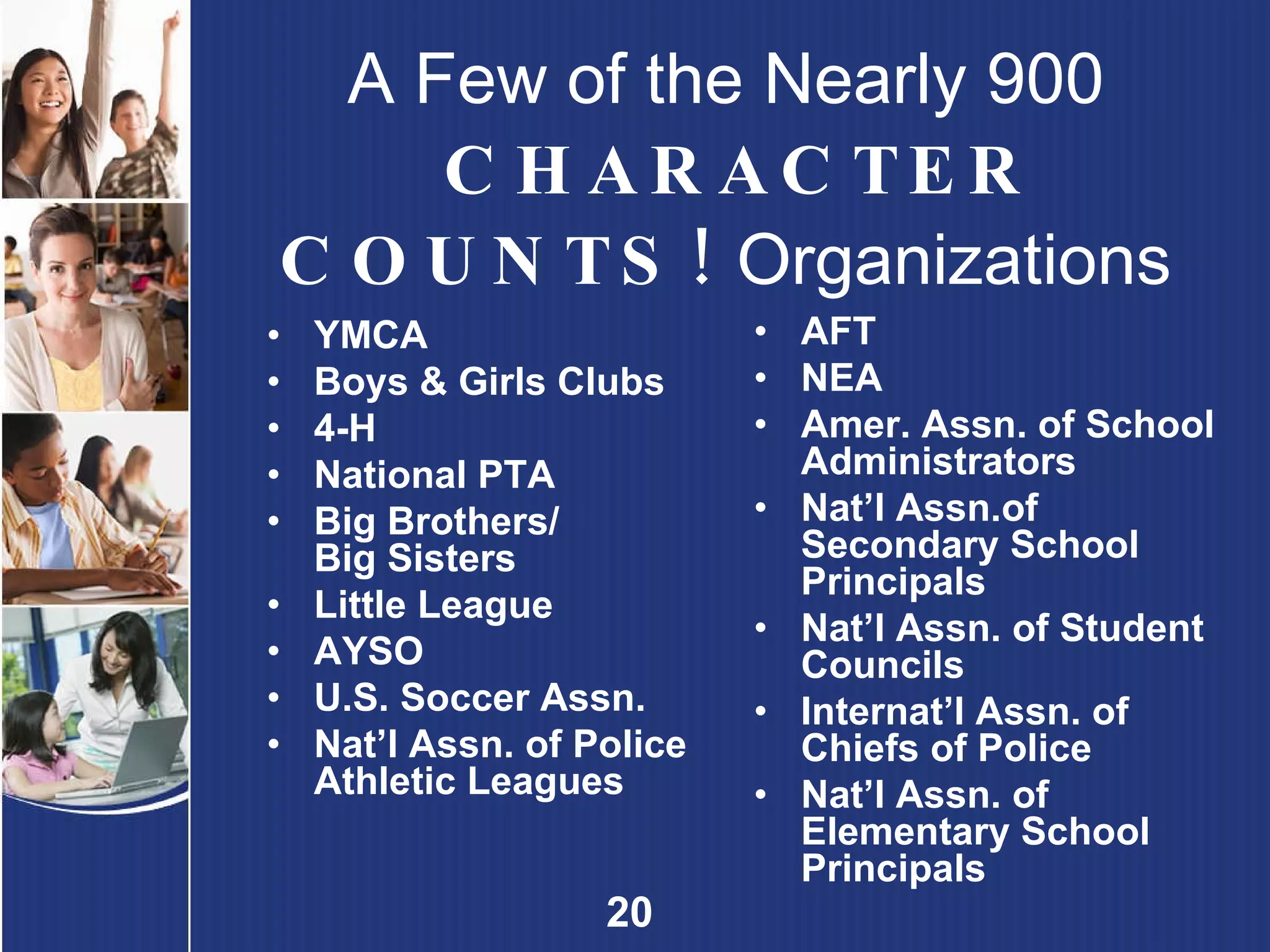
A Few of the Nearly 900  CHARACTER COUNTS!  Organizations YMCA Boys & Girls Clubs 4-H National PTA Big Brothers/ Big Sisters Little League AYSO U.S. Soccer Assn. Nat’l Assn. of Police Athletic Leagues AFT NEA Amer. Assn. of School Administrators Nat’l Assn.of Secondary School Principals Nat’l Assn. of Student Councils Internat’l Assn. of Chiefs of Police Nat’l Assn. of Elementary School Principals
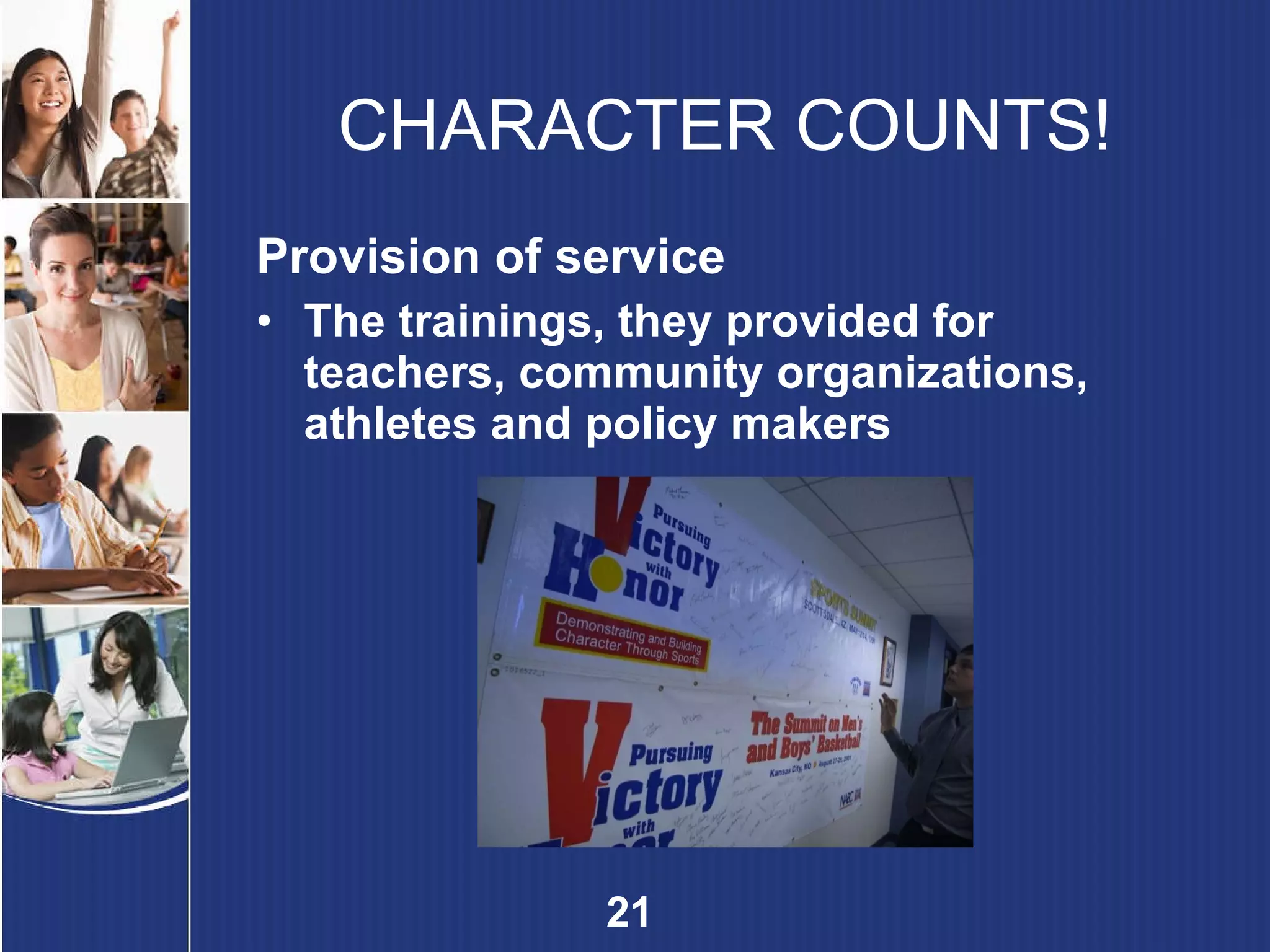
CHARACTER COUNTS! Provision of service The trainings, they provided for teachers, community organizations, athletes and policy makers
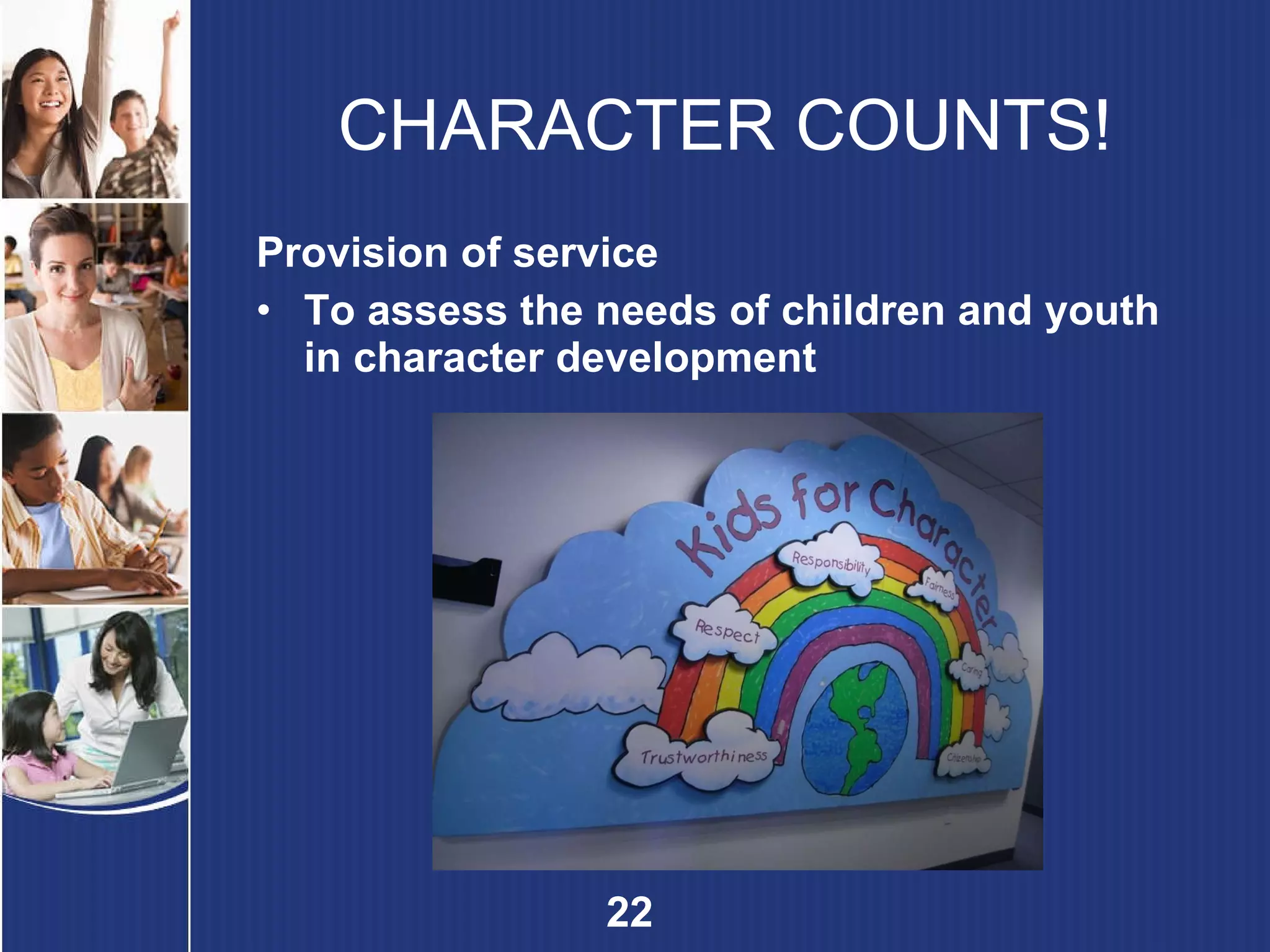
CHARACTER COUNTS! Provision of service To assess the needs of children and youth in character development
CHARACTER COUNTS! Provision of service To support and advice the graduates in implementation of character education among the locals To create the sharing platform among the graduates for our newly created plans for education. The graduates are able to share their experience and materials around the worldwide with the help from Character Counts
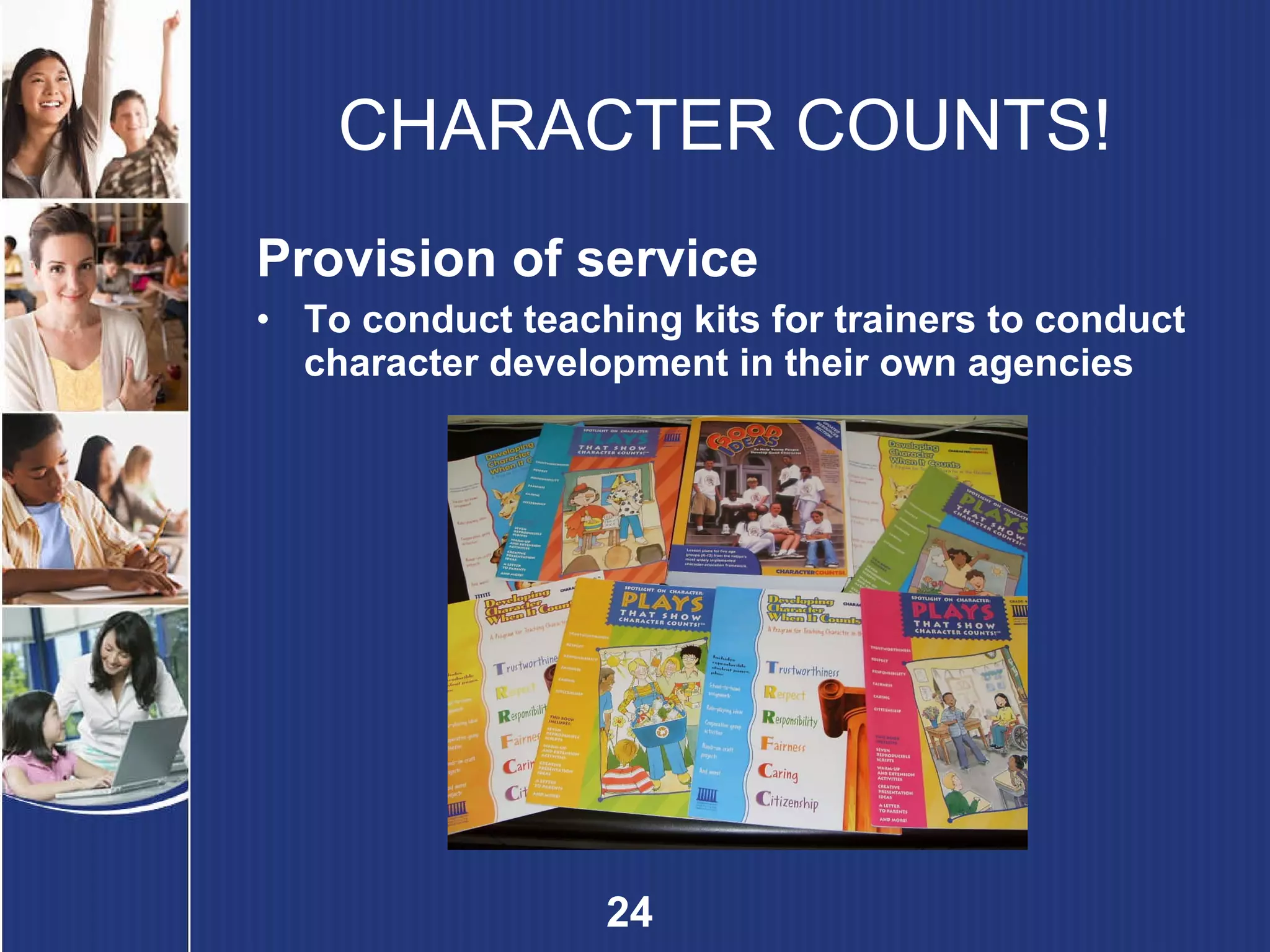
CHARACTER COUNTS! Provision of service To conduct teaching kits for trainers to conduct character development in their own agencies
Character development seminar Six Pillars of Character TRUSTWORTHINESS   – honesty, integrity, promise-keeping, loyalty RESPECT   –  courtesy, nonviolence, tolerance, autonomy RESPONSIBILITY   –  duty, accountability, pursuit of excellence, self-restraint FAIRNESS   –  openness, consistency, impartiality CARING   –  kindness, compassion, empathy CITIZENSHIP   –  civic virtue, lawfulness, common good
Our Y’s Perspectives Promoting the core ethic value; Building in the caring, honesty, respect and responsibility attitude towards our members; Empowering them with the ability to face the uncertainty;  Living with the model of Jesus Christ.
Our Y’s Perspectives Six Pillars (T.R.R.F.C.C.) comes to Four Pillars Caring --  To love others, to be sensitive to the well-being of others   Honesty --  To tell the truth, to act in such a way that I am worthy of trust, to have integrity, making sure my actions match my values   Respect --  To treat others as you would have them treat you, to value the worth of every person, including yourself Responsibility --  To do what you ought to do, to be accountable for your behavior and obligations
Educating for Good Character Character education is about helping students cultivate worthy lives.
Educating for Good Character Character education is more than giving students opportunities to practice virtues and uproot vice. It allows young people to assume responsibility for their own character formation. They soon realize that character education is not something being done to them, but something they’re doing to and for themselves.
Educating for Good Character Children aren’t mere blocks of stone whom adults ruthlessly carve into “ideal students.” Character education helps young people become the sculptors of their own lives and character.
T.E.A.M.   TEACH ENFORCE ADVOCATE MODEL
Seven Steps to Good Decisions Stop and think Clarify goals Determine facts Develop options Consider consequences  Choose Monitor and modify
Caring Pillar One
Caring A caring person is compassionate, considerate, and unselfish. A caring person shows appreciation, forgives others and helps people without expecting anything in return.
Caring The Pillar of Caring is demonstrated by two main concepts: Concern for others Passion for an ideal, belief, or cause
A Caring Person Is: Compassionate and empathetic Kind, loving, and considerate Thankful and expresses gratitude Forgiving of others
2. Caring Heroes 2.1 Florence Nightingale, the founder of modern nursing, organised and directed a field of nurses during the Crimean War. Her life was dedicated to the care of the sick and war-wounded.  She established a nursing school at St. Thomas’s Hospital in London.
2.2 Diana, Princess of Wales, had a genuine devotion to issues involving children and the aging. She was also an outspoken advocate for AIDS research.
3. Caring games 3.1 Folding Heart 3.2 Making Fair Decisions 3.3 I-Care Card
A Caring Person Is  Not : Mean, cruel, or insensitive Selfish or self-centered Too busy to lend a helping hand
Elements of Caring: Concern for others’ well-being Compassion Empathy Kindness and consideration Charity Sacrifice Gratitude Mercy and forgiveness
Concern for Others To engage or involve yourself in the well-being of others as if your happiness depended on theirs.
Compassion Sorrow or concern for the suffering of others accompanied by the urge to help.
Empathy The ability to share in another person’s thoughts and feelings.
Compassion and Empathy A person who cares feels an emotional response to both the pain and pleasure of others.
Kindness and Consideration Having sympathetic or generous qualities imply an inclination to be charitable and do good.
Charity The voluntary giving of money or other help to people in need.
Sacrifice Paying a personal cost to accomplish a goal. The personal cost may be small or great, but it’s paid to benefit another.
Gratitude Being genuinely grateful for others and their efforts. Gratitude should be without condescension.
Mercy and Forgiveness Mercy means giving someone who’s committed an offense more than he deserves. We might call it: Giving someone a break Cutting someone slack Giving someone another (or second) chance
Caring as Passion Caring is having regard for someone or something based on desire or esteem.   That means we place a value on what we care about.
Caring as Passion Avoid unfairly criticizing those who don’t care about (value) the things we do. We may embrace a cause or follow a belief system that is important to us. However, others may reject it. Respect asks us to accept and tolerate the rights of others to have their own values and views .
Elements Conviction  -- A strong belief in the rightness of an idea or course of action Commitment  -- Dedication or willingness to pay the price Persistence  emphasizes attitude: the inward determination to continue pursuing character development Endurance  emphasizes practice and behavior: in spite of obstacles, continuing to improve and practice good character
Good words are worth much and cost little. —  George Herbert
Do all the good you can, By all the means you can, In all the ways you can, In all the places you can, As long as ever you can. — John Wesley,  John Wesley’s Rule
Honesty Pillar Two Honesty means living with integrity, being reliable and loyal 2.1 Tower of Trust 2.2 Balloon Game
2. Honesty Heroes 2.1 George Washington, first president of the United States, was trustworthy and determined. There were numerous stories about his honesty and strength. It is said that the chopped down his father’s cherry tree and then confessed by saying, “I cannot tell a lie, Pa.”
2.2 Abraham Lincoln, the 16 th   president of the United States, was nicknamed Honest Abe. When he was an adolescent, he once charged a woman six and a quarter cents too much. He walked three miles to catch up with her and pay her back.
Honesty Embodies Four Ethical Principles Integrity Trust Promise-Keeping Loyalty
Honesty There are two types of honesty: Communications Conduct
Honesty: Communications Truthfulness  – representing facts and intentions to the best of one’s knowledge Sincerity  – being genuine without trickery or duplicity Candor  – volunteering information another person would want to know; being frank, forthright, and open
Honesty: Conduct Playing by the rules —  no cheating Being trustworthy with others’ property —  no stealing
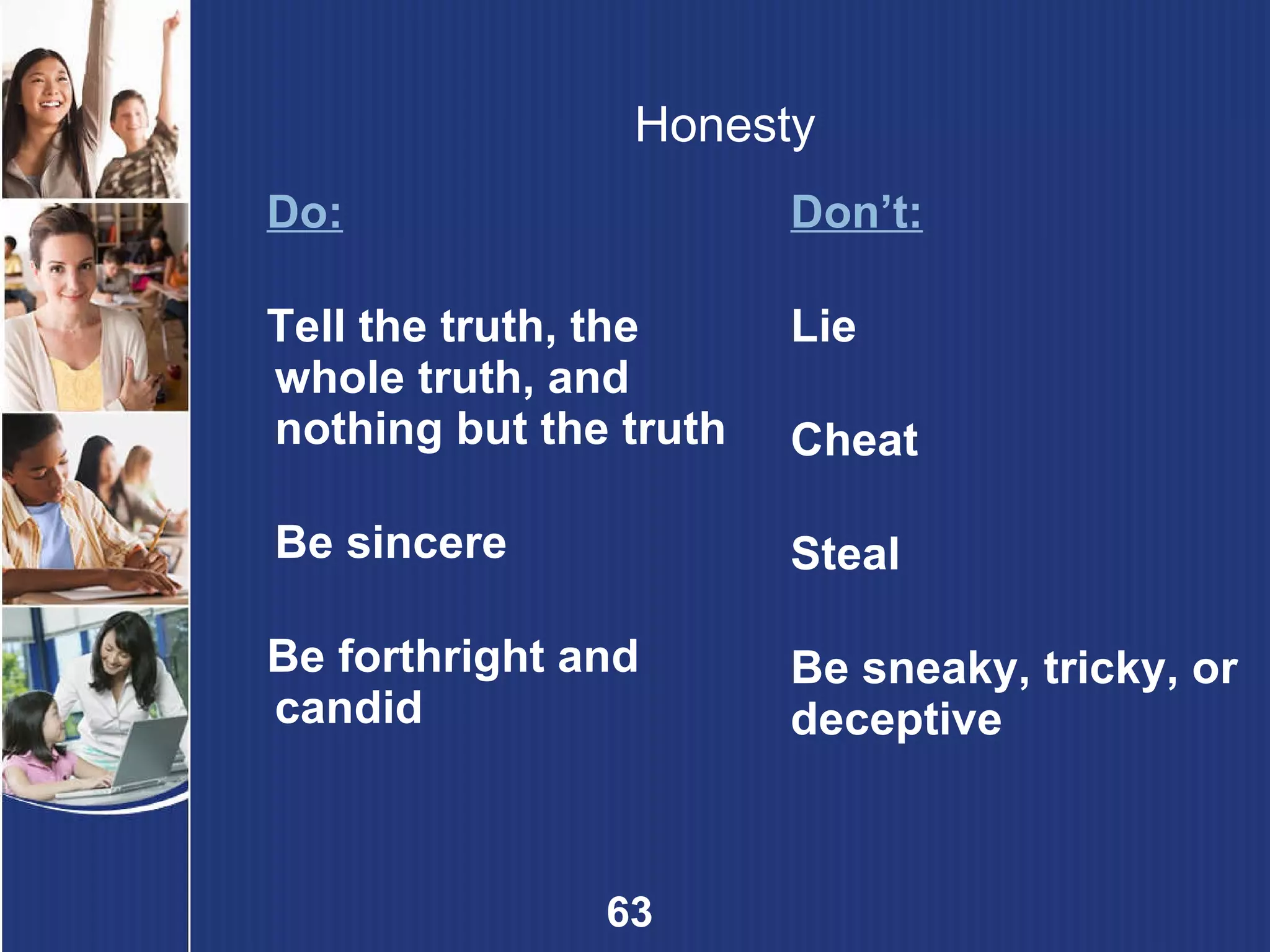
Honesty Do: Tell the truth, the whole truth, and nothing but the truth Be sincere Be forthright and candid Don’t: Lie Cheat Steal Be sneaky, tricky, or deceptive
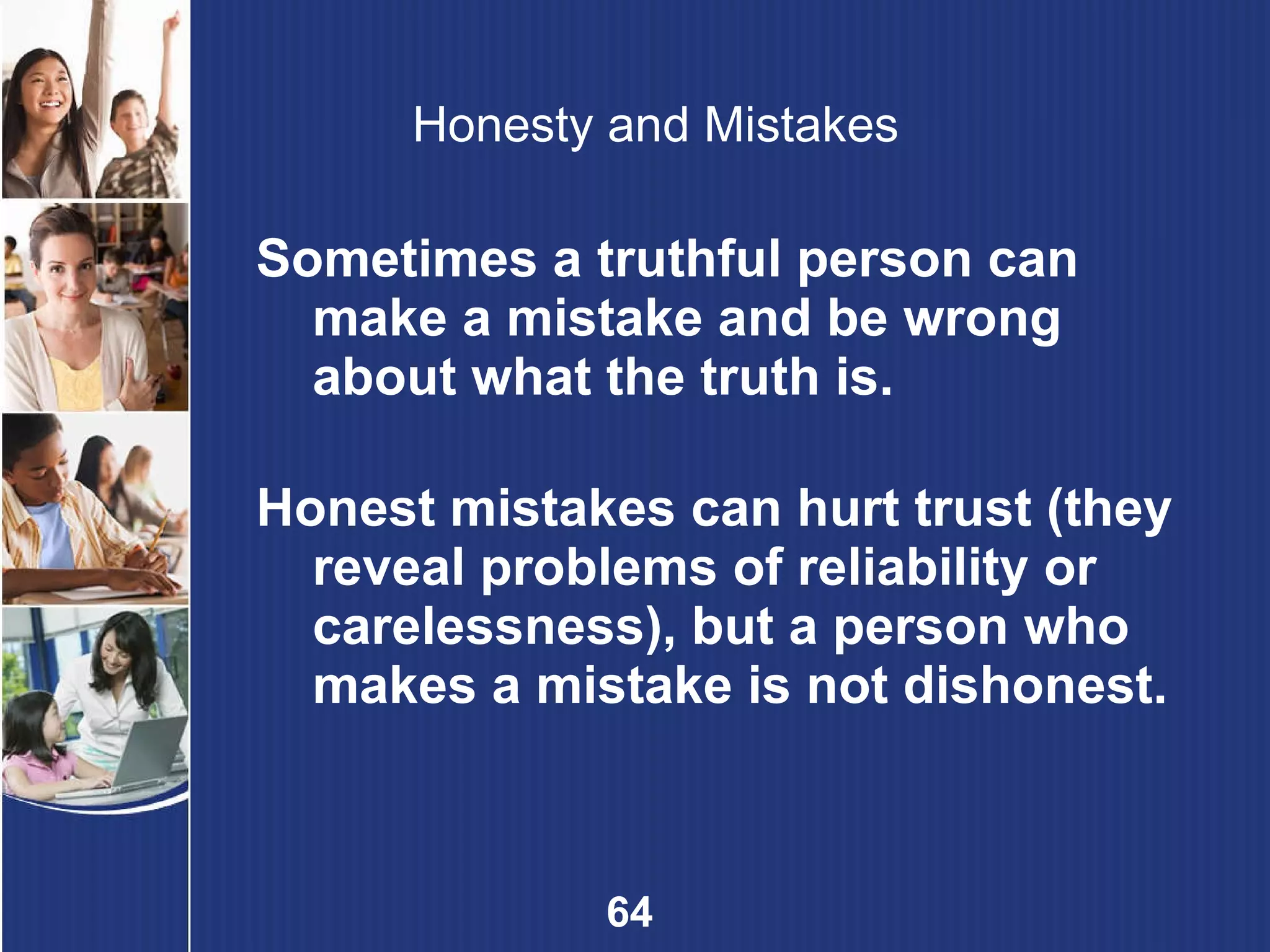
Honesty and Mistakes Sometimes a truthful person can make a mistake and be wrong about what the truth is. Honest mistakes can hurt trust (they reveal problems of reliability or carelessness), but a person who makes a mistake is not dishonest.
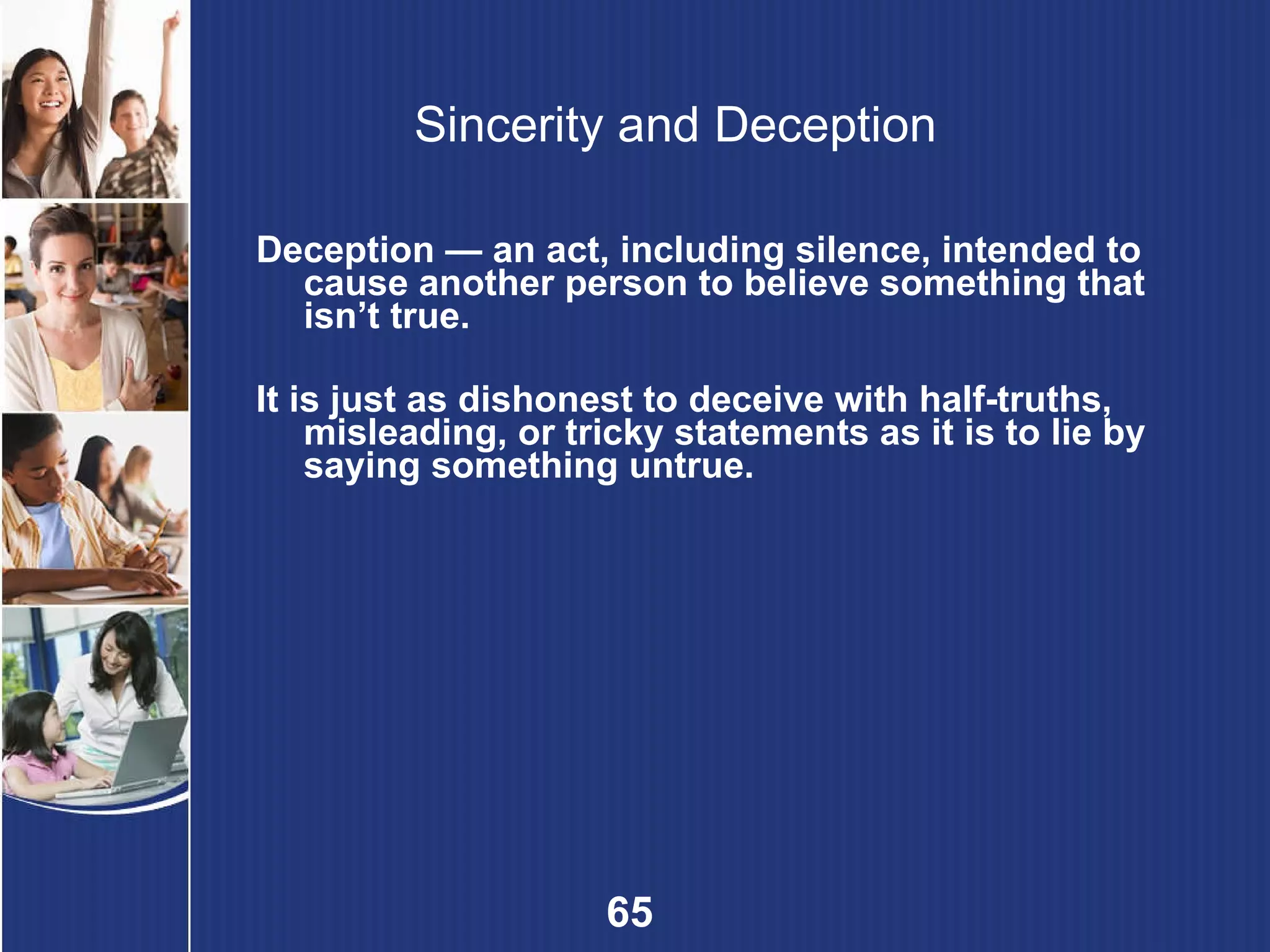
Sincerity and Deception Deception — an act, including silence, intended to cause another person to believe something that isn’t true. It is just as dishonest to deceive with half-truths, misleading, or tricky statements as it is to lie by saying something untrue.
Candor and Forthrightness In a trusting relationship, there is sometimes a moral obligation to reveal something even if you’re not asked. Unless prevented by another moral duty, a trustworthy person should volunteer information only when: The information could affect a trusting friend or associate in an important way It is fairly expected in the relationship that such information will be shared
In Trusting Relationships... Exaggerations Promising what you cannot deliver Deliberate distortions Concealment of important facts False statements of opinion ARE  LIES
Integrity Integrity is moral wholeness demonstrated by a consistency of:  Thoughts  – what we think Words  – what we say Deeds  – what we do Duties   – what we should do
Integrity Although living up to personal values and “walking the talk” are critical aspects of integrity, they aren’t enough. A person of integrity must also recognize and live up to  universal  moral obligations such as trustworthiness, respect, responsibility, fairness, caring, and citizenship.
Integrity Integrity requires both being true to oneself and living up to one’s highest and best personal values. Self-respect and self-esteem are essential to feelings of worthiness, fulfillment, contentment, and peace of mind — attitudes necessary to a personal sense of integrity.
Integrity Is Consistency People without integrity are often called hypocrites or “two-faced.” People who cannot be consistently counted on to demonstrate integrity cannot be trusted.
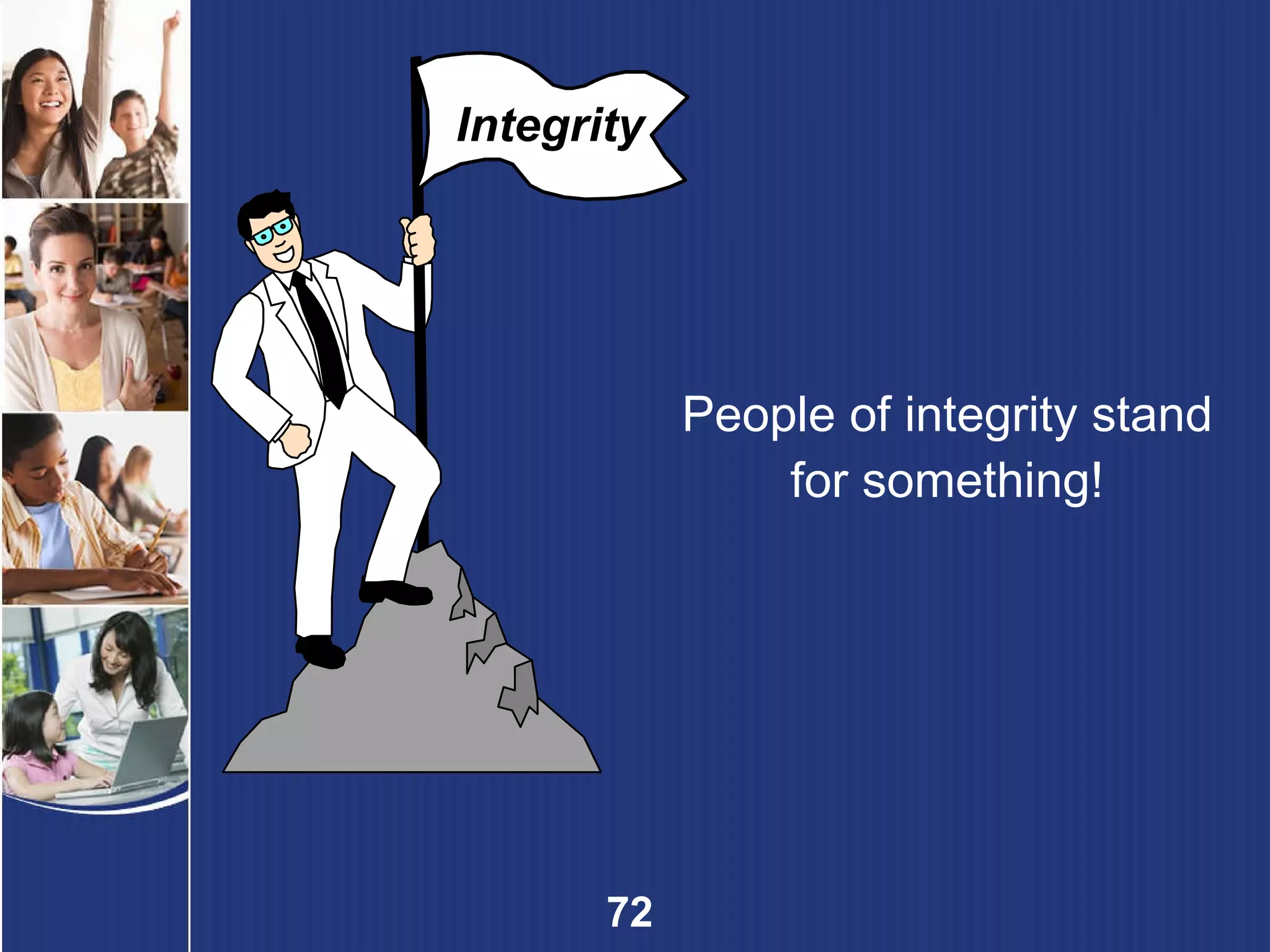
People of integrity stand for something! Integrity
People With Integrity Stand up for their beliefs openly and boldly Listen to their conscience and live by their principles no matter what others say and no matter the personal cost Are honorable and upright in all actions Have the courage to do what’s right and to try new things even when it’s hard or costly or when failure is probable   Build and guard their reputations
People With Integrity Don’t do anything they think is wrong   Don’t lose heart if they fail
Courage Courage doesn’t require us to be fearless. Fear is a natural and important protective emotion that warns us of danger. The essence of courage is the prudent overcoming of fear.
Moral Courage Integrity often requires courage — a firmness of spirit that enables us to: Try new things Pursue goals Persevere Overcome fears
Don’t compromise yourself. You are all you’ve got. —  Janis Joplin, 20th-century American rock singer
Before you advise anyone ‘Be yourself!’ reassess his character. –  Unknown
Let’s have lunch^^
Opening Activity of Afternoon 3/2/1
Respect Pillar Three 3.1 Playing Card Hierarchy
Respect The essence of respect is to show solemn regard for the worth of people, including yourself.
Two Aspects of Respect What you think of others How you treat others
Respect Treating people with respect means letting them know that: Their safety and happiness matter They’re important and worthy simply because they’re fellow human beings.
Seven Rules of Respect Honor the individual worth and dignity of others. Show courtesy and civility. Honor reasonable social standards and customs. Live by the Golden Rule. Accept differences and judge on character and ability. Respect the autonomy of others. Avoid actual or threatened violence.
The Magic Words Civility is a lubricant for human interaction and a sign of respect. The simple rituals of saying “please,” “thank you,” and “excuse me” acknowledge the importance of others as not merely things but as individuals entitled to respect.
Live by the  Golden Rule Do unto others as you would have them do unto you.
Distortions of the Golden Rule AS A RULE OF MORALITY   Do unto others as you would have them do unto you. AS A RULE OF REVENGE Do unto others as they have done unto you. AS A RULE OF SELF-DEFENSE Do unto others before they do unto you. AS A RULE OF INVESTMENT Do unto others so they will do unto you.
Rule of Universality Do only those acts that you’re willing to allow to become universal standards of behavior applicable to all people in similar situations. Ask yourself: If everyone did it, would it be a good thing?
Privacy Respect requires us to honor the desire for privacy. The claim to privacy is a matter of dignity, however, not an absolute right.  There are times when it’s morally justified and legally proper for parents, teachers, and police to invade privacy to advance a greater good.
Tolerance and Acceptance —  DO — Judge others on their character, abilities, and conduct, not on race, religion, gender, appearance, residence, or monetary worth. Be tolerant, respectful, and accepting of those who are different from you. Listen to others and try to understand their points of view and opinions.
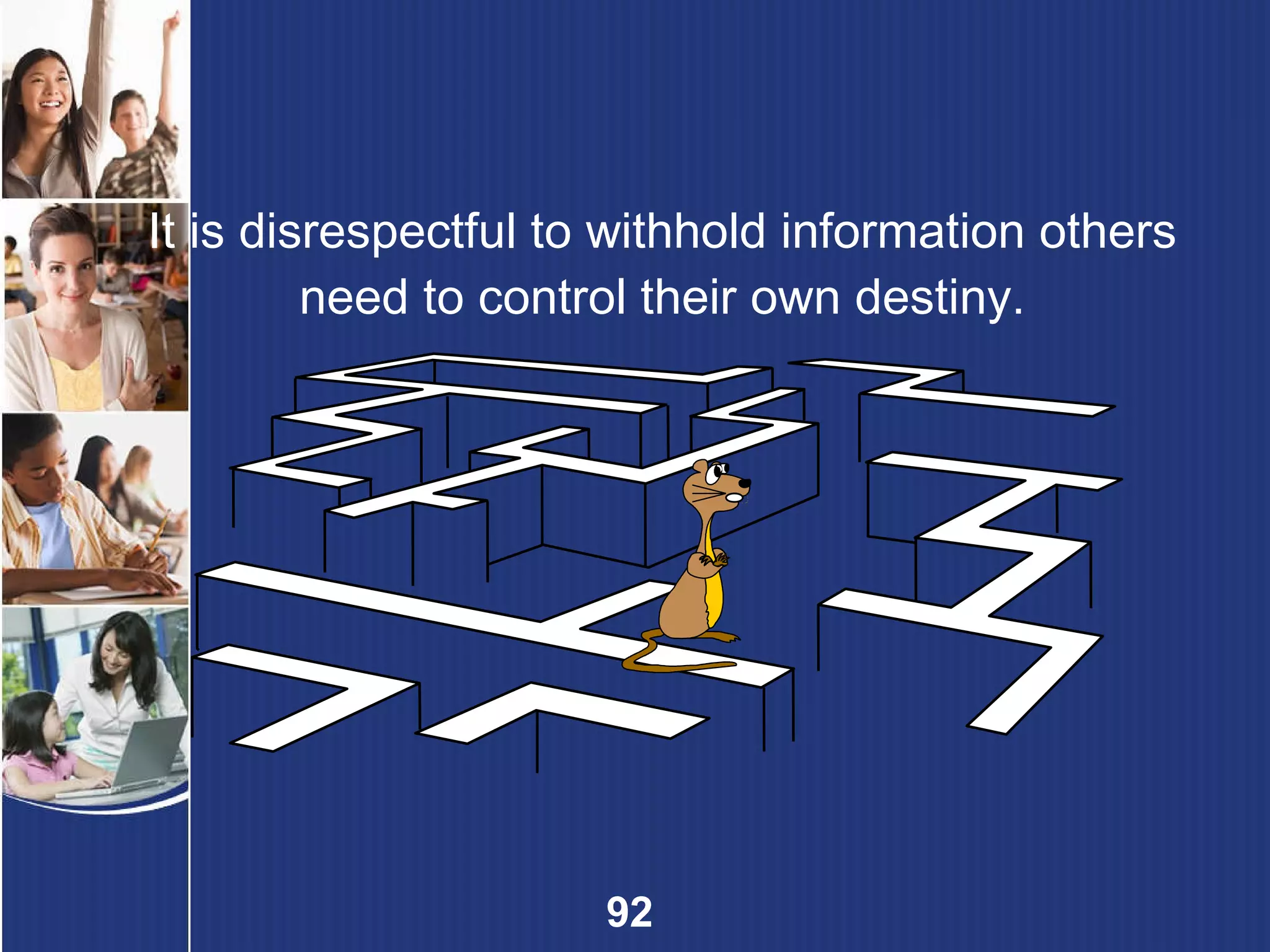
It is disrespectful to withhold information others need to control their own destiny.
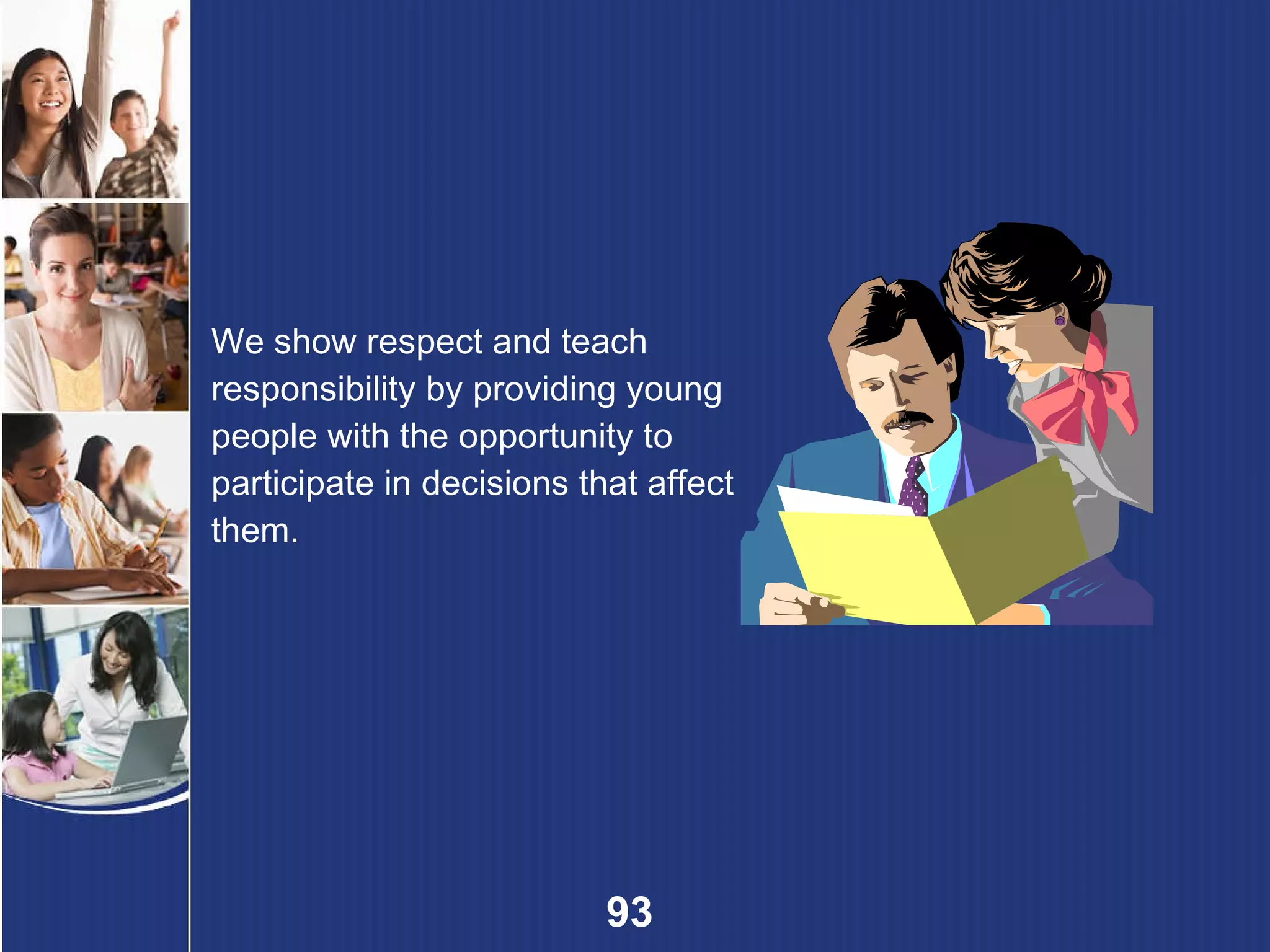
We show respect and teach responsibility by providing young people with the opportunity to participate in decisions that affect them.
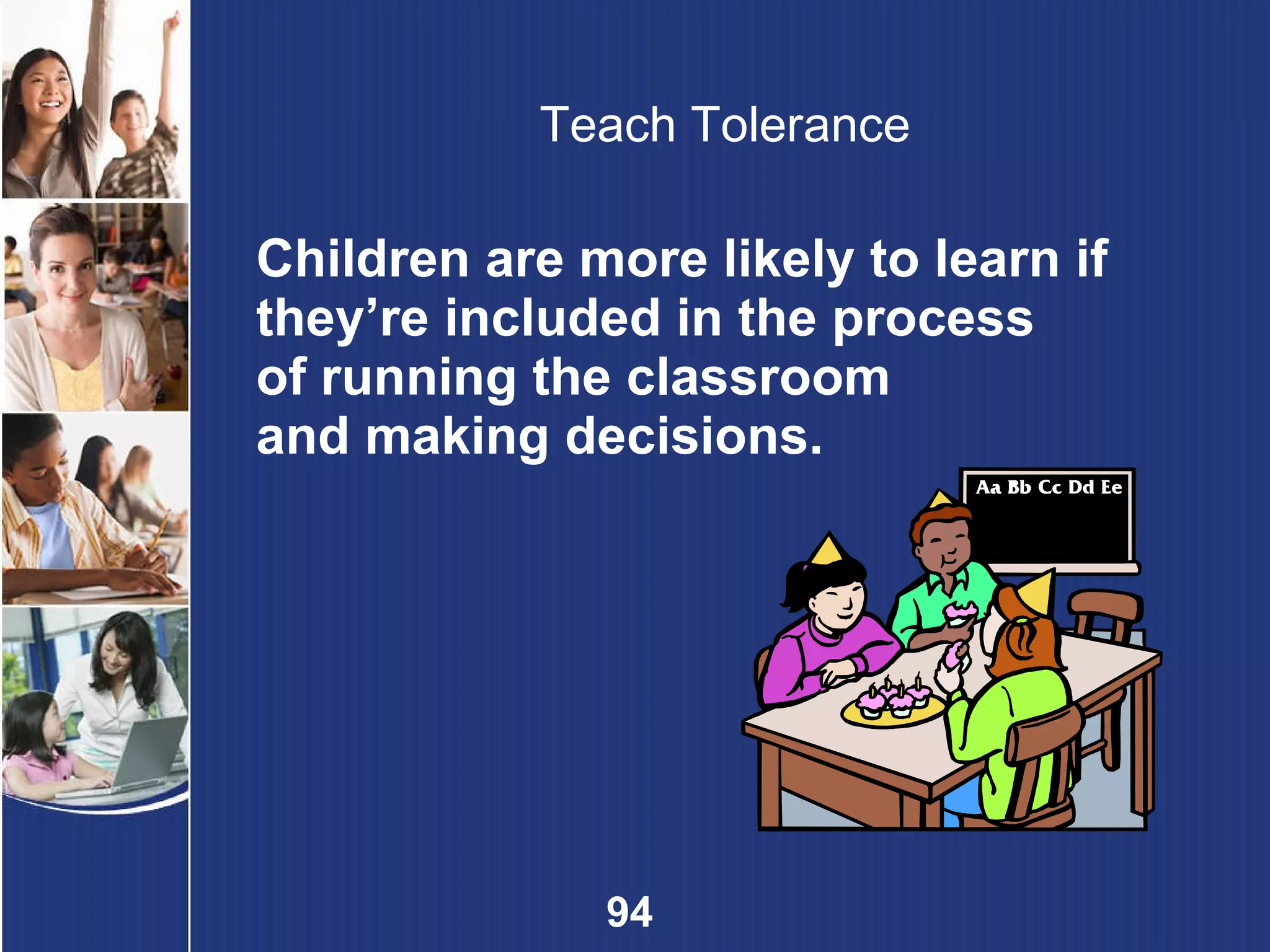
Teach Tolerance Children are more likely to learn if they’re included in the process of running the classroom and making decisions.
The honor we receive from those that fear us, is not honor. —  Montaigne, Essays (1580-1588)
It is nice to be important,  but it is more important  to be nice. –  Sir John Marks Templeton, American-born British financier (b. 1912)
Responsibility Pillar Four 4.1 Filling the Jar
Dimensions of Responsibility Your ability to reason and freedom to choose makes you morally autonomous and, therefore, accountable for your choices. You are bound by principles of morality to make choices that honor, rather than degrade, universal ethical obligations to be trustworthy, respectful, responsible, fair, caring, and a good citizen.
Responsibility Life is full of choices . . .   Responsibility is an important aspect of good character: the moral obligation to choose attitudes, words, and actions and the duty to accept personal responsibility for the consequences of those actions.
Responsibility Responsibility requires that you recognize what you do — and don’t do — matters.
Responsibility and Character Development You can’t choose to be good looking, smart, or athletic. You can’t choose your parents or the circumstances in which you grow up. But you can choose how to deal with the outrages and opportunities of life. From these choices, your character is formed.
Teach Children That... Choosing not to choose is a choice. Choosing whether to be conscious and concerned about the consequences of what you say and do, including the choice to be willfully blind, is a choice.
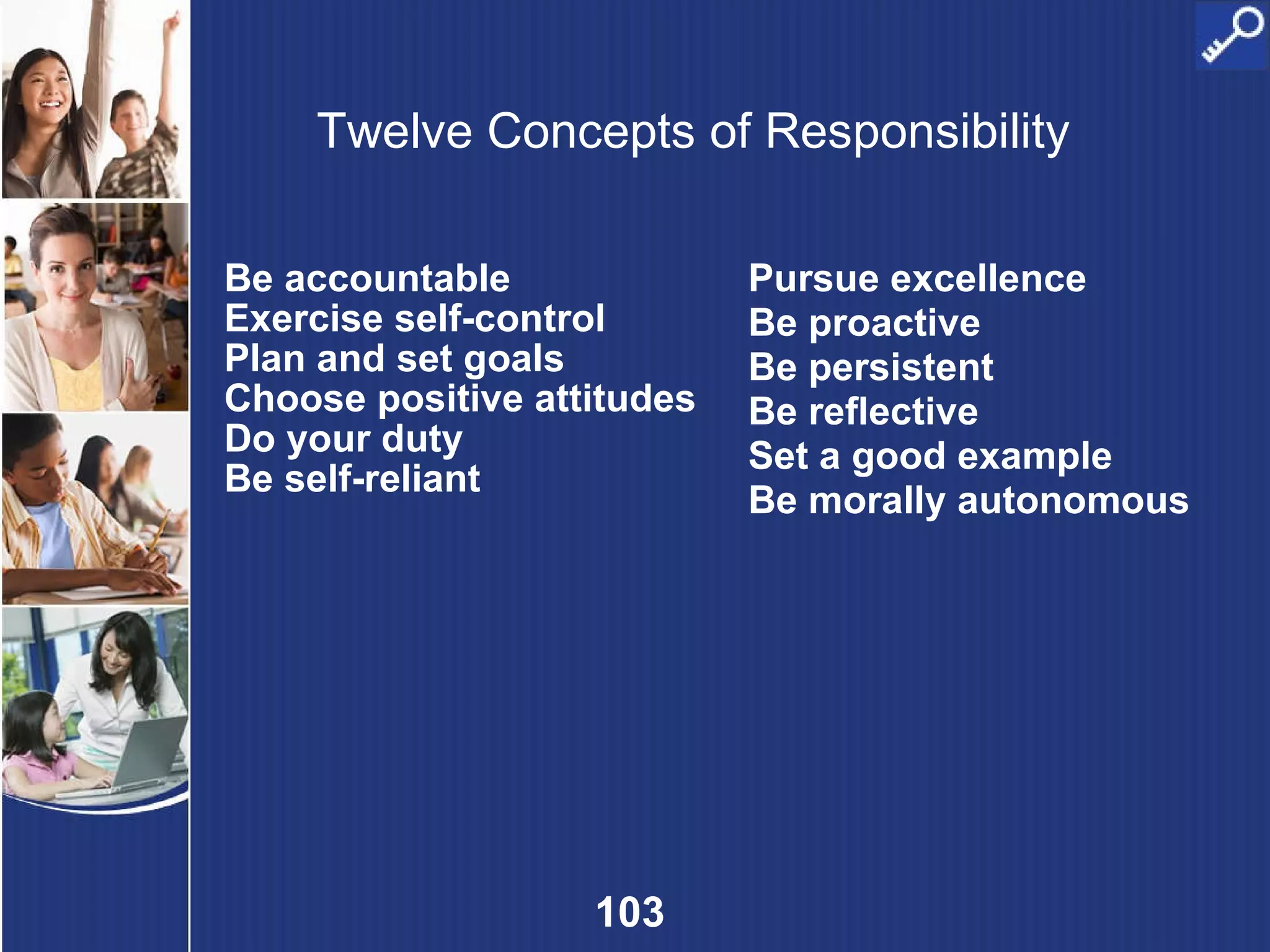
Twelve Concepts of Responsibility Be accountable Exercise self-control Plan and set goals Choose positive attitudes Do your duty Be self-reliant Pursue excellence Be proactive Be persistent Be reflective Set a good example Be morally autonomous
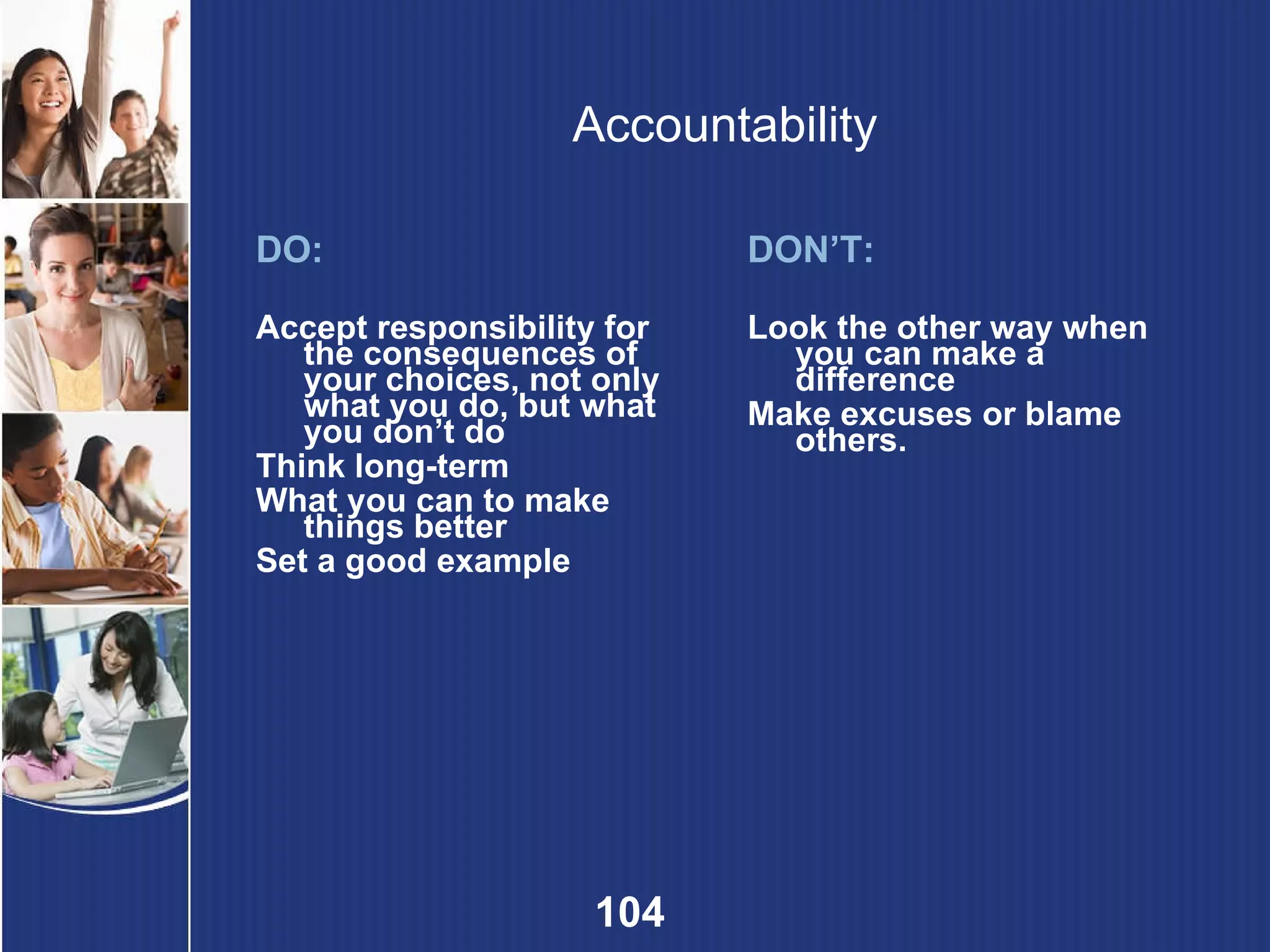
Accountability DO: Accept responsibility for the consequences of your choices, not only what you do, but what you don’t do Think long-term What you can to make things better Set a good example DON’T: Look the other way when you can make a difference Make excuses or blame others.
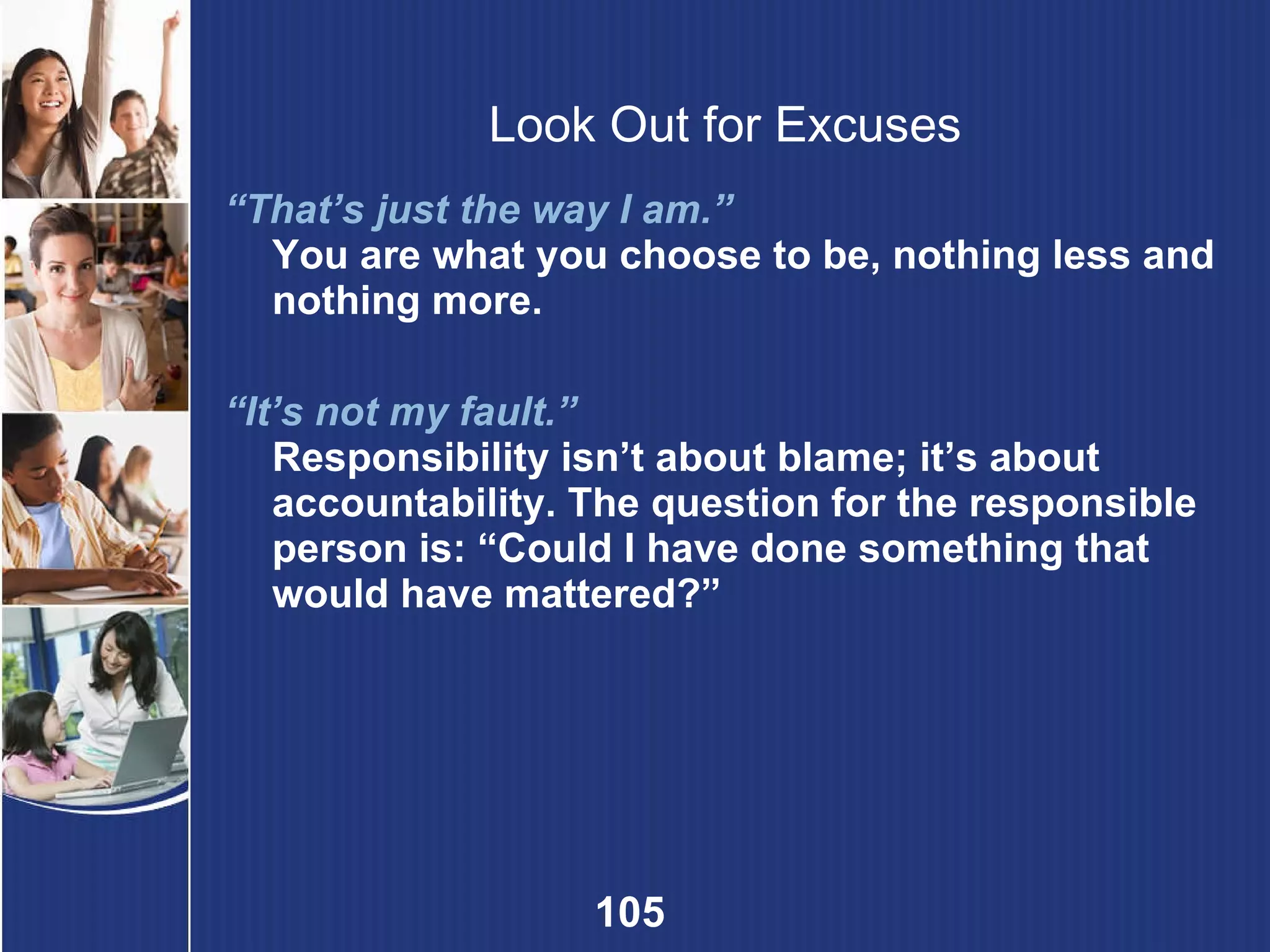
Look Out for Excuses “ That’s just the way I am.”   You are what you choose to be, nothing less and nothing more. “ It’s not my fault.”   Responsibility isn’t about blame; it’s about accountability. The question for the responsible person is: “Could I have done something that would have mattered?”
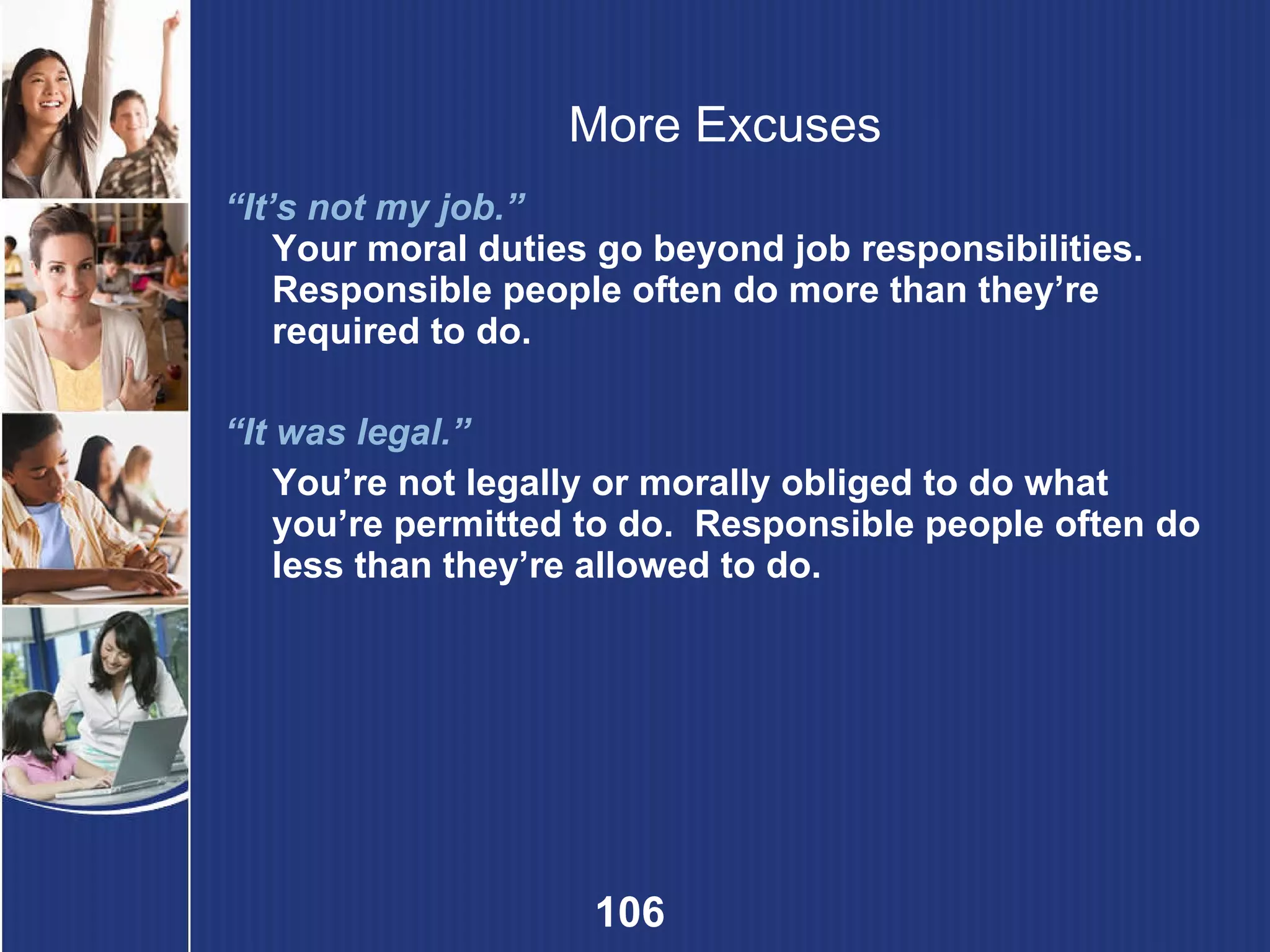
More Excuses “ It’s not my job.” Your moral duties go beyond job responsibilities. Responsible people often do more than they’re required to do. “ It was legal.”  You’re not legally or morally obliged to do what you’re permitted to do.  Responsible people often do less than they’re allowed to do.
Exercise  Self-Control Take charge of your life. Everyone’s responsible for the development of his or her personal character. Set realistic goals. Keep a positive outlook. Be prudent and self-disciplined with your health, emotions, time, and money. Be rational — act out of reason, not anger, revenge, or fear.
Exercise  Self-Control In honor of reason and moral duty, restrain even the most powerful passions and appetites. Recognize that everything you say and do makes a difference. Therefore, think about your choices.
Responsible People... Don’t blame others or make excuses for their actions and inactions Govern their behavior according to their sense of moral duty, which is broader than their legal obligation
Choosing Positive Attitudes Positive attitudes that produce better relationships and more productive work habits include: Trustfulness Optimism Cheerfulness Enthusiasm Hopefulness Generosity
Choosing Positive Attitudes Negative attitudes are forms of prejudice that distort perceptions and often produce unwise and self-defeating choices. They include: Cynicism Defeatism Suspiciousness Pessimism Hopelessness Selfishness
Do Your Duty Acknowledge and meet your legal and moral obligations.
Pursue Excellence Take pride in everything you do in recognition of the obligation to yourself — and those who rely on you — to do your best. Despite a shortage of time and resources, as a responsible person, do the best you can with what you have.
Pursue Excellence DO: Your best Persevere Prepare Be diligent Work hard Make all you do worthy of pride
Good Work Habits There is an ethical dimension to good work habits — the work ethic: Others depend on you to show up on time, prepared and ready to do your work, and dedicated to stick with the job until it’s done.
Set a Good Example Setting a good example means: Leading by Example  – Take the initiative to do what needs to be done. Role-modeling   – What you do is more important than what you say.
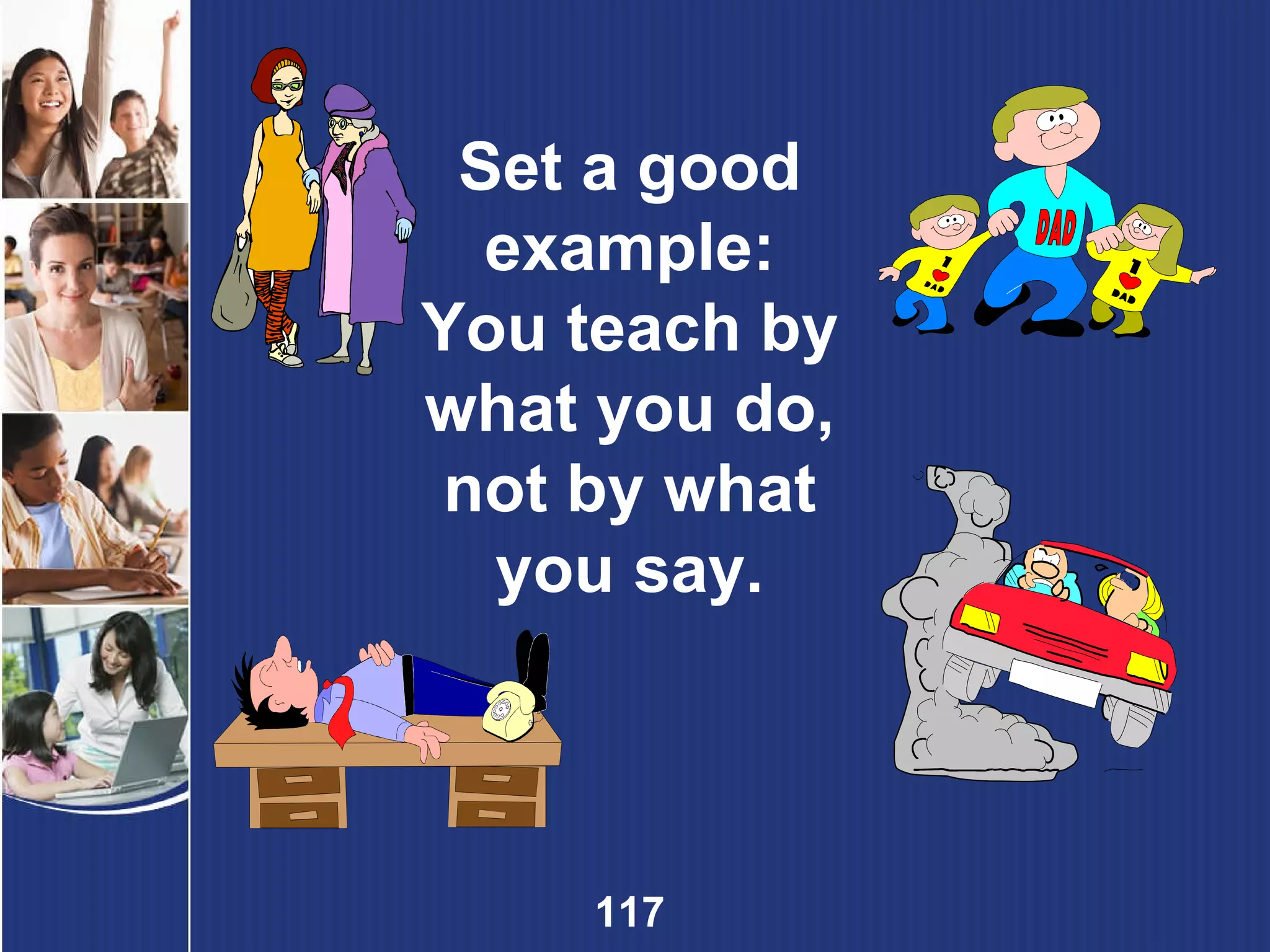
Set a good example: You teach by what you do, not by what you say.
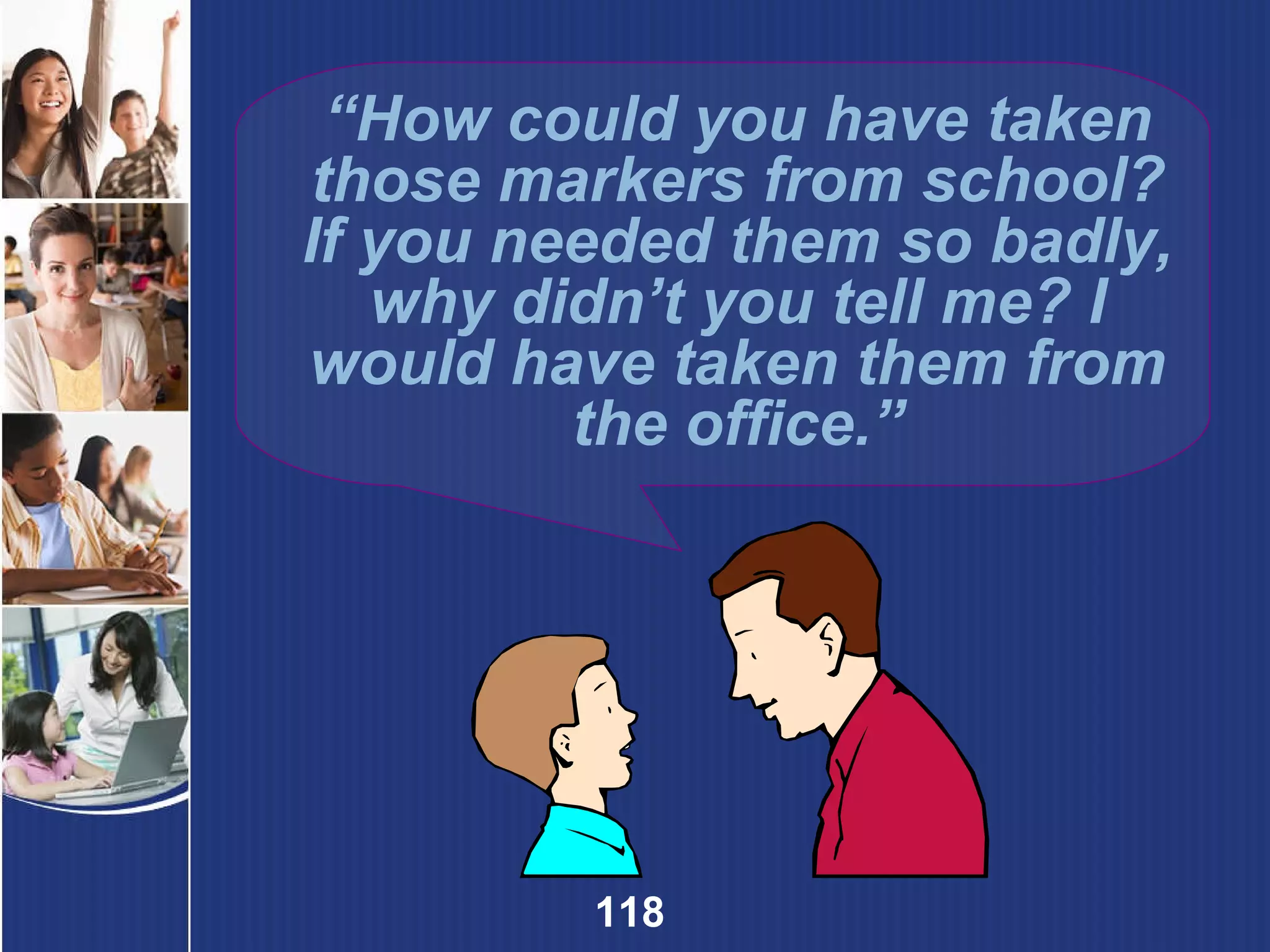
“ How could you have taken those markers from school? If you needed them so badly, why didn’t you tell me? I would have taken them from the office.”
Two Types of Responsibility Personal responsibility Collective responsibility
Teachers Help Students Develop Both Help students develop the motivation and skills to practice self-discipline. Help students develop a sense of responsibility toward their class- and schoolmates.
Developing Collective Responsibility Instill in students the value of careful planning, self-assessment, and skill development. Provide students with a sense of control over their behavior. Create in the classroom a balance of community support and challenge for individual strengths and weaknesses.
Developing Collective Responsibility Empower students to understand, monitor, and change their behavior. Provide students with a sense of what it means to be a member of the class or school. Enable students to share the responsibility for holding all class members accountable to agreed-upon rules.
School as a Community For a classroom to become a positive learning environment, students must believe they’re part of a safe and caring community – both in and out of school. Have students take responsibility for their own actions. Hold each other accountable for following rules.
School as a Community Students often fail to see the school as a community with an intrinsic worth. Thus, they justify rules about class attendance, bullying, stealing, or cheating solely in terms of how they benefit the individual.  Help students develop appropriate responses to what it means to be a member of their classroom and school. “ That’s not how we do things here.” “ At our school, we show respect for others.”
School as a Community Teachers need to give students the pleasure of saying “we” rather than “I.” Saying “we,” the child is aware that a supportive, dependable community is behind him or her. In order to develop the pleasure of saying “we,” teachers must call students’ attention to the spirit of the class or pride in the school and seize upon whatever events draw members of a class or a school together as occasions for furthering their collective consciousness.
Dreams are what get you started. Discipline is what keeps you going. –  Jim Ryun, American Congressman and former world record holder in the mile run (b. 1947)
What Works Effective character-building programs are centered on: Instilling habits Inspiring moral ambitions Imposing positive and negative consequences Developing critical thinking and problem-solving skills Modeling good conduct Comprehensive approach
An Effective  Character-Development Program Is... PURPOSEFUL PERVASIVE REPETITIVE CONSISTENT CREATIVE CONCRETE
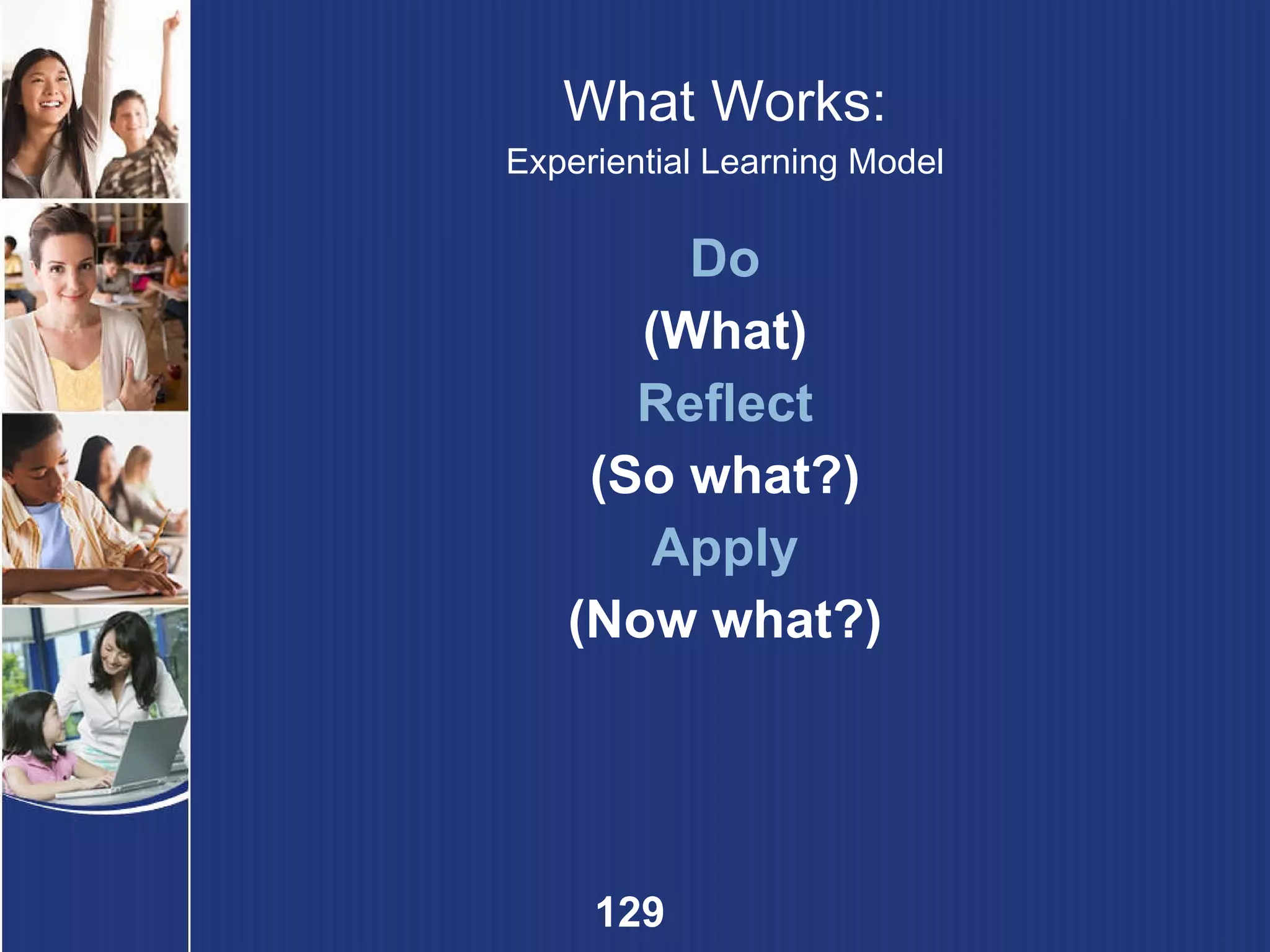
What Works: Experiential Learning Model Do (What) Reflect (So what?) Apply (Now what?)
What Works: Do – Reflect – Apply   Participants are guided through  doing  an activity,  reflecting  on their experience, and  applying  what they’ve learned. This process is key to learning and growing from experience.
Three Necessary Qualities For a character development initiative to succeed, it must be: Meaningful Measurable Sustainable
Implementation  Coalition Building model More & Less
Seven Elements of Implementation Put a team together. Conduct a needs and climate assessment. Train/consult. Create a vision and a plan. Involve all constituencies in action steps. Evaluate the program and adjust accordingly. Maintain and accelerate momentum.
Step One: Put a Team Together Form a Volunteer Task Force Can be called a  CHARACTER COUNTS!  Leadership Council Should be formed of genuinely interested parties Remember to be as broadly based as possible
Form a Volunteer  Task Force For communities, build a coalition team that includes key community leaders.  Either use an existing network focused on community needs or form a new coalition with  CHARACTER COUNTS!  as its primary mission.
Form a Volunteer  Task Force For schools, your team should include the principal or vice principal, athletic director, someone from the counselors’ office, teachers, support staff, parents, and student leaders.
Purpose of Volunteer Task Force Lead  Plan Implement Monitor Evaluate Sustain ...your initiatives
Closing Activity Elevator Encounter

3 Character Education Workshop

  • 1.
    Character Education WorkshopDate: 15th June, 2009 Venue: COC Room 104 Time: 10am-4pm Chinese YMCA of Hong Kong
  • 2.
    Starting Activities MoralCourage Treasure Hunt 1.1 Adult version 1.2 High School version
  • 3.
  • 4.
    What is Character?Small group sharing: My Board of Director
  • 5.
    Character In onesense, character is what is inside of us that responds to life Our responses come from the habits and dispositions we’ve learned and developed.
  • 6.
    Character Vs GoodCharacter Everyone has character, but not everyone has good character When we refer to specific person’s character, we’re concerned with the moral choices he or she makes and the virtues he or she may or may not practice. A person has good character because he or she knows the difference between right and wrong and strives to do what is right for the right reasons.
  • 7.
    Showing Our TrueCharacter Our true character is shown every day by: Our normal and consistent attitudes and behavior How we treat people who cannot help or hurt us
  • 8.
    “ Aperson’s character refers to dispositions and habits that determine the way that person normally responds to desires, fears, challenges, opportunities, failures, and successes.” Michael Josephson
  • 9.
    Character And ConscienceCharacter is how we act when we think no one’s watching. Conscience is the inner voice that warns us Someone may be watching
  • 10.
    Character And ReputationOur reputation is what other people think we are. Character is what we really are.
  • 11.
    “ Watchyour thoughts; they become words. Watch your words; they become actions. Watch your actions; they become habits. Watch your habits; they become character. Watch your character, it becomes your destiny.” _ Unknown
  • 12.
    Building Character Whenwe refer to building character, we’re concerned with instilling within a person the positive, admirable, and ethical traits that are associated with good character.
  • 13.
    Three Ways toBuild Character First, character training must involve teaching a person to follow the rules of good behavior. Those whom we’re training must know what’s expected of them.
  • 14.
    Second, character trainingmust involve developing good habits, which come only through repeated practice.
  • 15.
    Third, character trainingmust provide positive examples by placing children in the company of responsible adults. These adults must display an allegiance to good character and demonstrate the clear difference between right and wrong in their own everyday habits and behaviours.
  • 16.
    Overview of CHARACTER COUNTS! From the detail introduction and brief meeting with the Assistant Director, Justin Lu, of Character Counts, we had a better and concreted imagine also understanding how the Character Counts works over the States.
  • 17.
    How Did CHARACTER COUNTS! Get Started? Based on the belief that there are enduring moral truths that distinguish right from wrong and define the essence of good character, Josephson Institute sought to identify a list of core shared ethical values.
  • 18.
    What Is CHARACTERCOUNTS! ? CHARACTER COUNTS! is a national grassroots initiative based on voluntary citizen action.
  • 19.
    Partnership of OrganizationsThe CHARACTER COUNTS! Coalition is a partnership of nearly 900 national, regional, and local organizations committed to the CHARACTER COUNTS! strategy and joined together in a collaborative effort to improve the character of young people.
  • 20.
    A Few ofthe Nearly 900 CHARACTER COUNTS! Organizations YMCA Boys & Girls Clubs 4-H National PTA Big Brothers/ Big Sisters Little League AYSO U.S. Soccer Assn. Nat’l Assn. of Police Athletic Leagues AFT NEA Amer. Assn. of School Administrators Nat’l Assn.of Secondary School Principals Nat’l Assn. of Student Councils Internat’l Assn. of Chiefs of Police Nat’l Assn. of Elementary School Principals
  • 21.
    CHARACTER COUNTS! Provisionof service The trainings, they provided for teachers, community organizations, athletes and policy makers
  • 22.
    CHARACTER COUNTS! Provisionof service To assess the needs of children and youth in character development
  • 23.
    CHARACTER COUNTS! Provisionof service To support and advice the graduates in implementation of character education among the locals To create the sharing platform among the graduates for our newly created plans for education. The graduates are able to share their experience and materials around the worldwide with the help from Character Counts
  • 24.
    CHARACTER COUNTS! Provisionof service To conduct teaching kits for trainers to conduct character development in their own agencies
  • 25.
    Character development seminarSix Pillars of Character TRUSTWORTHINESS – honesty, integrity, promise-keeping, loyalty RESPECT – courtesy, nonviolence, tolerance, autonomy RESPONSIBILITY – duty, accountability, pursuit of excellence, self-restraint FAIRNESS – openness, consistency, impartiality CARING – kindness, compassion, empathy CITIZENSHIP – civic virtue, lawfulness, common good
  • 26.
    Our Y’s PerspectivesPromoting the core ethic value; Building in the caring, honesty, respect and responsibility attitude towards our members; Empowering them with the ability to face the uncertainty; Living with the model of Jesus Christ.
  • 27.
    Our Y’s PerspectivesSix Pillars (T.R.R.F.C.C.) comes to Four Pillars Caring -- To love others, to be sensitive to the well-being of others Honesty -- To tell the truth, to act in such a way that I am worthy of trust, to have integrity, making sure my actions match my values Respect -- To treat others as you would have them treat you, to value the worth of every person, including yourself Responsibility -- To do what you ought to do, to be accountable for your behavior and obligations
  • 28.
    Educating for GoodCharacter Character education is about helping students cultivate worthy lives.
  • 29.
    Educating for GoodCharacter Character education is more than giving students opportunities to practice virtues and uproot vice. It allows young people to assume responsibility for their own character formation. They soon realize that character education is not something being done to them, but something they’re doing to and for themselves.
  • 30.
    Educating for GoodCharacter Children aren’t mere blocks of stone whom adults ruthlessly carve into “ideal students.” Character education helps young people become the sculptors of their own lives and character.
  • 31.
    T.E.A.M. TEACH ENFORCE ADVOCATE MODEL
  • 32.
    Seven Steps toGood Decisions Stop and think Clarify goals Determine facts Develop options Consider consequences Choose Monitor and modify
  • 33.
  • 34.
    Caring A caringperson is compassionate, considerate, and unselfish. A caring person shows appreciation, forgives others and helps people without expecting anything in return.
  • 35.
    Caring The Pillarof Caring is demonstrated by two main concepts: Concern for others Passion for an ideal, belief, or cause
  • 36.
    A Caring PersonIs: Compassionate and empathetic Kind, loving, and considerate Thankful and expresses gratitude Forgiving of others
  • 37.
    2. Caring Heroes2.1 Florence Nightingale, the founder of modern nursing, organised and directed a field of nurses during the Crimean War. Her life was dedicated to the care of the sick and war-wounded. She established a nursing school at St. Thomas’s Hospital in London.
  • 38.
    2.2 Diana, Princessof Wales, had a genuine devotion to issues involving children and the aging. She was also an outspoken advocate for AIDS research.
  • 39.
    3. Caring games3.1 Folding Heart 3.2 Making Fair Decisions 3.3 I-Care Card
  • 40.
    A Caring PersonIs Not : Mean, cruel, or insensitive Selfish or self-centered Too busy to lend a helping hand
  • 41.
    Elements of Caring:Concern for others’ well-being Compassion Empathy Kindness and consideration Charity Sacrifice Gratitude Mercy and forgiveness
  • 42.
    Concern for OthersTo engage or involve yourself in the well-being of others as if your happiness depended on theirs.
  • 43.
    Compassion Sorrow orconcern for the suffering of others accompanied by the urge to help.
  • 44.
    Empathy The abilityto share in another person’s thoughts and feelings.
  • 45.
    Compassion and EmpathyA person who cares feels an emotional response to both the pain and pleasure of others.
  • 46.
    Kindness and ConsiderationHaving sympathetic or generous qualities imply an inclination to be charitable and do good.
  • 47.
    Charity The voluntarygiving of money or other help to people in need.
  • 48.
    Sacrifice Paying apersonal cost to accomplish a goal. The personal cost may be small or great, but it’s paid to benefit another.
  • 49.
    Gratitude Being genuinelygrateful for others and their efforts. Gratitude should be without condescension.
  • 50.
    Mercy and ForgivenessMercy means giving someone who’s committed an offense more than he deserves. We might call it: Giving someone a break Cutting someone slack Giving someone another (or second) chance
  • 51.
    Caring as PassionCaring is having regard for someone or something based on desire or esteem. That means we place a value on what we care about.
  • 52.
    Caring as PassionAvoid unfairly criticizing those who don’t care about (value) the things we do. We may embrace a cause or follow a belief system that is important to us. However, others may reject it. Respect asks us to accept and tolerate the rights of others to have their own values and views .
  • 53.
    Elements Conviction -- A strong belief in the rightness of an idea or course of action Commitment -- Dedication or willingness to pay the price Persistence emphasizes attitude: the inward determination to continue pursuing character development Endurance emphasizes practice and behavior: in spite of obstacles, continuing to improve and practice good character
  • 54.
    Good words areworth much and cost little. — George Herbert
  • 55.
    Do all thegood you can, By all the means you can, In all the ways you can, In all the places you can, As long as ever you can. — John Wesley, John Wesley’s Rule
  • 56.
    Honesty Pillar TwoHonesty means living with integrity, being reliable and loyal 2.1 Tower of Trust 2.2 Balloon Game
  • 57.
    2. Honesty Heroes2.1 George Washington, first president of the United States, was trustworthy and determined. There were numerous stories about his honesty and strength. It is said that the chopped down his father’s cherry tree and then confessed by saying, “I cannot tell a lie, Pa.”
  • 58.
    2.2 Abraham Lincoln,the 16 th president of the United States, was nicknamed Honest Abe. When he was an adolescent, he once charged a woman six and a quarter cents too much. He walked three miles to catch up with her and pay her back.
  • 59.
    Honesty Embodies FourEthical Principles Integrity Trust Promise-Keeping Loyalty
  • 60.
    Honesty There aretwo types of honesty: Communications Conduct
  • 61.
    Honesty: Communications Truthfulness – representing facts and intentions to the best of one’s knowledge Sincerity – being genuine without trickery or duplicity Candor – volunteering information another person would want to know; being frank, forthright, and open
  • 62.
    Honesty: Conduct Playingby the rules — no cheating Being trustworthy with others’ property — no stealing
  • 63.
    Honesty Do: Tellthe truth, the whole truth, and nothing but the truth Be sincere Be forthright and candid Don’t: Lie Cheat Steal Be sneaky, tricky, or deceptive
  • 64.
    Honesty and MistakesSometimes a truthful person can make a mistake and be wrong about what the truth is. Honest mistakes can hurt trust (they reveal problems of reliability or carelessness), but a person who makes a mistake is not dishonest.
  • 65.
    Sincerity and DeceptionDeception — an act, including silence, intended to cause another person to believe something that isn’t true. It is just as dishonest to deceive with half-truths, misleading, or tricky statements as it is to lie by saying something untrue.
  • 66.
    Candor and ForthrightnessIn a trusting relationship, there is sometimes a moral obligation to reveal something even if you’re not asked. Unless prevented by another moral duty, a trustworthy person should volunteer information only when: The information could affect a trusting friend or associate in an important way It is fairly expected in the relationship that such information will be shared
  • 67.
    In Trusting Relationships...Exaggerations Promising what you cannot deliver Deliberate distortions Concealment of important facts False statements of opinion ARE LIES
  • 68.
    Integrity Integrity ismoral wholeness demonstrated by a consistency of: Thoughts – what we think Words – what we say Deeds – what we do Duties – what we should do
  • 69.
    Integrity Although livingup to personal values and “walking the talk” are critical aspects of integrity, they aren’t enough. A person of integrity must also recognize and live up to universal moral obligations such as trustworthiness, respect, responsibility, fairness, caring, and citizenship.
  • 70.
    Integrity Integrity requiresboth being true to oneself and living up to one’s highest and best personal values. Self-respect and self-esteem are essential to feelings of worthiness, fulfillment, contentment, and peace of mind — attitudes necessary to a personal sense of integrity.
  • 71.
    Integrity Is ConsistencyPeople without integrity are often called hypocrites or “two-faced.” People who cannot be consistently counted on to demonstrate integrity cannot be trusted.
  • 72.
    People of integritystand for something! Integrity
  • 73.
    People With IntegrityStand up for their beliefs openly and boldly Listen to their conscience and live by their principles no matter what others say and no matter the personal cost Are honorable and upright in all actions Have the courage to do what’s right and to try new things even when it’s hard or costly or when failure is probable Build and guard their reputations
  • 74.
    People With IntegrityDon’t do anything they think is wrong Don’t lose heart if they fail
  • 75.
    Courage Courage doesn’trequire us to be fearless. Fear is a natural and important protective emotion that warns us of danger. The essence of courage is the prudent overcoming of fear.
  • 76.
    Moral Courage Integrityoften requires courage — a firmness of spirit that enables us to: Try new things Pursue goals Persevere Overcome fears
  • 77.
    Don’t compromise yourself.You are all you’ve got. — Janis Joplin, 20th-century American rock singer
  • 78.
    Before you adviseanyone ‘Be yourself!’ reassess his character. – Unknown
  • 79.
  • 80.
    Opening Activity ofAfternoon 3/2/1
  • 81.
    Respect Pillar Three3.1 Playing Card Hierarchy
  • 82.
    Respect The essenceof respect is to show solemn regard for the worth of people, including yourself.
  • 83.
    Two Aspects ofRespect What you think of others How you treat others
  • 84.
    Respect Treating peoplewith respect means letting them know that: Their safety and happiness matter They’re important and worthy simply because they’re fellow human beings.
  • 85.
    Seven Rules ofRespect Honor the individual worth and dignity of others. Show courtesy and civility. Honor reasonable social standards and customs. Live by the Golden Rule. Accept differences and judge on character and ability. Respect the autonomy of others. Avoid actual or threatened violence.
  • 86.
    The Magic WordsCivility is a lubricant for human interaction and a sign of respect. The simple rituals of saying “please,” “thank you,” and “excuse me” acknowledge the importance of others as not merely things but as individuals entitled to respect.
  • 87.
    Live by the Golden Rule Do unto others as you would have them do unto you.
  • 88.
    Distortions of theGolden Rule AS A RULE OF MORALITY Do unto others as you would have them do unto you. AS A RULE OF REVENGE Do unto others as they have done unto you. AS A RULE OF SELF-DEFENSE Do unto others before they do unto you. AS A RULE OF INVESTMENT Do unto others so they will do unto you.
  • 89.
    Rule of UniversalityDo only those acts that you’re willing to allow to become universal standards of behavior applicable to all people in similar situations. Ask yourself: If everyone did it, would it be a good thing?
  • 90.
    Privacy Respect requiresus to honor the desire for privacy. The claim to privacy is a matter of dignity, however, not an absolute right. There are times when it’s morally justified and legally proper for parents, teachers, and police to invade privacy to advance a greater good.
  • 91.
    Tolerance and Acceptance— DO — Judge others on their character, abilities, and conduct, not on race, religion, gender, appearance, residence, or monetary worth. Be tolerant, respectful, and accepting of those who are different from you. Listen to others and try to understand their points of view and opinions.
  • 92.
    It is disrespectfulto withhold information others need to control their own destiny.
  • 93.
    We show respectand teach responsibility by providing young people with the opportunity to participate in decisions that affect them.
  • 94.
    Teach Tolerance Childrenare more likely to learn if they’re included in the process of running the classroom and making decisions.
  • 95.
    The honor wereceive from those that fear us, is not honor. — Montaigne, Essays (1580-1588)
  • 96.
    It is niceto be important, but it is more important to be nice. – Sir John Marks Templeton, American-born British financier (b. 1912)
  • 97.
    Responsibility Pillar Four4.1 Filling the Jar
  • 98.
    Dimensions of ResponsibilityYour ability to reason and freedom to choose makes you morally autonomous and, therefore, accountable for your choices. You are bound by principles of morality to make choices that honor, rather than degrade, universal ethical obligations to be trustworthy, respectful, responsible, fair, caring, and a good citizen.
  • 99.
    Responsibility Life isfull of choices . . . Responsibility is an important aspect of good character: the moral obligation to choose attitudes, words, and actions and the duty to accept personal responsibility for the consequences of those actions.
  • 100.
    Responsibility Responsibility requiresthat you recognize what you do — and don’t do — matters.
  • 101.
    Responsibility and CharacterDevelopment You can’t choose to be good looking, smart, or athletic. You can’t choose your parents or the circumstances in which you grow up. But you can choose how to deal with the outrages and opportunities of life. From these choices, your character is formed.
  • 102.
    Teach Children That...Choosing not to choose is a choice. Choosing whether to be conscious and concerned about the consequences of what you say and do, including the choice to be willfully blind, is a choice.
  • 103.
    Twelve Concepts ofResponsibility Be accountable Exercise self-control Plan and set goals Choose positive attitudes Do your duty Be self-reliant Pursue excellence Be proactive Be persistent Be reflective Set a good example Be morally autonomous
  • 104.
    Accountability DO: Acceptresponsibility for the consequences of your choices, not only what you do, but what you don’t do Think long-term What you can to make things better Set a good example DON’T: Look the other way when you can make a difference Make excuses or blame others.
  • 105.
    Look Out forExcuses “ That’s just the way I am.” You are what you choose to be, nothing less and nothing more. “ It’s not my fault.” Responsibility isn’t about blame; it’s about accountability. The question for the responsible person is: “Could I have done something that would have mattered?”
  • 106.
    More Excuses “It’s not my job.” Your moral duties go beyond job responsibilities. Responsible people often do more than they’re required to do. “ It was legal.” You’re not legally or morally obliged to do what you’re permitted to do. Responsible people often do less than they’re allowed to do.
  • 107.
    Exercise Self-ControlTake charge of your life. Everyone’s responsible for the development of his or her personal character. Set realistic goals. Keep a positive outlook. Be prudent and self-disciplined with your health, emotions, time, and money. Be rational — act out of reason, not anger, revenge, or fear.
  • 108.
    Exercise Self-ControlIn honor of reason and moral duty, restrain even the most powerful passions and appetites. Recognize that everything you say and do makes a difference. Therefore, think about your choices.
  • 109.
    Responsible People... Don’tblame others or make excuses for their actions and inactions Govern their behavior according to their sense of moral duty, which is broader than their legal obligation
  • 110.
    Choosing Positive AttitudesPositive attitudes that produce better relationships and more productive work habits include: Trustfulness Optimism Cheerfulness Enthusiasm Hopefulness Generosity
  • 111.
    Choosing Positive AttitudesNegative attitudes are forms of prejudice that distort perceptions and often produce unwise and self-defeating choices. They include: Cynicism Defeatism Suspiciousness Pessimism Hopelessness Selfishness
  • 112.
    Do Your DutyAcknowledge and meet your legal and moral obligations.
  • 113.
    Pursue Excellence Takepride in everything you do in recognition of the obligation to yourself — and those who rely on you — to do your best. Despite a shortage of time and resources, as a responsible person, do the best you can with what you have.
  • 114.
    Pursue Excellence DO:Your best Persevere Prepare Be diligent Work hard Make all you do worthy of pride
  • 115.
    Good Work HabitsThere is an ethical dimension to good work habits — the work ethic: Others depend on you to show up on time, prepared and ready to do your work, and dedicated to stick with the job until it’s done.
  • 116.
    Set a GoodExample Setting a good example means: Leading by Example – Take the initiative to do what needs to be done. Role-modeling – What you do is more important than what you say.
  • 117.
    Set a goodexample: You teach by what you do, not by what you say.
  • 118.
    “ How couldyou have taken those markers from school? If you needed them so badly, why didn’t you tell me? I would have taken them from the office.”
  • 119.
    Two Types ofResponsibility Personal responsibility Collective responsibility
  • 120.
    Teachers Help StudentsDevelop Both Help students develop the motivation and skills to practice self-discipline. Help students develop a sense of responsibility toward their class- and schoolmates.
  • 121.
    Developing Collective ResponsibilityInstill in students the value of careful planning, self-assessment, and skill development. Provide students with a sense of control over their behavior. Create in the classroom a balance of community support and challenge for individual strengths and weaknesses.
  • 122.
    Developing Collective ResponsibilityEmpower students to understand, monitor, and change their behavior. Provide students with a sense of what it means to be a member of the class or school. Enable students to share the responsibility for holding all class members accountable to agreed-upon rules.
  • 123.
    School as aCommunity For a classroom to become a positive learning environment, students must believe they’re part of a safe and caring community – both in and out of school. Have students take responsibility for their own actions. Hold each other accountable for following rules.
  • 124.
    School as aCommunity Students often fail to see the school as a community with an intrinsic worth. Thus, they justify rules about class attendance, bullying, stealing, or cheating solely in terms of how they benefit the individual. Help students develop appropriate responses to what it means to be a member of their classroom and school. “ That’s not how we do things here.” “ At our school, we show respect for others.”
  • 125.
    School as aCommunity Teachers need to give students the pleasure of saying “we” rather than “I.” Saying “we,” the child is aware that a supportive, dependable community is behind him or her. In order to develop the pleasure of saying “we,” teachers must call students’ attention to the spirit of the class or pride in the school and seize upon whatever events draw members of a class or a school together as occasions for furthering their collective consciousness.
  • 126.
    Dreams are whatget you started. Discipline is what keeps you going. – Jim Ryun, American Congressman and former world record holder in the mile run (b. 1947)
  • 127.
    What Works Effectivecharacter-building programs are centered on: Instilling habits Inspiring moral ambitions Imposing positive and negative consequences Developing critical thinking and problem-solving skills Modeling good conduct Comprehensive approach
  • 128.
    An Effective Character-Development Program Is... PURPOSEFUL PERVASIVE REPETITIVE CONSISTENT CREATIVE CONCRETE
  • 129.
    What Works: ExperientialLearning Model Do (What) Reflect (So what?) Apply (Now what?)
  • 130.
    What Works: Do– Reflect – Apply Participants are guided through doing an activity, reflecting on their experience, and applying what they’ve learned. This process is key to learning and growing from experience.
  • 131.
    Three Necessary QualitiesFor a character development initiative to succeed, it must be: Meaningful Measurable Sustainable
  • 132.
    Implementation CoalitionBuilding model More & Less
  • 133.
    Seven Elements ofImplementation Put a team together. Conduct a needs and climate assessment. Train/consult. Create a vision and a plan. Involve all constituencies in action steps. Evaluate the program and adjust accordingly. Maintain and accelerate momentum.
  • 134.
    Step One: Puta Team Together Form a Volunteer Task Force Can be called a CHARACTER COUNTS! Leadership Council Should be formed of genuinely interested parties Remember to be as broadly based as possible
  • 135.
    Form a Volunteer Task Force For communities, build a coalition team that includes key community leaders. Either use an existing network focused on community needs or form a new coalition with CHARACTER COUNTS! as its primary mission.
  • 136.
    Form a Volunteer Task Force For schools, your team should include the principal or vice principal, athletic director, someone from the counselors’ office, teachers, support staff, parents, and student leaders.
  • 137.
    Purpose of VolunteerTask Force Lead Plan Implement Monitor Evaluate Sustain ...your initiatives
  • 138.