WORK STUDY-WORK STUDY-
METHOD,TIME STUDYMETHOD,TIME STUDY
Hareesh.MHareesh.M
I.D.NO:2014600120I.D.NO:2014600120
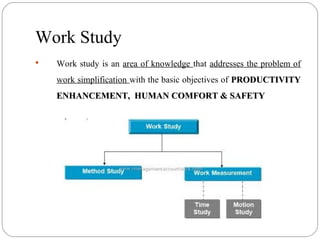
Work Study
 Work study is an area of knowledge that addresses the problem of
work simplification with the basic objectives of PRODUCTIVITYPRODUCTIVITY
ENHANCEMENT, HUMAN COMFORT & SAFETYENHANCEMENT, HUMAN COMFORT & SAFETY
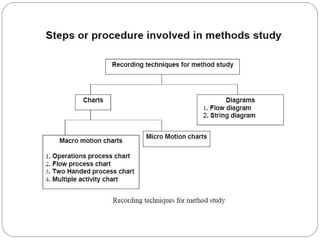
Method Study
Systematic recording and critical examination of
existing and proposed ways of doing work, as a
means of developing and applying easier and more
effective methods and reducing cost
The main purpose of method study is to
eliminate the unnecessary operations and to
achieve the best method of performing the
operation
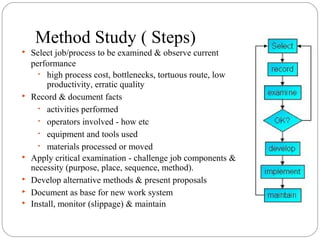
Method Study ( Steps)
 Select job/process to be examined & observe current
performance
• high process cost, bottlenecks, tortuous route, low
productivity, erratic quality
 Record & document facts
• activities performed
• operators involved - how etc
• equipment and tools used
• materials processed or moved
 Apply critical examination - challenge job components &
necessity (purpose, place, sequence, method).
 Develop alternative methods & present proposals
 Document as base for new work system
 Install, monitor (slippage) & maintain
Method Study (Objectives)
Improvement in use of all inputs
Economy in human effort
Layout improvement
Improvement in design of plant and
machinery
Improvement in safety standards and
procedures
Work measurement- Introduction
Work measurement (WM) is concerned with
investigating, reducing and eliminating ineffective
time, whatever may be the cause.
WM is the means of measuring the time taken in
the performance of an operation or series of
operations in such a way that the ineffective time is
shown up and can be separated out.
Purpose of WM
To reveal the nature and extent of ineffective time,
from whatever cause,
So that action can be taken to eliminate it; and
then,
To set standards of performance that are attainable
only if all avoidable ineffective time is eliminated
and work is performed by the best method
available.
Uses of WM
To compare the efficiency of alternative methods.
Other conditions being equal, the method which
takes the least time will be the best method.
To balance the work of members of teams, in
association with the multiple activity charts, so
that, as far as possible, each member has tasks
taking an equal time.
To determine, in association with man and
machine multiple activity charts, the number of
machines an worker can run.
Work Study (Benefits)
Increased productivity and increased efficiency
Reduced manufacturing costs
Improved work place layout
Better manpower planning and capacity planning
Improved work flow Provides better job satisfaction to
employees
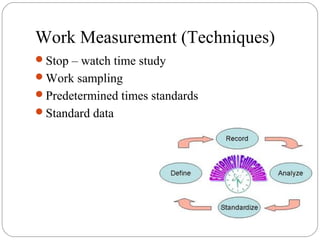
Work Measurement (Techniques)
Stop – watch time study
Work sampling
Predetermined times standards
Standard data
Time Study
One of the most common types of work
measurement is time study
For example - Purpose
An international coffee shop chain may want to
find out how long a barista should take to make a
specific coffee drink. Some of the stated
condition may include using cold milk that needs
to be steamed, rather than already steamed milk.
Time Study
Observations
A qualified practitioner should observe the
employee using a time measurement device. The
observer should also assess the quality of work
Observed Person
The observed person in the time study must be
fully trained in the measured task
Time StudiesTime Studies
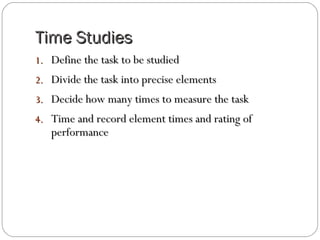
1.1. Define the task to be studiedDefine the task to be studied
2.2. Divide the task into precise elementsDivide the task into precise elements
3.3. Decide how many times to measure the taskDecide how many times to measure the task
4.4. Time and record element times and rating ofTime and record element times and rating of
performanceperformance
Time StudiesTime Studies
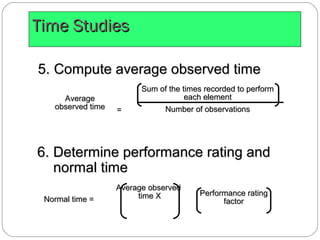
5.5. Compute average observed timeCompute average observed time
AverageAverage
observed timeobserved time
Sum of the times recorded to performSum of the times recorded to perform
each elementeach element
Number of observationsNumber of observations==
6.6. Determine performance rating andDetermine performance rating and
normal timenormal time
Normal time =Normal time =
Average observedAverage observed
time Xtime X Performance ratingPerformance rating
factorfactor
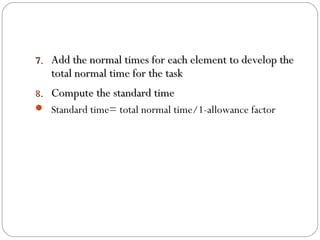
7.7. Add the normal times for each element to develop theAdd the normal times for each element to develop the
total normal time for the tasktotal normal time for the task
8.8. Compute the standard timeCompute the standard time
 Standard time= total normal time/1-allowance factor
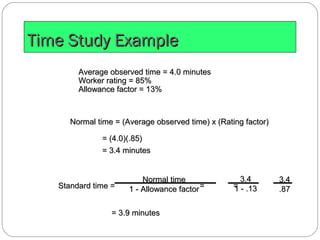
Time Study ExampleTime Study Example
Average observed time = 4.0 minutesAverage observed time = 4.0 minutes
Worker rating = 85%Worker rating = 85%
Allowance factor = 13%Allowance factor = 13%
Normal time = (Average observed time) x (Rating factor)Normal time = (Average observed time) x (Rating factor)
= (4.0)(.85)= (4.0)(.85)
= 3.4 minutes= 3.4 minutes
Standard time = = =Standard time = = =
Normal timeNormal time
1 - Allowance factor1 - Allowance factor
3.43.4
1 - .131 - .13
3.43.4
.87.87
= 3.9 minutes= 3.9 minutes
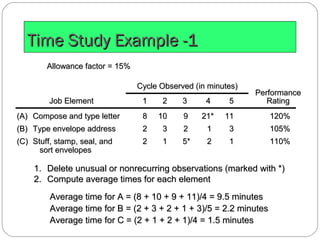
Time Study Example -1Time Study Example -1
Allowance factor = 15%Allowance factor = 15%
PerformancePerformance
Job ElementJob Element 11 22 33 44 55 RatingRating
(A)(A) Compose and type letterCompose and type letter 88 1010 99 21*21* 1111 120%120%
(B)(B) Type envelope addressType envelope address 22 33 22 11 33 105%105%
(C)(C) Stuff, stamp, seal, andStuff, stamp, seal, and 22 11 5*5* 22 11 110%110%
sort envelopessort envelopes
Cycle Observed (in minutes)Cycle Observed (in minutes)
1.1. Delete unusual or nonrecurring observations (marked with *)Delete unusual or nonrecurring observations (marked with *)
2.2. Compute average times for each elementCompute average times for each element
Average time for A = (8 + 10 + 9 + 11)/4 = 9.5 minutesAverage time for A = (8 + 10 + 9 + 11)/4 = 9.5 minutes
Average time for B = (2 + 3 + 2 + 1 + 3)/5 = 2.2 minutesAverage time for B = (2 + 3 + 2 + 1 + 3)/5 = 2.2 minutes
Average time for C = (2 + 1 + 2 + 1)/4 = 1.5 minutesAverage time for C = (2 + 1 + 2 + 1)/4 = 1.5 minutes
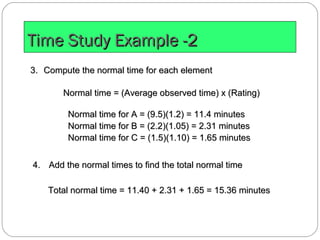
Time Study Example -2Time Study Example -2
3.3. Compute the normal time for each elementCompute the normal time for each element
Normal time for A = (9.5)(1.2) = 11.4 minutesNormal time for A = (9.5)(1.2) = 11.4 minutes
Normal time for B = (2.2)(1.05) = 2.31 minutesNormal time for B = (2.2)(1.05) = 2.31 minutes
Normal time for C = (1.5)(1.10) = 1.65 minutesNormal time for C = (1.5)(1.10) = 1.65 minutes
Normal time = (Average observed time) x (Rating)Normal time = (Average observed time) x (Rating)
4.4. Add the normal times to find the total normal timeAdd the normal times to find the total normal time
Total normal time = 11.40 + 2.31 + 1.65 = 15.36 minutesTotal normal time = 11.40 + 2.31 + 1.65 = 15.36 minutes
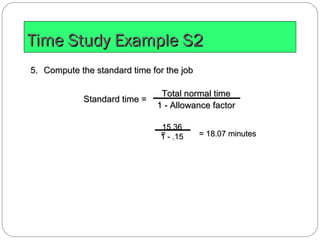
Time Study Example S2Time Study Example S2
5.5. Compute the standard time for the jobCompute the standard time for the job
Standard time =Standard time =
Total normal timeTotal normal time
1 - Allowance factor1 - Allowance factor
= = 18.07 minutes= = 18.07 minutes
15.3615.36
1 - .151 - .15
Thank youThank you

Work study method-and_time_study-final

  • 1.
    WORK STUDY-WORK STUDY- METHOD,TIMESTUDYMETHOD,TIME STUDY Hareesh.MHareesh.M I.D.NO:2014600120I.D.NO:2014600120
  • 2.
    Work Study  Workstudy is an area of knowledge that addresses the problem of work simplification with the basic objectives of PRODUCTIVITYPRODUCTIVITY ENHANCEMENT, HUMAN COMFORT & SAFETYENHANCEMENT, HUMAN COMFORT & SAFETY
  • 3.
    Method Study Systematic recordingand critical examination of existing and proposed ways of doing work, as a means of developing and applying easier and more effective methods and reducing cost The main purpose of method study is to eliminate the unnecessary operations and to achieve the best method of performing the operation
  • 5.
    Method Study (Steps)  Select job/process to be examined & observe current performance • high process cost, bottlenecks, tortuous route, low productivity, erratic quality  Record & document facts • activities performed • operators involved - how etc • equipment and tools used • materials processed or moved  Apply critical examination - challenge job components & necessity (purpose, place, sequence, method).  Develop alternative methods & present proposals  Document as base for new work system  Install, monitor (slippage) & maintain
  • 6.
    Method Study (Objectives) Improvementin use of all inputs Economy in human effort Layout improvement Improvement in design of plant and machinery Improvement in safety standards and procedures
  • 7.
    Work measurement- Introduction Workmeasurement (WM) is concerned with investigating, reducing and eliminating ineffective time, whatever may be the cause. WM is the means of measuring the time taken in the performance of an operation or series of operations in such a way that the ineffective time is shown up and can be separated out.
  • 8.
    Purpose of WM Toreveal the nature and extent of ineffective time, from whatever cause, So that action can be taken to eliminate it; and then, To set standards of performance that are attainable only if all avoidable ineffective time is eliminated and work is performed by the best method available.
  • 9.
    Uses of WM Tocompare the efficiency of alternative methods. Other conditions being equal, the method which takes the least time will be the best method. To balance the work of members of teams, in association with the multiple activity charts, so that, as far as possible, each member has tasks taking an equal time. To determine, in association with man and machine multiple activity charts, the number of machines an worker can run.
  • 10.
    Work Study (Benefits) Increasedproductivity and increased efficiency Reduced manufacturing costs Improved work place layout Better manpower planning and capacity planning Improved work flow Provides better job satisfaction to employees
  • 11.
    Work Measurement (Techniques) Stop– watch time study Work sampling Predetermined times standards Standard data
  • 12.
    Time Study One ofthe most common types of work measurement is time study For example - Purpose An international coffee shop chain may want to find out how long a barista should take to make a specific coffee drink. Some of the stated condition may include using cold milk that needs to be steamed, rather than already steamed milk.
  • 13.
    Time Study Observations A qualifiedpractitioner should observe the employee using a time measurement device. The observer should also assess the quality of work Observed Person The observed person in the time study must be fully trained in the measured task
  • 14.
    Time StudiesTime Studies 1.1.Define the task to be studiedDefine the task to be studied 2.2. Divide the task into precise elementsDivide the task into precise elements 3.3. Decide how many times to measure the taskDecide how many times to measure the task 4.4. Time and record element times and rating ofTime and record element times and rating of performanceperformance
  • 15.
    Time StudiesTime Studies 5.5.Compute average observed timeCompute average observed time AverageAverage observed timeobserved time Sum of the times recorded to performSum of the times recorded to perform each elementeach element Number of observationsNumber of observations== 6.6. Determine performance rating andDetermine performance rating and normal timenormal time Normal time =Normal time = Average observedAverage observed time Xtime X Performance ratingPerformance rating factorfactor
  • 16.
    7.7. Add thenormal times for each element to develop theAdd the normal times for each element to develop the total normal time for the tasktotal normal time for the task 8.8. Compute the standard timeCompute the standard time  Standard time= total normal time/1-allowance factor
  • 17.
    Time Study ExampleTimeStudy Example Average observed time = 4.0 minutesAverage observed time = 4.0 minutes Worker rating = 85%Worker rating = 85% Allowance factor = 13%Allowance factor = 13% Normal time = (Average observed time) x (Rating factor)Normal time = (Average observed time) x (Rating factor) = (4.0)(.85)= (4.0)(.85) = 3.4 minutes= 3.4 minutes Standard time = = =Standard time = = = Normal timeNormal time 1 - Allowance factor1 - Allowance factor 3.43.4 1 - .131 - .13 3.43.4 .87.87 = 3.9 minutes= 3.9 minutes
  • 18.
    Time Study Example-1Time Study Example -1 Allowance factor = 15%Allowance factor = 15% PerformancePerformance Job ElementJob Element 11 22 33 44 55 RatingRating (A)(A) Compose and type letterCompose and type letter 88 1010 99 21*21* 1111 120%120% (B)(B) Type envelope addressType envelope address 22 33 22 11 33 105%105% (C)(C) Stuff, stamp, seal, andStuff, stamp, seal, and 22 11 5*5* 22 11 110%110% sort envelopessort envelopes Cycle Observed (in minutes)Cycle Observed (in minutes) 1.1. Delete unusual or nonrecurring observations (marked with *)Delete unusual or nonrecurring observations (marked with *) 2.2. Compute average times for each elementCompute average times for each element Average time for A = (8 + 10 + 9 + 11)/4 = 9.5 minutesAverage time for A = (8 + 10 + 9 + 11)/4 = 9.5 minutes Average time for B = (2 + 3 + 2 + 1 + 3)/5 = 2.2 minutesAverage time for B = (2 + 3 + 2 + 1 + 3)/5 = 2.2 minutes Average time for C = (2 + 1 + 2 + 1)/4 = 1.5 minutesAverage time for C = (2 + 1 + 2 + 1)/4 = 1.5 minutes
  • 19.
    Time Study Example-2Time Study Example -2 3.3. Compute the normal time for each elementCompute the normal time for each element Normal time for A = (9.5)(1.2) = 11.4 minutesNormal time for A = (9.5)(1.2) = 11.4 minutes Normal time for B = (2.2)(1.05) = 2.31 minutesNormal time for B = (2.2)(1.05) = 2.31 minutes Normal time for C = (1.5)(1.10) = 1.65 minutesNormal time for C = (1.5)(1.10) = 1.65 minutes Normal time = (Average observed time) x (Rating)Normal time = (Average observed time) x (Rating) 4.4. Add the normal times to find the total normal timeAdd the normal times to find the total normal time Total normal time = 11.40 + 2.31 + 1.65 = 15.36 minutesTotal normal time = 11.40 + 2.31 + 1.65 = 15.36 minutes
  • 20.
    Time Study ExampleS2Time Study Example S2 5.5. Compute the standard time for the jobCompute the standard time for the job Standard time =Standard time = Total normal timeTotal normal time 1 - Allowance factor1 - Allowance factor = = 18.07 minutes= = 18.07 minutes 15.3615.36 1 - .151 - .15
  • 21.

Editor's Notes

  • #7 Inputs: Man, machine, material, capital and information.
  • #11 Nomethetic – philosophical Idiographic – clinical science – describes pecularity The human factor is very important for WS Good relations is a key factor for success Eductaional qualification
  • #13 Assumes: set sequence, routine work cycle (all workers), little discretion, 100% effort rating - trained/qualified, motivated/committed, working at normal pace & not fatigued .Fix standard time and enter into measured work manual/database. Time study determine how long a qualified worker under stated conditions can reasonably be expected to complete a task. time Study: establish standard times - management knowledge rate operator performance - criteria for appraisal gather information to calculate production capabilities & data for capacity planning. define/cost work content of finished goods and services e.g. for charging & estimating
  • #14 Observations: For instance, the manager in the example would be an ideal observer in conducting a time study of coffer making work. Observed Person: A person making coffee, for example, must be fully trained and familiar with the process of coffee making if the time study wishes to determine how long it takes to make the coffee.