CLUSTER DEVELOPMENT IN INDIA
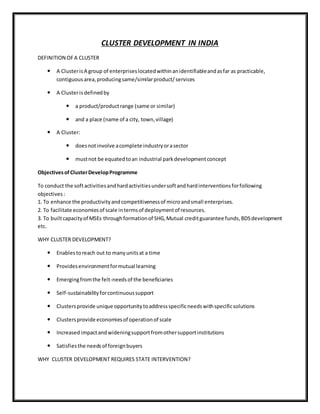
DEFINITION OFA CLUSTER
 A ClusterisA group of enterpriseslocatedwithinanidentifiableandasfar as practicable,
contiguousarea,producingsame/similarproduct/services
 A Clusterisdefinedby
 a product/productrange (same or similar)
 and a place (name of a city, town,village)
 A Cluster:
 doesnotinvolve acomplete industryorasector
 mustnot be equatedtoan industrial parkdevelopmentconcept
ObjectivesofClusterDevelopProgramme
To conduct the softactivitiesandhardactivitiesundersoftandhardinterventionsforfollowing
objectives:
1. To enhance the productivityandcompetitivenessof microandsmall enterprises.
2. To facilitate economiesof scale intermsof deploymentof resources.
3. To builtcapacityof MSEs throughformationof SHG,Mutual creditguarantee funds,BDSdevelopment
etc.
WHY CLUSTER DEVELOPMENT?
 Enablestoreach out to manyunitsat a time
 Providesenvironmentformutual learning
 Emergingfromthe felt-needsof the beneficiaries
 Self-sustainabilityforcontinuoussupport
 Clustersprovide unique opportunitytoaddressspecificneedswithspecificsolutions
 Clustersprovide economiesof operationof scale
 Increasedimpactandwideningsupportfromothersupportinstitutions
 Satisfiesthe needsof foreignbuyers
WHY CLUSTER DEVELOPMENT REQUIRES STATE INTERVENTION?
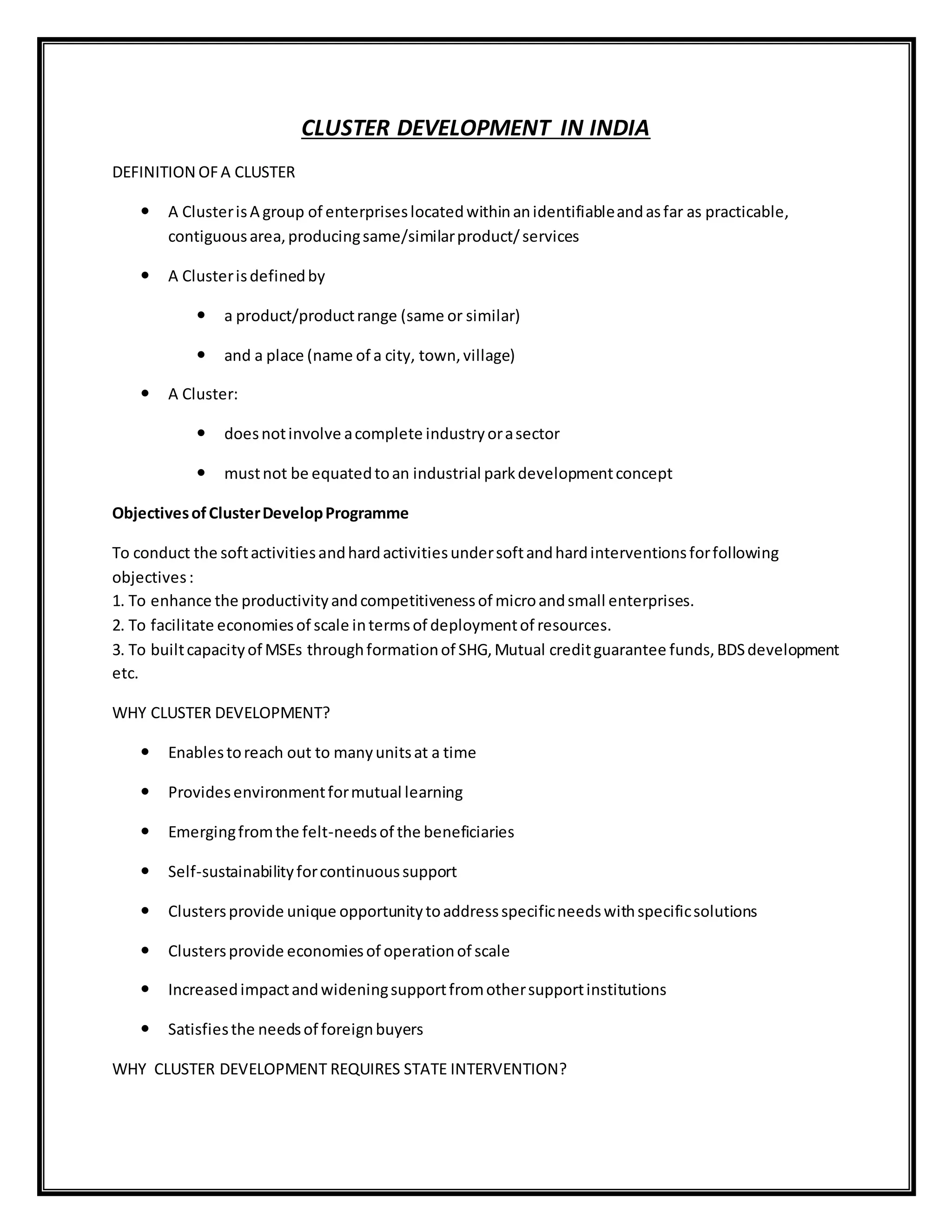
 Clusterdevelopmentisalong-termphenomenonwithlowergainsvisible inshorttomedium
term
 Commonfacilitiesandprogrammesneed State’seffort
 Gainswhentheyoccur, are forsharingacross the cluster
THE INDIAN SME CLUSTERS SCENARIO
 Witha contributionof 40 percent to the country’sindustrial outputand35 per centto direct
exports,India’sSME(Small andMediumEnterprises) sectoristhe keydriverinthe nation’s
economicgrowth.
 Indiahas 388 documentedindustrial clusters,around400 handloomclusters,about3,000
handicraftclustersand2,800 micro-enterprise clustersthatcontribute significantlytoits
economyandprovide employmenttomore than20 millionpeople.
 3.57 millionSSIs,across7,500 productsspreadoverthe country
 350 SSIand 2000 artisansclusterscontribute to60% of exports
Among the largerclusters,
 Panipataccountingfor75 per centof the total blanketsproducedinthe country.
 Tirupur,whichisresponsible for80per centof the country’scotton
hosieryexports.
 Agra with800 registeredand6,000 unregisteredsmall scale unitsmakingabout150,000 pairs of
shoesperday witha dailyproductionvalue of $1.3 millionandexportsworth$60 millionper
year.
 Ludhiana,alone contributes95percent of the country’swoolenknitwear,85 percent of the
country’ssewingmachinesand60 percent of the nation’sbicycle andbicycle parts.
METHODOLOGY OF CLUSTER DEVELOPMENT
 Selectionof aCluster
 Selectionof aClusterDevelopmentAgent
 Diagnosticstudy
 Trust building
 Preparationof actionplanfor intervention
 Approval of budgetandfurtherleveraging funds
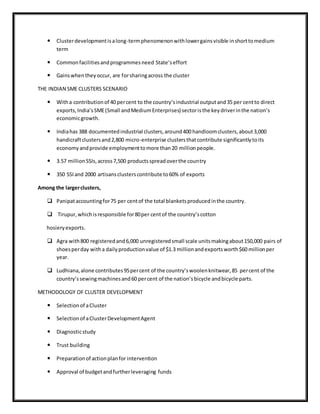
 ImplementationbytrustbuildingbetweenClusterActorsandCDA;BetweenActorandother
Actors
 Monitoringandevaluation
 Handingoverand exit
CLUSTER DEVELOPMENT INITIATIVES IN INDIA
Several institutionsinIndiahave takenupClusterProjectsbesidesvariousgovernmentinitiatives.The
majoronesbeing:
Central Government
 DevelopmentCommissioner(SSI),Ministryof Small Scale Industries
 National Small Industrial CorporationLtd(NSIC)
 DevelopmentCommissioner(Handicrafts),Ministryof Textile
National Support Institutions
 Small IndustriesDevelopmentBankof India(SIDBI) TechnologyUpgradationProgramme
 State Bank of India(SBI) UPTECH Programme
 National BankforAgriculture &Rural Development(NABARD)
State Governments
 The State governmentswhichhave startedclusterdevelopmentinitiativesare:
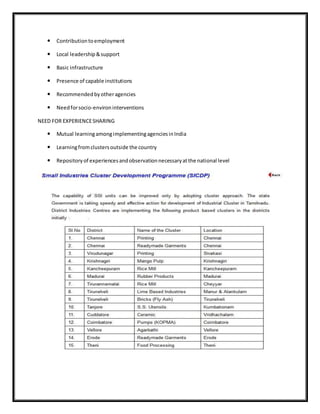
 AndhraPradesh,Gujarat,Kerala,MadhyaPradesh,TamilNadu
ACHIEVEMENTS AND NEW INITIATIVESIN CLUSTER DEVELOPMENT BY THE MINISTRY OF SSI
UPTECH SCHEME:
THE EARLY INITIATIVE
 Launchedin1998
 Aimedatdevelopmentof selectedclusters
 Initially,emphasisonTechnologyUpgradation
 Early interventionsinClustersof CeramicTiles,BulkDrugsandFormulations,Foundryand
Forging,FoodProcessing,Potteriesetc.
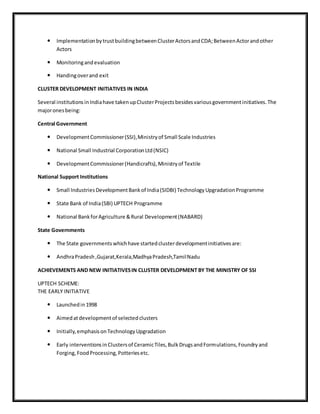
ASSOCIATION WITHUNIDOFOCALPOINT
 Ministryof SSI: the official counterpartagencyinIndia
 To provide aplatformforsharingmutual learning&bestpractices
 To designSME ClusterDevelopmentpolicies&Tools
 National Level SteeringCommittee headedbyAS&DC(SSI)
 Interventions:Directaswell asthroughState Govts.& national institutions.
 Interventionin4 Clusterscompleted,3nearingcompletionand17 underimplementation
 AssistingMinistryof SSItosetup a comprehensiveCDP
SECTORAL NATIONALPROGRAMMES
IN COLLABORATION WITHUNIDO
 Industry& demanddrivenprogrammes
 Active contributioninfinancingandimplementationbyUNIDO,State Govts,FI’s,Industry
Associations.
 Comprehensivesupportservicesintechnologyupgradation,marketdevelopment,capacity
building&sustainability
 Newinterventionsplannedforknitwear,bicycle &parts
SMALL INDUSTRY CLUSTER
DEVELOPMENT PROGRAMME (SSI-CDP)
 Ministry’sownprogramme
 Envisagescomprehensive coverageof the whole country
 Adoptsa holisticapproach
 Capable partnerinstitutionswelcometojoin
 Stakeholders’contribution&participationencouraged
PARAMETERS FORSELECTION OF CLUSTERS UNDER SSI-CDP
 DistinctTechnology&product
 Potential forgrowth
 Contributiontoemployment
 Local leadership&support
 Basic infrastructure
 Presence of capable institutions
 Recommendedbyotheragencies
 Needforsocio-environinterventions
NEED FOR EXPERIENCESHARING
 Mutual learningamongimplementingagenciesinIndia
 Learningfromclustersoutside the country
 Repositoryof experiencesandobservationnecessaryatthe national level
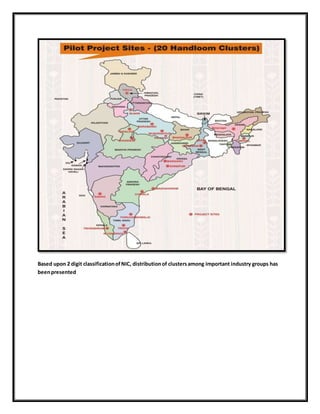
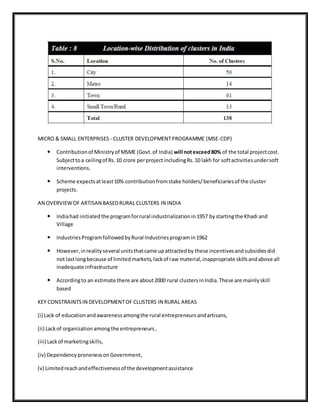
Based upon 2 digit classificationofNIC, distributionof clustersamong important industry groups has
beenpresented
MICRO & SMALL ENTERPRISES - CLUSTER DEVELOPMENTPROGRAMME (MSE-CDP)
 Contributionof Ministryof MSME (Govt.of India) will notexceed80% of the total projectcost.
Subjecttoa ceilingof Rs.10 crore perprojectincludingRs.10 lakh for softactivitiesundersoft
interventions.
 Scheme expectsatleast10% contributionfromstake holders/beneficiariesof the cluster
projects.
AN OVERVIEWOF ARTISAN BASEDRURAL CLUSTERS IN INDIA
 Indiahad initiatedthe programforrural industrializationin1957 bystartingthe Khadi and
Village
 IndustriesProgramfollowedbyRural Industriesprogramin1962
 However,inrealityseveral unitsthatcame upattractedby these incentivesandsubsidiesdid
not lastlongbecause of limitedmarkets,lackof raw material,inappropriate skillsandabove all
inadequate infrastructure
 Accordingto an estimate there are about2000 rural clustersinIndia.These are mainlyskill
based
KEY CONSTRAINTSIN DEVELOPMENTOF CLUSTERS IN RURAL AREAS
(i) Lack of educationandawarenessamongthe rural entrepreneursandartisans,
(ii) Lackof organizationamongthe entrepreneurs,
(iii) Lackof marketingskills,
(iv) DependencypronenessonGovernment,
(v) Limitedreachandeffectivenessof the developmentassistance
(vi) Lack of infrastructure facilitiessuchaselectricityandroads
KEY CONSTRAINTSIN DEVELOPMENTOF CLUSTERS IN RURAL AREAS
(i) Lack of educationandawarenessamongthe rural entrepreneursandartisans,
(ii) Lackof organizationamongthe entrepreneurs,
(iii) Lackof marketingskills,
(iv) DependencypronenessonGovernment,
(v) Limitedreachandeffectivenessof the developmentassistance
(vi) Lack of infrastructure facilitiessuchaselectricityandroads
The consortium initiativesare much more effective andsustainable if theyinvolve the entire range of
actors withwhomthe SMEs commonlyinteract.Amongsuchactorsare :
 Suppliersof rawmaterials,plant&machinery
❖ Consumersof goodsandservicesfrom the SMEs testinglaboratories(bothprivate andpublic)
❖ Researchanddevelopmentinstitutions
❖ Industrial associations
❖ Technical,marketingandmanagementconsultancyorganisations
❖ Traininginstitutions
❖ Regulatorybodiesenforcing/monitoringrulesandregulations
❖ Local government
❖ Financial institutionsForbanksandfinancial institutions,the clusterapproachmaybe beneficial as
❖ Separate packages/servicescanbe developedforeachcluster
❖ Products/servicessodevelopedcanprovide betteryields
The ultimate resultdue to cluster projects 1. Increasedincome,investment,capacityutilisation,cost
deduction,communityempowerment,energyconservation,pollutioncontrol.
2. Infrastructure creationandlinkage throughgovt.scheme.
3. Enhance collectiveeconomicefficiency
4. Developingcultureof co-operationandteamwork
Cluster development in india print out

Cluster development in india print out

  • 1.
    CLUSTER DEVELOPMENT ININDIA DEFINITION OFA CLUSTER  A ClusterisA group of enterpriseslocatedwithinanidentifiableandasfar as practicable, contiguousarea,producingsame/similarproduct/services  A Clusterisdefinedby  a product/productrange (same or similar)  and a place (name of a city, town,village)  A Cluster:  doesnotinvolve acomplete industryorasector  mustnot be equatedtoan industrial parkdevelopmentconcept ObjectivesofClusterDevelopProgramme To conduct the softactivitiesandhardactivitiesundersoftandhardinterventionsforfollowing objectives: 1. To enhance the productivityandcompetitivenessof microandsmall enterprises. 2. To facilitate economiesof scale intermsof deploymentof resources. 3. To builtcapacityof MSEs throughformationof SHG,Mutual creditguarantee funds,BDSdevelopment etc. WHY CLUSTER DEVELOPMENT?  Enablestoreach out to manyunitsat a time  Providesenvironmentformutual learning  Emergingfromthe felt-needsof the beneficiaries  Self-sustainabilityforcontinuoussupport  Clustersprovide unique opportunitytoaddressspecificneedswithspecificsolutions  Clustersprovide economiesof operationof scale  Increasedimpactandwideningsupportfromothersupportinstitutions  Satisfiesthe needsof foreignbuyers WHY CLUSTER DEVELOPMENT REQUIRES STATE INTERVENTION?
  • 2.
     Clusterdevelopmentisalong-termphenomenonwithlowergainsvisible inshorttomedium term Commonfacilitiesandprogrammesneed State’seffort  Gainswhentheyoccur, are forsharingacross the cluster THE INDIAN SME CLUSTERS SCENARIO  Witha contributionof 40 percent to the country’sindustrial outputand35 per centto direct exports,India’sSME(Small andMediumEnterprises) sectoristhe keydriverinthe nation’s economicgrowth.  Indiahas 388 documentedindustrial clusters,around400 handloomclusters,about3,000 handicraftclustersand2,800 micro-enterprise clustersthatcontribute significantlytoits economyandprovide employmenttomore than20 millionpeople.  3.57 millionSSIs,across7,500 productsspreadoverthe country  350 SSIand 2000 artisansclusterscontribute to60% of exports Among the largerclusters,  Panipataccountingfor75 per centof the total blanketsproducedinthe country.  Tirupur,whichisresponsible for80per centof the country’scotton hosieryexports.  Agra with800 registeredand6,000 unregisteredsmall scale unitsmakingabout150,000 pairs of shoesperday witha dailyproductionvalue of $1.3 millionandexportsworth$60 millionper year.  Ludhiana,alone contributes95percent of the country’swoolenknitwear,85 percent of the country’ssewingmachinesand60 percent of the nation’sbicycle andbicycle parts. METHODOLOGY OF CLUSTER DEVELOPMENT  Selectionof aCluster  Selectionof aClusterDevelopmentAgent  Diagnosticstudy  Trust building  Preparationof actionplanfor intervention  Approval of budgetandfurtherleveraging funds
  • 3.
     ImplementationbytrustbuildingbetweenClusterActorsandCDA;BetweenActorandother Actors  Monitoringandevaluation Handingoverand exit CLUSTER DEVELOPMENT INITIATIVES IN INDIA Several institutionsinIndiahave takenupClusterProjectsbesidesvariousgovernmentinitiatives.The majoronesbeing: Central Government  DevelopmentCommissioner(SSI),Ministryof Small Scale Industries  National Small Industrial CorporationLtd(NSIC)  DevelopmentCommissioner(Handicrafts),Ministryof Textile National Support Institutions  Small IndustriesDevelopmentBankof India(SIDBI) TechnologyUpgradationProgramme  State Bank of India(SBI) UPTECH Programme  National BankforAgriculture &Rural Development(NABARD) State Governments  The State governmentswhichhave startedclusterdevelopmentinitiativesare:  AndhraPradesh,Gujarat,Kerala,MadhyaPradesh,TamilNadu ACHIEVEMENTS AND NEW INITIATIVESIN CLUSTER DEVELOPMENT BY THE MINISTRY OF SSI UPTECH SCHEME: THE EARLY INITIATIVE  Launchedin1998  Aimedatdevelopmentof selectedclusters  Initially,emphasisonTechnologyUpgradation  Early interventionsinClustersof CeramicTiles,BulkDrugsandFormulations,Foundryand Forging,FoodProcessing,Potteriesetc.
  • 4.
    ASSOCIATION WITHUNIDOFOCALPOINT  MinistryofSSI: the official counterpartagencyinIndia  To provide aplatformforsharingmutual learning&bestpractices  To designSME ClusterDevelopmentpolicies&Tools  National Level SteeringCommittee headedbyAS&DC(SSI)  Interventions:Directaswell asthroughState Govts.& national institutions.  Interventionin4 Clusterscompleted,3nearingcompletionand17 underimplementation  AssistingMinistryof SSItosetup a comprehensiveCDP SECTORAL NATIONALPROGRAMMES IN COLLABORATION WITHUNIDO  Industry& demanddrivenprogrammes  Active contributioninfinancingandimplementationbyUNIDO,State Govts,FI’s,Industry Associations.  Comprehensivesupportservicesintechnologyupgradation,marketdevelopment,capacity building&sustainability  Newinterventionsplannedforknitwear,bicycle &parts SMALL INDUSTRY CLUSTER DEVELOPMENT PROGRAMME (SSI-CDP)  Ministry’sownprogramme  Envisagescomprehensive coverageof the whole country  Adoptsa holisticapproach  Capable partnerinstitutionswelcometojoin  Stakeholders’contribution&participationencouraged PARAMETERS FORSELECTION OF CLUSTERS UNDER SSI-CDP  DistinctTechnology&product  Potential forgrowth
  • 5.
     Contributiontoemployment  Localleadership&support  Basic infrastructure  Presence of capable institutions  Recommendedbyotheragencies  Needforsocio-environinterventions NEED FOR EXPERIENCESHARING  Mutual learningamongimplementingagenciesinIndia  Learningfromclustersoutside the country  Repositoryof experiencesandobservationnecessaryatthe national level
  • 6.
    Based upon 2digit classificationofNIC, distributionof clustersamong important industry groups has beenpresented
  • 8.
    MICRO & SMALLENTERPRISES - CLUSTER DEVELOPMENTPROGRAMME (MSE-CDP)  Contributionof Ministryof MSME (Govt.of India) will notexceed80% of the total projectcost. Subjecttoa ceilingof Rs.10 crore perprojectincludingRs.10 lakh for softactivitiesundersoft interventions.  Scheme expectsatleast10% contributionfromstake holders/beneficiariesof the cluster projects. AN OVERVIEWOF ARTISAN BASEDRURAL CLUSTERS IN INDIA  Indiahad initiatedthe programforrural industrializationin1957 bystartingthe Khadi and Village  IndustriesProgramfollowedbyRural Industriesprogramin1962  However,inrealityseveral unitsthatcame upattractedby these incentivesandsubsidiesdid not lastlongbecause of limitedmarkets,lackof raw material,inappropriate skillsandabove all inadequate infrastructure  Accordingto an estimate there are about2000 rural clustersinIndia.These are mainlyskill based KEY CONSTRAINTSIN DEVELOPMENTOF CLUSTERS IN RURAL AREAS (i) Lack of educationandawarenessamongthe rural entrepreneursandartisans, (ii) Lackof organizationamongthe entrepreneurs, (iii) Lackof marketingskills, (iv) DependencypronenessonGovernment, (v) Limitedreachandeffectivenessof the developmentassistance
  • 9.
    (vi) Lack ofinfrastructure facilitiessuchaselectricityandroads KEY CONSTRAINTSIN DEVELOPMENTOF CLUSTERS IN RURAL AREAS (i) Lack of educationandawarenessamongthe rural entrepreneursandartisans, (ii) Lackof organizationamongthe entrepreneurs, (iii) Lackof marketingskills, (iv) DependencypronenessonGovernment, (v) Limitedreachandeffectivenessof the developmentassistance (vi) Lack of infrastructure facilitiessuchaselectricityandroads The consortium initiativesare much more effective andsustainable if theyinvolve the entire range of actors withwhomthe SMEs commonlyinteract.Amongsuchactorsare :  Suppliersof rawmaterials,plant&machinery ❖ Consumersof goodsandservicesfrom the SMEs testinglaboratories(bothprivate andpublic) ❖ Researchanddevelopmentinstitutions ❖ Industrial associations ❖ Technical,marketingandmanagementconsultancyorganisations ❖ Traininginstitutions ❖ Regulatorybodiesenforcing/monitoringrulesandregulations ❖ Local government ❖ Financial institutionsForbanksandfinancial institutions,the clusterapproachmaybe beneficial as ❖ Separate packages/servicescanbe developedforeachcluster ❖ Products/servicessodevelopedcanprovide betteryields The ultimate resultdue to cluster projects 1. Increasedincome,investment,capacityutilisation,cost deduction,communityempowerment,energyconservation,pollutioncontrol. 2. Infrastructure creationandlinkage throughgovt.scheme. 3. Enhance collectiveeconomicefficiency 4. Developingcultureof co-operationandteamwork