Sampling Techniques
-Hareesh M
2014600120
Why Sampling..?
• Less Cost
• Less Field time
• The population of interest is usually too large to
attempt to survey all of its members.
• A carefully chosen sample can be used to represent
the population.
– The sample reflects the characteristics of the
population from which it is drawn.
• Sample described as a representative “taste” of a
group.
Sampling…
3
• What is your population of interest?
• To whom do you want to generalize your
results?
–All doctors
–School children
–Indians
–Women aged 15-45 years
–Other
• Can you sample the entire population?
Sampling…..
4
• 3 factors that influence sample representative-ness
• Sampling procedure
• Sample size
• Participation (response)
• When might you sample the entire population?
• When your population is very small
• When you have extensive resources
• When you don’t expect a very high response
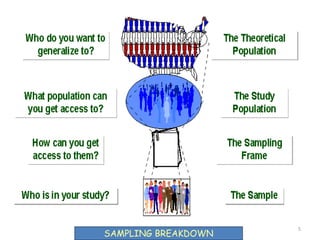
5
SAMPLING BREAKDOWN
Process
6
• The sampling process comprises several stages:
– Defining the population of concern
– Specifying a sampling frame, a set of items or events
possible to measure
– Specifying a sampling method for selecting items or
events from the frame
– Determining the sample size
– Implementing the sampling plan
– Sampling and data collecting
– Reviewing the sampling process
Sampling
• Sampling methods can be split into two
distinct groups:
1. Probability samples
2. Non-probability samples
Sampling
Probability Samples
• Probability samples offer each respondent an
equal probability or chance at being included
in the sample.
• They are considered to be:
• Objective
• Empirical
• Scientific
• Quantitative
• Representative
Types of probability sampling
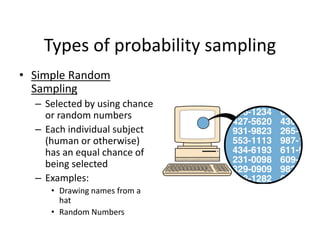
• Simple Random
Sampling
– Selected by using chance
or random numbers
– Each individual subject
(human or otherwise)
has an equal chance of
being selected
– Examples:
• Drawing names from a
hat
• Random Numbers
Types of probability sampling
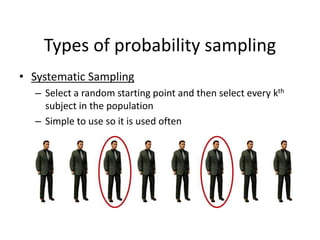
• Systematic Sampling
– Select a random starting point and then select every kth
subject in the population
– Simple to use so it is used often
Types of probability sampling
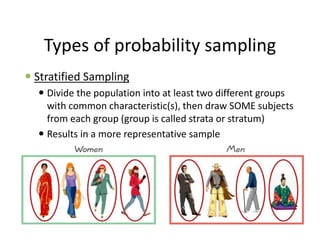
ď‚— Stratified Sampling
ď‚— Divide the population into at least two different groups
with common characteristic(s), then draw SOME subjects
from each group (group is called strata or stratum)
ď‚— Results in a more representative sample
Types of probability sampling
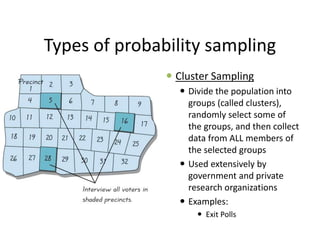
ď‚— Cluster Sampling
ď‚— Divide the population into
groups (called clusters),
randomly select some of
the groups, and then collect
data from ALL members of
the selected groups
ď‚— Used extensively by
government and private
research organizations
ď‚— Examples:
ď‚— Exit Polls
Sampling
Non Probability Samples
• A non probability sample relies on the
researcher selecting the respondents.
• They are considered to be:
• Interpretivist
• Subjective
• Not scientific
• Qualitative
• Unrepresentative
Non-probability Sampling
Convenience Sampling
• This involves selecting the nearest and most
convenient people to participate in the
research.
• This method of selection is not
representative and is considered a very
unsatisfactory way to conduct research.
Non-probability Sampling
Purposive Sampling
• Purposive sampling is selecting a sample “on
the basis of your own knowledge of the
population, its elements, and the nature of
your research aims”
• It is important to note that purposive
sampling precludes that the researcher
understand the characteristics clearly and
thoroughly enough to choose the sample and
relate those findings only to that specific
group and not to the population as a whole.
Non-probability Sampling
Snowball Sampling
• This type of sampling is used when the research
is focused on participants with very specific
characteristics such as being members of a gang.
• Having identified and contacted one gang
member the researcher asks to be put in touch
with any friends or associates who are also gang
members.
• This type of sampling is not representative
however is useful, especially where the groups in
the research are not socially organised i.e. they
do not have clubs or membership lists.
Non-probability Sampling
Quota Sampling
• Having decided on the characteristics of the
sample frame, a sample is selected to meet
these characteristics.
• E.g. if the sample frame is car drivers and the
car driving population is 55% male and 45%
female then the quota would require the
same proportions.
• Participants would be selected to fill this
quota using the random method
Errors in Sampling
• Non-Observation Errors
– Sampling error: naturally occurs
– Coverage error: people sampled do not match the
population of interest
– Underrepresentation
– Non-response: won’t or can’t participate
Errors of Observation
• Interview error- interaction between
interviewer and person being surveyed
• Respondent error: respondents have difficult
time answering the question
• Measurement error: inaccurate responses
when person doesn’t understand question or
poorly worded question
• Errors in data collection

Sampling types-presentation-business research

  • 1.
  • 2.
    Why Sampling..? • LessCost • Less Field time • The population of interest is usually too large to attempt to survey all of its members. • A carefully chosen sample can be used to represent the population. – The sample reflects the characteristics of the population from which it is drawn. • Sample described as a representative “taste” of a group.
  • 3.
    Sampling… 3 • What isyour population of interest? • To whom do you want to generalize your results? –All doctors –School children –Indians –Women aged 15-45 years –Other • Can you sample the entire population?
  • 4.
    Sampling….. 4 • 3 factorsthat influence sample representative-ness • Sampling procedure • Sample size • Participation (response) • When might you sample the entire population? • When your population is very small • When you have extensive resources • When you don’t expect a very high response
  • 5.
  • 6.
    Process 6 • The samplingprocess comprises several stages: – Defining the population of concern – Specifying a sampling frame, a set of items or events possible to measure – Specifying a sampling method for selecting items or events from the frame – Determining the sample size – Implementing the sampling plan – Sampling and data collecting – Reviewing the sampling process
  • 7.
    Sampling • Sampling methodscan be split into two distinct groups: 1. Probability samples 2. Non-probability samples
  • 8.
    Sampling Probability Samples • Probabilitysamples offer each respondent an equal probability or chance at being included in the sample. • They are considered to be: • Objective • Empirical • Scientific • Quantitative • Representative
  • 9.
    Types of probabilitysampling • Simple Random Sampling – Selected by using chance or random numbers – Each individual subject (human or otherwise) has an equal chance of being selected – Examples: • Drawing names from a hat • Random Numbers
  • 10.
    Types of probabilitysampling • Systematic Sampling – Select a random starting point and then select every kth subject in the population – Simple to use so it is used often
  • 11.
    Types of probabilitysampling ď‚— Stratified Sampling ď‚— Divide the population into at least two different groups with common characteristic(s), then draw SOME subjects from each group (group is called strata or stratum) ď‚— Results in a more representative sample
  • 12.
    Types of probabilitysampling ď‚— Cluster Sampling ď‚— Divide the population into groups (called clusters), randomly select some of the groups, and then collect data from ALL members of the selected groups ď‚— Used extensively by government and private research organizations ď‚— Examples: ď‚— Exit Polls
  • 13.
    Sampling Non Probability Samples •A non probability sample relies on the researcher selecting the respondents. • They are considered to be: • Interpretivist • Subjective • Not scientific • Qualitative • Unrepresentative
  • 14.
    Non-probability Sampling Convenience Sampling •This involves selecting the nearest and most convenient people to participate in the research. • This method of selection is not representative and is considered a very unsatisfactory way to conduct research.
  • 15.
    Non-probability Sampling Purposive Sampling •Purposive sampling is selecting a sample “on the basis of your own knowledge of the population, its elements, and the nature of your research aims” • It is important to note that purposive sampling precludes that the researcher understand the characteristics clearly and thoroughly enough to choose the sample and relate those findings only to that specific group and not to the population as a whole.
  • 16.
    Non-probability Sampling Snowball Sampling •This type of sampling is used when the research is focused on participants with very specific characteristics such as being members of a gang. • Having identified and contacted one gang member the researcher asks to be put in touch with any friends or associates who are also gang members. • This type of sampling is not representative however is useful, especially where the groups in the research are not socially organised i.e. they do not have clubs or membership lists.
  • 17.
    Non-probability Sampling Quota Sampling •Having decided on the characteristics of the sample frame, a sample is selected to meet these characteristics. • E.g. if the sample frame is car drivers and the car driving population is 55% male and 45% female then the quota would require the same proportions. • Participants would be selected to fill this quota using the random method
  • 18.
    Errors in Sampling •Non-Observation Errors – Sampling error: naturally occurs – Coverage error: people sampled do not match the population of interest – Underrepresentation – Non-response: won’t or can’t participate
  • 19.
    Errors of Observation •Interview error- interaction between interviewer and person being surveyed • Respondent error: respondents have difficult time answering the question • Measurement error: inaccurate responses when person doesn’t understand question or poorly worded question • Errors in data collection