WORK MEASUREMENT
MEANING
• Work measurement is a term that covers
several different ways of finding out how long
a job or part of a job should take to complete.
• Work measurement is the process of
establishing the time that a given task would
take when performed by a qualified worker
working at a defined level of performance.
DEFINITION
• Work measurement is defined as the
application of techniques designed to establish
the work content of a specified task by
determining the time required for carrying out
the task at a defined standard of performance
by a qualified worker.
OBJECTIVES
• Planning the work of a work force .
• To decide how many workers it would need to
complete certain jobs
• Scheduling the tasks allocated to people
• Reliable indices for labour performance
• Basis for sound incentive schemes
• Reliable basis for labour cost control
• Improved planning and control of activities or
operations
BENEFITS
• To prepare realistic work schedules by accurate
assessment of human work
• To compare the actual time taken by the worker
with the standard time for proper control of labour
• To assist in labour cost estimation
• To set standards of performances for labour
utilization by establishing the labour standards for
an element of work ,operation under ordinary
working condition
SCOPE AND IMPORTANCE
• Planning and scheduling work
• Appraisal and control of employee
performance
• Estimation of manpower requirements
• Cost calculation
• Improved employee motivation and control
PROCEDURE
• Analysis phase
• Measurement phase
• Synthesis phase
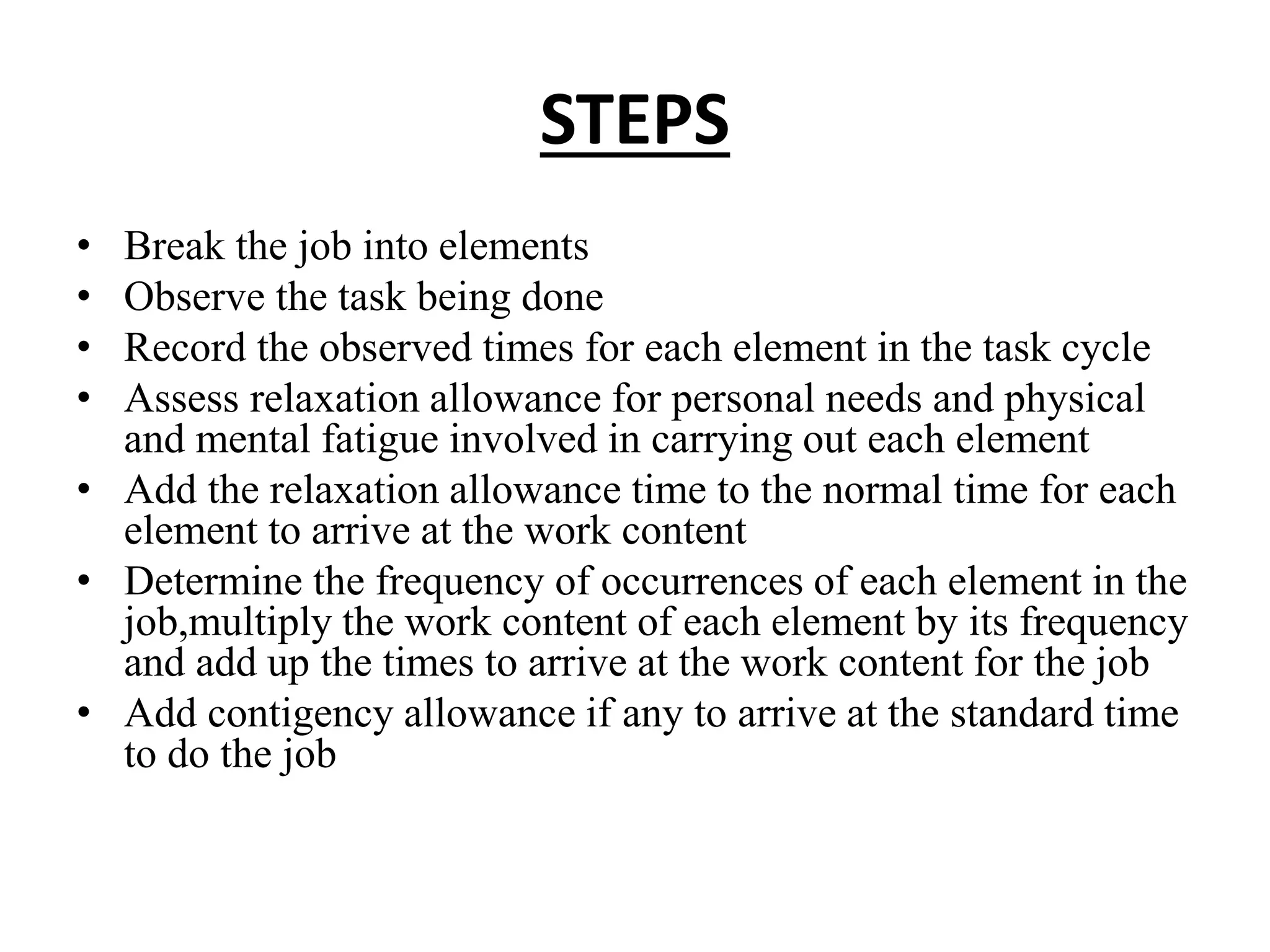
STEPS
• Break the job into elements
• Observe the task being done
• Record the observed times for each element in the task cycle
• Assess relaxation allowance for personal needs and physical
and mental fatigue involved in carrying out each element
• Add the relaxation allowance time to the normal time for each
element to arrive at the work content
• Determine the frequency of occurrences of each element in the
job,multiply the work content of each element by its frequency
and add up the times to arrive at the work content for the job
• Add contigency allowance if any to arrive at the standard time
to do the job
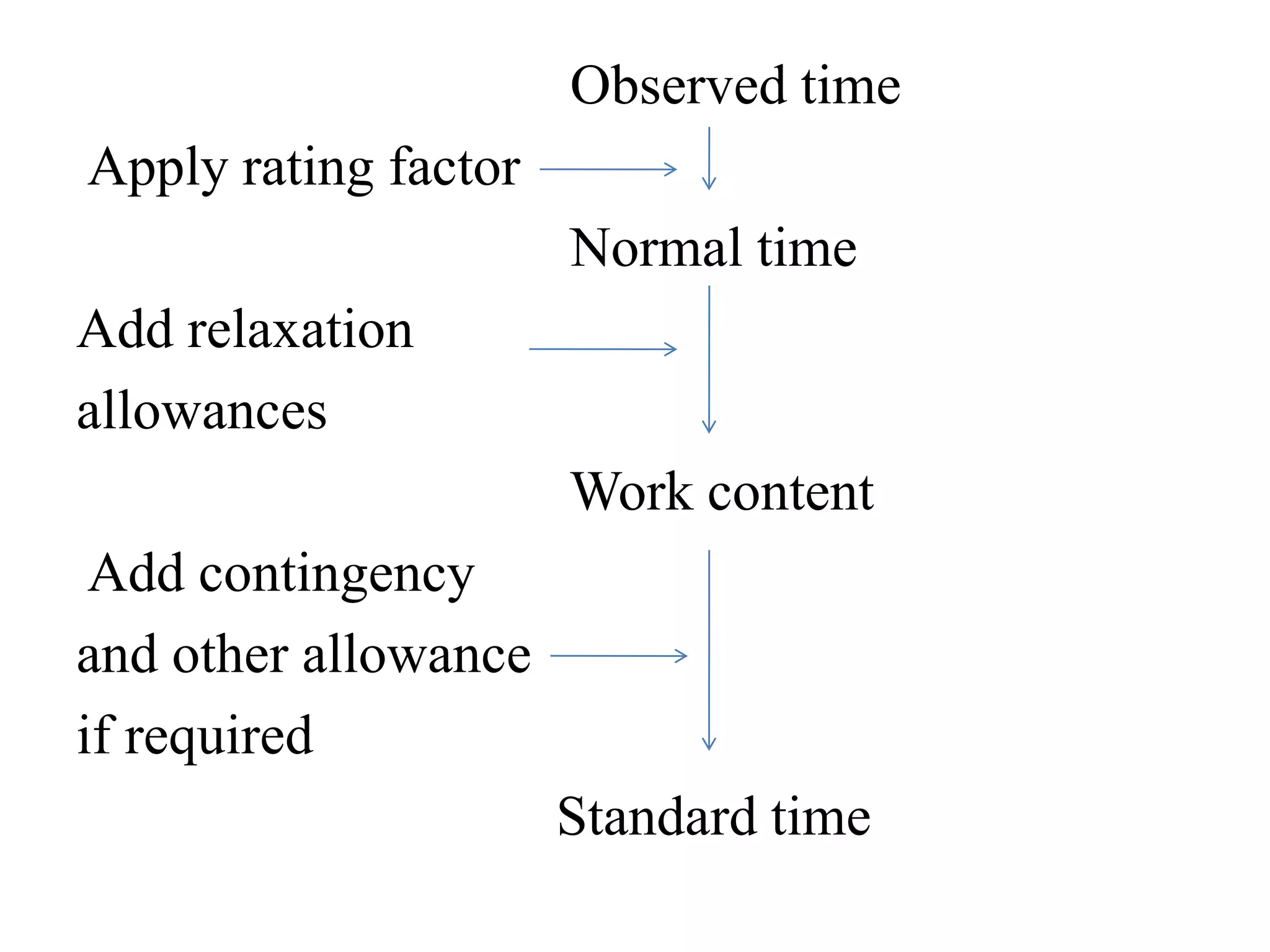
Observed time
Apply rating factor
Normal time
Add relaxation
allowances
Work content
Add contingency
and other allowance
if required
Standard time
TECHNIQUES
• Direct time study
• Synthesis method
• Analytical estimating
• Pre determined motion time system
• Work sampling
TIME STUDY
• Time study is concerned with the
determination of the amount of time required
to perform a unit of work.
• It consist of the process of observing and
recording the time required to perform each
element of an operation so as to determine the
reasonable time in which the work should be
completed.
• Objective is to establish the standard time.
ANALYTICAL ESTIMATING
• It is a structured work measurement technique.
• It is used to determine the time values for jobs
having long and non repetitive operations
PREDETERMINED MOTION TIME
SYSTEMS
• These systems are based on the theory that all
manually performed work is done by human
body motions of fingers, arms, and so on.
SYNTHESIS METHOD
• Synthesis is a method used from the existing
data on the time required for various elemental
work,in the organization.So a standard time is
set by adding all the elemental work time for a
particular new work and a standard time is
set.These time data is specific in nature,as it
totally depends on that organization and its
people and facilities.
WORK SAMPLING
• It randomly samples the work of one or more
employees at periodic intervals to determine
the proportion of the total operation that is
accounted for in one particular activity.
THANK YOU

WORK MEASUREMENT

  • 1.
  • 2.
    MEANING • Work measurementis a term that covers several different ways of finding out how long a job or part of a job should take to complete. • Work measurement is the process of establishing the time that a given task would take when performed by a qualified worker working at a defined level of performance.
  • 3.
    DEFINITION • Work measurementis defined as the application of techniques designed to establish the work content of a specified task by determining the time required for carrying out the task at a defined standard of performance by a qualified worker.
  • 4.
    OBJECTIVES • Planning thework of a work force . • To decide how many workers it would need to complete certain jobs • Scheduling the tasks allocated to people • Reliable indices for labour performance • Basis for sound incentive schemes • Reliable basis for labour cost control • Improved planning and control of activities or operations
  • 5.
    BENEFITS • To preparerealistic work schedules by accurate assessment of human work • To compare the actual time taken by the worker with the standard time for proper control of labour • To assist in labour cost estimation • To set standards of performances for labour utilization by establishing the labour standards for an element of work ,operation under ordinary working condition
  • 6.
    SCOPE AND IMPORTANCE •Planning and scheduling work • Appraisal and control of employee performance • Estimation of manpower requirements • Cost calculation • Improved employee motivation and control
  • 7.
    PROCEDURE • Analysis phase •Measurement phase • Synthesis phase
  • 8.
    STEPS • Break thejob into elements • Observe the task being done • Record the observed times for each element in the task cycle • Assess relaxation allowance for personal needs and physical and mental fatigue involved in carrying out each element • Add the relaxation allowance time to the normal time for each element to arrive at the work content • Determine the frequency of occurrences of each element in the job,multiply the work content of each element by its frequency and add up the times to arrive at the work content for the job • Add contigency allowance if any to arrive at the standard time to do the job
  • 9.
    Observed time Apply ratingfactor Normal time Add relaxation allowances Work content Add contingency and other allowance if required Standard time
  • 10.
    TECHNIQUES • Direct timestudy • Synthesis method • Analytical estimating • Pre determined motion time system • Work sampling
  • 11.
    TIME STUDY • Timestudy is concerned with the determination of the amount of time required to perform a unit of work. • It consist of the process of observing and recording the time required to perform each element of an operation so as to determine the reasonable time in which the work should be completed. • Objective is to establish the standard time.
  • 12.
    ANALYTICAL ESTIMATING • Itis a structured work measurement technique. • It is used to determine the time values for jobs having long and non repetitive operations
  • 13.
    PREDETERMINED MOTION TIME SYSTEMS •These systems are based on the theory that all manually performed work is done by human body motions of fingers, arms, and so on.
  • 14.
    SYNTHESIS METHOD • Synthesisis a method used from the existing data on the time required for various elemental work,in the organization.So a standard time is set by adding all the elemental work time for a particular new work and a standard time is set.These time data is specific in nature,as it totally depends on that organization and its people and facilities.
  • 15.
    WORK SAMPLING • Itrandomly samples the work of one or more employees at periodic intervals to determine the proportion of the total operation that is accounted for in one particular activity.
  • 16.