CLUSTER DEVELOPMENT
IN INDIA
Presented by:
Hareesh.M
ID.NO:2014600120
DEFINITION OF A CLUSTER
 A Cluster is A group of enterprises located within an identifiable and as
far as practicable, contiguous area, producing same/similar product/
services
 A Cluster is defined by
 a product/product range (same or similar)
 and a place (name of a city, town, village)
 A Cluster:
 does not involve a complete industry or a sector
 must not be equated to an industrial park development concept
Objectives of Cluster Develop
Programme
To conduct the soft activities and hard activities
under soft and hard interventions for following
objectives :
1. To enhance the productivity and
competitiveness of micro and small enterprises.
2. To facilitate economies of scale in terms of
deployment of resources.
3. To built capacity of MSEs through formation of
SHG, Mutual credit guarantee funds, BDS
development etc.
WHY CLUSTER DEVELOPMENT?
 Enables to reach out to many units at a time
 Provides environment for mutual learning
 Emerging from the felt-needs of the beneficiaries
 Self-sustainability for continuous support
 Clusters provide unique opportunity to address specific needs with
specific solutions
 Clusters provide economies of operation of scale
 Increased impact and widening support from other support institutions
 Satisfies the needs of foreign buyers
WHY CLUSTER DEVELOPMENT
REQUIRES STATE INTERVENTION?
 Cluster development is a long-term phenomenon with lower gains
visible in short to medium term
 Common facilities and programmes need State’s effort
 Gains when they occur, are for sharing across the cluster
THE INDIAN SME CLUSTERS
SCENARIO
 With a contribution of 40 per cent to the country’s industrial output and 35
per cent to direct exports, India’s SME (Small and Medium Enterprises)
sector is the key driver in the nation’s economic growth.
 India has 388 documented industrial clusters, around 400 handloom
clusters, about 3,000 handicraft clusters and 2,800 micro-enterprise clusters
that contribute significantly to its economy and provide employment to
more than 20 million people.
 3.57 million SSIs, across 7,500 products spread over the country
 350 SSI and 2000 artisans clusters contribute to 60% of exports
Among the larger clusters,
 Panipat accounting for 75 per cent of the total blankets produced in the
country.
 Tirupur, which is responsible for 80 per cent of the country’s cotton
hosiery exports.
 Agra with 800 registered and 6,000 unregistered small scale units making
about 150,000 pairs of shoes per day with a daily production value of $1.3
million and exports worth $60 million per year.
 Ludhiana, alone contributes 95 per cent of the country’s woolen knitwear,
85 per cent of the country’s sewing machines and 60 per cent of the
nation’s bicycle and bicycle parts.
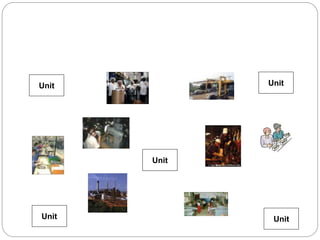
WHAT IS A CLUSTER?
Cluster : An agglomeration of SSI Units?
Unit Unit
Unit
Unit Unit
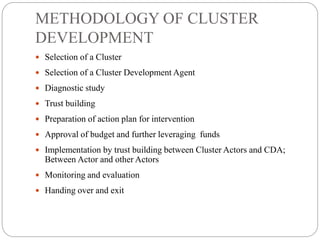
METHODOLOGY OF CLUSTER
DEVELOPMENT
 Selection of a Cluster
 Selection of a Cluster Development Agent
 Diagnostic study
 Trust building
 Preparation of action plan for intervention
 Approval of budget and further leveraging funds
 Implementation by trust building between Cluster Actors and CDA;
Between Actor and other Actors
 Monitoring and evaluation
 Handing over and exit
CLUSTER DEVELOPMENT
INITIATIVES IN INDIA
Several institutions in India have taken up Cluster Projects besides various
government initiatives. The major ones being:
Central Government
 Development Commissioner (SSI), Ministry of Small Scale Industries
 National Small Industrial Corporation Ltd (NSIC)
 Development Commissioner (Handicrafts), Ministry of Textile
National Support Institutions
 Small Industries Development Bank of India (SIDBI) Technology
Upgradation Programme
 State Bank of India (SBI) UPTECH Programme
 National Bank for Agriculture & Rural Development (NABARD)
State Governments
 The State governments which have started cluster development initiatives
are:
 Andhra Pradesh ,Gujarat,Kerala,Madhya Pradesh,Tamil Nadu
ACHIEVEMENTS AND NEW
INITIATIVES IN CLUSTER
DEVELOPMENT BY THE
MINISTRY OF SSI
UPTECH SCHEME:
THE EARLY INITIATIVE
 Launched in 1998
 Aimed at development of selected clusters
 Initially, emphasis on Technology Upgradation
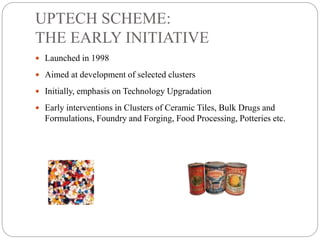
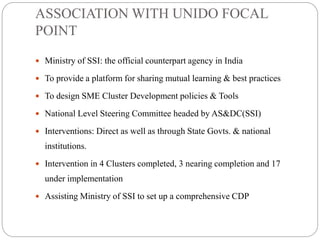
 Early interventions in Clusters of Ceramic Tiles, Bulk Drugs and
Formulations, Foundry and Forging, Food Processing, Potteries etc.
ASSOCIATION WITH UNIDO FOCAL
POINT
 Ministry of SSI: the official counterpart agency in India
 To provide a platform for sharing mutual learning & best practices
 To design SME Cluster Development policies & Tools
 National Level Steering Committee headed by AS&DC(SSI)
 Interventions: Direct as well as through State Govts. & national
institutions.
 Intervention in 4 Clusters completed, 3 nearing completion and 17
under implementation
 Assisting Ministry of SSI to set up a comprehensive CDP
SECTORAL NATIONAL
PROGRAMMES
IN COLLABORATION WITH UNIDO
 Industry & demand driven programmes
 Active contribution in financing and implementation by UNIDO, State
Govts, FI’s, Industry Associations.
 Comprehensive support services in technology upgradation, market
development, capacity building & sustainability
 New interventions planned for knitwear, bicycle & parts
SMALL INDUSTRY CLUSTER
DEVELOPMENT PROGRAMME (SSI-CDP)
 Ministry’s own programme
 Envisages comprehensive coverage of the whole country
 Adopts a holistic approach
 Capable partner institutions welcome to join
 Stakeholders’ contribution & participation encouraged
PARAMETERS FOR SELECTION OF
CLUSTERS UNDER SSI-CDP
 Distinct Technology & product
 Potential for growth
 Contribution to employment
 Local leadership & support
 Basic infrastructure
 Presence of capable institutions
 Recommended by other agencies
 Need for socio-environ interventions
NEED FOR EXPERIENCE SHARING
 Mutual learning among implementing agencies in India
 Learning from clusters outside the country
 Repository of experiences and observation necessary at the national
level
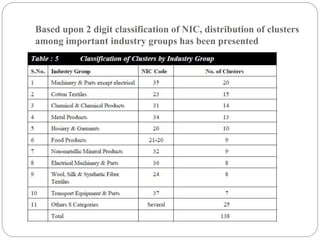
Based upon 2 digit classification of NIC, distribution of clusters
among important industry groups has been presented
MICRO & SMALL ENTERPRISES - CLUSTER
DEVELOPMENT PROGRAMME (MSE-CDP)
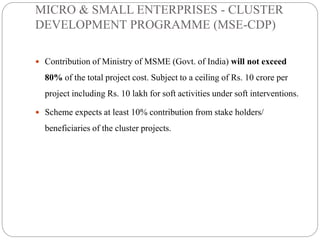
 Contribution of Ministry of MSME (Govt. of India) will not exceed
80% of the total project cost. Subject to a ceiling of Rs. 10 crore per
project including Rs. 10 lakh for soft activities under soft interventions.
 Scheme expects at least 10% contribution from stake holders/
beneficiaries of the cluster projects.
AN OVERVIEW OF ARTISAN BASED
RURAL CLUSTERS IN INDIA
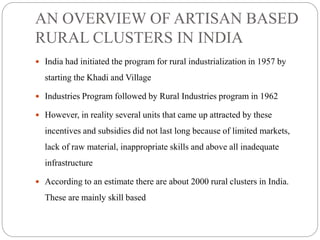
 India had initiated the program for rural industrialization in 1957 by
starting the Khadi and Village
 Industries Program followed by Rural Industries program in 1962
 However, in reality several units that came up attracted by these
incentives and subsidies did not last long because of limited markets,
lack of raw material, inappropriate skills and above all inadequate
infrastructure
 According to an estimate there are about 2000 rural clusters in India.
These are mainly skill based
KEY CONSTRAINTS IN DEVELOPMENT OF
CLUSTERS IN RURAL AREAS
(i) Lack of education and awareness among the rural entrepreneurs and
artisans,
(ii) Lack of organization among the entrepreneurs ,
(iii) Lack of marketing skills,
(iv) Dependency proneness on Government,
(v) Limited reach and effectiveness of the development assistance
(vi) Lack of infrastructure facilities such as electricity and roads
The consortium initiatives are much more effective and sustainable if they
involve the entire range of actors with whom the SMEs commonly interact.
Among such actors are :
 Suppliers of raw materials, plant & machinery
❖ Consumers of goods and services from the SMEs testing
laboratories (both private and public)
❖ Research and development institutions
❖ Industrial associations
❖ Technical, marketing and management consultancy organisations
❖ Training institutions
❖ Regulatory bodies enforcing/monitoring rules and regulations
❖ Local government
❖ Financial institutions For banks and financial institutions, the cluster
approach may be beneficial as
❖ Separate packages/services can be developed for each cluster
❖ Products/services so developed can provide better yields
The ultimate result due to cluster
projects
1. Increased income, investment, capacity
utilisation, cost deduction, community
empowerment, energy conservation, pollution
control.
2. Infrastructure creation and linkage through
govt. scheme.
3. Enhance collective economic efficiency
4. Developing culture of co-operation and team
work
5. Strengthened local governance strength.
6. Creation of competitive market.
Thank you

Cluster development final

  • 1.
    CLUSTER DEVELOPMENT IN INDIA Presentedby: Hareesh.M ID.NO:2014600120
  • 2.
    DEFINITION OF ACLUSTER  A Cluster is A group of enterprises located within an identifiable and as far as practicable, contiguous area, producing same/similar product/ services  A Cluster is defined by  a product/product range (same or similar)  and a place (name of a city, town, village)  A Cluster:  does not involve a complete industry or a sector  must not be equated to an industrial park development concept
  • 3.
    Objectives of ClusterDevelop Programme To conduct the soft activities and hard activities under soft and hard interventions for following objectives : 1. To enhance the productivity and competitiveness of micro and small enterprises. 2. To facilitate economies of scale in terms of deployment of resources. 3. To built capacity of MSEs through formation of SHG, Mutual credit guarantee funds, BDS development etc.
  • 4.
    WHY CLUSTER DEVELOPMENT? Enables to reach out to many units at a time  Provides environment for mutual learning  Emerging from the felt-needs of the beneficiaries  Self-sustainability for continuous support  Clusters provide unique opportunity to address specific needs with specific solutions  Clusters provide economies of operation of scale  Increased impact and widening support from other support institutions  Satisfies the needs of foreign buyers
  • 5.
    WHY CLUSTER DEVELOPMENT REQUIRESSTATE INTERVENTION?  Cluster development is a long-term phenomenon with lower gains visible in short to medium term  Common facilities and programmes need State’s effort  Gains when they occur, are for sharing across the cluster
  • 6.
    THE INDIAN SMECLUSTERS SCENARIO  With a contribution of 40 per cent to the country’s industrial output and 35 per cent to direct exports, India’s SME (Small and Medium Enterprises) sector is the key driver in the nation’s economic growth.  India has 388 documented industrial clusters, around 400 handloom clusters, about 3,000 handicraft clusters and 2,800 micro-enterprise clusters that contribute significantly to its economy and provide employment to more than 20 million people.  3.57 million SSIs, across 7,500 products spread over the country  350 SSI and 2000 artisans clusters contribute to 60% of exports
  • 7.
    Among the largerclusters,  Panipat accounting for 75 per cent of the total blankets produced in the country.  Tirupur, which is responsible for 80 per cent of the country’s cotton hosiery exports.  Agra with 800 registered and 6,000 unregistered small scale units making about 150,000 pairs of shoes per day with a daily production value of $1.3 million and exports worth $60 million per year.  Ludhiana, alone contributes 95 per cent of the country’s woolen knitwear, 85 per cent of the country’s sewing machines and 60 per cent of the nation’s bicycle and bicycle parts.
  • 8.
    WHAT IS ACLUSTER? Cluster : An agglomeration of SSI Units? Unit Unit Unit Unit Unit
  • 9.
    METHODOLOGY OF CLUSTER DEVELOPMENT Selection of a Cluster  Selection of a Cluster Development Agent  Diagnostic study  Trust building  Preparation of action plan for intervention  Approval of budget and further leveraging funds  Implementation by trust building between Cluster Actors and CDA; Between Actor and other Actors  Monitoring and evaluation  Handing over and exit
  • 10.
    CLUSTER DEVELOPMENT INITIATIVES ININDIA Several institutions in India have taken up Cluster Projects besides various government initiatives. The major ones being: Central Government  Development Commissioner (SSI), Ministry of Small Scale Industries  National Small Industrial Corporation Ltd (NSIC)  Development Commissioner (Handicrafts), Ministry of Textile National Support Institutions  Small Industries Development Bank of India (SIDBI) Technology Upgradation Programme  State Bank of India (SBI) UPTECH Programme  National Bank for Agriculture & Rural Development (NABARD) State Governments  The State governments which have started cluster development initiatives are:  Andhra Pradesh ,Gujarat,Kerala,Madhya Pradesh,Tamil Nadu
  • 11.
    ACHIEVEMENTS AND NEW INITIATIVESIN CLUSTER DEVELOPMENT BY THE MINISTRY OF SSI
  • 12.
    UPTECH SCHEME: THE EARLYINITIATIVE  Launched in 1998  Aimed at development of selected clusters  Initially, emphasis on Technology Upgradation  Early interventions in Clusters of Ceramic Tiles, Bulk Drugs and Formulations, Foundry and Forging, Food Processing, Potteries etc.
  • 13.
    ASSOCIATION WITH UNIDOFOCAL POINT  Ministry of SSI: the official counterpart agency in India  To provide a platform for sharing mutual learning & best practices  To design SME Cluster Development policies & Tools  National Level Steering Committee headed by AS&DC(SSI)  Interventions: Direct as well as through State Govts. & national institutions.  Intervention in 4 Clusters completed, 3 nearing completion and 17 under implementation  Assisting Ministry of SSI to set up a comprehensive CDP
  • 14.
    SECTORAL NATIONAL PROGRAMMES IN COLLABORATIONWITH UNIDO  Industry & demand driven programmes  Active contribution in financing and implementation by UNIDO, State Govts, FI’s, Industry Associations.  Comprehensive support services in technology upgradation, market development, capacity building & sustainability  New interventions planned for knitwear, bicycle & parts
  • 15.
    SMALL INDUSTRY CLUSTER DEVELOPMENTPROGRAMME (SSI-CDP)  Ministry’s own programme  Envisages comprehensive coverage of the whole country  Adopts a holistic approach  Capable partner institutions welcome to join  Stakeholders’ contribution & participation encouraged
  • 16.
    PARAMETERS FOR SELECTIONOF CLUSTERS UNDER SSI-CDP  Distinct Technology & product  Potential for growth  Contribution to employment  Local leadership & support  Basic infrastructure  Presence of capable institutions  Recommended by other agencies  Need for socio-environ interventions
  • 17.
    NEED FOR EXPERIENCESHARING  Mutual learning among implementing agencies in India  Learning from clusters outside the country  Repository of experiences and observation necessary at the national level
  • 20.
    Based upon 2digit classification of NIC, distribution of clusters among important industry groups has been presented
  • 22.
    MICRO & SMALLENTERPRISES - CLUSTER DEVELOPMENT PROGRAMME (MSE-CDP)  Contribution of Ministry of MSME (Govt. of India) will not exceed 80% of the total project cost. Subject to a ceiling of Rs. 10 crore per project including Rs. 10 lakh for soft activities under soft interventions.  Scheme expects at least 10% contribution from stake holders/ beneficiaries of the cluster projects.
  • 23.
    AN OVERVIEW OFARTISAN BASED RURAL CLUSTERS IN INDIA  India had initiated the program for rural industrialization in 1957 by starting the Khadi and Village  Industries Program followed by Rural Industries program in 1962  However, in reality several units that came up attracted by these incentives and subsidies did not last long because of limited markets, lack of raw material, inappropriate skills and above all inadequate infrastructure  According to an estimate there are about 2000 rural clusters in India. These are mainly skill based
  • 24.
    KEY CONSTRAINTS INDEVELOPMENT OF CLUSTERS IN RURAL AREAS (i) Lack of education and awareness among the rural entrepreneurs and artisans, (ii) Lack of organization among the entrepreneurs , (iii) Lack of marketing skills, (iv) Dependency proneness on Government, (v) Limited reach and effectiveness of the development assistance (vi) Lack of infrastructure facilities such as electricity and roads
  • 25.
    The consortium initiativesare much more effective and sustainable if they involve the entire range of actors with whom the SMEs commonly interact. Among such actors are :  Suppliers of raw materials, plant & machinery ❖ Consumers of goods and services from the SMEs testing laboratories (both private and public) ❖ Research and development institutions ❖ Industrial associations ❖ Technical, marketing and management consultancy organisations ❖ Training institutions ❖ Regulatory bodies enforcing/monitoring rules and regulations ❖ Local government ❖ Financial institutions For banks and financial institutions, the cluster approach may be beneficial as ❖ Separate packages/services can be developed for each cluster ❖ Products/services so developed can provide better yields
  • 26.
    The ultimate resultdue to cluster projects 1. Increased income, investment, capacity utilisation, cost deduction, community empowerment, energy conservation, pollution control. 2. Infrastructure creation and linkage through govt. scheme. 3. Enhance collective economic efficiency 4. Developing culture of co-operation and team work 5. Strengthened local governance strength. 6. Creation of competitive market.
  • 27.