Work
Measurement
and
Productivity


    Presented by:

        MD. NAZIR ANSARI

            ANSHUL GARG
Work Measurement
 Work Measurement: establish a
  measurable work standard upon which
  to evaluate, compare and improve labor
  productivity.
 Work (labor) Standard: Determine on
  average-how many labor-hour are
  required to produce one unit of desired
  output for a well-trained worker under
  normal operating conditions
Work Measurement Continue…
 Level of standard:
    * Operations/Department/Plant standards
    * Element/Operations/Product standards
 Use of work standard:
    * Work and personnel planning
    * Cost estimation for labor and machine
 Techniques to set work standard:
    * Time study
    * Work sampling
    * Elemental timing
    * Predetermined motion-time study
Three Levels of Standards
 Production and operations standards:
  individuals job standards
 Department standards: sum of
  performance of the individual and team
  in a department
 Plant standards: quantity and labor
  standards of the plant are the goals
  management strives to meet
Evaluation Performance
   Evaluating individual performance:
    subsequent compensation
   Evaluating department performance:
    subsequent supervisor compensation
   Evaluating process design, layout, and
    work methods
   Estimating expense and revenue streams
    in equipment evaluation as alternative are
    compared
   Formulating standards costs
Predicting, Planning, and
     Controlling Operations
 Aggregate planning of work force levels
  and production rates
 Capacity planning and utilization
 Scheduling operations: time sequencing
  jobs
 Cost estimating of products and
  production lots
 Planning types of labor skills necessary
  and budgeting labor expenses
Work Measurement- Average
             Worker
 Determined by observing several
  workers and estimating their average
  performance
 Sampling costs increase with number of
  workers sampled: accuracy of estimate
  increases as sample size increases
 Must tradeoff sampling cost and
  accuracy
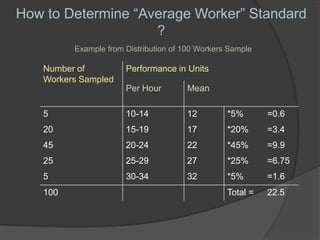
How to Determine “Average Worker” Standard
                    ?
         Example from Distribution of 100 Workers Sample

   Number of          Performance in Units
   Workers Sampled
                      Per Hour        Mean

   5                  10-14           12         *5%       =0.6
   20                 15-19           17         *20%      =3.4
   45                 20-24           22         *45%      =9.9
   25                 25-29           27         *25%      =6.75
   5                  30-34           32         *5%       =1.6
   100                                           Total =   22.5
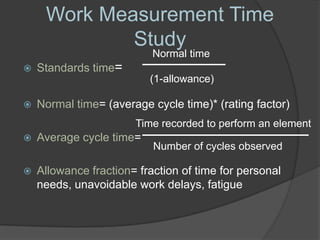
Work Measurement Time
             Study
                           Normal time
   Standards time=
                          (1-allowance)

   Normal time= (average cycle time)* (rating factor)
                       Time recorded to perform an element
   Average cycle time=
                           Number of cycles observed

   Allowance fraction= fraction of time for personal
    needs, unavoidable work delays, fatigue
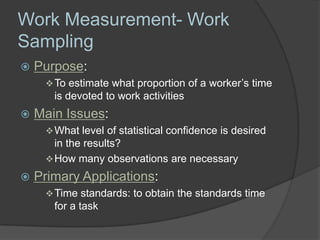
Work Measurement- Work
Sampling
   Purpose:
      To estimate what proportion of a worker’s time
       is devoted to work activities
   Main Issues:
      What level of statistical confidence is desired
       in the results?
      How many observations are necessary

   Primary Applications:
      Time standards: to obtain the standards time
       for a task
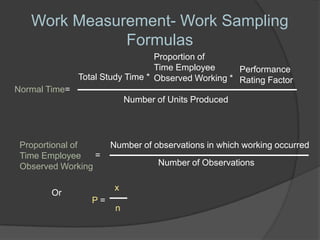
Work Measurement- Work Sampling
              Formulas
                                  Proportion of
                                  Time Employee      Performance
               Total Study Time * Observed Working * Rating Factor
Normal Time=
                            Number of Units Produced


 Proportional of       Number of observations in which working occurred
 Time Employee    =
 Observed Working                  Number of Observations

                        x
        Or
                  P=
                        n
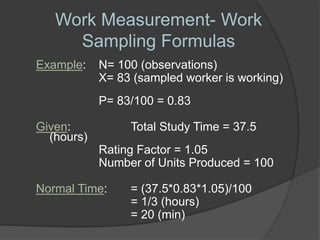
Work Measurement- Work
     Sampling Formulas
Example:    N= 100 (observations)
            X= 83 (sampled worker is working)
            P= 83/100 = 0.83

Given:           Total Study Time = 37.5
  (hours)
            Rating Factor = 1.05
            Number of Units Produced = 100

Normal Time:     = (37.5*0.83*1.05)/100
                 = 1/3 (hours)
                 = 20 (min)
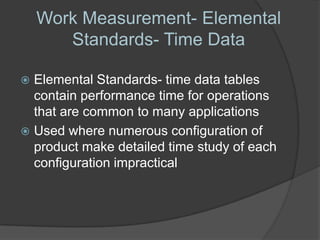
Work Measurement- Elemental
       Standards- Time Data

 Elemental Standards- time data tables
  contain performance time for operations
  that are common to many applications
 Used where numerous configuration of
  product make detailed time study of each
  configuration impractical
Work Measurement- Predetermined
      Motion- Time Study
   Description: used in the planning process
    when the jobs are not currently being
    performed
   Can also be an alternative to observed
    time studies
   Basis in the historical information on basic
    human movement and motion such as
    reaching, gasping, lifting, etc.
   Elemental times have been developed for
    the basic human motion
   Commonly industry specific
Measurement Problems
   Quality may change while the quantity
    of inputs and outputs remains
    constant
   External elements may cause an
    increase or decrease in productivity
   Precise units of measure may be
    lacking
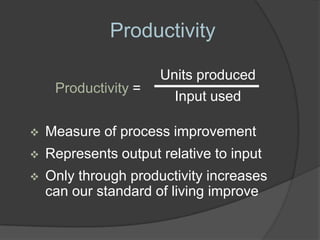
Productivity

                      Units produced
     Productivity =
                        Input used

   Measure of process improvement
   Represents output relative to input
   Only through productivity increases
    can our standard of living improve
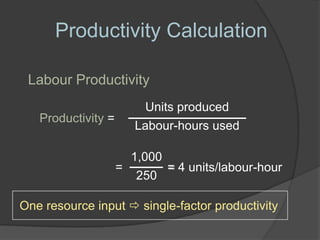
Productivity Calculation

 Labour Productivity
                          Units produced
   Productivity =
                        Labour-hours used

                        1,000
                    =           = 4 units/labour-hour
                        250

One resource input  single-factor productivity
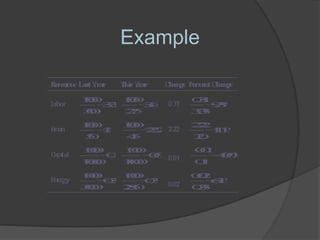
Example
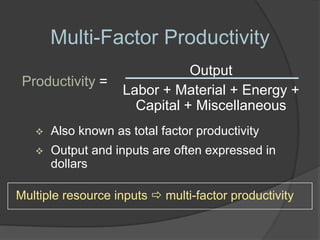
Multi-Factor Productivity
                               Output
 Productivity =
                    Labor + Material + Energy +
                      Capital + Miscellaneous
      Also known as total factor productivity
      Output and inputs are often expressed in
       dollars

Multiple resource inputs  multi-factor productivity
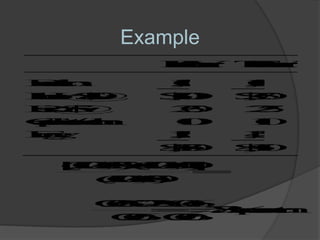
Example
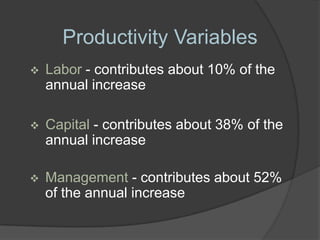
Productivity Variables
   Labor - contributes about 10% of the
    annual increase

   Capital - contributes about 38% of the
    annual increase

   Management - contributes about 52%
    of the annual increase
Key Variables for Improved
Labor Productivity
   Basic education appropriate for the labor
    force
   Diet of the labor force
   Social overhead that makes labor
    available
   Maintaining and enhancing skills in the
    midst of rapidly changing technology and
    knowledge
Service Productivity
   Typically labor intensive
   Frequently focused on unique individual
    attributes or desires
   Often an intellectual task performed by
    professionals
   Often difficult to mechanize
   Often difficult to evaluate for quality
Conclusion
Work measurement and productivity

Work measurement and productivity

  • 1.
    Work Measurement and Productivity Presented by: MD. NAZIR ANSARI ANSHUL GARG
  • 2.
    Work Measurement  WorkMeasurement: establish a measurable work standard upon which to evaluate, compare and improve labor productivity.  Work (labor) Standard: Determine on average-how many labor-hour are required to produce one unit of desired output for a well-trained worker under normal operating conditions
  • 3.
    Work Measurement Continue… Level of standard: * Operations/Department/Plant standards * Element/Operations/Product standards  Use of work standard: * Work and personnel planning * Cost estimation for labor and machine  Techniques to set work standard: * Time study * Work sampling * Elemental timing * Predetermined motion-time study
  • 4.
    Three Levels ofStandards  Production and operations standards: individuals job standards  Department standards: sum of performance of the individual and team in a department  Plant standards: quantity and labor standards of the plant are the goals management strives to meet
  • 5.
    Evaluation Performance  Evaluating individual performance: subsequent compensation  Evaluating department performance: subsequent supervisor compensation  Evaluating process design, layout, and work methods  Estimating expense and revenue streams in equipment evaluation as alternative are compared  Formulating standards costs
  • 6.
    Predicting, Planning, and Controlling Operations  Aggregate planning of work force levels and production rates  Capacity planning and utilization  Scheduling operations: time sequencing jobs  Cost estimating of products and production lots  Planning types of labor skills necessary and budgeting labor expenses
  • 7.
    Work Measurement- Average Worker  Determined by observing several workers and estimating their average performance  Sampling costs increase with number of workers sampled: accuracy of estimate increases as sample size increases  Must tradeoff sampling cost and accuracy
  • 8.
    How to Determine“Average Worker” Standard ? Example from Distribution of 100 Workers Sample Number of Performance in Units Workers Sampled Per Hour Mean 5 10-14 12 *5% =0.6 20 15-19 17 *20% =3.4 45 20-24 22 *45% =9.9 25 25-29 27 *25% =6.75 5 30-34 32 *5% =1.6 100 Total = 22.5
  • 9.
    Work Measurement Time Study Normal time  Standards time= (1-allowance)  Normal time= (average cycle time)* (rating factor) Time recorded to perform an element  Average cycle time= Number of cycles observed  Allowance fraction= fraction of time for personal needs, unavoidable work delays, fatigue
  • 10.
    Work Measurement- Work Sampling  Purpose:  To estimate what proportion of a worker’s time is devoted to work activities  Main Issues:  What level of statistical confidence is desired in the results?  How many observations are necessary  Primary Applications:  Time standards: to obtain the standards time for a task
  • 11.
    Work Measurement- WorkSampling Formulas Proportion of Time Employee Performance Total Study Time * Observed Working * Rating Factor Normal Time= Number of Units Produced Proportional of Number of observations in which working occurred Time Employee = Observed Working Number of Observations x Or P= n
  • 12.
    Work Measurement- Work Sampling Formulas Example: N= 100 (observations) X= 83 (sampled worker is working) P= 83/100 = 0.83 Given: Total Study Time = 37.5 (hours) Rating Factor = 1.05 Number of Units Produced = 100 Normal Time: = (37.5*0.83*1.05)/100 = 1/3 (hours) = 20 (min)
  • 13.
    Work Measurement- Elemental Standards- Time Data  Elemental Standards- time data tables contain performance time for operations that are common to many applications  Used where numerous configuration of product make detailed time study of each configuration impractical
  • 14.
    Work Measurement- Predetermined Motion- Time Study  Description: used in the planning process when the jobs are not currently being performed  Can also be an alternative to observed time studies  Basis in the historical information on basic human movement and motion such as reaching, gasping, lifting, etc.  Elemental times have been developed for the basic human motion  Commonly industry specific
  • 15.
    Measurement Problems  Quality may change while the quantity of inputs and outputs remains constant  External elements may cause an increase or decrease in productivity  Precise units of measure may be lacking
  • 16.
    Productivity Units produced Productivity = Input used  Measure of process improvement  Represents output relative to input  Only through productivity increases can our standard of living improve
  • 17.
    Productivity Calculation LabourProductivity Units produced Productivity = Labour-hours used 1,000 = = 4 units/labour-hour 250 One resource input  single-factor productivity
  • 18.
  • 19.
    Multi-Factor Productivity Output Productivity = Labor + Material + Energy + Capital + Miscellaneous  Also known as total factor productivity  Output and inputs are often expressed in dollars Multiple resource inputs  multi-factor productivity
  • 20.
  • 21.
    Productivity Variables  Labor - contributes about 10% of the annual increase  Capital - contributes about 38% of the annual increase  Management - contributes about 52% of the annual increase
  • 22.
    Key Variables forImproved Labor Productivity  Basic education appropriate for the labor force  Diet of the labor force  Social overhead that makes labor available  Maintaining and enhancing skills in the midst of rapidly changing technology and knowledge
  • 23.
    Service Productivity  Typically labor intensive  Frequently focused on unique individual attributes or desires  Often an intellectual task performed by professionals  Often difficult to mechanize  Often difficult to evaluate for quality
  • 24.