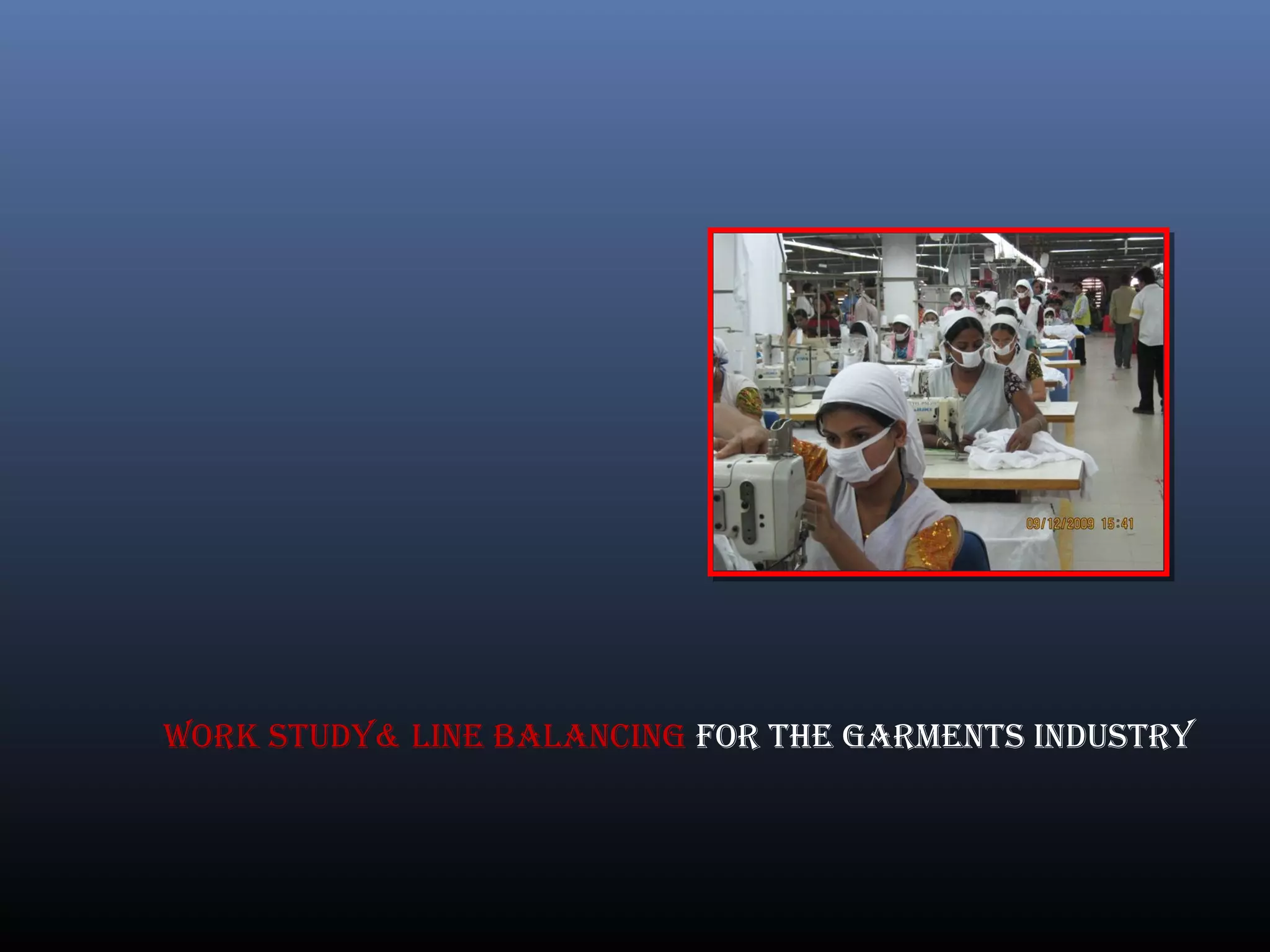
WORK study& LINE BALANCING FOR tHE GARMENts INdustRy
WORK STUDY & LINE BALANCING

INTRODUCTION
Project work is an indispensable part to study for a student of textile
Engineering department. The enable we to avoid the gap between
theories taught us just in the class room and it is applicable in the
practices every year the students of the university are assigned with a
particular project work. This is very important in the sense that it is the
assignment that a student or group students has to comply by
themselves prior to their job life in any industry. This work may be of any
type as production survey the mill data or may be analysis of the Textile
or Garments. This really increases level of confidence of the student and
also increases their knowledge about their field.
WORK STUDY & LINE BALANCING

WORK STUDY
Work study is a collection of techniques used to examine work-what is doneso that there is systematic analysis of all the elements, factors, recourses and
relationships affecting the efficiency and effectiveness of the work being
studied.
Work study is the investigation of work done in an organization in a systematic
process in order attain best possible use of men, materials and machines
available at present.
The slogan of work study is ‘work smart, not work hard’

Basic tools of work study
There are three basics tools of work study. They are1. Work measurement
2. Method study
-Motion study
3. Time study
-Partial work study
-Overall work study
WORK STUDY & LINE BALANCING

WORK STUDY
Objectives of work study
Accordance British Standards Institution approved definition B.S 3138:1959‘work study is the systematic
study of an operation or process to ensure the best possible use of the human and material resources
available. The prime aim is to improve productivity”
-To standardize the method of doing a task.
-To determine the standard time for doing a task.
-To minimize the materials movements, operator’s movement, idle time of the workers and machine by
proper plan layout
-To eliminate the unnecessary human motions in performing a task.
-To utilize the facilities such as men, machine or materials most efficiently and effectively.
-To establish the standard of performance.
WORK STUDY & LINE BALANCING

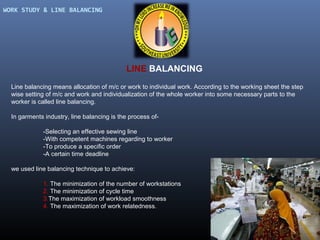
LINE BALANCING
Line balancing means allocation of m/c or work to individual work. According to the working sheet the step
wise setting of m/c and work and individualization of the whole worker into some necessary parts to the
worker is called line balancing.
In garments industry, line balancing is the process of-Selecting an effective sewing line
-With competent machines regarding to worker
-To produce a specific order
-A certain time deadline
we used line balancing technique to achieve:
1. The minimization of the number of workstations
2. The minimization of cycle time
3.The maximization of workload smoothness
4. The maximization of work relatedness.
WORK STUDY & LINE BALANCING

LINE BALANCING
Objectives of Line Balancing
Aim of this program is to get manufacturing and design to work together on the core objective i.e. ‘Profit’.
The designers have to start thinking the best possible ways of creating a design which will suit the
manufacturing in the most profitable way while the garment techs or sample makers will think of the most
efficient way of construction. Sewing supervisors and Industrial Engineers will learn how to look at the
way operators are working and how to improve sewing methods and to set standard times for the various
operations that go together to make the garment. They will also be able to provide management with
more information to allow management to make better informed decisions and manage more effectively
resulting in:-Higher productivity
-Increased profitability
-Reduction in work content
-Simplified work process
-Greater awareness of equipment
-Better understanding of how folders and special attachments can influence
-productivity
-Production information and documentation to management
WORK STUDY & LINE BALANCING

Objectives of Our Work
-To maximize the production.
-To improve per day production.
-To minimize the production cost.
-To find out the wasting time during a product making and to minimize the wasting time.
-Find out the problem restricting the production, generating proper solutions and
implement them in a proper way.
-To analyze what affects productivity in respect to a garments factory.
-To develop the best method or work and motion ergonomics
-To balance the line for best utilization of men, machine and material.
WORK STUDY & LINE BALANCING

This project means work study and line balancing presents a lot of problems and remedies occurred in
garments production. We are trying to give an idea about the possible problems and remedies related
to the garments production.

Tools and Equipments to Be used For Doing This Work :
•Calculator
•Stopwatch
•Scale
•Pen
•Paper
•Pencil
•Graph paper
•Time study sheet
•Cutting scissor
•Inspection table
•Input table
•Productivity improvement sheet.
WORK STUDY & LINE BALANCING

Process/Technique of Work Study:
The methodology of this thesis is the observation, understanding, recording,
improvement, implement of the existing operation condition and find out the
problems then give a suggestion. To increase the production of a company first of all
it is required to collect the data about the production capacity, the total floor space,
total machineries, total worker and minimum clearance between one work stations
to another to perform the best works so that maximum output can be achieved.
Then it is important to practically visualize the existing condition of the production
floor.
WORK STUDY & LINE BALANCING

Garments Manufacturing Process:

Stepwise garments manufacturing sequence on industrial basis is given below:
Cutting

Design/Sketch

Spreading

Basic block

Production pattern

Basic pat Pattern development

Working pattern

Working pattern

Basic pat Pattern development

Spreading

Basic block

Marking

Production pattern

Spreading

Cutting

Design/Sketch
WORK STUDY & LINE BALANCING

Sewing Machine Types
According to the operating system, there are two types of sewing m/c are available given below1. Manually Operated sewing machine
2. Electrically Operated sewing machine
1. Manually Operated sewing machine:
The m/c in which sewing is done by physical power called Manually Operated sewing
machines. These types of sewing m/c are widely used in tailoring and domestic purpose for
sewing fabrics. Because of less production, these types of sewing m/c are not used in
garments industry.
2. Electrically Operated sewing machine:
The m/c, in which sewing is done by electrical power called Electrically Operated sewing
machine. Comparatively these types of m/c contain high production and widely used in
garments industries for making garments. The machines which are used in garments
industries are called Industrial sewing m/cs.
WORK STUDY & LINE BALANCING

Sewing Machine Types
There are various types of industrial sewing machines and among them some features about these
various types of machines are given below -

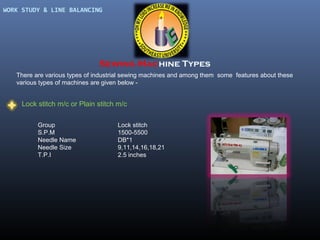
Lock stitch m/c or Plain stitch m/c
Group
S.P.M
Needle Name
Needle Size
T.P.I

Lock stitch
1500-5500
DB*1
9,11,14,16,18,21
2.5 inches
WORK STUDY & LINE BALANCING

Sewing Machine Types
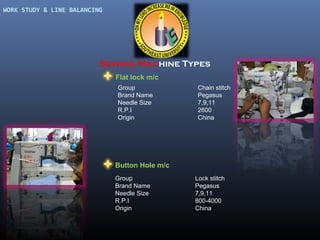
Flat lock m/c
Group
Brand Name
Needle Size
R.P.I
Origin

Chain stitch
Pegasus
7,9,11
2600
China

Button Hole m/c
Group
Brand Name
Needle Size
R.P.I
Origin

Lock stitch
Pegasus
7,9,11
800-4000
China
WORK STUDY & LINE BALANCING

Sewing Machine Types
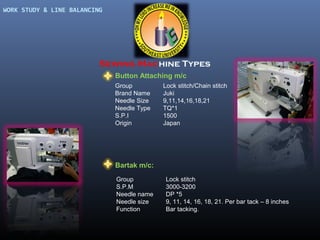
Button Attaching m/c
Group
Brand Name
Needle Size
Needle Type
S.P.I
Origin

Lock stitch/Chain stitch
Juki
9,11,14,16,18,21
TQ*1
1500
Japan

Bartak m/c:
Group
S.P.M
Needle name
Needle size
Function

Lock stitch
3000-3200
DP *5
9, 11, 14, 16, 18, 21. Per bar tack – 8 inches
Bar tacking.
WORK STUDY & LINE BALANCING

Sewing Machine Types
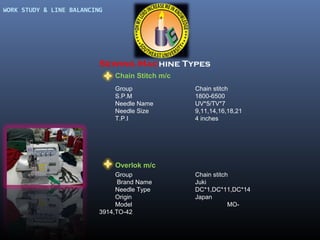
Chain Stitch m/c
Group
S.P.M
Needle Name
Needle Size
T.P.I

Chain stitch
1800-6500
UV*5/TV*7
9,11,14,16,18,21
4 inches

Overlok m/c
Group
Brand Name
Needle Type
Origin
Model
3914,TO-42

Chain stitch
Juki
DC*1,DC*11,DC*14
Japan
MO-
WORK STUDY & LINE BALANCING

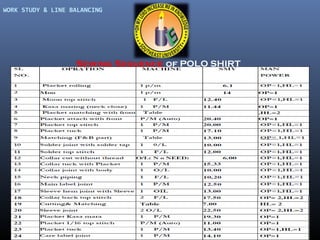
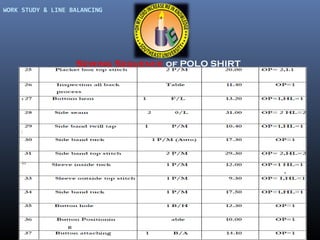
Sewing Sequence of POLO SHIRT
WORK STUDY & LINE BALANCING

Sewing Sequence of POLO SHIRT
WORK STUDY & LINE BALANCING

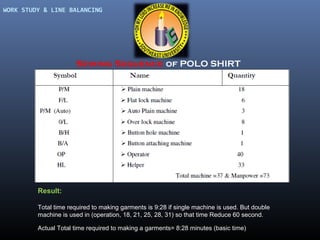
Sewing Sequence of POLO SHIRT

Result:
Total time required to making garments is 9:28 if single machine is used. But double
machine is used in (operation, 18, 21, 25, 28, 31) so that time Reduce 60 second.
Actual Total time required to making a garments= 8:28 minutes (basic time)
WORK STUDY & LINE BALANCING

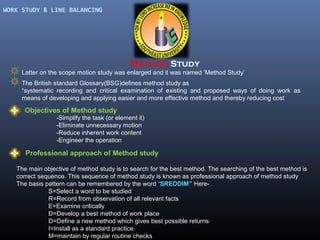
Method Study
Latter on the scope motion study was enlarged and it was named ‘Method Study’
The British standard Glossary(BSG)defines method study as
“systematic recording and critical examination of existing and proposed ways of doing work as
means of developing and applying easier and more effective method and thereby reducing cost

Objectives of Method study
-Simplify the task (or element it)
-Eliminate unnecessary motion
-Reduce inherent work content
-Engineer the operation

Professional approach of Method study
The main objective of method study is to search for the best method. The searching of the best method is
correct sequence. This sequence of method study is known as professional approach of method study
The basis pattern can be remembered by the word ‘SREDDIM” HereS=Select a word to be studied
R=Record from observation of all relevant facts
E=Examine critically
D=Develop a best method of work place
D=Define a new method which gives best possible returns
I=Install as a standard practice.
M=maintain by regular routine checks
WORK STUDY & LINE BALANCING

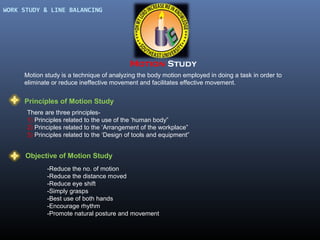
Motion Study
Motion study is a technique of analyzing the body motion employed in doing a task in order to
eliminate or reduce ineffective movement and facilitates effective movement.

Principles of Motion Study
There are three principles1) Principles related to the use of the ‘human body”
2) Principles related to the ‘Arrangement of the workplace”
3) Principles related to the ‘Design of tools and equipment”

Objective of Motion Study
-Reduce the no. of motion
-Reduce the distance moved
-Reduce eye shift
-Simply grasps
-Best use of both hands
-Encourage rhythm
-Promote natural posture and movement
WORK STUDY & LINE BALANCING

time Study
Time study is defined as a work measurement techniques for recording the time and rate of working for
the elements of a specific job, carried out under specific condition and for analyzing the data so as to
obtain the time necessary for carrying out the job at a defined level of performance.

Equipments needed for Time Study
- Stop watch.
- Study board.
- Time study forms. - Pen
- Calculator

When doing a time study------•Take more than 20 observations
•Record relevant details about the method and the machine
•Stand diagonally behind the operator about 1.5-2.0 meters

Observed time

Observed time comes from a direct observation by an observer that an operator takes to complete
his/her relevant operation or elements.

Performance Rating
Performance rating factor =

Observed rating
Standard rating
WORK STUDY & LINE BALANCING

time Study
Standard Rating
The place at which a qualified worker perform a task(standard rating 100)

Standard performance
Standard Performance is” the optimum rate of output that can be achieved by a qualified worker
as an average for the working day or shift, due allowance being made for the necessary time
required for rest”

Normal Time
It is the time that a normal operator would be expected to complete a job without the
consideration of allowances. In British Standard it is called basic time .
Normal Time=Average observed time*performance rating factor

Standard Time
Standard time is the time required for an average operator, fully qualified and trained, and working
at standard pace, to perform the operation.
Standard time = Normal time +Allowance
= Normal time +(Normal time*Allowance)
= NT(1+Allowance)
WORK STUDY & LINE BALANCING

SMV (Standard Minute Value)

time Study

SMV is the time taken by a qualified worker to perform a specified task in a defined level of
performance.
SMV calculation
SMV calculation of a basic T-shirt from a time study sheet of a garments industry. Following formulas are useNormal time =Average observed time *performance rating factor
SMV =Basic time +(Allowance *Basic time)

Target calculation
Capacity =
Target =

60
Average of the observed time +

( %)

of Allowance

No. of worker * work hours * 60
* Expected Efficiency
SMV

Efficiency Calculation
Produced minute *100
Overall Efficiency =
Used minutes

On standard Efficiency =

Produced minute *100
( Used minutes – Non productive time

)
WORK STUDY & LINE BALANCING

Conclusion
This study has identified the most pressing needs. Yet as already noted with
sufficient interest, effort, and resources applied to basic production techniques and
managerial disciplines, factories have great potential to increase productivity.
Improvements in productivity of 20-25 % can be achieved with the right attitude and
climate. A systematic program to introduce modern management concepts, including
industrial engineering, production engineering, systems and controls is therefore of
the highest priority. Training and professional development to implement such a
program are needed.
So we take work study department and work this department very hard. It is
completely a new experience in our life, which will be very effective in my service
life. During our training period we realized that practical experience is valuable for
service life.

WORK study& LINE BALANCING

  • 1.
    WORK study& LINEBALANCING FOR tHE GARMENts INdustRy
  • 3.
    WORK STUDY &LINE BALANCING INTRODUCTION Project work is an indispensable part to study for a student of textile Engineering department. The enable we to avoid the gap between theories taught us just in the class room and it is applicable in the practices every year the students of the university are assigned with a particular project work. This is very important in the sense that it is the assignment that a student or group students has to comply by themselves prior to their job life in any industry. This work may be of any type as production survey the mill data or may be analysis of the Textile or Garments. This really increases level of confidence of the student and also increases their knowledge about their field.
  • 4.
    WORK STUDY &LINE BALANCING WORK STUDY Work study is a collection of techniques used to examine work-what is doneso that there is systematic analysis of all the elements, factors, recourses and relationships affecting the efficiency and effectiveness of the work being studied. Work study is the investigation of work done in an organization in a systematic process in order attain best possible use of men, materials and machines available at present. The slogan of work study is ‘work smart, not work hard’ Basic tools of work study There are three basics tools of work study. They are1. Work measurement 2. Method study -Motion study 3. Time study -Partial work study -Overall work study
  • 5.
    WORK STUDY &LINE BALANCING WORK STUDY Objectives of work study Accordance British Standards Institution approved definition B.S 3138:1959‘work study is the systematic study of an operation or process to ensure the best possible use of the human and material resources available. The prime aim is to improve productivity” -To standardize the method of doing a task. -To determine the standard time for doing a task. -To minimize the materials movements, operator’s movement, idle time of the workers and machine by proper plan layout -To eliminate the unnecessary human motions in performing a task. -To utilize the facilities such as men, machine or materials most efficiently and effectively. -To establish the standard of performance.
  • 6.
    WORK STUDY &LINE BALANCING LINE BALANCING Line balancing means allocation of m/c or work to individual work. According to the working sheet the step wise setting of m/c and work and individualization of the whole worker into some necessary parts to the worker is called line balancing. In garments industry, line balancing is the process of-Selecting an effective sewing line -With competent machines regarding to worker -To produce a specific order -A certain time deadline we used line balancing technique to achieve: 1. The minimization of the number of workstations 2. The minimization of cycle time 3.The maximization of workload smoothness 4. The maximization of work relatedness.
  • 7.
    WORK STUDY &LINE BALANCING LINE BALANCING Objectives of Line Balancing Aim of this program is to get manufacturing and design to work together on the core objective i.e. ‘Profit’. The designers have to start thinking the best possible ways of creating a design which will suit the manufacturing in the most profitable way while the garment techs or sample makers will think of the most efficient way of construction. Sewing supervisors and Industrial Engineers will learn how to look at the way operators are working and how to improve sewing methods and to set standard times for the various operations that go together to make the garment. They will also be able to provide management with more information to allow management to make better informed decisions and manage more effectively resulting in:-Higher productivity -Increased profitability -Reduction in work content -Simplified work process -Greater awareness of equipment -Better understanding of how folders and special attachments can influence -productivity -Production information and documentation to management
  • 8.
    WORK STUDY &LINE BALANCING Objectives of Our Work -To maximize the production. -To improve per day production. -To minimize the production cost. -To find out the wasting time during a product making and to minimize the wasting time. -Find out the problem restricting the production, generating proper solutions and implement them in a proper way. -To analyze what affects productivity in respect to a garments factory. -To develop the best method or work and motion ergonomics -To balance the line for best utilization of men, machine and material.
  • 9.
    WORK STUDY &LINE BALANCING This project means work study and line balancing presents a lot of problems and remedies occurred in garments production. We are trying to give an idea about the possible problems and remedies related to the garments production. Tools and Equipments to Be used For Doing This Work : •Calculator •Stopwatch •Scale •Pen •Paper •Pencil •Graph paper •Time study sheet •Cutting scissor •Inspection table •Input table •Productivity improvement sheet.
  • 10.
    WORK STUDY &LINE BALANCING Process/Technique of Work Study: The methodology of this thesis is the observation, understanding, recording, improvement, implement of the existing operation condition and find out the problems then give a suggestion. To increase the production of a company first of all it is required to collect the data about the production capacity, the total floor space, total machineries, total worker and minimum clearance between one work stations to another to perform the best works so that maximum output can be achieved. Then it is important to practically visualize the existing condition of the production floor.
  • 11.
    WORK STUDY &LINE BALANCING Garments Manufacturing Process: Stepwise garments manufacturing sequence on industrial basis is given below: Cutting Design/Sketch Spreading Basic block Production pattern Basic pat Pattern development Working pattern Working pattern Basic pat Pattern development Spreading Basic block Marking Production pattern Spreading Cutting Design/Sketch
  • 12.
    WORK STUDY &LINE BALANCING Sewing Machine Types According to the operating system, there are two types of sewing m/c are available given below1. Manually Operated sewing machine 2. Electrically Operated sewing machine 1. Manually Operated sewing machine: The m/c in which sewing is done by physical power called Manually Operated sewing machines. These types of sewing m/c are widely used in tailoring and domestic purpose for sewing fabrics. Because of less production, these types of sewing m/c are not used in garments industry. 2. Electrically Operated sewing machine: The m/c, in which sewing is done by electrical power called Electrically Operated sewing machine. Comparatively these types of m/c contain high production and widely used in garments industries for making garments. The machines which are used in garments industries are called Industrial sewing m/cs.
  • 13.
    WORK STUDY &LINE BALANCING Sewing Machine Types There are various types of industrial sewing machines and among them some features about these various types of machines are given below - Lock stitch m/c or Plain stitch m/c Group S.P.M Needle Name Needle Size T.P.I Lock stitch 1500-5500 DB*1 9,11,14,16,18,21 2.5 inches
  • 14.
    WORK STUDY &LINE BALANCING Sewing Machine Types Flat lock m/c Group Brand Name Needle Size R.P.I Origin Chain stitch Pegasus 7,9,11 2600 China Button Hole m/c Group Brand Name Needle Size R.P.I Origin Lock stitch Pegasus 7,9,11 800-4000 China
  • 15.
    WORK STUDY &LINE BALANCING Sewing Machine Types Button Attaching m/c Group Brand Name Needle Size Needle Type S.P.I Origin Lock stitch/Chain stitch Juki 9,11,14,16,18,21 TQ*1 1500 Japan Bartak m/c: Group S.P.M Needle name Needle size Function Lock stitch 3000-3200 DP *5 9, 11, 14, 16, 18, 21. Per bar tack – 8 inches Bar tacking.
  • 16.
    WORK STUDY &LINE BALANCING Sewing Machine Types Chain Stitch m/c Group S.P.M Needle Name Needle Size T.P.I Chain stitch 1800-6500 UV*5/TV*7 9,11,14,16,18,21 4 inches Overlok m/c Group Brand Name Needle Type Origin Model 3914,TO-42 Chain stitch Juki DC*1,DC*11,DC*14 Japan MO-
  • 17.
    WORK STUDY &LINE BALANCING Sewing Sequence of POLO SHIRT
  • 18.
    WORK STUDY &LINE BALANCING Sewing Sequence of POLO SHIRT
  • 19.
    WORK STUDY &LINE BALANCING Sewing Sequence of POLO SHIRT Result: Total time required to making garments is 9:28 if single machine is used. But double machine is used in (operation, 18, 21, 25, 28, 31) so that time Reduce 60 second. Actual Total time required to making a garments= 8:28 minutes (basic time)
  • 20.
    WORK STUDY &LINE BALANCING Method Study Latter on the scope motion study was enlarged and it was named ‘Method Study’ The British standard Glossary(BSG)defines method study as “systematic recording and critical examination of existing and proposed ways of doing work as means of developing and applying easier and more effective method and thereby reducing cost Objectives of Method study -Simplify the task (or element it) -Eliminate unnecessary motion -Reduce inherent work content -Engineer the operation Professional approach of Method study The main objective of method study is to search for the best method. The searching of the best method is correct sequence. This sequence of method study is known as professional approach of method study The basis pattern can be remembered by the word ‘SREDDIM” HereS=Select a word to be studied R=Record from observation of all relevant facts E=Examine critically D=Develop a best method of work place D=Define a new method which gives best possible returns I=Install as a standard practice. M=maintain by regular routine checks
  • 21.
    WORK STUDY &LINE BALANCING Motion Study Motion study is a technique of analyzing the body motion employed in doing a task in order to eliminate or reduce ineffective movement and facilitates effective movement. Principles of Motion Study There are three principles1) Principles related to the use of the ‘human body” 2) Principles related to the ‘Arrangement of the workplace” 3) Principles related to the ‘Design of tools and equipment” Objective of Motion Study -Reduce the no. of motion -Reduce the distance moved -Reduce eye shift -Simply grasps -Best use of both hands -Encourage rhythm -Promote natural posture and movement
  • 22.
    WORK STUDY &LINE BALANCING time Study Time study is defined as a work measurement techniques for recording the time and rate of working for the elements of a specific job, carried out under specific condition and for analyzing the data so as to obtain the time necessary for carrying out the job at a defined level of performance. Equipments needed for Time Study - Stop watch. - Study board. - Time study forms. - Pen - Calculator When doing a time study------•Take more than 20 observations •Record relevant details about the method and the machine •Stand diagonally behind the operator about 1.5-2.0 meters Observed time Observed time comes from a direct observation by an observer that an operator takes to complete his/her relevant operation or elements. Performance Rating Performance rating factor = Observed rating Standard rating
  • 23.
    WORK STUDY &LINE BALANCING time Study Standard Rating The place at which a qualified worker perform a task(standard rating 100) Standard performance Standard Performance is” the optimum rate of output that can be achieved by a qualified worker as an average for the working day or shift, due allowance being made for the necessary time required for rest” Normal Time It is the time that a normal operator would be expected to complete a job without the consideration of allowances. In British Standard it is called basic time . Normal Time=Average observed time*performance rating factor Standard Time Standard time is the time required for an average operator, fully qualified and trained, and working at standard pace, to perform the operation. Standard time = Normal time +Allowance = Normal time +(Normal time*Allowance) = NT(1+Allowance)
  • 24.
    WORK STUDY &LINE BALANCING SMV (Standard Minute Value) time Study SMV is the time taken by a qualified worker to perform a specified task in a defined level of performance. SMV calculation SMV calculation of a basic T-shirt from a time study sheet of a garments industry. Following formulas are useNormal time =Average observed time *performance rating factor SMV =Basic time +(Allowance *Basic time) Target calculation Capacity = Target = 60 Average of the observed time + ( %) of Allowance No. of worker * work hours * 60 * Expected Efficiency SMV Efficiency Calculation Produced minute *100 Overall Efficiency = Used minutes On standard Efficiency = Produced minute *100 ( Used minutes – Non productive time )
  • 25.
    WORK STUDY &LINE BALANCING Conclusion This study has identified the most pressing needs. Yet as already noted with sufficient interest, effort, and resources applied to basic production techniques and managerial disciplines, factories have great potential to increase productivity. Improvements in productivity of 20-25 % can be achieved with the right attitude and climate. A systematic program to introduce modern management concepts, including industrial engineering, production engineering, systems and controls is therefore of the highest priority. Training and professional development to implement such a program are needed. So we take work study department and work this department very hard. It is completely a new experience in our life, which will be very effective in my service life. During our training period we realized that practical experience is valuable for service life.