I AM HASAN AHMED
AND MY ID IS
2012000400111
My assignment contains
1) Definition
2) What is Acrylic fibre
3) Chemical composition of acrylic fibre
4) Acrylic Fiber Features
5) Properties of Acrylic Fibers
6) Acrylic Fiber Characteristics
7) Advantages of Acrylic Fibers
8) Uses of Acrylic Fiber
9) Commercial market review
Acrylic is a synthetic man-made fiber which was
created to mimic wool and it does bear some
resemblance to it in softness.Some brand names for
acrylic are Acrilan, Orlan, and Creslon. The fiber
has a soft, smooth feel which is very similar to
wool, and is lightweight. It is often used to create
plush velvets, and dyes beautifully.
Acrylic can be thought of as artificial wool. It is made from the
unlikely combination of coal, air, water, oil and limestone. DuPont
first made acrylic fibers in 1944 and began commercial
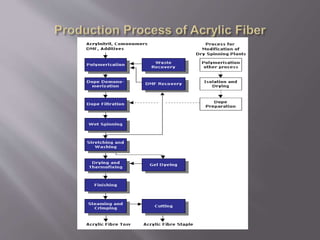
production in 1950. It is spun by either dry spinning or wet
spinning. In dry spinning the dissolved polymers are extruded
into warm air. The fibers solidify by evaporation. In wet spinning
the polymer is dissolved and extruded into a bath and then dried.
In some ways, acrylic imitates wool. It has wool's warmth and
softness, but does not absorb water. Instead, acrylic wicks
moisture to the surface where it evaporates. Acrylic is used in
knitted apparels such as fleece, socks, sportswear and sweaters. It
is also used to create fake fur, craft yarns, upholstery fabric,
carpet, luggage, awnings, and vehicle covers. The acrylic fibers
include acrylic, modacrylic, and other vinyl fibers containing
cyanide groups as side chains. Among the major acrylic fibers
used in commerce, acrylonitrile is the comonomer containing a
cyanide group.
 1. Specific Gravity ————— 1.14 – 1.19
 2. Melt Point ———————- No definite melt.
 3. Moisture Regain (%) ——— 1.0 – 2.5
 4. Breaking Tenacity (gpd) — 2.2 – 5.4
 5. Elongation at Break ——— 0.00 – 0.00
 Resilient and retains shape
 Quick drying
 Resistant to water damage, sunlight and does
not fade
 Resistant to mold, mildew and insects
 Flammable
 1. Acrylic has a warm and dry hand like wool. Its density is 1.17
g/cc as compared to 1.32 g/cc of wool. It is about 30% bulkier
than wool. It has about 20% greater insulating power than wool.
 2. Acrylic has a moisture regain of 1.5-2% at 65% RH and 70 deg F.
 3. It has a tenacity of 5 gpd in dry state and 4-8 gpd in wet state.
 4. Breaking elongation is 15% ( both states)
 5. It has a elastic recovery of 85% after 4% extension when the load
is released immediately.
 6. It has a good thermal stability. When exposed to temperatures
above 175 deg C for prolonged periods some discolouration takes
place.
 7. Acrylic shrinks by about 1.5% when treated with boiling water
for 30 min.
 8. It has a good resistance to mineral acids. The resistance to weak
alkalies is fairly good, while hot strong alkalies rapidly attack
acrylic.
 9. Moths, Mildew and insects do not attack Acrylic.
 Outstanding wickability & quick drying to move moisture
from body surface
 Flexible aesthetics for wool-like, cotton-like, or blended
appearance
 Easily washed, retains shape
 Resistant to moths, oil, and chemicals
 Dyeable to bright shades with excellent fastness
 Superior resistance to sunlight degradation
 Due to its wicking ability and other characteristics, the fabric designers
all over world are opting acrylic fabrics for manufacturing garments for
all seasons.
 Not only, the acrylic fabrics are high in performance but also they have
a luxurious feel and they also drape very well.
 They are lightweight but have more bulk. This is due to their quality of
lower specific gravity.
 They are comfortable to wear due to high moisture management.
 Dyes can be easily applied to them and they are colorfast.
 They are odor and mildew resistant too.
 In cold weather acrylics provide excellent insulation and warmth
without any extra weight.
 1. Knit Jersey, Sweater, blankets
 2. Wrinkle resistant fabrics.
 3. Pile and Fleece fabrics
 4. Carpets and rugs
As shown in the figure below, major apparel and home
furnishings applications for acrylic fiber account for 63 percent
and 30 percent, respectively, of the global acrylic fibers
market. These applications reflect its properties primarily as
synthetic wool and, to a lesser extent, synthetic cotton. Thus, in
garments it is found in sweaters, socks, fleece wear, circular knit
apparel, sportswear and children’s wear. In home furnishings, it
is used in blankets, area rugs, upholstery, awnings, and outdoor
furniture.
Partially carbonized and pre-oxidized acrylic fiber tow is used
as an asbestos replacement in applications such as clutch and
brake pads. Fully carbonized sub-tow (acrylic fiber precursor )
is used to produce high tenacity carbon fiber.
An acrylic fiber precursor for high performance carbon
fibers free of defects which comprises an acrylonitrile
polymer containing at least 90% by weight of acrylonitrile
and has a surface roughness of 2.0 to 3.0 with dense inner
structure. from a solution comprising 24 to 27.5% of the
acrylonitrile polymer is dry-jet wet spun into a coagulation
bath consisting essentially of dimethylformamide or
dimethylacetamide and having a bath temperature of 5
obtained by carbonizing these precursor acrylic fibers
have no fusion bonding or agglutination of filaments and
exhibit high performance.

Acrylic fiber

  • 1.
    I AM HASANAHMED AND MY ID IS 2012000400111
  • 2.
    My assignment contains 1)Definition 2) What is Acrylic fibre 3) Chemical composition of acrylic fibre 4) Acrylic Fiber Features 5) Properties of Acrylic Fibers 6) Acrylic Fiber Characteristics 7) Advantages of Acrylic Fibers 8) Uses of Acrylic Fiber 9) Commercial market review
  • 3.
    Acrylic is asynthetic man-made fiber which was created to mimic wool and it does bear some resemblance to it in softness.Some brand names for acrylic are Acrilan, Orlan, and Creslon. The fiber has a soft, smooth feel which is very similar to wool, and is lightweight. It is often used to create plush velvets, and dyes beautifully.
  • 4.
    Acrylic can bethought of as artificial wool. It is made from the unlikely combination of coal, air, water, oil and limestone. DuPont first made acrylic fibers in 1944 and began commercial production in 1950. It is spun by either dry spinning or wet spinning. In dry spinning the dissolved polymers are extruded into warm air. The fibers solidify by evaporation. In wet spinning the polymer is dissolved and extruded into a bath and then dried. In some ways, acrylic imitates wool. It has wool's warmth and softness, but does not absorb water. Instead, acrylic wicks moisture to the surface where it evaporates. Acrylic is used in knitted apparels such as fleece, socks, sportswear and sweaters. It is also used to create fake fur, craft yarns, upholstery fabric, carpet, luggage, awnings, and vehicle covers. The acrylic fibers include acrylic, modacrylic, and other vinyl fibers containing cyanide groups as side chains. Among the major acrylic fibers used in commerce, acrylonitrile is the comonomer containing a cyanide group.
  • 6.
     1. SpecificGravity ————— 1.14 – 1.19  2. Melt Point ———————- No definite melt.  3. Moisture Regain (%) ——— 1.0 – 2.5  4. Breaking Tenacity (gpd) — 2.2 – 5.4  5. Elongation at Break ——— 0.00 – 0.00
  • 7.
     Resilient andretains shape  Quick drying  Resistant to water damage, sunlight and does not fade  Resistant to mold, mildew and insects  Flammable
  • 9.
     1. Acrylichas a warm and dry hand like wool. Its density is 1.17 g/cc as compared to 1.32 g/cc of wool. It is about 30% bulkier than wool. It has about 20% greater insulating power than wool.  2. Acrylic has a moisture regain of 1.5-2% at 65% RH and 70 deg F.  3. It has a tenacity of 5 gpd in dry state and 4-8 gpd in wet state.  4. Breaking elongation is 15% ( both states)  5. It has a elastic recovery of 85% after 4% extension when the load is released immediately.  6. It has a good thermal stability. When exposed to temperatures above 175 deg C for prolonged periods some discolouration takes place.  7. Acrylic shrinks by about 1.5% when treated with boiling water for 30 min.  8. It has a good resistance to mineral acids. The resistance to weak alkalies is fairly good, while hot strong alkalies rapidly attack acrylic.  9. Moths, Mildew and insects do not attack Acrylic.
  • 10.
     Outstanding wickability& quick drying to move moisture from body surface  Flexible aesthetics for wool-like, cotton-like, or blended appearance  Easily washed, retains shape  Resistant to moths, oil, and chemicals  Dyeable to bright shades with excellent fastness  Superior resistance to sunlight degradation
  • 11.
     Due toits wicking ability and other characteristics, the fabric designers all over world are opting acrylic fabrics for manufacturing garments for all seasons.  Not only, the acrylic fabrics are high in performance but also they have a luxurious feel and they also drape very well.  They are lightweight but have more bulk. This is due to their quality of lower specific gravity.  They are comfortable to wear due to high moisture management.  Dyes can be easily applied to them and they are colorfast.  They are odor and mildew resistant too.  In cold weather acrylics provide excellent insulation and warmth without any extra weight.
  • 12.
     1. KnitJersey, Sweater, blankets  2. Wrinkle resistant fabrics.  3. Pile and Fleece fabrics  4. Carpets and rugs
  • 15.
    As shown inthe figure below, major apparel and home furnishings applications for acrylic fiber account for 63 percent and 30 percent, respectively, of the global acrylic fibers market. These applications reflect its properties primarily as synthetic wool and, to a lesser extent, synthetic cotton. Thus, in garments it is found in sweaters, socks, fleece wear, circular knit apparel, sportswear and children’s wear. In home furnishings, it is used in blankets, area rugs, upholstery, awnings, and outdoor furniture. Partially carbonized and pre-oxidized acrylic fiber tow is used as an asbestos replacement in applications such as clutch and brake pads. Fully carbonized sub-tow (acrylic fiber precursor ) is used to produce high tenacity carbon fiber.
  • 16.
    An acrylic fiberprecursor for high performance carbon fibers free of defects which comprises an acrylonitrile polymer containing at least 90% by weight of acrylonitrile and has a surface roughness of 2.0 to 3.0 with dense inner structure. from a solution comprising 24 to 27.5% of the acrylonitrile polymer is dry-jet wet spun into a coagulation bath consisting essentially of dimethylformamide or dimethylacetamide and having a bath temperature of 5 obtained by carbonizing these precursor acrylic fibers have no fusion bonding or agglutination of filaments and exhibit high performance.