WELCOME
TO
OUR PRESENTATION
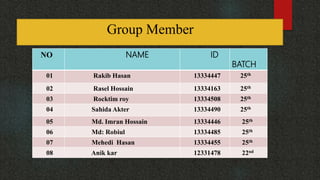
Group Member
NO NAME ID
BATCH
01 Rakib Hasan 13334447 25th
02 Rasel Hossain 13334163 25th
03 Rocktim roy 13334508 25th
04 Sahida Akter 13334490 25th
05 Md. Imran Hossain 13334446 25th
06 Md: Robiul 13334485 25th
07 Mehedi Hasan 13334455 25th
08 Anik kar 12331478 22nd
Application Of Different Types Study In
Garments Industry
INTRODUCTION
Work study
Work study is the investigation of work done in an organization in a
systematic process in order attain best possible use of men, materials and
machines available at present.
* The slogan of work study is ‘work smart, not work hard*
Objectives of work study
-To standardize the method of doing a task.
-To determine the standard time for doing a task.
-To minimize the materials movements, operator’s movement, idle time
of the workers and machine by proper plan layout.
-To eliminate the unnecessary human motions in performing a task.
-To utilize the facilities such as men, machine or materials most
efficiently and effectively.
-To establish the standard of performance.
Technique of Work Study
The methodology of this thesis is the observation, understanding, recording,
improvement, implement of the existing operation condition and find out the
problems then give a suggestion. To increase the production of a company first
of all it is required to collect the data about the production capacity, the total
floor space, total machineries, total worker and minimum clearance between one
work stations to another to perform the best works so that maximum output can
be achieved. Then it is important to practically visualize the existing condition of
the production floor.
LINE BALANCING
Line balancing means allocation of machine or work to individual work.
According to the working sheet the step wise setting of machine and work and
individualization of the whole worker into some necessary parts to the worker is
called line balancing.
In garments industry, line balancing is the process of-
-Selecting an effective sewing line
-With competent machines regarding to worker
-To produce a specific order
-A certain time deadline
use line balancing technique to achieve:
1. The minimization of the number of workstations
2. The minimization of cycle time
3.The maximization of workload smoothness.
4. The maximization of work relatedness.
Objectives of Line Balancing
 -Higher productivity
 -Increased profitability
 -Reduction in work content
 -Simplified work process
 -Greater awareness of equipment
 -Better understanding of how folders and special attachments can influence
productivity
 -Production information and documentation to management
Basic tools of work study
There are three basics tools of work study. They are-
1. Work measurement
2. Method study
-Motion study
3. Time study
-Partial work study
-Overall work study
Method Study
Latter on the scope motion study was enlarged and it was named ‘Method Study
The British standard Glossary defines method study as
“systematic recording and critical examination of existing and proposed ways of
doing work as means of developing and applying easier and more effective
method and thereby reducing cost.
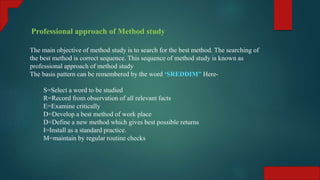
Professional approach of Method study
The main objective of method study is to search for the best method. The searching of
the best method is correct sequence. This sequence of method study is known as
professional approach of method study
The basis pattern can be remembered by the word ‘SREDDIM” Here-
S=Select a word to be studied
R=Record from observation of all relevant facts
E=Examine critically
D=Develop a best method of work place
D=Define a new method which gives best possible returns
I=Install as a standard practice.
M=maintain by regular routine checks
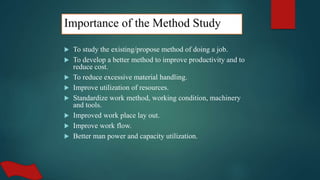
Importance of the Method Study
 To study the existing/propose method of doing a job.
 To develop a better method to improve productivity and to
reduce cost.
 To reduce excessive material handling.
 Improve utilization of resources.
 Standardize work method, working condition, machinery
and tools.
 Improved work place lay out.
 Improve work flow.
 Better man power and capacity utilization.
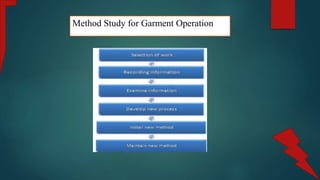
Method Study for Garment Operation
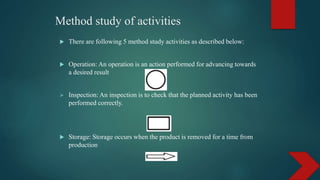
Method study of activities
 There are following 5 method study activities as described below:
 Operation: An operation is an action performed for advancing towards
a desired result
 Inspection: An inspection is to check that the planned activity has been
performed correctly.
 Storage: Storage occurs when the product is removed for a time from
production
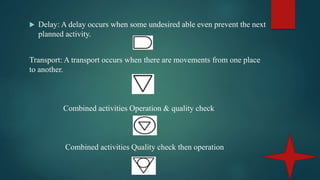
 Delay: A delay occurs when some undesired able even prevent the next
planned activity.
Transport: A transport occurs when there are movements from one place
to another.
Combined activities Operation & quality check
Combined activities Quality check then operation
Motion Study
Motion study is a technique of analyzing the body motion employed in
doing a task in order to eliminate or reduce ineffective movement and
facilitates effective movement.
Principles of Motion Study
There are three principles-
1) Principles related to the use of the ‘human body”
2) Principles related to the ‘Arrangement of the workplace”
3) Principles related to the ‘Design of tools and equipment”
Objective of Motion Study
 -Reduce the no. of motion.
 -Reduce the distance moved.
 -Reduce eye shift.
 -Simply grasps.
 -Best use of both hands.
 -Encourage rhythm.
 -Promote natural posture and movement.
Observed time
Observed time comes from a direct observation by an observer that an operator
takes to complete his/her relevant operation or elements.
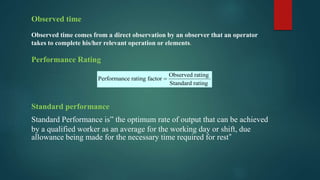
Performance Rating
Standard performance
Standard Performance is” the optimum rate of output that can be achieved
by a qualified worker as an average for the working day or shift, due
allowance being made for the necessary time required for rest”
Observed rating
Performance rating factor
Standard rating

Normal Time
It is the time that a normal operator would be expected to complete a job without the
consideration of allowances. In British Standard it is called basic time.
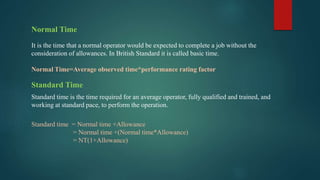
Normal Time=Average observed time*performance rating factor
Standard Time
Standard time is the time required for an average operator, fully qualified and trained, and
working at standard pace, to perform the operation.
Standard time = Normal time +Allowance
= Normal time +(Normal time*Allowance)
= NT(1+Allowance)
SMV(Standard minute value)
SMV is the time taken by a qualified worker to perform a specified task in a defined
level of performance.
SMV calculation
SMV calculation of a basic T-shirt from a time study sheet of a garments industry.
Following formulas are use-
Normal time =Average observed time *performance rating factor
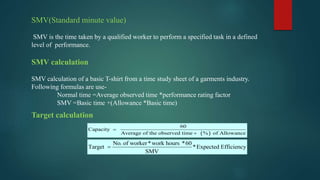
SMV =Basic time +(Allowance *Basic time)
Target calculation
 
60
Capacity
Average of the observed time % of Allowance


No. of worker*work hours *60
Target *Expected Efficiency
SMV

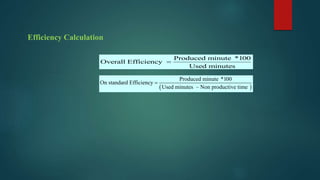
Efficiency Calculation
Produced minute *100
Overall Efficiency
Used minutes

 
Produced minute *100
On standard Efficiency
Used minutes – Non productive time

Time study
Time study measures the maximum necessary time required to do the job. It is
the most important technique of work measurement. It can be defined as
“Time study is the technique for determining as accurately” as possible from a
limited number of observations.
Objects of Time Study
 To determined stander time during which the operation can be performed
efficiently.
 To determined scheduling and planning.
 To calculate fair production per hours.
 Help to the motion study of the job.
 The standard time data is used in time. So a fair entire wage plane can be
established.
 To achieve a uniform flow of work.
Element used in the Time Study:
Stop watch: Stop watch is the element which used in time study.
Others: Expect stop watch, following tools may also be used
 Time study board
 Time study form
 Ruler
 Pencil
Conclusion
These studies has identified the most pressing needs.By applying these
tasks properly productivity can be increased. By completing the study on
Work study, Motion Study, Time Study we have been experienced that,
these studies how affects productivity in our industries.
It was completely a new experience in our life, which will be very effective
in our practical life.

Garments

  • 1.
  • 2.
    Group Member NO NAMEID BATCH 01 Rakib Hasan 13334447 25th 02 Rasel Hossain 13334163 25th 03 Rocktim roy 13334508 25th 04 Sahida Akter 13334490 25th 05 Md. Imran Hossain 13334446 25th 06 Md: Robiul 13334485 25th 07 Mehedi Hasan 13334455 25th 08 Anik kar 12331478 22nd
  • 3.
    Application Of DifferentTypes Study In Garments Industry
  • 4.
  • 5.
    Work study Work studyis the investigation of work done in an organization in a systematic process in order attain best possible use of men, materials and machines available at present. * The slogan of work study is ‘work smart, not work hard*
  • 6.
    Objectives of workstudy -To standardize the method of doing a task. -To determine the standard time for doing a task. -To minimize the materials movements, operator’s movement, idle time of the workers and machine by proper plan layout. -To eliminate the unnecessary human motions in performing a task. -To utilize the facilities such as men, machine or materials most efficiently and effectively. -To establish the standard of performance.
  • 7.
    Technique of WorkStudy The methodology of this thesis is the observation, understanding, recording, improvement, implement of the existing operation condition and find out the problems then give a suggestion. To increase the production of a company first of all it is required to collect the data about the production capacity, the total floor space, total machineries, total worker and minimum clearance between one work stations to another to perform the best works so that maximum output can be achieved. Then it is important to practically visualize the existing condition of the production floor.
  • 8.
    LINE BALANCING Line balancingmeans allocation of machine or work to individual work. According to the working sheet the step wise setting of machine and work and individualization of the whole worker into some necessary parts to the worker is called line balancing. In garments industry, line balancing is the process of- -Selecting an effective sewing line -With competent machines regarding to worker -To produce a specific order -A certain time deadline
  • 9.
    use line balancingtechnique to achieve: 1. The minimization of the number of workstations 2. The minimization of cycle time 3.The maximization of workload smoothness. 4. The maximization of work relatedness.
  • 10.
    Objectives of LineBalancing  -Higher productivity  -Increased profitability  -Reduction in work content  -Simplified work process  -Greater awareness of equipment  -Better understanding of how folders and special attachments can influence productivity  -Production information and documentation to management
  • 11.
    Basic tools ofwork study There are three basics tools of work study. They are- 1. Work measurement 2. Method study -Motion study 3. Time study -Partial work study -Overall work study
  • 12.
    Method Study Latter onthe scope motion study was enlarged and it was named ‘Method Study The British standard Glossary defines method study as “systematic recording and critical examination of existing and proposed ways of doing work as means of developing and applying easier and more effective method and thereby reducing cost.
  • 13.
    Professional approach ofMethod study The main objective of method study is to search for the best method. The searching of the best method is correct sequence. This sequence of method study is known as professional approach of method study The basis pattern can be remembered by the word ‘SREDDIM” Here- S=Select a word to be studied R=Record from observation of all relevant facts E=Examine critically D=Develop a best method of work place D=Define a new method which gives best possible returns I=Install as a standard practice. M=maintain by regular routine checks
  • 14.
    Importance of theMethod Study  To study the existing/propose method of doing a job.  To develop a better method to improve productivity and to reduce cost.  To reduce excessive material handling.  Improve utilization of resources.  Standardize work method, working condition, machinery and tools.  Improved work place lay out.  Improve work flow.  Better man power and capacity utilization.
  • 15.
    Method Study forGarment Operation
  • 16.
    Method study ofactivities  There are following 5 method study activities as described below:  Operation: An operation is an action performed for advancing towards a desired result  Inspection: An inspection is to check that the planned activity has been performed correctly.  Storage: Storage occurs when the product is removed for a time from production
  • 17.
     Delay: Adelay occurs when some undesired able even prevent the next planned activity. Transport: A transport occurs when there are movements from one place to another. Combined activities Operation & quality check Combined activities Quality check then operation
  • 18.
    Motion Study Motion studyis a technique of analyzing the body motion employed in doing a task in order to eliminate or reduce ineffective movement and facilitates effective movement.
  • 19.
    Principles of MotionStudy There are three principles- 1) Principles related to the use of the ‘human body” 2) Principles related to the ‘Arrangement of the workplace” 3) Principles related to the ‘Design of tools and equipment” Objective of Motion Study  -Reduce the no. of motion.  -Reduce the distance moved.  -Reduce eye shift.  -Simply grasps.  -Best use of both hands.  -Encourage rhythm.  -Promote natural posture and movement.
  • 20.
    Observed time Observed timecomes from a direct observation by an observer that an operator takes to complete his/her relevant operation or elements. Performance Rating Standard performance Standard Performance is” the optimum rate of output that can be achieved by a qualified worker as an average for the working day or shift, due allowance being made for the necessary time required for rest” Observed rating Performance rating factor Standard rating 
  • 21.
    Normal Time It isthe time that a normal operator would be expected to complete a job without the consideration of allowances. In British Standard it is called basic time. Normal Time=Average observed time*performance rating factor Standard Time Standard time is the time required for an average operator, fully qualified and trained, and working at standard pace, to perform the operation. Standard time = Normal time +Allowance = Normal time +(Normal time*Allowance) = NT(1+Allowance)
  • 22.
    SMV(Standard minute value) SMVis the time taken by a qualified worker to perform a specified task in a defined level of performance. SMV calculation SMV calculation of a basic T-shirt from a time study sheet of a garments industry. Following formulas are use- Normal time =Average observed time *performance rating factor SMV =Basic time +(Allowance *Basic time) Target calculation   60 Capacity Average of the observed time % of Allowance   No. of worker*work hours *60 Target *Expected Efficiency SMV 
  • 23.
    Efficiency Calculation Produced minute*100 Overall Efficiency Used minutes    Produced minute *100 On standard Efficiency Used minutes – Non productive time 
  • 24.
    Time study Time studymeasures the maximum necessary time required to do the job. It is the most important technique of work measurement. It can be defined as “Time study is the technique for determining as accurately” as possible from a limited number of observations.
  • 25.
    Objects of TimeStudy  To determined stander time during which the operation can be performed efficiently.  To determined scheduling and planning.  To calculate fair production per hours.  Help to the motion study of the job.  The standard time data is used in time. So a fair entire wage plane can be established.  To achieve a uniform flow of work.
  • 26.
    Element used inthe Time Study: Stop watch: Stop watch is the element which used in time study. Others: Expect stop watch, following tools may also be used  Time study board  Time study form  Ruler  Pencil
  • 27.
    Conclusion These studies hasidentified the most pressing needs.By applying these tasks properly productivity can be increased. By completing the study on Work study, Motion Study, Time Study we have been experienced that, these studies how affects productivity in our industries. It was completely a new experience in our life, which will be very effective in our practical life.