Adithy KottangalAdithy Kottangal
IntroductionIntroduction
 What is Line Balancing?What is Line Balancing?
Line Balancing is the technique of planningLine Balancing is the technique of planning
sufficient work load to each operator to achievesufficient work load to each operator to achieve
required output.required output.
Line Balancing includesLine Balancing includes
 Everyone is doing the same amount of wok.Everyone is doing the same amount of wok.
 Doing the same amount of work to customerDoing the same amount of work to customer
requirementrequirement
 Variation is smoothedVariation is smoothed
 No one over burdenedNo one over burdened
 No one waitingNo one waiting
 Everyone working together in balanced fashionEveryone working together in balanced fashion
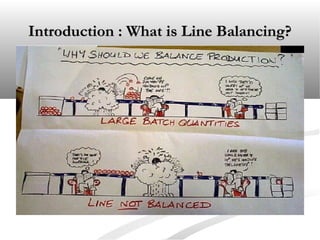
Introduction : What is Line Balancing?Introduction : What is Line Balancing?
When is the Line Balancing required?When is the Line Balancing required?
 Before starting a new styleBefore starting a new style
 While the style is being producedWhile the style is being produced
Everyday when the production starts or more than oneEveryday when the production starts or more than one
time a day, it depends on the situationtime a day, it depends on the situation
Line Balancing depends on;Line Balancing depends on;
 Performance of the individualsPerformance of the individuals
 Work in progressWork in progress
 AbsenteeismAbsenteeism
 Labour turnoverLabour turnover
 Management efficiencyManagement efficiency
AdvantagesAdvantages
 Line Balancing is an effective tool to improve the throughLine Balancing is an effective tool to improve the through
put of assembly line while reducing man powerput of assembly line while reducing man power
requirements and costsrequirements and costs
 It results in less work in processIt results in less work in process
 Assembly line balancing ensures:Assembly line balancing ensures:
1.1. The minimization of the number of work stationsThe minimization of the number of work stations
2.2. The minimization of cycle timeThe minimization of cycle time
3.3. The maximization of work load smoothnessThe maximization of work load smoothness
4.4. The maximization of work relatednessThe maximization of work relatedness
ProblemsProblems
 When assigning different tasks to individualWhen assigning different tasks to individual
workstations sum of task time at any stations shouldworkstations sum of task time at any stations should
not exceed the station time.not exceed the station time.
 Potential bottlenecks and work imbalancePotential bottlenecks and work imbalance
 Machinery failureMachinery failure
 Slow operators and absenteeism may interrupt the workSlow operators and absenteeism may interrupt the work
flowflow
 The change of operator efficiency during real timeThe change of operator efficiency during real time
production is the main reason that causes productionproduction is the main reason that causes production
line imbalanceline imbalance
Solution for ProblemsSolution for Problems
 Cross train operators to perform more than oneCross train operators to perform more than one
operationoperation
 Substitute machines must readily available forSubstitute machines must readily available for
immediate replacement if equipment breaksimmediate replacement if equipment breaks
downdown
 Reroute work, shift personal or reschedule toReroute work, shift personal or reschedule to
avoid delaysavoid delays
EngineeringEngineering
 Operation bulletin and machine specificationsOperation bulletin and machine specifications
o Article detailsArticle details
o No of operations involvedNo of operations involved
o Types of machines usedTypes of machines used
 Dividing the line in to two partsDividing the line in to two parts
o Preparation areaPreparation area
Small parts attachment Eg : Zipper to flySmall parts attachment Eg : Zipper to fly
o Assembling areaAssembling area
Assembling the garment Eg : Planning attachmentAssembling the garment Eg : Planning attachment
SMVSMV
 Visually absorbing the time taken by theVisually absorbing the time taken by the
operator for the specific taskoperator for the specific task
 Repeating the exercise for number of timeRepeating the exercise for number of time
 Standardizing the valueStandardizing the value
 Calculating the SMV of garmentCalculating the SMV of garment
 Forecasting the productionForecasting the production
 Implementing on the lineImplementing on the line
 Calculating number of operators required forCalculating number of operators required for
each operationeach operation
o Balance the line by adjusting the number ofBalance the line by adjusting the number of
operators tact time (TOPS)operators tact time (TOPS)
 EfficiencyEfficiency
o Production @100%Production @100%
o Production at present efficiencyProduction at present efficiency
o Implement the betterment on the lineImplement the betterment on the line
ExampleExample
 Coin pocket hem takes 0.16 minutes andCoin pocket hem takes 0.16 minutes and
requires one machine with the target of 375requires one machine with the target of 375
pieces, the next operations in the preparationpieces, the next operations in the preparation
area is coin pocket attachment on the facingarea is coin pocket attachment on the facing
takes 0.35 minutes with the target of 171 piecestakes 0.35 minutes with the target of 171 pieces
@100% efficiency. Working time is 8 hours.@100% efficiency. Working time is 8 hours.
According to TOPS, operator required for theAccording to TOPS, operator required for the
first operation would be 0.68=1 but the operatorfirst operation would be 0.68=1 but the operator
required for the second operations wouldrequired for the second operations would
be1.5=2.be1.5=2.
Balancing exercise for garment industry

Balancing exercise for garment industry

  • 1.
  • 2.
    IntroductionIntroduction  What isLine Balancing?What is Line Balancing? Line Balancing is the technique of planningLine Balancing is the technique of planning sufficient work load to each operator to achievesufficient work load to each operator to achieve required output.required output.
  • 3.
    Line Balancing includesLineBalancing includes  Everyone is doing the same amount of wok.Everyone is doing the same amount of wok.  Doing the same amount of work to customerDoing the same amount of work to customer requirementrequirement  Variation is smoothedVariation is smoothed  No one over burdenedNo one over burdened  No one waitingNo one waiting  Everyone working together in balanced fashionEveryone working together in balanced fashion
  • 4.
    Introduction : Whatis Line Balancing?Introduction : What is Line Balancing?
  • 5.
    Introduction : Whatis Line Balancing?Introduction : What is Line Balancing?
  • 6.
    When is theLine Balancing required?When is the Line Balancing required?  Before starting a new styleBefore starting a new style  While the style is being producedWhile the style is being produced Everyday when the production starts or more than oneEveryday when the production starts or more than one time a day, it depends on the situationtime a day, it depends on the situation
  • 7.
    Line Balancing dependson;Line Balancing depends on;  Performance of the individualsPerformance of the individuals  Work in progressWork in progress  AbsenteeismAbsenteeism  Labour turnoverLabour turnover  Management efficiencyManagement efficiency
  • 8.
    AdvantagesAdvantages  Line Balancingis an effective tool to improve the throughLine Balancing is an effective tool to improve the through put of assembly line while reducing man powerput of assembly line while reducing man power requirements and costsrequirements and costs  It results in less work in processIt results in less work in process  Assembly line balancing ensures:Assembly line balancing ensures: 1.1. The minimization of the number of work stationsThe minimization of the number of work stations 2.2. The minimization of cycle timeThe minimization of cycle time 3.3. The maximization of work load smoothnessThe maximization of work load smoothness 4.4. The maximization of work relatednessThe maximization of work relatedness
  • 9.
    ProblemsProblems  When assigningdifferent tasks to individualWhen assigning different tasks to individual workstations sum of task time at any stations shouldworkstations sum of task time at any stations should not exceed the station time.not exceed the station time.  Potential bottlenecks and work imbalancePotential bottlenecks and work imbalance  Machinery failureMachinery failure  Slow operators and absenteeism may interrupt the workSlow operators and absenteeism may interrupt the work flowflow  The change of operator efficiency during real timeThe change of operator efficiency during real time production is the main reason that causes productionproduction is the main reason that causes production line imbalanceline imbalance
  • 10.
    Solution for ProblemsSolutionfor Problems  Cross train operators to perform more than oneCross train operators to perform more than one operationoperation  Substitute machines must readily available forSubstitute machines must readily available for immediate replacement if equipment breaksimmediate replacement if equipment breaks downdown  Reroute work, shift personal or reschedule toReroute work, shift personal or reschedule to avoid delaysavoid delays
  • 11.
    EngineeringEngineering  Operation bulletinand machine specificationsOperation bulletin and machine specifications o Article detailsArticle details o No of operations involvedNo of operations involved o Types of machines usedTypes of machines used  Dividing the line in to two partsDividing the line in to two parts o Preparation areaPreparation area Small parts attachment Eg : Zipper to flySmall parts attachment Eg : Zipper to fly o Assembling areaAssembling area Assembling the garment Eg : Planning attachmentAssembling the garment Eg : Planning attachment
  • 12.
    SMVSMV  Visually absorbingthe time taken by theVisually absorbing the time taken by the operator for the specific taskoperator for the specific task  Repeating the exercise for number of timeRepeating the exercise for number of time  Standardizing the valueStandardizing the value  Calculating the SMV of garmentCalculating the SMV of garment  Forecasting the productionForecasting the production  Implementing on the lineImplementing on the line
  • 13.
     Calculating numberof operators required forCalculating number of operators required for each operationeach operation o Balance the line by adjusting the number ofBalance the line by adjusting the number of operators tact time (TOPS)operators tact time (TOPS)  EfficiencyEfficiency o Production @100%Production @100% o Production at present efficiencyProduction at present efficiency o Implement the betterment on the lineImplement the betterment on the line
  • 14.
    ExampleExample  Coin pockethem takes 0.16 minutes andCoin pocket hem takes 0.16 minutes and requires one machine with the target of 375requires one machine with the target of 375 pieces, the next operations in the preparationpieces, the next operations in the preparation area is coin pocket attachment on the facingarea is coin pocket attachment on the facing takes 0.35 minutes with the target of 171 piecestakes 0.35 minutes with the target of 171 pieces @100% efficiency. Working time is 8 hours.@100% efficiency. Working time is 8 hours. According to TOPS, operator required for theAccording to TOPS, operator required for the first operation would be 0.68=1 but the operatorfirst operation would be 0.68=1 but the operator required for the second operations wouldrequired for the second operations would be1.5=2.be1.5=2.