Word formation Process


          Lalit Aggarwal
          P2009Me1088


                           1
   How new words are being formed in the
    language.
   Word formation is of great interest for
    linguists as it sheds light on other aspects
    of language.


                                               2
Why are new words
needed?
 Because of new inventions and
  changes
 Language is dynamic
 vast amount of new inventions
  made in the 20th and 21st
 One of the distinctive properties of
  human language is creativity

                                         3
Entry Of a Word in a language

etymology: studies of the history of words,
           their origin, and how their form
          and meaning changed over time


                                         4
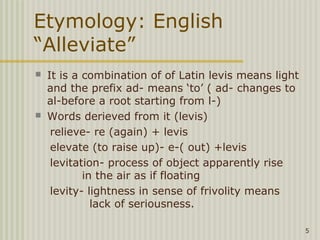
Etymology: English
“Alleviate”
   It is a combination of of Latin levis means light
    and the prefix ad- means ‘to’ ( ad- changes to
    al-before a root starting from l-)
   Words derieved from it (levis)
     relieve- re (again) + levis
     elevate (to raise up)- e-( out) +levis
     levitation- process of object apparently rise
            in the air as if floating
     levity- lightness in sense of frivolity means
              lack of seriousness.

                                                        5
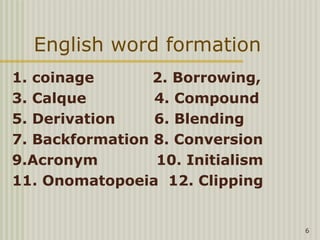
English word formation
1. coinage       2. Borrowing,
3. Calque        4. Compound
5. Derivation    6. Blending
7. Backformation 8. Conversion
9.Acronym        10. Initialism
11. Onomatopoeia 12. Clipping


                                  6
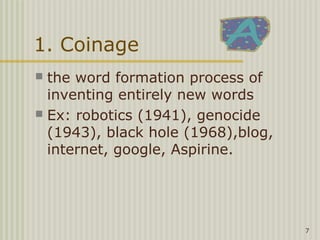
1. Coinage
 the word formation process of
  inventing entirely new words
 Ex: robotics (1941), genocide
  (1943), black hole (1968),blog,
  internet, google, Aspirine.


                                    7
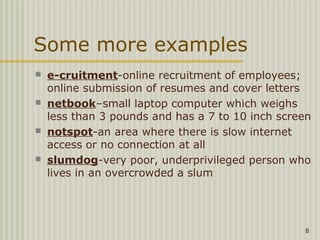
Some more examples
   e-cruitment-online recruitment of employees;
    online submission of resumes and cover letters
   netbook–small laptop computer which weighs
    less than 3 pounds and has a 7 to 10 inch screen
   notspot-an area where there is slow internet
    access or no connection at all
   slumdog-very poor, underprivileged person who
    lives in an overcrowded a slum


                                                  8
Eponym

   --new words based on names of
    persons/place
   volt [ Alessandro Volta, Italian]
   watt [James Watt, Scot scientist]
   boycott [Charles Boycott, Irish]
   fahrenheit [Gabriel Farenheit, German
    scientist]

                                            9
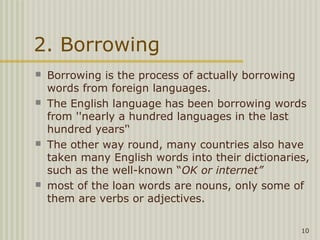
2. Borrowing
   Borrowing is the process of actually borrowing
    words from foreign languages.
   The English language has been borrowing words
    from ''nearly a hundred languages in the last
    hundred years'‘
   The other way round, many countries also have
    taken many English words into their dictionaries,
    such as the well-known “OK or internet”
   most of the loan words are nouns, only some of
    them are verbs or adjectives.

                                                   10
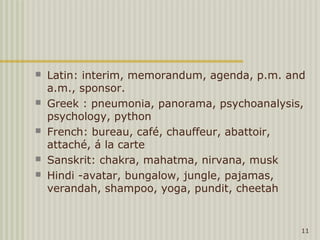
   Latin: interim, memorandum, agenda, p.m. and
    a.m., sponsor.
   Greek : pneumonia, panorama, psychoanalysis,
    psychology, python
   French: bureau, café, chauffeur, abattoir,
    attaché, á la carte
   Sanskrit: chakra, mahatma, nirvana, musk
   Hindi -avatar, bungalow, jungle, pajamas,
    verandah, shampoo, yoga, pundit, cheetah


                                               11
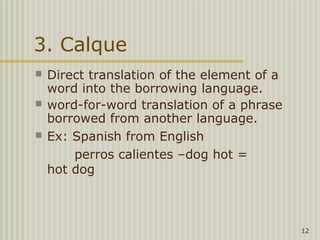
3. Calque
   Direct translation of the element of a
    word into the borrowing language.
   word-for-word translation of a phrase
    borrowed from another language.
   Ex: Spanish from English
        perros calientes –dog hot =
    hot dog


                                             12
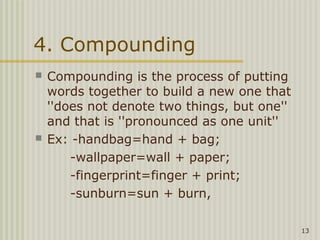
4. Compounding
   Compounding is the process of putting
    words together to build a new one that
    ''does not denote two things, but one''
    and that is ''pronounced as one unit''
   Ex: -handbag=hand + bag;
        -wallpaper=wall + paper;
        -fingerprint=finger + print;
        -sunburn=sun + burn,

                                              13
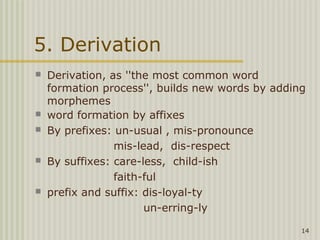
5. Derivation
   Derivation, as ''the most common word
    formation process'', builds new words by adding
    morphemes
   word formation by affixes
   By prefixes: un-usual , mis-pronounce
                 mis-lead, dis-respect
   By suffixes: care-less, child-ish
                 faith-ful
   prefix and suffix: dis-loyal-ty
                       un-erring-ly

                                                  14
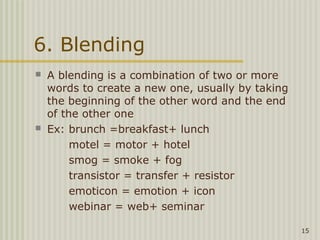
6. Blending
   A blending is a combination of two or more
    words to create a new one, usually by taking
    the beginning of the other word and the end
    of the other one
   Ex: brunch =breakfast+ lunch
         motel = motor + hotel
         smog = smoke + fog
         transistor = transfer + resistor
         emoticon = emotion + icon
         webinar = web+ seminar

                                                   15
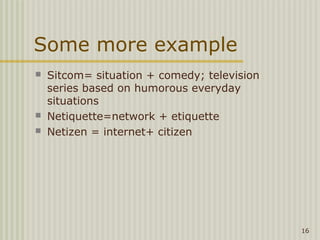
Some more example
   Sitcom= situation + comedy; television
    series based on humorous everyday
    situations
   Netiquette=network + etiquette
   Netizen = internet+ citizen


                                             16
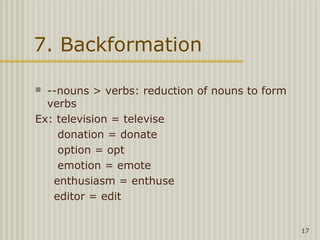
7. Backformation

 --nouns > verbs: reduction of nouns to form
  verbs
Ex: television = televise
    donation = donate
    option = opt
    emotion = emote
   enthusiasm = enthuse
   editor = edit


                                                17
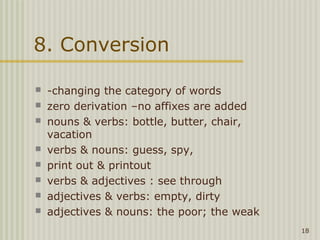
8. Conversion

   -changing the category of words
   zero derivation –no affixes are added
   nouns & verbs: bottle, butter, chair,
    vacation
   verbs & nouns: guess, spy,
   print out & printout
   verbs & adjectives : see through
   adjectives & verbs: empty, dirty
   adjectives & nouns: the poor; the weak
                                             18
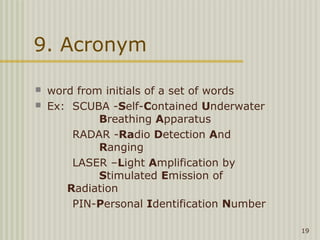
9. Acronym

   word from initials of a set of words
   Ex: SCUBA -Self-Contained Underwater
             Breathing Apparatus
        RADAR -Radio Detection And
             Ranging
        LASER –Light Amplification by
             Stimulated Emission of
       Radiation
        PIN-Personal Identification Number

                                             19
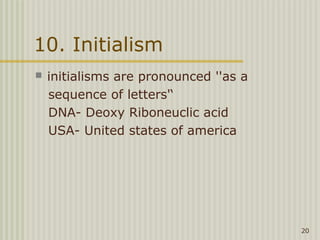
10. Initialism
   initialisms are pronounced ''as a
    sequence of letters'‘
    DNA- Deoxy Riboneuclic acid
    USA- United states of america


                                        20
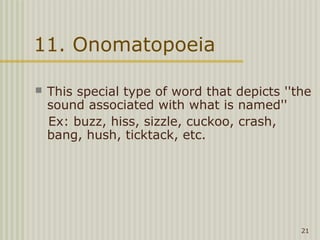
11. Onomatopoeia

   This special type of word that depicts ''the
    sound associated with what is named''
    Ex: buzz, hiss, sizzle, cuckoo, crash,
    bang, hush, ticktack, etc.


                                              21
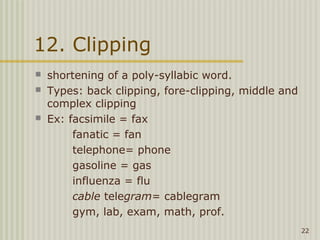
12. Clipping
   shortening of a poly-syllabic word.
   Types: back clipping, fore-clipping, middle and
    complex clipping
   Ex: facsimile = fax
         fanatic = fan
         telephone= phone
         gasoline = gas
         influenza = flu
         cable telegram= cablegram
         gym, lab, exam, math, prof.
                                                      22
Conclusion
   As we have seen before, there are many
    ways to create new words
   So finally, if we take a look around, we will
    see a mass of new words surrounding us,
    brought to us both consciously by language
    trends and unconsciously through language
    change over time
   Language changes constantly. And who
    knows if the people will understand the
    language we are using now in a few
    decades?
                                                    23
Refrences
   http://en.wikipedia.org/wiki/Word_formatio
   http://en.wikipedia.org/wiki/Clipping_%28m
   http://introling.ynada.com/session-7-word-


                                          24
THANK YOU


        25

Word formation process

  • 1.
    Word formation Process Lalit Aggarwal P2009Me1088 1
  • 2.
    How new words are being formed in the language.  Word formation is of great interest for linguists as it sheds light on other aspects of language. 2
  • 3.
    Why are newwords needed?  Because of new inventions and changes  Language is dynamic  vast amount of new inventions made in the 20th and 21st  One of the distinctive properties of human language is creativity 3
  • 4.
    Entry Of aWord in a language etymology: studies of the history of words, their origin, and how their form and meaning changed over time 4
  • 5.
    Etymology: English “Alleviate”  It is a combination of of Latin levis means light and the prefix ad- means ‘to’ ( ad- changes to al-before a root starting from l-)  Words derieved from it (levis) relieve- re (again) + levis elevate (to raise up)- e-( out) +levis levitation- process of object apparently rise in the air as if floating levity- lightness in sense of frivolity means lack of seriousness. 5
  • 6.
    English word formation 1.coinage 2. Borrowing, 3. Calque 4. Compound 5. Derivation 6. Blending 7. Backformation 8. Conversion 9.Acronym 10. Initialism 11. Onomatopoeia 12. Clipping 6
  • 7.
    1. Coinage  theword formation process of inventing entirely new words  Ex: robotics (1941), genocide (1943), black hole (1968),blog, internet, google, Aspirine. 7
  • 8.
    Some more examples  e-cruitment-online recruitment of employees; online submission of resumes and cover letters  netbook–small laptop computer which weighs less than 3 pounds and has a 7 to 10 inch screen  notspot-an area where there is slow internet access or no connection at all  slumdog-very poor, underprivileged person who lives in an overcrowded a slum 8
  • 9.
    Eponym  --new words based on names of persons/place  volt [ Alessandro Volta, Italian]  watt [James Watt, Scot scientist]  boycott [Charles Boycott, Irish]  fahrenheit [Gabriel Farenheit, German scientist] 9
  • 10.
    2. Borrowing  Borrowing is the process of actually borrowing words from foreign languages.  The English language has been borrowing words from ''nearly a hundred languages in the last hundred years'‘  The other way round, many countries also have taken many English words into their dictionaries, such as the well-known “OK or internet”  most of the loan words are nouns, only some of them are verbs or adjectives. 10
  • 11.
    Latin: interim, memorandum, agenda, p.m. and a.m., sponsor.  Greek : pneumonia, panorama, psychoanalysis, psychology, python  French: bureau, café, chauffeur, abattoir, attaché, á la carte  Sanskrit: chakra, mahatma, nirvana, musk  Hindi -avatar, bungalow, jungle, pajamas, verandah, shampoo, yoga, pundit, cheetah 11
  • 12.
    3. Calque  Direct translation of the element of a word into the borrowing language.  word-for-word translation of a phrase borrowed from another language.  Ex: Spanish from English perros calientes –dog hot = hot dog 12
  • 13.
    4. Compounding  Compounding is the process of putting words together to build a new one that ''does not denote two things, but one'' and that is ''pronounced as one unit''  Ex: -handbag=hand + bag; -wallpaper=wall + paper; -fingerprint=finger + print; -sunburn=sun + burn, 13
  • 14.
    5. Derivation  Derivation, as ''the most common word formation process'', builds new words by adding morphemes  word formation by affixes  By prefixes: un-usual , mis-pronounce mis-lead, dis-respect  By suffixes: care-less, child-ish faith-ful  prefix and suffix: dis-loyal-ty un-erring-ly 14
  • 15.
    6. Blending  A blending is a combination of two or more words to create a new one, usually by taking the beginning of the other word and the end of the other one  Ex: brunch =breakfast+ lunch motel = motor + hotel smog = smoke + fog transistor = transfer + resistor emoticon = emotion + icon webinar = web+ seminar 15
  • 16.
    Some more example  Sitcom= situation + comedy; television series based on humorous everyday situations  Netiquette=network + etiquette  Netizen = internet+ citizen 16
  • 17.
    7. Backformation  --nouns> verbs: reduction of nouns to form verbs Ex: television = televise donation = donate option = opt emotion = emote enthusiasm = enthuse editor = edit 17
  • 18.
    8. Conversion  -changing the category of words  zero derivation –no affixes are added  nouns & verbs: bottle, butter, chair, vacation  verbs & nouns: guess, spy,  print out & printout  verbs & adjectives : see through  adjectives & verbs: empty, dirty  adjectives & nouns: the poor; the weak 18
  • 19.
    9. Acronym  word from initials of a set of words  Ex: SCUBA -Self-Contained Underwater Breathing Apparatus RADAR -Radio Detection And Ranging LASER –Light Amplification by Stimulated Emission of Radiation PIN-Personal Identification Number 19
  • 20.
    10. Initialism  initialisms are pronounced ''as a sequence of letters'‘ DNA- Deoxy Riboneuclic acid USA- United states of america 20
  • 21.
    11. Onomatopoeia  This special type of word that depicts ''the sound associated with what is named'' Ex: buzz, hiss, sizzle, cuckoo, crash, bang, hush, ticktack, etc. 21
  • 22.
    12. Clipping  shortening of a poly-syllabic word.  Types: back clipping, fore-clipping, middle and complex clipping  Ex: facsimile = fax fanatic = fan telephone= phone gasoline = gas influenza = flu cable telegram= cablegram gym, lab, exam, math, prof. 22
  • 23.
    Conclusion  As we have seen before, there are many ways to create new words  So finally, if we take a look around, we will see a mass of new words surrounding us, brought to us both consciously by language trends and unconsciously through language change over time  Language changes constantly. And who knows if the people will understand the language we are using now in a few decades? 23
  • 24.
    Refrences  http://en.wikipedia.org/wiki/Word_formatio  http://en.wikipedia.org/wiki/Clipping_%28m  http://introling.ynada.com/session-7-word- 24
  • 25.